AI泡沫破裂

Search documents
股市暴跌54%、滞胀来袭?美联储模拟AI泡沫破裂极端情景
智通财经网· 2026-02-26 07:19
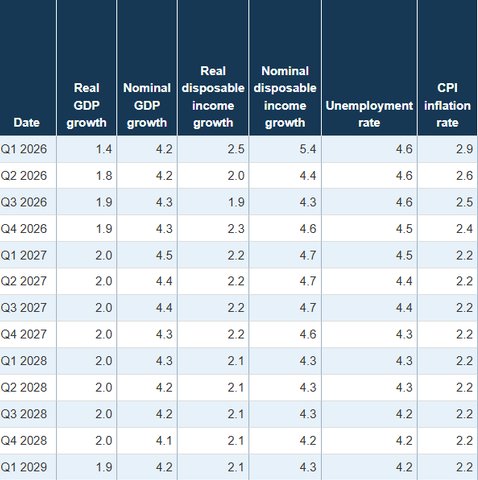
Core Viewpoint - The Federal Reserve's 2026 severe adverse scenario predicts a significant economic recession triggered by a sudden decline in risk appetite, leading to a sharp drop in risk asset prices and a spike in market volatility [1][2]. Adverse Scenario Summary - The severe adverse scenario outlines a global recession with a projected stock market decline of approximately 54% and a peak unemployment rate of 10% by Q3 2027 [1][6]. - The scenario anticipates a widening corporate bond spread to 5.7 percentage points and a significant drop in real estate prices, with nominal home prices falling by 29% and commercial real estate prices by 40% [1][6]. - The economic turmoil is expected to suppress consumer demand and lead to substantial cuts in employment and investment, resulting in a slow recovery of economic and asset prices [1]. Baseline Scenario Summary - The Federal Reserve's baseline scenario for 2026-2029 envisions moderate economic growth, stable unemployment rates, and gradually declining inflation, referred to as the "Goldilocks" scenario [3][5]. - Key projections include a decrease in the 3-month Treasury yield from 4.0% at the end of 2025 to 3.1% by the end of 2029, and a gradual decline in the 10-year Treasury yield to 3.9% [4][5]. - The stock market is expected to rise by an average of 4.3% annually until 2029, with nominal home prices initially declining before gradually increasing [5]. Global Economic Context - The severe adverse scenario is characterized by commodity-driven stagflation, with rising inflation expectations and a strengthening dollar against major currencies [8]. - The potential triggers for the adverse scenario include a bursting AI bubble and geopolitical tensions, such as a possible conflict involving Iran, which could lead to increased oil prices and a flight to safety in gold [9][10].

美股科技七巨头风光不再
Di Yi Cai Jing Zi Xun· 2026-02-24 02:40
Core Viewpoint - US stock investors are facing a scenario previously deemed impossible, where the decline of tech giants and leading AI cloud service providers could simultaneously drag down the US stock market and economy [2] Group 1: Market Performance - The overall performance of the US stock market has lagged behind major global markets this year, with the Nasdaq and S&P 500 indices completely reversing their gains [2] - The "Magnificent Seven" tech giants are under increasing scrutiny, with Microsoft down over 17% and Amazon down over 10% year-to-date [2] - Meta has become the third tech giant to enter a technical bear market [2] Group 2: Sector Rotation - A significant sector rotation is occurring, with previously lagging sectors leading the market, while the "Magnificent Seven" face pressure due to concerns over their substantial AI investments [3] - The S&P 500 energy sector has surged over 22% this year, leading among 11 sectors, while the information technology sector has declined by 4.5% [3] - The market shift began as a mean reversion trade but has evolved into a fundamental logic shift, focusing on AI's broader market impact [3] Group 3: Historical Context - Extreme market divergence has occurred only a few times in the past 25 years, typically accompanied by significant sector reshuffling [4] - The equal-weighted S&P 500 index has outperformed the traditional market-cap-weighted index, marking the most extreme divergence since 1992 [4][5] Group 4: Economic Implications - Concerns are rising over the capital expenditures of cloud service providers, with fears of a potential bubble bursting [6] - A significant drop in free cash flow for cloud service providers is anticipated, raising questions about revenue and profit margins [6] - If the AI sector's adjustments affect the credit market, it could pressure US GDP growth by 1.3 to 1.4 percentage points [6] Group 5: Nvidia's Earnings Focus - Investors are closely watching Nvidia's earnings report, which is expected to provide stability amid AI-related concerns [8] - Nvidia's projected earnings per share for Q4 are expected to grow by 71%, with revenue reaching $65.9 billion [8] - The CEO's statements during the earnings call are anticipated to have a broad impact on the AI industry, especially for companies facing pressure due to capital expenditure return rates [8][9]


美股风格切换!科技七巨头风光不再,英伟达能否扭转战局
Di Yi Cai Jing Zi Xun· 2026-02-24 00:29
Core Viewpoint - US stock investors are facing a scenario where the decline of major tech companies and leading AI cloud service providers could simultaneously drag down the US stock market and economy [1] Group 1: Market Performance - The overall performance of US stocks has lagged behind major global markets this year, with the Nasdaq and S&P 500 indices completely reversing their gains [1] - The "Magnificent Seven" tech giants are under increasing scrutiny, with Microsoft down over 17% and Amazon down over 10% year-to-date [1] - Meta has become the third tech giant to enter a technical bear market [1] - The energy sector has surged over 22% this year, leading among 11 sectors, while the information technology sector has declined by 4.5% [1] Group 2: Market Rotation - The current market rotation began in late 2025, initially as a mean reversion trade, but has evolved into a fundamental logic shift focusing on AI's broader market impact [2] - The S&P 500 equal-weight index has risen 5.5% in the first 32 trading days of the year, significantly outperforming the traditional market-cap-weighted index, which only increased by 0.1% [2] - Historical instances of extreme market divergence have occurred only a few times in the past 25 years, often accompanied by significant sector reshuffling [2] Group 3: Economic Context - The current market style shift resembles the 2000 internet bubble period, with investors trying to discern which tech companies will benefit from the technological wave [3] - The resilience of the US economy adds confusion regarding whether the capital outflow from large tech stocks is a sign of healthy market expansion or a precursor to risks [3] - If the "Magnificent Seven" can no longer drive the benchmark index, the broader US stock market may face a risk of correction [3] Group 4: AI and Cloud Services - Concerns are rising over the capital expenditures of cloud service providers, with fears of a potential bubble contraction [4] - A significant drop in free cash flow for cloud service providers is expected in the coming quarters due to high capital expenditure forecasts [4] - BCA Research estimates that to restore net asset return rates, cloud service providers need revenue growth of approximately 250 basis points or a 100 basis point increase in profit margins [4] Group 5: Nvidia's Earnings Focus - Investors are closely watching Nvidia's earnings report, which is expected to provide stability to the market amid AI-related concerns [6] - Market expectations for Nvidia's Q4 earnings per share growth are at 71%, with revenue projected at $65.9 billion [6] - Nvidia's CEO statements during the earnings call are anticipated to have a broad impact on the AI industry, especially for companies facing pressure due to concerns over capital expenditure returns [6]

黄金接近首个关键支撑位
Hua Er Jie Jian Wen· 2026-02-02 12:30
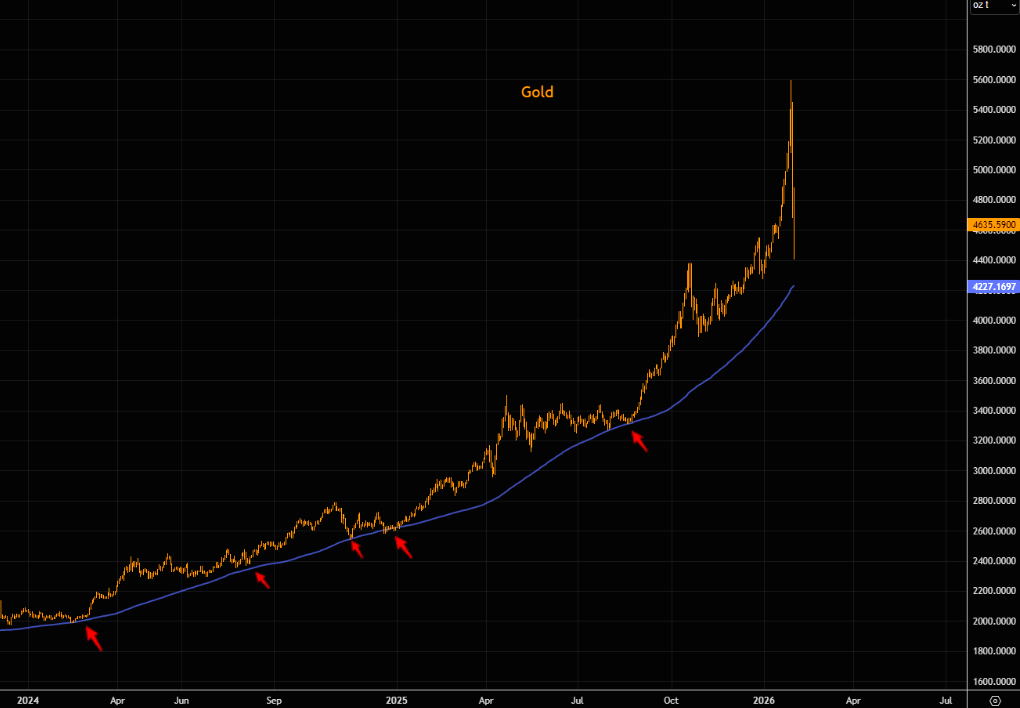
Core Viewpoint - Gold is facing one of the most critical technical tests since the bull market began in 2024, with prices retreating to a steep trendline from September of last year and testing the 50-day moving average during a mini flash crash [1] Group 1: Market Structure and Price Levels - Gold prices need to stabilize around $4600 (with a fluctuation of $50) to maintain a constructive market structure, with the current decline attributed to excessive "fear of missing out" (FOMO) trading and lack of downside risk management [3] - The market structure remains fragile, with approximately $20 trillion in paper profits accumulated by gold holders over the past three years, while only about $1 trillion has driven the recent price increase, indicating that a mere 5% profit-taking could offset all global physical demand [5] - Citi maintains a target price of $5000 per ounce for the next 0 to 3 months but expects gold prices to decline to $4000 by 2027, a potential drop of 20% as geopolitical risks ease [5] Group 2: Technical Analysis and Risk Management - From a technical perspective, gold is at a critical short-term support level, with the focus on the $4600 mark; if prices fall below this, the next key observation point will be around $4250, near the 100-day moving average [6] - Market participants are facing emotional tests, with many traders hoping to break even during the recent sell-off, revealing a lack of genuine risk management frameworks [6] Group 3: Market Imbalance and Future Projections - The current gold market structure is extremely imbalanced, with the price rising from $2500 to $5100 driven primarily by investor capital allocation of about $1 trillion, while the physical gold market is too small to accommodate such large asset allocation shifts [8] - Citi forecasts that several geopolitical and economic risk factors supporting gold prices will ease by the second half of 2026, predicting a quarterly decline in gold prices from $5000 in Q1 2026 to $4200 by Q4 2026, with an average price of $4600 for the year [8] - In scenario analysis, Citi estimates a 60% probability that gold prices will fall to $4000 by 2027, with a bullish scenario reaching $6000 (20% probability) and a bearish scenario potentially dropping to $3000 (20% probability) [8]
黄金最脆弱的时刻?仅需5%的获利盘出逃,就足以抵消全球实物需求
Hua Er Jie Jian Wen· 2026-02-02 04:47
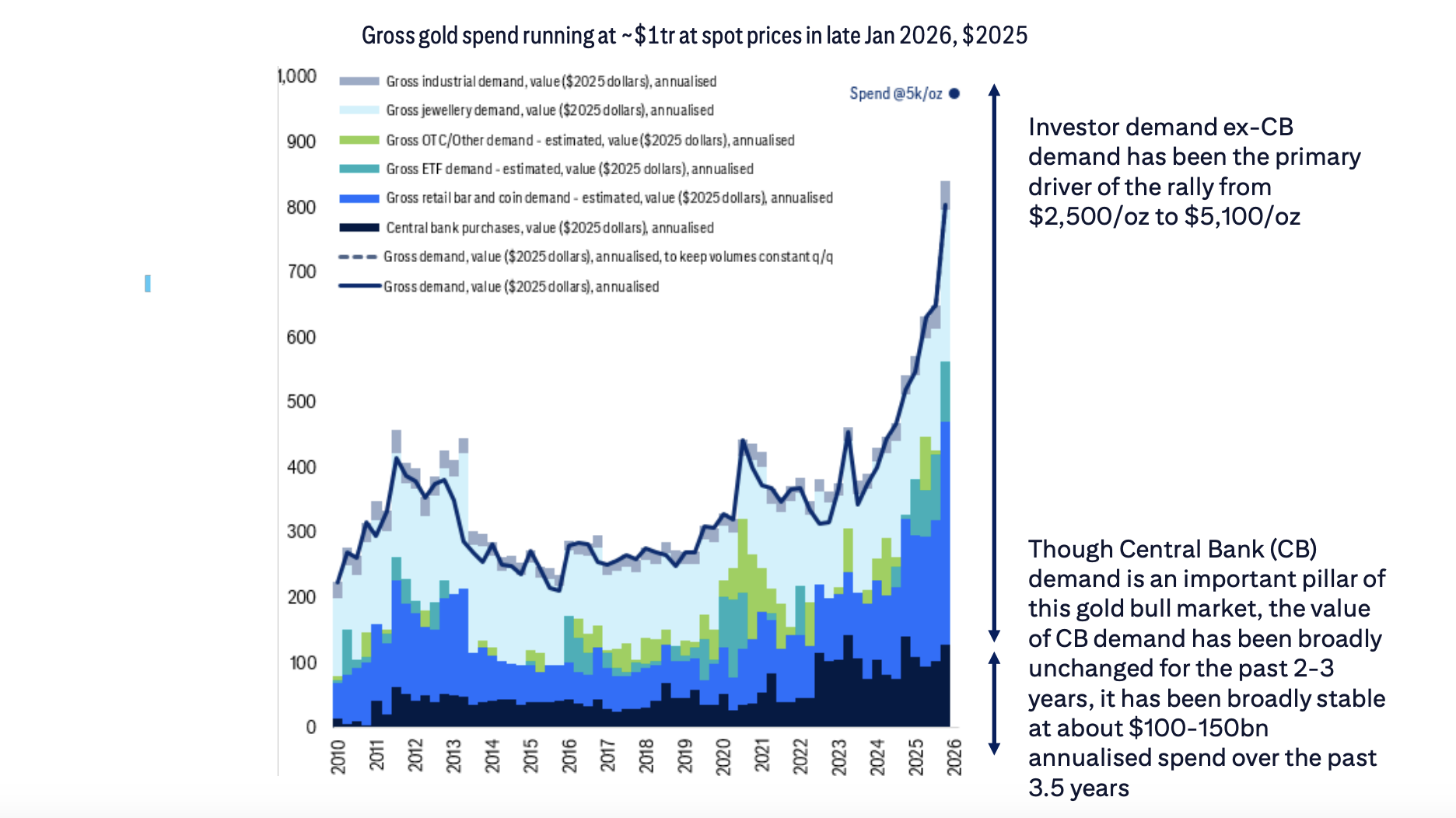
Core Viewpoint - The surge in gold prices over the past three years has created approximately $20 trillion in unrealized gains for investors, but this "wealth sword" could reverse at any moment, with a mere 5% of these gains (around $1 trillion) potentially offsetting all current physical demand and delivering a devastating blow to gold prices [1][5]. Group 1: Price Predictions - Citigroup maintains a target price of $5,000 per ounce for the next 0-3 months but expresses caution for the second half of 2026, predicting a decline to $4,000 per ounce by 2027 [1][10]. - The forecast for gold prices includes a quarterly breakdown: $5,000 in Q1 2026, $4,800 in Q2, $4,400 in Q3, and $4,200 in Q4, with an average price of $4,600 for the year [10]. Group 2: Market Dynamics - The current bull market in gold is primarily driven by massive capital allocation from investors rather than central bank purchases, with market-driven investments reaching a historical high of approximately $1 trillion [2][5]. - The physical gold market is structurally weak, as its supply value accounts for only about 0.1% of global household wealth, indicating that any significant shift in asset allocation towards gold would require a substantial increase in supply [4]. Group 3: Risks and Future Outlook - The potential for profit-taking is rising, especially as geopolitical risks are expected to ease by the second half of 2026, which could lead to a decrease in hedging demand for gold [1][7]. - Historical trends suggest that during significant corrections in the U.S. stock market, gold prices often decline first, adding another layer of risk for investors [9].
前瞻2026:全新的大周期正在开启
Jing Ji Guan Cha Bao· 2026-01-01 07:34
Group 1 - The core theme for 2026 is characterized by uncertainty and possibility, driven by geopolitical dynamics and technological advancements, particularly in AI [2][3] - The AI bubble may burst, similar to past technological waves, but the long-term evolution of AI remains unchanged as it is still in its early stages [2] - The first cohort of AI Native graduates in 2026 will face significant workplace transformations as AI replaces entry-level jobs, providing insights into the future of work [2] Group 2 - The concept of "rebalancing" describes the shift from Western dominance to a more equitable global power structure, particularly between the US and China [7] - The G2 relationship between the US and China is crucial, as both countries can learn from each other while navigating their respective economic challenges [7][8] - The global perception of Chinese innovation is changing, with foreign companies increasingly recognizing the value of China's technological advancements [8] Group 3 - The era of creativity is emerging as AI takes over repetitive tasks, prompting organizations to rethink the value of human contributions [10] - Key human attributes such as intuition, imagination, emotion, and common sense will become increasingly valuable in the AI-driven workplace [10][11][12][13] - The focus will shift from knowledge itself to the ability to transform knowledge into insights and creativity [14] Group 4 - The attention economy is being disrupted by AI, which is changing how information is accessed and consumed, leading to a re-evaluation of business models [16][17] - AI is expected to streamline processes, reducing the time spent on searching for information and products, thus altering the dynamics of consumer engagement [16][17] - New technological standards are emerging to facilitate AI interactions, shifting the focus from user attention to efficient problem-solving [18] Group 5 - A "relativistic world" is emerging, emphasizing development over security and the importance of human exploration in an AI-dominated landscape [19][20] - The value of different types of capital (financial, natural, human, and social) will fluctuate, impacting economic growth and development strategies [21][22] - The rise of social capital, characterized by trust and community, will become increasingly important as AI handles standardized tasks [22] Group 6 - The dual-speed economy is a significant issue in both the US and China, where technological sectors are thriving while traditional sectors face stagnation [23][24] - In the US, economic growth is concentrated among elites in tech, while ordinary citizens experience rising living costs and stagnant wages [23][24] - China's economic challenges are compounded by structural issues, including a sluggish domestic market and pressures on consumer confidence [24][25] Group 7 - The transition to a stock economy signifies a shift from growth-driven to capability-driven economic dynamics, where opportunities become more differentiated [25][26] - The need for policy focus on service sector reforms and stable job creation is critical in addressing the dual-speed economy [25][26] - The future will require a reevaluation of human capital development in light of AI's impact on labor markets and job structures [26] Group 8 - The cyclical nature of economic phases suggests that understanding past growth patterns can inform future strategies in a changing global landscape [27][28] - The upcoming economic cycle will necessitate embracing AI-driven opportunities while navigating geopolitical uncertainties [28][29]

美国正进入AI泡沫破裂时刻
Sou Hu Cai Jing· 2025-12-17 04:43
Core Viewpoint - The recent decline in Oracle's stock price, which fell by 13% on December 11, 2023, reflects deeper issues within the AI industry, indicating a shift from a phase of aggressive investment to a more cautious approach focused on risk assessment and cost control, signaling the potential bursting of the AI valuation bubble [1][4]. Financial Performance - Oracle's Q2 FY2025 revenue was reported at $16.06 billion, below the expected $16.21 billion, and adjusted revenue was $6.7 billion, also missing the Wall Street estimate of $6.8 billion [3]. - The company's guidance for Q3 FY2025 projected adjusted earnings per share between $1.64 and $1.68, significantly lower than the analyst estimate of $1.72, with revenue growth expectations of 16% to 18%, below the market's optimistic forecast of 19.4% [3]. Market Reaction - The drop in Oracle's stock triggered a chain reaction affecting other AI-related stocks, including Nvidia, AMD, and Micron, which saw declines between 3.1% and 4.2%, ultimately dragging the Nasdaq index to its lowest point in a week [1][3]. AI Industry Dynamics - The AI industry's capital frenzy has inflated valuations of leading companies, with Nvidia becoming the first company to surpass a $5 trillion market cap and OpenAI's valuation skyrocketing from $157 billion in October 2024 to $500 billion by October 2025 [5]. - This valuation surge is not supported by solid profitability but rather by a "value internal cycle" among major players like OpenAI, Nvidia, and Oracle, creating a disconnect between inflated demand expectations and actual market needs [7][8]. Investment and Spending Trends - Oracle's significant investment in AI, including a $40 billion deal with Nvidia for 400,000 GPUs, exemplifies the artificial demand signals being sent to the market, which have led to inflated valuations [7]. - The AI sector is experiencing a shift towards a "rational pricing phase," with companies like Amazon and Microsoft planning substantial capital expenditures in AI, raising concerns about the sustainability of such investments [10][13]. Financial Pressures and Risks - Oracle has reportedly consumed around $10 billion of its cash reserves in the first half of FY2025 due to heavy investments in AI, raising concerns about its financial stability and the potential for a significant market cap loss [10]. - The AI industry's reliance on high capital expenditures without corresponding revenue generation has created a precarious financial environment, with predictions of a $500 billion operating loss for OpenAI by 2030 [9][10]. Emerging Financial Mechanisms - A new financial cycle is emerging in the AI sector, characterized by the use of Special Purpose Vehicles (SPVs) to facilitate capital flow without creating substantial commercial value, resembling a "Ponzi scheme" [15][19]. - This mechanism involves a closed loop where funds circulate among tech companies and financial institutions, often relying on new debt to pay off old debt, further obscuring the lack of real profitability [19][20]. Market Sentiment and Future Outlook - There is growing skepticism in the market regarding the AI industry's ability to convert high capital investments into sustainable profits, with many investors shifting towards risk management strategies such as credit default swaps (CDS) to hedge against potential losses [26][27]. - The AI sector is transitioning from a focus on rapid expansion to a more sustainable model that emphasizes efficiency and the integration of technological value with commercial viability, marking a critical juncture in its development [27].

连续降息存疑,铜价冲高回落
Tong Guan Jin Yuan Qi Huo· 2025-12-15 02:00
1. Report Industry Investment Rating - No relevant content provided. 2. Core Views of the Report - Last week, copper prices rose first and then fell. The main reasons were that some hawkish officials opposed continuous interest rate cuts, the probability of continued rate cuts in January was low according to the CME observation tool, the expectation of the Bank of Japan's interest rate hike might affect the global foreign exchange carry - trade market, and concerns about the bursting of the AI bubble led to asset selling in the metal market. Domestically, the central economic work conference emphasized flexible use of policies like reserve requirement ratio and interest rate cuts, promoting a new real - estate development model [2][7]. - Overall, concerns about the bursting of the technology stock bubble in overseas markets on Friday and opposition to rate cuts from some hawkish officials on Thursday made the probability of continuous rate cuts in early next year slim, leading to a decline in market risk appetite. Fundamentally, the shortage of overseas concentrates persists, non - US inventories are low, and the artificial intelligence field offers broad demand prospects. It is expected that copper prices will slow their upward momentum and enter a high - level consolidation in the short term [2][10]. 3. Summary by Relevant Catalogs Market Data - LME copper price on December 12 was $11,552.50 per ton, down $112.50 (- 0.96%) from December 5. COMEX copper price was 535.84 cents per pound, down 9.56 cents (- 1.75%). SHFE copper price was 94,080 yuan per ton, up 1,300 yuan (1.40%). International copper price was 84,490 yuan per ton, up 1,100 yuan (1.32%). The Shanghai - London ratio rose from 7.95 to 8.14. LME spot premium dropped by 10.24% to $20.69 per ton, and Shanghai spot premium fell from 170 yuan to - 20 yuan [3]. - As of December 12, LME copper inventory increased by 3,350 tons (2.06%) to 165,900 tons, COMEX copper inventory increased by 13,765 short tons (3.15%) to 450,618 short tons, SHFE inventory increased by 484 tons (0.54%) to 89,371 tons, and Shanghai bonded - area inventory increased by 5,500 tons (5.80%) to 100,300 tons. Total inventory rose by 23,099 tons (2.95%) to 806,189 tons [6]. Market Analysis and Outlook - Macro - aspect: The Fed cut interest rates for the last time this year last Thursday, with the federal funds rate range at 3.5% - 3.75%. The dot - plot shows one rate cut each in 2026 and 2027. 7 officials expect no rate cut in 2026, and 4 expect two 25 - basis - point cuts. The probability of no rate cut in January next year is 75% according to the CME tool. Domestically, China's November CPI rose 0.7% year - on - year, and the core CPI rose 1.2%. The PPI index was - 2.2% year - on - year but + 0.1% month - on - month [8]. - Supply - demand aspect: In 2026, the production of some overseas mines is expected to be flat with 2025, and the global concentrate supply growth rate will be less than 1.5%. Codelco's premium for 2026 Chinese CIF refined copper long - term contracts reached a record high of $350 per ton. Traditional industry demand is cooling, while emerging industries like new - energy vehicles, AI data centers, and industrial robots offer broad market space [9]. Industry News - Rio2 acquired a 99.1% stake in Peru's Condestable copper mine for $241 million. The mine has a 60 - plus - year production history, with a daily processing capacity of 8,400 tons, and is expected to produce about 27,000 tons of copper equivalent annually [11]. - Anglo American and Teck Resources' shareholders approved a $53 - billion all - stock, zero - premium merger. The combined Collahuasi and Quebrada Blanca copper mines may produce over one million tons of copper annually by the early 2030s [12]. - Chile's state - owned Codelco's copper production in October fell 14.3% to 111,000 tons, while BHP's Escondida mine production rose 11.7% to 120,600 tons, and Collahuasi mine production dropped 29.3% to 35,000 tons [13]. Relevant Charts - The report includes multiple charts showing the trends of copper prices, inventories, premiums, spreads, and other indicators, such as the price trends of SHFE copper and LME copper, LME copper inventory changes, and the relationship between copper imports' profit and loss and other factors [17][19][22].
超长端承压走弱
Guo Mao Qi Huo· 2025-11-24 09:10
1. Report Industry Investment Rating No information provided in the report. 2. Core Views of the Report - Market sentiment is supported by expectations of further monetary policy easing in Q4, but global liquidity concerns lead to a decline in various assets, including bonds. However, considering China's independence, the pattern of bonds with a ceiling and a floor is difficult to break, and the 10 - year spot bond yield may remain in the range of 1.75% - 1.85% [8]. - In the long - term, insufficient effective demand is the main challenge for China's economic development. With the marginal decline of the economic pulling effect of land finance and debt - driven models, and new growth drivers still in the cultivation stage, along with potential trade frictions in the Trump 2.0 era, total demand is unlikely to fundamentally rebound in the short term, and deflation is likely to continue. Therefore, the fundamentals are favorable for bond futures. The synergy of monetary and fiscal policies, with monetary policy taking the lead, and the low - interest - rate environment are key for policy implementation. The logic of a bond bull market is expected to continue [8]. 3. Summary by Relevant Catalogs 3.1 Part One: Main Views - **Weekly Market Review**: Last week, the Treasury bond futures market showed slight differentiation among different tenors. The ultra - long - end declined, while other tenors fluctuated within a limited range. The market was mainly influenced by the resonance of domestic and foreign financial markets and various assets. News of real - estate stimulus policies in China, concerns about the sustainability of Nvidia's performance, and the divergence in expectations of the Fed's December interest - rate cut all contributed to the market movement. Multiple assets, including stocks, bonds, and commodities, declined due to liquidity concerns, and the safe - haven function of the domestic bond market failed [4]. - **Market Data**: The report provides closing prices, weekly price changes, trading volumes, and open interest data for different Treasury bond futures contracts [5]. 3.2 Part Two: Liquidity Tracking - **Open Market Operations**: The report presents data on the volume and price of open - market operations, including money injection, money withdrawal, and net money injection [10][11]. - **Medium - term Lending Facility (MLF)**: Information on the volume and price of MLF operations, such as the amount of MLF recovery, the amount of MLF injection, and the interest rate of MLF, is provided [12][13][16]. - **Funding Costs**: Data on various funding costs, including deposit - based repurchase rates, SHIBOR, and Shanghai Stock Exchange repurchase rates, are presented [18][19]. - **Yield and Spread**: The report shows data on Treasury bond yields, Treasury bond term spreads, US Treasury bond yields, and US Treasury bond term spreads [34][36][38]. 3.3 Part Three: Treasury Bond Futures Arbitrage Indicator Tracking - **Basis**: Data on the basis of 2 - year, 5 - year, 10 - year, and 30 - year Treasury bond futures are provided [44][45][47]. - **Net Basis**: Information on the net basis of 2 - year, 5 - year, 10 - year, and 30 - year Treasury bond futures is presented [52][53][57]. - **Implied Repo Rate (IRR)**: Data on the IRR of 2 - year, 5 - year, 10 - year, and 30 - year Treasury bond futures are shown [59][60][62]. - **Implied Interest Rate**: The report provides data on the implied interest rate of 2 - year, 5 - year, 10 - year, and 30 - year Treasury bond futures [65][66].
【笔记20251104— 央妈买债200亿?】
债券笔记· 2025-11-04 11:27
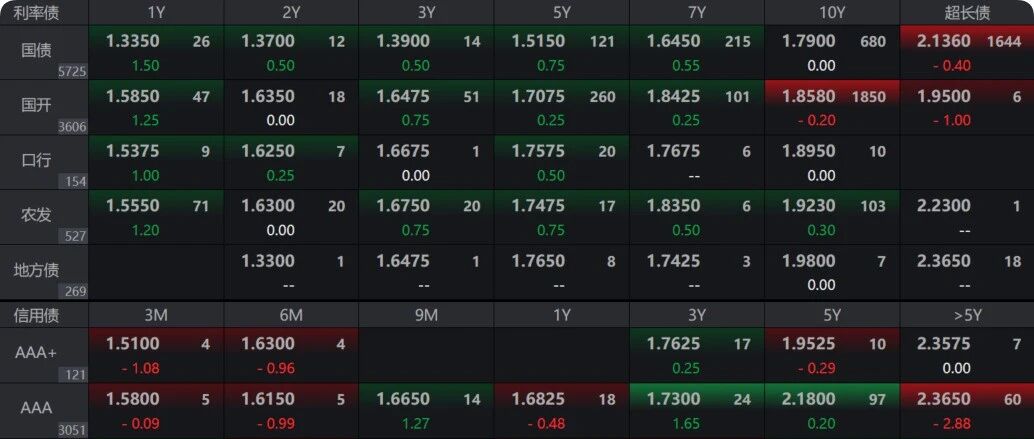
Core Viewpoint - The article discusses the recent actions of the central bank regarding bond purchases and their impact on the market, highlighting a cautious approach to monetary policy amid fluctuating market conditions [3][5][6]. Group 1: Central Bank Actions - The central bank conducted a 200 billion yuan bond purchase in October, which was lower than market expectations, leading to a slight increase in interest rates before stabilizing [5][6]. - A total of 1175 billion yuan in 7-day reverse repos was executed, with a net withdrawal of 3578 billion yuan due to the maturity of 4753 billion yuan in reverse repos [3]. - The central bank plans to conduct a 7000 billion yuan buyout reverse repo operation with a 3-month term, indicating a strategy to manage liquidity in the market [3]. Group 2: Market Reactions - The stock market experienced a slight decline, attributed to the lower-than-expected bond purchase by the central bank, which caused temporary fluctuations in interest rates [5][6]. - Global stock markets showed poor performance, influenced by concerns over potential AI bubble bursts and other macroeconomic factors, while the domestic banking sector remained relatively stable [6]. - The bond market reacted to the central bank's actions, with the 10-year government bond yield fluctuating around 1.79% following the announcement of the bond purchase [5][6]. Group 3: Interest Rate Trends - The weighted average rates for various repo transactions remained stable, with R001 at 1.36% and R007 at 1.46%, indicating a balanced liquidity environment [4]. - The interest rates for government bonds showed slight variations, with the 10-year bond yield at 1.7900% and other maturities reflecting minor changes [8]. - The overall trend in interest rates suggests a cautious approach by the central bank to maintain stability in the financial system while addressing liquidity needs [3][4].