固定收益

Search documents
全球固收量化:四大流派、五大局限未来已来系列之一
GF SECURITIES· 2026-02-12 13:02
[Table_Page] 固定收益|专题报告 2026 年 2 月 12 日 证券研究报告 [Table_Title] 全球固收量化:四大流派&五大局限 未来已来系列之一 [Table_Summary] 核心观点: | [分析师: Table_Author]杜渐 | | | --- | --- | | | SAC 执证号:S0260526020003 | | 010-59136690 | | | | dujian@gf.com.cn | | 分析师: | 吴棋滢 | | | SAC 执证号:S0260519080003 | | | SFC CE No. BQN213 | | 021-38003588 | | | | wuqiying@gf.com.cn | 请注意,杜渐并非香港证券及期货事务监察委员会的注册 持牌人,不可在香港从事受监管活动。 972918116公共联系人2026-02-12 20:06:58 [Table_ 相关研究: DocReport] 中国人如何理财:存款搬家研 究框架:A 股资金面框架(一) 2025-10-14 识别风险,发现价值 请务必阅读末页的免责声明 1 / 17 [Tabl ...
朝闻国盛:关注美元流动性和情绪指标何时修复
GOLDEN SUN SECURITIES· 2026-02-04 01:33
Group 1: Market Overview - The report emphasizes the need to monitor the recovery of US dollar liquidity and sentiment indicators, as recent market conditions have shown excessive liquidity and heightened risk aversion due to hawkish signals from the Federal Reserve [3] - Current US dollar liquidity is in a state of severe tightening, triggering a warning signal at -60%, indicating a significant reduction in net liquidity [3] - Fear sentiment indicators have worsened, amplifying market volatility, with rising uncertainty across global markets [3] Group 2: Fixed Income Insights - The fiscal outlook for 2026 remains challenging, necessitating larger fiscal expansions to ensure effective policy implementation, as 2025 saw insufficient internal growth in fiscal revenue [4] - Despite a budget deficit rate of 4% and an increase in government debt by 2.9 trillion yuan, actual spending fell short of initial budget expectations, indicating structural pressures on fiscal spending [4] - The report suggests that stronger fiscal measures will be required in 2026 to achieve effective expansion, with projections for special government bonds and a decrease in overall fiscal space [4] Group 3: Company-Specific Analysis - Haon Electric (301488.SZ) is positioned as a leader in intelligent driving perception, with a strategic partnership with NVIDIA to develop robotic brain technology, enhancing its competitive edge in the robotics sector [7] - The company is expected to see significant growth in net profit from 2025 to 2027, with projections of 0.99 billion yuan in 2025, 1.31 billion yuan in 2026, and 1.76 billion yuan in 2027, reflecting a robust expansion in its business model [8] - Cambricon Technologies (688256.SH) anticipates a substantial revenue increase in 2025, projecting revenues between 6 billion to 7 billion yuan, with a net profit turnaround expected to be between 1.85 billion to 2.15 billion yuan [10]


中金2026年展望:维持超配中国股票与黄金
Guan Cha Zhe Wang· 2025-11-17 04:29
Core Viewpoint - The current gold bull market is likely not over, as its price increase and duration are still below historical comparisons from the 1970s and 2000s [1] Gold Market Insights - The continuation of the gold bull market is contingent on the Federal Reserve's monetary policy and the U.S. economy not entering a strong recovery phase characterized by "declining inflation and rising growth" [1] - There is a possibility that gold prices could exceed $5,000 per ounce next year if current trends persist [1] - Despite a clear bull market logic, gold is currently considered overvalued, suggesting a strategy of increasing allocation during dips rather than chasing prices [1] Stock Market Insights - Chinese stocks are expected to benefit from the AI technology wave and ample liquidity, with reasonable valuations [1] - Although year-end volatility may increase, there are no signals indicating a market top, thus maintaining an overweight position is recommended [1] - The U.S. stock market also has a bullish outlook, but concerns about high valuations and low elasticity during the dollar depreciation cycle suggest a neutral allocation [2] Fixed Income Insights - Chinese interest rates have room to decline, but the current valuation of Chinese bonds is high, limiting upside potential, leading to a recommendation for underweighting [2] - U.S. Treasuries benefit from the Fed's easing cycle but face mid-term inflation and debt risks, resulting in a neutral allocation recommendation [2] Market Top Indicators - The analysis of market tops for Chinese stocks and gold highlights the importance of economic and policy signals, with economic slowdowns or tightening policies often indicating market tops [4][5] - The difficulty in accurately timing market tops is noted, particularly due to the close timing of economic and market turning points [4] 2026 Market Outlook Factors - Four key factors that could alter the bullish trends for stocks and gold in 2026 include unexpected growth shifts, tightening policies, high valuations, and geopolitical shocks [6][7][8] - Current data does not support a significant improvement in economic growth for China and the U.S., suggesting that the bullish trends for stocks and gold are likely to continue [8] Asset Allocation Recommendations - The recommendation is to overweight Chinese stocks and gold, maintain a neutral position in U.S. stocks and bonds, and adjust commodity allocations to neutral [9] - The strategy emphasizes the importance of being prepared for potential market trend changes by increasing commodity allocations [9]
利率市场趋势定量跟踪:利率价量择时信号整体仍偏多
CMS· 2025-10-19 11:23
Quantitative Models and Construction Methods - **Model Name**: Multi-cycle timing model for domestic interest rate price-volume trends **Model Construction Idea**: The model uses kernel regression algorithms to capture interest rate trend patterns, identifying support and resistance lines based on the shape of interest rate movements across different investment cycles [10][24] **Model Construction Process**: 1. **Data Input**: Utilize 5-year, 10-year, and 30-year government bond YTM data as the basis for analysis [10][24] 2. **Cycle Classification**: Divide the investment horizon into long-term (monthly frequency), medium-term (bi-weekly frequency), and short-term (weekly frequency) cycles [10][24] 3. **Signal Identification**: Detect upward or downward breakthroughs of support and resistance lines for each cycle [10][24] 4. **Composite Scoring**: Aggregate signals across cycles, assigning scores based on the number of consistent breakthroughs (e.g., 2/3 consistent signals lead to a "buy" or "sell" recommendation) [10][24] **Model Evaluation**: The model effectively captures multi-cycle resonance in interest rate trends, providing actionable timing signals for bond trading strategies [10][24] - **Model Name**: Multi-cycle timing model for U.S. interest rate price-volume trends **Model Construction Idea**: Apply the domestic interest rate price-volume timing model to the U.S. Treasury market [21] **Model Construction Process**: 1. **Data Input**: Use 10-year U.S. Treasury YTM data for analysis [21] 2. **Cycle Classification**: Similar to the domestic model, divide the investment horizon into long-term, medium-term, and short-term cycles [21] 3. **Signal Identification**: Detect upward or downward breakthroughs of support and resistance lines for each cycle [21] 4. **Composite Scoring**: Aggregate signals across cycles, assigning scores based on the number of consistent breakthroughs [21] **Model Evaluation**: The model provides a neutral-to-bullish outlook for U.S. Treasury yields, indicating its adaptability to international markets [21] Model Backtesting Results - **Domestic Multi-cycle Timing Model**: - **5-year YTM**: - Long-term annualized return: 5.5% - Maximum drawdown: 2.88% - Return-to-drawdown ratio: 1.91 - Short-term annualized return (since 2024): 1.86% - Maximum drawdown: 0.59% - Return-to-drawdown ratio: 3.16 - Long-term excess return: 1.07% - Short-term excess return: 0.85% [25][27] - **10-year YTM**: - Long-term annualized return: 6.09% - Maximum drawdown: 2.74% - Return-to-drawdown ratio: 2.22 - Short-term annualized return (since 2024): 2.42% - Maximum drawdown: 0.58% - Return-to-drawdown ratio: 4.19 - Long-term excess return: 1.66% - Short-term excess return: 1.55% [28][32] - **30-year YTM**: - Long-term annualized return: 7.38% - Maximum drawdown: 4.27% - Return-to-drawdown ratio: 1.73 - Short-term annualized return (since 2024): 3.11% - Maximum drawdown: 0.92% - Return-to-drawdown ratio: 3.39 - Long-term excess return: 2.42% - Short-term excess return: 2.87% [33][35] - **U.S. Multi-cycle Timing Model**: - **10-year YTM**: - Current signal: Neutral-to-bullish - Long-term annualized return: Not provided - Maximum drawdown: Not provided - Return-to-drawdown ratio: Not provided [21][23] Quantitative Factors and Construction Methods - **Factor Name**: Interest rate structure indicators (level, term, convexity) **Factor Construction Idea**: Transform YTM data into structural indicators to analyze the interest rate market from a mean-reversion perspective [7] **Factor Construction Process**: 1. **Level Structure**: Calculate the average YTM across maturities (1-10 years) 2. **Term Structure**: Measure the slope between short-term and long-term YTM 3. **Convexity Structure**: Assess the curvature of the yield curve [7] **Factor Evaluation**: The indicators effectively capture the current state of the interest rate market, highlighting deviations from historical averages [7] Factor Backtesting Results - **Interest Rate Structure Indicators**: - **Level Structure**: Current reading: 1.64%, historical 10-year percentile: 7% - **Term Structure**: Current reading: 0.38%, historical 10-year percentile: 16% - **Convexity Structure**: Current reading: -0.09%, historical 10-year percentile: 1% [7]
大会期间资金平稳或仍占主导
Tianfeng Securities· 2025-10-19 03:43
1. Report Industry Investment Rating - Not provided in the given content 2. Core Viewpoints - The funding situation has entered a comfortable state again in mid - early October, with limited disturbances and many supporting factors, and it is expected to remain stable next week [1][21] - Historically, funding disturbances in October are mainly concentrated in the second half, but important meetings have limited direct impact on the funding situation. This year, the funding situation is expected to maintain a seasonal stable state [20][21] 3. Summary by Directory 3.1 Next Week's Funding Still Expected to Be Stable - In mid - early October, the funding situation entered a comfortable state, with factors like holiday cash withdrawal funds flowing back, fiscal expenditures in place, and significant net long - term liquidity injection from the central bank [1][11] - Historically, funding disturbances in October are mainly in the second half due to tax payments and cross - month pressures. Important meetings in October in recent years have limited impact on the funding situation [17][20] - This year, the funding situation is expected to be seasonally stable. Next week's disturbances are limited, mainly government bond issuances on Monday and Friday, and relatively high certificate of deposit maturities on Tuesday and Friday. The central bank's precise control is expected to keep the funding situation loose [21] 3.2 Open Market: Next Week's Maturity Scale to Decline - From 10/13 - 10/17, the open - market net injection was - 6979 billion yuan. From 10/20 - 10/24, the open - market maturity is 7891 billion yuan [3][27] 3.3 Government Bonds: To Issue Over 800 Billion Yuan Next Week - From 10/13 - 10/17, government bonds were issued worth 3083 billion yuan. From 10/20 - 10/24, the planned issuance is 8802 billion yuan, with net treasury bond payment of 21.6 billion yuan and net local bond payment of 136.7 billion yuan [4][36] 3.4 Excess Reserve Tracking and Forecast - It is predicted that the excess reserve ratio in October 2025 will be about 1.43%, a month - on - month decrease of about 0.42 pct and a year - on - year decrease of 0.33 pct [40] 3.5 Money Market: Large Banks' Lending Willingness Continues to Recover - Most funding interest rates declined. As of 10/17, compared with 10/10, DR001 rose 0.21 BP, DR007 fell 1.44 BP, R001 rose 3.83 BP, and R007 fell 1.65 BP [5] - The average net lending of the banking system's funds was 4.07 trillion yuan, with state - owned large banks' average net lending at 4.38 trillion yuan, and the overnight lending ratio at 97% [5] 3.6 Interbank Certificates of Deposit 3.6.1 Primary Market: Issuance Scale to Increase - From 10/13 - 10/17, the total issuance of interbank certificates of deposit was 727.6 billion yuan, with a net financing of 23.4 billion yuan, an increase compared to 10/9 - 10/11 [6] - Next week (10/20 - 10/26), the maturity scale of interbank certificates of deposit is 603 billion yuan, an increase of 109.4 billion yuan compared to this week [76] 3.6.2 Secondary Market: Yields to Rise Slightly - Yields of certificates of deposit of all maturities rose. Yields of 1M, 3M, 6M, 9M, and 1Y AAA - rated certificates of deposit changed by 3, 3, 2, 1, 0 BP respectively [90]
政府关门危机逼近 美债有望连续三季度上涨
智通财经网· 2025-09-30 11:08
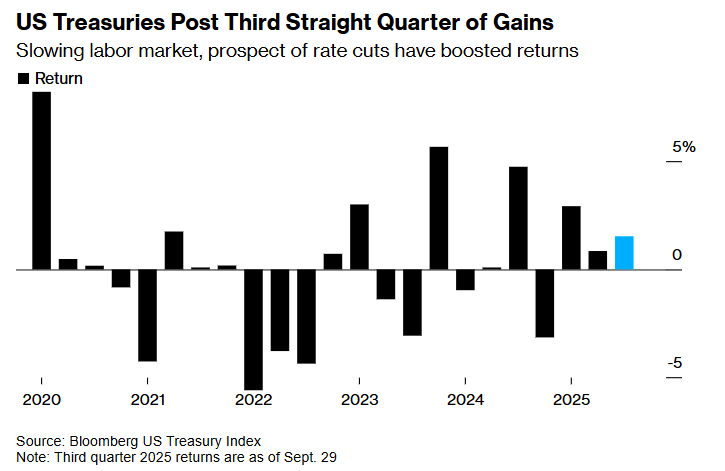
Group 1 - The core viewpoint is that U.S. Treasury prices are expected to rise for the third consecutive quarter due to potential government shutdowns that may suppress economic growth, increasing investor demand for U.S. Treasuries [1] - U.S. Treasury yields have generally decreased, with a reported return of 1.5% for the current quarter and over 5% for the first three quarters of 2025, potentially marking the best performance since 2020 [1] - A government shutdown could disrupt operations and delay key economic data releases, which historically leads to an increase in long-term Treasury prices [1] Group 2 - The yield on the 10-year Treasury note fell by 1 basis point to 4.13%, while the 2-year Treasury yield is at 3.60%, close to its lowest level in the past year [2] - Market sentiment reflects a shift towards U.S. Treasuries due to concerns over a prolonged government shutdown potentially leading to economic slowdown, resulting in a flattening yield curve [2] - Expectations of a Federal Reserve interest rate cut are contributing to the overall upward trend in U.S. Treasuries, with an 80% probability of a 25 basis point cut in October and a similar possibility in December [2]

机构行为跟踪周报20250928:债市再迎交易盘抛压考验-20250928
Tianfeng Securities· 2025-09-28 14:11
1. Report Industry Investment Rating No relevant content provided. 2. Core Viewpoints - The bond market's vitality index significantly declined, and the bond market is facing the test of trading - disk selling pressure again. The selling pressure from funds was released again in the second half of the week, while large - scale banks increased their net buying of long - end interest - rate bonds, and their sustainability and stabilizing effect need further observation. - Most interest and credit bond funds have recorded negative returns in the past three months, the growth rate of bond fund scale in September is still lower than that of equity funds, and the issuance share of newly established bond funds has declined this week [5][95]. 3. Summary by Directory 3.1 Overall Sentiment - The bond market vitality index dropped significantly. As of September 26, it decreased by 17 pcts to 0% compared with September 19, and the 5D - MA decreased by 5 pcts to 16%. There were no warming indicators, and the cooling indicators included the implied tax rate of the 10 - year CDB bond, the trading volume of the active 10Y CDB bond / the balance of 9 - 10Y CDB bonds, the excess level of the inter - bank bond market leverage ratio compared with the average of the past 4 years, the median duration of medium - and long - term pure bond funds, and the turnover rate of the 30Y treasury bond [1][10][12]. 3.2 Institutional Behavior 3.2.1 Buying and Selling Strength and Bond Selection - The net buying strength ranking in the current bond market this week is: money market funds > large - scale banks > insurance > wealth management > other product types > others; the net selling strength ranking is: city commercial banks > rural financial institutions > securities firms > funds > joint - stock banks > foreign - funded banks. For ultra - long bonds, the net buying strength ranking is: insurance > securities firms > wealth management > other product types > others, and the net selling strength ranking is: large - scale banks > funds > city commercial banks > joint - stock banks > rural commercial banks > foreign - funded banks [19]. - The main bond types of various institutions are: large - scale banks focus on 1 - 3Y and 7 - 10Y interest - rate bonds; rural commercial banks focus on 3 - 5Y credit bonds; insurance focuses on interest - rate bonds and other bonds over 10Y; funds focus on interest - rate bonds within 1Y; wealth management focuses on interest - rate bonds within 1Y and 3 - 5Y credit bonds; other product types focus on 7 - 10Y interest - rate bonds [2][22]. 3.2.2 Trading Disk - The median duration of all - sample medium - and long - term pure bond funds decreased by 0.01 years compared with September 19. Among them, the median durations of pure interest - rate bond funds, interest - rate bond funds, and credit bond funds changed by - 0.02 years, - 0.07 years, and + 0.03 years to 5.15 years, 4.81 years, and 3.74 years respectively. The median durations of high - performing interest - rate bond funds and credit bond funds changed by - 0.07 years and + 0.10 years to 6.39 years and 4.35 years respectively [3][39]. 3.2.3 Allocation Disk - **Primary Market**: The primary subscription demand for treasury bonds and policy - financial bonds decreased this week, and the subscription demand for ultra - long bonds was differentiated. The weighted average full - market multiples of treasury bonds and policy - financial bonds decreased from 3.39 times and 3.00 times in the previous week to 2.85 times and 2.80 times respectively. For treasury bonds and policy - financial bonds over 10Y, the weighted average full - market multiples decreased from 3.63 times to 3.33 times and increased from 3.34 times to 3.40 times respectively [53]. - **Secondary Market** - **Large - scale Banks**: The increasing supply of ultra - long bonds may restrict their secondary - market承接 capacity. Since June, large - scale banks have increased their net buying of treasury bonds within 1Y, but the cumulative net buying scale this year is still far lower than that of the same period in 2024. The net buying of 1 - 3Y treasury bonds increased from May to July and declined since August. As of September 26, the cumulative net buying scale of 1 - 3Y treasury bonds this year was 7271 billion yuan [58][60]. - **Rural Commercial Banks**: Their cumulative net buying scale of current bonds this year is significantly weaker than in previous years, mainly due to the weak net buying of short - term bonds within 1Y. However, the net buying of 7 - 10Y and over 10Y current bonds is significantly higher than in previous years [74]. - **Insurance**: The net buying strength of current bonds by insurance this year is significantly higher than in previous years, mainly due to the strong buying of ultra - long bonds over 10Y. As of September 19, the ratio of insurance's cumulative net buying of current bonds to the cumulative issuance scale of government bonds over 10Y was 30.04%, higher than 29.18% at the end of September last year [80]. - **Wealth Management**: Since June, the cumulative net buying scale of current bonds by wealth management has continued to rise. This week, the duration of net - bought current bonds in the secondary market reached the highest point since February 23, 2024. As of September 26, the weighted average duration of cumulative net - bought current bonds was 1.78 years, an increase of 0.03 years compared with September 19 [90][92]. 3.3 Asset Management Product Tracking - Since September, the growth rate of bond fund scale is still lower than that of equity funds. The scale of bond funds and equity funds increased by 1418 billion yuan and 2019 billion yuan respectively in September, compared with 732 billion yuan and 4855 billion yuan in August. - The issuance share of newly established bond - type funds declined this week. The scale of newly established bond funds this week was 106 billion yuan, down from 486 billion yuan in the previous week. - This week, the net value of various types of bond funds dropped significantly, with credit bond funds experiencing larger declines. Most interest and credit bond funds recorded negative returns in the past three months [95].
同时与基本面和资金面背离,债何时复归?
GOLDEN SUN SECURITIES· 2025-09-21 09:45
1. Report Industry Investment Rating - No industry investment rating is provided in the report. 2. Core View of the Report - The bond market is expected to gradually return to the fundamentals and asset shortage situation through incremental restoration in a volatile manner. The 10-year Treasury bond above 1.8% still has allocation value, and the long-term bond yield is expected to return to around the level before this round of adjustment by the end of the year, with the 10-year Treasury bond likely to recover to around 1.6% - 1.65% [6][21]. 3. Summary by Relevant Catalogs 3.1 Bond Market Performance This Week - The bond market rose first and then fell this week, remaining volatile overall. The yields of 10-year and 30-year Treasury bonds increased by 1.1bps and 2.1bps respectively to 1.80% and 2.10%. The yields of certificates of deposit and credit bonds remained stable or declined slightly, with the 1-year AAA certificate of deposit yield rising slightly by 0.5bps to 1.68%, and the yields of 3-year and 5-year AAA - secondary capital bonds falling by 2.6bps and 1.5bps respectively to 2.00% and 2.13% [1][9]. 3.2 Deviation of the Bond Market from Fundamentals and Capital - **Deviation from fundamentals**: The bond market trend is inconsistent with the fundamentals. The terminal demand calculated by export, infrastructure, and real estate investment decreased from 5.2% in April to 0.5% in August, and the year-on-year growth rate of industrial added value decreased from 6.8% in June to 5.2% in August. The manufacturing PMI has been below 49.5%, indicating relatively low economic prosperity, which is inconsistent with the overall upward trend of long-term bond yields in the past two months [2][10]. - **Deviation from capital**: The long-term bond also deviates significantly from the capital trend. The 20-day moving average of R007 has been declining since late February, from around 2.2% to around 1.5% currently, while the long-term bond yield has been rising in the past two months, and the spread between the two has reached over 30bps, a relatively high level in the past two years [2][10]. 3.3 Historical Situation of Interest Rate Deviation - Historically, it is rare for interest rates to deviate from both capital and fundamentals simultaneously. Previously, interest rate adjustments were usually accompanied by improvements in fundamentals or tightening of capital, and most of the time, changes in fundamentals and capital preceded interest rate adjustments. For example, in March 2016, the manufacturing PMI rose above the boom - bust line, and the interest rate recovery occurred in the fourth quarter of 2016 [3][13]. 3.4 Logic of Interest Rate Change - It is more logical for changes in capital or fundamentals to lead long - term interest rates. Interest rate is the financing cost. For the real economy, interest rates can only achieve a trend recovery when demand continues to rise. If the fundamentals are still weak and financing demand is insufficient, a premature rise in interest rates will suppress the fundamentals [4][18]. 3.5 Special Situation of Current Deviation - The current simultaneous deviation of long - term bonds from fundamentals and capital has its particularity. Part of the reason for the relative weakness of long - term bonds is the over - rise from the end of last year to the beginning of this year, and part of the triggering factor is the increase in risk appetite brought about by the rise of the stock market. However, from multiple perspectives such as the downward speed of broad - spectrum interest rates, interest rate cut expectations, curve slope, and the interpretability of fundamentals, the previous over - rise may have been digested, and subsequent interest rates are expected to return to the fundamentals and asset shortage situation [4][18]. 3.6 Situation in the Fourth Quarter - **Increasing possibility of asset shortage**: Asset supply is expected to further decline. If the net financing of government bonds in September is 1.3 trillion, the net financing of government bonds in the first nine months of this year is 11.6 trillion. According to the budget, the net financing in the fourth quarter is about 2.2 trillion. Even if 1 trillion of refinancing bonds for next year are advanced to this year, the net financing of government bonds in the fourth quarter will still be about 0.7 trillion less than last year. At the same time, the issuance of refinancing bonds may further increase the replacement of assets such as credit, and overall asset supply will further decline. However, fiscal deposits will continue to decrease year - on - year, and the central bank's bond trading will also increase capital supply, so the asset shortage may intensify [5][19]. - **Increasing possibility of fundamental pressure**: From the perspective of industrial product prices, the production material price index of the Ministry of Commerce has been falling since early August, and the PPI month - on - month in September may turn negative again, indicating that the fundamental pressure may increase [5][19]. 3.7 Bond Market Outlook and Investment Suggestions - **Bond market outlook**: The decline in the real return rate determines that the downward trend of broad - spectrum interest rates such as loan interest rates has not changed. The over - rise of interest rates at the beginning of the year has gradually been digested. Therefore, the current interest rate adjustment space is limited, and the bond market will gradually return to the fundamentals and asset shortage situation, but this return may be achieved through incremental restoration in a volatile manner [6][21]. - **Investment suggestions**: A dumbbell - shaped operation is recommended, that is, short - term credit/certificates of deposit + long - term interest rates. High - selling and low - buying band operations can be carried out on long - term interest rate positions [6][21].
国信证券 | 每日晨报(2025.9.18)
Zhong Guo Neng Yuan Wang· 2025-09-18 02:15
Industry and Company Insights - Real Estate Industry Commentary: The National Bureau of Statistics reported that the real estate sector continued its downward trend in August 2025, with expectations for more substantial policy measures in September [1] - Metal Industry Mid-Year Summary: The non-ferrous sector saw a net profit increase of 38%, highlighting the ongoing value of resource stocks [1] - Machinery Industry Weekly Report: The 28th edition of the manufacturing growth report noted that Oracle's RPO has increased to $455 billion, while Tesla is finalizing the design for Optimus V3 [1] - Electronics Industry Monthly Report: The power companies are experiencing a recovery in performance, with clear growth trends in the automotive and data center sectors [1] - Hanbell Precise Machinery (002158.SZ) Financial Report Commentary: The company is creating a new growth curve through its AIDC compressors and semiconductor vacuum pumps [1] - Zhongshen Power (001696.SZ) Financial Report Commentary: The company reported a 73% year-on-year increase in net profit for the second quarter, actively positioning itself in the low-altitude economy [1] - China Molybdenum Co., Ltd. (300470.SZ) Financial Report Commentary: As a leading manufacturer of mechanical seals, the company is expanding its international business to enhance growth opportunities [1]

就在今天|国泰海通 ·2025研究框架培训“洞察价值,共创未来”
国泰海通证券研究· 2025-08-17 22:48
Group 1 - The article outlines a comprehensive research framework training program titled "洞察价值,共创未来" (Insight Value, Co-create Future) scheduled for August 18-19 and August 25-26, 2025, focusing on various sectors including macroeconomics, consumption, finance, cycles, medicine, technology, and manufacturing [18][19]. - The training sessions will cover a wide range of topics, with specific time slots allocated for each area of research, such as food and beverage, internet applications, and renewable energy [14][15][16]. - The event will take place at the Guotai Junan Financial Bund Plaza in Shanghai, emphasizing the importance of in-depth analysis across all sectors [18]. Group 2 - The training program is designed to enhance the research capabilities of analysts and is led by various chief analysts specializing in different fields, ensuring a comprehensive approach to industry analysis [8][10]. - Participants will have the opportunity to engage with experts in macroeconomic research, strategy, fixed income, and various sector-specific studies, fostering a collaborative learning environment [14][15][16]. - The program aims to equip analysts with the necessary tools and insights to navigate the complexities of the financial markets and identify potential investment opportunities [18].