
房地产业

Search documents
出口延续高增长,结构性降息政策出台
Hua Lian Qi Huo· 2026-01-18 13:32
1. Report's Investment Rating for the Industry - No investment rating for the industry is provided in the report. 2. Core Viewpoints of the Report - In December 2025, China's exports continued high - growth, imports rebounded significantly, and the trade surplus expanded. The Fed's January rate - cut probability decreased, and the RMB showed an appreciation trend. The central bank adjusted the structural monetary policy tool rate and commercial real - estate credit policies, aiming to improve capital activation and support the real economy [8][10]. 3. Summary According to Relevant Catalogs 3.1 National Economic Accounting - GDP quarterly data from 2023 to 2025 are presented, showing the performance of different industries, including agriculture, forestry, animal husbandry, fishery, industry, and services. The contribution rates and pulling effects of the three industries on GDP are also provided [13][18]. 3.2 Industry Analysis - **Industrial Sector**: The growth rate, added - value of major industries, and production of key products are analyzed. The profit situation of industrial enterprises shows mixed results, with some industries growing and some declining. The inventory of industrial enterprises is at a relatively high level, and enterprises still have the intention to reduce inventory [28][43][53]. - **Price Index**: In December 2025, the national consumer price index (CPI) increased year - on - year, and the industrial producer price index (PPI) decreased year - on - year but the decline narrowed. The prices of different categories in CPI and PPI showed different trends [60][68]. 3.3 Real Estate Market - In January - November 2025, real estate development investment, construction area, new - start area, completion area, sales area, and sales volume all declined year - on - year. The prices of new and second - hand residential properties in major cities also showed different degrees of decline [122][126][130]. 3.4 Foreign Trade and Investment - In December 2025, China's total import and export volume reached a record high. Exports to ASEAN and the EU increased, while exports to the US decreased. The export of key products and the import of key commodities are presented in detailed tables [93][100][101]. 3.5 Fixed - Asset Investment - From January - November 2025, national fixed - asset investment (excluding rural households) decreased year - on - year. Private fixed - asset investment also declined. Investment in different industries showed different trends, with the second - industry investment growing and the third - industry investment declining [114]. 3.6 Domestic Trade - The growth of service retail sales and social consumer goods retail sales is analyzed, and the year - on - year changes in retail sales of different industries above the quota are presented [158][165]. 3.7 Transportation - The transportation volume of goods and passengers by different means, the subway passenger flow in major cities, and the freight rates of shipping routes are analyzed [168][173][179]. 3.8 Banking and Currency - The new social financing scale, social financing scale stock, new RMB loans, and money liquidity are analyzed. The central bank emphasizes reasonable interest - rate control to promote the decline of the real - economy financing cost [183][194][200]. 3.9 Bond Market - The issuance of interest - bearing bonds and the yields of long - and short - term treasury bonds are analyzed [213][216]. 3.10 Foreign Exchange and Gold - The RMB exchange rate against the US dollar and the US dollar index are presented. China's gold reserves increased, and the foreign exchange reserves reached a new high [220][223]. 3.11 Fiscal and Employment - The central and local general public budget revenues and expenditures are analyzed, and the urban surveyed unemployment rate and new urban employment are presented [232][236][242]. 3.12 Business Climate Survey - The global and Chinese manufacturing and non - manufacturing PMI are analyzed. In December 2025, China's manufacturing PMI returned to the expansion range, and the non - manufacturing business activity index also rebounded [245][248][256]. 3.13 US Macroeconomy - The US real GDP growth rate, employment situation, treasury bond yields, retail sales, and the Fed's asset structure and federal funds rate are analyzed [263][266][274].
基金研究周报:权益风格分化,白银再度飙涨(1.12-1.16)
Sou Hu Cai Jing· 2026-01-17 22:42
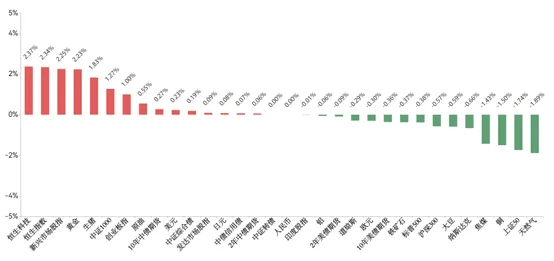
Market Overview - The A-share market exhibited structural differentiation and active trading last week, with the Shanghai Composite Index closing at 4101.91 points, down 0.45%, while the Shenzhen Component Index rose by 1.14% and the ChiNext Index increased by 1.00%, indicating resilience in growth sectors despite short-term volatility [1] - The overall market trend favored growth stocks while value stocks faced a pullback, with small-cap and technology sectors being the main focus of capital [1] Industry Performance - Most of the Wind first-level industry indices declined, averaging a drop of 0.44%. The information technology sector led with a 3.37% increase, driven by sustained AI computing demand, accelerated domestic substitution, and expectations of policy support. In contrast, the real estate sector fell by 3.66% due to weak sales data and limited policy effectiveness [1][9] Fund Issuance - A total of 23 funds were issued last week, including 10 equity funds, 7 mixed funds, 3 bond funds, 1 QDII fund, and 2 FOF funds, with a total issuance of 19.294 billion units [1][16] Fund Performance - The Wind All-Fund Index rose by 0.73% last week, with the equity mixed fund index increasing by 1.52%. However, there was significant differentiation, as the Wind Growth Fund Index rose by 1.88%, while the Wind Value Fund Index fell by 0.31%. The bond fund index saw a slight increase of 0.17% [1][5]

宏观经济周报:基本面降息是储备而非标配-20260117
Guoxin Securities· 2026-01-17 14:31
Monetary Policy - The central bank has lowered the interest rates of various structural monetary policy tools by 25 basis points to 1.25%, below the short-term policy rate of 1.4%[1] - The central bank indicated that there is still room for further rate cuts in 2026, but these are likely to be used as a reserve tool rather than a routine operation[1][11] - Current monetary policy focuses on structural rate cuts rather than comprehensive rate cuts, reflecting internal constraints such as low net interest margins for commercial banks[1][11] Economic Indicators - Fixed asset investment has decreased by 2.6% year-on-year[3] - Retail sales have increased by 1.3% year-on-year[3] - Exports have risen by 6.6% year-on-year[3] Fiscal Policy - Fiscal spending is expected to increase in Q1 2026, supported by a significant carryover of surplus funds from 2025[2][12] - The combination of structural monetary easing and fiscal policy aims to effectively expand domestic demand and solidify economic recovery[12] Market Trends - Production remains strong, with high demand in sectors like machinery and textiles, while real estate transactions continue to decline[13][14] - Port cargo throughput has increased by 4.82% year-on-year, indicating robust foreign trade momentum[22] Risks - There are uncertainties in overseas markets that could impact economic stability[2][51]
经观季度调查 |2025年四季度经济学人问卷调查:扩内需、反内卷,激活市场活力成为关键路径
Sou Hu Cai Jing· 2026-01-17 14:05
Economic Outlook - China's economy is currently facing a critical period of adjustment, with old problems and new challenges intertwining, necessitating more proactive fiscal policies and moderately loose monetary policies to stabilize and promote economic growth [1][7][8] - Economists predict that GDP growth for Q4 2025 will likely be between 4.7% and 4.9%, with a consensus for 2026 growth around 4.8% to 5.0% [2][7] Real Estate Market - The real estate market shows signs of stabilization but remains in a deep adjustment phase, with 79% of economists believing that the market will slow its decline in 2026 but has not yet bottomed out [2][17] - Economists suggest that the focus should not be on a trend reversal but rather on whether the rate of decline can be reduced [17] Investment Trends - Investment is seen as a key support for economic recovery, with 47% of economists forecasting a decline in fixed asset investment growth for Q4 2025, while 31% expect a modest increase in 2026 [17] - The primary sectors attracting investment include technology (42%), large infrastructure (33%), and energy (16%) [17] Debt and Financial Risks - Local government debt remains a significant concern, exacerbated by declining land revenues due to the ongoing downturn in the real estate market [8][10] - Economists emphasize the need for macroeconomic management to address the debt risks faced by real estate companies, which are currently in a "non-normal" state due to cash flow issues and declining sales [10][11] Consumer Demand and Employment - There is a pressing need to stimulate consumer demand, with suggestions including increasing residents' income and improving the social security system [26][27] - Employment remains a critical issue, particularly for recent graduates, with the urban unemployment rate averaging 5.2% in 2025, indicating a stable but concerning job market [28] Policy Recommendations - Economists recommend a combination of fiscal and monetary policies to stimulate demand and reduce costs for businesses and residents [30] - Long-term strategies should focus on stabilizing the macro tax burden and reforming the fiscal system to ensure sustainable economic growth [11][30]

信用利差周度跟踪20260116:信用债跟随利率下行超长信用二永表现强势-20260117
Huafu Securities· 2026-01-17 14:02
1. Report Industry Investment Rating There is no information provided in the content about the report industry investment rating. 2. Core Viewpoints of the Report - This week, the sentiment of interest - rate bonds was strong with slightly declining yields, and credit bond yields generally followed suit. The 10 - year ultra - long - term credit bonds performed strongly, and the spreads of secondary perpetual (Two - Perpetual, or "Two - Yong") bonds narrowed across the board. The excess spreads of industrial and urban investment perpetual bonds decreased slightly. [3][4] - Vanke's debt extension plan was better than expected, leading to an increase in the secondary prices of its outstanding bonds. However, due to the lack of unexpected industry support policies and the will to ensure rigid payment, the market remains cautious about central and state - owned enterprise real - estate bonds with the "high - debt, high - leverage, and high - turnover" model. It is recommended to maintain a wait - and - see attitude towards real - estate bonds in the short term. [5][40] - After the New Year, the performance of Two - Yong bonds was strong. The growth of dividend - insurance premium income may have increased the demand for ultra - long - term Two - Yong bonds, causing a significant decline in yields. Considering the central bank's strong intention to support the market, there may still be room for the spreads of Two - Yong bonds to compress. [5][40] 3. Summary According to the Table of Contents 3.1 Credit Bonds Follow Interest Rates Downward, Ultra - Long - Term Credit Bonds Perform Strongly - Interest - rate bond yields: The yields of 3Y, 5Y, 7Y, and 10Y China Development Bank bonds decreased by 2BP, 4BP, 3BP, and 1BP respectively, while the 1Y yield increased by 2BP. [3][11] - Credit bond yields: Overall, they followed the decline in interest rates. The yields of 1Y AA+ and above - grade credit bonds remained flat, while those of other grades decreased by 1BP; 3Y AA+ and above - grade yields decreased by 1BP, and other grades decreased by 3 - 4BP; 5Y AA+ grade yields decreased by 5BP, and other grades decreased by 1 - 2BP; 7Y credit bond yields of all grades decreased by 2 - 3BP; 10Y AA+ and above - grade yields decreased by 4 - 5BP, and AA grade decreased by 2BP. [3][11] - Credit spreads: Generally stable, with the 10 - year ultra - long - term credit performing strongly. The spreads of 1Y all grades narrowed by 1 - 2BP; 3Y AA+ and above spreads remained flat, and other grades narrowed by 2 - 3BP; 5Y AA+ spreads narrowed by 2BP, and other grades widened by 1 - 2BP; 7Y AAA spreads remained flat, and other grades widened by 1BP; 10Y AA+ and above spreads narrowed by 3 - 4BP, and AA grade spreads narrowed by 1BP. [3][11] 3.2 Urban Investment Bond Spreads Mostly Decline by 0 - 1BP - By external rating: The credit spreads of external - rated AAA - level urban investment platforms generally remained flat, while those of AA and AA+ levels generally decreased by 1BP. [4][16] - By administrative level: The credit spreads of provincial and municipal - level platforms generally remained flat compared with last week, while those of district - county - level platforms decreased by 1BP. [4][22] 3.3 Industrial Bond Spreads Remain Stable Overall, Vanke's Spreads Compress Significantly - Real - estate bonds: Central - state - owned enterprise real - estate bond spreads widened by 9BP, state - owned enterprise real - estate bond spreads widened by 4BP, mixed - ownership real - estate bond spreads converged significantly by 451BP, and private - enterprise real - estate bond spreads increased by 14BP. Vanke's spreads decreased by 4285BP. [4][27] - Other industrial bonds: AAA - grade coal bond spreads remained flat, and other grades decreased by 1BP; AA+ steel bond spreads decreased by 3BP, and AAA remained flat; the spreads of all grades of chemical bonds remained flat. [4][27] 3.4 Two - Yong Bond Spreads Narrow Across the Board, Yields of Medium - and Long - Term Varieties Decline Significantly - 1Y Two - Yong bonds: Yields of all grades decreased by 1BP, and spreads compressed by 2BP. - 3Y Two - Yong bonds: Yields of all grades decreased by 5 - 6BP, and spreads compressed by 3 - 5BP. - 5Y Two - Yong bonds: Yields of all grades decreased by 5 - 6BP, and spreads compressed by 1 - 2BP. [35] 3.5 Excess Spreads of Industrial and Urban Investment Perpetual Bonds Decrease Slightly - Industrial AAA - grade 3Y perpetual bonds: Excess spreads converged by 0.43BP to 14.41BP, at the 36.98% quantile since 2015. - Industrial 5Y perpetual bonds: Excess spreads remained the same as last week at 13.20BP, at the 32.28% quantile since 2015. - Urban investment AAA - grade 3Y perpetual bonds: Excess spreads decreased by 0.13BP to 4.51BP, at the 3.52% quantile. - Urban investment 5Y perpetual bonds: Excess spreads decreased by 0.79BP to 10.13BP, at the 18.64% quantile. [38] 3.6 Vanke's Extension Plan is Better than Expected, Two - Yong Bond Spreads Still Have Compression Space - Vanke: Its debt extension plan was better than expected, and the secondary prices of its outstanding bonds increased. However, due to the lack of relevant policies, the market is still cautious about central and state - owned enterprise real - estate bonds, and it is recommended to maintain a wait - and - see attitude in the short term. [5][40] - Two - Yong bonds: After the New Year, they performed strongly. The growth of dividend - insurance premium income may have increased the demand for ultra - long - term Two - Yong bonds. Considering the central bank's support, there may still be room for spread compression. [5][40] 3.7 Credit Spread Database Compilation Instructions - Market credit spreads, Two - Yong spreads, and urban investment/industrial perpetual bond spreads are calculated based on ChinaBond medium - and short - term note and ChinaBond perpetual bond data, with historical quantiles starting from the beginning of 2015. - Urban investment and industrial bond - related credit spreads are compiled and statistically analyzed by Huafu Securities Research Institute, with historical quantiles starting from the beginning of 2015. - Sample selection criteria: Industrial and urban investment bonds select medium - term notes and public - offering corporate bonds, excluding guaranteed bonds and perpetual bonds. Bonds with a remaining term of less than 0.5 years or more than 5 years are excluded from the statistical sample. Industrial and urban investment bonds use external entity ratings, while commercial banks use ChinaBond implied debt ratings. [46]

刚刚,利好来了!两部门联合发布
Zhong Guo Ji Jin Bao· 2026-01-17 09:00
Core Viewpoint - The People's Bank of China and the National Financial Regulatory Administration have announced a reduction in the minimum down payment ratio for commercial property loans to no less than 30%, aimed at stimulating the commercial real estate market and addressing inventory issues [1][2]. Group 1: Policy Changes - The minimum down payment ratio for commercial properties, including mixed-use properties, has been adjusted from 50% to 30%, significantly lowering the entry barrier for buyers [2]. - This policy allows local financial institutions to set their own minimum down payment ratios based on local government regulations, promoting a tailored approach to real estate market conditions [1][2]. Group 2: Market Impact - The reduction in down payment requirements is expected to enhance market activity in the commercial real estate sector, which has been facing significant inventory challenges, with approximately 52.34 million square meters of office space and 14 million square meters of commercial property unsold as of November 2025 [2][3]. - The adjustment is seen as a direct effort to support inventory reduction in the commercial property market, reflecting the central government's increasing focus on addressing these challenges [2][3]. Group 3: Regional Initiatives - Various cities are implementing supportive policies to promote the conversion of existing commercial properties into rental housing and other uses, indicating a broader strategy to revitalize the commercial real estate market [3]. - Examples include Shanghai's "zoning and classification compatibility" strategy and Wuhan's tax incentives for new commercial property purchases, showcasing localized efforts to stimulate the market [3].
中国中冶:预计2025年度归母净利润与上年同期相比下降50%以上
Zhi Tong Cai Jing· 2026-01-16 13:34
Core Viewpoint - China Metallurgical Group Corporation (China MCC) expects to achieve profitability in 2025, but the net profit attributable to shareholders is projected to decline by over 50% compared to the previous year due to losses in the real estate sector and increased asset impairment provisions [1] Group 1: Financial Performance - In 2025, the company anticipates a significant drop in net profit attributable to shareholders, primarily driven by losses in the real estate business and increased provisions for impairment of inventory, fixed assets, and investment properties [1] - The company's revenue is expected to decline as a result of the downturn in the construction industry [1] Group 2: Future Strategy - By 2026, the company plans to complete the disposal of real estate assets, which will help alleviate the losses from this sector [1] - The company aims to enhance its diversified business system centered around "one core, two main bodies, and five distinctive features," focusing on the integration of technological and industrial innovation to foster high-quality development and improve long-term performance [1]

突发重磅!2026 买房规则变了?中央 2 大信号改写置业逻辑!
Xin Lang Cai Jing· 2026-01-16 09:53
Core Insights - The real estate market in 2026 is undergoing a historic transformation, moving away from the previous era of guaranteed profits from property purchases, with new rules emerging for homebuyers [1][10] Group 1: Policy Signals - The first major signal indicates a solidification of policy support, entering a new phase of "precise reduction of burdens" for demand, focusing on activating reasonable housing demand rather than broad stimulus [3][4] - Significant reductions in transaction costs are central to the policy benefits, with tax incentives for homebuyers and optimized VAT policies leading to the lowest purchasing costs in five years [3][4] - The policies are specifically aimed at addressing reasonable housing needs, with measures such as lower down payment ratios and reduced mortgage rates for first-time buyers [4][5] Group 2: Market Differentiation - The second major signal highlights a comprehensive market differentiation, where "quality becomes king" over the previous "location is everything" mindset, indicating a shift in investment logic [5][7] - Urban and regional differentiation is an irreversible trend, with core areas experiencing price increases while lower-tier cities face significant declines, driven by population movement and resource concentration [7][8] - The demand for high-quality housing is rising, with a notable increase in the proportion of transactions for quality improvement units, while non-quality assets struggle to sell even at steep discounts [7][8] Group 3: Investment Strategy - The investment logic for 2026 has shifted from a vague decision of "whether to buy" to a precise decision of "where to buy, what to buy, and when to buy," emphasizing the need for strategic alignment with market trends [8][9] - Buyers are encouraged to focus on core areas with population inflows, prioritizing first-tier and strong second-tier cities, while avoiding third and fourth-tier cities with high inventory cycles [9] - Product selection should emphasize quality and practicality, with a focus on compact units for first-time buyers and quality units for those looking to upgrade, while avoiding non-quality assets [9]
住建部定调:十五五房产转型升级!未来5年,买房只看3个核心指标
Sou Hu Cai Jing· 2026-01-15 18:58
Core Insights - The real estate market is undergoing a significant transformation, shifting from a focus on property appreciation to prioritizing quality of life and practical living conditions [1][11] - The Ministry of Housing and Urban-Rural Development has outlined a three-step plan for the future of the real estate sector, emphasizing debt clearance, inventory digestion, and structural reshaping [2][5] Group 1: Market Transformation - The shift in buyer inquiries from investment potential to practical living conditions indicates a fundamental change in market sentiment [1] - The inventory clearance cycle for new residential properties has reached a historical high of 27.4 months, indicating increasing inventory pressure and a slow market digestion rate [1] - The government aims to gradually clear old debts and inventory rather than implementing immediate market rescue measures, signaling a change in industry regulations [2] Group 2: Steps for Market Recovery - The first step involves debt clearance and inventory digestion, which will take considerable time and may lead to the collapse and restructuring of problematic real estate companies [3] - The second step, expected to begin around 2026, focuses on stabilizing the market by adjusting land supply based on population and housing demand, moving away from previous practices of excessive land supply [4] - The third step will involve structural reshaping, where differentiation between desirable and less desirable properties will become more pronounced, affecting their marketability and pricing [4] Group 3: Key Indicators for Buyers - The first indicator for potential buyers is the population and industry dynamics of a city, as these factors determine long-term property value [7][8] - The second indicator is the availability of essential amenities such as schools, hospitals, and transportation, which significantly influence property usability and market value [7][8] - The third indicator is the quality of the property and the reputation of the developer, as buyers are now more cautious due to past issues with unfinished projects [8] Group 4: Future Market Dynamics - The expected annual growth rate of property prices may decline to between 0% and 3%, contrasting with the previous average growth of 5% to 10% over the last two decades [11] - The importance of a property's usability and surrounding environment will increase, as buyers prioritize comfort and convenience over speculative investment [11][12] - The relationship between new and second-hand properties will shift, with second-hand homes gaining importance as new supply decreases [12]

央行开启“定向降息”释放哪些信号?
Xin Lang Cai Jing· 2026-01-15 17:24
Group 1 - The central bank has introduced multiple monetary policy measures, including a 0.25 percentage point reduction in various structural monetary policy tool rates and an expansion of their scope and scale, aimed at stimulating financing in specific sectors [1][2] - The reduction in rates for structural monetary policy tools will lower the one-year interest rate from 1.50% to 1.25% for tools such as loans supporting agriculture and small businesses, technology innovation, and carbon reduction [1][2] - The central bank's policies are designed to provide targeted support to the real economy, particularly in sectors like small and micro enterprises, technology innovation, and green transformation [2][3] Group 2 - The central bank has expanded five structural monetary policy tools, focusing on technology innovation, private enterprises, green development, and consumption, signaling a strong commitment to financial support for specific industries [3][4] - Policies aimed at supporting private enterprises have been emphasized, particularly for small and medium-sized enterprises, which face challenges in financing [4] - The central bank aims to create a conducive monetary environment to boost consumption and expand domestic demand, enhancing the effectiveness of financial support for consumption [4] Group 3 - There is still room for comprehensive interest rate cuts and reserve requirement ratio reductions, as the average reserve requirement ratio is currently at 6.3% [5] - The central bank's recent adjustments to structural monetary policy tool rates may create space for further policy rate cuts, with expectations of a potential reduction of 20-30 basis points within the year [5][6] - The reduction in the minimum down payment ratio for commercial property loans to 30% is expected to facilitate inventory reduction in the commercial real estate market [6] Group 4 - The central bank encourages financial institutions to enhance their foreign exchange risk management services, aiming to maintain the stability of the RMB exchange rate amid complex external conditions [7][8] - Financial institutions are urged to provide a variety of foreign exchange hedging products to help enterprises manage exchange rate fluctuations effectively [8]