
服务业

Search documents
粤开宏观:2025年中国区域经济版图:东进西稳,南升北降
Yuekai Securities· 2026-02-01 15:20
证券研究报告 | 宏观深度 《【粤开宏观】5%的成绩与发力方向—— 2025 年中国经济复盘》2026-01-19 宏观研究 2026 年 02 月 01 日 分析师:罗志恒 执业编号:S0300520110001 电话:010-83755580 邮箱:luozhiheng@ykzq.com 分析师:方堃 执业编号:S0300521050001 电话:010-83755575 邮箱:fangkun@ykzq.com 近期报告 《【粤开宏观】美联储新主席沃什将如何 "掌舵"?能否保持独立?》2026-01-31 《【粤开宏观】美联储是否会屈从政治压 力?》2026-01-29 《【粤开宏观】如何明显提高居民消费 率?》2026-01-27 《【粤开宏观】万亿顺差从何而来?》 2026-01-25 【粤开宏观】2025 年中国区域经济版 图:东进西稳,南升北降 摘要 2025 年是"十四五"规划收官之年,在内外部复杂严峻的形势下,中国实施 更加积极有为的宏观政策,极不平凡地实现了经济增长目标。2025年中国GDP 同比增长 5.0%,名义 GDP 首次站上 140 万亿元台阶,折合 19.6 万亿美元。 区域经济 ...
2026年地方“两会”跟踪:地方“两会”观察:二十省市,三大特征
Shenwan Hongyuan Securities· 2026-02-01 14:14
宏 观 研 究 2026 年地方"两会"跟踪 国 内 经 济 相关研究 证券分析师 赵伟 A0230524070010 zhaowei@swsresearch.com 贾东旭 A0230522100003 jiadx@swsresearch.com 侯倩楠 A0230524080006 houqn@swsresearch.com 联系人 社零方面,多数省份设定的目标高于 2025 年实际增速。新疆、河南、海南等地将社零增速目 标定在 6%及以上;河北、吉林定在 5%左右。贵州、甘肃、辽宁及重庆的目标设定为 4%及以 上。与 2025 年目标相比,河南、新疆目标分别上调 0.5 个百分点和 1 个百分点。与 2025 年 地方实际社零增速相比,河北、吉林、河南、广东等明显调高社零增速目标。 侯倩楠 A0230524080006 houqn@swsresearch.com 2026 年 02 月 01 日 地方"两会"观察:二十省市,三大特征 ——2026 年地方"两会"跟踪 1 月下旬以来,地方"两会"进入密集召开期。各地 2026 年 GDP 增速设定情况如何,各地 2026 年政府工作报告定量与定性分析呈现 ...
1月PMI数据点评:上游与科技交相辉映
Changjiang Securities· 2026-02-01 12:10
Group 1: Manufacturing PMI Insights - The manufacturing PMI for January dropped to 49.3%, a significant decline compared to December, exceeding seasonal expectations[7] - Compared to November, the manufacturing PMI remained stable, indicating no significant strengthening in economic conditions[8] - The production index contributed 150% to the PMI, primarily driven by a recovery in upstream production[8] Group 2: Demand and Price Dynamics - New export orders increased by 0.2 percentage points, while new orders remained flat, suggesting stronger external demand compared to domestic demand[8] - The main raw material purchase price index rose by 3.0 percentage points to 56.1% compared to December, indicating cost-push inflation[8] - The finished goods inventory index increased to 48.6%, reflecting a trend of passive accumulation of inventory due to weak demand[8] Group 3: Non-Manufacturing Sector Performance - The non-manufacturing PMI fell to 49.4%, indicating a return to contraction territory[8] - The construction PMI dropped to 48.8%, influenced by seasonal factors as projects halted ahead of the Spring Festival[8] - The service sector PMI remained stable at 49.5%, supported by increased domestic travel demand during the holiday[8] Group 4: Economic Outlook and Risks - The report highlights concerns over the lack of demand support for production recovery and the potential impact of high raw material prices on industrial profitability[8] - Recent policy measures aim to stimulate demand and investment, with a focus on new consumption sectors[8]
【广发宏观吴棋滢】财政:12月收支变化与2026年开年预期
郭磊宏观茶座· 2026-02-01 09:23
Core Viewpoint - The fiscal revenue in December 2025 experienced a significant decline of 25.0% year-on-year, primarily due to a high base effect from December 2024, which saw a 40.4% increase in central fiscal revenue [1][6][9]. Group 1: Fiscal Revenue Analysis - In December 2025, general public budget revenue decreased by 25.0% year-on-year, with tax revenue down by 11.5% and non-tax revenue down by 47.9% [6][7]. - The central general public budget revenue fell by 50.3%, while local general public budget revenue remained stable with a year-on-year increase of 4.1% [6][7]. - The overall completion rate of the general public budget revenue for 2025 was 98.3%, indicating a satisfactory level despite the decline in December [9][10]. Group 2: Tax Revenue Trends - Tax revenue showed a pattern of being weak in the first half of 2025 but improved in the second half, with an overall annual growth of 0.8%, which was below the initial target of 3.7% [10][11]. - Specific tax categories such as stamp duty and personal income tax saw significant increases, with stamp duty growing by 24.1% and personal income tax by 11.5% [12][13]. - The growth in tax revenue was attributed to factors such as tax incentives, regulatory adjustments, and an active capital market [11][12]. Group 3: Fiscal Expenditure Insights - The fiscal expenditure in 2025 showed a weak trend, with a year-on-year increase of only 1.0% and a completion rate of 96.8% [16][17]. - The expenditure structure revealed a focus on social security, environmental protection, and health, while infrastructure spending saw negative growth in several areas [12][16]. - The divergence between revenue and expenditure created a fiscal gap of 71,350 billion yuan, which was lower than the initial budget estimate [16][22]. Group 4: Government Fund Budget Overview - The government fund budget revenue for 2025 decreased by 14.7%, with land transfer income significantly impacted [21][22]. - The government fund budget expenditure increased by 11.3%, primarily driven by special bonds and other fiscal instruments [21][22]. - The fiscal gap in the government fund budget was 55,170 billion yuan, indicating a need for adjustments in fiscal policy to stabilize the real estate market [21][22]. Group 5: 2026 Fiscal Outlook - The early fiscal situation for 2026 suggests potential improvements in tax revenue due to rising industrial indices and PPI [23]. - The land market remains weak, with a significant decline in land transfer revenue, indicating ongoing challenges in the real estate sector [23]. - The issuance of bonds in early 2026 is expected to align with proactive fiscal policies aimed at stimulating economic activity [23].


国内观察:2026年1月PMI:春节及高基数影响下的回落
Donghai Securities· 2026-02-01 08:24
Group 1: PMI Data Overview - In January, the manufacturing PMI decreased to 49.3%, down from 50.1% in December[2] - The non-manufacturing PMI also fell to 49.4%, compared to 50.2% in the previous month[2] - The decline in PMI is attributed to the upcoming Spring Festival and a high base effect from the previous month[2] Group 2: Sector Performance - High-tech and midstream equipment manufacturing PMIs remain above the threshold at 52.0% and 50.1% respectively, despite slight declines[2] - Downstream consumer goods manufacturing PMI dropped to 48.3%, indicating a significant decrease of 2.1 percentage points[2] - The construction PMI fell to 48.8%, a decrease of 4.0 percentage points, reflecting seasonal impacts and a high base from the previous month[2] Group 3: Price Indices - The main raw material purchase price index rose to 56.1%, an increase of 3.0 percentage points, while the factory price index reached 50.6%, up by 1.7 percentage points[2] - This marks the first time in 20 months that the factory price index has risen above the critical point, suggesting a potential narrowing of PPI declines[2] Group 4: Demand and Supply Dynamics - The production index decreased to 50.6%, down by 1.1 percentage points, while the new orders index fell to 49.2%, down by 1.6 percentage points[2] - The new export orders index also declined to 47.8%, indicating a slowdown in export momentum compared to the previous month[2] Group 5: Policy and Economic Outlook - The first batch of "two new" funds has been allocated, and a coordinated fiscal and financial policy to boost domestic demand has been deployed[2] - Continued attention is needed on marginal changes in investment, consumer performance during the Spring Festival, and new policies from the upcoming Two Sessions[2]
兼评1月PMI数据:开年PMI边际放缓
KAIYUAN SECURITIES· 2026-02-01 07:12
chence@kysec.cn 证书编号:S0790524020002 制造业:PMI 再度转弱,生产与需求均下行 (1)需求下行叠加高基数拖累,制造业景气度降至荣枯线下。1 月制造业 PMI 为 49.3%、环比下行了 0.8 个百分点,明显弱于季节性规律。此前我们曾指出"12 月工作日数同比增加 2 天,作为环比指标的 PMI 读数会出现一定改善",实际 上经济改善幅度可能有限,但这形成了较高的基数并拖累 1 月 PMI 表现。分行 业来看,农副食品加工、铁路船舶航空航天设备等产需指数位于高景气区间, 油煤加工、汽车等行业则相对承压。 (2)有色原油涨价提振工业原材料价格,预计 1 月 PPI 同比延续回升。1 月 PMI 原材料购进价格为 56.1%,较前值上升了 3.0 个百分点;PMI 出厂价格为 50.6%, 较前值上升了 1.7 个百分点。根据高频指标,我们预计 1 月 PPI 环比可能在 0.3% 左右、同比为-1.3%左右。 2026 年 02 月 01 日 开年 PMI 边际放缓 宏观研究团队 ——兼评 1 月 PMI 数据 何宁(分析师) 陈策(分析师) hening@kysec.cn ...
2026年1月PMI数据解读:1月PMI:生产蓄力开门红
ZHESHANG SECURITIES· 2026-02-01 04:10
证券研究报告 | 宏观专题研究 | 中国宏观 宏观专题研究 报告日期:2026 年 02 月 01 日 1 月 PMI:生产蓄力开门红 —2026 年 1 月 PMI 数据解读 核心观点 1 月制造业采购经理指数(PMI)为 49.3%,比上月下降 0.8 个百分点,重返 收缩区间。从结构上看,制造业企业生产指数有所放缓但仍处于扩张区间, 而市场有效需求仍显不足,生产存在蓄力开门红特征。从行业角度来看,消 费品制造业生产指数放缓拖累较多,但装备制造业、高技术制造业为代表的 新动能仍处于扩张区间。 1 月份,综合 PMI 产出指数为 49.8%,非制造业商务活动指数亦有所回落。 综合来看,随着春节临近,部分制造业行业进入传统淡季,建筑业景气下降, 1 月经济活动相较上月总体放缓。 ❑ 1 月生产放缓但仍处于扩张区间,蓄力开门红 1 月生产指数 50.6%,比上月回落 1.1 个百分点,仍处于扩张区间,表明制造业生 产活动保持扩张,此外,生产相关的原材料库存量回落、用工景气平稳。1 月生产 指数下降的首要原因是消费品制造业生产指数较上月下降超过 4 个百分点至 50% 以下,拖累整体生产指数运行,显示消费品制造业 ...
数据点评 | 1月PMI:春节效应前置(申万宏观·赵伟团队)
Xin Lang Cai Jing· 2026-01-31 16:26
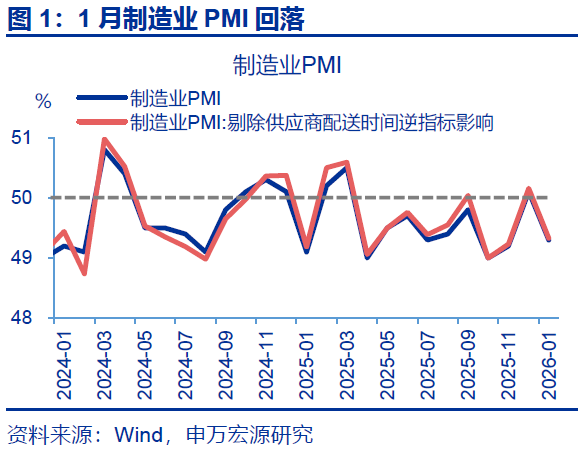
Core Viewpoint - The significant decline in January PMI is attributed to the early return of workers for the Spring Festival and weak domestic demand, with manufacturing PMI dropping to 49.3% from 50.1% and non-manufacturing PMI falling to 49.4% from 50.2% [1][6][7] Group 1: Manufacturing PMI Analysis - The manufacturing PMI fell below the growth threshold, decreasing by 0.8 percentage points to 49.3%, influenced by statistical factors and the early return of workers for the Spring Festival [1][7] - The production index decreased by 1.1 percentage points to 50.6%, while the new orders index fell by 1.6 percentage points to 49.2%, indicating a decline in manufacturing activity [4][38] - The purchasing index dropped significantly by 2.4 percentage points to 48.7%, reflecting a weaker supply side due to the early return of workers [2][16] Group 2: Sector-Specific Insights - Labor-intensive sectors such as consumer goods and high-energy industries experienced a more pronounced decline in PMI, with consumer goods PMI down 2.1 percentage points to 48.3% and high-energy PMI down 1 percentage point to 47.9% [2][22] - In contrast, capital-intensive sectors like high-tech and equipment manufacturing saw smaller declines, with PMIs of 52% and 50.1%, respectively, remaining above the growth threshold [2][22] Group 3: Non-Manufacturing PMI Insights - The non-manufacturing PMI also showed a decline, dropping by 0.8 percentage points to 49.4%, primarily due to a significant decrease in the construction sector, which fell by 4 percentage points to 48.8% [4][43] - The service sector PMI remained relatively resilient, only decreasing by 0.2 percentage points to 49.5%, with certain areas like railway transport showing strong performance [3][25] Group 4: Economic Outlook - The early Spring Festival may distort PMI readings for January and February, but the overall economic recovery trend is expected to continue, supported by consumer demand and service sector policies [3][32] - Despite short-term weaknesses in manufacturing and construction, the average PMI over the next two months is anticipated to reflect ongoing economic recovery [3][32]
数据点评 | 1月PMI:春节效应前置(申万宏观·赵伟团队)
赵伟宏观探索· 2026-01-31 16:03
Core Viewpoint - The significant decline in January PMI is primarily attributed to the early return of workers for the 2026 Spring Festival and weak domestic demand, with manufacturing PMI dropping to 49.3% from 50.1% and non-manufacturing PMI falling to 49.4% from 50.2% [2][8][61] Group 1: Manufacturing PMI Analysis - The manufacturing PMI fell below the neutral line, decreasing by 0.8 percentage points to 49.3%, influenced by statistical factors and the early return of workers [2][8][61] - The manufacturing production index declined by 1.1 percentage points to 50.6%, while the new orders index decreased by 1.6 percentage points to 49.2% [5][41] - The purchasing index for manufacturing dropped significantly by 2.4 percentage points to 48.7%, indicating a notable contraction in supply [3][15][62] Group 2: Sector-Specific Insights - Labor-intensive sectors such as consumer goods and high-energy industries experienced a more pronounced decline in PMI, with consumer goods PMI falling by 2.1 percentage points to 48.3% and high-energy PMI down by 1 percentage point to 47.9% [3][22][62] - In contrast, capital-intensive sectors like high-tech and equipment manufacturing saw smaller declines, with PMIs of 52% and 50.1%, respectively [3][22][62] Group 3: Non-Manufacturing PMI Insights - The non-manufacturing PMI showed asymmetric characteristics, with the construction PMI dropping to 48.8%, a decline of 4 percentage points, while the service sector PMI only slightly decreased by 0.2 percentage points to 49.5% [4][25][62] - The construction sector's decline is more significant than historical averages, indicating a substantial impact from the early return of workers [4][25][62] Group 4: Economic Outlook - The early Spring Festival may disrupt PMI readings for January and February, but the overall economic outlook remains positive, with expectations of recovery in the coming months [4][34][63] - Recent trends in service consumption and travel during the Spring Festival are expected to support service sector growth, highlighting the importance of monitoring consumer demand [4][34][63]
中采PMI点评(26.01):1月PMI:春节效应前置
Shenwan Hongyuan Securities· 2026-01-31 15:24
Group 1: PMI Data Overview - January manufacturing PMI decreased to 49.3%, down 0.8 percentage points from December's 50.1%[1] - Non-manufacturing PMI fell to 49.4%, a decline of 0.8 percentage points from the previous month's 50.2%[1] Group 2: Factors Influencing PMI Changes - The significant drop in January PMI is attributed to the early return of workers for the Spring Festival and weak domestic demand[2] - The national migration scale index increased from 4% to approximately 8.6% year-on-year, indicating an earlier return home[2] Group 3: Sector-Specific Insights - Labor-intensive sectors, such as consumer goods and high-energy industries, saw larger PMI declines of 2.1 and 1 percentage points, respectively, to 48.3% and 47.9%[3] - The construction sector's PMI dropped 4 percentage points to 48.8%, while service sector PMI remained relatively stable at 49.5%, down only 0.2 percentage points[3] Group 4: Future Economic Outlook - Despite short-term weaknesses in manufacturing and construction due to the Spring Festival, the overall economic recovery trend is expected to continue in the coming months[4] - Service sector expectations may improve due to increased travel and holiday consumption, supported by recent policy measures[4]