
有色金属

Search documents
英大证券晨会纪要-20260212
British Securities· 2026-02-12 02:50
Group 1 - The core viewpoint of the report indicates that the A-share market is currently in a phase of consolidation with expectations for a positive post-holiday market driven by liquidity improvements and policy expectations [3][10] - The report highlights that the market is experiencing cautious sentiment ahead of the holiday, with a notable focus on cyclical stocks such as chemicals and non-ferrous metals, which have shown strength [5][9] - It is noted that the trading volume has been around 2 trillion yuan, reflecting a prevailing wait-and-see attitude among investors, indicating that there is still uncertainty in the market [3][10] Group 2 - The report emphasizes that post-holiday, there is an expectation for increased liquidity and potential policy benefits from upcoming important meetings, which could stimulate investment opportunities in related sectors [3][10] - Specific sectors such as solid-state batteries, chemicals, and non-ferrous metals are identified as key areas to watch for potential growth, particularly as economic recovery signals strengthen [7][9] - The report advises investors to adopt a strategy of buying on dips rather than chasing high prices, suggesting a focus on small-cap growth stocks and sectors with clear industrial catalysts [3][10]
早盘直击|今日行情关注
申万宏源证券上海北京西路营业部· 2026-02-12 02:43
Group 1 - The market is expected to maintain a narrow range of fluctuations before the Spring Festival holiday, with investors adopting a cautious attitude due to concerns over potential volatility in overseas markets during the A-share market's closure [1] - The change in market style is noteworthy, with the Dow Jones index significantly outperforming the Nasdaq index amid fears that the new Federal Reserve Chairman's policies may negatively impact overvalued tech stocks [1] - The ongoing price increases in consumer goods and industrial products are highlighted, with multiple chemical products and non-ferrous metals continuing to rise, indicating a potential phase shift in market style favoring cyclical sectors benefiting from price hikes [1] Group 2 - The market has entered a holiday effect phase, with investors preferring to remain on the sidelines to avoid uncertainties during the long holiday, as evidenced by trading volumes dropping below 20 trillion [2] - The short-term outlook suggests that the index will continue to experience narrow fluctuations, with a favorable environment for cyclical sectors benefiting from price increases [2]


万联晨会-20260212
Wanlian Securities· 2026-02-12 02:39
Core Insights - The A-share market showed a narrow consolidation with the Shanghai Composite Index rising by 0.09% to 4,131.98 points, while the Shenzhen Component Index fell by 0.35% and the ChiNext Index dropped by 1.08% [2][9] - The total trading volume in the A-share market was approximately 1.98 trillion RMB, with nearly 2,000 stocks rising [2][9] - In terms of industry performance, the construction materials and non-ferrous metals sectors led the gains, while the telecommunications sector lagged behind [2][9] Economic Indicators - In January 2026, the Consumer Price Index (CPI) increased by 0.2% year-on-year, with urban prices rising by 0.2% and rural prices by 0.1% [3][11] - The Producer Price Index (PPI) for industrial producers decreased by 1.4% year-on-year, with the decline narrowing by 0.5 percentage points from the previous month, while month-on-month, it increased by 0.4% [4][11] Earnings Forecasts - As of February 9, 2026, 2,976 A-share companies had disclosed their annual earnings forecasts, with a disclosure rate of 54.32%. Among these, 1,106 companies (37.16%) issued positive earnings forecasts [12][15] - The stable sector had the highest proportion of positive forecasts at 57.58%, followed by the cyclical sector at 42.55%, while the consumer sector had the lowest at 30.81% [12][15] - Five industries had a positive forecast rate exceeding 50%, with notable improvements in the defense, automotive, and beauty care sectors [13][15] Investment Recommendations - The report suggests focusing on sectors with improving profit growth, including upstream non-ferrous metals and basic chemicals, midstream machinery and electrical industries, and TMT sectors [15] - The overall profitability of A-share companies is expected to continue recovering, with the highest positive forecast rates in non-bank financials, non-ferrous metals, and automotive industries [15]
不锈钢:二月检修减产频出,成本支撑重心上移:镍:印尼消息扰动再现,关注投机属性风险
Guo Tai Jun An Qi Huo· 2026-02-12 02:27
1. Report Industry Investment Rating - No information provided in the report 2. Core Viewpoints - The report focuses on the nickel and stainless - steel markets. For nickel, there are new disturbances from Indonesia, and attention should be paid to speculative risks. For stainless steel, there are frequent maintenance and production cuts in February, and the cost support center has shifted upward [1] 3. Summary by Directory 3.1 Fundamental Tracking - **Futures Data**: The closing price of the Shanghai Nickel main contract is 139,360, with a change of 6,010 compared to T - 1. The closing price of the stainless - steel main contract is 14,040, with a change of 300 compared to T - 1. The trading volume of the Shanghai Nickel main contract is 518,625, and that of the stainless - steel main contract is 263,049 [1] - **Industrial Chain Data**: The price of 1 imported nickel is 137,750, with a change of 3,750 compared to T - 1. The price of 8 - 12% high - nickel pig iron (ex - factory price) is 1,043, with a change of 2 compared to T - 1. The price of 304/2B roll - rough edge (Wuxi) is 14,100, with no change compared to T - 1 [1] 3.2 Macro and Industry News - Indonesia has suspended issuing new smelting licenses through the OSS platform for projects producing "restricted products" such as Nickel matte, MHP, FeNi, and NPI [1] - The Indonesian government will revise the benchmark price formula for nickel ore products in early 2026, and will start treating cobalt as an independent commodity and levy royalties [2] - Some Indonesian enterprises face potential fines of about 80.2 trillion Indonesian rupiah for illegal occupation of forest land, and are negotiating with the government [2] - The KPPU found monopoly behavior in the port warehousing and logistics of the IMIP park in Indonesia, and the park is negotiating with the KPPU [3] - The Indonesian Energy and Mineral Resources Ministry has started approving the 2026 mining work plan and budget (RKAB) [3] - The Solway Investment Group plans to restart its nickel mine business in Guatemala in a few months [3] - The approved nickel ore production quota in 2026 is between 2.6 billion and 2.7 billion tons, and PT WBN has received a preliminary notice to submit a RKAB [4] 3.3 Trend Intensity - The trend intensity of nickel is 0, and that of stainless steel is 0. The trend intensity ranges from - 2 to 2, with - 2 being the most bearish and 2 being the most bullish [5]
涨超1.3%,有色金属ETF基金(516650)近23个交易日净流入68.45亿元
Sou Hu Cai Jing· 2026-02-12 02:16
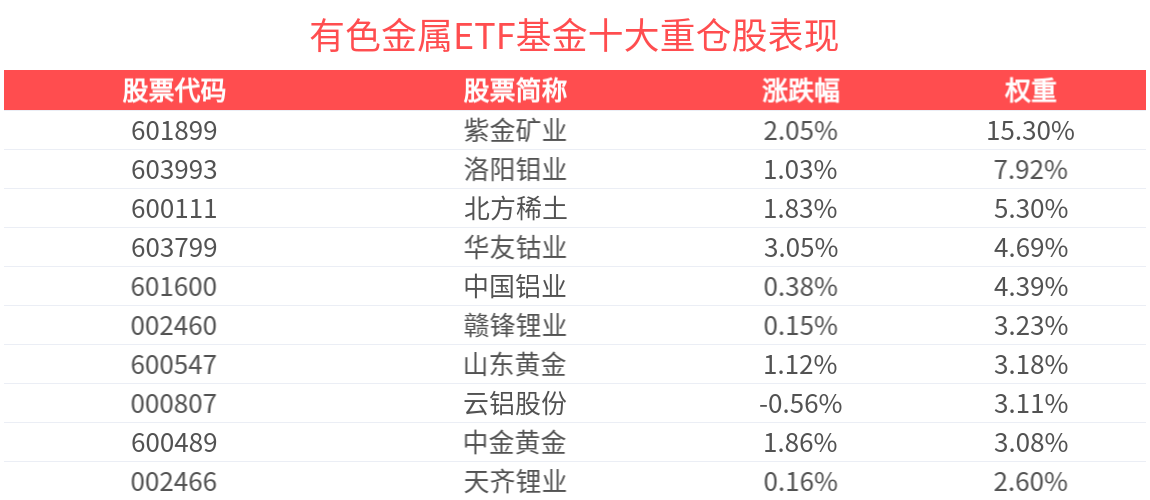
Group 1 - The core viewpoint of the news highlights the strong performance of the non-ferrous metal sector, with the non-ferrous metal ETF fund (516650) rising by 1.36% and significant gains in individual stocks such as BaoTi Co., Ltd. (5.97%) and Shenghe Resources (5.87%) [1] - The non-ferrous metal ETF fund has seen a net inflow of funds for 15 out of the last 23 trading days, totaling 6.845 billion yuan, indicating a strong interest from leveraged funds [1] - Market analysts suggest that while there is a recovery in bullish sentiment, macroeconomic uncertainties remain, particularly influenced by U.S. economic data and policy expectations [1] Group 2 - The non-ferrous metal ETF fund closely tracks the CSI sub-index for the non-ferrous metal industry, with the top ten weighted stocks accounting for 51.85% of the index as of January 30, 2026 [2] - The top ten weighted stocks in the non-ferrous metal index include Zijin Mining, Luoyang Molybdenum, Northern Rare Earth, and others, indicating a diversified portfolio within the sector [2] - The performance of individual stocks within the index shows varying degrees of increase, with Zijin Mining at 2.05% and Huayou Cobalt at 3.05%, reflecting the overall positive trend in the sector [3]





有色ETF鹏华(159880)涨近1.4%,有色金属中长期逻辑依然坚实
Xin Lang Cai Jing· 2026-02-12 02:13
Group 1 - The overall prices of non-ferrous metals are rising, with COMEX gold futures up 1.53% at $5107.8 per ounce and COMEX silver futures up 4.6% at $84.085 per ounce [1] - LME metal futures closed higher, with LME copper rising by $58 to $13166 per ton, LME aluminum up $10 to $3103 per ton, LME zinc up $12 to $3406 per ton, LME lead up $18 to $1993 per ton, LME nickel up $390 to $17880 per ton, and LME tin up $352 to $49635 per ton [1] - CITIC Securities indicates that since 2026, the investment enthusiasm for commodities has been increasing, and despite fluctuations in precious metal prices, commodities are expected to remain a preferred investment direction in 2026 due to factors like risk aversion and fundamental improvements [1] Group 2 - As of February 12, 2026, the National Securities Non-Ferrous Metal Industry Index (399395) rose by 1.65%, with stocks like Shengtun Mining up 8.96% and Zhongtung High-tech up 6.84% [2] - The Non-Ferrous Metal ETF Penghua (159880) increased by 1.39%, marking its fifth consecutive rise, with the latest price at 2.33 yuan [2] - The top ten weighted stocks in the National Securities Non-Ferrous Metal Industry Index account for 49.87% of the index, including Zijin Mining, Luoyang Molybdenum, and Northern Rare Earth [2]
铜冠金源期货商品日报-20260212
Tong Guan Jin Yuan Qi Huo· 2026-02-12 02:09
Report Industry Investment Rating No relevant content provided. Core Viewpoints of the Report - The US January non - farm payrolls were better than expected, with the A - share market continuing its volume - shrinking repair. The employment market shows a divergence between "strong single - month performance" and "slowing medium - term momentum". The market's interest - rate cut expectations have been postponed, and the market is expected to be dominated by shock repair in the short term, with structural opportunities prevailing [2][3]. - Precious metals rebounded despite the better - than - expected US non - farm employment data. The market was more sensitive to the poor 2025 employment data after revision. Short - term precious metal prices may show a wide - range shock trend [4][5]. - Copper prices are running strongly. The strong non - farm data and concerns about policy intervention are expected to drive the metal market to rise in the medium term. The supply of copper concentrates is growing at a low rate, and copper prices are expected to remain in a high - level shock in the short term [6][7]. - Aluminum prices are under pressure and fluctuating. The strong US employment data supports the Fed to postpone interest - rate cuts, increasing the upward pressure on metals. The supply of aluminum ingots is increasing, and aluminum prices are expected to fluctuate within a narrow range [8][9]. - Alumina is currently in a short - term stable shock, but there is still significant upward pressure in the long term [10]. - Cast aluminum is in a range - bound shock due to the light supply - demand situation and the impact of macro - level employment data on interest - rate cut expectations [11]. - Zinc prices are under pressure and fluctuating. The strong non - farm report has postponed the market's interest - rate cut expectations, and the fundamentals are under pressure. Zinc prices are expected to remain under pressure before the holiday [12]. - Lead prices are in a low - level shock due to the weak supply and demand on both sides of the lead market [13][14]. - Tin prices are in a weak rebound, and the upward space is limited. The market has reduced bets on Fed interest - rate cuts, and the spot market is weak. The price is expected to be affected by the 20 - day moving average resistance [15]. - Steel prices are in a weak shock before the holiday. The steel market shows a situation of weak supply and demand, and it is expected to be mainly in a shock in the short term [16]. - Iron ore prices are in a shock trend. The supply and demand are both weak, and the impact of post - holiday steel mill resumption on demand needs to be observed [17]. - Coking coal and coke prices are in a shock trend. The spot market is weakly stable, the supply of coking coal is shrinking, and the production of coking enterprises is restricted [18][19]. - Bean and rapeseed meal prices are rising in a shock. Brazil's soybean exports are at a high level in the same period, and the import cost increase supports the shock rise of domestic bean meal. It is expected to be in an overall shock operation in the short term [20]. - Palm oil prices are falling in a shock. The production of Malaysian palm oil has declined month - on - month, and the inventory reduction in February is expected to weaken the price support. Palm oil is expected to fall in a shock in the short term [21][22]. Summary by Relevant Catalogs 1. Metal Main Varieties Yesterday's Trading Data - **Copper**: SHFE copper closed at 102180 yuan/ton, up 0.61%; LME copper closed at 13239 dollars/ton, up 1.06% [23]. - **Aluminum**: SHFE aluminum closed at 23660 yuan/ton, up 0.62%; LME aluminum closed at 3117 dollars/ton, up 0.39% [23]. - **Alumina**: SHFE alumina closed at 2842 yuan/ton, up 0.25% [23]. - **Zinc**: SHFE zinc closed at 24585 yuan/ton, up 0.53%; LME zinc closed at 3418 dollars/ton, up 0.59% [23]. - **Lead**: SHFE lead closed at 16740 yuan/ton, up 0.45%; LME lead closed at 1995 dollars/ton, up 0.86% [23]. - **Nickel**: SHFE nickel closed at 139360 yuan/ton, up 4.51%; LME nickel closed at 18065 dollars/ton, up 2.93% [23]. - **Tin**: SHFE tin closed at 394700 yuan/ton, up 3.32%; LME tin closed at 50065 dollars/ton, up 1.70% [23]. - **Gold**: COMEX gold closed at 5107.80 dollars/ounce, up 1.19% [23]. - **Silver**: SHFE silver closed at 20944.00 yuan/kilogram, up 3.25%; COMEX silver closed at 84.09 dollars/ounce, up 4.35% [23]. - **Steel**: SHFE rebar closed at 3054 yuan/ton, up 0.07%; SHFE hot - rolled coil closed at 3228 yuan/ton, up 0.25% [23]. - **Iron Ore**: DCE iron ore closed at 762.5 yuan/ton, up 0.13% [23]. - **Coking Coal and Coke**: DCE coking coal closed at 1123.5 yuan/ton, up 0.40%; DCE coke closed at 1667.0 yuan/ton, up 0.12% [23]. - **Industrial Silicon**: GFEX industrial silicon closed at 8370.0 yuan/ton, down 0.06% [23]. - **Soybean and Meal**: CBOT soybean closed at 1123.5 yuan/ton, up 0.02%; DCE bean meal closed at 2773.0 yuan/ton, up 1.43%; CZCE rapeseed meal closed at 2288.0 yuan/ton, up 1.96% [23]. 2. Industrial Data Perspective - **Copper**: On February 11, SHFE copper main contract was 102180 yuan/ton, up 620 yuan from the previous day; LME copper 3 - month contract was 13239 dollars/ton, up 139 dollars. LME inventory increased by 3000 tons to 192100 tons [24]. - **Nickel**: SHFE nickel main contract was 139360 yuan/ton, up 6010 yuan; LME nickel 3 - month contract was 18065 dollars/ton, up 515 dollars. SHFE nickel warehouse receipts decreased by 12 tons to 52027 tons [24]. - **Zinc**: SHFE zinc main contract was 24585 yuan/ton, up 130 yuan; LME zinc was 3418 dollars/ton, up 20 dollars. SHFE zinc warehouse receipts increased by 8100 tons to 42335 tons [27]. - **Lead**: SHFE lead main contract was 16740 yuan/ton, up 75 yuan; LME lead was 1994.5 dollars/ton, up 17 dollars. LME lead inventory increased by 200 tons to 232950 tons [27]. - **Aluminum**: SHFE aluminum continuous - three contract was 23795 yuan/ton, up 135 yuan; LME aluminum 3 - month contract was 3117 dollars/ton, up 12 dollars. SHFE aluminum warehouse receipts increased by 1050 tons to 167566 tons [27]. - **Alumina**: SHFE alumina main contract was 2842 yuan/ton, up 7 yuan; the national alumina spot average price was 2646 yuan/ton, unchanged. SHFE alumina warehouse increased by 11721 tons to 262731 tons [27]. - **Tin**: SHFE tin main contract was 394700 yuan/ton, up 12700 yuan; LME tin was 50065 dollars/ton, up 835 dollars. SHFE tin warehouse receipts increased by 131 tons to 6516 tons [27]. - **Precious Metals**: SHFE gold was 1130.4 yuan, unchanged; COMEX gold was 5098.50 dollars/ounce, unchanged. SHFE silver was 20944.00 yuan/kilogram, unchanged; COMEX silver was 83.920 dollars/ounce, unchanged [27]. - **Steel and Iron Ore**: SHFE rebar main contract was 3054 yuan/ton, up 2 yuan; DCE iron ore main contract was 762.5 yuan/ton, up 1.0 yuan [29]. - **Coking Coal and Coke**: DCE coking coal main contract was 1123.5 yuan/ton, up 4.5 yuan; DCE coke main contract was 1667.0 yuan/ton, up 2.0 yuan [29]. - **Lithium and Industrial Silicon**: The lithium carbonate main contract was 14.69, up 1.10; the industrial silicon main contract was 8370 yuan/ton, down 5.00 yuan [29]. - **Soybean and Meal**: CBOT soybean main contract was 1123.5, up 0.25; DCE bean meal main contract was 2773, up 39; CZCE rapeseed meal main contract was 2288, up 44 [29].
资源博弈与科技革命加速格局重塑,战略资源价值攀升
Zhong Guo Neng Yuan Wang· 2026-02-12 02:08
Group 1 - The core viewpoint of the report indicates that the non-ferrous metal smelting and rolling processing industry achieved a cumulative revenue of 97,733.9 billion yuan in 2025, reflecting a year-on-year increase of 14%, with total profits rising by 22% year-on-year, driven by rising metal prices [1][3] - The report highlights that the mining and selection industry saw the largest profit increase, while the profit growth in smelting and rolling processing was contrary to the decline in actual processing fees, mainly due to some smelting companies owning their own mines [1][3] Group 2 - In 2025, the prices of major non-ferrous metals were influenced by tariffs, expectations of interest rate cuts by the Federal Reserve, and geopolitical factors, leading to a general increase in prices, except for lead and medium-heavy rare earths [2] - Precious metals experienced the highest price increases, with gains exceeding 100%, while small metals saw an approximate increase of 78%, and industrial metals rose by around 30% [2] - Specific price increases included tungsten rising by 343%, COMEX gold and silver increasing by 81% and 178% respectively, copper and tin rising by 51% and 67%, and neodymium oxide increasing by 97%, while dysprosium oxide saw a significant decline [2] Group 3 - The performance of the non-ferrous metal industry in 2025 reflected the price trends, with the mining and selection industry achieving a cumulative revenue of 4,247.4 billion yuan, a year-on-year increase of 12.7%, and operating profits of 1,248.7 billion yuan, up 36.1% [3] - The report indicates that the profit growth in the non-ferrous metal sector is consistent with the price trends, with the overall profit of the Shenwan non-ferrous sector increasing by 72%, and net profits for precious metals, industrial metals, and small metals rising by 94%, 68%, and 77% respectively [3] - The report also notes that the rare earth, lithium, nickel, gold, and copper sectors saw significant profit increases, while some new material profits declined by 17% [3]
工业有色ETF鹏华(159162)涨超1.2%,工业金属价格集体上涨
Xin Lang Cai Jing· 2026-02-12 02:03
Group 1 - LME metal futures closed higher, with LME copper rising by $58 to $13,166 per ton, LME aluminum up by $10 to $3,103 per ton, LME zinc increasing by $12 to $3,406 per ton, LME lead gaining $18 to $1,993 per ton, LME nickel up by $390 to $17,880 per ton, and LME tin rising by $352 to $49,635 per ton [1] - Ping An Securities analysis indicates that the domestic aluminum ingot long-term market in 2026 will exhibit characteristics of "stable prices with adjustments, declining signing willingness, and a tight supply-demand pattern," with a positive long-term outlook for aluminum prices supported by macro sentiment recovery and fundamental strengthening [1] - As of February 12, 2026, the CSI Industrial Nonferrous Metals Theme Index (H11059) surged by 1.18%, with component stocks such as Tungsten High-tech up by 6.70%, Dongyangguang up by 3.97%, and Huayou Cobalt up by 3.75%, while other stocks like Western Mining and Tongling Nonferrous also saw gains [1] Group 2 - As of January 30, 2026, the top ten weighted stocks in the CSI Industrial Nonferrous Metals Theme Index (H11059) include Luoyang Molybdenum, Northern Rare Earth, China Aluminum, Xinyi Silver Tin, Yun Aluminum, Tongling Nonferrous, Jiangxi Copper, Xiamen Tungsten, Zhongjin Gold, and Western Mining, collectively accounting for 55.71% of the index [2]



上海实施先进制造业转型升级三年行动方案
Ke Ji Ri Bao· 2026-02-12 02:01
Core Viewpoint - The "Three-Year Action Plan for Supporting the Transformation and Upgrading of Advanced Manufacturing in Shanghai (2026-2028)" aims to accelerate the establishment of a modern industrial system centered on advanced manufacturing, promoting green and intelligent transformation across various enterprises in Shanghai [1][2]. Group 1: Action Plan Overview - The action plan includes four major actions and 17 measures to enhance the development of advanced manufacturing [1]. - By 2028, Shanghai aims to add 100 manufacturing enterprises with an annual output value exceeding 1 billion yuan and increase the number of large-scale industrial enterprises in the supply chain by 500 [1]. Group 2: Industry Development Paths - The plan outlines three development paths: - For traditional advantageous industries, it emphasizes "optimization and enhancement" [1]. - For leading industries, it promotes "strategic guidance" [1]. - For key and emerging industries, it focuses on "expansion and development" [1]. Group 3: Innovation and Resource Support - The action plan supports enterprises in high-level R&D and high-value product transformation, addressing industry pain points and overcoming key core technologies [2]. - It encourages full-process upgrades, AI integration in manufacturing, and carbon footprint management to achieve quality and efficiency improvements [2]. Group 4: Financial Incentives - The plan provides substantial financial support for R&D, including: - A one-time subsidy of 10 million yuan for enterprises with annual R&D expenditures of 100 million yuan or more [2]. - A one-time subsidy of 5 million yuan for those spending between 50 million and 100 million yuan [2]. - A one-time subsidy of 2 million yuan for R&D expenditures between 1 million and 5 million yuan [2]. Group 5: Additional Financial Support Measures - The plan includes subsidies for fixed asset investment loans related to technology upgrades, with a maximum of 20 million yuan [3]. - Companies upgrading energy-saving processes and equipment can receive rewards based on coal consumption, up to 10 million yuan [3]. - A one-time reward of 200,000 yuan is available for enterprises recognized as national green factories [3].