
玻璃

Search documents
水泥出海再提速,继续推荐非洲龙头
Tianfeng Securities· 2025-06-30 07:11
Investment Rating - Industry Rating: Outperform the market (maintained rating) [5] Core Views - The cement industry is accelerating its overseas expansion, particularly in Africa, which is seen as a significant investment opportunity due to its rapid population growth and urbanization [3][20] - The recent performance of the construction materials sector shows a positive trend, with the CITIC construction materials index rising by 2.63% [12] - The report highlights the importance of monetary policy in supporting economic recovery, emphasizing a coordinated approach between monetary and fiscal policies [2][14] Summary by Sections Market Review - The Shanghai and Shenzhen 300 index increased by 1.95%, while the construction materials sector rose by 2.63% [12] - Notable stock performances include Saitex New Materials (+27.0%) and Guotong Shares (+14.2%) [12] Cement Industry Expansion - Recent data shows a decline in property sales in major cities, with a year-on-year decrease of 10.14% [2][15] - Companies like Western Cement and Huaxin Cement are making significant moves in Africa, with Western Cement planning to sell assets in Xinjiang to support its expansion [3][20] - Huaxin Cement's new project in Zambia has successfully increased production capacity, indicating a trend of overseas investment in the cement sector [3] Key Recommendations - The report recommends a focus on companies such as China National Materials, Honghe Technology, Western Cement, Huaxin Cement, and others, which are expected to benefit from the ongoing market dynamics [20][4] - The report suggests that traditional building materials are nearing a cyclical bottom, while new materials are expected to continue their growth trajectory [21]

实际供需矛盾不突出 玻璃中长线维持逢高空思维
Jin Tou Wang· 2025-06-30 06:59
瑞达期货(002961)分析称,宏观面:财政部:国家发改委:第三批消费品以旧换新资金将于7月下 达。玻璃方面,供应端:玻璃产线冷修增加一条,整体产量小幅下滑,维持在底部,刚需生产迹象明 显。行业整体利润不佳,继续下滑,后续复产力度恐继续下行。需求端当前地产形势不容乐观,5月房 地产数据显示下滑明显,需求预计进一步走弱。下游深加工订单下滑,采购以刚需为主,汽车玻璃厂备 货量增加难以抵消地产相关需求疲软,光伏玻璃需求也面临库存压力。基差维持正常范围,后续市场交 易更多是政策预期,预计反弹高度和力度将较为有限操作上短线建议逢低多,中长线依旧维持逢高空思 维。 华联期货指出,上周1条产线放水,2条前期点火产线陆续出玻璃,以及前期热修产线恢复,周熔量环比 略有减少,后续仍有产线点火,日熔量将低位回升。厂家库存环比小幅去库,其中华北地区去库较明 显,华东地区也有小幅去库,其它地区均小幅累库。短期玻璃估值相对偏低驱动反弹,不过淡季需求改 善有限,库存仍处同期高位,弱现实令玻璃价格持续承压,预计短期震荡偏强。操作上,建议维持反弹 做空思路,或卖出虚值看涨期权。 西南期货表示,多数深加工企业仍然刚需维持,实际供需矛盾不突出,市 ...
《特殊商品》日报-20250630
Guang Fa Qi Huo· 2025-06-30 05:41
Report Industry Investment Ratings No relevant information provided. Core Views Natural Rubber - Short - term rubber prices rebound due to market sentiment, but with supply increasing and demand weakening, prices are expected to remain weak. Hold short positions above 14,000 yuan/ton and monitor raw material supply in each production area and macro - event disturbances [1]. Industrial Silicon - The short - term price of industrial silicon futures rises supported by demand recovery and production cuts, but the medium - to - long - term fundamentals have not improved. Technically, the price is still strong [3]. Polysilicon - The current contradiction in the polysilicon market is the mismatch between weak demand and复产 expectations. In July, demand is likely to remain weak. If production resumes, prices will be under pressure; if significant production cuts are implemented, prices may stabilize and rebound [4]. Glass and Soda Ash - For soda ash, there is a short - term boost, but the medium - term is under pressure. Wait for trading opportunities after the sentiment fades. For glass, it is in the off - season, facing over - supply pressure, and the 09 contract is expected to oscillate between 950 - 1050 [6]. Logs - The log market is entering a supply - and - demand dual - weak pattern. The 07 contract is strong due to the first - delivery cost game, and short - term oscillation is expected [8]. Summary by Directory Natural Rubber Spot Price and Basis - Yunnan state - owned full - latex (SCRWF) in Shanghai rose 250 yuan/ton to 14,100 yuan/ton on June 27, a 1.81% increase [1]. - The full - latex basis switched to the 2509 contract rose 128.95% [1]. Monthly Spread - The 9 - 1 spread rose 20 yuan/ton to - 825 yuan/ton, a 2.37% increase [1]. Fundamental Data - Thailand's production in April decreased by 43.5 thousand tons to 105.7 thousand tons, a 29.16% decline [1]. - China's natural rubber import volume in May decreased by 6.98 tons to 45.34 tons, a 13.35% decline [1]. Inventory Change - The bonded - area inventory increased by 1,410 tons to 606,975 tons, a 0.23% increase [1]. Industrial Silicon Spot Price and Basis - The price of East China oxygen - passed S15530 industrial silicon rose 100 yuan/ton to 8,300 yuan/ton on June 27, a 1.22% increase [3]. Monthly Spread - The 2509 - 2510 spread rose 20 yuan/ton to 30 yuan/ton, a 133.33% increase [3]. Fundamental Data - The national industrial silicon production in May increased by 0.69 tons to 30.77 tons, a 2.29% increase [3]. Inventory Change - The Xinjiang factory - warehouse inventory decreased by 0.29 tons to 17.29 tons, a 1.65% decline [3]. Polysilicon Spot Price and Basis - The average price of N - type re - feed material remained at 34,500 yuan/ton on June 27 [4]. Futures Price and Monthly Spread - The PS2506 contract rose 1,600 yuan/ton to 33,315 yuan/ton, a 5.04% increase [4]. Fundamental Data - The polysilicon production in May increased by 0.07 tons to 9.61 tons, a 0.73% increase [4]. Inventory Change - The polysilicon inventory increased by 0.8 tons to 27 tons, a 3.05% increase [4]. Glass and Soda Ash Glass - related Price and Spread - The North China glass quotation remained at 1,140 yuan/ton [6]. Soda Ash - related Price and Spread - The North China soda ash quotation remained at 1,350 yuan/ton [6]. Supply - The soda ash production rate decreased by 5.04% to 82.21% [6]. Inventory - The glass factory - warehouse inventory decreased by 67.1 tons to 6,921.6 tons, a 0.96% decline [6]. Real Estate Data - The new construction area increased by 2.99% to - 18.73% [6]. Logs Futures and Spot Price - The log 2509 contract decreased by 2.5 yuan/cubic meter to 791 yuan/cubic meter, a 0.32% decline [8]. Cost - The RMB - US dollar exchange rate rose 0.01 to 7.168 [8]. Supply and Demand - The number of ships at the port decreased by 5 to 58, a 7.94% decline [8]. Inventory - The national coniferous log inventory decreased by 100,000 cubic meters to 3.35 million cubic meters as of June 20 [8].
国泰君安期货所长早读-20250630
Guo Tai Jun An Qi Huo· 2025-06-30 04:01
Report Industry Investment Rating No relevant content provided. Core Viewpoints of the Report - The central bank's second - quarter monetary policy committee meeting removed "opportunistically cut reserve requirements and interest rates" and made changes in policy tone, monetary policy thinking, and exchange - rate statements [6]. - Copper prices are expected to remain firm due to the resonance of micro and macro factors. It is recommended to pay attention to internal - external reverse arbitrage and hold domestic copper term positive arbitrage [7][8]. - Glass is in a short - term shock market, with limited short - term upside and caution needed for short - selling at low levels [9]. Summary by Related Catalogs Central Bank Policy - The central bank's second - quarter monetary policy committee meeting removed "combine the implementation of the strategy of expanding domestic demand with deepening supply - side structural reform" and added "put strengthening the domestic large - cycle in a more prominent position and coordinate the relationship between total supply and total demand". It also removed "opportunistically cut reserve requirements and interest rates" and added "flexibly grasp the intensity and rhythm of policy implementation". The exchange - rate statement was also adjusted [6]. Copper - The price of copper has risen due to the resonance of micro and macro factors. The spot is tight, with low domestic and rapidly falling LME inventories and continuous spot premiums. The overseas logic has a more obvious pulling effect on prices. It is expected that the price will remain firm, and it is recommended to pay attention to internal - external reverse arbitrage and hold domestic copper term positive arbitrage [7][8]. Glass - Glass has been in a downward trend in the first half of the year due to weak real - estate demand, insufficient supply contraction, high factory inventories, and large warrant pressures. After reaching a low - valuation level in early June, it rebounded. Currently, it is in a shock market, with limited short - term upside and caution needed for short - selling at low levels [9]. Other Commodities - For other commodities such as zinc, lead, nickel, etc., the report provides their price trends, fundamental data, and trend intensities. For example, zinc is at a short - term high, and attention should be paid to volume and price; lead has support from peak - season expectations [12][15][18].
从钢铁行业看中国价格复苏近在咫尺
2025-06-30 01:02
从钢铁行业看中国价格复苏近在咫尺 20250627 摘要 明整个链条最脆弱环节已经触底。 Q&A 如何看待中国工业价格的复苏及其背后的供需关系? 中国工业价格的复苏主要受供需关系变化驱动。过去几年,工业价格持续下行, 约束了供给,导致资本开支周期达到历史底部。部分行业逐渐走出供给过剩状 态,进入再资本开支过程。然而,中国大规模资本开支的可能性较小,因为脱 离债务周期的经济无法支持大规模投资。因此,企业在微观层面表现出谨慎态 度。从中下游制造业来看,其价格企稳和利润改善反映了供给约束带来的积极 影响。上游原材料板块则持续去库存,上游价格跌不动,这表明整个工业链条 正在见底。 钢铁行业在当前经济周期中的表现如何? 钢铁行业经历了十年的产能收缩,目前已达到供需稳态。尽管建筑需求下降, 但钢铁行业通过减少投资实现了平衡。在经济周期底部时,钢铁价格不再下跌, 而利润却在不断上升。这反映出供给约束带来的利润修复,以及需求回落对钢 铁行业的影响有限。此外,贸易企业普遍持有现金而非库存,这进一步说明社 会库存处于低位。当上游原材料如煤炭和焦煤开始减产且价格跌不动时,这表 如何判断中国工业整体是否已经见底? 从中下游制造业到上 ...
行业周报:房地产市场政策不断加码,关注建材投资机会-20250629
KAIYUAN SECURITIES· 2025-06-29 09:05
Investment Rating - The investment rating for the building materials industry is "Positive" (maintained) [1] Core Viewpoints - The report highlights that the real estate market policies are continuously tightening, creating investment opportunities in building materials. Recent policies from the central bank and local governments aim to support home purchases and improve safety in construction sites, indicating a shift towards a balanced supply-demand dynamic in the real estate market [3][4] - Recommended stocks in the consumer building materials sector include Sankeshu (channel penetration and retail expansion), Dongfang Yuhong (waterproof leader with optimized operational structure), Weixing New Materials (high-quality operations with a significant retail business), and Jianlang Wujin. Beneficiary stocks include Beixin Building Materials (gypsum board leader with diversified expansion in coatings and waterproof sectors) [3] - The report also notes that the National Development and Reform Commission has issued a plan for energy conservation and carbon reduction in the cement industry, aiming to control cement clinker capacity to around 1.8 billion tons by the end of 2025, which is expected to accelerate the iteration of energy-saving and efficient equipment [3][4] Market Performance - The building materials index increased by 2.41% in the week from June 23 to June 27, 2025, outperforming the CSI 300 index, which rose by 1.95%, resulting in a 0.46 percentage point advantage [4][13] - Over the past three months, the CSI 300 index has risen by 0.88%, while the building materials index has decreased by 3.79%, indicating a 4.67 percentage point underperformance [4][13] - In the past year, the CSI 300 index has increased by 13.29%, while the building materials index has only risen by 7.19%, showing a 6.11 percentage point underperformance [4][13] Cement Sector - As of June 27, 2025, the average price of P.O42.5 bulk cement nationwide was 284.72 yuan/ton, a decrease of 4.47% month-on-month. The price trends varied by region, with Northeast China seeing a significant drop of 21.95% [6][24] - The clinker inventory ratio reached 69.36%, an increase of 1.27 percentage points from the previous month [6][25] Glass Sector - The report indicates that the spot price of float glass as of June 27, 2025, was 1200.53 yuan/ton, reflecting a slight increase of 0.13%. The inventory of float glass decreased by 2.51%, with a total of 59 million weight boxes [6][75] - The average price of photovoltaic glass was 120.70 yuan/weight box, down by 3.44% [6][78] Fiberglass Sector - The report notes that the price of fiberglass remains stable, with various types of fiberglass priced between 3400 to 6600 yuan/ton depending on the type and region [6][3] Consumer Building Materials - The report tracks the prices of key raw materials for consumer building materials, noting slight fluctuations. For instance, the price of asphalt remained stable at 4520 yuan/ton, while the price of acrylic acid increased by 1.87% to 6825 yuan/ton [6][3]


国投安粮期货:国内经济数据边际改善,央行等六部门联合印发《关于金融支持提振和扩大消费的指
An Liang Qi Huo· 2025-06-27 05:04
1. Report Industry Investment Ratings No relevant content provided. 2. Core Views Macro and Stock Index - Domestic economic data shows marginal improvement, and six departments including the central bank have issued guidelines to support consumption, with a 500 - billion - yuan re - loan for service consumption and elderly care, promoting the entry of long - term funds into the market. The international Middle - East situation is short - term eased but still has the risk of recurrence. IC/IM maintains a deep discount. Short - sellers should choose the near - month contract to avoid basis fluctuations in the far - month contract, while long - term investors can focus on basis convergence opportunities. The long - IM and short - IH arbitrage portfolio may still have room, but beware of the callback pressure of small - cap stocks at high levels [2]. Crude Oil - The conflict between Israel and Iran has eased, and the risk premium of crude oil has shrunk significantly. The price has fallen sharply and is seeking support at the 500 - yuan/barrel level of the SC main contract. WTI main contract should focus on the support around $65/barrel [3]. Gold - Fed Chairman Powell reiterated "not in a hurry to cut interest rates", but Trump's dissatisfaction has led to concerns about the Fed's policy continuity and independence. The weakening dollar supports gold, while the easing of the Middle - East situation weakens its short - term safe - haven demand. The current gold price is in a shock range, and attention should be paid to the US GDP and PCE data [4][5]. Silver - The internal policy divergence of the Fed has intensified, and the expectation of interest - rate cuts has decreased, suppressing the short - term upward movement of precious metals. The demand growth in key areas of silver is slowing down, but it may have room for a supplementary rise compared with gold. Pay attention to the support at $34.8 - 35.0/ounce [6]. Chemicals - PTA and ethylene glycol may fluctuate in the short term. PVC, PP, and plastics still fluctuate with market sentiment in the short term due to weak fundamentals. Soda ash is recommended to be treated with a bottom - shock idea, and glass is recommended to be treated with an interval - shock idea [7][8][9][10][11][12][13][14][15]. Agricultural Products - Corn is in an upward channel but may face short - term callback pressure, and attention should be paid to the support at 2350 yuan/ton. Peanuts are expected to fluctuate in the short term. Cotton's upside space is limited. Bean II and soybean meal may test the platform support in the short term. Soybean oil may fluctuate in the short term. Hogs may fluctuate, and eggs may oscillate at a low level [19][20][21][22][23][24][25][26][27][28]. Metals - Shanghai copper is waiting for new signals. Shanghai aluminum can be operated in the short term by aggressive investors or waited by conservative investors. Alumina shows a weak adjustment trend. Cast aluminum alloy may fluctuate in the short term. Lithium carbonate may continue to be under pressure, and industrial silicon and polysilicon may oscillate at the bottom [29][30][31][32][33][34]. Black Metals - Stainless steel may fluctuate weakly at a low level. Rebar and hot - rolled coils can be considered to go long lightly at low levels. Iron ore may oscillate in the short term, and coal may also oscillate in the short term [35][36][37][38][39]. 3. Summaries by Catalog Macro and Stock Index - **Macro Situation**: Domestic economic data improves marginally, and policies support consumption and long - term funds entry. Internationally, the Middle - East situation is unstable [2]. - **Market Analysis**: Different stock index futures have different trading volumes, basis rates, and capital flows. The style differentiation continues [2]. - **Reference Views**: Provide suggestions for short - sellers, long - term investors, and arbitrageurs, and remind of risks [2]. Crude Oil - **Macro and Geopolitical Situation**: The conflict between Israel and Iran eases, and the risk premium of crude oil shrinks [3]. - **Market Analysis**: Geopolitical factors lead to price fluctuations, and the price is sensitive to external factors. The summer peak season supports the price to some extent [3]. - **Reference Views**: Focus on the support level of WTI [3]. Gold - **Macro and Geopolitical Situation**: Powell's statement and Trump's dissatisfaction affect the dollar and gold. The easing of the Middle - East situation weakens the safe - haven demand for gold [4]. - **Market Analysis**: Gold price is supported by the weak dollar and interest - rate cut expectations, and shows a short - term bearish signal [4][5]. - **Operation Suggestions**: Focus on key economic data and the support level of gold [5]. Silver - **Market Price**: The price of spot silver shows a narrow - range shock [6]. - **Market Analysis**: Policy divergence in the Fed, slowing demand growth in key areas, and geopolitical factors affect silver price [6]. - **Operation Suggestions**: Silver may have room for a supplementary rise, and pay attention to the support level [6]. Chemicals PTA and Ethylene Glycol - **Spot Information**: The prices of PTA and ethylene glycol in East China are the same, with a decline and a certain basis [7][8]. - **Market Analysis**: Middle - East geopolitical easing affects the cost. There are device overhauls and restarts, and the demand is weak [7][8]. - **Reference Views**: Short - term interval fluctuation [7][8]. PVC - **Spot Information**: The prices of different types of PVC are stable [9]. - **Market Analysis**: Supply capacity utilization rate changes, demand is mainly for rigid needs, and inventory decreases [9]. - **Reference Views**: Fluctuate with market sentiment due to weak fundamentals [9]. PP - **Spot Market**: The prices in different regions of PP decline [10]. - **Market Analysis**: Supply capacity utilization rate rises, demand decreases, and inventory increases [10]. - **Reference Views**: Fluctuate with market sentiment due to weak fundamentals [10][11]. Plastics - **Spot Market**: The prices in different regions of plastics have different trends [12]. - **Market Analysis**: Supply capacity utilization rate decreases slightly, demand has a small change, and inventory decreases [12]. - **Reference Views**: Fluctuate with market sentiment due to weak fundamentals [12]. Soda Ash - **Spot Information**: The prices in different regions are stable [13]. - **Market Analysis**: Supply increases slightly, inventory increases, and demand is average [13]. - **Reference Views**: Short - term bottom - shock [13][14]. Glass - **Spot Information**: The prices in different regions are stable [15]. - **Market Analysis**: Supply decreases slightly, inventory decreases slightly, and demand is weak [15]. - **Reference Views**: Short - term interval shock [15]. Rubber - **Market Price**: The prices of different types of rubber and raw materials are provided [16]. - **Market Analysis**: Affected by crude oil and trade policies, the supply is loose, and the demand is affected by the trade war [16]. - **Reference Views**: Bottom - shock and focus on downstream开工率 [16][17]. Methanol - **Spot Information**: The prices in different regions change [18]. - **Market Analysis**: Futures price rises, port inventory increases, supply increases, and demand has different trends [18]. - **Reference Views**: Short - term shock and focus on Iranian supply and domestic inventory [18]. Agricultural Products Corn - **Spot Information**: The prices in different regions are provided [19]. - **Market Analysis**: The USDA report has limited support, and the domestic market is affected by supply and demand factors [20]. - **Reference Views**: Short - term callback and focus on the support level [20]. Peanuts - **Spot Price**: The prices in different regions are provided [21]. - **Market Analysis**: The expected increase in planting area may put pressure on the price, and the current supply - demand is weak [21]. - **Reference Views**: Short - term interval shock [21]. Cotton - **Spot Information**: The prices of domestic and foreign cotton are provided [22]. - **Market Analysis**: The USDA report is positive, and the domestic supply is expected to be loose, with short - term supply - demand contradictions [22]. - **Reference Views**: Limited upside space [22]. Bean II - **Spot Information**: The import costs of soybeans from different countries are provided [23]. - **Market Analysis**: The Middle - East conflict eases, and the weather affects the market [23]. - **Reference Views**: Short - term test of the support level [23]. Soybean Meal - **Spot Information**: The prices in different regions are provided [24]. - **Market Analysis**: Affected by macro - policies, international factors, and domestic supply - demand [24][25]. - **Reference Views**: Short - term test of the support level [25]. Soybean Oil - **Spot Information**: The prices in different regions are provided [26]. - **Market Analysis**: Affected by international and domestic supply - demand factors [26]. - **Reference Views**: Short - term interval shock [26]. Hogs - **Spot Market**: The prices in different regions change [27]. - **Market Analysis**: Supply and demand factors affect the price, and the price may oscillate [27]. - **Reference Views**: Short - term oscillation, and focus on the slaughter situation [27]. Eggs - **Spot Market**: The prices in different regions decline [28]. - **Market Analysis**: Supply is still excessive, and demand is weak in the off - season [28]. - **Reference Views**: Low - level oscillation, and focus on farmers' culling willingness [28]. Metals Shanghai Copper - **Spot Information**: The price of electrolytic copper rises, and the import index falls [29]. - **Market Analysis**: Geopolitical and policy factors affect the market, and the copper market is in a complex situation [29]. - **Reference Views**: Wait for new signals [29]. Shanghai Aluminum - **Spot Information**: The price of aluminum rises [30]. - **Market Analysis**: Geopolitical risks, supply - demand situation, and inventory level affect the price [30]. - **Reference Views**: Different strategies for different types of investors [30]. Alumina - **Spot Information**: The price of alumina falls [31]. - **Market Analysis**: Supply is excessive, demand is average, and inventory is high [31]. - **Reference Views**: Weak adjustment [31]. Cast Aluminum Alloy - **Spot Information**: The price is stable [32]. - **Market Analysis**: Cost support and supply - demand contradictions affect the price [32]. - **Reference Views**: Short - term interval shock [32]. Lithium Carbonate - **Spot Information**: The prices of battery - grade and industrial - grade lithium carbonate rise [33]. - **Market Analysis**: Cost, supply, and demand factors lead to weak fundamentals and high inventory [33]. - **Reference Views**: Considered as an oversold rebound, and short - selling opportunities for aggressive investors [33]. Industrial Silicon - **Spot Information**: The prices of different types of industrial silicon fall [34]. - **Market Analysis**: Supply increases, demand is weak, and the price is under pressure [34]. - **Reference Views**: Bottom - shock, and short - selling opportunities for aggressive investors [34]. Polysilicon - **Spot Information**: The prices of different types of polysilicon are stable [34]. - **Market Analysis**: Supply increases, demand decreases, and inventory is high [34]. - **Reference Views**: Bottom - shock, and consider profit - taking for short - sellers [34]. Black Metals Stainless Steel - **Spot Information**: The price of cold - rolled stainless steel rises [35]. - **Market Analysis**: The cost support is weak, supply is high, and demand is weak [35]. - **Reference Views**: Weak shock at a low level [35]. Rebar - **Spot Information**: The price of rebar in Shanghai falls [36]. - **Market Analysis**: The market shows a shock trend, with cost and demand factors [36]. - **Reference Views**: Consider going long lightly at low levels [36]. Hot - Rolled Coils - **Spot Information**: The price of hot - rolled coils in Shanghai is stable [37]. - **Market Analysis**: The market is stabilizing, with cost and demand factors [37]. - **Reference Views**: Consider going long lightly at low levels [37]. Iron Ore - **Spot Information**: The prices of iron ore indexes and varieties are provided [38]. - **Market Analysis**: Supply and demand factors, and external factors affect the price [38]. - **Reference Views**: Short - term shock, and focus on inventory and production resumption [38]. Coal - **Spot Information**: The prices of coking coal and coke change [39]. - **Market Analysis**: Supply and demand factors affect the prices of coking coal and coke [39]. - **Operation Suggestions**: Short - term shock, and focus on inventory and policies [39].
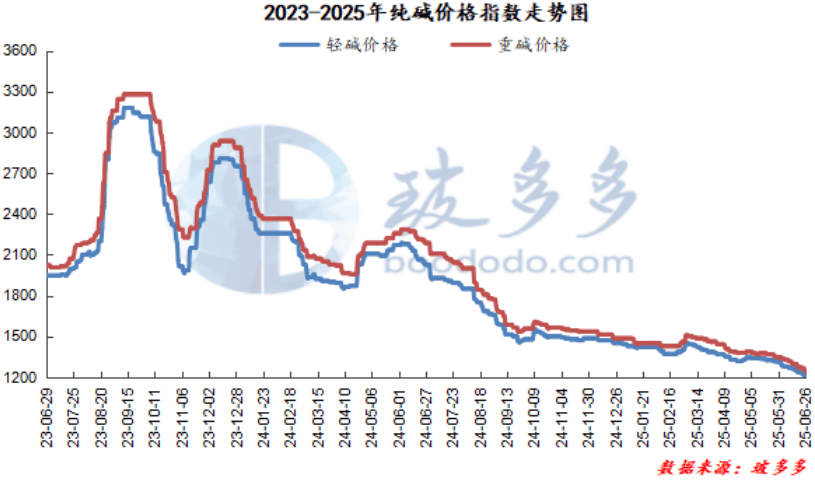
纯碱周刊:供强需弱格局难改 纯碱价格承压阴跌(20250626期)
Sou Hu Cai Jing· 2025-06-27 01:42
Group 1: Federal Reserve and Bond Market - The financial market experienced increased volatility, with short-term government bonds becoming the preferred choice for risk-averse investors as expectations for Federal Reserve rate cuts rose [1] - The yield curve steepened, with the difference between five-year and thirty-year Treasury yields approaching the highest level since 2021, indicating a consensus that short-term bond yields will decline faster than long-term yields [1] - Federal Reserve officials, including Waller and Bowman, signaled a dovish stance, suggesting that if inflation continues to improve, rate cuts could begin as early as July, with a 20% probability for action in September [2] Group 2: Sanyou Group's Achievements - Sanyou Group's subsidiaries in electronic chemicals, chlor-alkali, and silicon industries were recognized as "Advanced Intelligent Factories" by the Hebei Provincial Department of Industry and Information Technology, highlighting the group's strength in smart manufacturing [3][4] - The recognition reflects significant progress in digital transformation and the establishment of a "Smart Sanyou" framework, which aims to accelerate the intelligent upgrade of the entire industrial chain [4] Group 3: Soda Ash Market Analysis - The domestic soda ash market showed a weak and fluctuating trend, with prices gradually declining due to a supply surplus and weak demand, leading to increased industry inventory [5][6] - The market is characterized by high operating rates and a cautious purchasing strategy from downstream enterprises, resulting in a continued bearish outlook for soda ash prices [5][6] - As of June 26, the soda ash industry operating rate was approximately 84%, with total inventory rising to 176.65 million tons, reflecting a 2.20% increase from the previous week [14][16] Group 4: Production Profitability and Cost Analysis - As of June 26, the profitability of the soda ash production methods showed a significant decline, with the profit from the soda ash method dropping to 26.00 yuan/ton, a decrease of 73.87% from the previous week [10][11] - The overall cost remained stable, but the continuous decline in soda ash prices has led to a substantial drop in profitability [10]

纯碱、玻璃日报-20250627
Jian Xin Qi Huo· 2025-06-27 01:35
Report Summary 1. Report Industry Investment Rating No relevant content provided. 2. Core Viewpoints of the Report - The short - term trend of soda ash futures prices remains weakly volatile due to supply decline from equipment maintenance, weak downstream demand, and inventory accumulation. The long - term pattern is one of oversupply. The weak demand for architectural glass also suppresses the continuous upward momentum of soda ash futures prices [8]. - The short - term rebound space of glass is limited, and it is expected to operate with low - level volatility. The glass market is in the traditional rainy season, with weakening orders, high supply, falling costs, and continuous inventory accumulation. The real - estate completion stage has not improved substantially [9]. 3. Summary According to Relevant Catalogs 3.1 Soda Ash and Glass Market Review and Operation Suggestions - **Soda Ash Futures Data on June 26**: The main soda ash futures contract SA509 oscillated strongly. The closing price was 1,180 yuan/ton, up 20 yuan/ton or 1.72%, with a daily reduction of 32,209 lots. Other contracts also showed certain price increases [7][8]. - **Soda Ash Fundamental Situation**: In the week of June 26, China's weekly soda ash output dropped to 716,700 tons, a 5.04% week - on - week decrease, and was still at a high level this year. The weekly capacity utilization rate fell to 82.21%, a 4.36% week - on - week decrease. The shipment volume was 676,500 tons, a 5.29% week - on - week decrease. The total inventory of manufacturers was 1,766,900 tons, a 2.33% week - on - week increase [8]. - **Glass Fundamental Situation**: In the traditional rainy season, glass processing orders weakened slightly. Supply remained high, costs declined, and inventory continued to accumulate. The real - estate completion stage had not improved substantially, and the spot market had intense price competition with declining transaction prices [9]. 3.2 Data Overview - The report provides price trend charts of active soda ash and glass contracts, as well as data on the market price of heavy soda ash in Central China and flat - glass production, with data sources including Wind and Zhuochuang Information [11][14]
纯碱期货日报-20250627
Guo Jin Qi Huo· 2025-06-27 01:08
Report Summary 1. Report Industry Investment Rating No investment rating information is provided in the report. 2. Core View of the Report The current soda ash market has sufficient supply and weak demand. The two major downstream industries, float glass and photovoltaic glass, are in a difficult situation, with inventory on the rise. The overall market sentiment is pessimistic, and soda ash prices may still face downward pressure in the short term [8]. 3. Summary by Relevant Catalogs 3.1 Futures Market - On June 25, 2025, for the soda ash 2508 contract, the latest price was 1171, up 3 with a 0.26% increase, the open interest was 11699, down 29, and the trading volume was 2655. Its opening price was 1166, the highest was 1173, the lowest was 1159, and the settlement price was 1166 [4]. - For the soda ash 2509 contract, the latest price was 1166, up 1 with a 0.09% increase, the open interest was 1561404, down 7874, and the trading volume was 953401. Its opening price was 1158, the highest was 1168, the lowest was 1152, and the settlement price was 1160 [4]. - For the soda ash 2601 contract, the latest price was 1159, up 2 with a 0.17% increase, the open interest was 557916, up 2848, and the trading volume was 125828. Its opening price was 1150, the highest was 1160, the lowest was 1146, and the settlement price was 1154 [4]. 3.2 Spot Market On June 25, domestic soda ash enterprises' quotes remained at a low level. The mainstream ex - factory price of light soda ash was around 1250 - 1350 yuan/ton, and the mainstream delivered price of heavy soda ash to end - users was about 1300 - 1400 yuan/ton [4]. 3.3 Factors Affecting the Market - **Supply**: Since June, the weekly output of soda ash has remained above 700,000 tons, with significant supply pressure. Although some plants have maintenance plans in the medium - term approaching summer, there are few new maintenance plans in the short term, and the overall supply is at a high level [5]. - **Demand**: The involution in the photovoltaic glass industry has led to production cuts. The price rebound of float glass is based on the expectation of supply tightening. Whether the unplanned cold repairs are realized or not, it is unfavorable for the demand of soda ash. In addition, in the demand for light soda ash, the support from lithium carbonate and daily - use glass is limited, and the substitution ratio of caustic soda is less than 5%, with limited incremental demand. Overall, the demand recovery of downstream industries for soda ash is weak, and procurement is mostly for rigid needs, with a cautious market performance [5]. - **Macro - level**: There are signs of easing in the Middle East geopolitical conflict, and the overnight crude oil futures price has declined. Although the State Council executive meeting has made targeted arrangements for the real estate market recently, the year - on - year growth rate of real estate development investment is still declining without an obvious turning point, and its role in driving the demand for the glass industry downstream of soda ash is not clear [5][6].