
债券

Search documents
9月经济数据解读:内外动能或进入转换期
Huachuang Securities· 2025-10-20 15:40
1. Report Industry Investment Rating No industry investment rating is provided in the report. 2. Core Views of the Report - The GDP growth target of "5%" for the whole year is expected to be achieved. In the fourth quarter, "broad credit" will actively contribute, and investment may offset the slowdown in exports. With the injection of 500 billion yuan in policy - based financial instruments in late September and the allocation of 500 billion yuan in remaining quotas by the central government to local areas, investment is expected to recover [4]. - For the bond market, in the fourth quarter, with the implementation of "broad credit" and upcoming Sino - US negotiations, the internal economic momentum may improve marginally compared to the third quarter. The bond market may fluctuate in a narrow range on a new platform due to the intertwining of bullish and bearish factors [4]. 3. Summary by Relevant Catalogs 3.1 Third - Quarter Economic Data Overview: Investment Declines, Consumption Slows, and Exports Shine - **Overall Situation**: The cumulative growth rate of constant - price GDP in the first three quarters is 5.2%. The economy only needs to grow by more than 4.5% in the fourth quarter to achieve the annual target. In terms of rhythm, the GDP in the third quarter increased by 1.1% quarter - on - quarter, higher than that in the second quarter but lower than the same period in 2023 - 2024. In terms of price, the GDP deflator in the third quarter decreased by 1.0% year - on - year, higher than that in the second quarter, and the drag on nominal growth is narrowing [4][8]. - **Structural Features**: Investment weakening is prominent, and consumption also slows down, while exports rise against the trend, becoming a strong support for economic growth. In the third quarter, fixed - asset investment decreased by about 6.5% year - on - year, social retail sales increased by 3.4%, and exports increased by 6.6% [4][9]. - **Fourth - Quarter Outlook**: Consumption base increase may suppress readings, and exports may face marginal weakening pressure. However, with the injection of policy - based financial instruments and the allocation of remaining quotas, investment is expected to repair and offset the decline in exports to some extent [4][11]. 3.2 September Data Interpretation: Production Returns to Strength 3.2.1 Infrastructure: Policy Effects Begin to Appear, and Traditional Infrastructure Improves Marginally - From January to September, the cumulative year - on - year growth rate of infrastructure investment (excluding electricity) is +1.1%, and the full - scale infrastructure investment is +3.3%. In September, the year - on - year growth rate of infrastructure investment excluding electricity is - 4.6%, and the full - scale infrastructure is - 8.0%. In late September, the first batch of new policy - based financial instrument funds was injected, and high - frequency indicators improved, indicating an upward trend in infrastructure investment in October [1][20]. 3.2.2 Real Estate: Investment Decline Widens, and Sales Remain Stable - From January to September, the cumulative year - on - year growth rate of real estate investment is - 13.9%, and the single - month year - on - year is - 21.3%, a further decline of 1.8 percentage points. The year - on - year decline in residential sales area in September is - 11.4%, an expansion of 1.7 percentage points from the previous month. The "Golden September" market is weaker than last year, and the high - base effect may be more significant in the fourth quarter [1][24]. 3.2.3 Manufacturing Investment: Decline Continues to Widen - In September, manufacturing investment decreased by 1.9% year - on - year, with the decline expanding by 0.6 percentage points. From January to September, the cumulative year - on - year growth rate is +4.0%. The domestic price environment has not recovered, and corporate profit expectations need to be strengthened [2][25]. 3.2.4 Consumption: Weak Month - on - Month Growth and High Base Drag Down Social Retail Sales - In September, social retail sales increased by 3.0% year - on - year, a further decline of 0.4 percentage points from the previous month. The month - on - month growth rate after seasonal adjustment turned negative to - 0.18%. Due to the high - base effect of state - subsidized categories last year, the retail growth rate of related categories decreased in September this year, while communication equipment and furniture retail had relatively high growth rates [2][29]. 3.2.5 Industry: Export Pull and Peak Production Season Drive Industrial Growth to Return to Strength - In September, the industrial growth rate increased by 6.5% year - on - year, 1.3 percentage points higher than in August. The month - on - month growth rate after seasonal adjustment is +0.64%. Exports exceeded expectations in September, and the year - on - year growth rate of export delivery value increased to +3.8%, which promoted manufacturing production [2][34].
上周债市出现修复行情 纯债基金业绩有所提升
Mei Ri Jing Ji Xin Wen· 2025-10-20 14:52
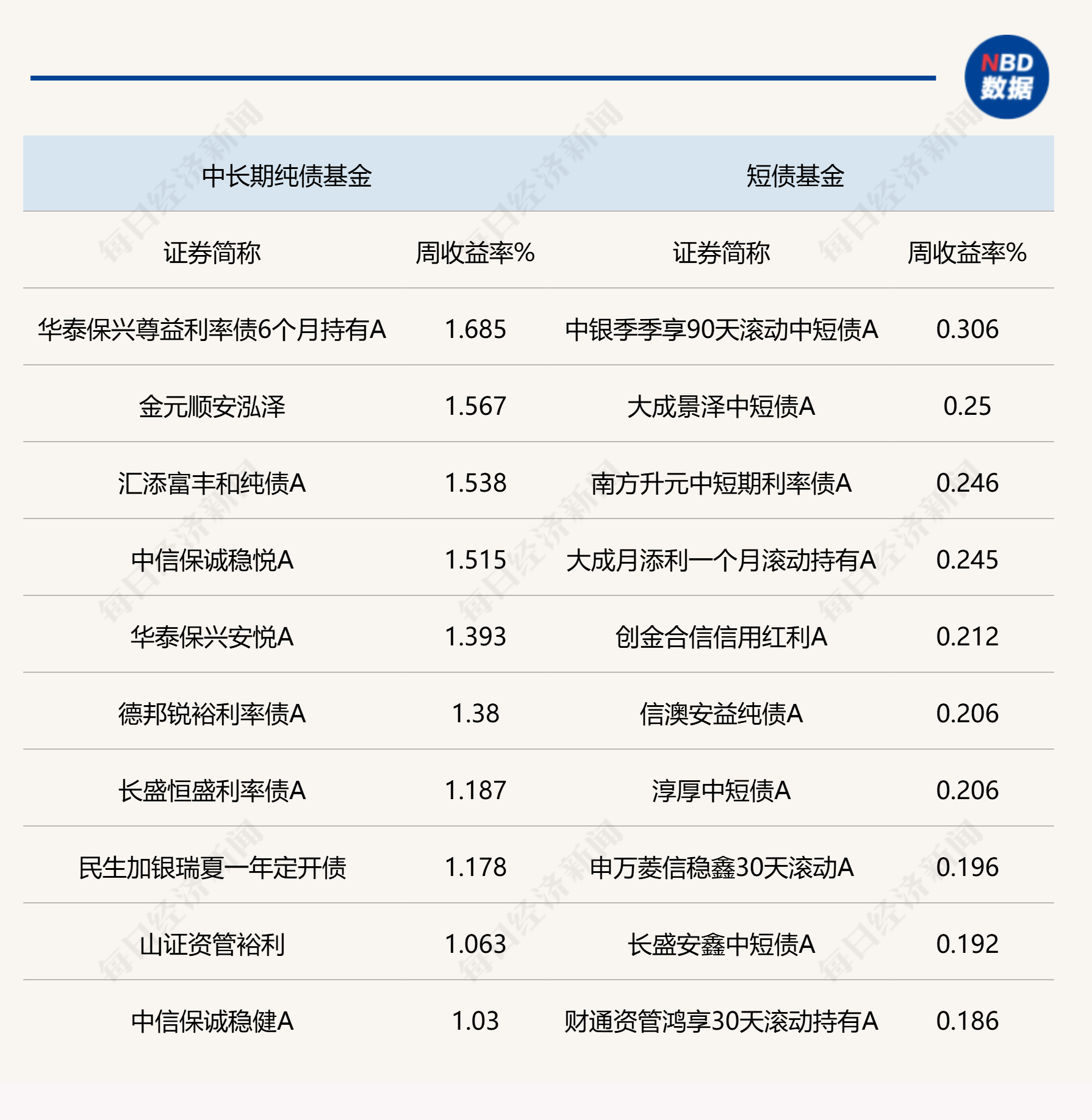
Core Viewpoint - The bond market has shown signs of recovery, with major bond yields declining, while the equity market, particularly A-shares, experienced significant volatility and a notable pullback, which contributed to the bond market's recovery [1][2]. Bond Market Performance - The 10-year government bond yield decreased from 1.85% to 1.82%, and the yield spread between 10-year government bonds and policy bank bonds narrowed from 18.5 basis points to 16.54 basis points [2]. - In the credit bond sector, the 5-year AAA corporate bond yield fell from 2.16% to 2.1%, with the yield spread between 5-year AAA corporate bonds and government bonds decreasing from 54.95 basis points to 51.44 basis points [2]. - Pure bond funds showed performance recovery, with medium to long-term pure bond funds averaging a return of 0.17% and short-term bond funds averaging 0.07% last week [2]. Fund Management and Market Dynamics - Several bond funds are facing redemption pressures, prompting them to enhance net asset value precision to manage liquidity [4]. - Over 20 announcements regarding the increase in net asset value precision have been made by various fund companies due to significant redemptions [4]. - The "stock-bond seesaw" effect continues, with new funds likely entering the equity market rather than the bond market, compounded by redemption pressures from public fund reforms [4]. Future Outlook - Analysts remain cautious about the bond market's outlook, citing potential economic data convergence in Q4 due to high base effects and weakening domestic demand and real estate trends [3]. - Factors influencing the bond market include trade tensions, monetary and fiscal policy adjustments, and the frequency of credit defaults [5][6]. - The bond market's recovery is expected to depend on the balance of fiscal and monetary policies, with limited upward risk for bond yields [4].
固收:哪些债券策略还有空间
2025-10-20 14:49
Summary of Key Points from the Conference Call Industry Overview - The conference call primarily discusses the bond market, focusing on fixed income strategies and interest rate predictions for the fourth quarter of 2025. [1][2] Core Insights and Arguments 1. **Interest Rate Predictions**: The current interest rate model has shifted to a bullish stance since October 10, with a historical success rate of approximately 85%. The bond market is expected to experience limited downward movement in interest rates, with the 10-year government bond rate fluctuating around 1.75% and unlikely to drop below 1.7% without external shocks. [2][3] 2. **Market Conditions**: The bond market is influenced by two main factors: the lack of expectations for domestic monetary policy easing and the realization of economic growth targets for the year. This results in limited downward pressure on interest rates in the short term. [3] 3. **Strategy Recommendations**: Traditional duration strategies are not recommended due to limited space for significant downward movement. Instead, investors should focus on non-directional strategies that capitalize on high spread compression opportunities, particularly in slightly longer durations and higher interest rate positions. [4] 4. **Credit Spread Evaluation**: The comparison between 5-year subordinated capital bonds and 5-year government bonds shows a spread of approximately 40 basis points, indicating that subordinated capital bonds have better holding value despite lower liquidity. [5] 5. **Investment Opportunities in Credit Bonds**: There is potential for further compression in credit spreads for certain long-term credit bonds. The analysis of credit spreads across different maturities suggests that mid to long-term credit bonds still have room for compression. [6][7] 6. **Impact of Redemption Fee Regulations**: The new redemption fee regulations may lead to increased fund redemption, widening spreads. However, the market has partially absorbed the impact, and high credit quality bonds may still attract investment despite potential short-term volatility. [8][9] 7. **Local vs. National Bonds**: The overall spread between local and national bonds is high, with specific maturities showing significant differences. New local bonds have a higher implied VAT rate, making them worthy of attention, particularly the 30-year local bonds which still hold investment value relative to national bonds. [10] 8. **Portfolio Construction**: It is recommended to construct portfolios based on the value proposition of different bond types, with government bonds in the 6-7 year range and credit bonds in the 4-6 year range being particularly attractive. The overall duration of the portfolio should remain neutral or slightly high. [11] 9. **Special Government Bonds**: The issuance of special government bonds in the first quarter of 2025 remains uncertain, with the issuance plan typically announced around April. This uncertainty could affect the performance of specific bond types. [12][13] 10. **Focus on 30-Year Bonds**: Four specific 30-year government bonds are recommended for attention due to their good configuration value and liquidity. [14] 11. **Mid-Term Government Bonds**: Two mid-term government bonds (5-year and 7-year) are highlighted for their favorable value in the current market environment. [15] 12. **Floating Rate Bonds**: Current floating rate bonds do not imply any easing expectations, leading to relatively high prices. While there is some attraction for certain funds, large purchases are not advised. [16] 13. **Government Bond Futures**: The December futures contract is considered overpriced relative to cash bonds, but there is potential for basis compression in the far-month contracts. [17] Other Important Insights - The analysis emphasizes the importance of monitoring economic indicators and external factors such as trade tensions and interest rate expectations, which could significantly impact the bond market dynamics. [3][4][8]
国泰海通|固收:利率修复,哪些信用债在受益
国泰海通证券研究· 2025-10-20 13:39
Core Viewpoint - The article highlights a recovery in the interest rate market, particularly in the underperforming secondary perpetual bonds and credit bonds, with a more pronounced recovery in perpetual bonds. The credit spread for medium to short-term bonds has narrowed significantly, leading to a steeper spread curve [1]. Primary Issuance - Net financing has seen a significant increase, with a total issuance of 4011.9 billion yuan in major credit bond varieties last week (October 13 - October 17, 2025), compared to a net financing of -35.1 billion yuan in the previous week (October 9 - October 11, 2025) [1]. Secondary Trading - Trading activity has increased, with total transactions in major credit bond varieties reaching 9165.71 billion yuan last week, a rise of 6748.54 billion yuan from the previous week. The yields on medium-term notes have generally declined, with specific decreases noted for AAA and AA+ rated notes [2]. Credit Rating Adjustments and Default Tracking - No credit rating adjustments were made by domestic rating agencies last week. However, one new default bond was reported, issued by Sunshine City Group Co., Ltd. [3].


【笔记20251020— 中美博弈关键的两周】
债券笔记· 2025-10-20 11:37
Core Viewpoint - The article discusses the current state of the US-China economic negotiations and its impact on the financial markets, highlighting the importance of upcoming meetings and the overall market sentiment [5][7]. Financial Market Overview - The interbank funding environment is balanced and slightly loose, with a notable increase in long-term bond yields [3]. - The central bank conducted a 1,890 billion yuan reverse repurchase operation, with 2,538 billion yuan maturing, resulting in a net withdrawal of 648 billion yuan [3]. - The funding rates remain stable, with DR001 around 1.31% and DR007 around 1.43% [3]. Bond Market Insights - The bond market showed a slight upward trend, influenced by comments from former President Trump regarding tariffs on China, which were deemed unsustainable [5][6]. - The 10-year government bond yield fluctuated, opening at 1.7525% and reaching approximately 1.768% [5]. - The latest LPR (Loan Prime Rate) remained unchanged, aligning with market expectations [5]. Upcoming Events - Key negotiations between US and Chinese representatives are scheduled in Malaysia, with significant implications for future trade relations [7]. - The upcoming APEC meeting is highlighted as a critical moment for high-level discussions between the two nations [7].

债市日报:10月20日
Xin Hua Cai Jing· 2025-10-20 09:10
Core Viewpoint - The bond market has returned to a weak state, with government bond futures declining across the board and interbank bond yields generally rising by 1-2 basis points, indicating a significant pullback in the long end of the curve [1][2]. Market Performance - Government bond futures closed lower, with the 30-year main contract down 0.37% at 115.300, the 10-year main contract down 0.14% at 108.110, the 5-year main contract down 0.11% at 105.655, and the 2-year main contract down 0.04% at 102.334 [2]. - Interbank yields for major bonds rose, with the 10-year policy bank bond yield increasing by 1.3 basis points to 1.918%, and the 10-year government bond yield rising by 2 basis points to 1.765% [2]. International Market Trends - In North America, U.S. Treasury yields rose collectively, with the 2-year yield increasing by 4.77 basis points to 3.466% and the 10-year yield rising by 4 basis points to 4.013% [3]. - In Asia, Japanese bond yields mostly increased, with the 10-year yield rising by 4.4 basis points to 1.669% [4]. Primary Market Activity - Agricultural Development Bank's financial bonds had a bid yield of 1.5549% for 182 days, 1.7285% for 3 years, and 1.7962% for 5 years, with bid-to-cover ratios of 3.79, 2.28, and 2.51 respectively [5]. Liquidity Conditions - The central bank conducted a 7-day reverse repurchase operation of 189 billion yuan at a fixed rate of 1.40%, resulting in a net withdrawal of 648 billion yuan for the day [6]. - Shibor rates showed mixed performance, with the overnight rate down by 0.1 basis points to 1.317% and the 7-day rate up by 0.3 basis points to 1.418% [6]. Economic Indicators - In September, the total retail sales of consumer goods grew by 3% year-on-year, below the expected 3.1% [7]. - Fixed asset investment (excluding rural households) decreased by 0.5% year-on-year from January to September, while real estate development investment fell by 13.9% [7]. Institutional Perspectives - Citic Securities noted a recent recovery in the bond market due to changes in U.S.-China trade tensions and rising market risk aversion, with expectations for continued monetary policy support [9]. - Huatai Fixed Income suggested that while trade tensions may persist, the bond market is expected to experience fluctuations, with a preference for short-term trading strategies [9].


债市出现修复行情 纯债基金业绩有所提升 业内谨慎看待市场修复空间
Mei Ri Jing Ji Xin Wen· 2025-10-20 08:57
Core Viewpoint - The bond market has shown signs of recovery, with major bond yields declining, while the equity market, particularly A-shares, experienced significant volatility and a notable pullback, which contributed to the bond market's recovery [1][2][3] Group 1: Bond Market Performance - Last week (October 13-19), the bond market exhibited a recovery, with the 10-year government bond yield decreasing from 1.85% to 1.82% [2] - The yield spread between 10-year government bonds and government-backed bonds narrowed from 18.5 basis points (bp) to 16.54 bp [2] - The yield on 5-year corporate bonds (AAA) fell from 2.16% to 2.1%, and the spread between 5-year corporate bonds (AAA) and government bonds decreased from 54.95 bp to 51.44 bp [3] Group 2: Fund Performance - Pure bond funds showed performance recovery, with average returns for medium- and long-term pure bond funds reaching 0.17% and short-term bond funds at 0.07%, a notable improvement from previous weeks [3] - The top-performing pure bond fund, Huatai Baoxing Zunyi Rate Bond 6-Month A, increased by 1.68%, with 10 pure bond funds reporting weekly returns exceeding 1% [3] Group 3: Market Outlook and Risks - Analysts remain cautious about the bond market's outlook, citing potential economic data convergence in Q4 due to high base effects from the previous year and weakening trends in domestic demand and real estate [3][4] - Trade frictions and increasing tail risks contribute to uncertainty, while favorable fundamental factors for bonds are accumulating [4] - The recent bond market recovery is influenced by economic and trade factors, with expectations for monetary policy adjustments to support continued recovery [5][6]
ETF基金周报:资金分歧显现红利低波类ETF净流入34亿-20251020
Dongguan Securities· 2025-10-20 08:50
Group 1 - The report highlights a significant inflow of 34 billion yuan into dividend low-volatility ETFs, indicating a divergence in fund allocation as investors seek both offensive and defensive positions in the market [2][10][16] - Gold and silver have shown strong performance, with silver futures rising by 7.15% and gold futures achieving a record nine consecutive weekly gains, reflecting a shift towards safe-haven assets [4][9] - The average weekly return for commodity ETFs was notably high at 9.05%, while stock and cross-border ETFs experienced an average decline of over 3% [4][10] Group 2 - In the stock ETF segment, traditional energy and banking sectors have shown resilience, with the banking sector experiencing its first significant weekly gain since early July [13][16] - The report suggests that investors should consider reallocating to new economy sectors such as artificial intelligence and robotics during market adjustments, while also recognizing seasonal opportunities in high-dividend coal stocks [13][16] - The bond ETF segment saw a net outflow of 138.97 billion yuan, with convertible bond ETFs underperforming due to pressure from equity funds, while long-term interest rate bonds showed stronger performance [17][19] Group 3 - The analysis of financing and margin trading indicates a split in high-risk leveraged funds, with some betting on safe-haven assets like gold and others on technology sectors supported by loose monetary policy [20][21] - The report emphasizes that the divergence in fund flows between recession and growth bets is expected to converge, depending on economic recovery or recession risks [20]
美元“贬值交易”:黄金、美债为何齐涨?
国泰君安国际· 2025-10-20 08:11
Group 1: Market Trends - Gold prices surged over 60% in the past 12 months, surpassing $4,300[5] - The US dollar index fell nearly 10% from its peak at the beginning of the year, currently fluctuating between 97 and 99[5][8] - The market is increasingly focused on "devaluation trades," betting on the US government diluting its debt through inflation[5] Group 2: Economic Factors - Concerns about the US government's ability to manage its debt have led to a loss of trust in the dollar, reflected in rising gold prices[24] - The long-term inflation expectations in the US remain stable around the Federal Reserve's 2% target, despite gold's rise[19][24] - The ongoing government shutdown has increased uncertainty, with over 70% probability that it will last more than 30 days[13][15] Group 3: Policy Implications - The Federal Reserve's potential shift towards a more dovish stance could lead to further interest rate cuts, impacting asset prices[19][24] - The interplay between inflation control and employment stability will be crucial in determining the Fed's future decisions[26] - Investors need to differentiate between long-term risks and short-term realities in the current market environment[25]
利率债周报:中美贸易摩擦反复,上周债市情绪有所修复-20251020
Dong Fang Jin Cheng· 2025-10-20 08:05
Report Summary 1. Report Industry Investment Rating No industry investment rating is provided in the report. 2. Core Viewpoints - Last week, affected by the repeated Sino - US trade frictions, the bond market sentiment recovered. The first half of the week saw weak fluctuations in the bond market due to trade news, while the second half strengthened with the stock market decline and increased risk - aversion. Long - term bond yields rose slightly, and the yield curve flattened further as short - term yields rose more significantly [3]. - This week, the bond market will continue the high - volatility and oscillating trend. Although the bond market environment is expected to improve marginally due to increased economic pressure, potential policy easing, and reduced government bond supply in Q4, the current loose market expectations are weak, and there are still negative factors such as the unimplemented public fund sales fee regulations and upcoming events affecting risk preferences. The 10 - year Treasury bond yield is expected to range between 1.70% - 1.80% [3]. 3. Summary by Directory 3.1 Last Week's Market Review - **Secondary Market**: The bond market recovered last week. The 10 - year Treasury bond futures main contract rose 0.31% in the whole week. However, the 10 - year Treasury bond yield rose 0.40bp and the 1 - year yield rose 7.43bp compared to the previous Friday, with the term spread continuing to narrow. The daily performance of the bond market was affected by factors such as stock market movements, trade frictions, and market sentiment [4]. - **Primary Market**: 47 interest - rate bonds were issued last week, 38 less than the previous week. The issuance volume was 450.7 billion yuan, 90.5 billion more, and the net financing was 20.2 billion yuan, 223.7 billion less. The issuance of Treasury bonds and policy - financial bonds increased, while local bonds decreased. The net financing of policy - financial bonds increased, while that of Treasury and local bonds decreased. The overall subscription demand for interest - rate bonds was acceptable [11]. 3.2 Last Week's Important Events - **Foreign Trade**: In September 2025, exports increased by 8.3% year - on - year, and imports increased by 7.4%. The high growth in exports was due to a low base last year, more working days, and strong external demand for some products. However, exports may decline in the future due to US high - tariff policies, and imports may enter negative growth [13]. - **CPI and PPI**: In September, CPI decreased by 0.3% year - on - year, with a seasonal increase in the month - on - month rate. PPI decreased by 2.3% year - on - year, with the decline narrowing mainly due to a lower base last year. The domestic demand was still insufficient, and some export - oriented industries' prices were under pressure [13]. - **Financial Data**: In September, new RMB loans were 1.29 trillion yuan, and new social financing was 3.5338 trillion yuan, both less than the same period last year. M2 growth slowed to 8.4%, and M1 growth accelerated to 7.2%. The factors affecting loan and social financing growth included implicit debt replacement and weak demand [14]. 3.3 Real - Economy Observation - **Production**: High - frequency production data showed mixed performance. The semi - steel tire开工 rate increased significantly, while the asphalt plant开工 rate and daily pig iron output decreased slightly, and the blast furnace开工 rate remained unchanged [15]. - **Demand**: The BDI index continued to rise, the CCFI index continued to decline, and the commercial housing sales area in 30 large and medium - sized cities increased significantly [15]. - **Prices**: Pork prices and most commodity prices, including crude oil, rebar, and copper, declined [15]. 3.4 Last Week's Liquidity Observation - The central bank's open - market operations resulted in a net capital withdrawal of 162.36 billion yuan last week. R007 and DR007 both decreased, the share - holding bank's inter - bank certificate of deposit issuance rate increased, and the pledged repurchase trading volume increased significantly. The inter - bank market leverage ratio fluctuated greatly and decreased slightly overall [24][27][31].