
债券

Search documents
固收定期报告:利率震荡市还是牛市?怎么看利差?
CAITONG SECURITIES· 2025-10-19 08:27
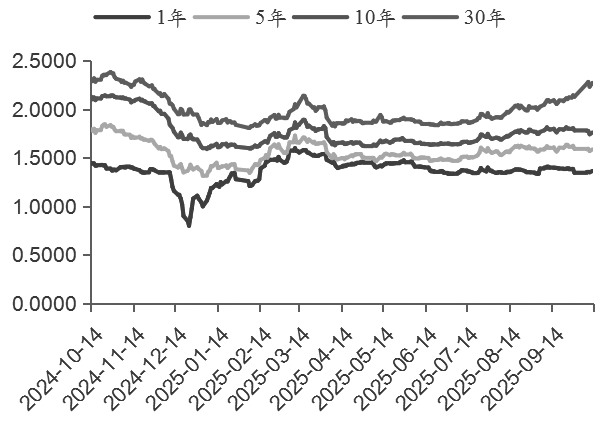
1. Report Industry Investment Rating There is no information provided regarding the report industry investment rating. 2. Core Viewpoints of the Report - The bond market is still "widely bearish," but it is likely to be a bull market. The upper limit of bond market interest rates is clear. The 10 - year Treasury bond rate above 1.8% has absolute value, and the downward space of bond market interest rates is at least 20bp. There are opportunities for the narrowing of the spreads of ultra - long bonds and variety spreads [2]. - The logic of the upper limit of interest rates comes from the weak fundamentals, asset shortage, and the need to cooperate with fiscal policies. The large - scale purchase of 7 - 10y Treasury bonds by large banks in mid - September may reflect the policy intention of maintaining stability in the bond market [2][8]. - Regarding the lower limit of interest rates, the report is firmly bullish. The 1.7% is not an important resistance level. Interest rates are expected to reach new lows under the influence of factors such as the central bank's possible restart of Treasury bond trading, regulatory policies being less than expected, and cross - year allocation [11][12]. - The term spreads in the bond market since 2024 have generally widened, different from the previous narrowing trend. In the future, with the improvement of market sentiment, there will be opportunities for spread compression. The impact of the 500 billion yuan local government debt limit on the bond market is expected to be limited in the short term [3]. 3. Summary According to the Table of Contents 3.1 Is It a Sideways Market or a Bull Market? - There are still significant differences in the market. The short - term view of most investors is that the downward space of interest rates is limited. The lower limit of the 10 - year Treasury bond active bond rate may be 1.7%, and the upper limit is around the previous high of 1.83% [7]. - The long - term view believes that short - term Sino - US trade frictions are beneficial, and the negative factors in the third quarter are weakening. The short - term view believes that Sino - US relations may improve, the stock market is still strong, and regulatory policies will affect the bond market [7]. - The upper limit of interest rates: The 10 - year Treasury bond above 1.8% and the 30 - year Treasury bond above 2.1% have absolute allocation value. The upper limit comes from the weak fundamentals, asset shortage, and the large - scale purchase of 7 - 10y Treasury bonds by large banks in mid - September, which may be a manifestation of the central bank's intention to maintain stability in the bond market and cooperate with fiscal policies [8]. - The lower limit of interest rates: The report is firmly bullish. The 1.7% is not an important resistance level. Interest rates are expected to reach new lows under the influence of factors such as the central bank's possible restart of Treasury bond trading, regulatory policies being less than expected, and cross - year allocation. In extreme cases, the 10 - year Treasury bond rate can refer to the pricing at the beginning of this year plus points, that is, OMO + 10bp [11][12]. 3.2 How to View Spreads in a Sideways Market? - By tracing the sideways markets since 2022 with the 10 - year Treasury bond yield as the standard, 7 time periods are sorted out. Since 2024, the term spreads in the sideways market have generally widened, mainly because the bond bull market since 2024 is usually accompanied by supply pressure or the central bank's attention to long - term interest rates, making the mid - short end relatively safer and more certain [19][24]. - In terms of variety spreads, the spread between policy - financial bonds and Treasury bonds usually narrows, especially at the long end. The credit spreads have decreased significantly in most sideways markets [25]. - Since the end of August 2025, the spread between 5 - year and 2 - year Treasury bonds has declined, while the spreads between 10 - year and 5 - year, and 30 - year and 10 - year Treasury bonds have increased, and the variety spreads have increased rapidly. The reasons include large - scale purchases of medium - term Treasury bonds by large state - owned banks, the reduction of fund duration by public funds, and the weak buying of ultra - long bonds by large and medium - sized banks [31][33]. - Looking forward, the 30 - year Treasury bond rate has a greater downward space, and the variety spreads may also narrow. Insurance funds may increase their purchases of ultra - long bonds when the Treasury bond rate rebounds above 2.1%. With the improvement of bond market sentiment and the end of the cross - quarter period, the buying power of funds and rural commercial banks may return, driving the compression of the spread between policy - financial bonds and Treasury bonds [36]. 3.3 How to View the Impact of 500 Billion Yuan of Local Government Debt Balance on the Bond Market? - In the absence of other incremental policy linkages, the impact of 50 billion yuan of special bonds on the bond market is limited. In 2022, the interest rate fluctuated upward due to a series of incremental policies, including fiscal, monetary, and structural policies [37][38]. - This 500 billion yuan of funds is likely to be issued in the form of new special bonds. Currently, the balance of general bonds is not large, and the use of this fund is more suitable for new special bonds [43]. 3.4 Bond Market Interest Rates First Rose and Then Fell - This week, the central bank's open - market operations changed from net investment to net withdrawal, but the liquidity in the market became looser. The bond market yield curve flattened as a whole, and the 10 - year Treasury bond yield first rose and then fell, rising 0.40bp to 1.82% [3][45]. - The reasons for the fluctuations in bond market interest rates include factors such as "TACO trading," good export performance, increased redemption pressure, market speculation on public fund fee reform, and the possible issuance of local government bonds in advance in 2026 [45]. 3.5 The Scale of Wealth Management Products Slightly Increased - As of October 12, the scale of existing wealth management products reached 30.9 trillion yuan, with a weekly increase of 120.652 billion yuan. From October 6 to October 12, the newly issued wealth management products totaled 14.68 billion yuan [55]. - In the second week of October, the scale of fixed - income products rebounded. By product type, the scale of cash - management products increased by 15.8 billion yuan, and the scale of fixed - income products increased by 41.7 billion yuan. By product risk level, the scale of first - level (low - risk) products increased by 5 billion yuan [59][60]. - The net - breaking rate of wealth management products decreased slightly last week. As of October 15, the average 7 - day annualized yield of 370 money funds was 1.05%, and the average 7 - day annualized yield of 265 cash - management products was 1.35% [60][62]. 3.6 Duration - This week, the duration of public funds decreased at first and then increased. From October 13 to October 17, the duration of public funds increased by 0.035 to 2.382 compared with October 10, and the weekly average was 2.364 [64]. - This week, the divergence of duration decreased, and the market's consensus expectation increased slightly. On October 17, the divergence of public fund duration decreased by 0.014 to 0.321 compared with October 10 [64].
7月以来,债市机构行为全解析
Shenwan Hongyuan Securities· 2025-10-19 04:44
Core Insights - The report analyzes the behavior of institutions in the bond market since July 2025, focusing on their buying patterns and the implications for future bond market trends [11][12][26]. Group 1: Bond Market Weekly Review (2025/10/13-2025/10/17) - The bond market experienced fluctuations influenced by U.S.-China trade news and the performance of the stock market, leading to a flattening of the government bond yield curve [10]. - The yields for 30Y, 10Y, and 1Y government bonds changed by -3.26 basis points, +0.40 basis points, and +7.43 basis points respectively during this week [10]. Group 2: Bond Funds - Since the bond market adjustment began in July 2025, bond funds have exhibited a clear trend of chasing gains and cutting losses, with significant net sales of government bonds, policy bank bonds, and perpetual bonds amounting to CNY 877 billion, CNY 1,549 billion, and CNY 766 billion respectively [12][15]. - The duration of bond funds has gone through three phases: initially reluctant to reduce duration, then forced to sell long-term bonds due to redemption pressures, and finally showing a renewed speculative mindset as yields reached critical levels [20][21]. Group 3: Wealth Management Products - Wealth management products have remained stable in net value and liabilities, serving as a major buying force for credit bonds, with net purchases of medium-term notes, perpetual bonds, and short-term financing bonds totaling CNY 1,484 billion, CNY 1,428 billion, and CNY 677 billion respectively since July 2025 [26][31]. - These products have adopted multiple strategies to stabilize net value, resulting in minimal redemption pressure [26]. Group 4: Banks - Large banks have increased their net purchases of bonds, particularly long-term bonds, acting as a stabilizing force in the bond market, while smaller banks have shown a tendency to take profits [33][37]. - From July to September 2025, large banks net purchased government bonds primarily with maturities of 3Y or less, expanding to 5Y and 10Y bonds in subsequent months [33][34]. Group 5: Insurance - Insurance companies have been cautious in their bond purchases, preferring to invest in 30Y government bonds and local government bonds rather than 10Y bonds due to the lack of expected yield declines [44][45]. - There has been a noticeable increase in equity allocations among large insurance firms, indicating a shift in asset allocation strategies [45][47]. Group 6: Bond Market Strategy - The current market shows a need for continued observation of institutional buying behavior, with a heavy speculative mindset persisting despite a decrease in trading congestion [53]. - The report suggests that the 10Y government bond yield may range between 1.75% and 1.90% (excluding tax) in the near term, with a recommendation to continue reducing duration [53].
再抛美债825亿,降至14年来新低,美债有暴雷的风险吗?
Sou Hu Cai Jing· 2025-10-19 03:38
Core Viewpoint - China has been continuously reducing its holdings of US Treasury bonds, with the latest data showing a decrease of $11.3 billion in June, bringing the total to $835.4 billion, the lowest in 14 years. This decision is driven by multiple strategic considerations [1]. Group 1: Risk Mitigation - The reduction in US Treasury holdings is aimed at mitigating potential default risks, as the US national debt has ballooned to $32.659 trillion, significantly exceeding its 2022 GDP of $25.45 trillion. Countries, including China, are increasingly concerned about the possibility of a US debt crisis [3]. - The current high dollar index during the Federal Reserve's interest rate hike cycle provides an opportune moment for China to reduce its US debt exposure and lower future risks [3]. Group 2: Diversification of Foreign Exchange Reserves - China has historically held a high proportion of US dollar assets, which once reached 70%, while non-dollar assets like gold and euros accounted for only 30%. This imbalance exposes China to significant risks from dollar depreciation [5]. - By selling off some US Treasury bonds and increasing holdings in gold and euros, China aims to optimize its foreign exchange reserve structure and reduce reliance on a single currency [5]. Group 3: Short-term Stability of US Treasury Bonds - Despite China's ongoing reduction of US Treasury bonds, the likelihood of a short-term crisis in the US bond market remains low. China's holdings represent only a small fraction of the total US debt, and domestic entities like the Federal Reserve and financial institutions can absorb any potential sell-off [6]. - The US can manage maturing debt through "rolling over" its obligations, as long as its credit system remains intact and it can continue issuing new bonds to pay off old ones [7]. - The US, as the largest economy globally, possesses substantial economic strength and innovation capabilities, allowing it to repay debts through the sale of high-tech products. The majority of US debt is held domestically, minimizing the impact of foreign holders [9].


国债周报:债市走向震荡修复-20251018
Wu Kuang Qi Huo· 2025-10-18 13:34
1. Report Industry Investment Rating No information provided. 2. Core Viewpoints of the Report - In the short - term, the resurgence of Sino - US trade disputes and the decline in risk appetite are conducive to the repair of the bond market. However, the uncertainty of tariff progress in the later stage is high. In the fourth quarter, the bond market still needs to focus on the fundamentals and institutional allocation power [13]. - From the perspective of fundamentals, the September PMI data shows that the manufacturing prosperity has rebounded but is still below the boom - bust line, with both supply and demand ends warming up month - on - month, and the non - manufacturing sector has declined slightly. Under the "anti - involution" policy, the price level has rebounded, but affected by the issuance rhythm of government bonds and the base, the growth rate of social financing has declined marginally [10][13]. - In terms of funds, the central bank maintains an attitude of caring for funds. Overall, the supply - demand pattern of the bond market in the fourth quarter may improve. The current market may generally remain volatile under the background of weak domestic demand repair and improved inflation expectations. The rhythm needs to pay attention to the seesaw effect between stocks and bonds. If the stock market cools down and the allocation power gradually increases, the bond market is expected to repair in a volatile manner [13]. 3. Summary According to Relevant Catalogs 3.1. Weekly Assessment and Strategy Recommendation - **Economic and Policy**: The September PMI data shows that the manufacturing prosperity has rebounded but is still below the boom - bust line, with both supply and demand ends warming up month - on - month, and the non - manufacturing sector has declined slightly. The "anti - involution" policy has boosted price expectations, but the coordination between demand and production still needs to be observed. In the future, exports may face certain pressure. The Fed has cut interest rates, and the subsequent degree of easing needs to pay attention to the inflation changes caused by tariffs. In the first three quarters of 2025, the cumulative increase in social financing scale was 30.09 trillion yuan, 4.42 trillion yuan more than the same period last year. At the end of September 2025, the stock of social financing scale was 437.08 trillion yuan, a year - on - year increase of 8.7%. The central government has arranged 500 billion yuan from the local government debt balance limit to local governments [10][11]. - **Liquidity**: This week, the central bank conducted 789.1 billion yuan of reverse repurchase operations, with 1021 billion yuan of reverse repurchase and 150 billion yuan of treasury cash fixed - deposit maturing. This week, there was a net withdrawal of 381.9 billion yuan, and the DR007 interest rate closed at 1.41% [13]. - **Interest Rates**: The latest 10Y treasury bond yield closed at 1.82%, a week - on - week decrease of 3.04BP; the 30Y treasury bond yield closed at 2.20%, a week - on - week decrease of 8.50BP; the latest 10Y US treasury bond yield was 4.02%, a week - on - week decrease of 3.00BP [13]. - **Trading Strategy**: Adopt a long - position strategy on dips, with a profit - loss ratio of 3:1 and a recommended period of 6 months. The core driving logic is loose monetary policy and the difficulty of credit improvement [15]. 3.2. Futures and Spot Markets - **Contract Market Performance**: The report presents the closing prices, annualized discounts, settlement prices, and net basis spreads of T, TL, TF, and TS contracts, as well as the closing prices and trading volumes of TS and TF, T and TL contracts [18][24][27][30][33][38]. 3.3. Main Economic Data - **Domestic Economy** - GDP: In the second quarter of 2025, the actual GDP growth rate was 5.4%, exceeding market expectations, and the economic growth in the first half of the year maintained resilience [47]. - PMI: In September, the manufacturing PMI was 49.8%, an increase of 0.4 percentage points from the previous value; the service industry PMI decreased by 0.4 points from the previous value to 50.1%. The manufacturing and service industries showed differentiation. The sub - items of the manufacturing PMI showed that both supply and demand ends had warmed up [47][48][53]. - Price Index: In September, CPI decreased by 0.3% year - on - year, core CPI increased by 1.0% year - on - year, and PPI decreased by 2.3% year - on - year. In terms of month - on - month data, CPI increased by 0.1%, core CPI remained unchanged, and PPI remained unchanged [56]. - Export: In September 2025, China's import and export data slightly exceeded expectations. Exports increased by 8.3% year - on - year, and imports increased by 7.4% year - on - year. Exports to the US decreased by 27.0% year - on - year, while exports to ASEAN maintained a relatively high growth rate [59]. - Industrial Added Value and Social Consumption: In August, the year - on - year growth rate of industrial added value was 5.2%, and the year - on - year growth rate of the total retail sales of social consumer goods was 3.4%, showing a slowdown [62]. - Fixed - Asset Investment and Real Estate: From January to August, the cumulative year - on - year growth rate of fixed - asset investment was 0.5%, and the real estate investment growth rate was - 12.9%. In August, the prices of second - hand houses in 70 large and medium - sized cities decreased both month - on - month and year - on - year. The new construction area and construction area of houses also showed a downward trend year - on - year [65][68]. - **Foreign Economy** - US Economy: In the second quarter, the annualized current - price GDP of the US was 3.0331 trillion US dollars, with a real year - on - year growth rate of 1.99% and a quarter - on - quarter growth rate of 3.0%. In August, the unadjusted CPI increased by 2.9% year - on - year, and the core CPI increased by 3.1% year - on - year. The order amount of durable goods increased by 7.63% year - on - year, and the non - farm employment population increased by 22,000. The unemployment rate was 4.3%. In September, the ISM manufacturing PMI was 49.1, and the non - manufacturing PMI was 50 [74][77][80]. - EU Economy: In the second quarter, the EU's GDP increased by 1.5% year - on - year and 0.2% quarter - on - quarter [80]. - Eurozone Economy: In September, the final value of the Eurozone's CPI increased by 2.2% year - on - year, the core CPI increased by 0.1% month - on - month. The manufacturing PMI was 49.8, and the service industry PMI was 51.3 [83]. 3.4. Liquidity - In September, the growth rate of M1 was 7.2%, and the growth rate of M2 was 8.4%. The increment of social financing was 3.53 trillion yuan, with a year - on - year decrease of 233.9 billion yuan. The main source of social financing was the growth of government bonds. In the sub - items of social financing, the year - on - year growth rate of government bonds slowed down, and the financing of the real - sector remained stable. In September, the balance of MLF was 5.85 trillion yuan, with a net investment of 300 billion yuan. This week, the central bank conducted 789.1 billion yuan of reverse repurchase operations, with a net withdrawal of 381.9 billion yuan, and the DR007 interest rate closed at 1.41% [88][91][94]. 3.5. Interest Rates and Exchange Rates - Interest Rates: The report lists the latest yields of domestic and US treasury bonds and their week - on - week changes, as well as the changes in repurchase rates [97]. - Exchange Rates: No specific analysis of exchange rates is provided, only relevant charts are presented [108].
一篇说清楚:Q4政府债券供给
Huachuang Securities· 2025-10-18 12:31
1. Report Industry Investment Rating There is no information provided in the content about the industry investment rating. 2. Core Viewpoints of the Report - The Q4 government bond issuance plan has significant changes, and the probability of additional treasury bond issuance this year is low, while local bond issuance has its own characteristics and trends [2][3]. - The Q4 government bond issuance forecast shows that the net financing is expected to be around 2.4 trillion yuan, lower than the average level of the past five quarters, with the supply pressure in October concentrated in the second half of the month [5]. 3. Summary by Relevant Catalogs Q4 Treasury Bond Issuance Plan Highlights - The Q4 plan announced on September 30 by the Ministry of Finance has changes compared with the annual plan. Some maturity issuance dates in October are adjusted, and the 30 - year ultra - long special treasury bond cancellation of re - issuance is replaced by one re - issuance each of 50 - year and 20 - year bonds [2][9]. - After the new plan, the spread between 25 Te 6 and 25 Te 2 widened under selling pressure. The issuance scale of 25 Te 6 stopped at 247 billion yuan, and the spread rose from 9.5 BP on September 29 to 13.20 BP [2][10]. October Treasury Bond Volume Reduction: May Indicate Low Probability of Additional Treasury Bond Issuance This Year - The remaining quota for ordinary treasury bonds is about 1.06 trillion yuan, and the issuance of special treasury bonds has been completed [14]. - The single - issue scale of key - maturity coupon treasury bonds in October decreased to 130.6 billion yuan, indicating a low probability of additional issuance this year [3][14]. Local Bonds: Analysis of Remaining Quotas and Issuance Forms This Year Local Bond Stock Quota Issuance Progress - The remaining quota for new bonds is 83.09 billion yuan, including 12.83 billion yuan for new general bonds and 70.27 billion yuan for other new special bonds [21]. - The issuance of debt - resolution bonds has basically completed the stock quota. The 2 - trillion - yuan replacement bonds have issued 1.9924 trillion yuan, and the 800 - billion - yuan new special bonds for debt resolution have been fully issued [21]. How to View Local Bond Additional Issuance - The advance allocation of the 2026 new local government debt quota is a regular Q4 operation, and additional issuance needs to wait until next year. The potential advance - batch quota may be 312 billion yuan [22]. - The central government arranges 50 billion yuan from the local government debt balance quota to be allocated to local areas, corresponding to an additional issuance of 50 billion yuan in special refinancing bonds and new special bonds this year. Special refinancing bonds have started issuing next week [26]. - The probability of advancing the issuance of replacement bonds to this year may have decreased. The Ministry of Finance issued a 6 - trillion - yuan replacement bond quota to provinces in 2024, and additional approval is needed for early issuance [32]. Q4 Government Bond Issuance Forecast - The to - be - issued quota for Q4 government bonds may be 2.6 trillion yuan, and the remaining quota as of October 17 is about 2.4 trillion yuan [5][34]. - Local bond net financing in Q4 is expected to be around 1.2 trillion yuan, with October, November, and December at around 650 billion, 440 billion, and 80 billion yuan respectively [5][35]. - Treasury bond net financing in Q4 is expected to be around 1.2 trillion yuan, with October, November, and December at around 230 billion, 630 billion, and 340 billion yuan respectively [5][38]. - Government bond net financing in Q4 is expected to be around 2.4 trillion yuan, lower than the average of the past five quarters. The net financing in October, November, and December is around 890 billion, 1070 billion, and 420 billion yuan respectively. The supply pressure in October is concentrated in the second half of the month, and attention should be paid to the liquidity fluctuation risk [5][38].
央行邹澜:银行间债券市场约280家主体发行科技创新债券6700亿元,呈现三大特点
Sou Hu Cai Jing· 2025-10-18 08:49
Core Insights - The People's Bank of China has reported significant growth in the bond market for technology innovation, with 670 billion yuan in technology innovation bonds issued by approximately 280 entities in the interbank bond market over the past five months [1] - Key characteristics of this market include a diverse structure of technology enterprises, flexible issuance methods for longer-term financing, and relatively low financing costs [1] - A total of 191 technology enterprises have issued 377 billion yuan in technology innovation bonds, covering 26 provinces and cities, with a focus on emerging sectors such as integrated circuits, intelligent computing centers, high-quality manufacturing, and biomedicine [1] Summary by Categories Market Development - The technology innovation bond market has seen rapid growth, with 670 billion yuan issued in five months [1] - The average coupon rate for bonds issued by technology enterprises and equity investment institutions is approximately 2% [1] Issuer Characteristics - Nearly half of the technology enterprises have bond maturities of three years or more, with equity investment institutions averaging a maturity of 5.8 years [1] - Some private equity investment institutions have successfully issued bonds with ten-year maturities [1] Geographic and Sectoral Coverage - The bond issuance spans across 26 provinces and cities, indicating a broad geographical distribution [1] - The sectors involved include cutting-edge fields such as integrated circuits, intelligent computing, high-quality manufacturing, and biomedicine [1]
债市 中长期布局正当时
Qi Huo Ri Bao· 2025-10-17 22:11
Group 1 - The bond market has experienced multiple shifts in logic this year, with tightening liquidity in Q1 leading to adjustments in short-term bonds, followed by pressure release in long-term bonds as liquidity turned loose in Q2 [1] - The 10-year government bond yield has risen to around 1.75%, with support expected near 1.8% after a 10 basis point rate cut this year [1] - The upward movement in bond yields since Q3 has been primarily driven by non-fundamental factors, indicating significant pressure on the bond market despite the central bank's efforts to maintain liquidity [2] Group 2 - The macroeconomic narrative has improved, but the bond market is still facing substantial pressure, with a bear-steep yield curve indicating stability in short-term bonds while long-term bonds have seen larger adjustments [2] - Recent inflation data shows a narrowing decline in PPI to 2.3% year-on-year, while core CPI has increased by 1%, suggesting a potential bottoming out of inflation, although demand remains a critical factor for further increases [4] - The bond market's attractiveness has diminished this year, leading to a higher likelihood of new funds entering the stock market rather than the bond market, resulting in reduced incremental funds and declining stock scale [4] Group 3 - The central bank's potential reinitiation of government bond trading is anticipated, especially if the bond market enters an overshoot state, with expectations for such actions remaining high for the year [5][6] - The central bank's objectives for restarting bond trading include liquidity management, influencing interest rates, and supporting government bond issuance [6] - Observations from September indicate a reversal in the decline of household deposits, suggesting a shift in market dynamics that could impact M1 growth, which needs further monitoring [7]
2025年第三季度债券市场信用利差分析:信用债利差整体走阔,长久期城投债信用分化缓解
Yuan Dong Zi Xin· 2025-10-17 11:04
1. Report Industry Investment Rating No relevant content provided. 2. Core Viewpoints of the Report - In Q3 2025, the credit spreads of bonds in the market generally widened across all tenors and ratings. The difference between the spreads of AA- and AAA bonds decreased, indicating a reduction in credit differentiation [2]. - For industrial bonds, the credit spreads of different industries changed variedly in Q3 2025, with overall small fluctuations. The spreads of industries such as leisure services, comprehensive, building decoration, machinery and equipment, non-ferrous metals, and mining increased significantly, while those of the banking and real estate industries narrowed. The spread of medium - rated (AA) real - estate bonds continued to widen due to the unimproved supply - demand relationship in the real - estate market [2]. - For urban investment bonds, the spreads of urban investment bonds at all tenors and ratings generally widened in Q3 2025, but the increase was limited. With the continuous progress of local debt resolution and the acceleration of the clearance of financing platforms, the credit risk of urban investment bonds was generally mitigated, and the credit spread fluctuation was relatively small. The difference in spreads between low - rated (AA -) and high - rated (AAA) 5 - year urban investment bonds narrowed, indicating a relief in credit differentiation for long - term urban investment bonds [2]. 3. Summary According to Relevant Catalogs Credit Spreads Widened Overall Spreads of All Tenors and Ratings Widened - **1 - year bonds**: Except for AA +, the spreads of 1 - year bonds of other ratings showed a similar trend. They narrowed slightly in July, then widened in August and September. Compared with the end of Q2 2025, the spreads of AA +, AA, AAA, and AA - bonds widened by 30.82BP, 8.55BP, 4.55BP, and 4.55BP respectively [5][8]. - **3 - year bonds**: The spreads of 3 - year bonds showed a differentiated trend. The spread of AA - narrowed, while those of other ratings fluctuated and widened. Compared with the end of Q2 2025, the spreads of AA, AAA, and AA + widened by 33.48BP, and the spreads of AAA and AA + had smaller increases, while the spread of AA - narrowed by 10.15BP [11][14]. - **5 - year bonds**: The spreads of 5 - year bonds generally showed an oscillating and widening trend. Compared with the end of Q2 2025, the spreads of AAA and AA + widened by 19.81BP, the spread of AA widened by 10.81BP, and the spread of AA - had a smaller increase [15][20]. The Difference between Low - and High - Rating Spreads Narrowed - In Q3 2025, the spread difference of 1 - year bonds remained relatively stable, while those of 3 - and 5 - year bonds narrowed. At the end of Q3 2025, the spread difference of 1 - year bonds was the same as that at the end of the previous quarter, while those of 3 - and 5 - year bonds decreased by 16BP compared with the end of the previous quarter, indicating a reduction in credit differentiation [21]. Industry Credit Spreads Fluctuated Slightly, and the Spread of Medium - Rated Real - Estate Industry Continued to Widen - For industrial bonds, the credit spreads of different industries changed variedly in Q3 2025, with overall small fluctuations. Industries such as building decoration, non - ferrous metals, and mining had relatively large increases in spreads, while the banking credit spread narrowed significantly [26]. - The top three industries in terms of spreads at the end of Q3 2025 were the same as those in the previous quarter, namely real estate, steel, and leisure services; the bottom three were also the same as in the previous quarter, namely power, highways, and banking. In Q3, the spreads of most industries increased compared with the previous quarter, while those of a few industries narrowed slightly [30]. - Among the eight key industries, the medium - rated spreads of building decoration, real estate, and non - bank finance widened significantly at the end of Q3 2025. The real - estate market's supply - demand relationship remained to be improved, and weak - quality real - estate enterprises still faced high credit risks [31]. Credit Spreads of Urban Investment Bonds at All Ratings Generally Widened - **1 - year urban investment bonds**: The spreads of 1 - year urban investment bonds at all ratings showed a similar trend. They narrowed slightly in July and then widened in the following two months. At the end of Q3 2025, the spreads of AAA and AA + were basically the same as those at the end of the previous quarter, while those of AA and AA - widened by 3.15BP and 4.65BP respectively [34]. - **3 - year urban investment bonds**: The spreads of 3 - year urban investment bonds at all ratings generally showed an oscillating and widening trend. At the end of Q3 2025, the spreads of AAA, AA +, AA, and AA - widened by 7.24BP, 9.74BP, 11.74BP, and 22.24BP respectively compared with the end of the previous quarter [40][42]. - **5 - year urban investment bonds**: The spreads of 5 - year urban investment bonds at all ratings generally showed an upward trend. At the end of Q3 2025, the spreads of AAA, AA +, and AA widened by 23.54BP, 26.44BP, and 30.54BP respectively compared with the end of the previous quarter, while the spread of AA - had a relatively small increase [43]. - The spread differences between low - rated (AA -) and high - rated (AAA) urban investment bonds of different tenors showed a differentiated trend in Q3 2025. The spread difference of 1 - year bonds fluctuated slightly, that of 3 - year bonds increased slightly, and that of 5 - year bonds narrowed slightly, indicating a relief in credit differentiation for long - term urban investment bonds [46].
国债衍生品周报-20251017
Dong Ya Qi Huo· 2025-10-17 10:24
Report Summary 1. Report Industry Investment Rating - Not provided in the given content 2. Core View of the Report - The possibility of a trend - weakening in the bond market is low, and yields are expected to maintain a high - level oscillation pattern. It is recommended to stay on the sidelines for unilateral trading [2] 3. Summary by Related Catalogs 3.1 Market Factors - **Liduo Factors**: The capital market is balanced and slightly loose, with the central bank's net injection supporting market liquidity. After the bond market became desensitized to the stock market, it generally rose. The marginal weakening of economic data and the continuation of supply - demand contradictions provide core support for the bond market [2] - **Likong Factors**: The issuance of 50 - year ultra - long - term special treasury bonds was poor, triggering market concerns. Strong overseas risk appetite put pressure on the bond market [2] 3.2 Market Data - **Yield**: Data on 2Y, 5Y, 7Y, 10Y, and 30Y treasury bond yields from 2024/04 to 2025/08 are presented [3] - **Funding Rate**: Data on deposit - type institutional pledged repurchase weighted average rates (1 - day and 7 - day) and 7 - day reverse repurchase rates from 2023/12 to 2025/06 are presented [3] - **Term Spread**: Data on treasury bond term spreads (7Y - 2Y and 30Y - 7Y) from 2024/04 to 2025/08 are presented [4][5] - **Futures Position and Trading Volume**: Data on the positions and trading volumes of 2 - year, 5 - year, 10 - year, and 30 - year treasury bond futures are presented [7][8] - **Futures Basis**: Data on the basis of 2 - year, 5 - year, 10 - year, and 30 - year treasury bond futures' current - quarter contracts are presented [9][11][12][14] - **Futures Inter - period Spread**: Data on the inter - period spreads (current - quarter minus next - quarter) of 2 - year, 5 - year, 10 - year, and 30 - year treasury bond futures are presented [18][20] - **Futures Inter - variety Spread**: Data on the inter - variety spreads (TS*4 - T and T*3 - TL) of treasury bond futures are presented [21][22]
为什么美联储一动,全世界都要屏息?
3 6 Ke· 2025-10-17 07:17
Group 1 - The core idea of the article revolves around the implications of interest rate cuts by the Federal Reserve, particularly how they affect various asset classes like gold, stocks, and bonds [3][10][15] - Interest rate cuts make borrowing cheaper, which can stimulate economic activity but also lead to concerns about inflation and asset bubbles [4][9][10] - The Federal Reserve's decisions have a global impact, as the U.S. dollar is a dominant currency in international trade and finance, influencing capital flows worldwide [11][12][14] Group 2 - Gold is viewed as a safe-haven asset, and its price tends to rise in response to expectations of interest rate cuts, as seen with gold prices reaching historical highs [17][19][20] - Central banks are increasing their gold purchases as a hedge against uncertainty and potential risks associated with other assets [21][22] - The bond market reacts directly to interest rate changes, with lower yields leading to higher prices for existing bonds, while high-risk bonds may face sell-offs due to credit risk concerns [23][29] Group 3 - The stock market's performance is influenced by interest rate expectations, with lower rates generally seen as beneficial for future profits, although current profit growth remains weak [32][34][35] - The disparity in wealth distribution is highlighted, as lower interest rates tend to benefit asset holders more than the general population, leading to increased economic anxiety among those without significant assets [38][39] - The article emphasizes the need for a balance between supporting growth and controlling inflation, indicating that the economic landscape remains uncertain despite the apparent market activity [36][39]