
有色

Search documents
7月转债月报:7月日历效应明显,重视上游、成长-20250707
Huachuang Securities· 2025-07-07 11:42
1. Report Industry Investment Rating No relevant content provided. 2. Core Viewpoints of the Report - 7 - 8 months have obvious seasonal suppression on the equity market, but there is usually an opportunity for a market rally in the second half of the year. It is recommended to pay attention to upstream and growth sectors in July [1][9]. - The valuation of convertible bonds is currently at a high level, with limited upside potential. It is advisable to focus on rotational opportunities in upstream and growth sectors and adopt a trading - based strategy [3]. 3. Summary by Directory 3.1 7 - Month Equity Calendar Effect: Emphasize Upstream and Growth - Historically, A - shares usually have two overall market opportunities a year, in February - March and October - November respectively. The market is generally suppressed from July to August due to the disclosure of mid - year reports. It is expected that the wide - based index will continue to fluctuate in the short term, and attention should be paid to the second overall opportunity in the second half of the year after the mid - year report disclosure [1][9]. - In July, upstream industries such as steel, non - ferrous metals, agriculture, forestry, animal husbandry, and fishery, and basic chemicals have positive returns, with a winning rate of no less than 50% in the past 10 years. Growth sectors represented by electronics, military, and new energy also have high returns and winning rates [1][9]. - Seasonal factors in production and consumption in July are favorable for upstream industries. As the traditional consumption peak season approaches in the second half of the year and Q3 is the production peak season, the prices of industrial products, metals, and energy - chemical products have generally shown an upward trend in the past 20 years. Additionally, the strengthening of anti - involution policies may lead to price increases in upstream products [2][13]. 3.2 Valuation Outlook: Reaching the Previous High, Suggesting Prudence and Neutrality - As of last Friday, the premium rate per 100 yuan of convertible bonds reached over 25%, approaching the previous highs in October 2024 and March 2025. To break through the previous high, more factual changes are needed. From the perspective of the comparison between convertible bonds and the implied volatility of valuation options, convertible bonds are currently overvalued. It is recommended to focus on rotational opportunities in upstream and growth sectors, and the current is not a good time for allocation [3]. - In June, the convertible bond valuation showed different trends. The convertible bond style shifted to a more conservative one, with the index elasticity and trading volume lower than that of the A - share market. The trading concentration of technology - sector convertible bonds decreased, showing a shift towards cyclical and financial sectors [25]. 3.3 Key Focused Convertible Bonds - From June 4th to July 3rd, the convertible bond portfolio in June had a return of 1.80%, underperforming the benchmark index by 1.98 pct. Rongtai, Mingli, and Zhanggu had relatively high returns, while Huitong had a decline due to unexpected early redemption [33]. - The "Huachuang Convertible Bond" July key - focused portfolio has been adjusted to include Xingqiu, Mingli, Fenggong, Liqun, Rongtai, Zhanggu, Qingnong, Xingye, Huayi, Yifeng, Ziyin, and Zhongyin. The portfolio's bond - selection strategy combines top - down and bottom - up approaches, and the bond - selection requirements include specific criteria for holdings, ratings, and liquidity [36][40][41]. 3.4 Market Review: Slight Increase in Convertible Bonds and Underlying Stocks, Significant Increase in Valuation - In June, the underlying stock market and the convertible bond market both rose. As of June 27th, the Shanghai Composite Index, Shenzhen Component Index, Wind All - A Index, and CSI Convertible Bond Index all increased, with the overall valuation rising by 2.04 pct. Small - cap stocks outperformed, and technology and financial sectors were relatively strong [42]. - In terms of industry performance, most sectors of the underlying stocks and convertible bonds rose in June. The hot concepts mainly included stablecoins, circuit boards, and solid - state batteries. The market hotspots were concentrated in the financial real - estate and TMT sectors [46]. - The trading volume of both the convertible bond and equity markets increased in June. The margin trading balance also recovered rapidly, and most industries received net margin purchases [51][53]. 3.5 Supply and Demand Situation: Increase in New Convertible Bond Supply Month - on - Month, Slowdown in Pre - plan Pace - In June, 6 new convertible bonds were issued, and the Hengshuai Convertible Bond was listed. The online subscription for new convertible bonds heated up, with an average effective subscription amount of 7.25 trillion yuan and an online winning rate of 0.00186595%. The scale of convertible bonds awaiting issuance exceeded 35 billion yuan, and the pre - plan pace slowed down [58][59][64]. - In June, 3 convertible bonds announced downward revisions, 5 announced early redemptions, and many others announced non - redemptions or expected to meet redemption conditions [71][76]. - In May, the holders of convertible bonds on the Shanghai and Shenzhen Stock Exchanges were cautious, and the overall scale continued to decrease. Public funds reduced their holdings, enterprise annuities increased their holdings on the Shanghai Stock Exchange and reduced them on the Shenzhen Stock Exchange, securities company self - operations reduced their holdings, and asset management and collective wealth management increased their holdings [79][83][86].
金属周期品高频数据周报:5月电解铝产能利用率创2012年有统计数据以来新高水平-20250707
EBSCN· 2025-07-07 06:45
Investment Rating - The report maintains an "Overweight" rating for the steel and non-ferrous metals sectors [6] Core Insights - In May 2025, the electrolytic aluminum capacity utilization rate reached a record high since 2012 [3] - The report highlights a positive correlation between the M1 and M2 growth rate differential and the Shanghai Composite Index [21] - The steel sector's profitability is expected to recover to historical average levels due to recent policy adjustments [5] Summary by Sections Liquidity - The M1 and M2 growth rate differential in May 2025 was -5.6 percentage points, with a month-on-month increase of 1.1 percentage points [12][21] - The BCI small and medium enterprise financing environment index for June 2025 was 49.12, up 0.07% from the previous month [21] Infrastructure and Real Estate Chain - In late June, the average daily crude steel production of key enterprises decreased by 0.88% [24] - The national average capacity utilization rate for blast furnaces was 90.29%, down 0.54 percentage points [42] - The average price of rebar was 3180 CNY/ton, with a week-on-week increase of 2.91% [42] Industrial Products Chain - The PMI new orders index for June was 50.20%, an increase of 0.4 percentage points month-on-month [2] - The average price of electrolytic aluminum was 20750 CNY/ton, down 0.91% from the previous week [11] Export Chain - The PMI new export orders for China in June 2025 was 47.70%, up 0.2 percentage points [4] - The CCFI comprehensive index for container shipping rates was 1342.99 points, down 1.92% [4] Valuation Metrics - The CSI 300 index increased by 1.54%, with the best-performing sector being ordinary steel, which rose by 6.52% [4] - The PB ratio of ordinary steel and industrial metals relative to the CSI 300 PB ratio was 37.44% and 69.40%, respectively [4] Investment Recommendations - The report suggests that the steel sector's profitability is likely to recover to historical average levels following the recent revisions to the "Steel Industry Normative Conditions" [5]
机构论后市丨7月A股将小幅震荡上行;中报季维持三条思路
Di Yi Cai Jing· 2025-07-06 09:01
Group 1 - Citic Securities maintains three strategies during the interim report season, focusing on industries with strong trends such as AI and innovative pharmaceuticals, sectors driven by performance and valuation like communication and electronics, and themes related to military and new energy [1] - Dongwu Securities highlights that financial stocks have been a driving force behind the index's rise, with a shift expected towards growth sectors, particularly in the technology space, as AI and computing sectors remain undervalued [2] - Huatai Securities notes that the robotics industry is entering a critical phase, with a shift in focus from initial capabilities to practical applications, emphasizing the importance of companies with actual orders and significant changes in their business layouts [3] Group 2 - Xiangcai Securities predicts a slight upward trend in the A-share market for July, driven by overlapping trends from new policies and investment strategies, with a focus on technology, green initiatives, consumption, and infrastructure as key areas of interest [4]
深度思考:反内卷与供给侧改革的异同
雪球· 2025-07-06 07:50
以下文章来源于黑貔貅俱乐部 ,作者黑貔貅 黑貔貅俱乐部 . 宏观经济 ,亮点行业,大类资产配置 风险提示:本文所提到的观点仅代表个人的意见,所涉及标的不作推荐,据此买卖,风险自负。 作者:黑貔貅俱乐部 来源:雪球 站在当下看未来的3-5年 , 反内卷或许会成为影响中国社会以及经济最重要的事件之一 。 映射到资本市场 上也会带来巨大的投资机会 , 尤其是对商品而言 , 可能会成为影响部分品种的核心变量 。 尽管大家都在 类比16年的供给侧改革 , 但是我觉得还是有很大的差异性 。 01 有较大的背景跟性质差异 15年过剩的行业相对集中在中上游领域 , 产品的同质化竞争是比较严重的 , 比如钢铁 , 水泥 , 电解铝 , 玻璃等等 , 大家生成的东西没有多少不同 , 价格上也没有多少差距 。 而且这种过剩很大程度上是因为 2011-2012年的经济繁荣带来的投资 , 主要是周期性因素为主 , 通过棚改货币化刺激需求以及行政手段 压减无效产能 , 退出效果还是比较显著的 。 但是本轮产能主要集中在终端消费领域 , 产品的差距还是很大 , 中低高端都有 , 很难通过行政命令去去 化 , 比如光伏是差异化过剩问题 。 ...


中信证券:市场目前缺的只剩一个点火的催化
news flash· 2025-07-06 07:26
Core Insights - The current market environment shows similarities to late 2014, with investors in Hong Kong stocks, small-cap stocks, and industry sectors experiencing some profit effects, leading to a mild recovery in new product launches [1] - Non-financial sector profit expectations are nearing a bottom, with improved investor patience, although confidence still needs to be restored [1] - Policies aimed at reducing competition and boosting domestic demand are clear objectives, with specific policy implementations and adjustments expected soon, potentially showcased in the "14th Five-Year Plan" [1] Investment Strategies - The report maintains three strategic focuses for the mid-year reporting season: 1. Industries with strong industrial trend characteristics, focusing on AI and innovative pharmaceuticals [1] 2. Industries driven by performance and valuation matching, focusing on North American computing chains in telecommunications and electronics, as well as non-ferrous metals and gaming [1] 3. Industries with thematic and speculative characteristics, particularly related to military industry and new energy linked to reducing competition [1] - Overall, the rotation among non-ferrous metals, AI hardware, innovative pharmaceuticals, gaming, and military industries is expected to be the main theme during the mid-year reporting season [1]

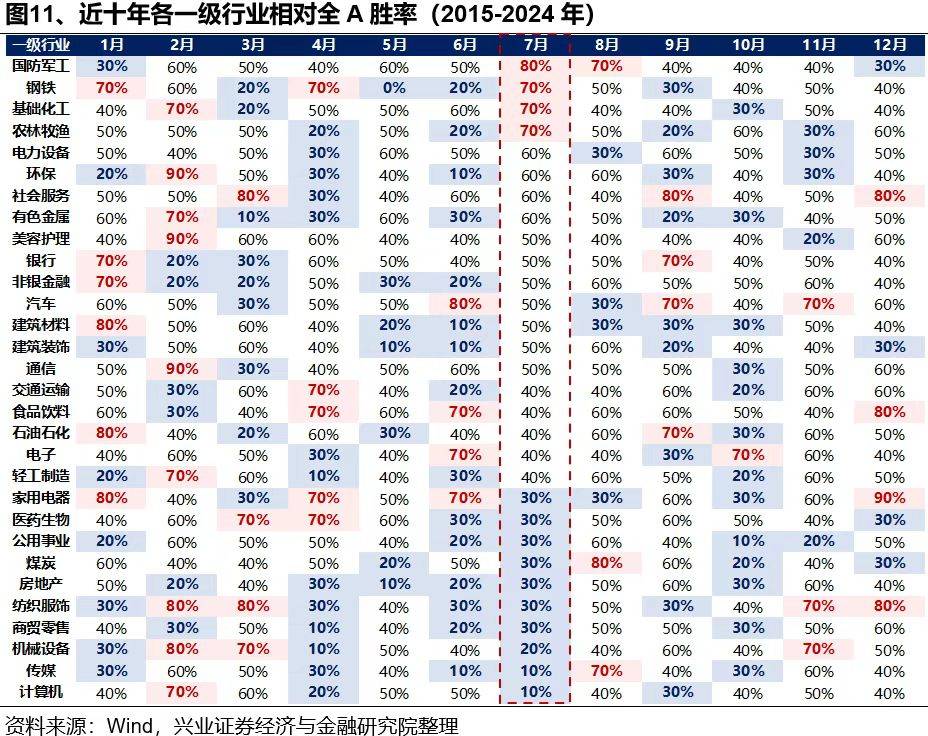
7月哪些板块胜率高?过去10年规律明显!
Sou Hu Cai Jing· 2025-07-05 09:27
Group 1 - The core viewpoint of the report highlights that sectors such as military, new energy, and resource products have shown higher winning rates in market performance over the past decade, particularly in July [1] - The report indicates that the military sector has benefited from policy catalysts and order releases, while resource products have seen improvements in supply-demand dynamics and macroeconomic easing expectations [2][5] - The report emphasizes the importance of not being misled by superficial market appearances, suggesting that investors often struggle to act on known opportunities due to emotional biases [2][5] Group 2 - The report advocates for a strategy of "timely stock rotation" over "blind holding" during bull markets, suggesting that the former allows for greater flexibility while the latter is merely speculative [5] - It points out that historical performance does not guarantee future results, stressing the need for discipline in investment decisions [5] - The report uses the example of bank stocks, which have seen a resurgence since 2022 despite initial skepticism, to illustrate the importance of recognizing institutional buying patterns [7] Group 3 - The report contrasts the performance of bank stocks with that of the liquor sector, which has seen a lack of institutional support leading to fleeting rebounds [9] - It emphasizes that without funding support, even low-priced stocks are not worth investing in, highlighting the critical role of capital flow in determining stock price movements [9] - The report advocates for the use of quantitative data to uncover market truths, arguing that emotional reactions and price movements can be misleading [9]
这次会很猛?“反内卷”浪潮席卷A股!最新概念股名单火线来袭!
私募排排网· 2025-07-05 09:03
Group 1: Core Views - The article discusses the "anti-involution" policy initiated by the Chinese government, which aims to address issues such as vicious competition, price wars, and overcapacity in various industries, particularly in steel, building materials, and photovoltaics [2][3] - The "anti-involution" policy has been elevated to a strategic level, with a focus on improving market competition by shifting the emphasis from price to quality and innovation [3] - The policy is expected to benefit listed companies in the A-share market, especially in the photovoltaic sector, where stocks like Tongwei Co., Longi Green Energy, and Yamaton have shown strong performance [2][4] Group 2: Policy Catalysts - The Central Financial Committee's sixth meeting highlighted the need to govern low-price disorderly competition, guide quality improvement, and facilitate the orderly exit of backward production capacity [3] - The policy is anticipated to improve supply-demand relationships and drive price rebounds in sectors like photovoltaics and steel, benefiting leading companies in these industries [3] Group 3: Industry Impact - In the photovoltaic sector, a meeting held by the Ministry of Industry and Information Technology indicated that the current situation cannot rely solely on self-discipline, and the anti-involution measures will be robust [4] - Major photovoltaic companies, including Tongwei Group and Longi Green Energy, expressed strong support for the government's policies aimed at curbing low-price competition and promoting the exit of outdated production capacity [4] - The article lists 15 photovoltaic stocks that are expected to benefit from the anti-involution policy, with notable price increases observed since July 2 [4][5] Group 4: Steel and Infrastructure - The steel and infrastructure sectors are also expected to benefit from the anti-involution policies, which aim to address long-standing issues of homogenized competition and overcapacity [6] - The new policies are designed to eliminate inefficient production capacity through differentiated regulation, encouraging mergers and high-end transformation [6] - Recent market performance shows significant recovery in steel stocks, with companies like Liugang Co. and Shougang Co. experiencing notable price increases [6][7] Group 5: Chemical and Nonferrous Metals - The chemical and nonferrous metals industries have faced prolonged adjustments, with significant overcapacity and declining profitability [8] - The anti-involution policy aims to address issues of homogenized competition and overcapacity in these sectors, with expectations for improved supply-demand dynamics and technological upgrades [8] - The article identifies several strong-performing stocks in the chemical and nonferrous metals sectors, including Dongyue Silicon Material and Western Mining [8][9]
在"反内卷去产能"政策背景下,哪个大宗商品发展潜力最大?
对冲研投· 2025-07-04 11:19
Core Viewpoint - The recent Central Financial Committee meeting emphasized the need to regulate low-price disorderly competition among enterprises, guide companies to improve product quality, and promote the orderly exit of outdated production capacity. This policy signal has led to a noticeable recovery in the sentiment of the bulk commodity market, with some investors anticipating market benefits similar to those from the supply-side structural reforms of 2016 [3][4]. Policy Impact Analysis - Different periods may have varying policy focuses, necessitating an in-depth analysis of the core impact range of policies. Attention should be directed towards industries with severe overcapacity, widespread losses, high proportions of outdated capacity, and strong policy constraints [4]. - Industries such as polysilicon, industrial silicon, and PVC currently exhibit persistently low profit levels, aligning with the main objectives of policy regulation. The sustainability of profit improvement in these industries hinges on the enforcement strength of policies and the effectiveness of actual capacity clearance [4][5]. Historical Context - The aluminum industry serves as an example where strong policy constraints successfully led to sustained profit improvements during the last capacity reduction phase. Historical experience indicates that there is a certain lag between policy issuance and market rebound, ultimately relying on strict enforcement to achieve profit redistribution within the industry chain [4]. Current Industry Status - Leading companies in industries like polysilicon are beginning to formulate capacity optimization plans. However, due to differences in company nature, interest conflicts, and market constraints, the realization of substantial capacity clearance in the industry will require more time for validation [5]. Profit and Capacity Overview - A summary of key indicators for various bulk commodities, including profit levels, capacity concentration, and the nature of enterprises, has been compiled for reference [6]. - For example, the profit margins and capacity concentration for several commodities are as follows: - PVC: -13% profit margin, 40% capacity concentration, state-owned enterprises [9] - Polysilicon: -13.5% profit margin, 82.23% capacity concentration, private enterprises [10] - Urea: 20% profit margin, 28% capacity concentration, state-owned enterprises [9] - Copper products show varying profit margins, with electrolytic copper at 0.31% and lithium battery copper foil at 26.07% [10].

“七翻身”能否上演?胜率、逻辑与策略全奉上
天天基金网· 2025-07-04 11:13
Core Viewpoint - The article discusses the "July Rebound" phenomenon in the A-share market, highlighting its historical patterns and potential investment opportunities based on behavioral finance and market trends [1][2]. Historical Performance - Over the past 15 years (2010-2024), the average return of the A-share index in June was -1.1%, while in July it rebounded to 0.9%, indicating a typical "bottoming-out and rebound" pattern [2]. - The success rate of the July rebound over the past 15 years was only 60%, with notable exceptions such as a more than 15% decline in July 2015 due to a liquidity crisis [2]. Structural Characteristics - The July market typically exhibits structural characteristics, with high success rates in sectors like military, new energy, and resource industries such as steel, chemicals, and non-ferrous metals, driven by policy expectations and industry cycles [2]. Driving Forces Behind July Rebound - The July rebound is supported by three main factors: liquidity recovery, policy signals from the Central Political Bureau meeting, and the onset of mid-year earnings reports, which can enhance market sentiment and structural opportunities [5]. Investment Opportunities - In July, focus on sectors with earnings forecast discrepancies and recovery potential, including non-US export chains, price increase chains, AI chains, and financial sectors [6]. - The military sector is expected to benefit from policy and event-driven catalysts, particularly during the transition from the 14th to the 15th Five-Year Plan [6]. - The technology sector, especially AI, is anticipated to continue its upward trend due to favorable valuations and market sentiment [6]. - Resource sectors are likely to see improvements due to seasonal demand and price increases in the third quarter [6].

研究所晨会观点精萃:美国非农就业数据好于预期,美联储降息预期下降-20250704
Dong Hai Qi Huo· 2025-07-04 00:48
2025年7月4日 研究所晨会观点精萃 商 品 研 究 研 究 所 晨 会 观 投资咨询业务资格: 证监许可[2011]1771号 分[析Ta师ble_Report] 点 精 萃 从业资格证号:F0256916 投资咨询证号:Z0000671 电话:021-68756925 邮箱:jialj@qh168.com.cn 明道雨 从业资格证号:F03092124 投资咨询证号:Z0018827 电话:021-68758786 邮箱:mingdy@qh168.com.cn 刘慧峰 从业资格证号:F3033924 投资咨询证号:Z0013026 电话:021-68751490 邮箱:Liuhf@qh168.com.cn 刘兵 从业资格证号:F03091165 投资咨询证号:Z0019876 联系电话:021-58731316 邮箱:liub@qh168.com.cn 王亦路 从业资格证号:F03089928 投资咨询证号:Z0019740 电话:021-68757092 邮箱:wangyil@qh168.com.cn 冯冰 从业资格证号:F3077183 投资咨询证号:Z0016121 电话:021-68757092 ...