农产品

Search documents
农产品价格合理为何如此重要
Jing Ji Ri Bao· 2025-12-15 22:34
保持重要农产品价格合理水平有多方面考量,比如保障供给安全、确保农民生计、巩固脱贫成果、农业 转型升级等。合理水平,意味着要平衡生产者和消费者利益,但也不是非此即彼的关系,是可以双赢 的。 中央经济工作会议提出,促进粮食等重要农产品价格保持在合理水平。国家统计局日前发布,2025年全 国粮食总产量14298亿斤,比2024年增加168亿斤。在粮食增产的背景下,如何保持重要农产品价格合理 水平是个重要课题。 合理水平,意味着要平衡生产者和消费者利益,但也不是非此即彼的关系,是可以双赢的。这是因为, 除了价格手段之外,还有其他手段。灵活应用期货、保险等市场化风险管理工具,推广"保险+期货"模 式,保障种粮农民收益稳定。将化肥、种子等关键农资纳入补贴联动机制,必要时给予阶段性补贴,减 轻成本上行对农民收益的挤压。强化对农业生产的基础性支持保护,改善农田基础生产条件、发展农业 社会化服务、完善仓储保鲜设施,尤其要注重产销顺畅衔接、流通模式改进。此外,要正确引导经营主 体预期,让生产者对未来有基本判断。 在我国,重要农产品包括粮棉油肉蛋奶果菜茶鱼等。在食物消费多元化的今天,调控不可能也没必要盯 住所有农产品。同样是重要农 ...

美国农业部称,10 月农产品收购价格同比上涨 6.9%。
Xin Lang Cai Jing· 2025-12-15 20:18
Group 1 - The core point of the article is that the U.S. Department of Agriculture reported a 6.9% year-over-year increase in agricultural product purchase prices for October [1] Group 2 - The increase in agricultural product prices indicates a potential rise in costs for consumers and businesses involved in the agricultural supply chain [1] - This price change may impact the profitability of agricultural companies and influence investment decisions in the sector [1] - The report highlights ongoing trends in agricultural pricing, which could affect market dynamics and food inflation [1]
前11个月浙江进出口总值突破5万亿元
Zhong Guo Jing Ji Wang· 2025-12-15 13:18
Core Insights - Zhejiang's total import and export value reached 5.06 trillion yuan from January to November, marking a year-on-year growth of 5.3%, which is 1.7 percentage points higher than the national average [1] - Exports amounted to 3.83 trillion yuan, growing by 7.1%, while imports were 1.23 trillion yuan, with a slight increase of 0.1% [1] - Zhejiang's import and export, export, and import values accounted for 12.3%, 15.7%, and 7.4% of the national totals, ranking third, second, and sixth respectively [1] Trade Market Performance - ASEAN solidified its position as Zhejiang's largest trading market with a total trade value of 786.81 billion yuan, growing by 15.4%, contributing 40.9% to the province's overall import and export growth [1] - The EU is the second-largest trading market for Zhejiang, with a trade value of 770.14 billion yuan, increasing by 8.3%, including imports and exports with France reaching 83.84 billion yuan, up by 7.3% [1] - Exports to emerging markets such as ASEAN, Latin America, the Middle East, and Africa grew by 16.1%, 10.0%, 12.0%, and 15.4% respectively [1] - Total trade with countries involved in the Belt and Road Initiative reached 2.90 trillion yuan, growing by 8.5%, accounting for 57.3% of the province's total import and export value [1] Private Sector Performance - Private enterprises' import and export values reached 4.16 trillion yuan, growing by 7.0%, and accounted for 82.1% of the province's total, an increase of 1.3 percentage points year-on-year [2] - Exports from private enterprises were 3.30 trillion yuan, up by 8.4%, while imports were 858.61 billion yuan, growing by 1.7% [2] - Foreign-invested enterprises reported an import and export value of 619.78 billion yuan, increasing by 2.8%, with exports at 394.41 billion yuan, up by 2.3%, and imports at 225.37 billion yuan, growing by 3.8% [2] Export Product Trends - The export of electromechanical products reached 1.79 trillion yuan, growing by 8.8%, with "new three samples" products exporting 120.2 billion yuan, a significant increase of 23.3% [2] - Solar products, electric vehicles, and lithium-ion batteries have seen continuous growth for 4, 12, and 20 months respectively [2] - Labor-intensive products exported amounted to 1.13 trillion yuan, growing by 3.9%, capturing 30.5% of the national market share [2] - High-tech product exports reached 324.35 billion yuan, increasing by 10.7%, with high-end equipment exports at 129.73 billion yuan, growing by 16.8% [2] Import Product Trends - Electromechanical product imports grew significantly, reaching 218.42 billion yuan, an increase of 21.8%, with aircraft and other aviation equipment, as well as computers and components, growing by 122.9% and 43.1% respectively [2] - Consumer goods imports totaled 143.46 billion yuan, growing by 8.7%, while agricultural product imports reached 112.04 billion yuan, increasing by 10.6% [2]
2026年豆粕期货年度行情展望:稳中求进,关注贸易与天气
Guo Tai Jun An Qi Huo· 2025-12-15 11:15
Group 1: Report Industry Investment Rating - Not provided in the content Group 2: Core Viewpoints of the Report - In normal circumstances, the price of soybean meal futures is expected to rise steadily in 2026. If there is adverse weather, the price may enter an upward cycle [2]. - The price of US soybeans is expected to rise steadily due to the tight supply - demand balance sheet. The Brazilian soybean premium is neutral, and the price of soybean meal is affected by US soybean prices, Brazilian premiums, and weather factors [2][118][119]. Group 3: Summary by Related Catalogs 1. 2025 DCE Soybean Meal Futures Price Review - From January to April 8, 2025, the price of soybean meal futures rose. The reasons included the bullish USDA report in January, Sino - US and Sino - Canadian trade frictions [6]. - From April 9 to November 28, 2025, the price entered an "interval operation" pattern, mainly trading "Sino - US trade sentiment", with five trading bands affected by trade news and market sentiment [7]. 2. 2026 Soybean Meal Futures Price Main Influencing Factors Analysis 2.1 Raw Material Soybean Supply and Demand: Tight US Supply, Neutral South American Supply - **US Soybean Balance Sheet: Tight Supply - Demand in the Inventory Reduction Cycle** - In 2025/26, US soybean supply decreased due to reduced planting, while demand decreased due to trade frictions. Supply decline was greater than demand, leading to a tight balance sheet [15]. - In 2026/27, the US soybean balance sheet is expected to remain tight. Planting area may increase slightly, supply and demand will both expand, but supply growth will be lower than demand, and ending stocks will decline [29][30]. - **South American Soybean Balance Sheet: Neutral, First Contracting, Then Loosening** - In 2025/26, the Brazilian soybean balance sheet slightly contracted, and it is expected to be loose in 2026/27. The Argentine balance sheet slightly contracted in 2025/26 and is expected to be slightly loose in 2026/27 [32][33][48]. - **Weather's Impact on the Balance Sheet** - Abnormal weather can lead to a tight balance sheet and price increases. Currently, La Nina weather is expected to last until February 2026 and turn ENSO neutral from January to March 2026, which may affect South American soybean production [51]. 2.2 Soybean Meal Supply: Stable or Slightly Decreasing due to Declining Import Profits - In 2025, China's soybean imports and soybean meal production were high, but the operating rate was low due to low profits and temporary shortages. In 2026, soybean imports may be stable or slightly decrease due to poor import profits, which may affect soybean meal supply [55][73]. 2.3 Soybean Meal Demand: Stable or Slightly Decreasing due to Declining Breeding Profits - In 2025, soybean meal demand was good, with stable growth in livestock and poultry breeding, increased feed production, and a rising proportion of soybean meal addition. In 2026, demand may be stable or slightly decrease due to declining breeding profits, a possible decline in the scale of livestock and poultry breeding, and a slight decrease in the proportion of soybean meal use [96][97]. 3. Conclusion and Investment Outlook - The price of US soybeans is expected to rise steadily, the Brazilian soybean premium is neutral. In normal weather, the balance sheets of Brazil and Argentina have minor contradictions. Adverse weather may tighten the balance sheets and drive up prices. Domestic soybean meal supply and demand may slightly contract, and the spot price may be slightly stronger [118][119][120][121][122]. - Investment strategy: Focus on the "buying on dips and trading in bands" strategy. Pay attention to possible driving events such as trade policies, adverse weather, and USDA reports [123].
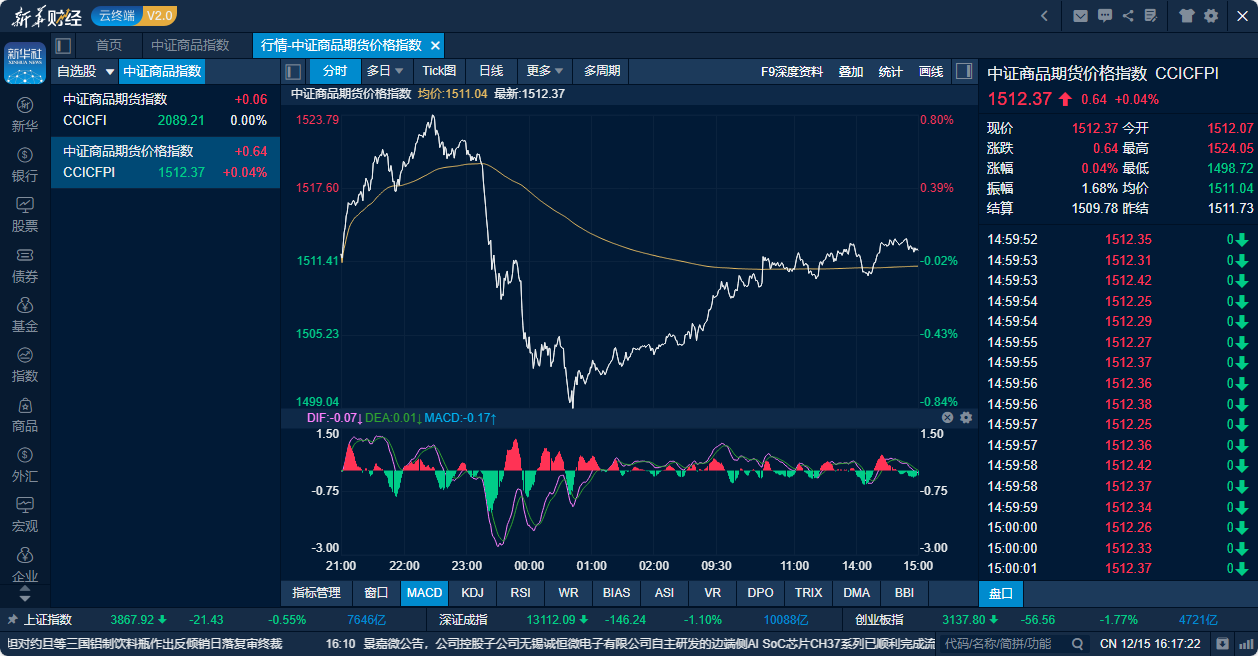
商品日报(12月15日):铂钯表现活跃铂金封板涨停 氧化铝多晶硅涨超3%
Xin Hua Cai Jing· 2025-12-15 10:33
Group 1: Market Overview - The domestic commodity futures market showed overall strength on December 15, with the China Securities Commodity Futures Price Index closing at 1512.37 points, up 0.64 points or 0.04% from the previous trading day [1] - The commodity futures index closed at 2089.21 points, with a slight increase of 0.06 points, reflecting a stable market [1] Group 2: Precious Metals Performance - Platinum prices surged to a limit-up, marking a 7.00% increase and reaching a historical high, driven by supply shortages and strong demand from the hydrogen energy sector [2] - Palladium also saw a significant rise of over 4%, benefiting from the bullish trend in platinum [2] - Gold's strong performance laid the foundation for the overall strength in the precious metals sector, despite silver experiencing volatility [2] Group 3: Silicon Market Dynamics - The main contract for polysilicon rose by 3.61%, nearing its historical high from earlier in the month, primarily due to the announcement of a capacity integration acquisition platform [3] - However, the supply-demand dynamics for polysilicon remain weak, with inventory levels reaching 293,000 tons, sufficient for nearly two months of production [3] - Production cuts in the silicon wafer segment were noted, with a significant reduction of over 10% in November and a further expected decrease in December [3] Group 4: Agricultural Products and Copper - The new season apples faced downward pressure, dropping over 3% due to an oversupply in the market and weak demand ahead of the holidays [4] - Copper prices experienced a decline of over 1% after reaching historical highs, influenced by increased inventories and expectations of weakened demand [5] - Domestic electrolytic copper inventories rose to 177,200 tons, indicating a supply surplus that may pressure prices further [5]

2026年玉米期货行情展望:底部确立,价格重心上移
Guo Tai Jun An Qi Huo· 2025-12-15 09:49
Report Summary 1. Investment Rating The report does not provide an investment rating for the corn industry. 2. Core Viewpoints - In the 2025/26 crop year, the bottom of the corn price is expected to rise, and investors should focus on trading opportunities in price fluctuations. The domestic corn supply will increase due to the growth in both planting area and yield in 2025, while the demand is expected to decline. As a result, the supply - demand situation will be marginally looser, and the overall policy - related substitutes still have room, which restricts the upside of the corn price [2][81][82]. - Before the Spring Festival, the selling pressure on corn may not be significant. After the resolution of the temporary supply - demand mismatch, traders will enter the market to build inventories, and the price correction will be limited. Subsequently, the corn price may fall again due to traders' selling and policy auctions, but the overall price center is expected to move up. Additionally, the situation of the new - season corn should be monitored [2][82]. - In 2026, the corn price is expected to fluctuate between 2000 - 2450 yuan/ton, with a core range of 2100 - 2400 yuan/ton [3][83]. 3. Summary by Directory 3.1 2025 Corn Market Review - In 2025, the corn futures price fluctuated within a large range, and the spot price moved up compared to the beginning of the year. In the first half of the year, the price rose due to factors such as policy - driven stockpiling, tariff counter - measures, wheat drought, and tight supply - demand. After reaching a high, the price declined due to factors like imported corn auctions and high warehouse receipts. After the new grain was on the market, the price rebounded. The overall price center continued to move down compared to the previous year, and the futures were mainly in a negative basis situation, with a "strong expectation, weak reality" tone [6]. 3.2 International Grains: Loose Supply - Demand Remains Unchanged - **Global Grains**: In the 2025/26 crop year, the global grain supply - demand remains loose. The global grain planting area increased due to better planting profit compared to soybeans, with production rising by 3.2% year - on - year to 2.946 billion tons. Demand increased by 2.3% year - on - year to 2.947 billion tons, mainly from the feed and industrial sectors. The ending inventory is expected to be 769 million tons, a 0.16% year - on - year decrease [11]. - **International Corn**: - **USA**: In the 2025/26 crop year, the US corn production reached a record high due to the increase in both area and yield. The domestic demand and export demand increased. The supply - demand is in a loose pattern, but the price center is expected to move up due to strong export demand and the possible reduction in the 2026 planting area [12][15]. - **Brazil**: The Brazilian corn production is expected to decline. The planting area increased by 4%, but the yield per hectare decreased by 5.4% due to factors such as high - temperature drought and delayed soybean harvest affecting the second - season corn [17]. - **Ukraine**: The Ukrainian corn production increased, and the export is expected to recover. The production increased by 5.2 million tons year - on - year, and the export is expected to reach 24.5 million tons in the 2025/26 crop year [19]. 3.3 Domestic Corn - **Production Increase in 2025/26**: In 2025, the national corn planting area increased by 940,000 mu (0.15%) to 60.912 million mu. The yield increased due to favorable climate conditions and the promotion of planting techniques. The national corn output was 282.45 million tons, a 4.1% year - on - year increase [21][22]. - **Feed Demand Expected to Decline Slowly**: - **2025/26 Feed Demand Forecast**: The overall feed demand is expected to decline. For pigs, the inventory of sows is expected to decrease, driving the decline in commercial pig inventory after the second quarter of 2026. For poultry, the feed demand for meat - type poultry is expected to increase slightly, while that for egg - laying poultry is expected to decline [24][29][39]. - **Structural Demand for Corn**: The structural demand for corn in feed is expected to decline slightly. The substitution of corn in feed depends on cost - effectiveness and policy. Currently, the substitution of wheat for corn has decreased, and the overall substitution situation is uncertain [41][42]. - **Deep - processing Demand Expected to Increase Slightly**: The deep - processing demand for corn is expected to be relatively rigid, with consumption remaining flat or increasing slightly compared to the previous year. In 2024/25, the consumption of deep - processing enterprises decreased by 5%, mainly in the starch and alcohol industries. Currently, the consumption is showing signs of recovery [45]. - **Supply - Demand Balance: Annual Inventory Accumulation**: In the 2025/26 crop year, the domestic corn market is expected to accumulate inventory. Supply will increase due to higher production and possible import growth, while demand will decline, resulting in a marginally looser supply - demand pattern [52]. 3.4 Range - bound with a Rising Price Floor - **Limited Price Decline and Weak Selling Pressure Before the Spring Festival**: Since November 2025, the corn price has been rising against the season due to factors such as restocking demand, farmers' reluctance to sell, and logistics bottlenecks. The outflow of corn from Northeast China is expected to decrease in the future, the downstream restocking enthusiasm will weaken, and the port inventory will gradually accumulate. After the resolution of the supply - demand mismatch, traders will build inventories, and the selling pressure on farmers may not be significant, with limited price correction [53][55][56]. - **After Grain Sales: Focus on Traders' Selling, Substitutes, and New - season Corn Planting**: - **Domestic Policy Substitutes - Wheat Substitution Limited**: The wheat - corn price spread is currently high, and the substitution volume is expected to remain stable or decrease slightly. The probability of a large - scale substitution of wheat for corn before the first quarter of 2026 is low. Attention should be paid to the new - season wheat production and the possible auction of overdue wheat [68][69]. - **Domestic Policy Substitutes - Possible Rice Auction**: There is still a surplus of brown rice, and attention should be paid to the policy regarding its release time, quantity, and base price [71]. - **Imported Grains May Increase Marginally**: The import of corn is expected to increase slightly, mainly depending on policy and import profit. The import of sorghum and barley is expected to decrease, and attention should be paid to cost - effectiveness and import policies [73][75]. - **Traders' Selling and New - season Corn**: After the Spring Festival, the corn price may fall due to traders' selling and the influence of substitutes. The planting cost of new - season corn may increase, and the price may rise in the third quarter due to inventory reduction and restocking demand [80].
印度经济将面临显著短期风险
Jing Ji Ri Bao· 2025-12-15 08:42
Core Viewpoint - The International Monetary Fund (IMF) report indicates that the Indian economy is performing well, supported by improving domestic conditions, with a projected growth rate of 6.5% for FY2024-2025 and 7.8% year-on-year GDP growth for Q1 FY2025-2026, despite facing significant short-term risks [1][2]. Economic Growth Projections - For FY2025-2026, India's actual GDP is expected to grow by 6.6%, with inflation projected to decrease to 2.8% [2] - By FY2026-2027, GDP growth is anticipated to slow to 6.2%, with inflation rebounding to 4% [2] Trade and External Debt - Commodity trade exports are projected to reach $416.3 billion, a year-on-year decline of 5.8%, while imports are expected to rise to $746.6 billion, a growth of 2.4% [2] - External debt is forecasted to increase to $791 billion, accounting for 19.2% of GDP [2] Structural Reforms - The implementation of the Goods and Services Tax (GST) on September 22, 2025, is expected to simplify the tax structure, stimulate domestic consumption, and mitigate the adverse effects of high tariffs [2][3] - Continuous structural reforms and fiscal consolidation are deemed crucial for achieving fiscal deficit targets and enhancing economic resilience [3] Risks and Challenges - The report highlights significant short-term risks, including potential tightening of financial conditions due to geopolitical fragmentation and unpredictable climate change impacts on agriculture, which could elevate inflation pressures [3] - The need for ongoing financial structural reforms and careful monitoring of non-bank financial institutions is emphasized to mitigate associated risks [3] Recommendations for Sustainable Growth - The Indian government is advised to enhance human capital accumulation, increase female labor participation, and optimize the business environment to attract foreign direct investment [4] - There is a call for increased R&D investment and innovation to support green economic transformation and ensure sustainable growth [4]
2026年度农产品策略报告-20251215
Guang Da Qi Huo· 2025-12-15 08:05
1. Report Industry Investment Ratings No investment ratings for the industry are provided in the report. 2. Core Views of the Report - The pricing logic of agricultural products has shifted, with policy and geopolitics taking precedence, followed by cost, and supply - demand coming third due to complex international trade environments and increased trade conflicts [8][114]. - In 2026, the overall supply of agricultural products is expected to increase, but the growth rate will slow down. There are potential opportunities in specific sectors and stages, while market volatility will intensify [114]. - For different agricultural products, such as oilseeds, grains, livestock, and eggs, their supply - demand structures, market trends, and influencing factors vary, and corresponding investment strategies and risk points need to be considered. 3. Summary by Relevant Catalogs 3.1 Oilseeds and Oils 3.1.1 2025 Market Review - Domestic soybean meal fluctuated, with a wider spot price range than the futures price. The price of oils declined from a high level, with palm oil leading the market, and the soybean - palm oil price spread widened and adjusted [7][11][19]. 3.1.2 2026 Market Analysis - The pricing of oilseeds is mainly influenced by policy and geopolitics. The global supply - demand of oilseeds is approaching balance in 2025/26, but there are opportunities for phased market movements due to uncertain factors such as weather and policies [8][114]. - Global oilseed production is expected to increase at a slower pace, with soybeans decreasing and rapeseed and sunflower seeds increasing. The consumption of oilseeds is expected to be strong, mainly driven by bio - diesel policies and feed demand [29][35]. - The production of palm oil may exceed expectations, driven by weather and technological factors. The biodiesel policies of the US and Indonesia are uncertain, which will affect the demand for oils [67][83]. - There are differences in the forecasts of global vegetable oil trade volume by different institutions. The inventory of vegetable oils is expected to decline slightly, and the market lacks a clear driving force [106][110]. 3.1.3 Price Outlook - If South American soybean production decreases by more than 10 million tons, the global soybean price center will move up. If South American production is stable and China actively purchases soybeans, the market will be relatively loose. If China purchases cautiously, the supply - demand contradiction will intensify [114]. 3.2 Corn 3.2.1 2025 Market Review - Domestic and international corn futures prices first rose and then fell. The domestic market was mainly affected by policies, experiencing a roller - coaster ride from state - owned grain reserve purchases to imported corn auctions [120][123]. 3.2.2 2026 Market Analysis - Global corn production is expected to have a good harvest, with increased production in the US and China. The demand for feed and deep - processing is expected to decline slightly due to losses in the breeding industry [121][164]. - The inventory of corn is expected to increase, with an increase in trade - link inventory and expected imports of substitutes [121]. 3.2.3 Future Concerns - The relative changes between the expected high - yield and carry - over inventory will affect the corn price [186]. - The increase in Xinjiang's corn production will change the national corn trade pattern [191]. - The impact of bio - energy policies on US corn exports and the guidance of agricultural policies on the corn market [195][197]. 3.2.4 Price Outlook - In 2026, the international corn market supply is expected to increase, and the domestic market will face pressure from a large harvest and increased imports. The price is expected to be high in the first half and low in the second half of the year [206]. 3.3 Pork 3.3.1 2025 Market Review - The supply of pork increased in 2025, leading to a decline in prices. The market was affected by factors such as secondary fattening and policy regulation [208][212]. 3.3.2 2026 Market Analysis - The number of sows in stock decreased in October 2025, which will lead to a reduction in pig slaughter in the second half of 2026, resulting in a supply contraction [209][220]. - Pig prices are expected to be weak first and then strong, and industry profits are expected to recover. Policy guidance and supply - demand adjustment will interact to affect pig prices [209]. 3.3.3 Price Outlook - In 2026, the pig market is expected to experience a price reversal. After the Spring Festival, pig prices may decline seasonally, but they will rebound after May as supply decreases and demand recovers [266]. 3.4 Eggs 3.4.1 2025 Market Review - The spot price of eggs was under pressure from the supply side and showed a weak performance throughout the year, with obvious seasonal patterns [267][271]. 3.4.2 2026 Market Analysis - The inventory of laying hens has slightly decreased but remains at a high level. The willingness of farmers to replenish the flock has decreased, and the willingness to cull old hens has increased, which will help alleviate over - capacity [283][285]. - Feed raw material prices are expected to be weak, reducing the cost support for egg prices. The terminal demand for eggs maintains normal seasonal patterns without new bright spots [268]. 3.4.3 Price Outlook - In 2026, egg prices are expected to follow seasonal patterns. With the expected slow decline in production capacity, egg prices are expected to improve, but uncertainties in farmers' replenishment and culling decisions need to be monitored [308][310].
——2025年玉米及玉米淀粉市场回顾与2026年展望:玉米:青纱帐起接天势,金缕风回落地痕
Fang Zheng Zhong Qi Qi Huo· 2025-12-15 05:12
1. Report Industry Investment Rating No relevant content provided. 2. Core Viewpoints of the Report - In 2025, the corn futures price showed a "rise - fall - rise" trend. Looking ahead to 2026, the corn futures price is expected to rise first and then fall, with the key points being the release rhythm and time of old grain and the expected difference in total quantity confirmation. The price of CBOT corn may gradually bottom out and rebound, which will support the domestic corn market sentimentally. The consumption side is expected to be in a slow de - capacity game stage, and the domestic corn yield in the next year is initially expected to remain stable, but the weather uncertainty makes the driving force unclear. The expected fluctuation ranges of corn contracts 2601, 2603, and 2605 are 2200 - 2350, 2170 - 2340, and 2230 - 2360 respectively. It is recommended to adopt an interval trading strategy, and trading enterprises can pay attention to the selling - hedging opportunities at the upper edge of the interval [2]. - In 2025, the center of the corn starch futures price did not change significantly, and the fluctuation trend was basically the same as that of the cost corn futures price, showing a "rise - fall - rise" rhythm. In 2026, the supply - demand of the corn starch market is expected to remain relatively balanced, and the profit game will still be the main theme. The futures price is expected to continue to fluctuate with the cost. The expected operating ranges of corn starch contracts 2601, 2603, and 2605 are 2480 - 2660, 2460 - 2670, and 2560 - 2700 respectively. It is also recommended to adopt an interval trading strategy, and trading enterprises can pay attention to the selling - hedging opportunities at the upper edge of the interval [3][4]. 3. Summary According to Relevant Catalogs 3.1 Corn Market Long - term Trend and 2025 Market Review - **Long - term Historical Review**: The corn futures price trend can be divided into six stages since 2004. Each stage is affected by policies, economic situations, and supply - demand relationships. For example, from 2004 - 2008, without the temporary storage purchase policy, the corn price rose continuously; from 2008 - 2015, the corn market was supported by the temporary storage purchase policy; from 2015 - 2016, it entered the post - temporary storage policy era, and the price fell sharply [13][14][18]. - **2025 Futures Market Summary**: The futures price of the main corn contract in 2025 showed an interval - oscillating pattern, which can be divided into three stages: rising from January to June, falling from July to mid - October, and rebounding from late October to November. The price center at the end of the year was slightly higher than that at the beginning of the year [22]. - **2025 Spot Market Summary**: The corn spot price in 2025 showed an interval - oscillating trend, and the operating range at the end of the year was slightly higher than that at the beginning of the year. The price showed a "rise - fall - rebound" pattern, affected by factors such as supply - demand, policies, and weather [24][26]. - **Futures Trading and Position - holding Situation**: In 2025, the trading activity of the corn futures market increased compared with the previous year. The cumulative trading volume from January to November was 163,009,844 lots, a year - on - year increase of 15.30%, and the cumulative trading volume was 36,872 billion yuan, a year - on - year increase of 11.33%. The overall position - holding level was slightly higher than that in 2024, showing a distribution characteristic of "high at both ends and low in the middle" [28]. 3.2 Corn Starch Long - term Trend and 2025 Market Review - **Long - term Historical Review**: The price trend of corn starch futures is highly correlated with that of corn futures. It can be divided into six stages since 2014, affected by factors such as corn price, supply - demand, and policies [35][36]. - **2025 Futures Market Summary**: The corn starch futures price in 2025 showed an oscillating trend, with limited change in the annual fluctuation center. It can be divided into three stages: rising from January to June, falling from July to October, and rebounding in November, which is basically consistent with the trend of the raw material corn price [40]. - **2025 Spot Market Summary**: The corn starch spot price in 2025 first rose and then fell, following the trend of the raw material corn price. It can be divided into three stages: rising from January to June, consolidating narrowly from July to August, and falling from September to November [41]. - **Futures Trading and Position - holding Situation**: From January to November 2025, the cumulative trading volume of corn starch futures was 33,603,107 lots, a year - on - year increase of 3.66%, but the cumulative trading volume was 8,711.6 billion yuan, a year - on - year decrease of 3.08%. The overall position - holding scale remained relatively stable, and the position - holding volume at the end of November was 330,503 lots, slightly higher than that in the same period of 2024 [45]. 3.3 Global Corn Market Situation - **2025/26 Global Corn Yield Estimated to Increase Year - on - Year**: The global corn yield in the 2025/26 season is expected to reach a record high of 1.286 billion tons, an increase of 55.49 million tons compared with the previous year. The United States is the core driving force for the increase, with an estimated yield of 425.525 million tons, an increase of 47.257 million tons year - on - year [52]. - **Increasing Disagreements on 2026/27 Global Corn Yield**: In the 2026/27 season, the global corn planting area is expected to be stable with a slight downward trend. The influence of weather factors on yield is expected to be more prominent [57][58]. - **Steady and Slight Increase in Global Corn Demand**: The global corn consumption in the 2025/26 season is expected to reach 1.284 billion tons, a year - on - year increase of about 2.74%. Feed consumption is the main support, and industrial consumption also shows a slow - growth expectation [62]. - **CBOT Corn Price Expected to Bottom Out and Rebound**: In 2026, the supply side of the global corn market is expected to be stable, and the demand side shows structural highlights. The price of CBOT corn is expected to show a trend of rising in the first half of the year and oscillating at a high level in the second half of the year [66][67]. 3.4 Domestic Corn Market Situation - **Supply Market Analysis** - **Increasing Yield Pattern Set, Quality Differentiation and Purchase - Sales Rhythm Become Focus**: In the 2025/26 season, the domestic corn yield is expected to increase, but there is significant regional quality differentiation in North China. The selling rhythm of farmers and traders will affect the price rhythm in different periods [71][72]. - **Limited Change in 2026/27 Planting Area, Weather Still the Dominant Factor for Yield**: The corn planting area in 2026 is expected to be relatively stable, and the yield is initially estimated to be stable with a slight increase. However, weather is still the key variable affecting the final yield [78]. - **2025/26 Import Volume Expected to Remain at a Low Level**: From January to October 2025, China's corn import volume was only 129.28 million tons, a year - on - year decrease of 90.1%. In 2026, the import volume is expected to recover slightly but still remain at a low level [81][82]. - **Demand Market Analysis** - **Limited Increment in Feed Consumption, Substitution as the Anchor**: In 2026, the feed consumption of corn is expected to be stable with limited increment. The breeding industry is expected to continue to reduce capacity slowly, and substitution by other grains will cause periodic disturbances [85][86]. - **2025/26 Industrial Consumption Expected to be Stable**: The domestic corn industrial consumption market is expected to maintain a "stable with a slight increase" pattern in the 2025/26 season. However, the starch and alcohol industries are affected by cost pressure and have weak support for corn consumption [108][109]. - **Supply - Demand Balance Sheet Analysis**: In the 2025/26 season, the domestic corn supply - demand is expected to remain relatively balanced. The supply side shows a stable year - on - year trend, and the demand side also maintains a stable expectation [116]. 3.5 Corn Starch Market Fundamentals - **Supply Market Analysis - Yield Expected to Decrease Slightly Year - on - Year under the Expectation of Profit Convergence**: In 2025, the corn starch industry was under the triple pressure of weak demand, high cost, and low profit, and the yield decreased significantly. In 2026, the industry is still expected to face the contradiction of rising cost and weak demand, and the yield is expected to decrease slightly year - on - year [118]. - **Demand Market Analysis - Insufficient Incremental Drivers**: In 2026, the terminal consumption of corn starch is expected to continue the stable and weak trend, lacking growth highlights. The consumption is expected to be stable with a slight decrease [121]. - **Supply - Demand Balance Sheet Analysis**: In 2026, the supply and demand of corn starch in China are expected to decline. The industry is expected to show a relatively balanced state [124]. 3.6 Arbitrage Opportunity Analysis - **Cross - Variety Arbitrage**: The spread between corn starch and corn is recommended to be treated with an interval - trading idea. Currently, the spreads in May and September are in the middle - low range, and there is limited downward space. In the short term, the spread is expected to continue to shrink, and there is a repair expectation in the medium term [129]. - **Corn Cross - Period Arbitrage**: It is recommended to pay attention to the opportunity of going long on the May - March contract spread and going short on the May - September contract spread of corn. The current fundamentals support the May contract the most [131]. 3.7 Seasonal Analysis - **Seasonal Analysis of Corn Index Price**: According to the seasonal chart of the corn futures index, the prices are more likely to rise in February, April, and October and more likely to fall in July. Seasonal rules are only for reference [133]. - **Seasonal Analysis of Corn Starch Index Price**: According to the seasonal chart of the corn starch futures index, the prices are more likely to rise in January, February, April, and October and more likely to fall in July. Seasonal rules are only for reference [138]. 3.8 Corn and Corn Starch Market Viewpoint Summary and Operation Suggestions - **Corn Market Viewpoint Summary and Operation Suggestions**: In 2026, the supply - side focuses on the release rhythm of grain sources, yield expectations, and import market changes. The demand - side focuses on the breeding and deep - processing markets. The overall consumption of corn is expected to be weak, but periodic disturbances are still the focus. The price is expected to rise first and then fall. It is recommended to adopt an interval - trading strategy [142][143][145]. - **Corn Starch Market Viewpoint Summary and Operation Suggestions**: In 2026, the supply - demand of the corn starch market is expected to be relatively balanced, and the profit game is still the main theme. The price is expected to fluctuate with the cost. It is recommended to adopt an interval - trading strategy [149]. 3.9 Option Market Analysis and Operation Strategy - **Corn Option Market Situation and Operation Strategy**: Based on the judgment that the corn 2605 contract fluctuates in the range of 2200 - 2400, upstream enterprises are recommended to sell out - of - the - money call options, downstream enterprises are recommended to sell out - of - the - money put options, and speculators are recommended to sell a wide - straddle combination strategy [155]. - **Corn Starch Option Market Situation and Operation Strategy**: Based on the judgment that the corn starch 2603 contract fluctuates in the range of 2460 - 2670, upstream enterprises are recommended to sell out - of - the - money call options, downstream enterprises are recommended to sell out - of - the - money put options, and speculators are recommended to sell a wide - straddle combination strategy [162]. 3.10 Related Stock Price Changes - The report lists the stock price changes of several companies related to the corn industry in 2025, such as Muyuan Co., Ltd. with a rise of 29.77%, New Hope with a rise of 3.42%, and Zhengbang Technology with a fall of 13.82% [163].
重要大宗商品指数再平衡在即,黄金白银期货将迎巨大抛压!
Hua Er Jie Jian Wen· 2025-12-15 04:41
Core Viewpoint - A significant "technical storm" driven by index rules is anticipated, primarily affecting gold and silver due to an upcoming rebalancing of the Bloomberg Commodity Index (BCOM) in January 2026, which is expected to exert substantial selling pressure on these precious metals [1][2]. Group 1: Technical Selling Pressure - The core driver of the anticipated selling pressure is the mean reversion effect, as gold and silver have outperformed other commodities over the past three years, leading to an inflated weight in the BCOM index [2]. - The forced selling operations are projected to occur between January 8 and 14, 2026, coinciding with the BCOM index roll period, potentially resulting in concentrated capital outflows from the market [2]. Group 2: Seasonal Factors vs. Technical Selling - January will present a battleground of bullish and bearish factors for gold investors, with historical data indicating an average price increase of 4.6% during the last ten trading days of the year and the first twenty trading days of the new year, with an 80% probability of price increases [3]. - However, the significant technical selling pressure from the index rebalancing may counteract this seasonal bullish trend, particularly with silver facing greater selling pressure than in previous years [3]. Group 3: Broader Commodity Market Impacts - The rebalancing will not only impact precious metals but will also create complex long and short dynamics across other commodities, as different indices will adjust their weights differently [4]. - The oil market outlook is cautious, with expectations of a growing oversupply in 2026 and 2027, which may exert downward pressure on oil prices [4]. Group 4: Specific Commodity Predictions - Silver is expected to face the heaviest selling pressure, with the anticipated sell-off amounting to approximately 9% of its total open interest in the futures market [5]. - Gold's projected selling pressure is estimated at about 3% of its total open interest, which, despite being lower than silver's, still represents a significant absolute value due to gold's large market size [5]. - Cocoa is predicted to be the biggest winner from the rebalancing, with expected buying pressure equivalent to 22% of its total open interest, significantly surpassing other agricultural products [6]. Group 5: Market Volatility and Key Observations - The rebalancing will also involve the S&P GSCI index, with both indices adjusting during the same period, which could amplify market volatility due to the large asset scale tracking BCOM exceeding $60 billion [8]. - Notably, there are significant directional discrepancies between the two indices, such as cocoa being a large buy in BCOM while facing substantial sell pressure in S&P GSCI, potentially leading to cross-index arbitrage activities and unusual market fluctuations [8].