原材料

Search documents
华安基金:本周美联储或重启降息,港股流动性有望受益
Xin Lang Ji Jin· 2025-09-16 08:14
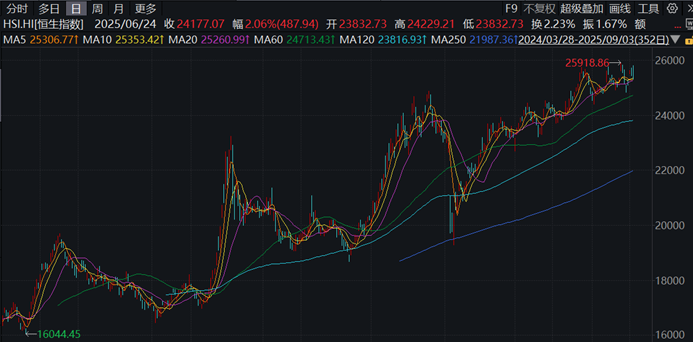
Market Overview and Key Insights - The Hong Kong stock market's dividend sector saw an increase last week, with the Hang Seng China Enterprises Dividend Total Return Index rising by 4.14%, the Hang Seng Index by 4.04%, and the Hang Seng Tech Index by 5.34% [1] - Active foreign capital returned to the Hong Kong stock market, with a net inflow of HKD 60.8 billion from southbound funds last week [1] - The U.S. job market has shown signs of weakness, with the unemployment rate reaching 4.3%, the highest in nearly four years, indicating economic cooling [1] - Market expectations for a Federal Reserve rate cut have increased, with a 90% probability of a 25 basis point cut in September and an overall expectation of three cuts within the year [1] Federal Reserve Impact on Hong Kong Stocks - The Federal Reserve's potential rate cuts may benefit the capital flow into Hong Kong stocks, as the market is sensitive to U.S. monetary policy changes due to its peg to the U.S. dollar [2] - Historically, the Hang Seng Index has shown a negative correlation with the U.S. dollar index and U.S. Treasury yields, suggesting that a rate cut could lead to increased investment in undervalued Hong Kong stocks [2] Dividend Strategy and Valuation - The Hang Seng China Enterprises Dividend Index has a dividend yield of 6.25%, significantly higher than the 4.51% yield of the CSI Dividend Index, with a price-to-book ratio of 0.62 and a price-to-earnings ratio of 6.98 [2] - Since early 2021, the total return index has gained 141%, outperforming the Hang Seng Total Return Index by 126% [2] - The low interest rate environment and weak economic recovery in China are favorable for dividend strategies, with strong dividend capabilities from state-owned enterprises [2] ETF Overview - The Huaan Hong Kong Stock Connect Central State-Owned Enterprises Dividend ETF (code: 513920) tracks the Hang Seng China Enterprises Dividend Index, focusing on high-dividend securities listed in Hong Kong with state-owned enterprise majority ownership [3] - This ETF is the first in the market to combine the attributes of Hong Kong stocks, state-owned enterprises, and dividends [3] ETF Performance - The Huaan Hong Kong Stock Connect Central State-Owned Enterprises Dividend ETF had a net asset value of 1.6275 billion and a trading volume of 10.27 billion last week [4] - The top ten weighted stocks in the index include China Nonferrous Mining (4.7% weight, 16.1% weekly increase) and China Merchants Energy (3.7% weight, 13.2% weekly increase) [5]


港股市场策略周报2024.1.22-2024.1.28-20250916
Zhe Shang Guo Ji Jin Rong Kong Gu· 2025-09-16 05:31
Market Performance Review - The Hong Kong stock market showed strong performance this week, driven by southbound capital, rising interest rate cut expectations, and technology sector strength, with the Hang Seng Index, Hang Seng Composite Index, and Hang Seng Tech Index rising by +4.07%, +3.82%, and +5.31% respectively [3][13] - Most primary industry sectors recorded gains, with the materials sector continuing to perform strongly, achieving a weekly increase of over 6%. The information technology sector, led by major tech companies like Alibaba and Tencent, also saw a weekly increase exceeding 6% [3][13] - As of the end of the week, the 5-year PE (TTM) valuation percentile for the Hang Seng Composite Index stood at 82.57%, indicating a valuation level above the 5-year average [3] Macroeconomic Environment - The macroeconomic environment for the Hong Kong market remains closely tied to the performance of the Chinese economy, with over 80% of profits in the Hong Kong market coming from Chinese companies [39][41] - In August, China's exports in USD terms grew by 4.4% year-on-year, while imports increased by 1.3%, both figures falling short of expectations [39][46] - The People's Bank of China is expected to conduct a 600 billion yuan reverse repurchase operation on September 15, indicating ongoing monetary support [41] Sector Allocation Outlook - The report favors sectors that are relatively prosperous and benefit from policy support, including automotive, new consumption, innovative pharmaceuticals, and technology [3][46] - Low-valuation state-owned enterprises that are stable in performance and stock price, as well as local Hong Kong banks, telecommunications, and utility dividend stocks, are also highlighted as favorable [3][46] - Attention is drawn to potential impacts from the US-China trade disputes, with recommendations to avoid sectors and companies with significant exposure to the US market [3][46] Buyback Statistics - The total buyback amount for the week was 3.81 billion HKD, a decrease from the previous week's 5.58 billion HKD, with 49 companies participating in buybacks [27][30] - Tencent Holdings led the buyback activity with 2.75 billion HKD, followed by HSBC Holdings with 490 million HKD [27][30] - The information technology and financial sectors saw the highest number of companies engaging in buybacks, with 12 and 9 companies respectively [30]
欧元区7月贸易顺差收窄至124亿欧元 进口增长快于出口
Xin Hua Cai Jing· 2025-09-15 15:18
Core Viewpoint - The latest data from the European Union's statistical office indicates that the Eurozone's trade surplus in July was €12.4 billion, a decrease from €18.5 billion in the same month last year, but slightly above market expectations of €11.7 billion, reflecting ongoing impacts of external demand and changes in the trade environment [1] Trade Surplus and Imports - The Eurozone's trade surplus with the United States decreased from €16 billion to €11.2 billion, influenced by an 11.3% increase in imports and a 4.5% decline in exports [1] - Total imports in the Eurozone rose by 3.1% year-on-year to €239.1 billion, driven by increased purchases in food and beverages (+9.3%), chemicals (+10.6%), and machinery and vehicles (+2.0%) [1] - Imports from China increased by 3.6%, while imports from the UK (+1.0%), Switzerland (+7.3%), and Turkey (+9.0%) also showed upward trends [1] Export Performance - Total exports from the Eurozone saw a slight increase of 0.4% year-on-year, reaching €251.5 billion, supported by growth in food and beverages (+2.8%) and machinery and vehicles (+3.5%) [2] - However, exports of raw materials decreased by 4.7%, while fuel and lubricants exports plummeted by 18.5%, and chemical exports fell by 6.0%, which were significant drag factors on overall export performance [2]
帮主郑重:8月CPI同比降0.4%,核心CPI回升藏着经济复苏的关键信号
Sou Hu Cai Jing· 2025-09-15 12:07
Group 1: CPI Analysis - The Consumer Price Index (CPI) decreased by 0.4% year-on-year in August, indicating a cooling trend, but the core CPI, which excludes food and energy, increased by 0.9%, reflecting a gradual recovery in consumer spending [3][5] - Food prices overall dropped by 2.5% in August, primarily due to significant declines in pork prices (down 16.1%) and fresh vegetables (down 15.2%), which are influenced by seasonal factors [3][4] - Other consumer sectors showed positive trends, with clothing prices rising by 1.8%, household goods and services also up by 1.8%, and education, culture, and entertainment increasing by 1.0%, indicating a shift towards improved consumer quality of life [4][6] Group 2: PPI Insights - The Producer Price Index (PPI) for industrial producers fell by 2.9% year-on-year in August, but the rate of decline narrowed by 0.7 percentage points compared to July, signaling a potential easing of profit pressures for industrial enterprises [4][6] - The narrowing decline in PPI suggests that the costs of raw materials for factories are stabilizing, which may lead to improved business expectations and increased production investments [4][6] Group 3: Economic Outlook - The core CPI's steady increase is a key indicator of underlying economic strength, suggesting that consumer spending foundations are gradually solidifying, which is essential for economic recovery [5][6] - The positive changes in CPI and PPI data indicate a trend towards economic stability, with potential investment opportunities in sectors related to consumer quality goods and industrial production as the economy shows signs of gradual recovery [6]
核心CPI涨幅连续第4个月扩大,专家认为扩内需政策持续显效
Jing Ji Ri Bao· 2025-09-11 01:37
Group 1 - The consumer market in August showed overall stability, with the Consumer Price Index (CPI) remaining flat month-on-month and decreasing by 0.4% year-on-year, while the core CPI, excluding food and energy, increased by 0.9% year-on-year, marking the fourth consecutive month of growth [1] - The Producer Price Index (PPI) month-on-month ended an eight-month decline, stabilizing after a 0.2% drop in the previous month, with a year-on-year decrease of 2.9%, which is a narrowing of 0.7 percentage points from the previous month [2][3] - The improvement in supply-demand relationships in certain industries has contributed to the stabilization of PPI, with energy and raw material prices showing signs of recovery [2][3] Group 2 - The "old-for-new" consumption policy has been expanded, providing significant support for prices of covered goods, with transportation tool prices stabilizing month-on-month and the year-on-year decline narrowing from 2.1% to 1.9% [2] - Service prices have shown a continuous upward trend since March, with a year-on-year increase of 0.6% in August, indicating the release of service consumption potential [2] - The overall low price level since the beginning of the year is expected to continue, providing ample space for future growth-stabilizing policies [3][4]
机构论后市丨坚持“科技为先”;继续聚焦消费电子等结构性机会
Di Yi Cai Jing· 2025-09-07 09:48
Group 1 - The A-share market is expected to see a rotation between growth and balanced styles in September [5] - Recent market adjustments are primarily due to profit-taking pressures, but a significant rebound was observed on September 5 [5] - The current market valuation is at a historically relatively high level, leading to increased market speculation [5] Group 2 - Citic Securities focuses on structural opportunities in consumer electronics, resources, innovative pharmaceuticals, chemicals, and gaming [1][2] - The market is entering a phase of active public fund redemption, with core assets expected to rise as pressure from redemptions is gradually digested [1] - The attractiveness of RMB assets is continuously increasing as China's manufacturing sector gains pricing power and profit margins are expected to recover in the long term [2] Group 3 - Guojin Securities highlights that the basic fundamentals are stabilizing, with opportunities emerging in physical assets like non-ferrous metals and capital goods due to domestic improvements and overseas monetary easing [3] - There are emerging opportunities in domestic demand-related sectors such as food and beverage, tourism, and insurance as capital returns are expected to recover [3] Group 4 - Kaiyuan Securities maintains an optimistic long-term outlook for the index, emphasizing a dual-driven market with technology leading the way [4] - The market structure is characterized by strong growth in technology sectors and cyclical recovery driven by anti-involution trends [4] - Investors are encouraged to focus on growth sectors while also considering lower-priced varieties in gaming, media, and the Huawei supply chain [4]
国金证券:把握机会,风格切换正当时
Di Yi Cai Jing· 2025-09-07 09:21
Group 1 - The fundamental changes in the past week are not as severe as the market volatility suggests, indicating a potential cooling in the market as it awaits clearer signals from fundamentals [1] - The monetary and fiscal expansion in Europe and the US is expected to become clearer in September, while China's anti-involution and consumption paths are gradually clarifying [1] - New structural opportunities are emerging, particularly in physical assets benefiting from domestic operational improvements and overseas interest rate cuts, including non-ferrous metals (copper, aluminum, gold), capital goods (lithium batteries, wind power equipment, engineering machinery, heavy trucks, photovoltaics), and raw materials (basic chemicals, fiberglass, paper, steel), as well as crude oil [1] Group 2 - After profit recovery, opportunities are expected to arise in domestic demand-related sectors such as food and beverages, pork, tourism, and scenic spots [1] - The long-term asset side of insurance is likely to benefit from a rebound in capital returns, followed by brokerage firms [1]

港股“慢牛”底色未改:资金面拐点临近,基本面有望换挡,九月关注补涨与结构机会
Sou Hu Cai Jing· 2025-09-04 16:02
Market Dynamics - Since the beginning of 2024, A-shares and Hong Kong stocks have alternated in performance, with Hong Kong stocks stabilizing in Q1 driven by the internet sector, followed by new consumption and innovative pharmaceuticals in Q2, leading to a compression of the AH premium to approximately 120 by June 2025 [2] - In July and August, A-shares continued to perform strongly while Hong Kong stocks faced pressure from tightening liquidity and competition in the platform economy [2] Funding Environment - The liquidity situation is improving, with the Hong Kong Monetary Authority passively injecting liquidity in April and May, leading to a temporary drop in HIBOR to near zero; however, by late June, excess liquidity was being withdrawn, and HIBOR rose rapidly to around 4% in August [3] - The Hong Kong dollar has moved away from the 7.85 weak-side guarantee, and the HIBOR-SOFR overnight interest rate spread has returned to a normal range of about 0.36%, indicating that the most stringent phase of the funding environment is likely over [3] Fundamental Outlook - The consensus EPS forecast for the Hang Seng Index for 2025 was revised down from 6.7% in early July to 2.35% by the end of August, primarily due to lowered profit expectations in the platform economy and increased competition in food delivery [4] - However, earnings expectations for sectors such as materials and healthcare within the Hong Kong Stock Connect have been significantly upgraded, and regulatory constraints on unfair competition are expected to reduce price wars in instant retail [4] - With the release of mid-year reports and a shift in outlook for Q4 towards "AI empowerment and efficiency recovery," the internet sector is anticipated to see a rebound in expectations [4] Long-term Framework - The long-term bullish logic for A/H shares is supported by policies and wealth migration, emphasizing a balance between an effective market and proactive government intervention [5] - The dynamic balance aims to stabilize the market while enhancing capital market functions through measures such as mergers and acquisitions, registration system deepening, and attracting long-term capital [5] Structural Changes in Funding - There is a noticeable acceleration in the entry of long-term funds such as social security, insurance, and wealth management into the market, with a clear trend of increased allocation to ETFs and institutional investments [7] - The decline in deposit and wealth management yields has created an "asset shortage" environment, suggesting that both residents and institutions have room to increase their equity allocation [7] Industry and Sector Trends - Emerging sectors such as AI computing chains, semiconductor equipment and materials, military technology, innovative pharmaceuticals, and humanoid robots are advancing from technology to commercialization [8] - This trend is beneficial for platform-based internet companies in AI commercialization as well as for hard technology and its upstream supply [8] External Variables and Capital Inflow - Historically, there is a strong negative correlation between the US dollar index and the Hang Seng Index; if the Federal Reserve enters a rate-cutting cycle in September and the dollar weakens in Q4, the previously high short-selling ratio in Hong Kong stocks may trigger a short-covering rally [9] - The potential for overseas capital to flow back into A/H shares is expected to increase [9] September Outlook - The market may experience fluctuations due to external interest rates and internal expectations, but the tightest phase of the funding environment has passed, and the fundamental narrative of "AI empowerment" is set to unfold [10] - Valuations and risk premiums remain attractive, suggesting that in a "fluctuating-upward" rhythm, sectors such as technology internet (AI), innovative pharmaceuticals, high-dividend stocks, and cyclical leaders with "anti-involution" characteristics are more cost-effective main lines [10] Strategy and Allocation - The strategy focuses on capturing rebound opportunities and the main line of "qualitative change," with a shift from "price wars" to "AI efficiency" in the internet/technology sector [10] - The innovative pharmaceutical sector is viewed positively, with September being a key window for positioning [10] - In the new consumption sector, performance is prioritized, emphasizing differentiation [10] - High-dividend and "anti-involution" sectors are also highlighted, with a focus on selecting companies with stable cash flow and sustainable dividends [10] Valuation Insights - The forecasted PE for the Hang Seng Technology Index is approximately 20.3 times, which is around 30% lower than levels seen since July 2020 [11] - The Hang Seng Index's TTM PE is about 12.3 times, significantly lower than that of the S&P 500, Nikkei, and European stocks [11] - The risk premium of the Hang Seng Index relative to 10-year government bonds is about 6.4%, making it attractive to global capital [11] Core Logic - Following the mid-year reports, the impact of "involution" is weakening, and the narrative for Q4 is shifting towards "AI empowerment," with a focus on commercialization and efficiency [12] - The direction includes AI applications, advertising efficiency improvements, and collaboration in cloud and computing services [12] - The strategy emphasizes holding quality leaders with strong execution capabilities during the concentrated period of academic and medical insurance directory catalysts in Q3 and Q4 [12]

张忆东9月展望:港股补涨动力已积蓄 震荡向上慢牛行情有望继续展开
Xin Lang Zheng Quan· 2025-09-04 03:53
Group 1 - The core viewpoint is that the Hong Kong stock market is experiencing a potential upward trend, driven by improved liquidity and a reassessment of technology stocks [1][3][4] - Since June 2025, the liquidity environment in Hong Kong has been tightening, but there are signs of improvement as the HKD has moved away from the weak side guarantee, reducing the likelihood of further liquidity tightening [1][3] - The earnings forecast for the Hang Seng Index has been downgraded from 6.7% to 2.35% year-on-year as of August 31, 2025, primarily due to increased competition in the takeaway market and lowered profit expectations in the internet sector [2][3] Group 2 - The Hang Seng Technology Index is currently trading at a price-to-earnings ratio of 20.3, which is at the 29.9% percentile since July 2020, indicating potential for a rebound [3] - The risk premium of the Hang Seng Index relative to the 10-year Chinese government bond yield is 6.4%, significantly higher than the risk premiums of US, Japanese, and European stocks, suggesting that Hong Kong stocks are undervalued [3][4] - Despite potential volatility in September, the overall direction for the Hong Kong stock market is upward, with opportunities for buying quality assets during market fluctuations [4]
南向资金连续27个月净流入港股,银行股的持股数量增幅较高
Huan Qiu Wang· 2025-09-04 00:55
Group 1 - The Hong Kong stock market has attracted significant attention from global investors, with net inflows from southbound funds reaching 100.573 billion HKD as of September 3, marking the highest annual level since the launch of the mutual market access mechanism [1] - Since July 2023, southbound funds have recorded 27 consecutive months of net inflows, with nearly 60% of Hong Kong Stock Connect stocks seeing an increase in shareholding [3] - According to a report by China Merchants Securities, the Hong Kong market is undergoing a destocking cycle, with upstream industries continuing to destock while midstream and downstream sectors have entered a restocking phase [3] Group 2 - The new economy sectors are entering a sustained restocking phase, while the old economy is still experiencing a double-digit contraction in supply [3] - By industry, information technology, consumer discretionary, and healthcare are in a "proactive restocking" phase with favorable supply-demand dynamics, while energy, utilities, and real estate are in a "proactive destocking" phase at the cycle bottom [3] - China Merchants Securities suggests that investors focusing on fundamentals should pay attention to investment opportunities in technology growth stocks, as companies in the new economy with strong growth potential and weak ties to the Chinese macroeconomy reported better mid-year results [3]