非银金融

Search documents
两融余额创10年新高,哪些行业、个股受到市场青睐?
Di Yi Cai Jing· 2025-08-25 09:25
Group 1 - The A-share market has seen significant growth, with the margin trading balance reaching a new high of 2.155 trillion yuan as of August 22, marking the highest level in 10 years [1] - The Shanghai Composite Index and Shenzhen Component Index hit new highs, with respective peaks of 3883.56 points and 12477.97 points [1] - The margin trading balance has exceeded 2 trillion yuan for 14 consecutive trading days, indicating high market sensitivity and strong trading activity [1] Group 2 - As of August 22, the financing balance reached 2.14 trillion yuan, accounting for 2.30% of the circulating market value, with a net buying amount of 81.74 billion yuan [2] - The number of individual investors participating in margin trading has increased significantly to 7.5852 million, while institutional investors number nearly 50,000 [2][3] - The average maintenance margin ratio has risen to 290.69% as of August 22, up from 277.2% on August 1, indicating a safer leverage environment [3] Group 3 - The electronics sector leads in margin trading balance with 271.96 billion yuan, followed by computer, non-bank financial, pharmaceutical, power equipment, machinery, and automotive sectors, each exceeding 100 billion yuan [4] - The electronics sector also recorded the highest net buying amount of 43.08 billion yuan during the period from August 5 to August 22 [4] - Notable stocks with high margin trading balances include Dongfang Caifu and China Ping An, each exceeding 20 billion yuan [4] Group 4 - Five stocks saw net buying amounts exceeding 2 billion yuan, with notable increases in share prices, such as Cambrian (up 80.42%) and New Yisheng (up 48.41%) [5]





8月W3港股资金:南向流入非银软件,外资流
Changjiang Securities· 2025-08-25 09:17
Core Insights - The report highlights a net inflow of 306.13 billion HKD from southbound funds between August 18 and 21, 2025, primarily into non-bank financials, software services, and consumer discretionary sectors [2][7][34] - The top five sectors receiving inflows accounted for a total of 238.11 billion HKD, with non-bank financials leading at 85.1 billion HKD [2][7][34] - In contrast, foreign capital saw a net outflow of 145.99 billion HKD during the same period, with significant withdrawals from non-bank financials and consumer discretionary sectors [7][40] Sector Summaries Southbound Fund Inflows - Non-bank financials received the highest inflow of 85.1 billion HKD, followed by software services at 62.8 billion HKD, and consumer discretionary retail at 30.69 billion HKD [2][7][34] - Other notable inflows included pharmaceuticals and hardware equipment, each receiving 30.69 billion HKD and 28.85 billion HKD respectively [2][7][34] Foreign Capital Outflows - Foreign capital saw significant outflows from non-bank financials (-61.11 billion HKD), consumer discretionary retail (-47.58 billion HKD), and banking sectors [7][40] - The top sectors for foreign inflows included daily consumer retail (73.52 billion HKD) and medical equipment and services (31.31 billion HKD) [7][40] Market Performance - The Hang Seng Index increased by 0.27% and the Hang Seng Tech Index rose by 1.89% during the period from August 18 to 22, 2025 [6][12] - Key drivers for market performance included technological breakthroughs in semiconductor design and strong earnings reports from leading companies [6][12] Comparative Analysis - The report notes a divergence in fund flows, with southbound funds showing net inflows while foreign capital exhibited net outflows during the same timeframe [7][40] - The report also indicates that the southbound funds have been increasingly directed towards sectors like non-bank financials and software services, contrasting with the foreign capital's focus on consumer retail and medical sectors [7][40]
食品饮料行业今日净流入资金27.80亿元 五粮液等7股净流入资金超亿元
Zheng Quan Shi Bao Wang· 2025-08-25 09:16
沪指8月25日上涨1.51%,申万所属行业中,今日上涨的有31个,涨幅居前的行业为通信、有色金属, 涨幅分别为4.85%、4.63%。食品饮料行业今日上涨2.57%。 资金面上看,两市主力资金全天净流出449.29亿元,今日有9个行业主力资金净流入,有色金属行业主 力资金净流入规模居首,该行业今日上涨4.63%,全天净流入资金40.25亿元,其次是食品饮料行业,日 涨幅为2.57%,净流入资金为27.80亿元。 主力资金净流出的行业有22个,电子行业主力资金净流出规模居首,全天净流出资金174.12亿元,其次 是计算机行业,净流出资金为139.22亿元,净流出资金较多的还有非银金融、基础化工、汽车等行业。 食品饮料行业今日上涨2.57%,全天主力资金净流入27.80亿元,该行业所属的个股共124只,今日上涨 的有114只,涨停的有4只;下跌的有9只。以资金流向数据进行统计,该行业资金净流入的个股有77 只,其中,净流入资金超亿元的有7只,净流入资金居首的是五粮液,今日净流入资金6.49亿元,紧随 其后的是泸州老窖、舍得酒业,净流入资金分别为2.72亿元、2.57亿元。食品饮料行业资金净流出个股 中,资金净流出 ...

两融余额创10年新高,杠杆资金比例低于2015年峰值
Di Yi Cai Jing· 2025-08-25 09:01
Market Overview - The A-share market has been performing strongly, with the margin trading balance reaching a new high of 2.155 trillion yuan as of August 22, marking the highest level in 10 years [1][2] - The Shanghai Composite Index and Shenzhen Component Index hit new highs of 3883.56 points and 12477.97 points respectively, while the ChiNext Index reached 2782.01 points and the Sci-Tech Innovation Index reached 1596.83 points [1] Margin Trading Data - The margin trading balance has exceeded 2 trillion yuan for 14 consecutive trading days, indicating high market sensitivity and significant trading activity [1] - As of August 22, the financing balance was 2.14 trillion yuan, accounting for 2.30% of the circulating market value [2] Investor Participation - The number of investors participating in margin trading has significantly increased, with individual investors totaling 7.5852 million and institutional investors reaching 49,994 as of August 22 [2] - The number of participants rose by 44% from 387,700 on August 1 to 558,800 by August 22 [2] Industry and Stock Performance - The electronics industry had the highest margin trading balance at 271.96 billion yuan, followed by computer, non-bank financials, pharmaceutical biology, power equipment, machinery, and automotive sectors, each exceeding 100 billion yuan [3] - The electronics sector also led in net financing purchases with 43.08 billion yuan, while coal was the only sector experiencing net outflows of 1.375 billion yuan [3] Notable Stocks - Stocks with margin trading balances exceeding 20 billion yuan include Dongfang Fortune, China Ping An, and Guizhou Moutai, with several others ranging between 10 billion to 18 billion yuan [3][4] - Notable stocks with net financing purchases over 2 billion yuan include Cambrian Biologics, SMIC, Northern Rare Earth, NewEase, and Haiguang Information, with Cambrian Biologics seeing an increase of 80.42% during the period [4]
长城基金汪立:全球流动性共振,科技产业催升市场情绪
Xin Lang Ji Jin· 2025-08-25 08:51
上周市场整体延续强势,在金融与科技权重的共振下持续走高,场内出现大盘科技龙头领涨的特征,领 涨方向集中在国产芯片方向;同时,非银金融发力走强,推动指数再上新台阶。上证时隔十年重回3800 点,科创50指数大涨 8.6%也创出近三年半新高。行业方面,上周申万一级行业均收涨,通信、电子、 综合等表现相对较好;医药生物、煤炭、房地产等表现相对较差。(基金过往业绩不预示其未来表现, 以上行业仅供示意,不构成实际投资建议,投资需谨慎。) 海外方面,上周公布的8月标普美国PMI、新屋开工均好于预期,9月降息预期一度回落,但市场情绪被 美联储主席鲍威尔讲话主导。上周五鲍威尔在杰克逊霍尔全球央行年会上表示"风险平衡发生变化",强 调就业的下行风险,或为9月降息铺路,降息交易重现,带动美股反弹、美元和美债收益率下行。 在降息预期进一步抬升的状态下,海外大宗商品、黄金、美股同步上涨,风险偏好再度回升。具体看本 次发言,主要强调了以下三点内容:1)强调了就业的下行风险,认为"一旦下行将加速恶化",通胀的 持续上行风险存在但相对较小;2)相对明确地释放了即将降息的信号,含义是如果8月就业和通胀不大 幅超预期,则9月可能会降息;3)货 ...
中国A股历史上第一次“系统性‘慢’牛”(二):当前“慢”牛或难以复制2015年
ZHESHANG SECURITIES· 2025-08-25 08:50
Core Viewpoints - The current market trend is likely to exhibit a "slow bull" pattern rather than replicating the "fast bull" market of 2015, due to differences in macroeconomic narratives and liquidity conditions [1][10][29] - The investment strategy under the "slow bull" framework suggests a balanced approach, favoring "big finance + broad technology" sectors, with a focus on banks, non-bank financials, and technology growth areas such as military, computing, media, electronics, and new energy [1][31] Section Summaries 1. Fast Bull Market of 2014-2015 - Major narratives such as "Belt and Road," state-owned enterprise reform, and "Internet Plus" significantly propelled the index during the fast bull market [2][10] - Macro liquidity was enhanced through interest rate cuts and reserve requirement ratio reductions, with R007 20MA dropping from 5.4% in January 2014 to approximately 2.5% by June 2015 [2][13] - Margin trading and financing saw rapid inflow, with the combined margin balance reaching 9.3% of the total A-share market capitalization by June 2015, indicating a strong liquidity environment [3][17] - The influx of off-market financing through systems like HOMS contributed significantly to market liquidity, with nearly 500 billion yuan flowing into the stock market by mid-2015 [4][25] 2. Current Slow Bull Market Since 2024 - The current market lacks the robust macro narratives seen in 2014-2015, with emerging themes like new consumption and innovative pharmaceuticals not matching the previous scale [29] - Current liquidity conditions are less favorable, with the reserve requirement ratio and R007 20MA at lower levels, limiting further downward adjustments [29] - The inflow speed of margin trading and financing is slower compared to the previous bull market, with combined balances only reaching 5.0% of the total A-share market capitalization by mid-2025 [3][30] - The absence of significant off-market financing mechanisms, similar to those in 2015, further constrains the potential for a fast bull market [29] 3. Investment Recommendations - The report advocates for a diversified investment strategy focusing on "big finance + broad technology," suggesting that this combination is likely to outperform the benchmark [1][31] - There is an emphasis on sectors that have previously underperformed, such as real estate, which may present opportunities for catch-up growth [1][31]
两融连增9周,加仓这些行业
天天基金网· 2025-08-25 07:43
Core Viewpoint - The A-share market has shown strong performance recently, with the margin trading balance reaching 21,467.95 billion yuan, indicating increased investor confidence and market activity [2][11]. Margin Trading Balance - As of August 21, the A-share margin trading balance reached 21,467.95 billion yuan, with a financing balance of 21,319.52 billion yuan, marking a significant increase over the past nine weeks [2][4]. - The margin trading balance surpassed the 20 trillion yuan mark for the first time since July 2015, reflecting a notable shift in market dynamics compared to ten years ago [2][11]. Industry Performance - From August 18 to August 21, 30 out of 31 industries saw an increase in financing balances, with the electronics, computer, and communication sectors leading in net buying amounts of 23.30 billion yuan, 11.63 billion yuan, and 7.62 billion yuan, respectively [4][6]. - The coal industry was the only sector to experience net selling, amounting to 0.02 billion yuan [4]. Investor Behavior - Investors have shown a preference for popular stocks, with 251 stocks receiving over 100 million yuan in additional financing during the specified period [8]. - The top five stocks with the highest net buying amounts included SMIC, Cambrian, Zhongji Xuchuang, Northern Rare Earth, and Zhinan Compass, with net buying amounts of 1.87 billion yuan, 1.73 billion yuan, 1.56 billion yuan, 1.25 billion yuan, and 1.16 billion yuan, respectively [8][9]. Market Dynamics - The current market structure is considered more optimized and mature compared to ten years ago, with a more stable influx of funds and a preference for emerging industries and growth styles [11][12]. - Analysts suggest that the increase in margin trading balance reflects a structural activity and a recovery in risk appetite, with a more rational financing structure and improved regulatory framework compared to 2015 [12].

东方财富陈果:增量资金或推动A股牛市第二阶段加速演绎!本轮牛市较近2轮牛市高点仍有明显距离
Sou Hu Cai Jing· 2025-08-25 04:00
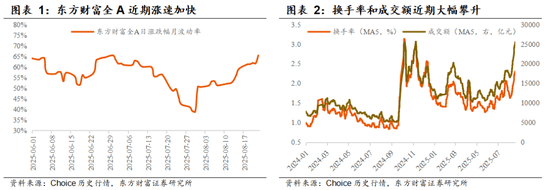
Group 1 - The core viewpoint of the article indicates that the Shanghai Composite Index has surged past the 3700 and 3800 points, reaching a 10-year high, driven by a recovery in risk appetite and a rebalancing of valuation between stocks and bonds [1][5][8] - The market is experiencing a second phase of a bull market, with significant participation from retail investors, private equity, and foreign capital, leading to increased liquidity and trading volume [2][5][12] - The shift from a "barbell strategy" to a more balanced investment approach is confirmed, as sectors like technology and domestic semiconductor industries gain traction [5][10][22] Group 2 - Recent behavior of different types of incremental capital shows that retail investors are increasingly optimistic about the bull market, with a notable rise in discussions and investments in ETFs [14][17] - The Federal Reserve's signals regarding potential interest rate cuts have improved the liquidity environment, particularly benefiting Hong Kong stocks, which are now seen as more attractive compared to A-shares [3][26] - The current bull market is still in its second phase, with many indicators suggesting that there is significant room for growth compared to previous bull market peaks [4][25][27]

A股市值十强座次洗牌:贵州茅台、宁德时代入列,昔日市值龙头股掉队
Di Yi Cai Jing· 2025-08-25 03:15
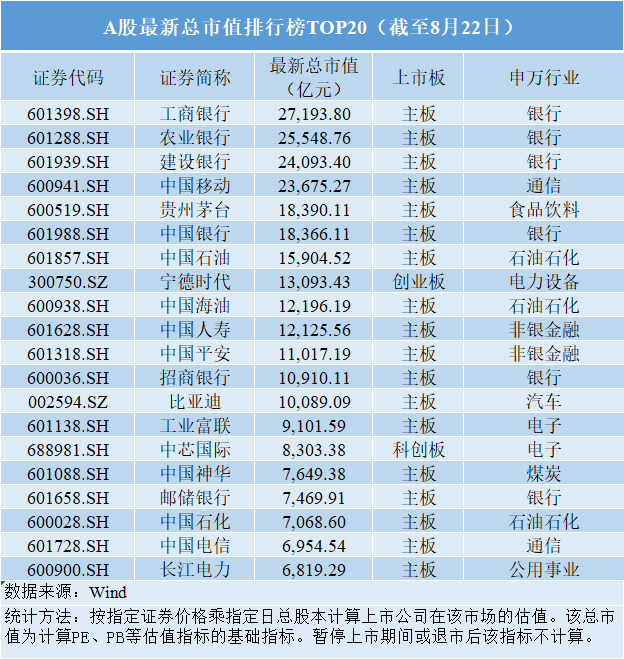
Core Viewpoint - The A-share market has seen significant growth, with the Shanghai Composite Index surpassing 3800 points for the first time in ten years, reflecting a "slow bull" market trend and an increase in total market capitalization to approximately 116 trillion yuan [1][13]. Group 1: Market Capitalization Overview - As of August 22, the total market capitalization of all listed companies in A-shares reached 102.81 trillion yuan, with the Shanghai Stock Exchange at 61.41 trillion yuan and the Shenzhen Stock Exchange at 40.48 trillion yuan [1]. - The number of companies with a market capitalization exceeding 1 trillion yuan has increased to 13, including major state-owned banks and industry leaders like China Mobile and Kweichow Moutai [2][4]. Group 2: Top Companies by Market Capitalization - The top three companies by market capitalization are all state-owned banks: Industrial and Commercial Bank of China (ICBC) at 27.19 trillion yuan, Agricultural Bank of China at 25.55 trillion yuan, and China Construction Bank at 24.09 trillion yuan [3][10]. - Other notable companies in the top ten include China Mobile (23.68 trillion yuan), Kweichow Moutai (18.39 trillion yuan), and Ningde Times (13.09 trillion yuan) [3][10]. Group 3: Changes Over Time - Compared to the end of 2016, the top three companies by market capitalization have all been replaced by state-owned banks, with ICBC maintaining its position as the market leader [7][9]. - Historical data shows that in 2016, the top companies included China Petroleum and Bank of Communications, which have since fallen out of the top rankings [9][10]. Group 4: Significant Market Growth - Since the beginning of the year, the number of companies with a market capitalization exceeding 1 trillion yuan has increased from 10 to 13, with new entrants including Ping An Insurance, China Merchants Bank, and BYD [4]. - A total of 22 stocks have seen their market capitalization increase by over 100 billion yuan since the start of the year, with notable growth from Industrial Fulian and Cambrian Biologics [4][5]. Group 5: Industry Trends - The banking sector remains dominant, with a total market capitalization of 15.8 trillion yuan, followed by the electronics sector at 12.14 trillion yuan and non-bank financials at 8.36 trillion yuan [11][12]. - The electronics industry has experienced significant growth, with its market capitalization increasing by over 460% in the past decade [11]. Group 6: Market Structure Changes - The number of listed companies in A-shares has grown from 3052 in 2016 to 5434 in 2025, with total market capitalization increasing by 109% [13]. - The Shanghai Stock Exchange continues to hold a significant portion of the total market capitalization, while the ChiNext and STAR Market have also seen substantial growth in both the number of companies and total market value [13].






上证创十年新高,牛回速归还是落袋为安?| 周度量化观察
申万宏源证券上海北京西路营业部· 2025-08-25 02:44
Market Overview - A-shares continue to reach new highs this week, with daily average trading volume exceeding 20 trillion yuan for two consecutive weeks, reflecting strong market sentiment [2][10] - The bond market experienced a decline, with both interest rate bonds and credit bonds weakening, indicating a potential negative return for pure bond funds [2][29] - Gold prices remain under pressure due to the Federal Reserve's stance on interest rates and positive geopolitical developments, leading to reduced safe-haven demand [3][36] Stock Market Performance - The A-share market's rise is primarily driven by capital inflow and industry catalysts, with significant structural opportunities present [5][10] - Major indices such as the CSI 500 and CSI 300 saw substantial weekly gains, with the STAR 50 index increasing over 10% [10][11] - The trading volume for the two markets increased by 22.62% week-on-week, with the CSI 300 and CSI 500 seeing higher trading volume proportions [12][13] Bond Market Insights - The bond market is expected to remain volatile in the short term, with a focus on coupon strategies as the market dynamics shift [6][29] - The interbank funding environment has tightened, while exchange funding has loosened, contributing to the overall weakness in the bond market [29][30] Commodity Market Analysis - The Nanhua Commodity Index fell by 0.44% this week, with declines in various sectors including black and non-ferrous commodities [36][38] - Gold prices decreased by 0.23%, while crude oil prices increased by 0.81%, indicating mixed trends in the commodity market [38] Industry Performance - In the industry sector, telecommunications, electronics, and comprehensive sectors showed strong performance with weekly gains of 10.84%, 8.95%, and 8.25% respectively [19][21] - The real estate and coal sectors lagged behind, reflecting a divergence in sector performance [19][21]