半导体

Search documents
寒武纪(688256):2025年业绩快报点评:营收高增驱动全面扭亏,有望受益中国Token出海
Guohai Securities· 2026-03-03 09:34
Investment Rating - The investment rating for the company is "Buy" (maintained) [1] Core Insights - The company has reported a significant increase in revenue and has turned losses into profits, benefiting from the rising demand in the computing power industry [6][9] - The company achieved a revenue of 6.497 billion yuan in 2025, representing a year-on-year growth of 453.21%, with a net profit of 2.059 billion yuan, compared to a loss of 0.452 billion yuan in the previous year [5][6] - The fourth quarter of 2025 saw a revenue of 1.89 billion yuan, up 91.10% year-on-year, and a net profit of 0.454 billion yuan, marking a 66.91% increase [5][6] Revenue and Profit Growth - The company’s revenue and profit have shown remarkable breakthroughs, with a full-year revenue of 6.497 billion yuan and a net profit of 2.059 billion yuan, indicating a complete turnaround from previous losses [6][10] - The quarterly performance in Q4 2025 reflects a strong growth trajectory, with significant improvements in both revenue and net profit [6][10] Market Demand and Product Deployment - The growth in performance is attributed to the increasing demand for computing power, with successful large-scale deployments in key sectors such as telecommunications, finance, and the internet [6][9] - The company’s products support various large models, including LLaMA, GPT, and BLOOM, facilitating the training and inference tasks essential for AI applications [6][9] Future Projections - Revenue projections for 2025 to 2027 are estimated at 6.497 billion yuan, 17.008 billion yuan, and 24.488 billion yuan respectively, with net profits expected to reach 2.059 billion yuan, 6.839 billion yuan, and 9.406 billion yuan [10][11] - The company is positioned to benefit from the growing demand for large models and ongoing product optimization, with a projected price-to-sales ratio (PS) of 77.36, 29.55, and 20.52 for the years 2025 to 2027 [10][11]

GTC大会前瞻:重点关注哪些领域?
格隆汇APP· 2026-03-03 09:19
Core Viewpoint - The article discusses the upcoming advancements in AI computing infrastructure, particularly focusing on the developments expected at the NVIDIA GTC conference, including new GPU architectures and power supply innovations [5][21]. Power Supply Architecture - The competition in AI computing power is fundamentally about power density, with significant advancements expected in power supply and cooling technologies. NVIDIA's Rubin chip is projected to exceed 2000W, while the upcoming "Feiman" chip aims for over 5000W, necessitating a shift to 800V high-voltage power systems [9][10]. - The transition to 800V high-voltage direct current (HDVC) is expected to reduce current and alleviate power loss issues, with NVIDIA's Rubin Ultra generation likely adopting this technology [9][10]. - Modular power supply solutions are anticipated to enhance current capacity and reduce PCB layout space, with significant implications for manufacturing complexity and costs [10][11]. - The value of inductors in power supply components is expected to increase significantly, from approximately 3 yuan in traditional designs to 8-10 yuan in modular designs, with potential for further increases due to technological advancements [10][11]. AI Computing and Data Transmission - The demand for higher bandwidth, lower latency, and reduced power consumption in AI computing is driving the evolution of optical communication technologies from traditional modules to Co-Packaged Optics (CPO) and Near-Packaged Optics (NPO) [14][15]. - The GTC conference is seen as a critical point for the commercialization of CPO technology, with expectations for significant production increases by 2027 [14][15]. - The integration of optical engines with network cards in the Rubin Ultra design is expected to lead to a surge in demand for optical components, enhancing the overall market for optical communication [15]. Liquid Cooling Technology - As GPU power levels rise above 2000W, liquid cooling is transitioning from an optional feature to a mandatory requirement, with projections indicating that liquid cooling will dominate the market by 2026 [16][17]. - The deployment of the "Feiman" chip is expected to significantly increase the demand for liquid cooling components, with a focus on upgrading cooling materials and thermal interface materials (TIM) [17][19]. - Innovations in cooling materials, such as diamond-based thermal conductors and liquid metal TIMs, are anticipated to enhance cooling efficiency and reduce total cost of ownership (TCO) for GPU servers [19][20]. Industry Supply Chain Developments - Domestic companies are making significant strides in integrating into the supply chains of major players like NVIDIA, Amazon, and Google, with several firms already validated for key components [12][13]. - The article highlights the importance of companies with core technologies and established supply chain relationships as key investment targets in the evolving AI infrastructure landscape [21].



突然,熔断!暴跌超1400点!日本、韩国股市崩了
新浪财经· 2026-03-03 09:17
Core Viewpoint - The ongoing escalation of tensions in the Middle East has led to significant declines in the stock markets of South Korea and Japan, with the KOSPI index experiencing a drop of over 5% and triggering a trading halt [2][3]. Group 1: Market Reactions - The KOSPI 200 futures index fell by 5%, and the KOSPI index itself dropped over 5%, leading to a trading suspension for 5 minutes due to programmatic trading [3]. - Major stocks such as Korean Air and Hynix Semiconductor saw declines of 9% and 7% respectively, while defense stocks like Hanwha Aerospace surged over 14% [3]. - Foreign funds sold a record 6.8 trillion KRW (approximately 32.3 billion RMB) worth of KOSPI index components on the previous Friday, marking the largest single-day net sell-off in history [5]. Group 2: Impact of Middle East Tensions - The recent drone attacks on the U.S. embassy in Saudi Arabia have heightened concerns, with U.S. President Trump indicating that retaliatory actions would follow [6][7]. - Analysts suggest that hedge funds, which had heavily invested in Asian markets, are now reassessing their positions due to the increased geopolitical risks [4]. - A macro hedge fund executive noted that the current market environment poses significant challenges for funds that have been betting on the rise of Asian stocks, indicating a potential shift in investment strategies [4]. Group 3: Fund Manager Sentiments - Fund managers are reevaluating their exposure to emerging markets, particularly in light of the region's reliance on oil imports amid the ongoing Middle East crisis [5]. - The latest reports indicate that hedge funds have a high allocation to emerging market equities, with a particular focus on South Korean stocks, which have been popular investments recently [4].

暴涨120%!三大板块,逆市爆发
证券时报· 2026-03-03 09:16
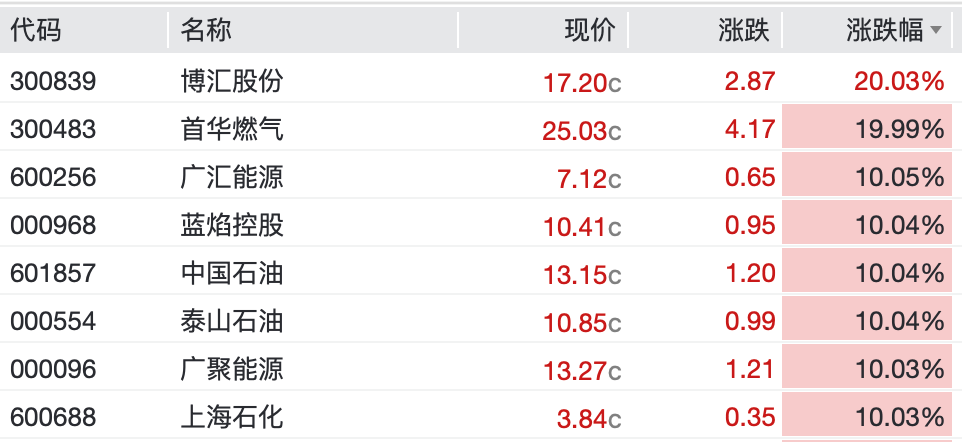
Core Viewpoint - The oil, gas, and shipping sectors have experienced significant gains despite a broader market downturn, driven by geopolitical tensions and supply chain concerns [12][13]. Group 1: Market Performance - On March 3, major Asia-Pacific stock indices fell sharply, with the Nikkei 225 down over 3% and the Korean Composite Index down 7.24%, marking its largest single-day drop since August 5, 2024 [1]. - The A-share market also declined, with the Shanghai Composite Index dropping 1.43% to 4122.68 points, and the ChiNext Index falling 2.57% [2]. - Despite the overall market weakness, the oil, gas, and shipping sectors saw substantial gains, with major companies like China National Petroleum, China National Offshore Oil, and Sinopec hitting consecutive daily limits [2][5]. Group 2: Sector Highlights - In the oil sector, companies such as Keli Co. and Tongyuan Petroleum reached their daily limits, with Keli Co. up 30% and Tongyuan Petroleum up 20% [6][7]. - The gas sector also showed strength, with Kaiti Gas hitting a 30% limit and several other companies like Shenzhen Gas and Meino Energy seeing gains of over 20% [8][9]. - The shipping sector saw continuous gains, with companies like China Merchants Energy and China Merchants Shipping achieving daily limits [10]. Group 3: Geopolitical Impact - Reports indicate that the Strait of Hormuz has been closed by Iranian forces, raising concerns about global oil supply disruptions, as approximately 20% of the world's oil transport passes through this strait [12]. - The escalation of tensions in the Middle East is expected to significantly increase global shipping prices, benefiting various shipping segments [13]. Group 4: Banking and Insurance Performance - The banking sector showed resilience, with Agricultural Bank of China rising nearly 4% and other major banks like Industrial and Commercial Bank of China and China Construction Bank increasing over 2% [15][16]. - The insurance sector also saw gains, with companies like New China Life and China Life Insurance rising over 1% [17]. Group 5: Semiconductor Sector Decline - The semiconductor sector faced a sharp decline, with companies like Zhenlei Technology and Canxin Technology dropping over 10% [19][20]. - Despite the current downturn, institutions remain optimistic about long-term investment opportunities in semiconductor-related sectors due to ongoing demand for AI infrastructure [21][22].






海外宏观周报:地缘冲突风险上升-20260303
Ping An Securities· 2026-03-03 09:07
Group 1: Economic Policies and Market Reactions - As of February 27, non-US stock markets performed strongly while US stocks declined, with the S&P 500 down 0.44% and the Nasdaq down 0.95%[6][8] - The US PPI for January exceeded expectations at 2.8% year-on-year, raising concerns about persistent inflation[4][6] - The US initial jobless claims for the week ending February 21 were 212,000, slightly above the previous week's 208,000[4][6] Group 2: Geopolitical Risks and Trade Policies - The US implemented a 10% global tariff under "Section 122" on February 24, with potential increases to 15% pending[4][6] - Following the death of Iranian leader Khamenei on February 28, tensions escalated, with Iran threatening retaliation against US and Israeli military bases[4][6] - The EU postponed a vote on the US-EU trade agreement due to uncertainties surrounding US tariff policies, which could disrupt existing trade balances[9][6] Group 3: Currency and Commodity Movements - The Swiss Franc appreciated by 0.87% against the USD, reflecting its safe-haven status amid geopolitical tensions[16] - The Chinese Yuan strengthened, reaching a high of 6.8760 against the USD, before a subsequent adjustment following a policy change by the central bank[16] - Commodity prices rose, with Brent crude oil increasing by 1.0% to $72.5 per barrel and gold prices rising by 3.3% to $5222.3 per ounce[14][6]
横盘两季又如何?大摩坚定看好:英伟达还是芯片“首选”
华尔街见闻· 2026-03-03 08:10
英伟达过去两个季度的股价几乎没动,但摩根士丹利的判断是:基本面反而在变强,市场只是被两件事卡住——增长能不能"熬过"2026,以及市场份额会不会 被ASIC、AMD慢慢啃掉。大摩把英伟达重新抬回半导体板块的"首选",维持增持评级与260美元目标价,并把当前估值视作少见的介入窗口。 据追风交易台,摩根士丹利北美半导体分析师Joseph Moore在最新报告中表示,英伟达以2027年盈利计仅约18倍市盈率,是一个出人意料的好切入点。他的 逻辑不是押注下个季度再超预期,而是押注投资人对"增长耐久度"的怀疑,会在未来几个月开始松动。 它提到一个反常对比——当初把板块首选从英伟达换到SanDisk、再换到美光之后,内存股累计涨幅达到300%—900%,而英伟达股价"原地踏步";与此同 时,英伟达"当前季度"的盈利预期在6个月里上调了38%。这意味着,压着股价的不是数据,而是对周期寿命的怀疑。 报告也把这种情绪波动放进历史模式: 过去三年里,每年年初市场都会对"下一年"不放心,直到可见度补上,股价才出现阶段性跑赢。它押注2026年会重复 这一过程。 供应链给出的信号偏"硬":三年锁单、甚至全额预付 摩根士丹利认为,持续性 ...
瑞芯微(603893):生态共赢,务实前行
China Post Securities· 2026-03-03 08:06
Investment Rating - The report upgrades the investment rating for 瑞芯微 (Rockchip) to "Buy" [2][7] Core Views - The AI technology is reshaping electronic products, and the AIoT market is entering a high-speed development cycle. The market is transitioning from "Internet of Everything" to a period of deep value release, with advancements in edge-cloud collaboration architecture and the proliferation of lightweight AI models and edge NPU chips. This shift is driving devices from passive responses to autonomous decision-making [5] - The company is expected to achieve revenue of approximately 43.87 billion to 44.27 billion yuan and a net profit of 10.23 billion to 11.03 billion yuan in 2025, representing a year-on-year growth of 71.97% to 85.42% [5] - The company is advancing its dual-track strategy of "SoC + co-processor" to accelerate the development of next-generation products, including the global first 3D architecture edge computing co-processor RK182X, which is being rapidly adopted across various industries [6] Financial Projections - Revenue projections for the company are 44.2 billion yuan in 2025, 56.8 billion yuan in 2026, and 71.1 billion yuan in 2027, with net profits of 11.0 billion yuan, 14.7 billion yuan, and 19.1 billion yuan respectively [7] - The company’s revenue growth rates are projected at 40.79% for 2025, 28.55% for 2026, and 25.26% for 2027 [9] - The expected earnings per share (EPS) are 2.61 yuan for 2025, 3.49 yuan for 2026, and 4.53 yuan for 2027 [9]

A股军工股大跌,煤炭逆势走强,陕西黑猫涨停,港股赣锋锂业跌超10%
2 1 Shi Ji Jing Ji Bao Dao· 2026-03-03 07:50
Group 1 - The Asia-Pacific markets experienced a collective decline on March 3, with major indices in A-shares and Hong Kong all weakening, while Japanese and South Korean markets saw significant drops. The Shanghai Composite Index fell over 1%, the ChiNext Index dropped over 2%, and the Shenzhen Component Index declined by more than 3% [1] - Over 4,800 stocks in the market declined, with the total trading volume in the Shanghai and Shenzhen markets exceeding 3 trillion yuan, an increase of over 110 billion yuan compared to the previous day [1] Group 2 - The military, non-ferrous metals, computer, media, electronics, and chemical sectors saw significant declines, with aerospace and military stocks leading the drop. Several stocks, including AVIC Control and AVIC Technology, hit the daily limit down, while others like Zhenxin Technology fell over 15% [2] - The rare earth sector also faced heavy losses, with stocks like Northern Rare Earth and Baotou Steel hitting the daily limit down. The semiconductor industry chain declined, with over ten stocks, including Purun and Dongwei Microelectronics, dropping more than 10% [2] - Conversely, the oil and gas and shipping sectors maintained strong performance, with over 30 stocks, including China Petroleum, hitting the daily limit up. China Petroleum's stock price reached a new high since March 2008 [2] Group 3 - In the Hong Kong market, the Hang Seng Index fell over 1%, and the Hang Seng Tech Index dropped over 2%. Tech stocks collectively declined, with companies like Li Auto and NIO falling over 6% [3] - The non-ferrous metals sector led the decline in Hong Kong, with Ganfeng Lithium dropping over 10% and other companies like Jiangxi Copper and Zijin Mining falling over 7% [3] Group 4 - The Japanese and South Korean stock markets both closed lower, with the Nikkei 225 index down 3.1% and the KOSPI index down 7.24%, marking the largest single-day drop since August 5, 2024 [4] - International oil prices surged, with WTI crude oil rising over 2% to exceed $73 per barrel, while Brent crude increased by over 3%. Gold and silver prices experienced sharp declines, with silver dropping over 7% at one point [4]



策略行业2026年春季投资策略:从急行军到安营扎寨:牛市新节奏新打法
KAIYUAN SECURITIES· 2026-03-03 07:48
Group 1 - The report emphasizes a shift in market strategy from a rapid ascent to a more stable approach, indicating a transition from a "quick run" to a "camping and resting" phase in the bull market, with a focus on managing stamina and structure rather than speed [3][29] - The current market is characterized by a rising securities ratio, which is seen as a sign of moving from an early valuation repair phase to a deeper activation of existing assets, indicating a more cautious and structured investment environment [3][16] - The report identifies three signals indicating the failure of old investment strategies, highlighting a shift from beta-driven index performance to alpha-driven structural performance, suggesting a need for more selective investment approaches [3][36] Group 2 - The report introduces a new pricing logic for the "new rhythm bull market" based on the Dividend Discount Model (DDM), emphasizing the importance of understanding the marginal changes in profit growth (ΔG) rather than just the existence of growth [3][41] - It discusses the restructuring of the funding ecosystem, noting that the outflow from broad-based ETFs and inflow into non-broad-based ETFs reflects a healthy market dynamic, indicating a shift in investment strategies [4][62] - The report highlights the importance of AI technology in profit distribution, suggesting that sectors with stable price increase capabilities, such as non-ferrous metals and certain chemicals, will be key investment areas [4][56] Group 3 - The report provides industry allocation recommendations, focusing on sectors such as AI technology, cyclical industries benefiting from price increases, and high-dividend stocks, indicating a strategic shift towards sectors with strong growth potential and stable returns [4][5] - It emphasizes the significance of structural changes in profitability, particularly in the technology sector, where internal differentiation is crucial for investment success [4][55] - The report notes that the real estate sector's investment appeal is diminishing, leading to a shift in resident funds towards equity markets, which are becoming the new main stage for wealth management [4][67]
A股军工股大跌,煤炭逆势走强,陕西黑猫涨停,港股赣锋锂业跌超10%
21世纪经济报道· 2026-03-03 07:46
Market Overview - The Asia-Pacific markets experienced a collective decline due to escalating tensions in the Middle East, with major indices in A-shares and Hong Kong all weakening, and Japanese and South Korean markets suffering significant losses [1][5] - The Shanghai Composite Index fell over 1%, the ChiNext Index dropped over 2%, the Shenzhen Component Index decreased by more than 3%, and the Sci-Tech Innovation Index fell over 5% [1][2] - Over 4,800 stocks in the market declined, with total trading volume in the Shanghai and Shenzhen markets exceeding 3 trillion yuan, an increase of over 110 billion yuan compared to the previous day [1] Sector Performance - The military, non-ferrous metals, computer, media, electronics, and chemical sectors saw significant declines, with aerospace and military stocks leading the drop [3] - Notable stocks such as Hangfa Control and Hangfa Technology hit the daily limit down, while others like Hanya Technology fell over 15% [3] - The rare earth sector also faced heavy losses, with stocks like Northern Rare Earth and Baogang hitting the daily limit down [3] Commodity Trends - Oil and shipping concepts continued to show strength, with over 30 oil-related stocks hitting the daily limit up, including China Petroleum, which reached its highest price since March 2008 [3] - The coal sector performed well against the trend, with stocks like Shanxi Black Cat and Dayou Energy hitting the daily limit up [4] Hong Kong Market - The Hang Seng Index fell over 1%, and the Hang Seng Tech Index dropped over 2%, with tech stocks like Li Auto and NIO declining over 6% [5] - The non-ferrous metals sector led the decline, with stocks like Ganfeng Lithium and China Molybdenum dropping significantly [5] International Oil Prices - International oil prices surged, with WTI crude oil rising over 2% to exceed $73 per barrel, while Brent crude oil increased by over 3% [5]