
基本金属

Search documents
商品日报(12月15日):铂钯表现活跃铂金封板涨停 氧化铝多晶硅涨超3%
Xin Hua Cai Jing· 2025-12-15 10:33
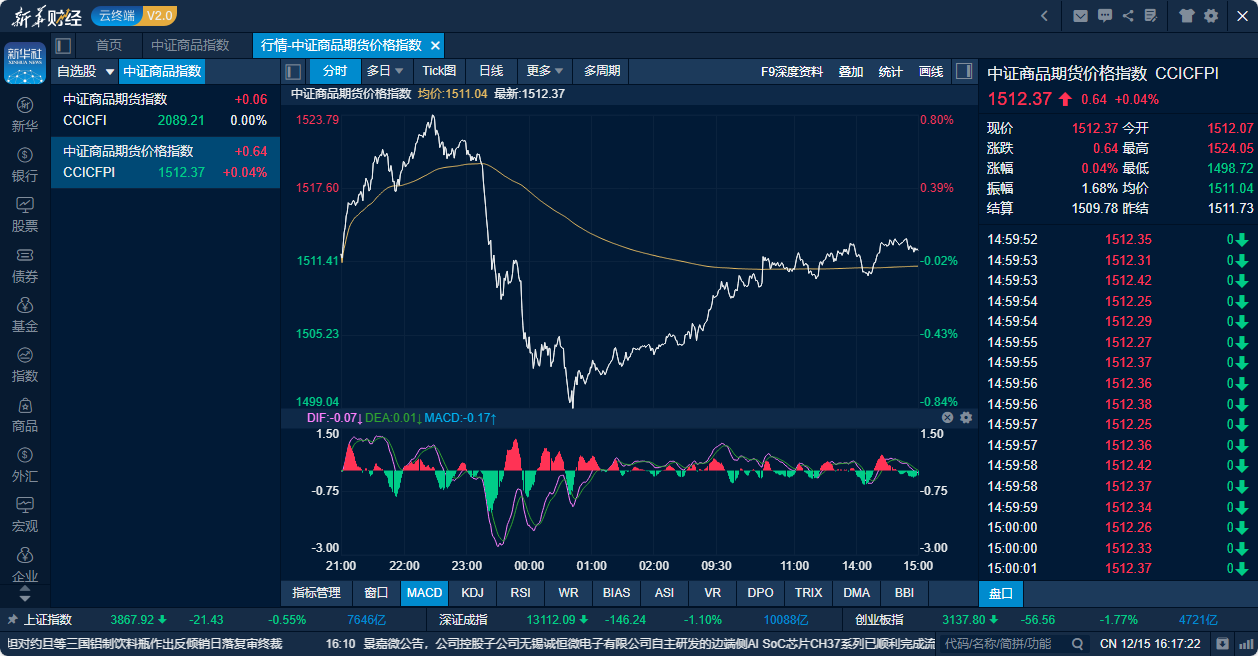
Group 1: Market Overview - The domestic commodity futures market showed overall strength on December 15, with the China Securities Commodity Futures Price Index closing at 1512.37 points, up 0.64 points or 0.04% from the previous trading day [1] - The commodity futures index closed at 2089.21 points, with a slight increase of 0.06 points, reflecting a stable market [1] Group 2: Precious Metals Performance - Platinum prices surged to a limit-up, marking a 7.00% increase and reaching a historical high, driven by supply shortages and strong demand from the hydrogen energy sector [2] - Palladium also saw a significant rise of over 4%, benefiting from the bullish trend in platinum [2] - Gold's strong performance laid the foundation for the overall strength in the precious metals sector, despite silver experiencing volatility [2] Group 3: Silicon Market Dynamics - The main contract for polysilicon rose by 3.61%, nearing its historical high from earlier in the month, primarily due to the announcement of a capacity integration acquisition platform [3] - However, the supply-demand dynamics for polysilicon remain weak, with inventory levels reaching 293,000 tons, sufficient for nearly two months of production [3] - Production cuts in the silicon wafer segment were noted, with a significant reduction of over 10% in November and a further expected decrease in December [3] Group 4: Agricultural Products and Copper - The new season apples faced downward pressure, dropping over 3% due to an oversupply in the market and weak demand ahead of the holidays [4] - Copper prices experienced a decline of over 1% after reaching historical highs, influenced by increased inventories and expectations of weakened demand [5] - Domestic electrolytic copper inventories rose to 177,200 tons, indicating a supply surplus that may pressure prices further [5]

国泰君安期货商品研究晨报:贵金属及基本金属-20251215
Guo Tai Jun An Qi Huo· 2025-12-15 02:09
1. Report Industry Investment Ratings The document does not provide industry investment ratings. 2. Core Views - Gold: Interest rates were cut as expected [2][4]. - Silver: Adjusting at a high level [2][4]. - Copper: The long - term driving logic remains, and the price decline is limited [2][8]. - Zinc: Domestic inventory is continuously decreasing [2][11]. - Lead: Inventory reduction supports the price [2][14]. - Tin: Supply is disrupted again [2][16]. - Aluminum: Macroeconomic disturbances are increasing [2][19]. - Alumina: Continuously monitor production capacity cuts [2][19]. - Cast aluminum alloy: Fluctuating at a high level [2][19]. - Platinum: Breaking through the previous high and starting to make up for lost ground [2][22]. - Palladium: ETF holdings have increased significantly, and it is expected to hit the previous high [2][22]. - Nickel: The structural surplus has changed, and attention should be paid to policy risks in Indonesia [2][26]. - Stainless steel: Supply and demand are both weak, and steel prices are fluctuating at a low level [2][26]. 3. Summary by Directory Gold - **Fundamentals**: The closing prices of various gold products such as Shanghai Gold 2602, Gold T + D, etc. showed different degrees of increase, and trading volumes and positions also changed. ETF and inventory data also had corresponding changes [4]. - **News**: Trump prefers to appoint Warsh or Hassett as the Fed Chairman; China's November new social financing, new RMB loans, and M2 - M1 scissors - gap data are released; multiple Chinese ministries respond to the Central Economic Work Conference [4][6]. - **Trend Intensity**: Neutral [7]. Silver - **Fundamentals**: The closing prices of Shanghai Silver 2602 and other products had significant price fluctuations, and trading volumes, positions, ETF holdings, and inventory data also changed [4]. - **Trend Intensity**: Neutral [7]. Copper - **Fundamentals**: The closing prices of Shanghai Copper and London Copper had different trends, and trading volumes, positions, inventory, and price spreads all changed. China's November copper - related import data and Chile's copper - related export and production data are released [8][10]. - **News**: The Chinese central bank will flexibly use various monetary policy tools; Trump hopes the interest rate will be 1% or lower in a year; the US is negotiating to provide over $1 billion for key mineral and railway projects in Central Africa [8][10]. - **Trend Intensity**: Neutral [10]. Zinc - **Fundamentals**: The closing prices of Shanghai Zinc and London Zinc changed, and trading volumes, positions, inventory, and price spreads also had corresponding changes [11]. - **News**: Three Chinese ministries will strengthen business - finance cooperation to boost consumption [11]. - **Trend Intensity**: Strongly bullish [11]. Lead - **Fundamentals**: The closing prices of Shanghai Lead and London Lead decreased slightly, and trading volumes, positions, inventory, and price spreads all changed [14]. - **News**: The Chinese central bank will flexibly use various monetary policy tools; Trump hopes the interest rate will be 1% or lower in a year [14]. - **Trend Intensity**: Neutral [14]. Tin - **Fundamentals**: The closing prices of Shanghai Tin and London Tin showed different trends, and trading volumes, positions, inventory, and price spreads all changed. Spot and industrial chain prices also increased [16]. - **News**: Trump prefers to appoint Warsh or Hassett as the Fed Chairman; China's November new social financing, new RMB loans, and M2 - M1 scissors - gap data are released; multiple Chinese ministries respond to the Central Economic Work Conference [16][17]. - **Trend Intensity**: Bearish [18]. Aluminum, Alumina, Cast Aluminum Alloy - **Fundamentals**: The closing prices, trading volumes, positions, inventory, and price spreads of Shanghai Aluminum, LME Aluminum, Shanghai Alumina, and cast aluminum alloy all changed. Data on related premiums, processing fees, and corporate profits are also updated [19]. - **News**: Global monetary policy is at a critical turning point; the Fed's asset - liability purchase may push up inflation in 2026 [21]. - **Trend Intensity**: Aluminum is neutral, Alumina is bearish, and Cast Aluminum Alloy is neutral [21]. Platinum and Palladium - **Fundamentals**: The closing prices of platinum and palladium products increased, and trading volumes, positions, ETF holdings, and price spreads all changed [22]. - **News**: Multiple international events such as the US - Mexico water resource agreement and Zelensky's decision to abandon NATO membership are reported [25]. - **Trend Intensity**: Both are strongly bullish [24]. Nickel and Stainless Steel - **Fundamentals**: The closing prices of Shanghai Nickel and stainless steel had different trends, and industrial chain - related prices, profits, and spreads all changed [26]. - **News**: There are multiple events in Indonesia related to nickel production, including government sanctions, policy changes, and production restrictions. The Fed has dovish remarks, and China will implement export license management for some steel products [26][29]. - **Trend Intensity**: Both are neutral [30].
有色金属:行情延续,宏观情绪仍是主导 (1)
2025-12-15 01:55
Summary of Key Points from Conference Call Records Industry Overview: Non-Ferrous Metals - The non-ferrous metals market is significantly influenced by macroeconomic sentiment, with the Federal Reserve's easing policies being a key driver. Despite uncertainties in future interest rate cuts, a liquidity-rich environment is expected to support rising commodity prices, similar to the market performance from 2019 to 2021 [1][5] - Concerns regarding AI investments and interest rate hikes in Japan have emerged, but liquidity easing reduces de-leveraging risks, making the likelihood of a bubble burst low in the short term. If Japan's interest rates exceed expectations, it may create downward pressure, but any pullback could present a good investment opportunity due to supply-demand imbalances and demand recovery expected by 2026 [1][6] Precious Metals Market - Gold is not advisable to short due to geopolitical factors, weakening of the dollar credit system, and increased central bank purchases. Historically, gold experiences two phases of price increases during easing cycles, and it is expected to rise post-RMP implementation [1][7] - Silver may face short-term pullback pressure but is expected to maintain a long-term upward cycle due to supply shortages and its industrial properties. The market for silver has been in a state of shortage for the past few years, and its investment demand is likely to increase during economic recovery [1][8] Price Projections - Gold prices are projected to reach $4,800 by 2026, driven by liquidity easing and rising inflation. Companies like Lingbao Gold, through acquisitions, are expected to see their valuations rise to 15-20 times [1][9] - The copper market is currently experiencing weak supply and demand, with low inventories. High copper prices are suppressing demand, but liquidity easing is expected to mitigate negative impacts. The copper price is projected to be between $11,000 and $12,000 in the first half of 2026, making valuations of related A-share and H-share companies attractive [2][11] Aluminum Market - The aluminum market shows a favorable supply-demand balance, with profit margins exceeding 5,500 yuan per ton. The current valuation levels are considered attractive for investment, especially as the U.S. easing cycle lowers dividend yield requirements [4][12] Lithium Market - The lithium carbonate market is expected to experience a slight shortage in 2025, with a total supply of around 1.6 million tons. In 2026, a slight surplus is anticipated, with prices sensitive to rapid increases in supply. The price may reach between 90,000 to 100,000 yuan, but rapid price increases could stimulate supply and create pressure [13][14] Small Metals: Tungsten and Cobalt - Tungsten and cobalt are expected to maintain a trend of price increases due to ongoing shortages. Tungsten's price is unlikely to drop significantly due to its importance in technology and military applications, while cobalt prices may rise due to export quota issues from the Democratic Republic of Congo [15] Copper Foil and Aluminum Foil Processing Fees - Recent surveys indicate that processing fees for copper and aluminum foils in lithium battery materials have bottomed out and are beginning to recover. This sector is highlighted as an important area for investors, with overall supply-demand dynamics remaining balanced [16][17]
有色金属:行情延续,宏观情绪仍是主导
2025-12-15 01:55
Summary of Key Points from Conference Call Records Industry Overview: Non-Ferrous Metals - The non-ferrous metals market is significantly influenced by macroeconomic sentiment, with the Federal Reserve's easing policies being a key driver. Despite uncertainties in future interest rate cuts, a liquidity-rich environment is expected to support rising commodity prices, similar to the market performance from 2019 to 2021 [1][5] - Concerns regarding AI investments and interest rate hikes in Japan have emerged, but liquidity easing reduces de-leveraging risks, making the likelihood of a bubble burst low in the short term. If Japan's interest rates exceed expectations, it may create downward pressure, but any pullback could present a good investment opportunity due to supply-demand imbalances and demand recovery anticipated by 2026 [1][6] Precious Metals Market - Gold is not advisable to short due to geopolitical factors, weakening of the dollar credit system, and increased central bank purchases. Historically, gold tends to experience two phases of price increases during easing cycles, and it is expected to rise post-RMP implementation [1][7] - Silver may face short-term pullback pressure but is expected to maintain a long-term upward cycle due to supply shortages and its industrial properties. The market has shown a consistent shortfall in silver supply over the past few years [1][8] Price Projections - Gold prices are projected to reach $4,800 by 2026, benefiting from liquidity easing and rising inflation. Companies like Lingbao Gold, through acquisitions, are expected to see their valuations rise to 15-20 times [1][9] - The copper market is currently experiencing weak supply and demand, with low inventories. High copper prices are suppressing demand, but liquidity easing is expected to mitigate negative impacts, making any price corrections a good buying opportunity. The copper price is projected to be between $11,000 and $12,000 in the first half of 2026, with many A-share and H-share companies showing attractive valuations [2][11] Aluminum Market - The aluminum market is currently in a favorable supply-demand balance, with profit margins exceeding 5,500 yuan per ton. The U.S. interest rate cuts are expected to lower dividend yield requirements, making aluminum an attractive investment due to its cyclical and dividend growth attributes [4][12] Lithium Market - The lithium carbonate market is expected to experience a slight shortage in 2025, with a projected small surplus in 2026. The price sensitivity is high, and rapid price increases may stimulate supply. The overall economic environment and liquidity easing may push lithium prices higher in the first half of 2026 [4][14] Minor Metals: Tungsten and Cobalt - Tungsten and cobalt are expected to remain in a state of continuous shortage, with prices likely to trend upwards. Tungsten's significance in technology and military applications makes it less likely to drop to previous low levels, while cobalt's price is influenced by export quotas from the Democratic Republic of Congo [15] Copper and Aluminum Foil Processing Fees - Recent surveys indicate that processing fees for copper and aluminum foils in lithium battery materials have bottomed out and are beginning to recover. This sector is highlighted as an important area for investors, with overall supply-demand dynamics remaining balanced [16] This summary encapsulates the key insights and projections from the conference call records, providing a comprehensive overview of the non-ferrous metals industry and its various segments.
国泰君安期货·有色及贵金属周报合集-20251214
Guo Tai Jun An Qi Huo· 2025-12-14 12:16
国泰君安期货·有色及贵金属 周报合集 国泰君安期货研究所·有色及贵金属团队 王 蓉 投资咨询从业资格号:Z0002529 wangrong2@gtht.com 季先飞 投资咨询从业资格号:Z0012691 jixianfei@gtht.com 刘雨萱 投资咨询从业资格号:Z0020476 liuyuxuan@gtht.com 王宗源 (联系人)从业资格号:F03142619 wangzongyuan@gtht.com 2025年12月14日 Guotai Junan Futures all rights reserved, please do not reprint 1 08 01 黄金:震荡调整 白银:美股AI压力戳破上涨泡沫 02 铜:高位风险增加,价格暂时调整 03 铸造铝合金:供需双弱,价格高位震荡 04 锌:内外盘共振,价格高位震荡 05 铅:再生增加,需求谨慎,价格震荡 06 07 锡:基本面难以跟涨价格,警惕价格调整风险 铂:突破前高开启补涨 钯:在铂金带领下冲击前高 金银周报 国泰君安期货研究所 有色及贵金属 刘雨萱投资咨询从业资格号:Z0020476 日期:2025年12月14日 Guota ...
大宗商品综述:市场情绪疲弱拖累油价走低 黄金上涨 白银和铜创新高
Xin Lang Cai Jing· 2025-12-11 22:01
Oil Market - Oil prices fell to the lowest point since October, with WTI crude dropping approximately 1.5% to below $58 per barrel and Brent crude around $61 per barrel, influenced by a decline in U.S. stock markets and disappointing corporate earnings [2][7] - The International Energy Agency (IEA) has revised down its forecast for global oil supply surplus for the next two years, now predicting a surplus of 3.815 million barrels per day by 2026, a decrease of 231,000 barrels per day from the previous month [2][8] Precious Metals - Gold prices increased as traders assessed the Federal Reserve's interest rate outlook, with gold rising by 1.2% during U.S. trading hours, while silver surpassed $64 per ounce, reaching a historical high of $64.16 [4][11] - The Federal Reserve's recent 25 basis point rate cut, despite dissent from three officials, has led traders to anticipate further easing, with expectations of two additional rate cuts in 2026 [4][11] Base Metals - Copper prices reached a new record high, climbing 3% to $11,906 per ton, following the Federal Reserve's rate cut and an upward revision of U.S. economic growth forecasts [5][12] - The London Metal Exchange reported a 2.7% increase in copper prices, closing at $11,872 per ton, with other metals also experiencing gains, including a 4.4% rise in tin prices to $41,751 per ton, the highest since April 2022 [6][12]
中欧基金王培:展望2026,周行不殆,科技迭新
Zheng Quan Shi Bao Wang· 2025-12-11 09:05
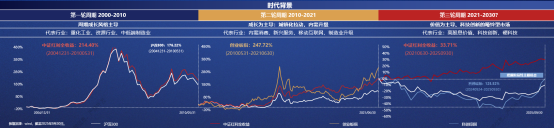
Core Viewpoint - The current market is transitioning from high growth to moderate growth, with a trend of convergence between technology and value sectors in the new cycle [1] Group 1: Market Cycle Analysis - Understanding cyclical changes is essential for future market judgments, with significant shifts observed over the past two decades [2] - The first phase (2000-2010) was dominated by cyclical growth, benefiting heavy industries, resource sectors, and low-end manufacturing [3] - The second phase (2010-2021) saw a shift towards growth, driven by urbanization and the rise of consumer demand and emerging services, with the ChiNext index experiencing rapid growth [3] - Since 2021, the market has gradually shifted back to moderate growth, with value styles regaining dominance, as evidenced by the performance of the STAR Market index compared to the CSI Dividend Index [3] - Long-term migration of industry weights indicates structural upgrades, with technology, consumer healthcare, and cyclical finance gaining share in the CSI 300 over the past 16 years [3] Group 2: Future Outlook for 2026 - The outlook for 2026 is summarized by three keywords: technology leading, value following, and returning to leaders, based on long-term industry structural evolution [4] - The current AI narrative, represented by the STAR Market, mirrors the technology cycle from 2011 to 2015, but with different supporting backgrounds such as demographic changes and geopolitical factors [4] - Key signals for market improvement include PPI and inventory conditions, with expectations for corporate performance to improve in mid-2024 following a low PPI point [4][5] Group 3: Investment Directions - The market is witnessing a recovery in value sectors, which may present structural opportunities in 2026, especially after a year of significant underperformance compared to growth sectors [6] - Investment focus will include cyclical industries (oil, coal, basic metals), non-banking sectors (insurance, brokerage), high ROE industries (internet, traditional consumption), and new cycle industries (new energy, power equipment) [6] - Continuous themes may emerge in CXO, innovative pharmaceuticals, AI applications, and humanoid robotics, although market volatility is expected to increase [6] Group 4: Research and Investment Strategy - The exponential growth of fund numbers, asset management scale, and listed companies has increased information density, posing challenges for research and investment [7] - The company is developing a systematic investment approach through professional division of labor and industrialized production lines to meet client needs [7] - AI is anticipated to become a core capability in active management, fundamentally reshaping the research and investment chain over the next three years [7]
招商期货-期货研究报告:商品期货早班车-20251211
Zhao Shang Qi Huo· 2025-12-11 01:59
1. Report Industry Investment Ratings - No industry investment ratings are provided in the report. 2. Core Views - The Fed's third rate cut this year has influenced the commodity futures market. Different commodities have different market performances, fundamentals, and trading strategies due to various factors such as supply - demand relationships, policy changes, and inventory fluctuations [1][2][3]. 3. Summary by Commodity Categories Precious Metals Gold - Market performance: After the Fed's third rate cut this year, precious metal prices first declined and then rose, with the silver price approaching $62 per ounce [1]. - Fundamentals: The Fed announced the third rate cut this year and the purchase of short - term bonds. Powell's speech was considered dovish, and there were internal voting differences in the FOMC. Domestic gold ETFs had outflows, and inventories in different markets showed different changes [1]. - Trading strategy: As the Fed cut rates as expected, gold prices regained strength, so it is recommended to go long. For silver, the overseas market is tight, but domestic inventories have been accumulating for many days, so it is recommended to take profits in long positions temporarily [1]. Silver - Market trends are affected by the same Fed rate - cut event. The overseas market is tight, while domestic inventories have been increasing [1]. - The trading strategy is related to the inventory situation, suggesting taking profits in long positions temporarily [1]. Base Metals Copper - Market performance: Copper prices oscillated strongly yesterday [2]. - Fundamentals: Domestic market sentiment improved due to discussions on bond extension and mortgage贴息. The CPI and PPI continued to weaken. The Fed's dovish rate cut and bond - buying plan also had an impact. The supply - side copper mine shortage will be difficult to change in the medium term, and the demand - side showed certain trading prices [2]. - Trading strategy: It is recommended to buy on dips [2]. Aluminum - Market performance: The closing price of the main electrolytic aluminum contract increased by 0.73% compared to the previous trading day, and there were corresponding price differences and LME prices [2]. - Fundamentals: On the supply side, electrolytic aluminum plants maintained high - load production, and the operating capacity increased slightly. On the demand side, the weekly aluminum product start - up rate declined slightly [2]. - Trading strategy: Both long and short positions decreased, and the aluminum price retreated from a high level. However, the favorable macro - environment and low inventory provided support, so it is expected that the price will maintain a range - bound oscillation [2]. Alumina - Market performance: The closing price of the main alumina contract decreased by 2.71% compared to the previous trading day, and there was a corresponding price difference [2]. - Fundamentals: On the supply side, some alumina plants started maintenance, and the operating capacity decreased, but there was no large - scale production reduction. On the demand side, electrolytic aluminum plants maintained high - load production [2]. - Trading strategy: Before large - scale production reduction occurs, the spot price will continue to decline under pressure. Be cautious of technical rebounds in the futures market due to the concentrated stop - profit of short positions [2][3]. Industrial Silicon - Market performance: On Wednesday morning, it opened flat and oscillated narrowly throughout the day. The main 01 contract price decreased, the position decreased, the variety's settled funds decreased, and the warehouse receipt volume increased [3]. - Fundamentals: On the supply side, the number of open furnaces decreased this week, mainly in Sichuan. Social inventories increased slightly, and warehouse receipt inventories also increased. On the demand side, the polysilicon and organic silicon industries were promoting anti - involution, and the production and start - up rates of related industries showed certain trends [3]. - Trading strategy: The current supply - demand is stable, but social inventories have increased slightly for three consecutive weeks. There may be further production cuts in the southwest, and environmental protection disturbances need to be monitored in the northwest. It is recommended to wait and see [3]. Lithium Carbonate - Market performance: Affected by news, the LC2605 contract price increased [3]. - Fundamentals: The spot price of Australian spodumene concentrate increased. The supply showed certain production trends, and the demand of related industries such as lithium iron phosphate and ternary materials was expected to change. The inventory situation showed a trend of destocking, but the shortage degree was narrowing [3]. - Trading strategy: Currently, there is a situation of strong reality and weak seasonal expectations. The short - term upward price drive is limited. It is necessary to pay attention to inventory data and downstream inventory trends. It is recommended to consider selling call options with high implied volatility or shorting on rallies [3]. Polysilicon - Market performance: On Wednesday morning, it rushed up and then oscillated narrowly throughout the day. The main 01 contract price increased, the position decreased, the variety's settled funds decreased, and the warehouse receipt volume increased [3]. - Fundamentals: The weekly production was stable, and the industry inventory increased slightly this week. The prices of silicon wafers and battery cells declined, and the downstream production plan in December decreased significantly compared to the previous month. The new photovoltaic installation in October had certain changes, and the policy implementation was expected to put pressure on the fourth - quarter photovoltaic installation [3]. - Trading strategy: After the Guangzhou Futures Exchange added two new delivery brands on Friday, it is expected that the main contract price will first return to the core spot trading range. It is necessary to focus on the new brands' production capacity, supply stability, and product quality to judge their long - term impact on the market [3]. Tin - Market performance: Tin prices oscillated strongly yesterday [4]. - Fundamentals: Domestic market sentiment improved, the CPI and PPI continued to weaken, and the Fed's dovish rate cut and bond - buying plan had an impact. The supply - side tin mine shortage continued, and the demand - side showed certain premium and inventory trends. There was also new information about the war in the Congo tin - producing area [4]. - Trading strategy: It is recommended to buy on dips [4]. Black Industry Rebar - Market performance: The main 2605 contract of rebar closed at 3108 yuan per ton, up 24 yuan from the previous night's closing price [5]. - Fundamentals: The building material apparent demand decreased in different statistical calibers, and the production also decreased. The steel supply - demand was weak, and there was significant structural differentiation. Rebar futures had a large discount and low valuation, while hot - rolled coil futures' discount was basically flat and the valuation was high. Steel mills continued to lose money, and production may continue to decline slightly [5]. - Trading strategy: It is recommended to close short positions and try to go long on the rebar 2605 contract, with the RB05 reference range of 3080 - 3130 [5]. Iron Ore - Market performance: The main 2605 contract of iron ore closed at 767 yuan per ton, up 8.5 yuan from the previous night's closing price [5]. - Fundamentals: The arrival volume of iron ore decreased, and the shipment volume from Australia and Brazil increased. The iron ore supply - demand was weak, and the iron water production decreased significantly. The fourth - round coke price increase failed, and the first - round price cut was implemented and the second - round was proposed. Steel mills' profits were poor, and future blast furnace production may decline steadily. The supply was in line with seasonal rules and slightly increased year - on - year. The iron ore maintained a forward discount structure but with a relatively low absolute level, and the valuation was moderately high [5]. - Trading strategy: It is recommended to try to go long on the iron ore 2605 contract, with the I05 reference range of 750 - 780 [5]. Coking Coal - Market performance: The main 2605 contract of coking coal closed at 1078 yuan per ton, down 5 yuan from the previous night's closing price [5]. - Fundamentals: The iron water production decreased significantly, and steel mills' profits deteriorated. The first - round price cut was implemented, and the second - round was proposed. The inventory at each supply - side link was differentiated, and the overall inventory level was moderate. The futures were at a premium to the spot, and the forward premium structure was maintained, with a relatively high futures valuation [5]. - Trading strategy: It is recommended to try to go long on the coking coal 2605 contract, with the JM05 reference range of 1060 - 1100 [5]. Agricultural Products Soybean Meal - Market performance: The overnight CBOT soybean price rose slightly [8]. - Fundamentals: On the supply side, there was a slight near - term production reduction, and the long - term South American supply was expected to be large. On the demand side, the US soybean crushing was strong, and the export was still in a game. The global supply - demand was improving marginally but still in a loose state [8]. - Trading strategy: The US soybean price was weak, reflecting the expectation of a South American bumper harvest. The domestic market was strong in the near - term and weak in the long - term, and the medium - term situation depends on the tariff policy and production in the producing areas [8]. Corn - Market performance: The corn futures price was weak, and the spot price was falling rapidly [8]. - Fundamentals: The national corn channel inventory was low, and there was a need for inventory building. The short - term procurement was concentrated in the northeast, causing logistics tension. The rising spot price intensified farmers' reluctance to sell, resulting in a short - term supply shortage. However, the continuous rise in corn prices increased the losses of downstream deep - processing enterprises, and the feed - end procurement enthusiasm would decline after continuous inventory replenishment. The short - term spot price is expected to decline gradually [8]. - Trading strategy: As the spot price weakens, the futures price is expected to oscillate and decline [8]. Oils and Fats - Market performance: The Malaysian palm oil futures price fell yesterday due to a negative report [8]. - Fundamentals: On the supply side, the estimated November production in Malaysia decreased by 5% month - on - month, entering the seasonal production reduction period. On the demand side, the estimated November exports decreased by 28% month - on - month. Overall, the near - term Malaysian palm oil inventory continued to accumulate, and the long - term was in the seasonal production reduction period [8]. - Trading strategy: There are no major contradictions in the short - term, with a weak seasonal production reduction and differentiation among oil varieties. It is necessary to pay attention to future production and biodiesel policies [8]. Cotton - Market performance: The US cotton futures price started to rebound, and the international crude oil price stopped falling and rebounded [8]. - Fundamentals: Internationally, the US cotton planting and harvesting areas in 25/26 had certain data, and the Turkey's cotton import volume in October decreased. Domestically, the Zhengzhou cotton futures price oscillated upward, with strong buying support below. Spinning enterprises adjusted their raw material procurement strategies, planning to replenish inventory before the Chinese New Year, and the high - count yarn sales were good [8]. - Trading strategy: It is recommended to buy on dips, with a strategy based on the 13700 - 14000 yuan per ton range [8]. Eggs - Market performance: The egg futures price was weak, and the spot price was stable [8]. - Fundamentals: The number of laying hens in production decreased, the enthusiasm for culling decreased, and the capacity reduction slowed down. The market sales were average, and traders mainly purchased on a need - to - buy basis, with increasing wait - and - see sentiment and accumulating inventory. The rising vegetable price supported the egg price, and currently, there is no major supply - demand contradiction, so the egg price is expected to oscillate [8]. - Trading strategy: Due to the lack of major supply - demand contradictions, the futures price is expected to oscillate [8]. Pigs - Market performance: The pig futures price fell, and the spot price rose slightly [8]. - Fundamentals: The demand is expected to increase seasonally, and the supply - demand pressure has eased compared to the previous period. Before the Winter Solstice, there will be a concentrated slaughter in the breeding sector, with weak pig prices in the first half of the month. As the demand continues to increase later, the pig price is expected to stop falling and rebound. It is necessary to pay attention to the recent slaughter volume changes [8]. - Trading strategy: Due to the seasonal increase in demand, the futures price is expected to oscillate [8]. Energy and Chemicals LLDPE - Market performance: The main LLDPE contract fell slightly yesterday. The low - price spot price in North China was 6530 yuan per ton, the 01 contract basis was stable, the market trading was average, the overseas US dollar price fell slightly, and the import window was closed [10]. - Fundamentals: On the supply side, new production facilities were put into operation, some facilities reduced production or stopped, and the domestic supply pressure eased. The import window remained closed, and the future import volume is expected to decrease slightly. Overall, the domestic supply pressure increased but at a slower pace. On the demand side, the current downstream agricultural film is in the off - season, and the demand decreased month - on - month, while the demand in other fields remained stable [10]. - Trading strategy: In the short - term, the industrial chain inventory decreased slightly, the basis was weak, the supply - demand was weak, and it is expected to oscillate weakly in the short - term as it enters the delivery month, with the upside space significantly restricted by the import window. In the long - term, the new production capacity will decrease in the first half of next year, and the supply - demand pattern will improve. It is recommended to buy the far - month contract on dips [10]. PP - Market performance: The main PP contract fell slightly yesterday. The PP spot price in East China was 6150 yuan per ton, the 01 contract basis was stable, the overall market trading was average, the overseas US dollar price fell slightly, the import window was closed, and the export window was open [10]. - Fundamentals: On the supply side, in the short - term, new production facilities were still being put into operation, some facilities unexpectedly stopped, and the domestic supply gradually increased, and the supply pressure in the market increased. The export window was open. On the demand side, the downstream start - up rate decreased month - on - month, and the national subsidy this year over - exploited part of the fourth - quarter demand [10]. - Trading strategy: In the short - term, the industrial chain inventory decreased slightly, the supply - demand was weak, the basis was weak, and due to the repeated situation in Russia - Ukraine, it is expected that the futures price will still oscillate weakly as it enters the delivery month, with the upside space significantly restricted by the import window. In the long - term, the new production facilities will decrease in the first half of next year, and the supply - demand pattern will improve. It is recommended to seize the opportunity to buy the far - month contract on dips [10]. Crude Oil - Market performance: Oil prices weakened again yesterday. The US and Ukraine held talks on a peace proposal, and if a peace agreement is reached, the risk premium may be reversed, and the support for oil prices will be broken. The EIA weekly report showed that the US crude oil inventory drawdown was lower than expected, the gasoline and diesel inventories increased more than expected, and the EIA raised the US annual supply forecast by 20,000 barrels per day, indicating strong US supply resilience [10]. - Fundamentals: On the supply side, due to US sanctions on Russia, the Russian oil production and exports in December need to be monitored, and the impact of the US - Venezuela military conflict on Venezuelan exports also needs attention. OPEC+ plans to nominally increase production by 130,000 - 140,000 barrels per day per month in December, but the actual monthly increase is expected to be less than 100,000 barrels per day. At the same time, the increased production in the US, Canada, Brazil, Guyana, and Norway continues to be released, and the supply pressure is still large. On the demand side, the refinery start - up rates in Europe and the US have fully recovered, but the terminal demand is still in the off - season. The OECD oil product inventory is higher than the five - year average, and both water and land inventories have accumulated [10]. - Trading strategy: The probability of supply surplus is high at the end of the year and in Q1, and crude oil should still be used as a short - position allocation. It is possible to wait for a premium due to geopolitical events and then short on rallies [10]. Styrene - Market performance: The main EB contract fell slightly yesterday. The spot price in East China was 6500 yuan per ton, and the market trading atmosphere was average. The overseas US dollar price rose slightly, and the import window was still closed [10]. - Fundamentals: On the supply side, the pure benzene inventory is at a normal - to - high level, and the future pure benzene supply - demand is still weak, with a large overall contradiction. The styrene inventory is at a normal - to - high level, and short - term maintenance increased, with a marginal improvement in supply - demand. On the demand side, the finished - product inventory of downstream enterprises is still at a high level, the demand is in the off - season, the start - up rate decreased month - on - month, and the national subsidy over - exploited part of the future demand [10][11]. - Trading strategy: In the short - term, the pure benzene inventory increased slightly, the supply - demand was weak, the valuation was low, and the overall contradiction was still large; the styrene inventory decreased slightly, was at a normal - to - high level, the basis was stable, the supply - demand weakened with the resumption of facilities, and due to the repeated situation in Russia - Ukraine, it is expected that the futures price will oscillate in the short - term, with the upside space restricted by the import window. In the medium - to - long -
大宗商品综述:白银突破60美元再创新高 原油和铜下跌
Xin Lang Cai Jing· 2025-12-09 22:42
Oil Market - Crude oil prices have declined for the second consecutive day due to concerns over oversupply and falling refined oil prices, with WTI crude down 1.1% to approximately $58 per barrel [2][6] - The spread between gasoline and crude oil prices has reached its weakest level since February, indicating a significant drop in refined oil demand [2][6] - The U.S. Energy Information Administration projects that U.S. crude oil production will reach a record average of 13.61 million barrels per day this year, exacerbating concerns over short-term oversupply [2][6] Precious Metals - Silver prices surged above $60 per ounce, reaching a new historical high, driven by expectations that the Federal Reserve will further ease monetary policy [3][8] - The spot silver price increased by 4.5% to $60.79 per ounce, supported by tight supply conditions in the market [9][10] - Gold prices also rose, reflecting the overall bullish sentiment in precious metals due to anticipated interest rate cuts by the Federal Reserve [3][10] Base Metals - Copper prices have retreated from historical highs, with a recent peak of $11,771 per ton, as investors adopt a cautious stance ahead of the Federal Reserve's meeting [11][12] - The 14-day relative strength index for copper has recently surpassed 70, indicating potential overextension in price increases [11] - LME copper closed down 1.3% at $11,487 per ton, with other base metals like aluminum, nickel, zinc, tin, and lead also experiencing declines [12]

有色金属行业报告(2025.12.01-2025.12.05):铜逼仓上行引领金属牛市
China Post Securities· 2025-12-08 07:44
Investment Rating - The industry investment rating is "Outperform the Market" and is maintained [2] Core Views - The report emphasizes a bullish outlook on copper, driven by warehouse cancellations and supply-demand dynamics, suggesting that adjustments in price should be seen as buying opportunities [6] - The report also highlights the performance of precious metals, particularly silver, which has shown volatility but is expected to perform well in the long term due to ongoing de-dollarization trends and ETF inflows [5] - The aluminum market is following copper's upward trend, although it is experiencing seasonal demand weakness [7] - Tin prices are influenced by geopolitical factors, with expectations of long-term supply tightness despite recent price corrections [8] - Tungsten prices are reaching new highs due to supply constraints and export controls, indicating a persistent upward trend in the industry [9] - Investment suggestions include companies such as Shengda Resources, Xingye Silver Tin, Chifeng Gold, Shenhuo Co., and Zijin Mining [10] Summary by Sections Industry Performance - The non-ferrous metals sector saw a weekly increase of 4.30%, ranking second among industry sectors [18] Prices - LME copper rose by 4.38%, aluminum by 1.24%, zinc by 1.56%, lead by 1.41%, and tin by 2.23% during the week [21] Inventory - Global visible copper inventories increased by 8,709 tons, while aluminum saw a decrease of 10,852 tons, indicating varied inventory trends across metals [35][37]