
工业金属

Search documents
金银狂飙,A股、期市相关标的齐涨,高波动下谨防高杠杆与非理性追高
Di Yi Cai Jing· 2026-01-26 12:40
Group 1: Market Performance - On January 26, gold and silver prices surged, with platinum and palladium also experiencing significant increases, leading to a strong performance in the precious metals sector of the A-share market, which rose by 7.3% [1][2] - The London spot gold price broke through the $5,100 per ounce mark, while silver prices continued to set new highs after first closing above $100 per ounce [1][3] - The A-share market saw individual stocks in the precious metals sector, such as Hunan Gold and Zhaojin Mining, hit the daily limit up [2] Group 2: Price Drivers - The price surge in metals is driven by a shift from traditional supply-demand dynamics to a focus on global financial capital allocation amid policy stimuli and geopolitical tensions [1][3] - Analysts expect a strong price trend for precious metals, with a focus on the profitability of the price increase chain in the medium to long term [1][9] Group 3: Company Performance - As of January 26, 73% of the 26 listed companies in the non-ferrous metals sector have issued positive earnings forecasts for 2025, largely due to rising metal prices [6] - Companies like Zhaojin Mining and Xianglu Tungsten are expected to turn losses into profits, with significant year-on-year increases in net profit attributed to rising metal prices [7][8] Group 4: Regulatory Environment - The Shanghai Futures Exchange has implemented regulatory measures to curb excessive speculation in tin and silver futures, indicating a commitment to maintaining market order [4][5] - Analysts suggest that the recent regulatory signals reflect a proactive approach to managing market volatility and protecting investors [5][11] Group 5: Future Outlook - Analysts predict that gold prices may challenge the $6,000 per ounce mark by 2026, driven by ongoing geopolitical uncertainties and a weakening dollar credit system [10] - The overall strong market for precious metals is expected to continue, with strategies recommended for cautious participation in the current high-volatility environment [11]
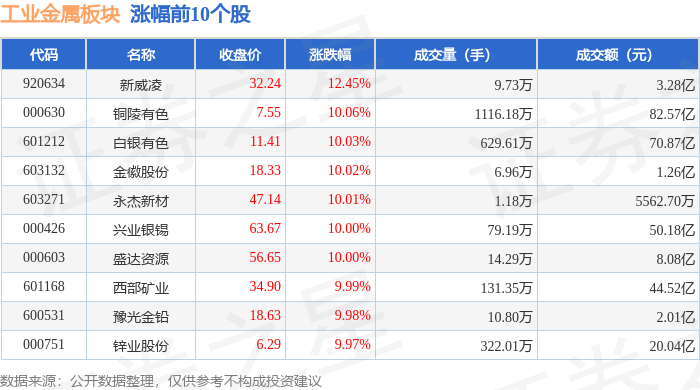
工业金属板块1月26日涨5.45%,新威凌领涨,主力资金净流出23.76亿元
Zheng Xing Xing Ye Ri Bao· 2026-01-26 09:37
| 代码 | 名称 | 收盘价 | 涨跌幅 | 成交量(手) | | 成交额(元) | | --- | --- | --- | --- | --- | --- | --- | | 300337 | 银邦股份 | 16.72 | -6.44% | | 107.15万 | 18.33亿 | | 603115 | 海星股份 | 23.24 | -4.36% | | 12.09万 | 2.83亿 | | 603876 | 鼎胜新材 | 16.20 | -3.46% | | 31.54万 | 5.20亿 | | 003038 | 鑫铂股份 | 18.25 | -2.98% | 1 | 27.92万 | 5.11亿 | | 601702 | 华峰铝业 | 22.57 | -2.25% | | 22.05万 | 5.02亿 | | 002171 | 楚江新材 | 14.52 | -2.22% | | 120.11万 | 17.70亿 | | 605208 | 永成泰 | 14.16 | -1.39% | | 8.70万 | 1.24亿 | | 002540 | 亚太科技 | 7.80 | -1.39% | | 38.78万 ...


业绩杀!利润预告大幅下降超60%!白酒龙头逼近跌停,带崩整个板块!白酒还能相信吗?
雪球· 2026-01-26 08:05
Core Viewpoint - The article discusses the recent performance of various sectors in the A-share market, highlighting significant movements in the precious metals and space photovoltaic sectors, while also noting the decline in the liquor industry. Group 1: Precious Metals Sector - The precious metals sector experienced a significant surge, with the sector rising over 10%, led by companies like Shandong Gold and China Gold, which saw substantial gains [5][6]. - Both silver and gold prices reached historical highs, with silver surpassing $108 and gold exceeding $5,100 per ounce, driven by geopolitical factors and fluctuations in confidence towards U.S. assets [7]. - Goldman Sachs raised its year-end gold price target from $4,900 to $5,400 per ounce, citing increasing demand from private investors and central banks, with expectations of monthly purchases of 60 tons by central banks [8]. Group 2: Industrial Metals Sector - The industrial metals sector showed structural strength, with companies like Zijin Mining and Luoyang Molybdenum rising over 5% and 8% respectively, indicating robust performance across the board [9][10]. - The income of mining companies is closely linked to the spot prices of metals like copper and lithium, with rising prices translating into significant profit increases due to fixed mining costs [11]. Group 3: Space Photovoltaic Sector - The space photovoltaic concept stocks surged, with companies like Mingyang Smart Energy and GCL-Poly Energy seeing strong performance, following Elon Musk's endorsement of space solar power at the World Economic Forum [12][13]. - Musk's plans include achieving an annual solar manufacturing capacity of 100GW within three years, which is nearly half of China's annual new photovoltaic installation capacity [15]. - Space photovoltaic technology is positioned as a strategic solution for commercial space and high-end applications, marking a potential turning point for the sector [16]. Group 4: Liquor Industry - The liquor sector faced a collective downturn, with Yanghe Distillery dropping 9.85%, alongside other brands like Jiuzi Liquor and Shui Jing Fang showing weak performance [17][18]. - Yanghe Distillery projected a significant decline in net profit for 2025, estimating a drop of 62.18% to 68.30%, and adjusted its dividend plan to ensure sustainability amid industry challenges [20].


ETF盘中资讯|洛阳钼业完成巴西金矿收购!有色ETF华宝(159876)猛拉5%,量价齐创历史新高!获资金净申购超1.2亿份!
Sou Hu Cai Jing· 2026-01-26 05:41
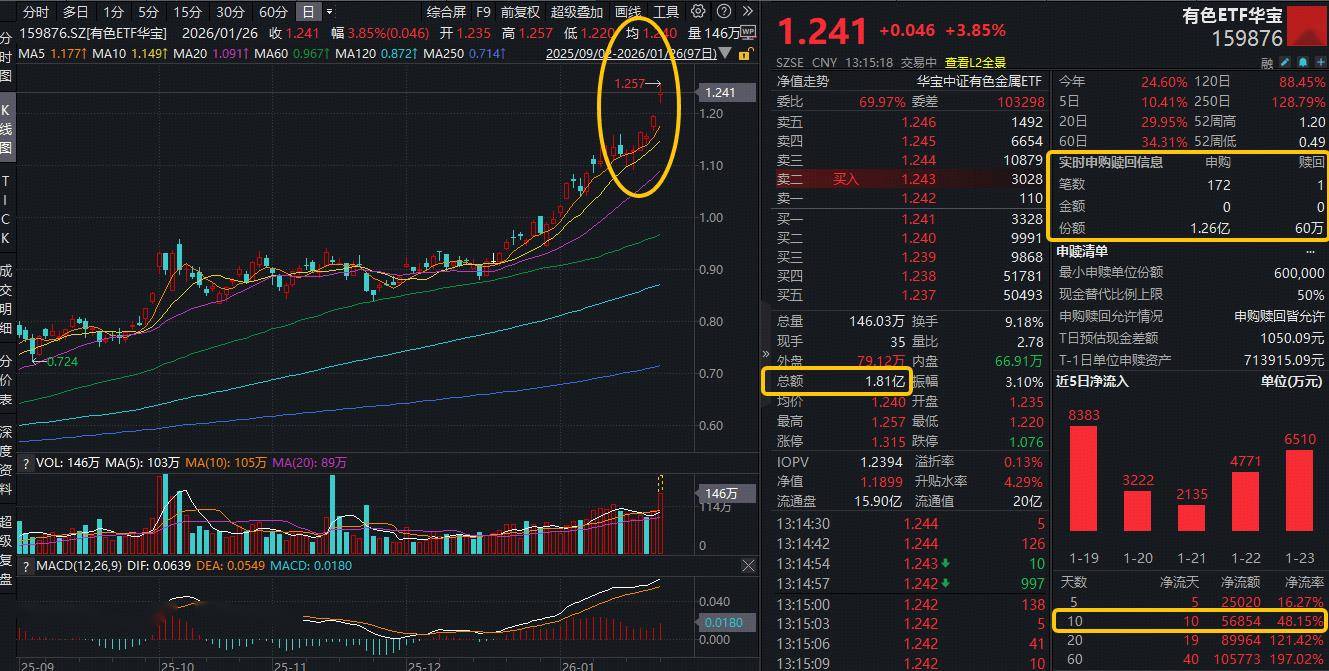
Group 1 - The non-ferrous metal sector is leading the market with a net inflow of nearly 15 billion yuan, ranking first among 31 Shenwan primary industries [1] - The Huabao non-ferrous ETF (159876) saw its price surge over 5.1% during the day, with a current increase of 3.85% and a transaction volume of 181 million yuan, setting historical highs in both price and volume [1] - The Huabao non-ferrous ETF has reached a new scale of 1.892 billion yuan, marking a historical peak [4] Group 2 - The recent acquisition by Luoyang Molybdenum of a Brazilian gold mine is expected to yield 6 to 8 tons of gold this year, with strong profitability and a short investment return period [3] - The non-ferrous metal industry is anticipated to maintain high profitability for an extended period, supported by continuous demand growth [4] - Domestic non-ferrous metal companies are valued lower compared to their overseas counterparts, despite having similar growth potential and core competitiveness [4] Group 3 - Several stocks in the non-ferrous sector, including Vanadium Titanium Co., Silver Nonferrous, and Hunan Gold, have reached their daily limit up, indicating strong market performance [5] - The Huabao non-ferrous ETF and its associated funds cover a wide range of metals, including copper, aluminum, gold, and lithium, allowing for better exposure to the sector's performance [8]

有色板块 “狂飙” 不止,新一轮“超级周期”备受关注
Sou Hu Cai Jing· 2026-01-26 05:21
Core Viewpoint - The non-ferrous metal sector is experiencing significant growth, driven by high international gold prices and strong performance from leading companies, making it a focal point for investors in 2026 [1][2]. Group 1: Market Performance - The non-ferrous metal sector has outperformed other sectors, with the MSCI Metals and Mining Index rising nearly 90% since the beginning of 2025, surpassing semiconductor and global banking sectors [2]. - Major companies in the sector, such as Zijin Mining, are expected to report substantial profit increases, with projected net profits for 2025 reaching between 51 billion to 52 billion yuan, reflecting a year-on-year growth of 59% to 62% [2]. Group 2: Fund Inflows and ETF Growth - There has been a remarkable influx of capital into the non-ferrous metal sector, with over 36 billion yuan net inflow into non-gold themed ETFs as of January 22, 2026, pushing the total scale of these ETFs to over 100 billion yuan [3]. - The non-ferrous metal ETF (512400) reached a scale of 40 billion yuan, indicating strong investor interest and positioning in this sector [3]. - Public funds have significantly increased their holdings in the non-ferrous sector, with 15 related fund products reported in a short span from early December 2025 to mid-January 2026, indicating a robust investment trend [3]. Group 3: Geopolitical and Economic Factors - The non-ferrous metal sector is transitioning from traditional cyclical characteristics to a new phase characterized by a combination of safe-haven demand, strategic security, and tight supply-demand balance due to rising geopolitical risks [4]. - The recent surge in gold prices, surpassing 5,000 USD per ounce, and silver prices exceeding 100 USD per ounce, reflects a shift in the global monetary system and increased demand for these metals as safe-haven assets [4][5]. Group 4: Specific Metal Insights - Gold and silver are experiencing a "super cycle" driven by geopolitical conflicts, loss of confidence in the US dollar, and ongoing central bank purchases, making them attractive for investment [5]. - Copper prices are showing resilience due to strong pre-holiday stocking, with supply constraints emerging as copper concentrate treatment charges have dropped to negative values, indicating a tight supply situation [6]. - Aluminum prices are expected to rebound due to low global inventories and strong demand driven by investments in power grids and solar exports, despite slight domestic inventory increases [7]. - The strategic importance of metals like cobalt and lithium is being reaffirmed, with supply concentrated in regions like the Democratic Republic of Congo, highlighting their long-term investment potential [8].


A股午盘:黄金股大涨,全市逾3700股下跌,深指、创业板指收跌
Xin Lang Cai Jing· 2026-01-26 04:32
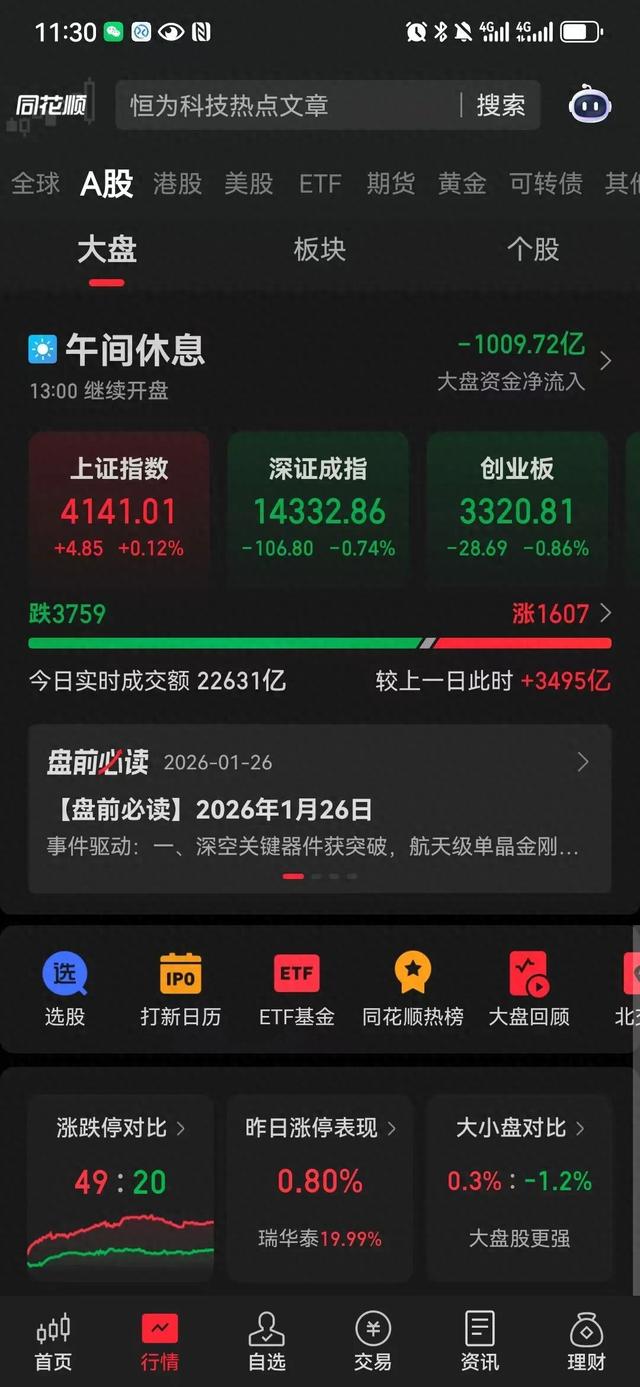
Market Performance - The A-share market opened higher on January 26, with the three major indices showing mixed performance, where the Shanghai Composite Index rose by 0.12%, while the Shenzhen Component Index and the ChiNext Index fell by 0.74% and 0.86% respectively [1] - The total trading volume exceeded 2.2 trillion yuan, with over 3,700 stocks declining [1] Sector Performance - The precious metals sector experienced significant gains, with stocks like Hunan Gold and Zhaojin Gold hitting the daily limit [1] - Industrial metals, minor metals, and insurance sectors also showed strong performance [1] - Conversely, sectors such as military electronics, military equipment, gaming, and software development were among the biggest losers [1]

午评:沪指半日涨0.12% 贵金属板块涨幅居前
Zhong Guo Jing Ji Wang· 2026-01-26 03:41
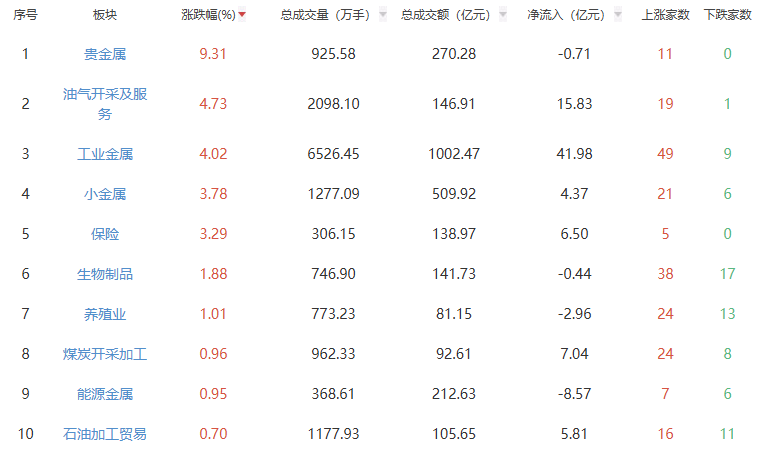
Core Viewpoint - The A-share market showed mixed performance with the Shanghai Composite Index slightly up by 0.12%, while the Shenzhen Component and ChiNext indices fell by 0.74% and 0.86% respectively [1] Market Performance - As of the midday close, the Shanghai Composite Index stood at 4141.01 points, the Shenzhen Component at 14332.86 points, and the ChiNext at 3320.81 points [1] - The top-performing sectors included precious metals, oil and gas extraction and services, and industrial metals, while sectors such as military electronics, military equipment, and gaming experienced significant declines [1] Sector Performance Rankings - The top sectors by percentage increase included: - Audio and video equipment: +9.31% with a total trading volume of 925.58 million hands and a net inflow of 270.28 million [2] - Oil and gas extraction and services: +4.73% with a trading volume of 2098.10 million hands and a net inflow of 146.91 million [2] - Industrial metals: +4.02% with a trading volume of 6526.45 million hands and a net inflow of 1002.47 million [2] - The sectors with the largest declines included: - Military electronics: -4.63% with a trading volume of 1899.58 million hands and a net outflow of 74.76 million [2] - Military equipment: -2.95% with a trading volume of 2273.68 million hands and a net outflow of 83.28 million [2] - Gaming: -2.74% with a trading volume of 926.31 million hands and a net outflow of 22.32 million [2]
ETF盘中资讯 暴涨4%,有色ETF华宝(159876)续创新高,资金加速抢筹!金价首次突破5000美元关键心理整数关口!
Jin Rong Jie· 2026-01-26 02:40
Group 1 - The core viewpoint of the article highlights that spot gold prices have surged, breaking the psychological barrier of $5000 per ounce for the first time, with expectations for further increases due to various economic factors [1] - Historical trends suggest that gold prices may rise between 10% and 35% by 2026, influenced by anticipated Federal Reserve interest rate cuts, instability in the US dollar, midterm elections, and geopolitical uncertainties [1] - Long-term bullish factors for gold include rising US fiscal risks, strong global central bank demand for gold, continuation of the Federal Reserve's easing cycle, and increased geopolitical risks due to disruptions in international order [1] Group 2 - On January 26, the non-ferrous metals sector led the market, with notable stocks such as Hunan Gold and Xiyang Co. hitting the daily limit, and others like Vanadium Titanium and Hengbang shares rising over 9% [1] - The Huabao Non-Ferrous ETF (159876) experienced a significant price increase of 4.1%, reaching a historical high, with a net subscription of 70.2 million shares, indicating strong market interest [2] - As of January 23, the Huabao Non-Ferrous ETF reached a record size of 1.892 billion yuan, making it the largest ETF tracking the non-ferrous metals index in the market [4]
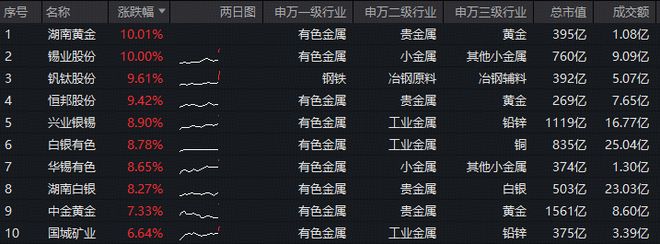
ETF盘中资讯|暴涨4%,有色ETF华宝(159876)续创新高,资金加速抢筹!金价首次突破5000美元关键心理整数关口!
Sou Hu Cai Jing· 2026-01-26 02:08
Group 1 - The core viewpoint of the news is that gold prices have surged, breaking the $5000 per ounce psychological barrier, with expectations of further increases due to various economic factors [1] - Historical patterns suggest that gold prices may rise between 10% and 35% by 2026, driven by anticipated Federal Reserve interest rate cuts, instability in the US dollar, midterm elections, and geopolitical uncertainties [1] - Long-term bullish factors for gold include rising US fiscal risks, strong global central bank demand for gold, continuation of the Fed's easing cycle, and increased geopolitical risks due to disruptions in international order [1] Group 2 - On January 26, the non-ferrous metals sector led the market, with significant gains in stocks such as Hunan Gold and Xiyang Co., which hit the daily limit, and others like Vanadium Titanium and Hengbang, which rose over 9% [2] - The non-ferrous ETF Huabao (159876) saw a substantial increase, with a 4.1% jump in intraday trading, reaching a historical high, and attracting significant capital inflow, totaling 569 million yuan over the past 10 days [2][5] - As of January 23, the Huabao non-ferrous ETF reached a record size of 1.892 billion yuan, making it the largest ETF tracking the non-ferrous metal index in the market [5] Group 3 - The Huabao non-ferrous ETF and its linked funds cover a wide range of sectors including copper, aluminum, gold, rare earths, and lithium, allowing investors to capture various market cycles effectively [8] - The ETF's comprehensive index tracking positions it well to benefit from different economic phases, including safe-haven assets, strategic metals, and industrial metals [8]
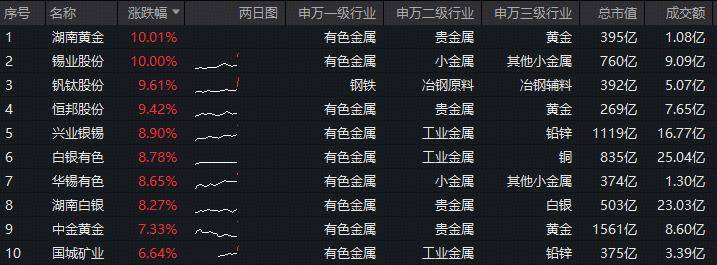
洛阳钼业大涨5.40%,成交额17.56亿元,主力资金净流出2158.66万元
Xin Lang Cai Jing· 2026-01-26 01:54
Core Viewpoint - Luoyang Molybdenum Co., Ltd. has shown significant stock price appreciation and strong financial performance, indicating potential investment opportunities in the company and the industrial metals sector [2][3]. Stock Performance - As of January 26, Luoyang Molybdenum's stock price increased by 5.40%, reaching 23.99 CNY per share, with a trading volume of 1.756 billion CNY and a turnover rate of 0.42% [1]. - Year-to-date, the stock price has risen by 19.95%, with a 2.92% increase over the last five trading days, 28.29% over the last 20 days, and 36.31% over the last 60 days [2]. Company Overview - Luoyang Molybdenum, established on December 22, 1999, and listed on October 9, 2012, is primarily engaged in the mining, selection, deep processing, trading, and research of precious metals such as molybdenum, tungsten, and gold [2]. - The company's revenue composition includes 48.56% from refined metal product trading, 38.31% from concentrate product trading, and smaller contributions from copper (27.14%), cobalt (6.04%), molybdenum (3.12%), and others [2]. Financial Performance - For the period from January to September 2025, Luoyang Molybdenum reported a revenue of 145.485 billion CNY, a year-on-year decrease of 5.99%, while the net profit attributable to shareholders increased by 72.61% to 14.280 billion CNY [2]. Dividend Distribution - Since its A-share listing, Luoyang Molybdenum has distributed a total of 21.562 billion CNY in dividends, with 10.576 billion CNY distributed over the past three years [3]. Shareholder Structure - As of September 30, 2025, the number of shareholders increased to 304,200, reflecting a growth of 28.08% [2]. - Major shareholders include Hong Kong Central Clearing Limited, holding 669.5 million shares, and various ETFs with varying changes in holdings [3].