
贵金属

Search documents
资产配置日报:上涨共识初现-20251225
HUAXI Securities· 2025-12-25 15:22
Group 1 - The core view of the report indicates that the equity market is showing signs of upward momentum, with the total A-share index rising by 0.60% and trading volume increasing by 467 billion yuan compared to the previous day [1][2] - The report highlights that the market is attempting to establish new narratives, which historically accompany successful breakthroughs of previous highs at year-end [1][2] - The report suggests that the index is approaching previous highs, with the total A-share index breaking through 6400 points, nearing the highs of October and November [2] Group 2 - The report identifies strong performance in specific sectors, particularly defense, military, and communication industries, which have successfully broken through previous high points, indicating a positive market sentiment towards these sectors [2] - The commercial aerospace sector has led the market with a cumulative increase of 31.12% since November 24, and its trading volume has reached a historical high of 6.05% of total A-share trading volume [3] - The bond market is experiencing a mixed performance, with short-term bonds showing a downward trend while long-term bonds are under pressure due to rising yields influenced by equity market movements [4][5] Group 3 - The report notes that the commodity market has shifted from a broad rally to a more differentiated performance, with precious metals experiencing a decline while industrial metals remain resilient [6] - The report emphasizes that the long-term bullish logic for precious metals remains intact, but short-term volatility may arise due to profit-taking after significant price increases [7] - The report discusses the dynamics in the polysilicon industry, where price increases are being driven by supply-side adjustments, despite ongoing supply-demand imbalances [7]
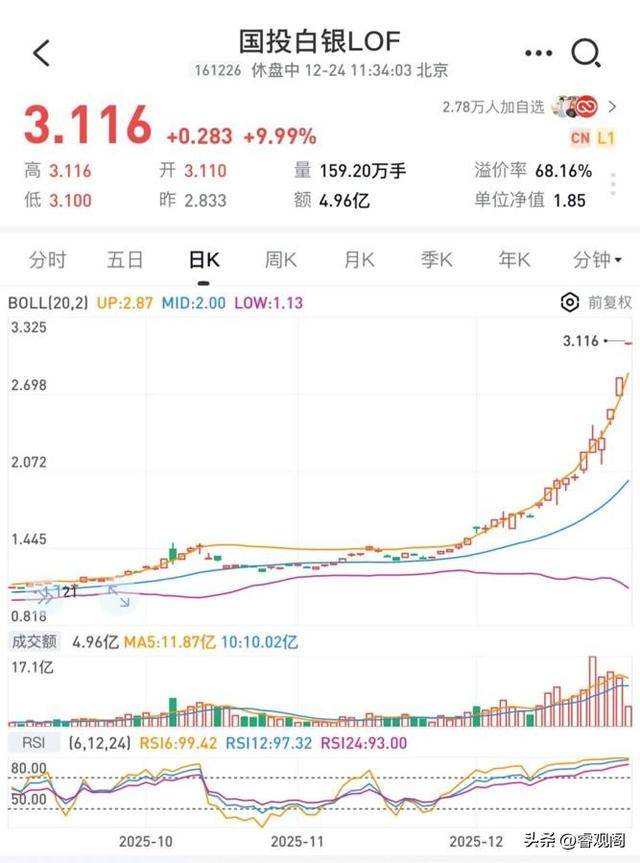
散户蜂拥入场!扎堆抄底白银,微型期货爆量,是暴富还是归零?
Sou Hu Cai Jing· 2025-12-25 11:08
哈喽,大家好,我是今天这篇财经评论,梳理了白银价格为何在圣诞假期突然加速上涨至72美元? 12月24日前后,在传统流动性偏弱的圣诞行情中,白银却走出了一轮极不寻常的加速上涨行情。 与黄金偏重避险与货币属性不同,白银的价格弹性更高,既受宏观金融环境影响,也高度依赖市场结构 和实物供需。 在当前全球降息预期强化、美元指数走弱的背景下,白银的"高贝塔"属性被明显放大,成为资金博取弹 性的首选工具。 资金正在押注"非常态行情" 如果说价格是结果,那么资金流向则是过程。 近期,全球白银ETF出现了持续且集中的净流入。数据显示,仅一周内,以实物白银为支撑的ETF就新 增持仓约1530万盎司,接近今年第二高水平。 中国海关数据显示,10月白银出口量超过660吨,创下历史新高,其中相当一部分流向伦敦市场。尽管 近期开始补库,但速度仍难以完全覆盖潜在的交割需求。 三大交易所的"结构性紧张" 全球规模最大的白银ETF——SLV,单周净流入资金接近10亿美元,罕见地超过了同期黄金ETF的吸金 规模。 与此同时,衍生品市场的风险偏好也明显升温。COMEX微型白银期货的成交量升至10月以来高位,期 权市场中,2025年2月到期、执行价 ...

数据复盘丨93股获主力资金净流入超1亿元 龙虎榜机构抢筹12股
Zheng Quan Shi Bao Wang· 2025-12-25 10:45
Market Performance - The Shanghai Composite Index closed at 3959.62 points, up 0.47%, with a trading volume of 785 billion yuan [1] - The Shenzhen Component Index closed at 13531.41 points, up 0.33%, with a trading volume of 1139.5 billion yuan [1] - The ChiNext Index closed at 3239.34 points, up 0.3%, with a trading volume of 532.66 billion yuan [1] - The STAR 50 Index closed at 1349.06 points, down 0.23%, with a trading volume of 44.8 billion yuan [1] - Total trading volume for both markets reached 1924.5 billion yuan, an increase of 44.26 billion yuan from the previous trading day [1] Sector Performance - Strong sectors included defense and military, light industry manufacturing, machinery equipment, insurance, automotive, textiles and apparel, computing, and food and beverage [3] - Active concepts included satellite internet, space stations, commercial aerospace, synchronous reluctance motors, humanoid robots, antibacterial fabrics, industrial mother machines, and PEEK materials [3] - Weak sectors included non-ferrous metals, precious metals, commercial retail, coal, and telecommunications [3] Fund Flow - The net outflow of main funds from the Shanghai and Shenzhen markets was 20.439 billion yuan [4] - The automotive sector saw the highest net inflow of main funds, amounting to 1.158 billion yuan [5] - Other sectors with significant net inflows included machinery equipment and food and beverage, with net inflows of 504 million yuan and 228 million yuan, respectively [5] - The electronics sector experienced the largest net outflow, totaling 5.068 billion yuan [5] Individual Stock Performance - A total of 1969 stocks saw net inflows, with 93 stocks receiving over 100 million yuan in net inflows [6] - Jin Feng Technology had the highest net inflow at 829 million yuan, followed by Yangguang Electric, Sanhua Intelligent Control, and others [7] - Conversely, 3196 stocks experienced net outflows, with 105 stocks seeing over 100 million yuan in net outflows [8] - Shenghong Technology had the largest net outflow at 1.651 billion yuan [9] Institutional Activity - Institutions had a net sell of approximately 108 million yuan, with 12 stocks seeing net purchases and 17 stocks net sold [10] - The stock with the highest net purchase by institutions was Hainan Development, with a net purchase amount of approximately 289 million yuan [10]
【财经分析】2026年,贵金属的牛市还能走多远?
Xin Hua Cai Jing· 2025-12-25 10:43
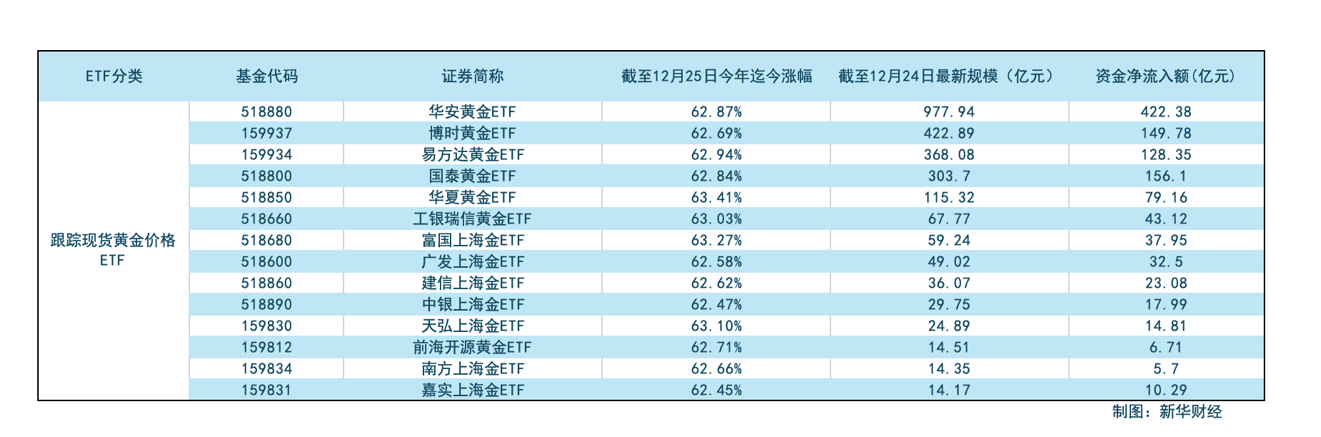
新华财经上海12月25日电(葛佳明) 在美联储进入降息周期、外部不确定性加剧的背景下,2025年黄金、白银价格持续刷新历史新高,带动贵金属板块整 体走强。 多位接受新华财经采访的分析师表示,在美联储降息与美国滞胀压力并存的宏观环境下,全球宏观秩序加速重构,黄金及黄金股在2026年仍具备进一步上行 的基础。同时,黄金股的内生成长性正在逐步兑现,叠加金矿龙头公司赴港上市提升了市场关注度与板块活跃度,当前具备较高估值性价比的黄金股后续表 现依然值得期待。 黄金再创历史新高多只概念股2025年翻倍 在各国央行大举购金、避险资金流入以及利率下行等多重因素推动下,2025年全球的贵金属走势迅速升温。截至12月25日,现货黄金价格今年已创造了54次 历史新高,现货白银价格突破了47次纪录新高。国际现货白银、铂金价格上涨均超过140%,钯金上涨超100%,国际现货黄金价格年内上涨超70%。 在今年国际金价不断走高的带动下,黄金ETF的投资收益也带来了显著提升。根据新华财经数据统计,今年以来,14只跟踪国内现货黄金价格的ETF,其年 收益率平均为62.83%。截至24日,上述14只ETF合并总规模超2497亿元,其中规模超过百 ...
金银铜罕见同创历史新高!16家有色金属公司被外资、公募共同抢筹!9家股价翻倍
私募排排网· 2025-12-25 10:00
Core Viewpoint - The non-ferrous metals sector is experiencing a structural bull market driven by global monetary easing, geopolitical risks, and tight supply-demand dynamics, with significant price increases in various metals such as gold, silver, copper, palladium, and platinum [2][3][4]. Supply Constraints and Demand Drivers - The recent strength in the non-ferrous metals sector is attributed to global monetary easing expectations, geopolitical tensions, and tight supply-demand conditions [2]. - On the demand side, emerging industries are expected to drive incremental demand for non-ferrous metals, with copper consumption in China projected to reach 15.4 million tons by 2025, particularly from sectors like new energy vehicles, photovoltaics, wind power, and artificial intelligence, estimated to consume 3.8 to 4 million tons [3]. - On the supply side, global copper production has faced continuous disruptions, and the supply tightness is expected to deepen by 2026. Domestic aluminum production capacity is limited, and export quotas on rare metals like antimony and rare earths have further constrained supply [4]. Market Performance and Company Insights - In the A-share market, several non-ferrous metal companies have seen significant stock price increases, with companies like Tianli Composite and Western Materials rising over 150% in the past month. Year-to-date, companies such as Tianli Composite, China Tungsten High-tech, and Zijin Mining have doubled in value [2]. - The non-ferrous metals industry reported a total revenue of 2.82 trillion yuan in the first three quarters of 2025, a year-on-year increase of 9.3%, with net profits rising by 41.55% to 151.29 billion yuan [12]. - Companies like Chuangjiang New Material and Shenghe Resources have shown exceptional performance, with net profit growth exceeding 40% year-on-year, indicating strong operational results in the sector [12][13]. Institutional Holdings - As of the end of Q3 2025, 116 non-ferrous metal companies were held by public funds, with 48 having a holding ratio exceeding 3%. Additionally, 82 companies were held by foreign capital, with 26 exceeding the same threshold. Notably, 16 companies had both foreign and public fund holdings above 3%, with significant stock price increases [9][10].



贵金属的转折点?风浪越大鱼越贵!
格隆汇APP· 2025-12-25 09:41
Core Viewpoint - The current precious metals market is experiencing significant volatility, with extreme bullish sentiment on one side and sudden bearish movements on the other, indicating a potential turning point for precious metals [5][10]. Short-term Disturbances - Investors should avoid acting as "purchasers" during the upcoming passive fund rebalancing, which is expected to exert selling pressure on silver (9%) and gold (3%) [16][18]. - Active funds are likely to preemptively reduce their holdings to lock in profits, suggesting that the current bullish trend in precious metals may soon end [20][21]. - It is advised to reduce positions in non-ferrous stocks to navigate this turbulent period [22]. Long-term Support for Gold Bull Market - The long-term bullish trend for gold is supported by four key factors: 1. Central banks have been net buyers of gold for three consecutive years, with purchases exceeding 1,000 tons annually, and are projected to reach 1,086 tons in 2024 [31]. 2. The Federal Reserve's interest rate cuts are expected to support gold prices, with three cuts anticipated by 2025 [36][37]. 3. The global debt crisis, particularly in the U.S., has created a demand for safe-haven assets like gold, as debt levels exceed $36 trillion [42][45]. 4. Retail investors currently have a low allocation to gold, with U.S. gold ETFs comprising only 0.17% of private investment portfolios, indicating significant room for growth [49]. Market Trends and Predictions - Historical data shows that gold has consistently outperformed U.S. equities over the past 25 years, with a 20-year return rate of 761% compared to the S&P 500's 673% [64]. - The current gold price has surpassed $4,500, with a total market capitalization of $31.5 trillion, suggesting a strong valuation relative to historical peaks [66]. - Analysts predict that gold could reach $5,000 per ounce by 2026, with some forecasts suggesting a potential rise to $10,000 per ounce by 2029, driven by multiple factors including the Fed's interest rate policies and global de-dollarization [69][72]. Investment Strategy - Short-term strategies should focus on defensive measures, such as reducing positions to avoid passive selling pressure, while long-term strategies should involve buying on dips as market volatility stabilizes [83][88]. - Investors are encouraged to consider gold-related ETFs for a straightforward investment approach that aligns with gold price movements [92].

12月25日白银晚评:本周美宏观数据显韧性 银价长期保持上涨趋势
Jin Tou Wang· 2025-12-25 09:20
Group 1 - The core viewpoint of the article highlights the resilience of the U.S. economy, as indicated by strong macroeconomic data and a robust labor market, which is influencing the silver market [3] - The recent increase in silver prices is attributed to heightened risk awareness due to global trade disruptions and energy supply issues, leading investors to seek traditional safe-haven assets like silver [3] - The current trading environment is characterized by low liquidity due to the holiday season, which is amplifying the inflow of funds into gold and silver as macro hedging tools rather than purely speculative assets [3] Group 2 - The latest silver price is reported at $71.94 per ounce, with a trading range between $70.16 and $72.70 [2] - Technical analysis indicates a bullish trend for silver, with key support at $70.65 and potential upward targets at $73.80 and $75.30 [4] - The market is advised to consider buying silver around $70.70, with a target of $75.00 and a stop-loss below $69.50, while monitoring the critical support level at $66.75 for potential buying interest [4]
2026商品风险:宏观主导的高波动与深分化
Dong Zheng Qi Huo· 2025-12-25 09:14
1. Report Industry Investment Rating The provided text does not contain information about the report's industry investment rating. 2. Core Views of the Report - In 2026, the commodity market will enter a period of high volatility and deep differentiation driven by macro - logic. Each commodity sector faces unique risks, including macro - policy changes, geopolitical issues, supply - demand imbalances, and policy uncertainties [167]. - The long - term bullish logic for gold remains intact, but in 2026, there are risks of short - term corrections due to factors such as "twin - peak inflation", delayed Fed rate cuts, and high risk premiums [16]. - Non - ferrous metals may see their price centers rise, but they are exposed to risks from macro - policy fluctuations, trade protectionism, and supply - demand mismatches [46]. - Black commodities will continue to face challenges of weak demand and oversupply, with the risk of a negative feedback loop [79]. - Energy and chemical products will struggle to re - balance due to long - term geopolitical risks, overcapacity, and weak demand [108]. - Agricultural products are in an era of increased production but face uncertainties in demand, policy interventions, and inventory and supply chain risks [138]. 3. Summary by Relevant Catalogs 3.1 Precious Metals: Risks in Safe - Haven Assets - **"Twin - Peak Inflation" and Monetary Policy**: Trump's tariff policies may lead to supply - side "twin - peak inflation". If inflation rebounds, the Fed may adopt a "Higher for Longer" policy, suppressing precious metal prices [17]. - **Fiscal Policy and Asset Rotation**: Fiscal expansion may trigger economic recovery expectations, leading to asset rotation from safe - haven assets to risk assets. The short - term economic boost from fiscal policies may reduce the attractiveness of gold [29]. - **Central Bank Buying and Investment Demand**: Central banks buy gold to hedge against dollar depreciation, but some may slow down or sell gold due to high prices. The shift from central bank buying to Western ETF investment funds increases market vulnerability [33][35]. - **International Political Risks**: Geopolitical risks are already priced into gold. If tensions ease, the risk premium may disappear. Trade frictions may also cause price fluctuations [41]. - **High Beta Trap in Silver**: Silver's price is more volatile than gold. If the manufacturing recovery is weak or gold prices fall, silver prices may decline more sharply [42]. 3.2 Non - Ferrous Metals: Macro - Policy and Supply - Demand Structural Contradictions - **Macro - Environment and Price Volatility**: Uncertainty in Fed monetary policy and dollar index fluctuations can directly impact non - ferrous metal prices. US trade protectionism may reshape trade flows and cause regional supply - demand imbalances [47][48]. - **Supply - Side Risks**: Supply shortages in copper mines, structural problems in aluminum mines, and slow capacity clearance in new energy metals are major risks. Resource nationalism also increases costs and supply chain risks [52][54][56]. - **Demand - Side Challenges**: Traditional demand from real estate and home appliances is weak, while emerging demand from new energy vehicles, photovoltaics, and AI may not meet expectations, leading to insufficient demand [60][64][70]. - **Inventory and Capital Risks**: Inventory mismatches and financial risks in the capital market can amplify price fluctuations. Low - inventory environments may lead to forced - liquidation events, and large - scale capital inflows and outflows can cause price bubbles and sharp corrections [74][76]. 3.3 Black Commodities: Pains in the Post - Real Estate Era - **Demand - Side Risks**: The real estate market remains a major drag on demand, while manufacturing demand may slow down, and the sustainability of steel exports is uncertain. Over - interpretation of demand resilience may lead to supply - demand imbalances [80][83][85]. - **Supply - Side Risks**: Global iron ore supply will shift from tight balance to oversupply in 2026. Double - coking coal and alloys also face supply - side pressures [89][96]. - **Policy and Macro - Level Risks**: The implementation of the "anti - involution" policy is uncertain, and fiscal and monetary policies may have a diminishing marginal effect. International rules such as CBAM and US trade policies also pose risks [98][99][101]. - **Profit Distribution and Negative Feedback**: The profit distribution in the industrial chain is distorted, and a negative feedback loop may occur, leading to a systemic price collapse [102][105]. 3.4 Energy and Chemical Products: Difficult Re - balance in a Geopolitically Fragmented World - **Geopolitical Risks**: Crude oil geopolitical risks are long - term and fragmented, leading to trade flow restructuring and cost increases. OPEC+ faces challenges in maintaining production cuts, and non - OPEC+ countries have limited capacity for production increases [109][113]. - **Demand - Side Constraints**: The logic of oil consumption has changed, and global economic factors such as trade frictions and high - interest rates limit energy demand. Shipping and logistics risks also affect energy costs and trade flows [119][125]. - **Inventory Risks**: Crude oil and chemical product inventories are expected to increase, suppressing prices and weakening the impact of geopolitical premiums. High - inventory situations in chemicals will become normal [132][135]. - **Policy Execution Risks**: The implementation of the "anti - involution" policy is uncertain, and without effective measures, capacity clearance in the chemical industry will be difficult [137]. 3.5 Agricultural Products: Increased Production Meets Uncertain Demand - **Supply - Side Risks**: Major agricultural products are expected to increase in production, leading to a global supply surplus. The soybean market is highly dependent on Brazil, and any local disruptions may have a global impact [138][139]. - **Demand - Side Risks**: Food, feed, and industrial demand for agricultural products are all weakening. Policy uncertainties in bio - fuels also affect industrial demand [143][144]. - **Policy Intervention Risks**: Sino - US trade relations and bio - diesel policies are major variables that can significantly impact the agricultural market [151][156]. - **Inventory and Supply Chain Risks**: High inventories of US corn and soybeans suppress prices, and supply chain risks from logistics and geopolitical factors can cause price fluctuations [164]. 3.6 Summary and Response - In 2026, commodity risk management should be more forward - looking, structural, and flexible, upgrading from price risk management to volatility management and risk - return structure optimization [167]. - For precious metals, maintain long - term bullish positions but use dynamic stop - profit mechanisms and options to manage risks [168]. - For non - ferrous metals, refine futures hedging and use options to protect against extreme risks [169]. - For black commodities, shift from hedging absolute prices to managing profits and use options to manage costs and risks [170]. - For energy and chemical products, use futures to manage geopolitical risks and options to manage volatility. Take advantage of price rebounds to lock in processing fees [171]. - For agricultural products, use futures for selling hedging and options to manage price fluctuations and input costs [172].
市场分析:航天机器人领涨,A股震荡上行
Zhongyuan Securities· 2025-12-25 09:10
Market Overview - On December 25, the A-share market opened lower but rose slightly, with the Shanghai Composite Index encountering resistance around 3955 points before closing at 3959.62 points, up 0.47%[2][7] - The Shenzhen Component Index closed at 13531.41 points, up 0.33%, while the ChiNext Index rose by 0.30%[7][8] - Total trading volume for both markets reached 19,441 billion yuan, above the median of the past three years[3][16] Sector Performance - Key sectors showing strong performance included aerospace, robotics, general equipment, and wind power equipment, while precious metals, energy metals, retail, and automotive sectors lagged[3][7] - Over 70% of stocks in the two markets rose, with significant inflows into aerospace, automotive parts, and general equipment sectors[7][9] Valuation Metrics - The average price-to-earnings (P/E) ratios for the Shanghai Composite and ChiNext indices are 16.19 times and 49.94 times, respectively, above the median levels of the past three years, indicating a favorable environment for medium to long-term investments[3][16] - The current market conditions suggest a consolidation phase around the 4000-point mark for the Shanghai Composite Index, influenced by macroeconomic data and policy expectations[3][16] Investment Recommendations - Investors are advised to focus on sectors such as aerospace, robotics, general equipment, and wind power for short-term opportunities[3][16] - The recent Central Economic Work Conference emphasized a shift towards quality and sustainability in economic policies, highlighting future industries like AI, commercial aerospace, quantum technology, and 6G as key investment areas[3][16] Risk Factors - Potential risks include unexpected overseas economic downturns, slower-than-expected domestic policy and economic recovery, and fluctuations in macroeconomic conditions[4]
ETF收评 | A股7连阳,商业航天爆发涨停潮,卫星ETF涨近7%
Ge Long Hui· 2025-12-25 08:25
Core Viewpoint - The Shanghai Composite Index rose by 0.47%, marking a seven-day consecutive increase, while the ChiNext Index increased by 0.3% [1] Group 1: Market Performance - Commercial aerospace concept stocks experienced a surge, leading to a wave of limit-up stocks [1] - The robotics sector saw a significant breakout, with the Invesco Robotics 50 ETF rising by 4.23% and the Fidelity Robotics ETF increasing by 4.15% [1] - The precious metals sector faced a pullback, with gold stocks declining, and related ETFs dropping by 1% [1] Group 2: ETF Movements - The satellite ETFs from Yongying Fund, GF Fund, and E Fund rose by 6.93%, 5.91%, and 5.86% respectively [1] - The mini-sized Hong Kong stock ETFs continued to rise for the second consecutive day, with the GF Hang Seng ETF increasing by 4.92% and a latest premium rate of 9.22% [1] - Some Hong Kong technology ETFs declined, with the Hong Kong Stock Connect 50 ETF falling by 1% [1] Group 3: Sector Highlights - The stablecoin, storage, and intelligent transportation themes showed strong performance [1] - The paper, packaging, and insurance sectors were notably active [1] - Adjustments were observed in the Hainan Free Trade Zone, gold, and lithium mining directions [1]