电子设备

Search documents
沪银涨超5%创新高;绍兴地铁撞击事故调查报告发布;京东年终奖震惊“打工人”!从19薪到25薪,最高“上不封顶”丨每经早参
Mei Ri Jing Ji Xin Wen· 2025-12-25 23:09
Group 1 - The price of silver in Shanghai rose by 5.50%, reaching a historical high of 18,131 RMB per kilogram [4] - JD.com announced its year-end bonus plan for 2025, with departments upgraded to 19 salaries offering up to 22 salaries for top performers, and those upgraded to 20 salaries offering up to 24 salaries [25] - JD.com's average salary for the procurement and sales department is expected to reach 25 salaries this year, with a target of 26 salaries in 2026 [25] Group 2 - The Egyptian central bank decided to lower the benchmark interest rate by 100 basis points, bringing the deposit rate down to 20% and the loan rate to 21% [4] - The Chinese Ministry of Commerce expressed strong opposition to the U.S. imposing additional tariffs on Chinese semiconductor products, stating that it does not recognize the conclusions of the U.S. 301 investigation [6] - The Ministry of Commerce also responded to questions regarding TikTok's establishment of a joint venture in the U.S., emphasizing the need for solutions that comply with Chinese laws and regulations [5] Group 3 - The National Defense Ministry of China stated that it will increase pressure in response to provocations from Taiwan independence advocates, emphasizing the necessity of military preparedness [8] - The Chinese government announced an increase in the compensation and living allowance standards for certain retired military personnel and other beneficiaries starting from August 1, 2025 [9] - The National Tobacco Monopoly Administration is seeking public opinion on a draft notice to enforce restrictive policies on the e-cigarette industry [7] Group 4 - Longi Green Energy confirmed a price increase for silicon wafers, with average increases reaching 12% [20] - Xiaomi announced the price of its new flagship model, the Xiaomi 17 Ultra, starting at 6,999 RMB, reflecting a 500 RMB increase from the previous model [21] - Deep Blue Automotive completed a C-round financing of 6.122 billion RMB, aimed at enhancing its competitiveness in the new energy vehicle sector [26]






2025年终经济观察丨供需两端齐发力 激活消费“主引擎”
Xin Hua Wang· 2025-12-25 14:11
Group 1 - Consumption is the "main engine" of economic growth and a barometer of people's well-being, with policies effectively boosting consumption potential throughout the year [1] - In the first 11 months, the total retail sales of consumer goods increased by 4% year-on-year, surpassing both the same period last year and the total growth for the previous year [1] - The Central Economic Work Conference emphasized the importance of domestic demand and outlined specific measures to stimulate consumption, including the implementation of special actions to boost consumption and the release of service consumption potential [1] Group 2 - Consumer demand has shifted from "availability" to "quality," with high-end products experiencing strong demand, such as the Huawei Mate80 series and popular events [2] - The supply of consumer goods has entered a new phase characterized by high quality and high prices, although structural mismatches in supply and demand still exist in some areas [2] - In the first 11 months, new energy vehicle sales accounted for 53.2% of total new car sales, indicating a significant shift towards greener consumption [2] Group 3 - Large-scale consumption is crucial for solidifying the consumption base, with policies supporting the optimization of the "two new" policy and promoting reforms in the automotive circulation market [3] - Service retail sales increased by 5.4% year-on-year in the first 11 months, indicating a recovery in service consumption, which is essential for driving overall consumption [3] - Various regions are focusing on niche consumer demands and leveraging local resources to enhance service offerings, such as themed trains and tourism initiatives [3] Group 4 - New supply is expected to create new demand, with advancements in technology such as L3-level autonomous driving set to stimulate market growth and innovation [4] - The "first store economy" is gaining traction, with new retail formats attracting significant foot traffic and consumer interest [4] - Policies aimed at enhancing the adaptability of supply and demand in consumer goods are being implemented to foster innovation and growth in the sector [4] Group 5 - China is evolving into a global innovation hub, with various industries accelerating their transformation towards smart, green, and high-end products, thus opening new consumption opportunities [5] - The integration of digital consumption and quality e-commerce is continuously activating new growth points in the consumer market [5] Group 6 - The Sanya International Duty-Free City has seen a surge in customer traffic, with new duty-free products attracting significant consumer interest, reflecting a booming market [6] - High-level openness is enriching the supply of quality products and enhancing the business environment, which in turn promotes innovation and quality improvements in "Made in China" and "China Services" [6] - The focus on consumer experience extends beyond mere purchasing, indicating a systemic reform in the consumption landscape [6] Group 7 - Policies aimed at enhancing public services and increasing disposable income are being implemented to boost consumer spending capacity [7] - Various regions are creating community spaces and optimizing housing policies to enhance consumer experiences and stimulate spending [7] - The "14th Five-Year Plan" emphasizes the integration of consumer promotion and public welfare, highlighting the importance of increasing residents' consumption capacity [7] Group 8 - Multiple initiatives are being launched to promote employment and income growth, with a focus on stabilizing the real estate market and enhancing consumer confidence [8] - Efforts to reduce competition pressures and encourage quality over price are being emphasized to improve the overall consumption environment [8] - A comprehensive approach is being adopted to stimulate consumption through coordinated supply and demand efforts, enhancing consumer confidence and spending power [8]
中国发现“无价之宝”,每吨估价46亿,日本破防:怎么又是中国的
Sou Hu Cai Jing· 2025-12-25 07:05
Core Viewpoint - China has made significant discoveries in rare metal resources, particularly in rubidium and rhenium, enhancing its position in the global market and reducing reliance on imports [1][17]. Group 1: Rubidium Discovery - China has discovered a super-large independent rubidium mine with a reserve of 175,000 tons, which is unprecedented globally [1][4]. - Rubidium is crucial in high-tech, medical, and renewable energy sectors, previously difficult to extract and costly [3][6]. - The global demand for rubidium is increasing, with annual production only around 4-5 tons, leading to a significant supply gap [8]. Group 2: Global Market Impact - With the new rubidium mine, China can potentially meet global demand for over a thousand years, shifting from a passive to an active role in the market [8][9]. - The estimated value of rubidium is around 4.6 billion per ton, reflecting its scarcity and importance in high-tech applications [8][9]. - Japan, heavily reliant on imported rubidium, faces increased pressure and potential supply chain instability due to China's resource advantage [9][11]. Group 3: Rhenium Discovery - China has also discovered rhenium, a rarer metal than rubidium, with a reserve of 176 tons, ranking fourth globally [13][14]. - Rhenium is essential for aerospace applications, particularly in turbine blades, enhancing performance and longevity [13][14]. - China has developed its own extraction and application technologies for rhenium, breaking the previous technological monopoly held by developed countries [14][15]. Group 4: Sustainable Development - The development of both rubidium and rhenium resources emphasizes efficiency, technology, and environmental protection [15][16]. - China is implementing strict emission monitoring during the extraction processes to ensure sustainable development [16]. - The focus on self-sufficiency in these rare metals supports the growth of high-tech, renewable energy, and aerospace industries [17][18].

首席收18万“吹票”获刑!事发时已入职新东家,带病跳槽谁埋单?
Xin Lang Cai Jing· 2025-12-25 05:56
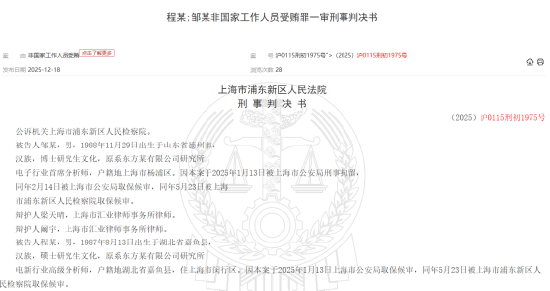
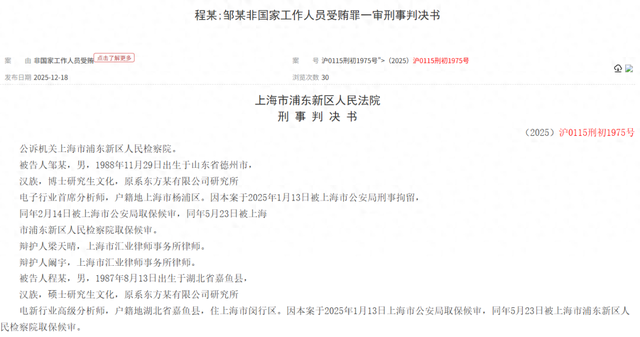
Core Viewpoint - A recent court ruling has revealed unethical practices in the securities research business, specifically involving analysts from a brokerage firm who accepted bribes to issue favorable reports for Jiangsu Litong Electronics Co., Ltd. [1][6] Group 1: Legal Case and Analyst Misconduct - Analysts Zou and Cheng were found guilty of accepting bribes of 180,000 yuan and 50,000 yuan respectively, leading to prison sentences and fines [1][6] - The analysts involved are identified as Zou Jie and Cheng Wenxiang, both previously associated with Dongfang Caifu Securities [1][8] - Zou Jie continued to work as an analyst at Dongbei Securities after receiving the bribe, raising concerns about the industry's ability to prevent such misconduct [6][12] Group 2: Stock Performance and Research Reports - The stock price of Litong Electronics was below 19 yuan in March 2023, but surged to a historical high of 40.70 yuan by November 2023 following the release of favorable research reports [2][8] - After the second report was published in December 2023, the stock price plummeted over 60% within two months, dropping below 15 yuan [2][8] Group 3: Company Financial Performance - Litong Electronics reported a revenue of 2.025 billion yuan for 2022, marking a year-on-year increase of 12.24%, despite a downturn in the display industry [10] - The company achieved a net profit of 66 million yuan, a 14.20% increase from the previous year, with a non-recurring net profit of 35 million yuan, up 7.35% [10] - The company has successfully maintained relationships with major clients and expanded its global production capacity, with factories in Mexico and Vietnam nearing operational status [10]

日股能否突破“预期值天花板”?
日经中文网· 2025-12-25 02:56
Group 1 - The core viewpoint of the article highlights that Japan's stock market has struggled to break through a PER ceiling of 16 times, with the PER not being a driving factor for market growth historically [2][6][8] - The Nikkei average index reached a historic high of around 50,000 points by the end of 2025, with the focus on whether market expectations can be further improved [2] - Analysts suggest that many individual stocks still have low PERs, and the challenge for 2026 is for companies to improve performance and capital efficiency to stimulate further stock price increases [2] Group 2 - The trading volume of the Tokyo Stock Exchange's Prime section fell below 4 trillion yen, marking a five-month low, while SCREEN Holdings saw a significant stock price increase of 13%, reaching 15,320 yen, with a 57% rise in 2025, outperforming the Nikkei average [4] - Morgan Stanley MUFG Securities raised SCREEN's target stock price from 16,200 yen to 24,400 yen, citing a genuine recovery phase in the front-end equipment market starting from mid-November 2025 [4] - SCREEN has consistently achieved revenue and profit growth since the fiscal year ending March 2022, with ROE increasing from 7.9% in the fiscal year ending March 2021 to 25.1% in the fiscal year ending March 2025 [5] Group 3 - The PER of Japan's stock market has remained between 12 to 16 times since the Lehman crisis, with the current market conditions pushing PER close to the upper limit of this range [6][8] - Despite improvements in ROE, the trend of declining PER continues, indicating that the long-term growth of Japanese companies is not being properly priced in the stock market [8] - To achieve ROE growth and enhance market expectations, companies need to focus on sustainable profitability through sales growth, especially in an inflationary economic environment [9] Group 4 - Japan's PER is approaching levels seen in technology-driven markets like the US, India, and Taiwan, suggesting that it is unlikely for Japan's PER to continue rising in isolation [11] - While inflation may push PER higher, rising interest rates pose a risk, as the yield on newly issued 10-year Japanese government bonds has entered the 2% range, surpassing the Nikkei average dividend yield of 1.8% [11] - The underestimation of growth potential in the Japanese stock market is a long-standing barrier, with investors looking for catalysts such as companies that boldly adjust their business portfolios and focus on growth markets [11]
8点1氪|官方回应吸毒记录封存相关问题;强生爽身粉致癌案判赔女子约110亿元;俞敏洪敲定东方甄选接班人
3 6 Ke· 2025-12-24 23:57
Group 1 - The revised Public Security Administration Punishment Law will take effect on January 1, 2026, with a focus on sealing records of minor offenses, particularly for minors [2][3] - The law aims to prevent the lifelong consequences of a single punishment, providing a framework for sealing minor offense records, which will still be recorded but not publicly accessible [4][5] - The law clarifies the relationship between the Public Security Administration Punishment Law and the Criminal Law, stating that criminal acts must be prosecuted under criminal law, while non-criminal acts are subject to administrative penalties [6][7] Group 2 - The sealing of drug-related records is included in the law, emphasizing that drug use is treated as a violation rather than a crime, with a strong focus on rehabilitation and prevention of drug abuse [8][9] - The government has established a comprehensive system for drug rehabilitation, including voluntary and mandatory rehabilitation measures, and emphasizes the importance of confidentiality regarding the personal information of drug users [9][10] Group 3 - The law has received no objections since its announcement on June 27, 2025, indicating broad acceptance and support from the public [3][4] - The law's provisions are designed to ensure that all citizens are treated equally under the law, reinforcing the principle of equality before the law [2][5]
沪上券商首席被判刑!撰写研报收取18万元好处费
Xin Lang Cai Jing· 2025-12-24 15:44
Core Viewpoint - A recent court ruling revealed a bribery case involving analysts from a brokerage firm, highlighting ethical concerns in the financial analysis industry and its potential impact on stock valuations [1][2]. Group 1: Legal Proceedings - The Shanghai Pudong New District People's Court sentenced two analysts from a brokerage firm for accepting bribes, with one receiving a ten-month prison sentence (suspended for one year) and the other receiving an eight-month prison sentence (also suspended for one year), along with fines of 100,000 yuan each [1][2]. - The analysts were found guilty of accepting bribes to enhance the market visibility of Jiangsu Litong Electronics Co., Ltd. through research reports [2]. Group 2: Company Performance - Jiangsu Litong Electronics' stock price experienced a significant increase, starting from May 2023 and reaching a historical high of 40.51 yuan per share in November 2023, representing an annual growth of over 155% [4]. - As of the latest closing price, the stock is reported at 26.87 yuan per share [4].
金融工程日报:指震荡攀升录得六连阳,商业航天概念再度爆发-20251224
Guoxin Securities· 2025-12-24 15:25
证券研究报告 | 2025年12月24日 金融工程日报 沪指震荡攀升录得六连阳,商业航天概念再度爆发 核心观点 金融工程日报 市场表现:20251224 大部分指数处于上涨状态,规模指数中中证 2000 指数 表现较好,板块指数中科创 100 指数表现较好,风格指数中中证 500 成长指 数表现较好。国防军工、电子、建材、轻工制造、计算机行业表现较好,农 林牧渔、煤炭、食品饮料、银行、家电行业表现较差。毫米波、玻璃纤维、 卫星互联网、商业航天、MLCC 等概念表现较好,钨矿、黄金精选、动物保健 精选、乳业、猪瘟疫苗等概念表现较差。 市场情绪:20251224 收盘时有 86 只股票涨停,有 6 只股票跌停。昨日涨停 股票今日收盘收益为 2.54%,昨日跌停股票今日收盘收益为-1.12%。今日封 板率 75%,较前日提升 6%,连板率 28%,较前日提升 2%。 市场资金流向:截至 20251223 两融余额为 25316 亿元,其中融资余额 25146 亿元,融券余额 170 亿元。两融余额占流通市值比重为 2.6%,两融交易占市 场成交额比重为 11.3%。 折溢价:20251223 当日 ETF 溢价较多 ...
2025年11月经济数据点评:分化延续,政策需加力
Haitong Securities International· 2025-12-24 14:34
Economic Overview - The national economy in November 2025 showed characteristics of "stable production, differentiated consumption, and pressured investment" with industrial production recovering to normal levels after holiday disruptions[2] - Emerging industries continue to be the main support for production and investment, although industrial growth has slightly slowed down, indicating significant industry differentiation[6] Production Insights - The industrial added value in November increased by 4.8% year-on-year, a slight decrease of 0.1 percentage points from the previous month, while month-on-month growth improved by 0.44 percentage points[8] - The production-sales rate for industrial enterprises was 96.5%, showing a month-on-month increase of 0.1 percentage points, with the export delivery value decline narrowing from 2.1% to 0.1%[8] Consumption Trends - Retail sales growth in November was 1.3% year-on-year, marking a continuous decline for six months, with large-scale retail sales dropping by 2.0%[20] - The promotional season had limited impact on consumer spending, with online retail growth decreasing from 8.1% to 5.4%[22] Investment Analysis - Fixed asset investment from January to November decreased by 2.6% year-on-year, with November showing a month-on-month decline of 12.0%[26] - Manufacturing, broad infrastructure, and real estate investments saw declines of -4.5%, -11.9%, and -30.3% respectively, indicating a challenging investment environment[26] Risk Factors - There is an increasing uncertainty in external trade and a potential unexpected decline in domestic demand, which could further pressure economic growth[37]
美国首次申请失业救济人数降至21.4万人
Xin Lang Cai Jing· 2025-12-24 14:33
Group 1 - The number of initial jobless claims in the U.S. decreased by 10,000 to 214,000 for the week ending December 20, which is below the economists' median forecast of 224,000 [5] - The number of individuals continuing to claim unemployment benefits rose to 1.92 million in the previous week [5] - The recent fluctuations in new claims are typical for this time of year, especially around the holiday season, with claims having spiked earlier in the month from a three-year low during Thanksgiving [5] Group 2 - The four-week moving average of new claims, which helps smooth out volatility, also showed a decline last week [5] - The layoff rate in the labor market remains relatively low, maintaining stability throughout the year despite increasing economic uncertainty [5] - Major companies like PepsiCo and HP have announced layoff plans, but these have not yet translated into a significant increase in actual layoffs [5]