
能源

Search documents
云南能投(002053.SZ):拟570.89万元收购砚山公司100%股权
Ge Long Hui A P P· 2025-08-14 12:48
Core Viewpoint - Yunnan Energy Investment (002053.SZ) has agreed to acquire 100% equity of Yunnan Yanshi Yanshan Co., Ltd. from its wholly-owned subsidiary, Yunnan Salt Industry Co., Ltd., for a purchase price based on the audited net asset value of approximately RMB 5.7089 million as of December 31, 2024 [1] Group 1 - The acquisition aims to enhance the company's resource integration and strategic development [1] - Following the completion of the acquisition, the company will directly hold 100% equity of Yanshan Co., transforming it from a wholly-owned subsidiary to a wholly-owned subsidiary of the company [1] - Yanshan Co. will serve as the investment entity for the Changning Changtian Wind Farm and the Zhongzhai Wind Farm projects [1]

欧元区6月工业产出跌幅超预期,GDP仍维持增长
智通财经网· 2025-08-14 11:23
Group 1 - Eurozone industrial output fell by 1.3% in June, worse than the expected decline of 1.0%, primarily due to significant drops in Germany and weak consumer goods production [1] - The revision of May's output growth from 1.7% to 1.1% indicates a weaker underlying trend than previously anticipated [1] - The second quarter GDP growth of 0.1% aligns with initial estimates, while employment growth of 0.1% matches expectations but is lower than the previous quarter's 0.2% [1] Group 2 - Year-on-year economic growth of 1.4% in the second quarter was driven by a surge in demand before the implementation of US tariffs, but this growth is expected to slow down until a potential recovery in 2026 [2] - The monthly industrial output decline was mainly attributed to Germany (-2.3%) and Ireland (-11.3%), with the latter's data being affected by tax maneuvers of multinational pharmaceutical companies [2] - All sectors, except for energy production, experienced contraction last month, with non-durable consumer goods (-4.7%) and capital goods (-2.2%) leading the decline [2]
桥水二季度大举增持英伟达,加仓谷歌、微软、Meta,清仓阿里等中概
华尔街见闻· 2025-08-14 10:46
Core Viewpoint - Bridgewater Associates, one of the largest hedge funds globally, significantly increased its investments in major U.S. tech companies during the second quarter of this year, particularly in Nvidia, which is now its third-largest holding [1][3]. Summary by Sections Investment Increases - Bridgewater raised its stake in Nvidia by nearly 4.39 million shares, bringing its total to 7.23 million shares, a 154% increase from the previous quarter, making up 4.61% of its total portfolio [3][7]. - Microsoft saw a 111.9% increase in shares, with an additional 905,620 shares added, totaling 1.72 million shares, now representing 3.44% of the portfolio [3][7]. - Alphabet was increased by approximately 2.56 million shares, totaling 5.60 million shares, an 84.1% rise, now accounting for 3.98% of the portfolio [3][7]. - Meta's shares increased by over 38,146 shares to 807,073 shares, marking an 89.6% increase, now 2.40% of the portfolio [4][7]. - Uber's shares surged by 314,000, a 531% increase, now making up 1.41% of the portfolio [5][7]. - Johnson & Johnson's shares increased by over 199,000, a 667.8% rise, now 1.41% of the portfolio [6][7]. Investment Reductions - Bridgewater reduced its Amazon holdings by approximately 795,500 shares, a 6% decrease, now 1.10% of the portfolio [8][9]. - AMD shares were reduced by about 408,860 shares, a decrease of 18.89% [11]. - PayPal saw a reduction of nearly 447,790 shares, a drop of over 12% [10]. - The fund completely exited its positions in Alibaba, Baidu, and JD.com, which were previously increased in the first quarter [12][13]. New Investments - Bridgewater initiated a position in Arm with nearly 474,000 shares, representing 0.31% of the total portfolio [14]. - New positions were also taken in Intuit, EQT, Lyft, and Ulta Beauty, with each holding a small percentage of the overall portfolio [14]. Major Holdings - The SPDR S&P 500 ETF remains Bridgewater's largest holding, despite a reduction of 731,882 shares, now accounting for 6.51% of the portfolio [15][18]. - The iShares Core S&P 500 ETF increased by nearly 6.2% to approximately 2.31 million shares, now 5.78% of the portfolio [17][18]. - The second to tenth largest holdings include Nvidia, Alphabet, Microsoft, Meta, Salesforce, Booking Holdings, and GE Vernova, with various changes in share counts and percentages [17][18].





胜通能源龙虎榜数据(8月14日)
Zheng Quan Shi Bao Wang· 2025-08-14 10:13
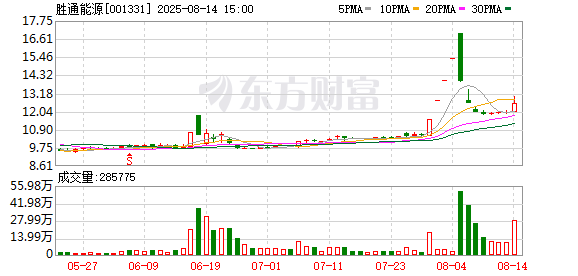
胜通能源8月14日交易公开信息 | 买/卖 | 会员营业部名称 | 买入金额(万元) | 卖出金额(万元) | | --- | --- | --- | --- | | 买一 | 广发证券股份有限公司武汉和平大道证券营业部 | 1000.01 | 1.25 | | 买二 | 机构专用 | 838.19 | 1165.83 | | 买三 | 机构专用 | 726.94 | 215.47 | | 买四 | 机构专用 | 627.60 | 295.47 | | 买五 | 方正证券股份有限公司杭州平澜路证券营业部 | 557.73 | 109.34 | | 卖一 | 机构专用 | 838.19 | 1165.83 | | 卖二 | 机构专用 | 77.79 | 365.47 | | 卖三 | 机构专用 | 520.93 | 328.76 | | 卖四 | 广发证券股份有限公司广州康王中路证券营业部 | 4.92 | 313.55 | | 卖五 | 机构专用 | 627.60 | 295.47 | 胜通能源今日上涨4.50%,全天换手率40.50%,成交额3.56亿元,振幅8.61%。龙虎榜数据显示,机构净 买入420. ...
美股期货小幅下跌,欧股开盘多数上涨,日元涨约0.7%,美元转涨,比特币涨超2%
Hua Er Jie Jian Wen· 2025-08-14 07:39
Core Points - US stock futures fell by approximately 0.1%, while major European indices opened mostly higher [1][11] - The Japanese stock market declined, with the Nikkei 225 index down by 1.4% and the Topix index down by 1.1% [3] - The US Treasury yields mostly decreased, with both 2-year and 10-year yields down by over 1 basis point [4] - The British GDP for Q2 exceeded expectations with a growth of 0.3%, reducing the likelihood of further rate cuts [5] - Oil prices saw a slight increase, with WTI crude rising over 0.4% to above $62.20 [8][18] - Bitcoin and Ethereum experienced significant gains, with Bitcoin rising over 2% to above $121,800 and Ethereum rising over 3% to above $47,700 [9][10] Market Reactions - The US dollar index initially fell by nearly 0.2% but later turned to an increase [4][12] - The Japanese yen appreciated by approximately 0.7%, marking its largest gain in nearly two weeks [1] - Gold prices remained stable, with spot gold slightly up by over 0.2% [6][15] - Silver prices showed minimal movement, with spot silver remaining flat [7]

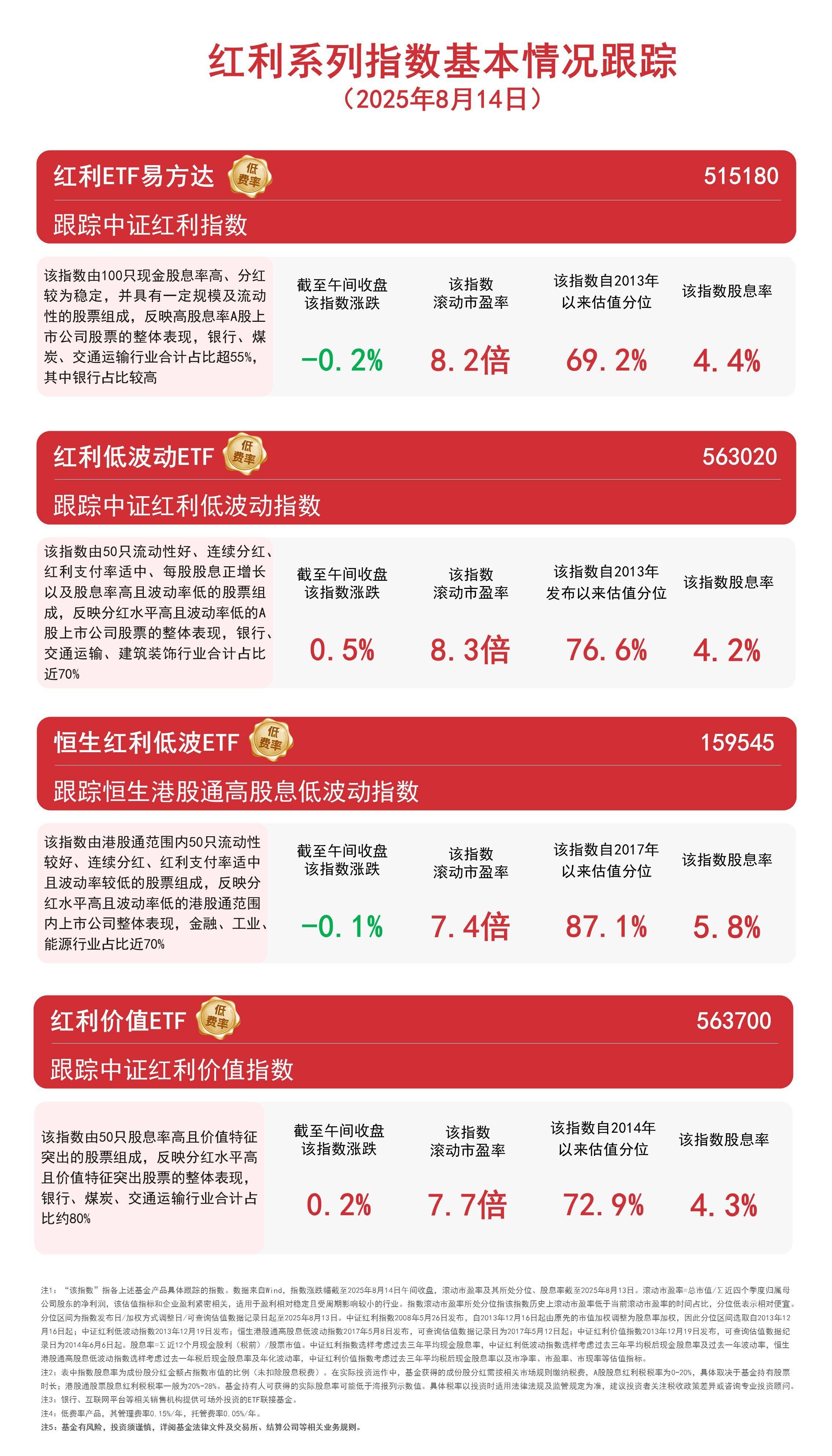
恒生红利低波ETF(159545)半日获净申购660万份,此前连续7个交易日“吸金”
Sou Hu Cai Jing· 2025-08-14 05:35
Group 1 - The core viewpoint indicates that the performance of various indices reflects the overall market trends, with the 中证红利低波动指数 and 中证红利价值指数 showing positive movements, while the 恒生港股通高股息低波动指数 and 中证红利指数 experienced slight declines [1][5][7] - The 恒生红利低波ETF (159545) has seen a net inflow of 6.6 million units in the first half of the trading day, continuing a trend of net inflows for seven consecutive trading days, totaling over 300 million yuan [1][5] - The composition of the indices includes stocks with moderate dividend payout ratios, positive growth in earnings per share, high dividend yields, and low volatility, with significant representation from the banking, transportation, and construction industries, accounting for approximately 70% [5][7] Group 2 - The 恒生红利低波ETF tracks the 恒生港股通高股息低波动指数, which consists of 50 liquid stocks that have a history of continuous dividends and moderate payout ratios, reflecting high dividend levels and low volatility [6][7] - The 中证红利价值指数 is tracked by another ETF, which includes 50 stocks characterized by high dividend yields and value traits, contributing to the overall performance of the market [8][9]
金融期货早评-20250814
Nan Hua Qi Huo· 2025-08-14 02:29
Group 1: Overall Market Analysis - The domestic decision - makers have introduced a series of livelihood and consumption - promoting policies, but the demand repair needs time. The new RMB loans decreased by 50 billion yuan in July due to multiple factors, and the credit cycle has not started. Overseas, the market's expectation of the US interest rate cut has risen again [2]. - The market has fully priced in a 25 - basis - point interest rate cut by the Fed in September, but the US inflation stickiness has not been eradicated, and the dollar index may fluctuate around 98 in the short term [4]. - The A - share market rose significantly with heavy volume, and it is expected to have upward space in the short term, but the weak fundamentals may suppress the upward movement of the stock index center if the situation persists [6]. Group 2: Currency and Exchange Rate - The on - shore RMB against the US dollar closed at 7.1755 on the previous trading day, up 156 basis points. The central parity rate of the RMB against the US dollar was raised by 68 basis points. The US inflation is generally stable, and the Jackson Hole meeting may be crucial [3]. Group 3: Stock Index - The stock index continued to rise with heavy volume yesterday, and the small - cap stocks performed strongly. The trading volume of the two markets increased by 269.417 billion yuan. Foreign capital is accelerating its inflow into the Chinese stock market [5]. Group 4: Treasury Bonds - The bond market was less affected by the strong rise of the A - share market. The 7 - month financing was still supported by government bonds, and the new loans turned negative. It is recommended to buy the next - quarter contracts at low prices [7]. Group 5: Container Shipping - The futures prices of the container shipping index (European line) continued to decline. The spot prices of some shipping routes have changed. It is expected that the EC will fluctuate and decline or continue to fluctuate in the future [8][9]. Group 6: Commodities - Precious Metals - The prices of gold and silver rebounded. The market's expectation of the Fed's interest rate cut within the year has risen. It is recommended to buy on dips for the medium - and long - term [11][13]. Group 7: Commodities - Base Metals - Copper prices were in high - level shock. The inflation data in the US is conducive to the Fed's interest rate cut, and it is recommended to make low - level purchases [14][15]. - Aluminum prices are expected to be in high - level shock in the short term and have upward momentum in the medium term. Alumina is expected to be in weak shock, and cast aluminum alloy is expected to fluctuate [17][19]. - Nickel and stainless steel prices are expected to continue to fluctuate in the short term. Tin prices fell slightly, and it is recommended to hold cash and wait and see [20][21]. Group 8: Commodities - Black Metals - The prices of rebar and hot - rolled coil followed the decline of coking coal and then stabilized slightly at night. The short - term market is expected to be in a range - bound pattern [22][24]. - Iron ore prices declined due to the cooling of sentiment. The short - term supply is neutral, and the demand is expected to be stable, with prices expected to fluctuate [25][26]. - Coking coal and coke prices opened lower with a gap. The supply reduction expectation of coking coal is strengthened, and the medium - and long - term trends are not pessimistic, but attention should be paid to the impact of Dalian Commodity Exchange's position limit [27][29]. - The prices of ferrosilicon and ferromanganese followed the decline of coal. The demand is supported in the short term, but the long - term demand is uncertain, and they follow the price fluctuations of coal [30][32]. Group 9: Commodities - Energy and Chemicals - Crude oil prices continued to fall due to the unexpected increase in EIA inventories. The supply surplus risk is increasing, and attention should be paid to the progress of the "Trump - Putin meeting" on the cease - fire in Ukraine [34][36]. - PX - PTA prices followed the decline of the cost side. It is recommended to expand the PTA processing fee at low prices [37][39]. - Ethylene glycol prices are expected to be in a range - bound pattern, and it is recommended to buy on dips. Bottle - grade PET prices follow the cost side, and the processing fee is operated in a range [40][42]. - Methanol 09 contract is expected to be weak, and attention should be paid to the downstream resistance and the port - inland price difference [43][44]. - PP and PE prices mainly follow the macro - sentiment fluctuations. The supply and demand of PP are relatively stable, and PE is moving towards a pattern of both supply and demand growth [45][49]. - PVC is recommended to be short - allocated. It is in a state of high valuation, high inventory, and high warehouse receipts [50][51]. - Pure benzene and styrene prices are expected to be in a range - bound pattern. It is recommended to shrink the pure benzene - styrene price difference at high prices [52][54]. - Fuel oil prices are still weak, and low - sulfur fuel oil prices fell due to the drag of crude oil. Asphalt prices followed the cost side in weak shock [55][59]. - Rubber prices are under pressure above, with internal and external differentiation. It is recommended to expand the price difference between deep - colored and light - colored rubber at low prices [60]. Group 10: Commodities - Building Materials - The prices of soda ash, glass, and caustic soda are expected to be in shock. Soda ash supply is strong and demand is weak, glass is in a weak - balance state, and caustic soda needs to pay attention to the improvement of downstream demand [61][65]. - Log prices have limited downward space, and it is recommended to buy on dips [66]. Group 11: Agricultural Products - Hog prices are recommended to be short - sold at high prices, and appropriate reverse spreads can be arranged [67]. - Oilseeds are recommended to be bought on dips. The short - term decline space of domestic soybean - based products is limited, and the rapeseed - based products can be long - positioned after the short - term rise and fall [68][70]. - The prices of oils are running strongly. Palm oil, soybean oil, and rapeseed oil have different influencing factors, and attention should be paid to relevant policies and relationships [71][72]. - Cotton prices are expected to be strong in the short term. The low inventory of old cotton supports the price, and attention should be paid to the downstream stocking situation [72][73].
研究所晨会观点精萃-20250814
Dong Hai Qi Huo· 2025-08-14 02:18
1. Report Industry Investment Ratings No investment ratings for the entire industry are provided in the reports. 2. Core Views of the Report - Overseas, the possibility of the Fed cutting interest rates has led to a weaker US dollar and rising global risk appetite. Domestically, economic growth slowed in July, but policies may boost consumption, and the extension of the tariff truce period has reduced short - term tariff uncertainties, with different asset classes showing various trends [2]. - Different sectors in the market have different outlooks. For example, the stock market may be strong in the short - term, precious metals are supported at high levels, the black metal market is expected to be volatile, the non - ferrous and new energy sectors are showing weakness, the energy and chemical sector is facing downward pressure, and the agricultural products market has various influencing factors [2][4][5]. 3. Summary by Relevant Catalogs Macro - finance - Overseas: US Treasury Secretary indicated a possible 50 - basis - point rate cut by the Fed, and multiple Fed officials' dovish stances led to a decline in the US dollar index and rising global risk appetite. - Domestic: China's July manufacturing PMI was 49.3%, down 0.4 percentage points from the previous month, with economic growth slowing. Trade deficit decreased, and net exports' contribution to the economy weakened. Policies may boost consumption, and the extension of the tariff truce period reduced short - term tariff uncertainties. Asset trends: stocks may be strong in the short - term, bonds may oscillate and correct, and different commodity sectors have different trends [2]. Stock Index - Driven by sectors like armament restructuring, industrial metals, and components, the domestic stock market continued to rise. The market's trading logic focuses on domestic stimulus policies and trade negotiation progress, with short - term upward macro - drivers strengthening. Short - term cautious long - position is recommended [3]. Precious Metals - Gold and silver prices showed different trends on Wednesday. Moderate inflation data in the US strengthened the expectation of a September rate cut, pushing up the expectation of a loose environment. The weakening US dollar and lower 10 - year Treasury yields supported precious metals at high levels. Gold has a long - term bullish outlook, and long - term positions can be considered when it retraces to support levels [4]. Black Metals - **Steel**: The domestic steel futures and spot markets weakened on Wednesday. Japan's anti - dumping investigation on steel from South Korea and China dampened market sentiment. Demand continued to weaken, inventories increased, and production decreased. A range - bound trading strategy is recommended in the short - term [5]. - **Iron Ore**: Futures and spot prices of iron ore weakened slightly. With the expansion of production restrictions in the north, iron ore supply decreased, but port inventories increased, and prices may weaken in the short - term [5]. - **Silicon Manganese/Silicon Iron**: Spot prices were flat, and futures prices weakened slightly. Demand for ferroalloys decreased due to a decline in steel production. Silicon manganese prices were stable, and manganese ore prices were firm. A range - bound trading strategy is recommended [6][7]. Non - ferrous and New Energy - **Copper**: US inflation data met expectations overall. The expectation of a rate cut increased, but the probability of a 50 - basis - point cut is low. Copper inventories are at a high level, and terminal demand may weaken [8]. - **Aluminum**: Aluminum prices rose slightly on Wednesday. However, its fundamentals weakened, with domestic and LME inventories increasing. The medium - term upside is limited [8]. - **Aluminum Alloy**: Scrap aluminum supply is tight, increasing production costs and causing losses for some enterprises. It is in the off - season, with weak demand. Prices are expected to be range - bound and slightly strong in the short - term [8]. - **Tin**: Supply - side开工率 increased slightly, and the mining end may become looser. Demand is weak, and prices are expected to oscillate in the short - term, with limited upside [9]. - **Lithium Carbonate**: Prices fluctuated sharply on Wednesday. Spot prices increased, and the supply shortage due to mine shutdowns supported prices. Long - term bullish outlook, but pay attention to the progress of mine type changes [10][11]. - **Industrial Silicon**: Prices fell on Wednesday. Pay attention to the influence of coking coal and polysilicon, and the cash - flow cost support [11]. - **Polysilicon**: Prices fell on Wednesday. The number of warehouse receipts increased, indicating stronger hedging and delivery intentions. It is expected to oscillate at a high level in the short - term [12]. Energy and Chemical - **Crude Oil**: US crude oil inventories increased more than expected, and the IEA warned of a record supply surplus next year, causing oil prices to decline. Pay attention to the impact of the meeting on promoting a cease - fire in Ukraine [13][14]. - **Asphalt**: Crude oil costs were low and oscillating, and asphalt prices followed with limited weakness. Inventory removal was slow, and it may continue to be weak and oscillating [14]. - **PX**: PX prices oscillated narrowly. PTA device production cuts and low processing fees limited the recovery, and it will oscillate in the short - term [14]. - **PTA**: PTA prices declined slightly. Profit recovery was limited, and demand growth was restricted. Supply pressure decreased, and it is expected to be range - bound in August [15]. - **Ethylene Glycol**: Prices fell. Inventory pressure was relieved to a limited extent, and supply may increase. It is expected to oscillate in the short - term, with limited upside and a risk of a slight decline [15][16]. - **Short - fiber**: Prices fell due to sector resonance. Terminal orders were average, and inventory accumulated. It is recommended to short on rallies in the medium - term [16]. - **Methanol**: Prices oscillated narrowly. Supply and demand contradictions were not prominent, but there were regional differences. It is expected to oscillate, and the spread between contracts is expected to narrow [17]. - **PP**: Spot prices oscillated narrowly. Supply was abundant, and demand was in the off - season. It is expected to be weak, and attention should be paid to oil price fluctuations [18]. - **LLDPE**: Prices rose. Supply pressure remained, and demand showed signs of improvement. It is expected to oscillate weakly in the short - term [19]. Agricultural Products - **US Soybeans**: CBOT soybean prices rose overnight. The USDA's unexpected reduction in the planting area supported the market. Attention should be paid to US soybean exports and Sino - US soybean trade relations [19]. - **Soybean and Rapeseed Meal**: High domestic inventories of soybeans, soybean meal, rapeseed oil, and rapeseed meal. If there are no major weather risks in South America, there is no stable market foundation in the medium - term. If China continues to purchase US soybeans or Canada's rapeseed products enter the market, prices may face downward pressure [20]. - **Soybean, Rapeseed, and Palm Oil**: Rapeseed oil inventory is high and difficult to reduce, and supply is expected to shrink. Soybean oil's cost is stable, and its supply - demand situation will improve in the fourth quarter. Palm oil prices are expected to be strong. Domestic rapeseed oil was affected by policies, and related oils have limited short - term upside. Attention should be paid to soybean oil's catch - up rally and the buy - soybean - sell - palm oil arbitrage [20]. - **Corn**: Northeast corn prices are weak, with inactive trading. Supply is expected to be sufficient in late August, and the corn futures market is weak [21][22]. - **Hogs**: After continuous price drops, farmers are reluctant to sell at low prices. Supply pressure may ease, and pig prices may stabilize [22].
广发期货日评-20250814
Guang Fa Qi Huo· 2025-08-14 01:24
Group 1: Report Summary - The report provides investment analysis and operation suggestions for various commodities on August 13, 2025 [2][3] Group 2: Core Views - The Sino-US second - round trade talks extended the tariff exemption clause, and the central political bureau meeting's policy tone was consistent with the previous one, affecting the financial and commodity markets [3] - The inflation in the US remained moderate, boosting the expectation of interest rate cuts, and the US dollar declined, which had an impact on the prices of gold, silver and other commodities [3] Group 3: Variety Analysis and Operation Suggestions Equity Index - The Sino - US joint statement on extending tariff exemptions led to a continued upward trend in the equity index. There was a short - term expectation difference in the market. It was advisable to sell the MO2509 put option with an exercise price around 6400 at high prices and maintain a moderately bullish view [3] Treasury Bonds - The current stage of bond futures was suppressed by the strong performance of equities, and the overall sentiment was weak. Unilateral strategies suggested short - term waiting and focusing on financial data and new bond issuance pricing. Curve strategies could appropriately bet on a steeper yield curve [3] Precious Metals - The macro news increased the volatility of gold prices, but there was still a possibility of a pulse - like rise. A bull spread portfolio could be constructed through gold call options at low prices after the price correction. The silver price was expected to maintain a range - bound shock and still had upward space. A bull spread strategy could be constructed using silver put options at relatively low prices to earn premium income [3] Shipping Index (European Line) - The EC main contract oscillated weakly. It was expected to oscillate weakly, and the idea of shorting at high prices should be maintained [3] Steel and Iron Ore - Steel mills' inventory accumulation was not significant, providing support for steel prices. It was advisable to try to go long on dips. The iron ore shipments decreased and the port inventory and clearance increased, following the steel price fluctuations. It was advisable to go long on dips and short iron ore while going long on coking coal [3] Coking Coal and Coke - The coking coal futures rebounded, and the spot auction was strong. The large - mine long - term agreement price increased. It was advisable to go long on dips. The sixth round of price increases for mainstream coking plants was launched, and there was still an expectation of further increases. It was advisable to go long on dips [3] Non - ferrous Metals - The expectation of interest rate cuts improved, and the copper price strengthened slightly. The main contract reference range was 78,000 - 80,000. The market priced in a higher probability of interest rate cuts in September due to the slowdown of US inflation. The zinc price main contract reference range was 22,000 - 23,000. For tin, it was necessary to pay attention to the import situation from Myanmar and maintain a wait - and - see attitude [3] Energy and Chemicals - The oil price was mainly oscillating in the short term. It was advisable to wait and see unilaterally and expand the spread between October - November/December. For PX, it was treated as an oscillation in the range of 6600 - 6900 and expand the PX - SC spread at low levels. For PTA, it was oscillating in the short term in the range of 4600 - 4800. For short - fiber, it was oscillating in the range of 6300 - 6500 [3] Agricultural Products - The US soybean export expectation improved. It was advisable to hold long positions in RM509. The palm oil was expected to have a large - amplitude shock after a strong upward rush, and the main contract might hit 9500. The overseas sugar supply outlook was relatively loose, and it was advisable to reduce the previous high - level short positions [3] Special Commodities - The glass industry was in a negative feedback process, and it was advisable to hold short positions. The rubber raw material price strengthened due to more rainfall in Thailand, and it was necessary to pay attention to the raw material supply during the peak season and maintain a wait - and - see attitude [3] New Energy Commodities - The polysilicon was oscillating downward with the increase of warehouse receipts. The lithium carbonate was affected by more news disturbances, and it was advisable to be cautious and wait and see [3]
法国经济竞争力遭受关税重创
Jing Ji Ri Bao· 2025-08-13 22:05
Core Viewpoint - The recent trade agreements between Europe and the U.S. have not mitigated the damaging impacts of U.S. tariffs, leading to a significant increase in France's trade deficit and raising concerns about the competitiveness of French exports [1][2]. Trade Deficit and Economic Impact - In June, France's trade deficit expanded to approximately 7.7 billion euros, with imports rising by 400 million euros to 57.6 billion euros and exports increasing by 300 million euros to 49.9 billion euros [1]. - For the first half of 2025, France's cumulative trade deficit reached 43 billion euros, an increase of about 4.4 billion euros compared to the second half of 2024 [1]. - The trade deficit for the second quarter of 2025 was 22.9 billion euros, widening by approximately 2.8 billion euros from the first quarter [1]. Structural Issues in Trade Agreements - The framework agreement between the U.S. and Europe reveals significant structural differences, particularly regarding tariff exemptions, with the U.S. interpreting a 15% tariff as broadly applicable to European goods, while Europe seeks exemptions for key industries [2]. - French officials emphasize the need to advocate for exemptions beyond the aviation sector, including pharmaceuticals and food processing [2]. Agriculture and Food Sector Concerns - French agricultural products, including wine and cheese, are excluded from tariff exemptions, with potential additional tariffs of 800 million euros if wine and spirits do not receive exemptions [3]. - The U.S. demands simplification of health certifications for meat and dairy, which could impact food safety standards in France and Europe [3]. Digital Services and Technology - The U.S. claims that Europe has committed to exempting American companies from certain taxes, while Europe has only stated it will coordinate further [3]. - France views the digital services sector as a critical area for exerting pressure on the U.S. and aims to implement a digital tax on American tech giants [3]. Military and Energy Procurement - The U.S. has indicated that Europe will significantly purchase American military equipment by 2026, but European officials argue that military procurement was never formally on the agenda [4]. - France is pushing for exemptions in energy and pharmaceuticals to protect domestic jobs and industries, criticizing the reliance on U.S. fossil fuels [4]. France's Position and Strategy - France expresses dissatisfaction with compromises made in negotiations with the U.S. and vows to maintain its competitiveness through "strategic autonomy" [5]. - French officials argue that the U.S. tariffs will lead to a "lose-lose" situation, affecting both American consumers and exports [5]. - The French government aims to strengthen its position in trade negotiations by focusing on collective unity within the EU and addressing structural imbalances in service trade [6]. Future Coordination and Policy Recommendations - Experts suggest that France should enhance coordination in trade strategy, avoid unilateral actions, and utilize "anti-coercion tools" against U.S. threats [6]. - Policy recommendations include targeted subsidies, diversifying export markets, and increasing investments in innovation and green development to counteract U.S. tariff impacts [6].