债券

Search documents
政府债周报(02/01):特殊再融资债发行加速-20260204
Changjiang Securities· 2026-02-04 08:17
Report Investment Rating - Not provided in the report Core Viewpoints - The issuance of special refinancing bonds is accelerating, with significant amounts of special refinancing bonds and special new special-purpose bonds being disclosed [8] - There are differences between the planned and actual issuance of local government bonds in 2026, and the net financing amounts vary across different months [9] Summary by Directory 1. Issuance Forecast and Review - **2/2 - 2/8 Forecast**: Local government bonds are expected to be issued worth 5796.73 billion yuan, including 2098.11 billion yuan in new bonds (755.35 billion yuan in new general bonds and 1342.76 billion yuan in new special bonds) and 3698.61 billion yuan in refinancing bonds (442.82 billion yuan in refinancing general bonds and 3255.79 billion yuan in refinancing special bonds) [6] - **1/26 - 2/1 Review**: A total of 4392.75 billion yuan in local government bonds were issued, including 2322.72 billion yuan in new bonds (392.03 billion yuan in new general bonds and 1930.69 billion yuan in new special bonds) and 2070.03 billion yuan in refinancing bonds (847.84 billion yuan in refinancing general bonds and 1222.19 billion yuan in refinancing special bonds) [7] 2. Special Bond Issuance Progress - **Special Refinancing Bonds**: As of February 1st, the fifth round's second batch of special refinancing bonds totaled 20000.00 billion yuan, and the third batch totaled 5599.98 billion yuan, with an additional 3023.79 billion yuan to be newly disclosed next week. The top three regions in terms of the third - batch disclosure scale are Jiangsu (800.00 billion yuan), Zhejiang (564.00 billion yuan), and Henan (482.95 billion yuan) [8] - **Special New Special - Purpose Bonds**: As of February 1st, 95.88 billion yuan of special new special - purpose bonds for 2026 have been disclosed, and 25546.72 billion yuan have been disclosed since 2023. The top three regions in terms of the total disclosure scale since 2023 are Jiangsu (2440.35 billion yuan), Hubei (1377.69 billion yuan), and Henan (1325.34 billion yuan), while the top three in 2026 are Sichuan (62.58 billion yuan), Shandong (22.30 billion yuan), and Zhejiang (11.00 billion yuan) [8] 3. Local Issuance Plans and Actual Issuance - **2026 Plans**: In January, the planned issuance was 8059 billion yuan, an increase of 2529.96 billion yuan compared to the same period in 2025, with an actual disclosure of 8633 billion yuan, a planned repayment of 849 billion yuan, and a net financing of 8059 billion yuan. In February, the planned issuance is 8071 billion yuan, a decrease of 3818.89 billion yuan compared to the same period in 2025, with a planned repayment of 1662 billion yuan and a net financing of 6409 billion yuan. In March, the planned issuance is 8463 billion yuan, a decrease of 1353.98 billion yuan compared to the same period in 2025, with a planned repayment of 4191 billion yuan and a net financing of 4272 billion yuan [9] 4. Weighted Average Issuance Term - This week, the weighted average issuance term of local government bonds is 17.31 years, and next week it is 16.12 years. As of January 30th, it is 17.66 years, a 7.7% increase compared to the same period in 2025 [10] 5. Local Government Bond Investment and Trading - **One - Two - Level Spread**: The report presents the one - level and two - level spreads of local government bonds, as well as the two - level spreads by region [41][42] 6. New Special - Purpose Bond Allocations - The report provides a monthly statistics of the allocation of new special - purpose bonds, with the latest month's statistics considering only the issued new bonds [44]
许正宇:多措并举着力推动香港本地债券市场发展
智通财经网· 2026-02-04 08:01
Core Viewpoint - The Hong Kong government is committed to developing the local bond market to enhance its role as an international financial center, focusing on innovative bond issuance and various supportive measures [1][2]. Group 1: Bond Market Development - The Hong Kong government aims to activate the bond market through regular issuance of government bonds, including institutional, retail, green, and tokenized bonds [1]. - Since 2008, Hong Kong has been the leading hub for bond issuance in Asia, with over $130 billion in issuance planned for 2024, capturing nearly 30% of the market share [1]. - Hong Kong accounts for approximately 70% of the first-time bond issuance market and 45% of the green and sustainable bond issuance market, indicating its leadership in various segments [1]. Group 2: Regulatory and Market Measures - The Hong Kong government and financial regulators are implementing measures to enhance primary market issuance, improve secondary market liquidity, and expand offshore RMB business [2]. - As of January 2, 2026, there are 1,351 listed bonds on the Hong Kong Stock Exchange, with 1,302 being professional investor bonds, which are primarily traded over-the-counter [2]. - The Hong Kong Securities and Futures Commission is exploring the feasibility of an electronic bond trading platform to improve market liquidity [3]. Group 3: Offshore RMB and Risk Management - The offshore RMB bond market has seen significant growth, with issuance reaching 1.07 trillion RMB in 2024, a 37% year-on-year increase [1]. - The Hong Kong Stock Exchange is enhancing its role in the offshore RMB market by allowing foreign investors to use onshore government bonds as collateral for derivatives trading [3]. - The Hong Kong government is working on introducing offshore government bond futures to provide effective risk management tools for investors [5]. Group 4: Tokenized Bonds - The Hong Kong government has issued three batches of tokenized green bonds since 2023, with the largest issuance of 10 billion HKD in November 2025, attracting significant global institutional interest [5]. - The Hong Kong Monetary Authority is researching the secondary market applications for tokenized bonds to enhance their attractiveness and demand [6]. - Efforts are underway to optimize the legal framework for broader application of tokenization technology in the bond market [6].

2026年2月信用债市场展望:套息压舱,品种掘金
Shenwan Hongyuan Securities· 2026-02-04 05:45
Key Insights - The credit bond carry trade strategy remains robust, but the safety cushion is narrowing, especially at the short end [3][4] - Current credit spreads are at relatively low levels, with attention on certain varieties and the value of lower-rated coupons [3][4] - The performance of perpetual bonds has been strong since the beginning of the year, but the market may have reached a temporary peak [3][4] Market Overview - In January 2026, the issuance of traditional credit bonds increased slightly, with net financing rising significantly [11][13] - The total issuance of credit bonds reached 12,308 billion, with net financing at 4,997 billion, showing a substantial increase compared to previous months [11][13] - The performance of credit bonds in January was strong, with yields declining and credit spreads narrowing across various maturities [19][23] Investment Strategy - It is recommended to extend the duration of carry trades to 3-5 years while focusing on mid to short-term coupon assets [4][6] - The demand for certain credit bonds is expected to remain supported by the accumulation of amortized debt funds, although the market may not see the same level of activity as in Q4 of the previous year [4][6] - Attention should be given to high-quality central state-owned enterprise real estate bonds, lower-rated city investment bonds, and high-grade insurance subordinated bonds for potential investment opportunities [4][6]
债市 短线窄幅波动
Qi Huo Ri Bao· 2026-02-04 03:21
Group 1 - The core viewpoint of the articles indicates that the recent economic indicators, particularly the manufacturing PMI, have shown a decline, suggesting a cautious outlook for the manufacturing sector and potential implications for the bond market [2][3]. - The official manufacturing PMI for January recorded 49.3%, down 0.8 percentage points from the previous month, indicating a contraction in manufacturing demand [2][3]. - The production index remains in the expansion zone at 50.6%, but the new orders index fell to 49.2%, reflecting a decrease in demand [2][3]. Group 2 - The price indices show a mixed picture, with the raw material purchase price index rising to 56.1%, indicating increased costs, while the factory price index rose to 50.6%, suggesting limited price transmission from raw materials to finished goods [2][3]. - The inventory management of manufacturing firms appears cautious, with raw material inventory index at 47.4% and finished goods inventory index at 48.6%, indicating a proactive reduction in raw materials and a passive accumulation of finished goods [2][3]. - The funding environment remains loose, with the central bank maintaining a supportive liquidity stance, and the interbank market showing a balanced liquidity condition [4][5]. Group 3 - The bond market is expected to experience limited downward movement in the short to medium term due to the current economic fundamentals and the central bank's liquidity support [5]. - The anticipated large-scale government bond supply and the upcoming seasonal factors related to the Spring Festival may lead to a cautious sentiment in the bond market [4][5]. - Overall, the combination of weaker PMI data, a loose funding environment, and increased volatility in risk assets is seen as favorable for the bond market, although caution is advised due to potential seasonal fluctuations [4][5].
信用利差周报2025年第45期:交易商协会优化并购票据工作机制,民营创投科创债扩容-20260204
Zhong Cheng Xin Guo Ji· 2026-02-04 03:02
1. Report Industry Investment Rating - Not provided in the document 2. Core Viewpoints of the Report - The second batch of private venture - capital and tech - innovation bonds supported by risk - sharing tools was launched, with policy support for the expansion of such bonds. The optimization of the M&A note mechanism is conducive to strengthening the linkage between stocks and bonds, but the actual effects remain to be seen. The manufacturing PMI improved slightly in November, and the bond market showed different trends in the primary and secondary markets [4][11][16] 3. Summary by Relevant Catalogs Market Hotspots - **Private Venture - capital and Tech - innovation Bonds Expansion** - From November 26th to 28th, the second batch of private venture - capital and tech - innovation bonds supported by risk - sharing tools were launched, with 4 institutions planning to raise a total of 930 million yuan. The issuance scale and the number of enterprises decreased compared with the first batch. These bonds have features such as low cost, long - term, innovative credit - enhancement mechanisms, and "credit - enhancement + investment" dual - wheel drive, and the funds are invested in key technological fields [11][12] - Policy support is significant. The central bank proposed to use risk - sharing tools for tech - innovation bonds, and the first meeting of the Science and Technology Finance Coordination and Promotion Mechanism put forward to build a "tech board" in the bond market and smooth the "raising, investment, management, and exit" chain of private equity and venture capital [13][14] - Current problems include small scale, unbalanced issuer structure, and difficulty in matching funds. Suggestions are to introduce diversified investors and improve the risk - mitigation mechanism [15] - **Optimization of M&A Note Working Mechanism by the NAFMII** - On December 1st, the NAFMII optimized the M&A note mechanism, which is conducive to promoting the innovation and development of "bond + stock" products and strengthening the linkage between stocks and bonds. The definition of M&A activities was clarified, and regulations were made in terms of fundraising, innovative terms, and risk - sharing [16][17] - This optimization can help meet the needs of industrial restructuring and upgrading, expand corporate financing channels, and improve the efficiency of financial services to the real economy. However, the actual effects depend on the cooperation of market participants and require continuous regulatory monitoring [18] Macroeconomic Data - In November, the official manufacturing PMI rose slightly from 49% to 49.2%, with the production of the manufacturing industry generally stable. New order, employee, and supplier delivery indexes increased, but the RatingDog manufacturing PMI declined slightly [19] Money Market - Last week, the central bank conducted 5 periods of 7 - day reverse repurchase operations totaling 151.18 billion yuan, 800 million yuan of 21 - day and 1.2 billion yuan of 1 - month treasury cash fixed - deposits. A total of 167.6 billion yuan of reverse repurchase, 90 billion yuan of MLF, and 30 billion yuan of 6 - month repurchase expired, resulting in a net withdrawal of 16.42 billion yuan. Despite the withdrawal, the money market remained balanced, with most pledged - repo rates falling, except for DR007 and DR021, which rose by 1bp and 2bp respectively [6][23][24] Primary Market of Credit Bonds - The issuance scale of credit bonds increased by 7.007 billion yuan to 42.6731 billion yuan last week, with the average daily issuance scale increasing by 1.4014 billion yuan. Different bond types showed different trends, and the infrastructure investment and financing industry and industrial bonds both saw an increase in issuance scale. The infrastructure investment and financing industry had a net inflow of funds, and the net inflow of industrial bonds exceeded the net outflow. The average issuance cost of credit bonds mostly decreased, with a decline ranging from 1bp to 15bp [7][27][30] Secondary Market of Credit Bonds - The trading volume of bond secondary - market cash bonds was 809.199 billion yuan, a decrease of 13.2468 billion yuan compared with the previous period. The average daily trading volume decreased by 2.6494 billion yuan to 161.8398 billion yuan, indicating a decline in trading activity. Due to concerns such as the possible implementation of new regulations on public - fund redemptions and some real - estate enterprises' announcements of medium - term note extensions, most bond yields rose. Interest - rate bond yields (treasury bonds and policy - bank bonds) mostly increased by 2bp to 4bp, with long - term yields rising more than short - term ones. Credit - bond yields mostly increased, with a maximum increase of 7bp. Most credit spreads expanded, and rating spreads showed mixed trends [8][38][39]
信用利差周报2025年第44期:LPR连续六个月持平,外币主权债券接力发行-20260204
Zhong Cheng Xin Guo Ji· 2026-02-04 02:39
Report Industry Investment Rating No relevant content provided. Core Views - The LPR has remained unchanged for six consecutive months, and monetary policy still has a certain degree of determination. The central bank may maintain reasonable and sufficient liquidity through structural tools or timely reserve requirement ratio cuts. In the bond market, with the interweaving of long and short factors, the wait-and-see sentiment will continue in the short term, and it is more likely to be volatile [2][10][12]. - The Ministry of Finance successfully issued 4 billion euro sovereign bonds in Luxembourg, indicating that China's bond market opening continues to advance. This not only releases a positive signal of China's financial market opening but also has multiple meanings such as constructing diversified foreign currency financing channels and promoting cross - border docking of financial infrastructure [3][14][16]. - In October, the cumulative year - on - year data of real estate investment and sales further weakened, and the real estate market continued to operate at the bottom, with the confidence of real estate enterprises to be restored [4][18]. - The central bank provided liquidity support last week, and the overall capital price showed a downward trend. The issuance scale of the primary credit bond market increased significantly, and the issuance cost mostly declined. In the secondary market, the trading activity continued to decline, and the credit bond yields fluctuated [5][6][35]. Summary by Directory Market Hotspots - **LPR Remains Unchanged for Six Consecutive Months**: The 1 - year LPR is 3.00%, and the 5 - year and above LPR is 3.50%, both remaining unchanged for 6 months. The reasons include the narrowing of the net interest margin of commercial banks, the current low - level interest rate, and the emphasis on "cross - cycle adjustment" in monetary policy. The central bank may use structural tools or reserve requirement ratio cuts to maintain liquidity. The bond market is expected to fluctuate [2][10][12]. - **Foreign - Currency Sovereign Bonds Issued Continuously**: On November 18, the Ministry of Finance issued 4 billion euro sovereign bonds in Luxembourg. The total subscription amount was 100.1 billion euros, 25 times the issuance amount. It is innovative in product types, with diversified investor structures. It has multiple meanings such as reducing exchange - rate risks, providing pricing references, and promoting cross - border docking of financial infrastructure [3][14][16]. Macroeconomic Data - In October, the real estate development climate index was 92.43, a decrease of 0.34 from the previous value. National real estate development investment decreased by 14.7% year - on - year, the housing construction area of real estate development enterprises decreased by 9.4% year - on - year, and the sales area of newly built commercial housing decreased by 6.8% year - on - year, with the decline narrowing compared with the same period last year [4][18]. Money Market - The central bank conducted 5 periods of 7 - day reverse repurchase operations totaling 167.6 billion yuan and 1 period of 6 - month outright reverse repurchase of 80 billion yuan last week. After deducting the maturity amount, the net investment in the open market was 123.4 billion yuan. Except for DR014 and DR1M, most term pledged repurchase rates decreased by 1 - 5bp. The 3 - month Shibor slightly decreased, and the 1 - year Shibor remained unchanged [21]. Primary Market of Credit Bonds - The issuance scale of credit bonds last week was 356.661 billion yuan, an increase of 105.252 billion yuan from the previous value. Except for the private placement corporate bonds, the issuance scale of other bond types increased. The infrastructure investment and financing industry had a net inflow of financing, while the industrial bond financing situation varied. The average issuance cost of credit bonds mostly declined, especially for medium - and high - grade bonds [6][24][25]. Secondary Market of Credit Bonds - The secondary - market spot trading volume of bonds last week was 822.4458 billion yuan, a decrease of 44.3106 billion yuan from the previous period. The average daily spot trading volume decreased to 164.4892 billion yuan. The bond market yields fluctuated. The yields of interest - rate bonds and credit bonds showed different trends, and most of the rating spreads expanded [35]. Appendix - **Credit Risk Events in the Bond Market**: There were events such as bond extensions and defaults of some real estate and media companies, including the interest extension of "H1 Greenview 01" and "H1 Greenview 02" and the principal and interest default of "17 Huawen Media MTN001H" [44]. - **Regulatory and Market Innovation Dynamics**: There were updates to the list of special institutional investors for private placement debt financing instruments, and policies such as including savings bonds (electronic) in the scope of personal pension products [45]. - **Monthly Net Financing of Main Credit Bond Types**: The net financing of different types of credit bonds showed different trends from January 2024 to October 2025 [46].
法国10年期国债收益率涨1.7个基点
Mei Ri Jing Ji Xin Wen· 2026-02-03 22:20
每经AI快讯,周二(2月3日)欧市尾盘,法国10年期国债收益率涨1.7个基点,意大利10年期国债收益率涨 1.7个基点,西班牙10年期国债收益率涨2.3个基点,希腊10年期国债收益率涨1.2个基点。 ...
30年期德债收益率涨超3个基点
Jin Rong Jie· 2026-02-03 17:36
周二欧市尾盘,德国10年期国债收益率涨2.3个基点,报2.891%,日内交投于2.874%-2.903%区间。两年 期德债收益率涨0.9个基点,报2.123%;30年期德债收益率涨3.4个基点,报3.550%。2/10年期德债收益 率利差涨1.367个基点,报+76.553个基点。 ...
欧洲债市:德国提高发债规模 30年期国债收益率升至15年高位
Xin Lang Cai Jing· 2026-02-03 16:51
在德国宣布今年将大幅增加发债规模后,德国30年期国债收益率跳升至15年高点。 30年期国债收益率一度上升4个基点,至3.56%,为2011年以来最高水平。此前,德国表示计划通过发 债筹集5120亿欧元(6040亿美元),用于升级基础设施并推进军队现代化的支出计划。 较长期德国国债表现逊于短端,推动收益率曲线陡化;5年期与30年期国债收益率差升至近七年最高水 平。 法国10年期国债收益率涨2个基点,至3.47%。 10年期英国国债收益率涨1个基点,至4.52%。 责任编辑:李桐 在德国宣布今年将大幅增加发债规模后,德国30年期国债收益率跳升至15年高点。 30年期国债收益率一度上升4个基点,至3.56%,为2011年以来最高水平。此前,德国表示计划通过发 债筹集5120亿欧元(6040亿美元),用于升级基础设施并推进军队现代化的支出计划。 投资者等待德国周三发行7年期国债。 市场: 德国国债收益率涨3个基点,至2.89%。 德国国债期货跌28点,至127.66。 意大利10年期国债收益率涨2个基点,至3.50%。 意大利-德国国债利差缩小1个基点,至61个基点。 责任编辑:李桐 较长期德国国债表现逊于短端,推动 ...
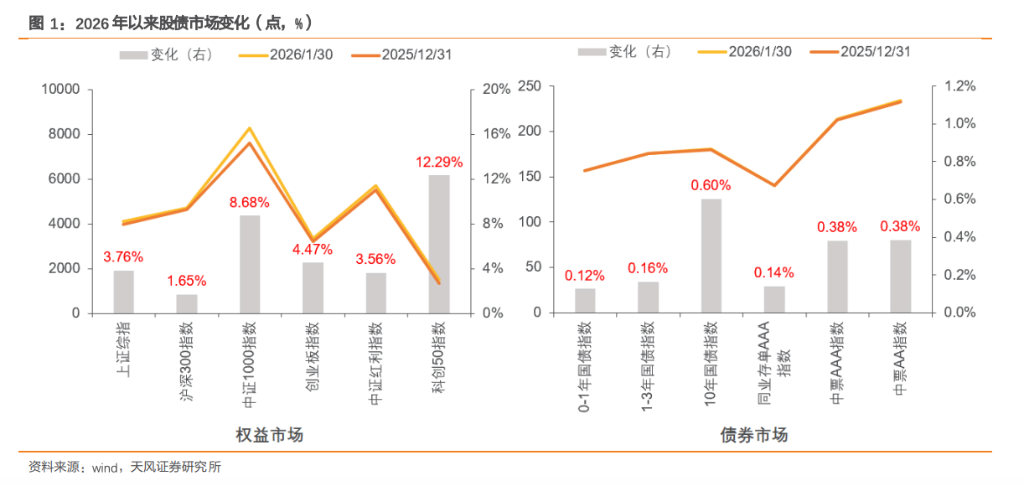
节前债稳,节后股暖?
Hua Er Jie Jian Wen· 2026-02-03 13:27
Core Viewpoint - The market performance at the beginning of 2026 is breaking traditional historical patterns, with significant divergence between stocks and bonds observed in the Chinese capital market [1]. Market Environment - The A-share market is expected to experience a "spring rally" after the Spring Festival, with a shift from a defensive large-cap style to a growth-oriented small-cap style [1][5]. - The bond market has shown a "V-shaped" recovery after initial pressure, with a structural interest rate cut of 0.25% by the central bank in January, leading to a stabilization in market sentiment [3][12]. Historical Patterns - Historical data from 2015 to 2025 indicates a clear seasonal pattern in the A-share market, with a 63.64% probability of the CSI 300 index rising in the 30 days before the Spring Festival, while the probability for the CSI 1000 index is only 27.27% [5][6]. - Post-Spring Festival, the CSI 300 index has a 72.73% probability of rising, with an average increase of 3.15%, while the CSI 1000 index shows an 81.82% probability and an average increase of 8.71% [5][6]. Bond Market Dynamics - The bond market typically shows strength in the 30 days before the Spring Festival due to increased liquidity and strong demand from institutional investors, with a historical average decline of 5.73 basis points in the 1-year bond yield [7][11]. - After the Spring Festival, the bond market may face upward pressure on yields due to changes in policy expectations and increased supply, with an average increase of 1.03 basis points in the 10-year bond yield [7][11]. 2026 Outlook - The foundation for the "spring rally" is expected to be stronger this year due to favorable policy expectations, global liquidity conditions, and a trend of residents allocating more assets to equity markets [12]. - Consumer demand is anticipated to be released earlier than in previous years due to an extended holiday, with expectations for increased spending on travel and consumption [12]. - The bond market is likely to experience a range-bound trading pattern, with reduced necessity for further rate cuts following the January reduction [12]. Potential Changes in Patterns - The traditional "strong bonds, weak stocks" model before the Spring Festival may be disrupted this year, with both markets potentially showing support and increased competition [13]. - The typical post-Spring Festival shift to small-cap growth may be weakened, as large-cap growth could perform well alongside high-dividend assets, leading to a mixed market style rather than a clear transition [13][14].