能源

Search documents
红利板块走势分化,恒生红利低波ETF(159545)获净申购2100万份
Sou Hu Cai Jing· 2025-08-08 05:31
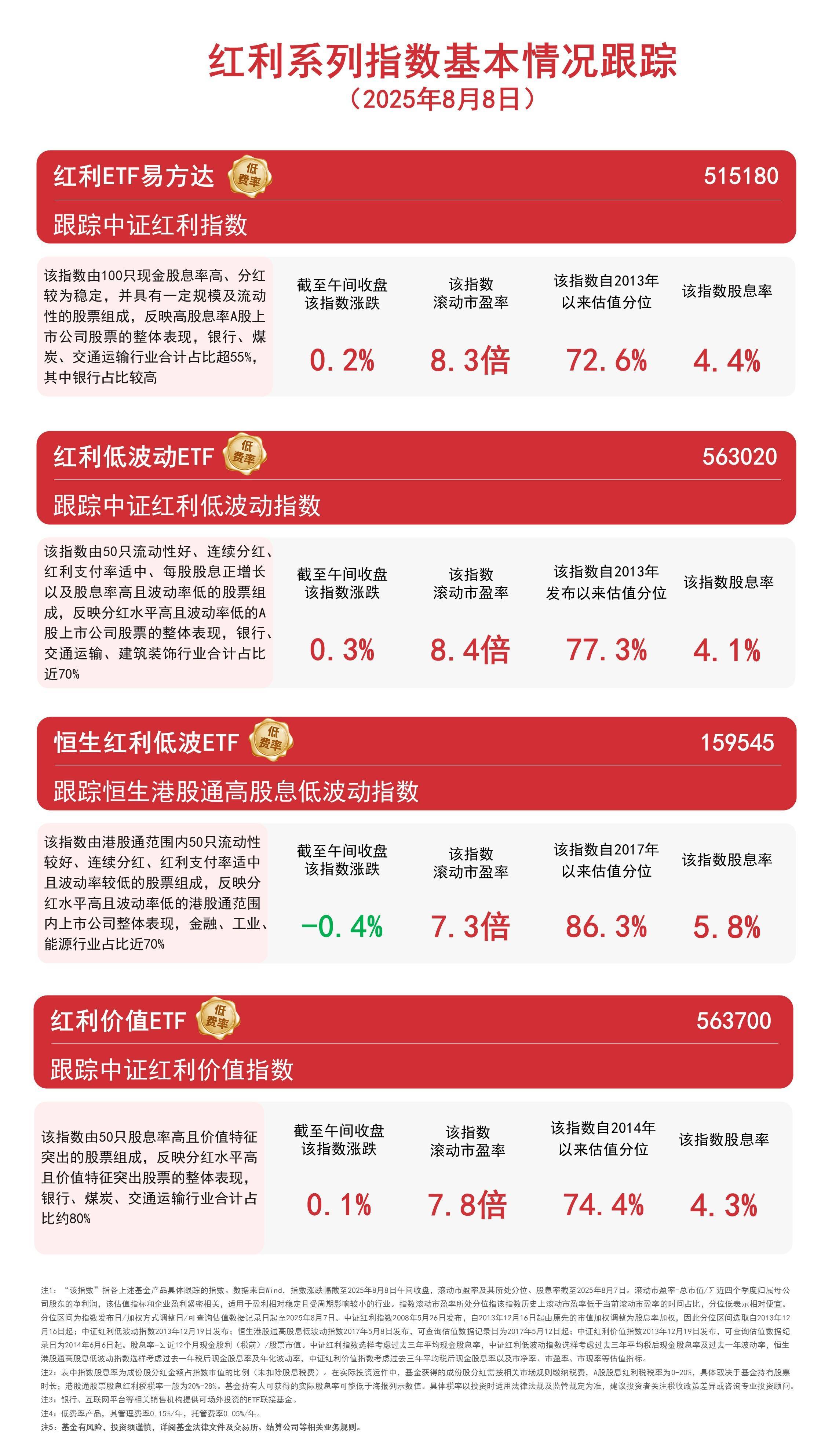
Group 1 - The core indices related to dividend-paying stocks showed mixed performance, with the China Securities Dividend Low Volatility Index up by 0.3%, the China Securities Dividend Index up by 0.2%, and the China Securities Dividend Value Index up by 0.1%. In contrast, the Hang Seng Hong Kong Stock Connect High Dividend Low Volatility Index decreased by 0.4% [1][5][7] - The Hang Seng Dividend Low Volatility ETF (159545) experienced a net subscription of 21 million units, reaching a historical high of 4.1 billion yuan in total scale as of yesterday [1][6] - The composition of the indices reflects a focus on stocks with moderate dividend payout ratios, positive growth in earnings per share, high dividend yields, and low volatility, with significant representation from the banking, transportation, and construction industries, which together account for approximately 70% of the A-share market [5][7] Group 2 - The Hang Seng Dividend Low Volatility Index consists of 50 stocks within the Hong Kong Stock Connect that are characterized by good liquidity, continuous dividend payments, moderate dividend payout ratios, and low volatility, with nearly 70% representation from the financial, industrial, and energy sectors [7][8] - The China Securities Dividend Value Index tracks 50 stocks that exhibit high dividend yields and value characteristics, indicating a focus on companies that provide consistent returns to shareholders [9][10]

红利港股ETF(159331)盘中飘红,高股息策略防御价值较高
Mei Ri Jing Ji Xin Wen· 2025-08-08 03:46
Core Viewpoint - The Hong Kong Stock Connect high dividend sector offers defensive allocation value in the current market environment, particularly suitable for investors seeking stable cash flow [1] Group 1: Market Environment - The expectation of economic recovery in mainland China and the continued downtrend in interest rates enhance the attractiveness of high dividend strategies [1] - Traditional high dividend industries such as energy, telecommunications, and public utilities exhibit strong earnings stability, with Hong Kong stock valuations being more cost-effective compared to similar A-share counterparts [1] Group 2: Investment Opportunities - Certain financial sectors under the Hong Kong Stock Connect mechanism show significantly higher dividend yields than the domestic market, coupled with ongoing demand for southbound allocation from mainland funds due to RMB exchange rate fluctuations [1] - The Hong Kong Stock Connect High Dividend ETF (159331) tracks the Hong Kong Stock Connect High Dividend Index (930914), which selects quality securities with high dividend characteristics from the Hong Kong Stock Connect universe [1] - The index is composed of leading companies in mature industries such as finance and energy, demonstrating sustained stable profitability and cash flow performance [1] Group 3: Investment Products - Investors without stock accounts can consider the Cathay CSI Hong Kong Stock Connect High Dividend Investment ETF Initiated Link A (022274) and Cathay CSI Hong Kong Stock Connect High Dividend Investment ETF Initiated Link C (022275) [1]
中国7月进出口超预期,特朗普拟对芯片征100%关税
Hua Tai Qi Huo· 2025-08-08 03:13
Report Industry Investment Rating - No relevant information provided Core Viewpoints - The market has returned to the fundamental verification stage. China's July import and export data exceeded expectations, but the export is still under pressure due to the upcoming "reciprocal tariff 2.0", and the progress of Sino-US trade negotiations needs to be continuously monitored. The US has imposed a series of new tariffs, and Trump plans to levy about 100% tariffs on chips and semiconductors, which will have a certain impact on the market. The UK central bank cut interest rates by 25 basis points as expected, and there are internal differences due to the increasing inflation risk. Putin said that he may meet with Trump in the UAE [1][2] Summary by Relevant Catalogs Market Analysis - The Politburo meeting on July 30 deployed the economic work for the second half of the year, emphasizing the need for continuous and timely strengthening of macro policies and more moderate "anti-involution" policies. China's official manufacturing PMI in July fell to 49.3, and the new order index fell to 49.4, while the non-manufacturing sector remained in expansion. China's foreign exchange reserves in July decreased by 0.76% month-on-month, and the central bank increased its gold holdings for the ninth consecutive month. China's exports in July increased by 7.2% year-on-year in US dollars, mainly supported by the low base last year and the "rush to export" effect under tariff uncertainty. Imports increased by 4.1%, with significant growth in the imports of integrated circuits, copper ore concentrates, and high-tech products [1] Impact of "Reciprocal Tariffs" - On July 31, the White House issued an executive order to reset the "reciprocal tariff" rate standards for some countries. The new tariffs will take effect on August 7. Trump plans to levy about 100% tariffs on chips and semiconductors, and the EU's chip exports to the US are subject to a 15% tariff cap. The US economic data in July was not as expected, and the uncertainty of Trump's tariff policy continued to drag down business activities. The market expects the Fed to cut interest rates twice this year [2] Commodity Segments - Domestically, the black and new energy metal sectors are the most sensitive to the supply side. Overseas, the energy and non-ferrous sectors benefit significantly from inflation expectations. The black sector is still dragged down by downstream demand expectations, and the implementation of "anti-involution" policies should be closely monitored. The supply constraints in the non-ferrous sector have not been alleviated, and the impact of tariff implementation on demand expectations needs to be followed. In the short term, the geopolitical premium in the energy sector has ended, and the medium-term supply is expected to be relatively loose. OPEC+ accelerated production increase, agreeing to increase production by 548,000 barrels per day in August, higher than expected. In the chemical sector, the "anti-involution" potential of methanol, PVC, caustic soda, urea and other products is also worthy of attention. There is no short-term weather disturbance in agricultural products, and the price fluctuation range is relatively limited [3] Key News - As of the end of July 2025, China's foreign exchange reserves decreased by $25.2 billion to $3.2922 trillion compared with the end of June, a decrease of 0.76%. China's gold reserves increased by 600,000 ounces to 73.96 million ounces in July, the ninth consecutive month of increase. China's exports in July increased by 8% year-on-year in RMB and 7.2% in US dollars, while imports increased by 4.8% in RMB and 4.1% in US dollars. Trump plans to levy about 100% tariffs on chips and semiconductors, and will sign an executive order to allow 401K accounts to invest in alternative assets such as cryptocurrencies and private equity funds. The Bank of England cut interest rates by 25 basis points as expected, and Putin said he may meet with Trump in the UAE [5]
能源化工期权策略早报-20250808
Wu Kuang Qi Huo· 2025-08-08 01:32
1. Report Industry Investment Rating - No information available in the provided content 2. Core Viewpoints of the Report - The energy - chemical options market involves various sectors such as energy, polyolefins, polyesters, and alkali chemicals. It is recommended to construct option portfolio strategies mainly based on sellers and spot hedging or covered strategies to enhance returns [3] - Each option variety is analyzed from aspects of underlying market conditions, option factor research, and option strategy suggestions 3. Summary According to Relevant Catalogs 3.1 Option Underlying Futures Market Overview - The latest prices, price changes, trading volumes, and open interest changes of multiple energy - chemical option underlying futures are presented, including crude oil, LPG, methanol, etc. For example, the latest price of crude oil (SC2509) is 497, down 7 with a decline rate of 1.43%, trading volume of 14.76 million lots, and open interest of 3.16 million lots [4] 3.2 Option Factor - Volume and Open Interest PCR - Volume and open interest PCR values and their changes of various option varieties are given. For example, the volume PCR of crude oil options is 0.72, down 0.17; the open interest PCR is 0.56, down 0.05 [5] 3.3 Option Factor - Pressure and Support Levels - Pressure and support levels of different option varieties are provided. For instance, the pressure level of crude oil is 550, and the support level is 500 [6] 3.4 Option Factor - Implied Volatility - Implied volatility data of various option varieties are presented, including at - the - money implied volatility, weighted implied volatility, and their changes. For example, the at - the - money implied volatility of crude oil options is 30.805%, and the weighted implied volatility is 34.99%, up 1.41% [7] 3.5 Strategy and Suggestions for Each Option Variety 3.5.1 Energy - related Options (Crude Oil, LPG) - **Crude Oil**: Fundamentals show an increase in US crude oil inventories. The market has been weakening and fluctuating. Implied volatility is near the average, and the open interest PCR indicates a weakening trend. It is recommended to construct a short - neutral call + put option combination strategy and a long collar strategy for spot hedging [8] - **LPG**: Factory and port inventories are high. The market shows a short - term bearish trend. Implied volatility is at a relatively high historical level, and the open interest PCR indicates strong bearish pressure. Similar to crude oil, a short - bearish call + put option combination strategy and a long collar strategy for spot hedging are recommended [10] 3.5.2 Alcohol - related Options (Methanol, Ethylene Glycol) - **Methanol**: Inventories of sample production enterprises have decreased. The market is under pressure and shows a weakening trend. Implied volatility is below the average, and the open interest PCR indicates a weakening trend. A short - neutral call + put option combination strategy and a long collar strategy for spot hedging are suggested [10] - **Ethylene Glycol**: The overall operating rate remains stable, but production profits are under pressure. The market shows a wide - range volatile trend. Implied volatility is below the average, and the open interest PCR indicates a sideways trend. A short - volatility strategy and a spot long - hedging strategy are recommended [11] 3.5.3 Polyolefin - related Options (Polypropylene, PVC, etc.) - **Polypropylene**: The number of maintenance production lines has decreased, and production has increased. The market is under bearish pressure. Implied volatility is near the historical average, and the open interest PCR indicates a weakening trend. A spot long - hedging strategy is recommended [11] 3.5.4 Rubber - related Options (Rubber, Synthetic Rubber) - **Rubber**: The opening area and output in Hainan have decreased. The market shows a bearish downward trend. Implied volatility is near the average after a sharp rise, and the open interest PCR indicates a bearish trend. A short - neutral call + put option combination strategy is recommended [12] 3.5.5 Polyester - related Options (PX, PTA, etc.) - **PTA**: Factory inventories are accumulating, and the market is under pressure. Implied volatility is above the average, and the open interest PCR indicates a weakening trend. A short - neutral call + put option combination strategy is recommended [13] 3.5.6 Alkali - related Options (Caustic Soda, Soda Ash) - **Caustic Soda**: The average utilization rate of production capacity has decreased slightly. The market shows a weakening and volatile trend. Implied volatility is at a relatively high level, and the open interest PCR indicates strong bearish pressure. A spot collar hedging strategy is recommended [14] - **Soda Ash**: Inventories are accumulating. The market shows a trend of rebounding after a sharp decline. Implied volatility is at a relatively high level, and the open interest PCR indicates strong bearish pressure. A short - volatility combination strategy and a long collar strategy for spot hedging are recommended [14] 3.5.7 Urea Options - The supply is slightly decreasing, and the demand is weak. The market shows a low - level volatile trend. Implied volatility is near the historical average, and the open interest PCR indicates strong bearish pressure. A short - bearish call + put option combination strategy and a spot hedging strategy are recommended [15] 3.6 Option Charts - Charts of various option varieties are provided, including price trend charts, trading volume and open interest charts, open interest distribution charts, PCR charts, implied volatility charts, historical volatility cone charts, and pressure - support level charts for each option variety such as crude oil, LPG, and methanol [17][37][57]
国际观察丨美“对等关税”生效 经济讹诈遭各国反对
Xin Hua She· 2025-08-07 23:21
Core Viewpoint - The U.S. government has implemented adjusted "reciprocal tariffs" that impose tariffs ranging from 10% to 41% on numerous trade partners, leading to significant international criticism and concerns about economic colonialism [1][10][12]. Group 1: Tariff Implementation and Agreements - The tariffs have been enacted despite the U.S. reaching agreements with several countries, including the UK, Vietnam, and the EU, but key details remain contentious and uncertain [1][3]. - The agreements deviate from the U.S. claim of "reciprocal" tariffs, as most trade partners face tariffs over 15%, while the U.S. products often enjoy lower or no tariffs [5][9]. - The U.S. is leveraging these agreements to push for unilateral market access while maintaining high tariffs to protect its own industries [5][6]. Group 2: Economic Impact and Criticism - The agreements are perceived as benefiting the U.S. disproportionately, with Japan committing to invest $550 billion, of which the U.S. claims it will receive 90% of the profits, raising concerns about fair profit distribution [5][8]. - The EU's commitment to purchase $750 billion worth of energy from the U.S. by 2028 is questioned due to logistical challenges and current capacity limitations [8][12]. - Critics, including European leaders, argue that these agreements represent a form of economic coercion that undermines multilateral trade systems and could lead to increased isolation for the U.S. [10][12][13]. Group 3: Global Trade Dynamics - The U.S. tariffs and agreements are prompting trade partners to seek closer ties with each other, potentially reshaping global trade dynamics away from U.S. influence [13]. - Observers note that the U.S. underestimates the negative impact of its tariff policies on its own economy and global trade, risking long-term economic consequences [13].

317家港股公司预告上半年业绩 三大行业增势强劲
Shang Hai Zheng Quan Bao· 2025-08-07 18:28
Group 1: Overall Market Performance - As of August 7, 317 Hong Kong companies have forecasted their first-half performance, with 182 companies expecting profit growth or turnaround, accounting for nearly 60% [1] - The overall performance of Hong Kong companies in the first half shows characteristics of "profit recovery and structural differentiation," with high profit growth rates in the securities, information technology, and industrial sectors [1] Group 2: Significant Profit Increases - Among the companies with profit forecasts, Zhongtai Futures expects a net profit growth of approximately 5415% compared to the same period in 2024, driven by a focus on core business and a low base effect [2] - Wuling Motors anticipates a net profit of about 38 million yuan for the first half of 2025, representing a year-on-year increase of approximately 23 times, attributed to improved gross margins and cost control measures [2] - Yimai Sunshine, a third-party medical imaging service provider, forecasts a net profit of 14.5 million to 16.5 million yuan, reflecting a year-on-year growth of approximately 1350% to 1550% due to increased customer numbers and reduced administrative expenses [2] Group 3: Resource Sector Performance - Benefiting from capacity release, cost optimization, and rising commodity prices, some resource stocks have seen significant profit growth, with Minmetals Resources expecting a net profit of approximately 340 million USD (about 2.441 billion yuan), a year-on-year increase of over 15 times [3] Group 4: Industry-Specific Growth - The securities and futures, information technology, and industrial sectors have a high number of companies with positive profit forecasts, with Huiri Group expecting a net profit of about 250 million HKD, a year-on-year increase of approximately 5.76 times [4] - Guotai Junan International anticipates a net profit between 515 million and 595 million HKD, with a year-on-year growth rate of 161% to 202% [4] - The information technology sector is experiencing a strong recovery, with companies like Youzan expecting a net profit of 68 million to 74 million yuan, a turnaround from a loss of 4.3 million yuan in the previous year, driven by revenue growth and improved operational efficiency [4] Group 5: Other Notable Performances - Qutai Technology expects a year-on-year growth of approximately 150% to 180% for the first half of the year, focusing on high-end products and expanding into automotive and IoT camera modules [5] - Dexion Shipping anticipates a net profit of approximately 180 million to 200 million USD (about 1.292 billion to 1.435 billion yuan), reflecting a year-on-year increase of 220% to 255% due to rising average freight rates and increased charter income [5] - Pop Mart expects a net profit growth of no less than 350% for the first half of the year, while Laopu Gold anticipates a net profit of 2.23 billion to 2.28 billion yuan, a year-on-year increase of 279% to 288% [6]
【环球财经】法国上半年贸易逆差扩大至430亿欧元
Xin Hua Cai Jing· 2025-08-07 17:08
Core Insights - France's trade deficit has significantly widened amid escalating trade tensions and economic downturn, reaching €43 billion in the first half of the year, an increase of €4.4 billion compared to the second half of 2024 [1] Trade Deficit Analysis - In the first half of the year, imports rose by 1.9% year-on-year, outpacing export growth of 0.7%, contributing to the expanding trade deficit [1] - The trade deficit for the second quarter alone reached €22.9 billion, an increase of €2.8 billion from the first quarter [1] - Key factors for the widening deficit include rising energy prices, a decline in electricity exports, decreased exports of aerospace and maritime products, and a significant increase in pharmaceutical imports, which hit a "historical high" [1] Yearly Trade Deficit Overview - Over the past 12 months, France's cumulative trade deficit has reached €81.7 billion [1] - Since the imposition of new tariffs by the U.S. in early April, French exports to the U.S. have seen a slight year-on-year decline, but no significant drop has been observed compared to the same period last year [1] Government Response - The French Minister for Foreign Trade, Laurent Saint-Martin, indicated that the trade deficit serves as a serious warning signal for France, especially in light of new trade agreements between the EU and the U.S. [1] - He urged France and Europe to take action to enhance competitiveness and "accelerate efforts" to avoid falling behind [1]
广西与巴西企业拓能源旅游合作
Zhong Guo Xin Wen Wang· 2025-08-07 16:42
Group 1 - The "Guizhou-Tong Wuzhou (South America Station)" economic and trade investment cooperation conference was held in Nanning, focusing on strengthening economic ties between Guangxi and Brazil [1][2] - Guangxi's trade with BRICS countries reached a total import and export value of 41.333 billion yuan from January to May, with Brazil accounting for 8.9 billion yuan [1] - The cooperation between Guangxi and Brazil spans various sectors including agriculture, energy, mining, infrastructure, and aerospace, indicating a deepening partnership [1][2] Group 2 - The conference facilitated precise matching between participating enterprises across industries such as mining, construction, new energy, machinery, agriculture, and cultural tourism [2] - Brazilian companies are increasingly focused on the Chinese market, particularly in the mining sector, with significant investments from Chinese enterprises in Brazil [2] - The "Guizhou-Tong Wuzhou" initiative promotes international cooperation under the Belt and Road Initiative, having previously hosted events with various countries to enhance practical cooperation between Chinese and foreign businesses [2]
7月外贸数据解读:进出口为何再回升?
CAITONG SECURITIES· 2025-08-07 13:11
Export Performance - In July, China's export year-on-year growth rate recorded 7.2%, an increase of 1.3 percentage points from the previous month, but the month-on-month growth rate is below the median of the past five years[3] - The rebound in export growth is primarily due to a lower base from the same period last year, while the month-on-month growth rate remains below the five-year median[6] - Exports to the US have decreased, but support from European recovery and deepening cooperation with Latin America and Africa has bolstered exports[7] Import Performance - China's import year-on-year growth rate in July exceeded expectations at 4.1%, up 3 percentage points from the previous month, with month-on-month growth significantly above the five-year average[3] - The increase in imports is driven by continuous domestic production expansion and a notable drop in commodity prices from June, stimulating higher imports of energy and industrial raw materials[6] - Specific imports such as copper saw significant increases, with copper ore rising by 33.1% and unwrought copper by 11.3%[16] Economic Outlook - Despite a downward trend in export centrality, the contribution to economic growth is expected to remain stable, supported by European fiscal expansion and potential unexpected rate cuts by the Federal Reserve[4] - Risks include potential underperformance in domestic economic recovery, unexpected declines in demand from developed countries, and uncertainties in import-export policies[23]
“散户歇了,机构满了”,美股9月风暴将至?
华尔街见闻· 2025-08-07 11:05
Group 1 - The core viewpoint of the article highlights that despite the recent rise in the U.S. stock market, key support forces are showing signs of weakening, leading to potential risks in September [1][21] - Retail investors have been a significant driving force behind the recent rebound in the U.S. stock market, with net buying occurring on 27 out of the last 28 trading days [4][20] - Systematic funds, which have injected over $365 billion into global markets in the past 75 trading days, are nearing their capacity limits, which may reduce their role as stabilizing buyers [9][12] Group 2 - Historical data indicates that retail trading activity typically peaks in June and July, then declines in August, reaching its lowest point in September, suggesting a loss of a key buying force [6][16] - The article warns of a "support vacuum" as retail buying wanes and institutional buying exhausts, particularly in September, which is historically the worst-performing month for the S&P 500 index [2][17] - Despite strong earnings reports, with 85% of companies exceeding expectations, these positive factors may not be enough to counteract the dual pressures from funding and seasonal trends [20][21] Group 3 - The article emphasizes that the market's ability to withstand negative macroeconomic news will be significantly weakened, preparing investors for potential higher volatility [3][21] - The article also notes that volatility control strategies may see a slowdown in buying demand due to recent increases in volatility, while risk parity strategies are returning to historical levels [13][14]