
债券

Search documents
4.3万亿外资涌入中国债市,占比2.3%持续攀升
Sou Hu Cai Jing· 2025-08-13 23:32
Group 1 - Foreign institutions are showing a clear medium to long-term strategy in allocating to the Chinese bond market, with a custody balance of 4.3 trillion yuan as of the end of June, accounting for 2.3% of the market [1][4] - The current foreign investment trend has accelerated since the second half of last year, driven by a decline in confidence in dollar assets and an increased preference for non-dollar assets, highlighting the diversification value of the Chinese bond market [3][4] - From 2018 to 2022, foreign holdings of Chinese bonds increased from 200 billion to a peak of 600 billion dollars, and after a slight decline, are expected to rise again starting in the second half of 2024 [4][5] Group 2 - The structure of the Chinese bond market currently shows that interest rate bonds account for approximately 62.3%, while credit bonds account for about 37.7%, with foreign institutions primarily favoring the most liquid interest rate bonds [5][6] - Future preferences of foreign institutions may expand towards credit bonds and asset-backed securities (ABS), as they begin to explore these investment options [5][6] - The Chinese bond market offers multiple advantages for foreign institutions, including large scale, high openness, low correlation, and low volatility, making it an attractive investment destination [6][7]


7月信贷季节性波动,金融机构破除内卷式竞争“挤水分”
Sou Hu Cai Jing· 2025-08-13 15:43
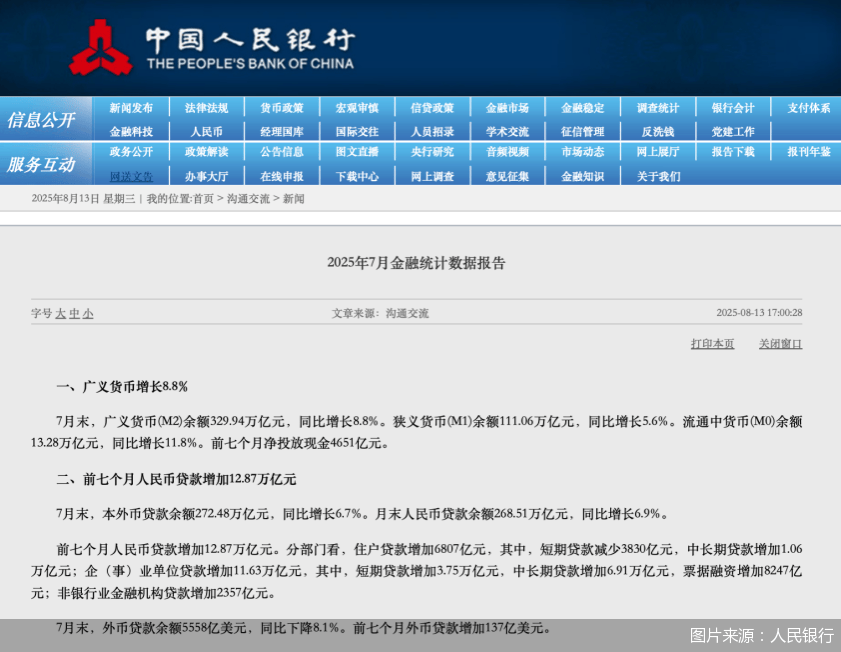
Group 1 - The core viewpoint of the article highlights the acceleration of M2 growth and the sustained high level of social financing, indicating strong financial support for the real economy and effective coordination of monetary and fiscal policies [1][5][10] - As of the end of July 2025, the broad money (M2) balance reached 329.94 trillion yuan, with a year-on-year growth of 8.8%, reflecting a 0.5 percentage point increase from the previous month and a 2.5 percentage point increase from the same period last year [5] - The total social financing stock was 431.26 trillion yuan, with a year-on-year growth of 9%, indicating a robust financing environment for the real economy [5][10] Group 2 - The increase in social financing is primarily attributed to a favorable issuance pace of government bonds, with over 17 trillion yuan issued from January to July 2025, averaging a net increase of 1.27 trillion yuan per month [5][12] - Direct financing's share in the total social financing stock is gradually rising, reflecting an ongoing optimization of the financing structure in China [7][11] - The M1-M2 gap has narrowed to 3.2%, indicating an improvement in the liquidity and efficiency of fund circulation, which aligns with the trend of economic activity recovery [7][10] Group 3 - The RMB loan balance reached 268.51 trillion yuan by the end of July, with a year-on-year growth of 6.9%, although this growth rate has slowed down due to seasonal factors [8][10] - The balance of inclusive small and micro loans was 35.05 trillion yuan, growing by 11.8% year-on-year, while medium to long-term loans in the manufacturing sector reached 14.79 trillion yuan, with an 8.5% year-on-year growth [10][12] - The overall downward trend in bond issuance rates in July has stimulated corporate bond financing demand, with an increase of 755 billion yuan year-on-year [6][12] Group 4 - The article emphasizes the importance of observing broader indicators such as social financing scale and M2, rather than solely focusing on loan balances, to better understand the financial support for the real economy [9][11] - The shift towards direct financing and the diversification of corporate financing channels are seen as beneficial for meeting the varied financing needs of enterprises [7][11] - The ongoing efforts to improve local debt management and promote financing platform reforms are expected to enhance the efficiency of fund utilization and support economic activity [12][13]
2.2%的超长信用债值得博弈吗?
SINOLINK SECURITIES· 2025-08-13 14:44
1. Report Industry Investment Rating No relevant content provided. 2. Core View of the Report Considering that the absolute return of ultra - long credit bonds remains at a low level and the direction of the bond market is unclear, trading opportunities for this bond type still need to be awaited [5]. 3. Summary by Directory 3.1存量市场特征 - Ultra - long credit bond yields fluctuate within a narrow range. From August 4th to August 8th, 2025, information affecting bond pricing was still complex, and the bond market sentiment was cautious. Compared with the previous week, the yields of existing ultra - long credit bonds declined slightly, with the yield center maintaining between 2.1% and 2.3% [2][13]. 3.2一级发行情况 - The subscription sentiment for new ultra - long industrial bonds rebounded. The total issuance scale of new ultra - long credit bonds this week was 19.7 billion yuan. Although the supply increased to some extent, its proportion in the total issuance scale of credit bonds for the week continued to decline. The average issuance interest rate of new ultra - long industrial bonds continued to rise and has now reached over 2.3%. Due to the increase in the coupon rate of ultra - long industrial bonds and the low - level hovering of the initial - month capital interest rate, investors' participation in subscribing for ultra - long credit bonds strengthened [3]. 3.3二级成交表现 - The pricing of the ultra - long credit bond index was basically the same as last week. Against the backdrop of increased difficulty in bond market forecasting, the performance of ultra - long credit bonds was inferior to mainstream bond assets. This week, the index trends of treasury bonds over 10 years, medium - term notes from 3 - 5 years, and secondary bonds of national - owned and joint - stock banks from 3 - 5 years were all better than that of the ultra - long credit bond index [4]. - The number of ultra - long credit bond transactions decreased significantly. Since July, ultra - long credit bonds have lacked floating profits. In an unstable bond market, the drawback of difficult - to - control drawdowns led to a significant weakening of the trading demand for this bond type. The total number of transactions of urban investment bonds and industrial bonds with a term of 7 years and above decreased from 515 last week to 389 this week. In terms of transaction returns, the average transaction yield of the most active 7 - 10 - year industrial bonds marginally recovered, and the spread with 20 - 30 - year treasury bonds compressed to 22bp, but the yields of general credit bond varieties over 10 years were still rising [4]. - Correspondingly, the low - valuation transaction margin of ultra - long credit bonds narrowed significantly this week, and the trading form of some long - term bond varieties changed to high - valuation. In terms of buying sentiment, the proportion of TKN transactions of 7 - 10 - year credit bonds with good liquidity dropped below 70% [4]. - Regarding the investor structure, insurance companies' willingness to hold ultra - long credit bonds was strong. This week, insurance companies' net purchase of credit bonds over 7 years reached 4.55 billion yuan. Funds, which had significantly reduced their holdings of ultra - long credit bonds in the previous two weeks, increased their holdings of 7 - 20 - year varieties to some extent this week. It is possible that as the assessment time approaches, some fund investors are extending the duration to increase returns [4].
“清欠”专项债披露超千亿
Guoxin Securities· 2025-08-13 14:24
Government Debt Financing - Net financing for government debt in week 32 (8/4-8/10) was 421.4 billion, and in week 33 (8/11-8/17) it was 200.9 billion, totaling 9.6 trillion, exceeding last year's figure by 4.9 trillion[1][5] - The net financing for national bonds and new local bonds in week 32 was 386.1 billion, and in week 33 it was 264 billion, with a cumulative broad deficit of 7.7 trillion, achieving 65.0% of the annual target[1][5] - National bonds net financing in week 32 was 338.6 billion, and in week 33 it was 214.6 billion, with a cumulative total of 4.3 trillion, reaching 65.2% of the annual target[1][7] Local and Special Bonds - Local debt net financing in week 32 was 82.8 billion, while in week 33 it was -13.7 billion, with a cumulative total of 5.3 trillion, exceeding last year's figure by 3 trillion[1][9] - New general bonds in week 32 amounted to 7.3 billion, and in week 33 it was 30.3 billion, with a cumulative total of 545.6 billion, achieving 68.2% of the annual target[1][9] - New special bonds in week 32 were 40.3 billion, and in week 33 it was 19 billion, with a cumulative total of 2.8 trillion, reaching 64.0% of the annual target[2][12] - Special new bonds issued totaled 857.9 billion, with 102.8 billion issued in August alone, accounting for 61% of the new special bonds[2][12] Risk and Market Indicators - Special refinancing bonds in week 32 had no issuance, while in week 33 it was 1.2 billion, with a cumulative total of 1.9 trillion, achieving 94% of the issuance target[2][21] - Urban investment bonds in week 32 had net financing of 20.6 billion, while week 33 is projected to be -21.5 billion, with the total balance of urban investment bonds below 10.3 trillion[2][26] - Fixed asset investment year-on-year growth is at 2.80%, retail sales growth is at 4.80%, and export growth is at 7.20%[4]
债市的多空之辩,谁是主线?
Changjiang Securities· 2025-08-13 08:45
Report Industry Investment Rating No relevant content provided. Core Viewpoints of the Report - The current inflation is likely to recover moderately, and the probability of the bond market turning bearish due to "anti-involution" is low [2][26] - Funds are expected to remain abundant for a long time, and the probability of the 10-year Treasury yield continuing to adjust above 1.75% is low. However, if it drops to the range of 1.6% - 1.65%, the bond market may face capital constraints [2][7] - In the second half of the year, the fundamentals may gradually become the unexpected main line of the bond market and may be beneficial to the bond market. It is recommended to allocate when the 10-year Treasury yield is above 1.7% [2][7] Summary by Related Catalogs Bond Market Facing Adjustment Pressure - After experiencing significant fluctuations, rapid upswings, and rapid downswings, the bond market is facing adjustment pressure again. Since August, the bond market has been under obvious pressure, and there are still significant differences between the bulls and bears in the market [5][11] How the Bulls and Bears View the Impact of "Anti-Involution" on the Bond Market - **Bulls**: The "anti-involution" policy will be implemented in the context of high-quality development. The probability of re - introducing large - scale demand - stimulus policies is low. The impact on inflation and the bond market needs to be observed [7][14] - **Bears**: Even if the probability of short - term demand - side policies is low, rapid capacity restrictions can cause price increases. A small price recovery can trigger bond market adjustments, and subsequent price factors may be negative for the bond market [7][23] - **Our View**: "Anti-involution" has raised inflation expectations, but the inflation is likely to recover moderately, and the probability of the bond market turning bearish is low [7][26] How the Bulls and Bears View the Impact of Monetary Policy on the Bond Market - **Bulls**: In the second half of the year, the economy still faces pressure, and liquidity is likely to remain abundant. The restart of Treasury bond trading in the fourth quarter will directly benefit the bond market [7][27] - **Bears**: The moderate monetary easing has been reflected in bond prices. The bottom line of further easing is "fund idling." The central bank's interest rate cut and reserve requirement ratio cut space is limited this year, and the impact of subsequent Treasury bond trading on the bond market will be similar to that of repurchase [7][29] - **Our View**: Funds are expected to remain abundant for a long time, and the probability of the 10-year Treasury yield continuing to adjust above 1.75% is low. However, if it drops to 1.6% - 1.65%, the bond market may face capital constraints [7][34] How the Bulls and Bears View the Impact of Economic Fundamentals on the Bond Market - **Bulls**: The pricing power of fundamentals on the bond market has been weak, but attention should be paid to the downward pressure on fundamentals under the background of high real interest rates. Fundamentals may become the unexpected main line of the bond market in the next stage [7][35] - **Bears**: Treasury yields have priced in the pressure on fundamentals, and the bond market is not very sensitive to fundamental changes [7][45] - **Our View**: In the second half of the year, the pricing power of fundamentals on the bond market may increase marginally, and it may gradually become the unexpected main line of the bond market, which may be beneficial to the bond market [7][47]
化债进行时系列:化债两年:城投付息下降,缩量格局延续
ZHESHANG SECURITIES· 2025-08-13 07:19
1. Report Industry Investment Rating No information provided regarding the report industry investment rating. 2. Core Viewpoints of the Report - After two years of debt resolution, there are improvement signals in the total amount of urban investment debt, with the proportion of bank loans increasing and the "stable quantity and falling price" of urban investment debt driving down interest - payment expenditures. The changes in fundamentals are consistent with the pricing trend of urban investment bonds. In July, the urban investment sentiment index improved, with a double - decline in the number of non - standard and private placement products. The issuance and review side improved month - on - month but remained tight overall, and the urban investment bonds continued to shrink. The trading sentiment in the secondary market warmed up, and the model pointed to going long. In the volatile market, the coupons of medium - and short - term bonds are more certain [1]. - The supply - and - demand pattern of urban investment bonds continues, and institutions still lack coupon assets. Although the registration scale and feedback days on the issuance and review side improved slightly month - on - month, the supply remained tight overall. In July, there was a net outflow of 21.784 billion yuan in urban investment bonds, and the outstanding scale continued to shrink. On the demand side, the net purchase volume of funds was not large in July due to subscription and redemption, while the allocation rhythm of wealth management was not significantly affected. With the relief of the redemption pressure on funds and the seasonal growth of wealth management scale after the quarter, the allocation power of credit bonds in the third quarter is expected to be strongly supported [2]. 3. Summary According to the Table of Contents 3.1 What Changes Have Occurred in Urban Investment Debt in Two Years of Debt Resolution? 3.1.1 Changes in Urban Investment Debt Structure - At the industry level, the scale of urban investment debt is still growing, and the proportion of bank loans has increased slightly. As of the end of March 2025, the total interest - bearing debt of urban investment platforms was 61.72 trillion yuan, a 9.4% increase from the end of June 2023. Among them, bank loans, bonds, and non - standard debts were 40.67 trillion yuan, 15.41 trillion yuan, and 5.63 trillion yuan respectively, with increases of 13.06%, 2.25%, and 4.97% respectively compared to the end of June 2023. The proportion of bank loans in the interest - bearing debt of urban investment platforms increased from 63.76% at the end of June 2023 to 65.9% at the end of March 2025 [14][15]. - There are differences among provinces. As of the end of March 2025, 18 provinces saw an increase in the proportion of bank loans, and 8 provinces including Ningxia, Hainan, Inner Mongolia, etc. had an increase of more than 3 percentage points. The financing structures of key provinces such as Gansu, Guangxi, Guizhou, etc. improved, with an increase in the proportion of bank loans and a simultaneous decrease in the proportion of bonds and non - standard debts [18][19]. 3.1.2 Has the Interest - Payment Pressure of Urban Investment Been Alleviated? - The costs of all channels have decreased. Since June 2023, the financing costs of bank loans and non - standard financing have decreased. In March 2025, the bank loan interest rate was 3.26%, a 69 - basis - point decrease from June 2023, and the non - standard financing cost was 5.14%, a 208 - basis - point decrease. The issuance coupon rate of urban investment bonds also decreased, reaching 2.2% in July 2025 [21]. - The annual interest - payment has decreased by over 190 billion yuan. The interest expenditure of bank loans decreased by 28.438 billion yuan, that of urban investment bonds decreased by 135.535 billion yuan, and that of non - standard debts decreased by 26.173 billion yuan [23][24]. - Except for Beijing and Shanghai, the interest - payment expenditures of urban investment bonds in all provinces have decreased. The interest - payment expenditures of urban investment bonds in some economically strong provinces and provinces that have received more debt - resolution support, such as Jiangsu and Zhejiang, have decreased significantly [29]. 3.2 Market Outlook: Medium - and Short - Term Urban Investment Bonds Are More Certain - In early July, the bond market adjusted due to the anti - involution policy. In the second half of the month, under the influence of multiple factors, the market sentiment eased, and the market started to repair and re - price funds and fundamentals. In the volatile bond market, medium - and short - term coupon assets are more certain, and the recovery of low - and medium - grade urban investment bonds is favored [32]. 3.3 Primary Issuance: Supply Remains Tight, and Issuance Enthusiasm Is High 3.3.1 Urban Investment Bond Issuance and Review Situation - The issuance and review rhythm improved month - on - month but remained tight overall. In July, the registration quota of urban investment bonds in the inter - bank market was 11.7091 billion yuan, a 52.69% month - on - month increase, but the registration completion ratio was only 11%. The number of feedbacks before the meeting decreased from 2.7 times in June to 2.28 times in July but remained at a relatively high level [34]. - The use of raised funds is still mainly for debt replacement, and it is difficult to break through new increments. In July, the proportion of debt replacement in the raised funds of urban investment bonds was 86.13%, and the proportion of other new uses was 3.62%, the lowest in 2025 [36]. 3.3.2 Urban Investment Dim - Sum Bonds: Increased Month - on - Month - The issuance of urban investment dim - sum bonds reached a new high in 2025 but was less popular than the same period last year. In July, 13 urban investment dim - sum bonds were issued, with a total scale of 8.273 billion yuan, significantly lower than 20.166 billion yuan in the same period of 2024. Henan and Shandong were the main issuers [42]. 3.3.3 The Issuance Enthusiasm Remains High, and the Coupon Rate Reached a New Low in the Year - The overall subscription enthusiasm in the primary market of urban investment bonds remained high. In July, the subscription multiple of urban investment bonds reached 3.67 times, and the "issuance coupon - lower limit of the range" was 34.75BP, lower than the same period last year [47]. - The issuance term of urban investment bonds was concentrated in 3 - 5 years, accounting for 46.48% in July. The weighted issuance coupon rate in July was 2.2%, a 7 - basis - point decrease from the previous month [49][50]. 3.3.4 Continued Net Outflow, and Urban Investment Bonds Further Shrunk - The net financing scale of urban investment bonds generally decreased, and the financing of key provinces tightened more significantly. In July, the cumulative net financing scale of urban investment bonds in key provinces was - 104.293 billion yuan, and that in non - key provinces was - 43.302 billion yuan [53]. 3.4 Secondary Market: Trading Sentiment Warmed Up, and the Model Pointed to Going Long 3.4.1 The Turnover Ratio of Each Term Declined Month - on - Month, and 3 - Year Urban Investment Bonds May Be More Suitable for Trading - Since the beginning of 2024, credit bonds have gradually moved towards the logic of liquidity pricing. The liquidity of bonds with a term of less than 1 year is better than that of medium - and long - term bonds. The turnover ratio of 3 - 5 - year bonds slightly recovered in June and July, and 3 - year high - grade urban investment bonds are more suitable for trading [54][55]. 3.4.2 Good Trading Sentiment, and More Low - Valuation Transactions - After a short - term adjustment, the weekly main - buying index began to rise, and the bullish sentiment quickly recovered. In the last week of July, the proportion of Bid transactions reached 34.52%, and the TKN proportion increased by 13.9 percentage points month - on - month [56]. - Low - valuation transactions of urban investment bonds reappeared, and the transaction term remained at a high level. On July 31, the deviation was - 2.40BP, and the weighted transaction term on the last trading day of July was 2.51 years, at the 82.2% quantile level since the beginning of 2024 [56].
ESG投资周报:ESG指数有所回暖,绿色债券稳步发行-20250813
GUOTAI HAITONG SECURITIES· 2025-08-13 05:27
Market Performance - The A-share market showed overall recovery from August 4 to August 8, 2025, with the CSI 300 index rising by 1.23%, the ESG 300 index increasing by 1.06%, and the STAR Market ESG index up by 1.31%[5] - The average daily trading volume across the A-share market was approximately 1.70 trillion RMB, indicating a contraction in liquidity compared to previous periods[5] ESG Fund Issuance - No new ESG fund products were issued in August 2025; however, a total of 241 ESG public funds were launched in the past year, with a total issuance of 171.41 billion units[7] - As of August 10, 2025, there are 910 existing ESG fund products, with the largest share being ESG strategy funds at 50.33% of the total net asset value of 1,022.06 billion RMB[9] Fund Performance - The top-performing fund for the week of August 4 to August 10, 2025, was the Zhonghai Charm Yangtze River fund, achieving a weekly return of 6.14% and a year-to-date return of 29.00%[10] - Other notable funds included the Robeco Resource Selection and Yongying New Energy Selection, which also performed well during the same period[10] Green Bond Issuance - A total of 23 new green bonds were issued in the interbank and exchange markets from August 4 to August 8, 2025, with a planned issuance scale of approximately 18.64 billion RMB[13] - In August 2025, 33 ESG bonds were issued, amounting to 15.3 billion RMB, with a total of 1,034 ESG bonds issued in the past year, totaling 1,227.7 billion RMB[13] Green Bond Trading - The total trading volume of ESG green bonds for the week was 562.58 billion RMB, with the interbank market accounting for 77.45% of the total trading volume[17] - Repo transactions dominated the trading methods, comprising 94.96% of the total trading volume, while cash transactions accounted for only 0.07%[20] Bank Wealth Management Products - In August 2025, 30 ESG bank wealth management products were issued, with a total of 1,049 existing products in the market as of August 10, 2025[18] - The largest share of existing products is pure ESG-themed products, which account for 54.53% of the total[18] Risk Factors - Potential risks include insufficient policy support for ESG initiatives, lack of standardized data reporting, and lower-than-expected product issuance scales[19]
大类资产早报-20250813
Yong An Qi Huo· 2025-08-13 05:04
1. Report Industry Investment Rating - Not provided in the content 2. Core View of the Report - Not provided in the content 3. Summary by Related Catalogs Global Asset Market Performance 10 - year Treasury Yields of Major Economies - On August 12, 2025, the 10 - year Treasury yields of the US, UK, France, etc. were 4.291, 4.625, 3.408 respectively. The latest changes were 0.004, 0.061, 0.053; the one - week changes were 0.079, 0.110, 0.124; the one - month changes were - 0.192, 0.001, 0.003; the one - year changes were 0.500, 0.798, 0.443 [3]. - For Asian countries like Japan, China, and South Korea, on August 12, 2025, the yields were 3.732, 1.730, - respectively. The latest changes were - 0.037, 0.013, -; the one - week changes were 0.007, 0.027, -; the one - month changes were - 0.210, 0.072, -; the one - year changes were - 0.150, - 0.400, - [3]. 2 - year Treasury Yields of Major Economies - On August 12, 2025, the 2 - year Treasury yields of the US, UK, Germany were 3.760, 3.880, 1.965 respectively. The latest changes were 0.040, 0.021, 0.004; the one - week changes were 0.070, 0.060, 0.060; the one - month changes were - 0.150, 0.050, 0.084; the one - year changes were - 0.530, 0.291, - 0.380 [3]. - For other countries such as Japan, Italy, and China (1Y), on August 12, 2025, the yields were 0.767, 2.205, 1.362 respectively. The latest changes were 0.009, 0.000, - 0.001; the one - week changes were 0.018, 0.063, - 0.008; the one - month changes were - 0.008, 0.123, - 0.001; the one - year changes were 0.369, - 0.673, - 0.036 [3]. Dollar Exchange Rates Against Major Emerging - Market Currencies - On August 12, 2025, the dollar - to - Brazilian real, South African rand, and South Korean won exchange rates were 5.389, 17.593, 1383.950 respectively. The latest changes were - 0.99%, - 0.92%, - 0.50%; the one - week changes were - 2.16%, - 1.81%, - 0.18%; the one - month changes were - 3.02%, - 1.86%, - 0.26%; the one - year changes were - 5.92%, - 3.68%, 1.68% [3]. - For the on - shore and off - shore RMB, on August 12, 2025, the exchange rates were 7.181 and 7.185 respectively. The latest changes were - 0.10%, - 0.16%; the one - week changes were - 0.04%, - 0.06%; the one - month changes were - 0.02%, 0.01%; the one - year changes were 0.13%, 0.29% [3]. Stock Indices of Major Economies - On August 12, 2025, the S&P 500, Dow Jones Industrial Average, and NASDAQ were 6445.760, 44458.610, 21681.900 respectively. The latest changes were 1.13%, 1.10%, 1.39%; the one - week changes were 2.33%, 0.79%, 3.66%; the one - month changes were 3.24%, 0.99%, 4.86%; the one - year changes were 20.56%, 11.88%, 29.24% [3]. - For Asian indices such as the Nikkei, Hang Seng Index, and Shanghai Composite Index, on August 12, 2025, they were 42718.170, 24969.680, 3665.918 respectively. The latest changes were -, 0.25%, 0.50%; the one - week changes were 5.35%, 0.27%, 1.34%; the one - month changes were 7.66%, 1.54%, 4.59%; the one - year changes were 18.96%, 47.35%, 26.18% [3]. Credit Bond Indices - The latest changes of the US investment - grade credit bond index, euro - zone investment - grade credit bond index, and emerging - market investment - grade credit bond index were 0.02%, - 0.12%, 0.04% respectively; the one - week changes were - 0.21%, - 0.27%, 0.11%; the one - month changes were 1.82%, 0.17%, 1.59%; the one - year changes were 3.93%, 4.35%, 5.44% [3][4]. - The latest changes of the US high - yield credit bond index, euro - zone high - yield credit bond index, and emerging - market high - yield credit bond index were 0.09%, 0.05%, 0.22% respectively; the one - week changes were 0.19%, 0.23%, 0.67%; the one - month changes were 0.90%, 0.86%, 2.44%; the one - year changes were 9.41%, 8.45%, 15.18% [3][4]. Stock Index Futures Trading Data Index Performance - The closing prices of A - shares, CSI 300, and SSE 50 were 3665.92, 4143.83, 2807.01 respectively, with daily changes of 0.50%, 0.52%, 0.61% [5]. - The PE (TTM) of CSI 300, SSE 50, and CSI 500 were 13.39, 11.52, 30.93 respectively, with环比 changes of 0.09, 0.09, 0.11 [5]. Fund Flows - The latest values of A - share, main - board, and SME - board fund flows were - 605.19, - 420.84, - respectively, and the 5 - day average values were - 317.74, - 237.07, - respectively [5]. Trading Volume - The latest trading volumes of the Shanghai and Shenzhen stock markets, CSI 300, and SSE 50 were 18815.20, 3830.88, 1096.88 respectively, with环比 changes of 545.47, 224.02, 193.54 respectively [5]. Basis and Spread - The basis of IF, IH, and IC were - 12.63, 2.59, - 75.56 respectively, with spreads of - 0.30%, 0.09%, - 1.18% respectively [5]. Treasury Futures Trading Data - The closing prices of T00, TF00, T01, and TF01 were 108.420, 105.715, 108.305, 105.725 respectively, with daily changes of - 0.13%, - 0.10%, - 0.13%, - 0.11% respectively [6]. - The R001, R007, and SHIBOR - 3M were 1.3486%, 1.4619%, 1.5480% respectively, with daily changes of - 10.00 BP, 1.00 BP, 0.00 BP respectively [6]
上交所:凯盛科技集团有限公司债券8月14日上市,代码243500
Sou Hu Cai Jing· 2025-08-13 04:38
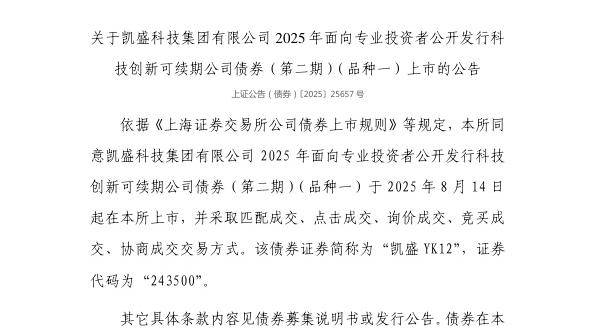
8月13日,上交所发布关于凯盛科技集团有限公司2025年面向专业投资者公开发行科技创新可续期公司 债券(第二期)(品种一)上市的公告。 依据《上海证券交易所公司债券上市规则》等规定,上交所同意凯盛科技集团有限公司2025年面向专业 投资者公开发行科技创新可续期公司债券(第二期)(品种一)于2025年8月14日起在上交所上市,并 采取匹配成交、点击成交、询价成交、竞买成交、协商成交交易方式。该债券证券简称为"凯盛 YK12",证券代码为"243500"。 来源:金融界 ...

美国国债突破37万亿美元 黄金多头力量积聚
Jin Tou Wang· 2025-08-13 04:24
美国7月份消费者价格指数(CPI)环比上涨0.2%,同比涨幅为2.7%,基本符合市场预期,却略低于部 分经济学家的预测。这一数据继6月份0.3%的涨幅后显示出通胀压力的缓和迹象,特别是核心CPI(扣 除食品和能源)环比上涨0.3%,同比达3.1%,为今年1月以来的最大涨幅,但整体并未出现大幅上行。 周三(8月13日)亚洲时段,现货黄金小幅走高,黄金价格在3350水平附近反复震荡,美国通胀数据公 布后,交易员们维持了对9月和12月降息的押注,这让黄金的多头力量得以积聚,短期内市场保持谨 慎,等待更多经济指标的验证,当地时间8月12日,由于美国联邦政府继续以创纪录的速度积累债务, 美国国债总额首次超过37万亿美元。 【要闻速递】 当地时间8月12日,由于美国联邦政府继续以创纪录的速度积累债务,美国国债总额首次超过37万亿美 元。美国财政部发布的最新数据显示,截至当日下午,美国国债总额已达到37004817625842美元。美国 联邦预算问责委员会主席马娅·麦吉尼亚斯对此表示,美国财政状况严重失衡,但国会却不断让情况恶 化。 白宫发言人莱维特周二表示,美国总统特朗普正考虑起诉美联储主席鲍威尔,因鲍威尔对美联储华盛顿 ...