建材

Search documents
策略对话建材:建材反内卷行情展望
2025-07-23 14:35
Summary of Key Points from the Conference Call on the Building Materials Industry Industry Overview - The building materials industry is currently facing a situation where it aims to achieve a "de-involution" goal through limiting capital expenditures, reducing production capacity, and constraining output, similar to the supply-side reforms from 2015 to 2017, but the current efforts are not as strong as the previous round [1][2][4] - The cement industry experienced significant price increases due to supply-side reforms starting in 2016, driven by environmental production limits, but these constraints weakened after 2018, leading to enhanced industry resilience through improved corporate collaboration [1][7][8] Core Insights and Arguments - For the market to sustain or experience a second wave of growth, clear policy support for de-involution is necessary, alongside a favorable outlook for demand-driven industries, strict environmental regulations, and increased industry concentration [1][5][6] - The current institutional holding ratio and market expectations in the building materials sector are at low levels, meaning any positive changes could lead to significant stock price reactions, as evidenced by the recent performance of Conch Cement [1][10] - Recommended sectors for investment include photovoltaic glass and cement, with photovoltaic glass benefiting from de-involution and price recovery expectations, while the cement sector is noted for its solid self-discipline and collaborative effects [1][11] Important but Overlooked Content - The building materials industry has not yet implemented significant de-involution policies, but potential future measures may include limiting capital expenditures, reducing production capacity, and output constraints [2][4] - Historical experiences from the 2015-2017 supply-side reforms indicate that while the current situation may not match the previous level of demand or constraint, there are lessons to be learned regarding market expectations and policy impacts [3][4][9] - The current supply-demand situation in the building materials industry has not shown significant changes, with institutional holdings at historical lows, suggesting that even minor positive developments could lead to drastic stock price movements [10][13] Investment Strategy - The overall investment strategy in the building materials sector is to prioritize photovoltaic glass, followed by the cement sector, focusing on companies with cost advantages and potential for profit improvement, such as Qibin Group and Taipai Group [11][12][13] - The strategy emphasizes the importance of selecting stocks with solid fundamentals and the ability to respond quickly to policy changes, which could lead to significant returns [12][14]
大宗商品价格飙升,业内期待全产业链协同优化
Di Yi Cai Jing· 2025-07-23 13:55
Group 1 - The main driving force behind the recent market rally is supply-side expectations of "anti-involution," which have led to price increases, while rising coal prices are expected to increase downstream electricity costs, potentially leading to supply contraction and further price hikes [1][2][6] - The market anticipates that fiscal policies will strengthen in the second half of the year, alongside urban renewal and major infrastructure projects, contributing to improved demand expectations [1][2][5] - Recent futures market trends show significant price increases across various commodities, with notable gains in coking coal, silicon, and glass, driven by supply-side reforms and demand recovery expectations [3][4][6] Group 2 - The "anti-involution" policy is seen as a catalyst for the current market dynamics, with expectations of reduced low-price competition and the orderly exit of outdated production capacities [4][5][11] - Analysts express differing views on the sustainability of the current rally, with some optimistic about policy impacts while others caution about the need for alignment between policy execution and downstream demand [2][8][11] - The recent surge in commodity prices is attributed to a combination of supply-side adjustments and improved market sentiment, with significant price recoveries observed in various sectors, including black metals and energy materials [3][6][10] Group 3 - The coal price increase is expected to lead to reduced production in downstream sectors, further contributing to price increases in related commodities [6][7] - The market is currently experiencing a strong rebound in various commodity prices, with significant gains reported in coking coal and silicon, driven by both supply-side reforms and rising production costs [3][7][10] - The outlook for the commodity market remains mixed, with some analysts predicting continued volatility and others highlighting the potential for sustained price increases if supply-side policies are effectively implemented [8][11]
行业景气观察:黑色系商品价格上涨,新能源和光伏产业链价格反弹
CMS· 2025-07-23 13:33
Core Insights - The report highlights a significant rebound in prices for black commodities, as well as the new energy and photovoltaic industry chains, driven by expectations of "anti-involution" policies [1][2][21] - Key price increases are observed in steel, coal, glass, and certain metals, with many currently at historical lows, indicating potential for recovery [2][21] - The report recommends focusing on sectors with high or improving sentiment, including coke, steel, building materials, non-ferrous metals, batteries, silicon materials, semiconductors, telecommunications, and securities [1][2][21] Industry Overview Upstream Resources - Recent price increases in steel, coal, and glass are attributed to "anti-involution" policies, with coke and coal futures rising by 13.1% and 22.7% respectively [13][21] - Steel prices have also seen a rise, with rebar prices increasing by 4.2% and steel billet prices by 6.1% [13][21] New Energy and Photovoltaics - The new energy and photovoltaic sectors have experienced rapid price increases, with DMC and lithium carbonate prices rising by 13.5% and 8.5% respectively [16][21] - The photovoltaic industry composite price index has increased by 16.2%, with silicon wafers and polysilicon prices rising by 39.4% and 19.5% respectively [16][21] Metals - Industrial metals such as copper, aluminum, zinc, and tin have generally increased in price, driven by robust downstream demand and supply constraints [14][21] - Precious metals have shown strong performance, with COMEX gold and silver prices rising by 3.4% and 4.4% respectively [14][21] Agricultural Products - Seasonal demand has led to a significant increase in egg prices, which rose by 14.8% [18][21] - High temperatures have impacted supply, resulting in increases in soybean and soybean oil prices by 2.3% and 2.1% respectively [18][21]
建材ETF大跌5.61%,基建ETF大跌4.51%点评
Sou Hu Cai Jing· 2025-07-23 13:10
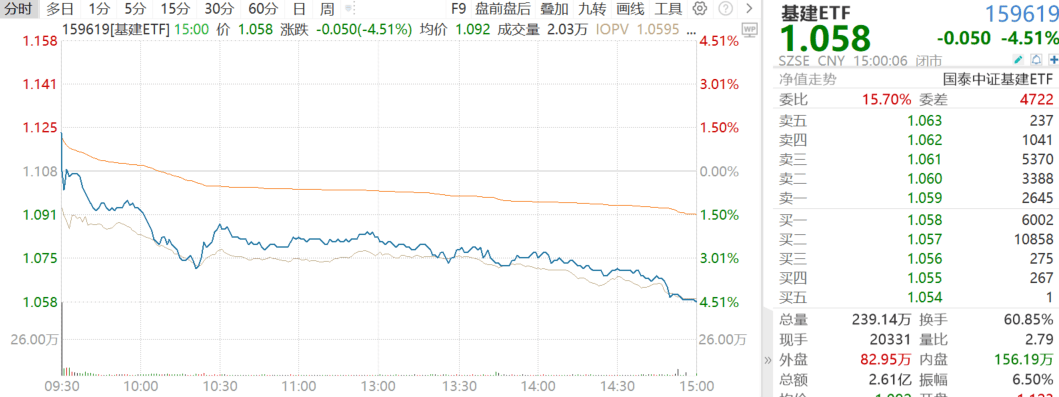
Core Viewpoint - The construction materials ETF (159745) and infrastructure ETF (159619) experienced significant declines of 5.61% and 4.51% respectively, attributed to profit-taking and the lack of concrete policy implementation [1][5]. Market Performance - The construction materials ETF closed at a drop of 5.61%, while the infrastructure ETF closed down 4.51% [1][3]. - The trading volume for the infrastructure ETF was 2.61 billion CNY, with a turnover rate of 60.85% [3]. Reasons for Decline - The decline is linked to the absence of policy rollout, with prior market enthusiasm leading to profit-taking by investors [5]. - The market had previously reacted positively to expectations surrounding anti-involution policies and major project investments, but the actual impact of the Yajiang Hydropower project on the construction and materials sectors remains to be seen [5]. Future Outlook - Short-term volatility is expected, but the long-term outlook remains positive due to anticipated growth in infrastructure investment and anti-involution policies [6]. - The total investment for the Yajiang downstream hydropower project is projected at 1.2 trillion CNY, which is expected to gradually stimulate demand across various sectors, including cement and construction materials [6]. - Fixed asset investment in China is projected to reach 24.87 trillion CNY in the first half of 2025, with a year-on-year growth of 2.8% [6]. Policy and Investment Trends - The implementation of more proactive macro policies is expected to support steady growth in infrastructure investment [7]. - The construction materials sector has seen a bottoming out of profits in various sub-industries, indicating potential recovery [7][8]. - Upcoming policies aimed at urban renewal and housing improvements are likely to boost demand for construction materials [7]. Investment Opportunities - The construction materials ETF (159745) is highlighted as a leading option, tracking the CSI All Share Construction Materials Index, which includes segments like cement and glass [8]. - Investors are encouraged to consider the potential for recovery in the construction materials sector, with 2025 anticipated as a pivotal year for profit restoration [8].

集体大反弹,有期货月内涨超50%!当“反内卷的风”吹向大宗商品
21世纪经济报道· 2025-07-23 12:20
Core Viewpoint - The article discusses the impact of the "anti-involution" policy on supply contraction expectations in various industries, particularly focusing on coal and other commodities, which have shown significant price increases in the futures market due to anticipated production restrictions [1][7][12]. Group 1: Commodity Price Movements - Coal futures, particularly the焦煤期货主力2509 contract, surged by 11% on July 23, with a monthly increase exceeding 34% [1]. - Other commodities have also seen price increases, with多晶硅2509 rising over 50% and焦炭2509 increasing nearly 20% since July [3]. - The glass futures market has experienced a rise of approximately 20% since July, while the actual spot price of glass has only increased by about 7% [6][15]. Group 2: Market Dynamics and Policy Implications - The "anti-involution" trend is spreading from the photovoltaic and steel industries to coal and building materials, indicating a broader market response [5]. - The current market reaction is primarily speculative, with actual spot markets not reflecting the same intensity as futures markets [6][17]. - The central government's focus on eliminating low-price competition and promoting quality improvements is expected to lead to more structured production policies [9][10]. Group 3: Future Expectations and Uncertainties - The implementation of stricter production regulations could lead to a significant reduction in coal output, with estimates suggesting a potential decrease of 43 million tons in Inner Mongolia alone [10]. - The upcoming release of new policies aimed at stabilizing growth in key industries, including steel and non-ferrous metals, is anticipated to further influence commodity prices [11][12]. - The actual impact of the "anti-involution" policies on supply and pricing remains uncertain, with market participants closely monitoring the situation [17].

东方雨虹:依托共生的力量开拓市场新蓝海
Ren Min Wang· 2025-07-23 08:54
Core Viewpoint - The company is evolving its business model from a traditional profit-sharing approach to a value co-creation ecosystem through the "platform + creator" strategy, aiming to build competitive barriers that are difficult to replicate [1][2] Group 1: Strategic Initiatives - The company emphasizes a dual approach of leveraging technology as a spear and co-creation as a shield to reshape the value chain amid industry changes [1] - The "partner" system initiated in 2018 has transformed the company into an open empowerment platform, attracting resource-based partners to build an ecological system together [1][2] Group 2: Product and Service Strengths - The company has established a robust supply chain directly connected to major firms like BASF and Sinopec, supported by a five-step quality inspection system and third-party controls [1] - A standardized construction system has been created, backed by a certified craftsmanship academy, focusing on standardized processes, modern equipment, and professional talent [1] Group 3: Market Position and Competitive Advantage - The company’s competitive edge lies in its technological leadership, supported by a national key laboratory for advanced materials, addressing critical technical challenges [2] - The company has achieved green product certification in 2022 and developed innovative materials for specific applications, enhancing safety and reliability in construction [2] Group 4: Project Experience and Future Opportunities - The company has successfully executed major projects, including 85% of waterproof engineering for Olympic venues and the Hong Kong-Zhuhai-Macao Bridge, creating replicable methodologies for future projects [2] - The company is strategically positioning itself in emerging sectors such as high-standard farmland and water conservancy pipelines, mobilizing resources to seize new market opportunities [2]

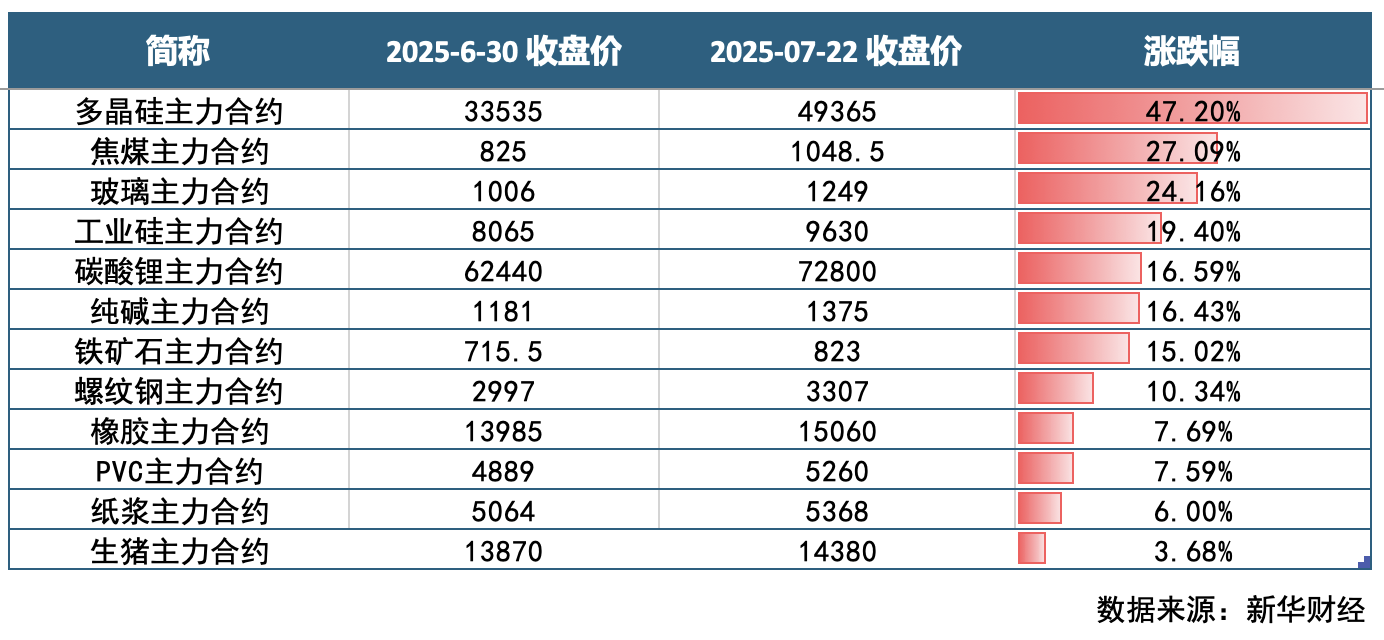
“反内卷”提振市场情绪 多晶硅7月涨超47% 焦煤创5个月新高
Xin Hua Cai Jing· 2025-07-23 08:25
对于黑色金属本轮涨势,多数分析师表示,一则有关"煤矿生产核查"的通知推动黑色系期货市场走强,叠加部分钢厂对焦煤第二轮提价的情绪提振,在政策 预期的支撑下,黑色系金属价格呈高位波动的行情。 一德期货分析师张源表示,从基本面看,焦煤及焦炭供应格局仍显紧平衡。一方面,前期山西等地的环保、安监等因素导致的减产尚未完全恢复;另一方 面,本轮盘面上涨显著带动了现货补库、期现套利(正套)入场以及贸易商囤货行为,这些操作共同加速了现货去库节奏,形成价格上涨的正反馈循环。 中信证券研究煤炭与氢能行业首席分析师祖国鹏认为,目前动力煤处于迎峰度夏的旺季,下游采购需求逐步释放。随着高温天气的持续,短期动力煤需求和 煤价仍有扩张空间。若后续稳增长政策或重大基建项目建设的预期进一步叠加,则有望推动煤价超预期。 随着"反内卷"政策信号持续释放,市场对行业格局优化的预期增强,国内工业品期货市场集体大涨。 7月23日,多晶硅期货、焦煤期货、玻璃期货开盘再度大涨,多晶硅期货主力合约早盘一度涨停,盘中最高触及每吨53165元,再创上市以来新高;工业硅期 货主力合约早盘涨超2%,一度站上万元关口;煤炭板块中,焦煤主力合约再次触及涨停,涨幅达11%, ...
光大期货金融期货日报-20250723
Guang Da Qi Huo· 2025-07-23 06:45
Group 1: Investment Ratings - The investment rating for stock indices is "volatile" [1] - The investment rating for treasury bonds is "volatile" [2] Group 2: Core Views - The A-share market continued to rise, with the Wind All A up 0.61% and a turnover of 1.93 trillion yuan. The central government is stimulating economic recovery through investment, which may bring incremental funds in the short term, but the long-term effect remains to be seen. Overseas, the Fed's rate cut expectation has slowed, and the domestic small-cap index has been less boosted. The index's future depends on the domestic economic recovery process, and it is expected to remain volatile [1] - Treasury bond futures closed lower, with the central bank conducting reverse repurchase operations and a net withdrawal of funds. The economy remains resilient, reducing the short-term expectation of interest rate cuts, and treasury bonds are expected to run bearishly in the short term [2] Group 3: Summary by Directory Research Views - **Stock Indices**: The A-share market rose, with various indices showing different increases. The construction of the Yarlung Zangbo River hydropower project drove up the infrastructure sector. Economic and financial data showed mixed results, with investment continuing to decline and M1 performing well. The central government's economic stimulus measures may bring short-term incremental funds, but the long-term effect is uncertain. Overseas factors also affect the market, and the index is expected to remain volatile [1] - **Treasury Bonds**: Treasury bond futures closed lower, and the central bank conducted reverse repurchase operations with a net withdrawal of funds. Economic data indicates resilience, reducing the short-term expectation of interest rate cuts, and treasury bonds are expected to run bearishly in the short term [2] Daily Price Changes - **Stock Index Futures**: IH, IF, IC, and IM all increased, with IC having the highest increase of 1.22% [3] - **Stock Indices**: The Shanghai Composite 50, CSI 300, CSI 500, and CSI 1000 all increased, with the CSI 500 having the highest increase of 0.85% [3] - **Treasury Bond Futures**: TS, TF, T, and TL showed different changes, with TL remaining unchanged [3] - **Treasury Bond Yields**: The yields of 2-year, 5-year, 10-year, and 30-year treasury bonds all increased [3] Market News - The S&P 500 hit a new high, while the Nasdaq was dragged down by the tech sector. Gold returned to $3400, and domestic coking coal futures continued to soar [4] - Trump announced trade agreements with Japan and the Philippines, with tariff rates of 15% and 19% respectively [5][6] - Trump's stance on "firing Powell" softened, and he and Bessent pressured the Fed to cut interest rates [6] - The domestic commodity market had a collective rally, with six varieties hitting the daily limit [7] Chart Analysis - **Stock Index Futures**: The report includes charts of the trends and basis of IH, IF, IC, and IM [8][9][10] - **Treasury Bond Futures**: The report includes charts of the trends, basis, inter - period spreads, cross - variety spreads, and funding rates of treasury bond futures [15][16][18] - **Exchange Rates**: The report includes charts of various exchange rates, such as the US dollar against the Chinese yuan, the euro against the Chinese yuan, and cross - currency exchange rates [22][23][27]
涨停潮还有几个?雅下水电概念引爆A股,三大股指再创新高,谁是下一个爆点
Hua Xia Shi Bao· 2025-07-23 04:41
Core Viewpoint - The A-share market experienced a significant rally on July 22, 2025, with all three major indices reaching new highs for the year, driven by the launch of the Yarlung Tsangpo River hydropower project and supportive macroeconomic policies [2][4][5]. Market Performance - The Shanghai Composite Index rose by 0.62% to close at 3581.86 points, with an intraday high of 3584.72 points [2]. - The total trading volume across the Shanghai, Shenzhen, and Beijing markets reached 1.9286 trillion yuan, an increase of 201.5 billion yuan from the previous day [2]. - Over 2500 stocks in the market saw gains, with more than 100 stocks hitting the daily limit for the second consecutive day [2]. Sector Performance - The Yarlung hydropower concept sector led the gains with an increase of 11.77%, followed by the civil explosives sector at 6.04% and the cement sector at 4.58% [2]. - Despite the strong performance, the Yarlung hydropower sector experienced a net outflow of 557 million yuan in main funds [3]. - The coal mining and processing sector saw a net inflow of 2.571 billion yuan, while the liquor sector attracted 1.829 billion yuan [2]. Project Significance - The Yarlung Tsangpo River hydropower project, with a total investment of approximately 1.2 trillion yuan, is expected to significantly boost infrastructure development and clean energy initiatives in the western region of China [4]. - The project is projected to account for 88.7% of China's total water conservancy investment in 2024, benefiting various sectors including water conservancy, tunneling, civil explosives, and construction materials [4]. Market Sentiment and Future Outlook - Analysts suggest that while the Yarlung hydropower project serves as a catalyst for market sentiment, the actual impact on corporate earnings may be limited in the short term due to the project's long construction cycle [4][5]. - The market is expected to experience structural pressures, particularly from the banking sector, which may limit upward movement in indices [9]. - Future investment opportunities may arise in sectors related to high-voltage power transmission and infrastructure in Tibet, as well as in high-growth industries such as AI and semiconductors [6][10].

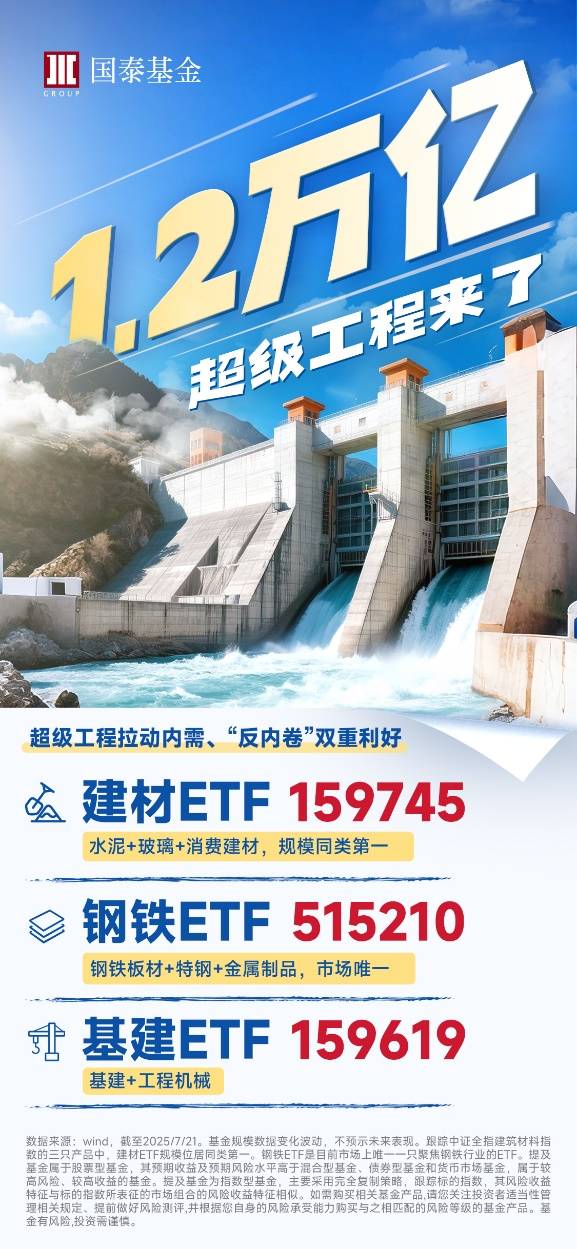
建材ETF(159745)、基建ETF(159619)纳入第五届指数投资大赛标的
Sou Hu Cai Jing· 2025-07-23 03:52
Group 1 - The core viewpoint of the articles highlights the positive impact of the Yajiang project on the construction materials and infrastructure sectors, leading to significant market activity and investment opportunities [1][2] - The Yajiang project, a national strategic initiative, is expected to enhance Tibet's GDP growth rate to over 8% annually and generate over 2 trillion yuan in related investments over the next decade, significantly boosting demand for cement and construction materials [1] - Recent government policies aimed at stabilizing growth in key industries, including construction materials, are expected to optimize the industry structure and improve the fundamentals for leading companies in the construction and materials sectors [1][2] Group 2 - The construction materials sector has seen a downturn in recent years, but recent data indicates that various sub-industries are approaching profitability bottoms, with expectations for recovery in 2025 [2] - Demand-side factors, such as urban renewal initiatives and support for home renovations, are anticipated to drive consumption of construction materials like pipes, waterproofing, and coatings [2] - The trend of "anti-involution" is expected to lead to positive changes in supply-side dynamics, with potential improvements in industry structure and profit margins for companies in the construction materials sector [2]