
传统零售

Search documents
消费板块2026年展望:政策密集出台推动行业高质量发展 消费板块有望接力科技轮动
Zhong Guo Jin Rong Xin Xi Wang· 2025-12-31 10:49
Core Insights - In 2025, the A-share consumer sector is undergoing unprecedented changes, shifting from "scale expansion" to "quality improvement and efficiency enhancement" amid external uncertainties like global economic fluctuations and geopolitical tensions [1][2] - The focus of competition is moving from price wars to service quality and operational efficiency, prompting companies to adopt refined operational strategies [2][4] Policy Initiatives - Multiple policies have been introduced to regulate market order, boost consumer confidence, and promote high-quality development in the consumer sector [2][3] - The National Development and Reform Commission and the Ministry of Finance announced a plan for a large-scale equipment update and a consumption upgrade policy for 2026, with an initial allocation of 62.5 billion yuan for consumer goods [2][3] - A joint notification from the Ministry of Commerce, the People's Bank of China, and financial regulators aims to enhance collaboration between commerce and finance to stimulate consumption [2][3] Industry Challenges - Many companies are facing the challenge of "increasing revenue without increasing profit," as consumer demands for product quality, service experience, and transparency rise [2][3] - The government is addressing industry pain points through regulatory measures and encouraging innovation to ensure food safety, fair pricing, and consumer rights protection [3] Future Outlook - Analysts from various brokerages express optimism about investment opportunities in the consumer sector for 2026, with a focus on different sub-sectors [5][6] - The domestic demand policy is expected to strengthen, making the consumer sector a key area for investment alongside technology themes [6][7] - Specific recommendations include focusing on high-dividend companies and sectors benefiting from wealth effects and supply-side optimization [8][9]
如何做好研究与投资?
材料汇· 2025-12-19 15:08
Core Insights - The article emphasizes the importance of time management in research and investment, highlighting that time is the most scarce asset for individuals [3] - It advocates for focusing on significant issues and understanding the macro, industry, business, and financial logic to make informed decisions [5][6] - The essence of industries and their core drivers should be grasped, especially during critical changes, to identify investment opportunities [7][8] Group 1: Research and Investment Insights - Time management is crucial; individuals should prioritize researching significant issues over minor details [3] - Research should focus on major problems, industry directions, and high-probability outcomes [3] - A scientific and rational research methodology should be established and continuously optimized [4] Group 2: Analytical Frameworks - Four logical frameworks for analyzing important issues include macro logic, industry logic, business logic, and financial logic [5] - Macro logic considers economic factors, societal trends, and geopolitical relationships that influence industries [5] - Industry logic examines how core drivers and competitive factors change across different development stages [6] Group 3: Industry Characteristics and Changes - Understanding the essence of different industries is vital; for example, the stability of the water and electricity industry versus the rapid changes in technology-driven sectors [7] - Key drivers of industry growth and company success must be identified, such as product strength in consumer goods [8] - Recognizing critical changes at inflection points in industries, like the end of the smartphone boom, is essential for strategic investment [8] Group 4: Core Competencies and Business Models - Companies should align their business models with societal trends and human development to ensure sustainability [9] - The importance of a strong governance structure and entrepreneurial spirit in driving a company's core competitiveness is emphasized [10] - Sustainable competitive advantages can be built through strong systems, R&D capabilities, and brand loyalty [10] Group 5: Industry-Specific Analysis - In the consumer goods sector, the disappearance of demographic dividends and the rise of the middle class will shift market dynamics [11] - The service industry is expected to grow as consumer preferences shift towards experience and service consumption [14] - Manufacturing in China retains competitive advantages due to its comprehensive capabilities and large domestic market [18] Group 6: Research Methodology - Research involves three processes: induction, deduction, and empirical validation, which should be interlinked for effective analysis [24] - Induction requires organizing fragmented information to identify key issues, while deduction involves formulating hypotheses based on this information [24] - Empirical research validates hypotheses and can lead to new insights, enhancing understanding and decision-making [25] Group 7: Characteristics of Successful Researchers - Curiosity and a strong desire to learn are essential traits for effective researchers [26] - Honesty and self-reflection are critical for recognizing biases and improving research quality [29] - Independent thinking allows for clearer analysis and the development of a unique research framework [30] Group 8: Daily Work Recommendations - Establishing a personal network of experts can enhance research quality and provide diverse perspectives [33] - Continuous learning and broad reading are vital for staying informed and developing a comprehensive understanding of industries [35] - Structuring research documentation can improve efficiency and facilitate future analysis [37]


四家传统零售巨头业绩承压,武汉如何冲刺万亿消费城
Di Yi Cai Jing· 2025-12-10 08:42
Core Viewpoint - Wuhan aims to exceed 1.07 trillion yuan in total retail sales of consumer goods by 2027, supported by a three-year action plan to establish itself as an international consumption center city [2] Group 1: Action Plan and Goals - The action plan includes six categories and 25 tasks aimed at enhancing global consumption links, creating new consumption landmarks, and fostering diverse consumption scenarios [2] - The plan sets a target for annual growth in tourism and service sectors, with specific goals for retail sales and international visitor numbers [9][10] Group 2: Retail Sector Performance - In the first three quarters of 2025, Wuhan's total retail sales reached 629.97 billion yuan, a year-on-year increase of 5.5%, leading among 19 sub-provincial cities [3] - Retail companies in Wuhan show mixed performance, with Wushang Group reporting a revenue decline of 11.64% but maintaining a profit margin, while other companies like Zhongbai Group faced significant losses [3][4] - The overall retail market in Wuhan remains resilient, with growth in wholesale and retail, as well as hospitality and catering sectors [4] Group 3: Emerging Consumption Trends - The "first release economy" is gaining traction, with nearly 300 new stores introduced in the first three quarters of the year, indicating a shift towards quality consumption [7][8] - The city is focusing on enhancing its cultural and sports events to drive tourism and consumption, with significant increases in visitor numbers and tourism revenue [5][9] Group 4: Internationalization and Consumer Experience - The action plan emphasizes the need for an international consumption environment, including improved payment systems and a wider range of high-quality goods and services [2][10] - Strategies include expanding tax refund stores and enhancing the shopping experience for international visitors, aiming to create a globally attractive consumption environment [10]
百联股份:公司持续提升企业数智化能力
Zheng Quan Ri Bao Wang· 2025-12-09 14:16
Core Viewpoint - The company is enhancing its digital intelligence capabilities and integrating digitalization with new consumption scenarios to empower the transformation and upgrading of traditional retail [1] Group 1: Digital Transformation Initiatives - The company is optimizing the promotion of the BLOS project [1] - AI-enabled digital tools are being developed to support the digital transformation [1] - The company is advancing the integration of business and finance through specific project developments [1] Group 2: Strategic Expansion and Governance - The company is accelerating the expansion of its smart outlet initiatives [1] - Systematic data governance measures are being implemented to strengthen the company's digital foundation [1]

百联股份:2025年下半年,公司将持续提升企业数智化能力
Zheng Quan Ri Bao Wang· 2025-12-08 13:41
Core Viewpoint - The company, Bailian Co., Ltd. (600827), indicated that future performance will be disclosed in subsequent information releases, emphasizing a focus on enhancing digital capabilities and integrating new consumption scenarios with traditional retail by the second half of 2025 [1] Group 1 - The company will continue to enhance its digital intelligence capabilities [1] - The integration of digitalization with new consumption scenarios is a key focus for the company [1] - The transformation and upgrading of traditional retail is a priority for the company [1]
武商集团子公司拟收购小电科技部分股权 以期实现战略转型
Zhi Tong Cai Jing· 2025-11-28 11:35
Core Viewpoint - The company aims to transform from traditional retail to a commercial technology company through the acquisition of Hangzhou Xiaodian Technology Co., Ltd. by its subsidiary Wuhan Jiangtun Digital Technology Co., Ltd. [1] Group 1: Acquisition Details - The acquisition agreement was signed on November 28, 2025, with the seller represented by Mr. Tang Yongbo [1] - The intended share acquisition range is between 70% to 100% of the target company, pending legal and financial compliance and due diligence [1] Group 2: Strategic Objectives - The transaction aims to integrate Xiaodian Technology's extensive offline traffic network and digital capabilities [1] - The core investment objective is to acquire key digital assets to address challenges in traffic conversion and intelligent management [1] - The strategy includes restructuring the "people-goods-scene" ecosystem to extend consumption scenarios and achieve data-driven operations while enhancing local market dominance [1]

武商集团(000501.SZ)子公司拟收购小电科技部分股权 以期实现战略转型
智通财经网· 2025-11-28 11:32
Core Viewpoint - The company, Wushang Group, is transitioning from traditional retail to a commercial technology company through the acquisition of Hangzhou Xiaodian Technology Co., Ltd. by its subsidiary, Wuhan Jiangtun Digital Technology Co., Ltd. [1] Group 1: Acquisition Details - The acquisition agreement was signed on November 28, 2025, with the seller represented by Mr. Tang Yongbo [1] - The intended share acquisition range is between 70% to 100%, pending legal and financial compliance and due diligence [1] Group 2: Strategic Objectives - The transaction aims to integrate Xiaodian Technology's extensive offline traffic network and digital capabilities [1] - The core investment goal is to acquire key digital assets to address challenges in traffic conversion and intelligent management [1] - The strategy includes reconstructing the "people-goods-market" ecosystem to extend consumption scenarios and achieve data-driven operations while enhancing local market dominance [1]
15%年增长!揭秘沙特电商崛起背后的秘密
Sou Hu Cai Jing· 2025-11-28 02:55
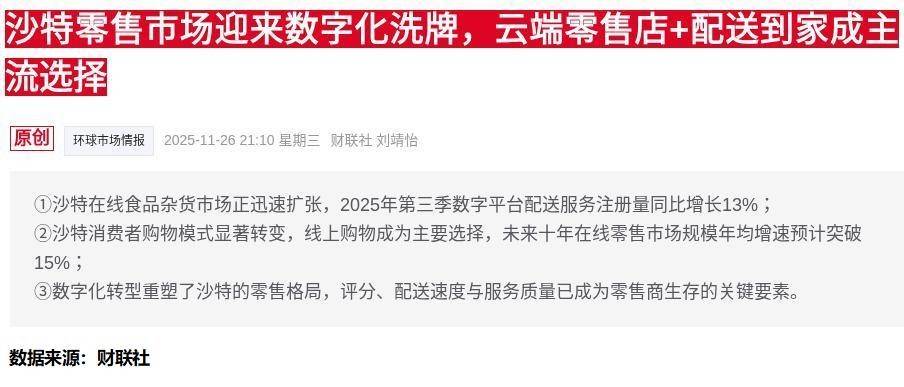
Group 1 - The core idea is that traditional retail businesses in Saudi Arabia are struggling due to the rapid digital transformation, mirroring historical trends seen in other markets like Shanghai's Nanjing Road [1][2] - By Q3 2025, the number of registered physical retail stores in Saudi Arabia is expected to decline by 4% year-on-year, while digital platform delivery services are projected to grow by 13% [2] - The competitive edge in the retail sector has shifted from location and size to digital presence and customer experience, reflecting a broader trend in investment markets [3] Group 2 - The article highlights two major regrets in the investment market: investors often hesitate to participate during market adjustments and may act impulsively at market peaks [4][5][6] - Many investors, like traditional retailers, miss opportunities due to fear of market corrections, similar to how some Saudi retailers are slow to adapt to digital changes [5] - The importance of understanding consumer behavior and market fundamentals is emphasized, suggesting that investors should not be misled by superficial market trends [7][12] Group 3 - A cautionary example is provided where some retail businesses in Saudi Arabia realize too late that consumer preferences have shifted, paralleling investors who fail to recognize critical market signals [16] - The article stresses the need for investors to find suitable tools and methods for analysis, akin to how different consumer segments require tailored retail strategies [17] - The IMARC Group predicts that Saudi Arabia's online retail market will grow at an annual rate exceeding 15% over the next decade, indicating a significant growth opportunity [17]
美国关税政策大变!小企业纷纷裁员倒闭,大企业赚得盆满钵满?
Sou Hu Cai Jing· 2025-11-20 10:54
Core Viewpoint - The article highlights the stark contrast between the struggles of small businesses and the booming performance of large corporations in the U.S. due to the impact of tariffs, raising questions about the underlying reasons for this disparity [1][20]. Group 1: Impact on Small Businesses - Small businesses, which account for 99.9% of U.S. enterprises, are facing severe challenges due to increased tariffs, leading to inventory reductions and even existential threats [1][3]. - Approximately 36 million small businesses contribute 43% of the U.S. GDP and are responsible for nearly half of private sector employment, yet they are heavily burdened by rising costs from tariffs on raw materials like steel and aluminum, which have doubled to 50% [3][5]. - The cost pressures have significantly squeezed the already thin profit margins of small businesses, forcing many to drastically cut inventory levels compared to previous years [5][9]. Group 2: Performance of Large Corporations - In contrast, large retailers like Amazon and Walmart have seen substantial revenue growth, with Amazon's net sales increasing by 13% to $180 billion and Apple's revenue reaching $102 billion, up 8% [5][11]. - Large corporations benefit from economies of scale, allowing them to negotiate better terms with suppliers and distribute tariff costs across a vast array of products, thus mitigating the direct impact of tariffs [11][16]. - The disparity in operational capabilities between small and large businesses is exacerbated by the tariff policies, which act as a magnifying glass on existing inequalities [11][18]. Group 3: Broader Economic Implications - The struggles of small businesses are likely to have a ripple effect on the employment market, as many may resort to layoffs due to high costs and shrinking profits [13][18]. - Retaliatory tariffs from other countries are specifically targeting U.S. small business exports, further constraining their operational viability [13][16]. - The exit of small businesses from the market could disrupt supply chain diversity, potentially leading to increased costs for large corporations in the future [13][16]. Group 4: Consumer Impact - While large corporations have managed to absorb costs in the short term, the long-term exit of small businesses could reduce market competition, allowing larger firms to gain pricing power [15][20]. - The imbalance in the industry ecosystem may lead to higher hidden costs for large companies as supply chain connections weaken [16][20].

京东首辆“国民好车”在长沙工厂下线;阿里泽泰拟减持三江购物不超过3%股份|未来商业早参
Mei Ri Jing Ji Xin Wen· 2025-11-05 23:20
Group 1: JD's National Car Launch - JD, in collaboration with GAC and CATL, launched the "National Good Car" Aion UT Super 1, which was auctioned for 78.19 million yuan [1] - The car is set to be officially released on November 9, with an expected retail price around 100,000 yuan, targeting the mainstream market [1] - The competitive landscape includes established players like Leap Motor and BYD, posing challenges for differentiation and market entry [1] Group 2: Alibaba's Autonomous Driving Initiative - Alibaba's Gaode announced a global partnership with Xpeng Motors to integrate Xpeng's Robotaxi into the Gaode platform, aiming to create the largest Robotaxi aggregation platform [2] - This collaboration represents a significant step for Gaode as it transitions towards spatial intelligence and opens its AI capabilities [2] - The initiative faces competition from Baidu's leading position in the market and must navigate regulatory and infrastructure challenges for global expansion [2] Group 3: Alibaba's Stake Reduction in Sanjiang Shopping - Alibaba's subsidiary, Alibaba Zetai, plans to reduce its stake in Sanjiang Shopping by up to 3%, reflecting a strategic shift in Alibaba's focus [3] - The reduction involves selling up to 16.43 million shares, with a portion through public trading and block transactions [3] - This move indicates Alibaba's realignment of resources towards its "Taobao Flash Purchase" initiative, impacting traditional retail investments [3] Group 4: Volcano Engine's AI Security Platforms - Volcano Engine launched a large model security assessment platform and an intelligent agent security management platform, addressing compliance and protection needs in the AI sector [4] - The platforms offer capabilities for risk management and continuous protection, marking a significant entry into the AI security niche [4] - The company faces competition from established players like Huawei and Tencent, and must adapt to rapidly evolving AI threats [4]

