
计算机

Search documents
粤开市场日报-20260305
Yuekai Securities· 2026-03-05 07:52
Market Overview - The A-share market indices all rose today, with the Shanghai Composite Index increasing by 0.64% to close at 4108.57 points, the Shenzhen Component Index rising by 1.23% to 14088.84 points, the Sci-Tech 50 up by 1.72% to 1405.35 points, and the ChiNext Index gaining 1.66% to 3216.94 points [1][10] - Overall, 4076 stocks rose while 1304 stocks fell, with a total trading volume of 239 billion yuan, an increase of 243 billion yuan compared to the previous trading day [1] Industry Performance - Among the Shenwan first-level industries, the following sectors saw gains: Communication (+2.84%), Power Equipment (+2.18%), Machinery (+2.05%), Electronics (+2.02%), and Computers (+1.68%). Conversely, the sectors that declined included Agriculture, Forestry, Animal Husbandry, and Fishery (-2.02%), Oil and Petrochemicals (-1.81%), Non-ferrous Metals (-0.64%), Coal (-0.18%), and Transportation (-0.05%) [1][15] Concept Sectors - The leading concept sectors with significant gains today included Mini LED, New Display Technology, Ultra High Voltage, Nuclear Fusion, Cultivated Diamonds, Nuclear Power, Superconductors, Superhard Materials, Cameras, AI Wearable Devices, Third Generation Semiconductors, Virtual Power Plants, OLED, Charging Piles, and Low-priced ChiNext Stocks [2][12]
2026年第9周计算机行业周报:国产模型调用量超美国,看好应用与基础资源
Changjiang Securities· 2026-03-05 01:10
Investment Rating - The investment rating for the software and services industry is "Positive" and maintained [7] Core Insights - The computer sector rebounded after a pullback, with an overall increase of 1.34%, ranking 20th among primary industries in the Yangtze River region, and accounting for 7.62% of total trading volume [2][4] - The OpenRouter platform's model invocation volume has surpassed that of the United States, indicating a significant growth in domestic AI model usage [6][44] - The report highlights the commercialization explosion of large models in 2026, with a shift from selling computing power to selling tokens, and emphasizes the emergence of the Agent era in AI [6][53] Summary by Sections Market Performance - The overall market experienced a rise of 1.98%, with the Shanghai Composite Index closing at 4162.88 points [4][15] - The computer sector's trading volume was notably active, particularly in computing power-related themes [2][17] Key Recommendations - Focus on application and foundational resources, particularly in the context of the explosive growth of domestic AI model invocation [6][44] - The report suggests monitoring three main lines: new entry points and the commercialization of large models, domestic chips (CPU+GPU) and third-party cloud services, and the restructuring of software through Agents [6][53] Industry Developments - Hong Kong's government plans to submit a digital asset policy bill within the year, which is expected to enhance the liquidity of the digital asset market [21][24] - The launch of the humanoid robot and embodied intelligence standard system marks a new phase of standardized development in the industry [35][39]
必看,保险大佬们的最新十大观点
表舅是养基大户· 2026-03-04 13:33
Core Viewpoint - The article emphasizes the importance of a long-term perspective in investment strategies, particularly in the context of the insurance asset management industry and its outlook for 2026 [1]. Group 1: Interest Rate Projections - The forecast for 10-year government bonds is between 1.8% and 1.9%, while 30-year bonds are expected to yield between 2.2% and 2.4% [6][9]. - Approximately 70-80% of institutions predict that 10-year bonds will remain below 2%, with a significant portion expecting 30-year bonds to stay within the 2.2%-2.4% range [9]. - The yield on AAA-rated credit bonds is projected to be between 2% and 2.5%, influencing the actual risk-free rate for residents [12]. Group 2: Asset Allocation Trends - A significant trend is the shift from non-standard to standardized assets, with a notable increase in allocations towards bonds and equities, while deposits and other non-standard investments are being reduced [13][15]. - The majority of institutions (over 70%) plan to increase their allocations to stocks, indicating a strong preference for equity investments [15]. Group 3: Insurance Liability and Product Trends - The reform in insurance liabilities is leading to a rise in the popularity of participating insurance products, which in turn reduces the demand for long-duration bonds [19][21]. - The shift towards participating insurance products is resulting in a higher allocation to equities compared to traditional insurance products [21]. Group 4: Factors Influencing A-Share Market - Three main factors are identified as influencing the A-share market in 2026: corporate profit recovery, liquidity environment, and industrial policy along with technological growth [22][26]. - 90% of institutions believe that corporate profit recovery is the most critical factor affecting market performance [26]. Group 5: Preferred Investment Indices - The most favored indices among insurance asset management institutions are the Sci-Tech 50, CSI 300, and A500, with 80%, 60%, and nearly 50% of institutions respectively selecting them [29][33]. - The preference for these indices is partly due to regulatory changes that have adjusted risk factors for insurance companies investing in stocks [33]. Group 6: Industry Focus Areas - The consensus among institutions highlights several key industry sectors: non-ferrous metals, electronics, computers, power equipment, telecommunications, chemicals, pharmaceuticals, and military industry [34][39]. - The intersection of preferences from both insurance asset management and insurance companies reveals a strong interest in semiconductor, AI computing, and defense sectors [39]. Group 7: Investment Vehicles - Secondary bond funds are becoming a primary vehicle for insurance capital entering the market, with a notable increase in their allocation among insurance companies [41]. - The demand for overseas investments, particularly in Hong Kong stocks, remains high, while the interest in US dollar bonds has significantly decreased [45][49].


ETF资金流向视角下的行业轮动配置
Huafu Securities· 2026-03-04 13:27
Quantitative Models and Construction Methods 1. Model Name: Industry Allocation Model Based on ETF Fund Flows - **Model Construction Idea**: The model leverages ETF fund flow data to identify industry rotation opportunities. It incorporates short-term fund inflows/outflows, style-adjusted holding levels, marginal changes in holdings, and the divergence between ETF and active equity fund holdings to construct an industry allocation strategy[3][69][72] - **Model Construction Process**: 1. **Short-term Fund Flows**: Calculate the first-order difference of weekly ETF holdings to identify industries with significant inflows or outflows[40][44] 2. **Style-Adjusted Holdings**: Adjust industry holdings based on market style (e.g., large-cap vs. small-cap, growth vs. value) using a single-sided HP filter and factor momentum to determine style trends[49][50][57] 3. **Marginal Changes in Holdings**: Analyze the marginal changes in ETF holdings by ranking industries into five groups based on their monthly holding changes[22][25] 4. **Divergence with Active Equity Funds**: Compare ETF holdings with active equity fund holdings to identify industries with higher or lower relative allocations. Use regression-based methods to estimate active fund holdings when real data is unavailable[27][28][31] 5. **Final Strategy**: Combine the above factors equally, select the top six industries, and rebalance the portfolio bi-weekly[72] - **Model Evaluation**: The model effectively captures industry rotation opportunities by integrating multiple dimensions of ETF fund flow data and market style trends[72] --- Model Backtesting Results 1. Industry Allocation Model Based on ETF Fund Flows - **Annualized Return**: 15.57% - **Excess Annualized Return**: 7.56% (compared to equal-weighted industry benchmark) - **Information Ratio (IR)**: 0.93 - **Maximum Drawdown**: 8.30% - **Monthly Excess Win Rate**: 64% - **Payoff Ratio**: 1.38x[72] --- Quantitative Factors and Construction Methods 1. Factor Name: Short-term Fund Flows - **Factor Construction Idea**: Identify industries with significant short-term fund inflows or outflows to capture immediate price impacts[40][44] - **Factor Construction Process**: 1. Calculate the first-order difference of weekly ETF holdings 2. Rank industries based on the magnitude of fund flow changes[40][44] - **Factor Evaluation**: Demonstrates strong monotonicity in short-term returns, with industries experiencing inflows showing higher returns[44] 2. Factor Name: Style-Adjusted Holdings - **Factor Construction Idea**: Adjust industry holdings based on prevailing market styles (e.g., large-cap vs. small-cap, growth vs. value)[46][49] - **Factor Construction Process**: 1. Use a single-sided HP filter to smooth market style data (e.g., CSI 300/CSI 1000 index ratios) 2. Define factor momentum as the difference between the current value and the average of the previous two periods 3. Classify industries into five groups based on their adjusted holdings[49][50][57] - **Factor Evaluation**: Captures the relationship between industry holdings and market style trends, effectively identifying style-driven opportunities[47][57] 3. Factor Name: Marginal Changes in Holdings - **Factor Construction Idea**: Analyze the marginal changes in ETF holdings to identify industries with increasing or decreasing allocations[22][25] - **Factor Construction Process**: 1. Calculate the monthly difference in ETF holdings for each industry 2. Rank industries into five groups based on the magnitude of changes[22][25] - **Factor Evaluation**: Demonstrates a strong correlation with growth and value style trends, providing insights into industry rotation opportunities[47] 4. Factor Name: Divergence with Active Equity Fund Holdings - **Factor Construction Idea**: Compare ETF holdings with active equity fund holdings to identify industries with higher or lower relative allocations[27][28] - **Factor Construction Process**: 1. Use regression-based methods to estimate active fund holdings when real data is unavailable 2. Calculate the difference between ETF and active fund holdings and rank industries into three groups based on the magnitude of divergence[27][28][31] - **Factor Evaluation**: Highlights the pricing power of ETF flows relative to active funds, especially post-2021[31][65] --- Factor Backtesting Results 1. Short-term Fund Flows - **Absolute Return**: 6.17% (highest group) - **Annualized Volatility**: 21.22% - **Sharpe Ratio**: 0.29 - **Maximum Drawdown**: -37.61%[42] 2. Style-Adjusted Holdings - **Annualized Return**: 9.66% - **Excess Annualized Return**: 5.82% - **Information Ratio (IR)**: 0.75 - **Maximum Drawdown**: -29.11%[55] 3. Marginal Changes in Holdings - **Annualized Return**: 7.80% (highest group) - **Excess Annualized Return**: 6.91% - **Information Ratio (IR)**: 1.13 - **Maximum Drawdown**: -16.10%[71] 4. Divergence with Active Equity Fund Holdings - **Annualized Return**: 14.01% - **Excess Annualized Return**: 6.11% - **Information Ratio (IR)**: 0.76 - **Maximum Drawdown**: -28.80%[64][65]
【4日资金路线图】国防军工板块净流入超67亿元居首 龙虎榜机构抢筹多股
证券时报· 2026-03-04 12:48
Market Overview - The A-share market experienced an overall decline on March 4, with the Shanghai Composite Index closing at 4082.47 points, down 0.98%, the Shenzhen Component Index at 13917.75 points, down 0.75%, and the ChiNext Index at 3164.37 points, down 1.41% [1] - The total trading volume for both markets was 23657.54 billion yuan, a decrease of 7637.56 billion yuan compared to the previous trading day [1] Capital Flow - The net outflow of main funds from the Shanghai and Shenzhen markets reached nearly 500 billion yuan, with an opening net outflow of 198.53 billion yuan and a closing net outflow of 38.18 billion yuan, totaling 499.6 billion yuan for the day [2] - The net outflow for the CSI 300 index was 141.69 billion yuan, while the ChiNext saw a net outflow of 217.14 billion yuan [4] Sector Performance - The defense and military industry saw a net inflow of 67.61 billion yuan, with a growth of 1.29%, driven by stocks like China Shipbuilding [6][7] - The power equipment sector had a net inflow of 64.39 billion yuan, increasing by 1.12%, led by TBEA [7] - Other sectors with net inflows included agriculture, forestry, animal husbandry, and fishery (30.44 billion yuan, up 0.86%) and non-ferrous metals (29.60 billion yuan, up 0.11%) [7] - Conversely, the non-bank financial sector experienced a net outflow of 72.15 billion yuan, down 1.87%, with stocks like Dongfang Caifu leading the outflow [7] Institutional Activity - Notable institutional buying included stocks such as Sinopec Oilfield Service, which saw a net purchase of 21423.45 million yuan, and CNOOC Services with 15754.82 million yuan [10] - The top 20 stocks by net inflow included various companies, indicating a selective interest from institutional investors [8] Analyst Recommendations - Analysts have recently rated several stocks with potential upside, including Xiangdian Co. with a target price of 20.4 yuan, representing a 44.58% upside from its latest closing price [12] - Other stocks highlighted include Bawei Storage and Neway Valve, with target prices indicating significant potential returns [12]

2026 年第 92]周计算机行业周报:国产模型调用量超美国,看好应用与基础资源-20260304
Changjiang Securities· 2026-03-04 08:48
Investment Rating - The report maintains a "Positive" investment rating for the software and services industry [8] Core Insights - The computer sector rebounded after a recent pullback, with an overall increase of 1.34%, ranking 20th among primary industries in the Yangtze River region [2][5] - The OpenRouter platform's model invocation volume has surpassed that of the United States for the first time, indicating a significant growth in domestic AI model usage [7][51] - The report highlights the potential for a commercial explosion in large models in 2026, with key shifts from selling computing power to selling tokens, and the emergence of the "Agent" era in AI [7][59] Summary by Sections Market Performance - The overall market saw a rise of 1.98%, with the Shanghai Composite Index closing at 4162.88 points [5][15] - The computer sector's trading volume accounted for 7.62% of the total market [5][15] Key Developments - Hong Kong plans to submit a digital asset policy bill within the year, aiming to enhance market liquidity and provide more products for professional investors [21][24] - Blue Arrow Aerospace announced plans for a second recovery test of its reusable rocket, Zhuque-3, in the second quarter of this year [27][32] - The release of the "Humanoid Robot and Embodied Intelligence Standard System (2026 Edition)" marks a new phase of standardized development in the humanoid robot industry [38][44] Investment Recommendations - Focus on application and foundational resources, particularly in the context of the explosive growth of domestic AI model invocation [7][51] - Emphasize three main lines of investment: new entry points and commercialization of large models, domestic chips (CPU+GPU) and third-party cloud services, and the restructuring of software through agents [7][59]
未知机构:东财策略每日复盘20260303一市场概况3月-20260304
未知机构· 2026-03-04 02:50
Summary of Conference Call Notes Industry Overview - The conference call discusses the A-share market performance on March 3, 2023, highlighting a significant decline across major indices. The Shanghai Composite Index fell by 1.43% to close at 4122 points, while the Shenzhen Component Index and the ChiNext Index dropped by 3.07% and 2.57%, respectively. The total trading volume reached 3.13 trillion yuan, an increase of over 100 billion yuan compared to the previous trading day [1][1][1]. Key Points on Industry Performance - **Top Performing Industries**: - Oil and Petrochemicals: +6.75% - Coal: +1.76% - Transportation: +1.13% - Banking: +1.07% - Public Utilities: +0.49% [1][1][1] - **Underperforming Industries**: - Defense and Military: -6.74% - Non-ferrous Metals: -5.61% - Electronics: -5.30% - Computers: -4.94% - Media: -4.29% [1][1][1] Market News - The Ministry of Industry and Information Technology, along with five other departments, released guidelines to promote the comprehensive utilization of photovoltaic components, aiming to enhance technology and equipment levels by 2030 [3][3][3]. - In the first week following new policies in the Shanghai real estate market, there was a rapid increase in demand-side activity, with online inquiries rising by 97.6% and conversion rates improving by 180% [3][3][3]. - Qatar Energy, the world's largest natural gas producer, announced a halt in liquefied natural gas exports due to military attacks on its facilities [3][3][3]. Market Outlook and Considerations - The Shanghai Composite Index's recent performance has created a situation of trapped capital and pessimism that will require time to resolve. If the intensity of the U.S.-Iran conflict continues, short-term risk aversion may persist. However, there is no need for excessive pessimism as the current economic resilience and cycle position have improved compared to 2022. The impact of war and high oil prices on inflation affecting AI hardware and other assets is expected to be limited [4][4][4]. - Despite the overall market decline, sectors with solid supply-demand dynamics, such as gas turbines, remain strong. Core assets with robust supply-demand support are crucial indicators. As the Two Sessions approach, the deeply corrected technology growth sector may see a rebound in funding due to policy catalysts [4][4][4]. Recommendations - It is advised to closely monitor the situation in the Middle East and oil price trends, while also paying attention to policy signals from the Two Sessions that may influence market risk appetite [5][5][5].
分论坛:科技产业链|国泰海通“远望又新峰”2026春季策略会
国泰海通证券研究· 2026-03-03 22:26
Core Insights - The article discusses the investment strategies in the technology sector, highlighting the rapid evolution from mobile internet to AI, smart devices, and new consumption trends. It emphasizes the historical performance of leading companies in the tech industry and outlines a selection methodology for identifying outstanding stocks in the current and future tech landscape [1]. Agenda Highlights - The session on beauty industry leadership, using Proya as a case study, will be led by the Deputy Director of the Research Institute and Chief Analyst for Food & Beverage and Beauty Research [2]. - A discussion on how to capture high-growth stocks in the electronic semiconductor sector will be presented by the Chief Analyst of Electronic Research [3]. - The session will focus on identifying high-value, high-inflation, and high-barrier segments within the technology supply chain, led by the Chief Analyst of Construction Engineering Research [4]. - A segment on finding the most effective tools in computing will be conducted by the Chief Analyst of Computer Research [4]. - The new directions in military investment, particularly in commercial aerospace, will be explored by the Chief Analyst of Military Research [4].


A股三次大牛市:启动、上涨与终结
泽平宏观· 2026-03-03 16:06
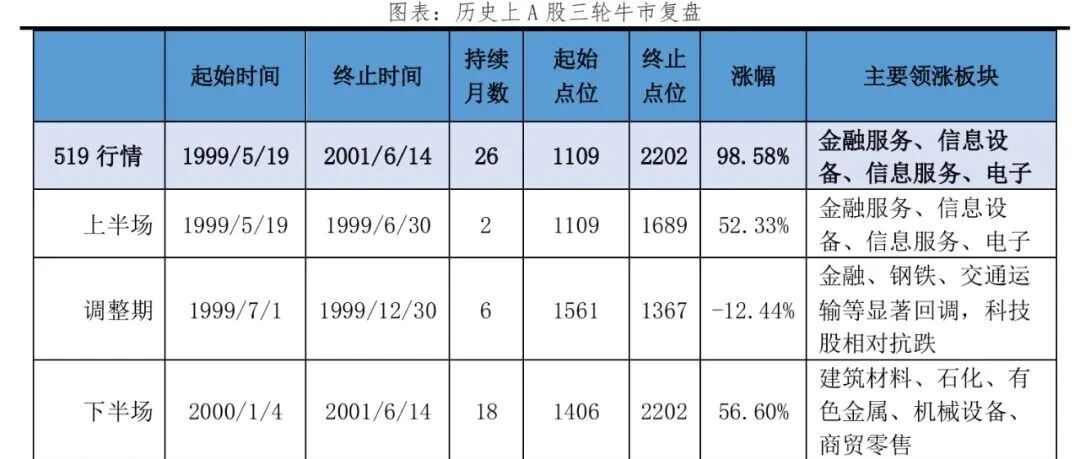
Core Viewpoint - The article discusses the unprecedented stimulus policies since late September 2024 that have ignited a "confidence bull market" in A-shares and Hong Kong stocks, exploring the patterns of previous bull markets and the potential trajectory of the current market [1][2]. Summary by Sections Historical Bull Markets - The article reviews three major bull markets in A-shares: the 519 market from 1999-2001, the cyclical bull from 2005-2007, and the reform bull from 2014-2015, analyzing their characteristics and outcomes [2][10]. 1999-2001 519 Market - Initiated during economic downturns with policy stimulus, ending due to profit inability to support valuation bubbles. The Shanghai Composite Index rose 98.6% over 26 months [3][15]. - The first half was driven by policy and valuation speculation, while the second half saw a surge due to economic recovery and tech stock performance, culminating in a peak in June 2001 [15][21]. 2005-2007 Cyclical Bull Market - This bull market was driven by strong economic fundamentals and the resolution of the split share structure, with the Shanghai Composite Index increasing by 513.6% over 28 months [4][28]. - The market experienced a three-phase structure: recovery from undervaluation, a brief adjustment, and a performance-driven surge, particularly in resource and financial sectors [31][35]. 2014-2015 Reform Bull Market - Triggered by economic slowdown and policy easing, this market saw the Shanghai Composite Index rise by 148.96% in 11 months, primarily driven by leverage and external capital inflows [5][47]. - The market transitioned from cyclical to growth stocks, with significant gains in technology and consumer sectors, but ended due to lack of fundamental support and regulatory tightening [51]. Key Discoveries from Historical Bull Markets - A bull market requires three conditions: policy shift, capital inflow, and low valuations, often starting amid controversy and ending in exuberance [6][53]. - Bull markets typically progress through three phases: policy-driven, capital-driven, and fundamentally driven, with the latter being crucial for sustainability [6][54]. - A-shares exhibit characteristics of short bull markets and long bear markets, with average bull market durations of 17.35 months compared to 27.12 months for bear markets [7][53]. Current "Confidence Bull Market" Analysis - The current bull market shares similarities with previous ones, starting during economic downturns and driven by policy shifts, with a focus on technology and liquidity [8][56]. - The market's sustainability hinges on continued policy support, technological innovation, and effective management of leverage to avoid extreme volatility [62][61].
金融工程日报:市场放量下挫,科技股回调显著-20260303
Guoxin Securities· 2026-03-03 13:42
- The provided content does not include any quantitative models or factors for analysis[1][2][3]