消费

Search documents
节后关键周:市场面临方向选择
Sou Hu Cai Jing· 2026-01-03 07:56
Market Overview - Global stock markets showed significant divergence this week, with U.S. markets pressured by profit-taking in technology stocks, leading to a 1.52% decline in the Nasdaq and a 1.03% drop in the S&P 500, primarily due to short-term adjustments in high-valuation sectors [1] - In contrast, European markets strengthened, with France's CAC40, Germany's DAX, and the UK's FTSE 100 all recording gains, driven by improving regional economic recovery expectations [1] - The Asia-Pacific market exhibited a mixed pattern, with strong performances from South Korea, Taiwan, and India, while Japan's Nikkei 225 index saw a slight decline [1] Domestic Market Performance - The A-share and Hong Kong stock markets displayed an independent trend of "strong Hong Kong, stable A-share," with the A-share market showing a fluctuating trend and significant index divergence [1] - The Shanghai Composite Index rose slightly by 0.13%, while the ChiNext Index and North Star 50 Index fell by 1.25% and 1.55%, respectively, becoming the main drag on the market [1] - In terms of style, small-cap and large-cap stocks showed notable divergence, with the Wind Micro-cap Index up by 0.16%, while the CSI 300 and Shenzhen Component Index fell by 0.59% and 0.58% respectively [1] Trading Activity - The average daily trading volume reached 1.97 trillion yuan, an increase of 205.3 billion yuan week-on-week, indicating strong trading momentum [2] - Resource and high-end manufacturing sectors emerged as clear leaders, with the Shenwan Oil and Petrochemical sector surging by 3.92% and the defense and military industry rising by 3.05%, driven by geopolitical tensions and resource supply constraints [2] - The Hong Kong market performed strongly, with the Hang Seng Index up by 2.01% and the Hang Seng Technology Index soaring by 4.31%, supported by robust momentum [2] Sector Performance - Semiconductor and defense sectors acted as dual drivers in Hong Kong, with the Wind Hong Kong semiconductor materials and equipment sector skyrocketing by 28.81% and the aerospace and defense sector increasing by 9.70% [2] - The strong performance in these sectors was underpinned by three main supports: favorable mergers and acquisitions, increased AI computing demand, and improved capital flow, with net inflows from southbound funds amounting to 2.573 billion HKD [2] Future Outlook - The A-share market is expected to maintain a fluctuating consolidation pattern amid a tug-of-war between policy support and fundamental verification, with clear supporting factors such as the continued rollout of policy details and a rebound in holiday consumption data [3] - However, limiting factors include the relatively limited valuation recovery space for major indices and the potential constraints posed by upcoming macroeconomic data and persistently low foreign capital activity [3][4] Investment Strategy - Investors are advised to adopt a prudent mindset, focusing on structural opportunities, particularly in "hard technology" sectors like semiconductors and commercial aerospace, as well as "stable consumption" areas such as home appliances and new energy vehicles [5] - It is also recommended to explore reasonably valued quality growth stocks from a bottom-up perspective, while maintaining positions at a reasonable level to avoid high-flying speculative stocks [6] - For the Hong Kong market, the rebound trend in the technology sector is expected to continue, but caution is warranted regarding potential profit-taking pressures following rapid gains [7]
金银铜资源企业的高利润率之谜
雪球· 2026-01-03 03:46
Core Viewpoint - The article emphasizes that certain companies, regardless of their industry, consistently achieve high gross and net profit margins due to monopolistic and scarcity-driven advantages [4][5]. Group 1: Supply-Side Moat - The source of profit lies in the principle of "scarcity" where companies have absolute control over supply [6]. - For mining companies, this is characterized as "geological monopoly," where high-quality mineral deposits are unevenly distributed and non-renewable [6]. - For tech and consumer giants, it is referred to as "cognitive monopoly," with examples like Nvidia's CUDA ecosystem, Apple's iOS, and Moutai's unique microbial community [7]. Group 2: Demand-Side Consensus - High margins require not just supply scarcity but also stable demand, forming a commercial loop [9]. - Products like copper, gold, silver, and Moutai have demand that remains resilient across economic cycles [9]. - These products have a widely recognized value consensus, making them not just consumer goods but also vehicles for value preservation over time [9]. Group 3: Unique Financial Attributes of Precious Metals - Compared to consumer brands, commodities like copper, gold, and silver possess unmatched liquidity and financial pricing power [10]. - These metals are standardized and globally traded, allowing for continuous market pricing through major exchanges like LME, COMEX, and SHFE [12]. - Their financial attributes make them natural hedges against inflation, as their prices tend to rise during inflationary periods [12]. Conclusion - The essence of high margins is rooted in the ownership of scarce resources, with companies like Moutai and Nvidia controlling cognitive and technological scarcity, while mining firms control geological scarcity [13]. - Precious metals further leverage a global financial pricing system to convert scarcity into readily available purchasing power, explaining their enduring profitability [13].


2026年中国股市十大预言
Xin Lang Cai Jing· 2026-01-03 01:17
Core Viewpoint - The Chinese stock market is undergoing structural adjustments and ecological optimization, with a consensus on improving asset quality, market credibility, and fair competition significantly increasing, leading to greater public confidence in increasing holdings of Chinese assets [2][17]. Group 1: Stock Market Predictions - The Shanghai Composite Index is expected to break through 5200 points, supported by stable long-term capital inflow and improved asset quality, with a current P/E ratio of around 17, indicating further upside potential [3][18]. - Quantitative trading will face significant restrictions, with new regulatory rules likely to limit its scope based on market capitalization and turnover rates, and measures will be taken to combat price manipulation and insider trading [4][18]. - The IPO scale is set for moderate expansion, with a focus on supply-demand balance, expecting 100 new listings in 2024 raising 67.55 billion yuan and 116 listings in 2025 raising 131.77 billion yuan, with a notable increase in high-tech companies [5][19][20]. Group 2: Semiconductor and Military Industry - The semiconductor industry is anticipated to experience significant growth, with investments potentially exceeding 500 billion yuan, driven by capital input, industry expansion, and technological breakthroughs, especially in the context of the "AI+ year" [6][20]. - Military concept stocks are expected to see a phase of growth, with China's defense spending remaining around 1.3% of GDP, which is lower than that of major powers, and a moderate increase in the defense budget is anticipated due to geopolitical changes [9][22]. Group 3: Economic and Trade Dynamics - The Sino-US trade relationship is entering a "dual balance" phase, with both governmental and commercial levels maintaining stability in general trade while facing instability in sectors like semiconductors and renewable energy [10][23]. - New consumer scenarios are emerging as investment opportunities, driven by policy support and the rise of the post-2000 consumer demographic, leading to significant growth in technology, digital, cultural tourism, and health-related consumption [11][23]. Group 4: Inflation and Real Estate Market - CPI growth is expected to exceed 1.5%, approaching 2%, with an overall economic growth target of around 5%, supported by fiscal investments and structural optimization of trade [13][25]. - The real estate market is at a turning point, with policies aimed at stabilizing the market and reducing purchasing costs, while also addressing the debt risks of real estate companies [14][26]. Group 5: Regulatory Environment - The capital market will see new measures and initiatives, with a focus on enhancing governance, optimizing the environment, combating illegal activities, and protecting investors, reflecting a commitment to high-quality economic and financial development [15][14].
95岁巴菲特正式交棒!一个时代落幕,留下600亿美元捐赠
Sou Hu Cai Jing· 2026-01-01 14:59
Group 1 - Warren Buffett, the 95-year-old "Oracle of Omaha," officially retired as CEO of Berkshire Hathaway on January 1, 2026, after a remarkable 60-year tenure, during which he achieved a 55,000-fold investment miracle [1] - Buffett has committed to donating over 99% of his personal wealth, and before his retirement, he donated an additional $6 billion in Berkshire stock to the Gates Foundation and family charities, bringing his total donations to over $60 billion, setting a record in personal philanthropy [3] - The transition of leadership to Greg Abel is supported by Buffett, who retains the role of chairman and a significant number of shares, ensuring market confidence as Berkshire's market value exceeds $1 trillion [3] Group 2 - Buffett's investment philosophy emphasizes understanding investments before committing, as he has avoided trends like AI and cryptocurrencies, and has historically acted contrary to market sentiment, such as buying during downturns [4] - The era of wealth accumulation through compounding is concluding, but Buffett's legacy extends beyond financial success to a profound understanding of rationality, patience, and the belief in giving back to society [6] - Buffett's approach to wealth transfer focuses on leaving a positive impact on the world rather than merely passing down financial assets to heirs [6]

【老丁投资笔记】2026年1月展望:市场明年的机会在哪里,1月还会继续涨价吗?
Sou Hu Cai Jing· 2025-12-31 12:41
Group 1 - The emergence of a new main theme in the market is commercial aerospace, which has gained traction recently [1] - Overall market sentiment is optimistic, with expectations for the index to rise from 4000 to 4500 by the end of next year, indicating a cautious but positive outlook [1] - There are differing views on market structure, with some investors favoring high-valuation stocks driven by AI, while others believe that blue-chip sectors like consumption and insurance may perform better due to high valuations without earnings support [1] Group 2 - Macroeconomic policies are expected to remain stagnant until after the upcoming Two Sessions, as this year marks the conclusion of the 15th Five-Year Plan [2] - The market is anticipated to react significantly once the Producer Price Index (PPI) turns positive, which is a key indicator for capital markets [2] - A rational approach to the market is advised, focusing on both valuation and trend rationality [2] Group 3 - The divergence in investor opinions reflects a critical point, with a tendency to favor trend rationality, as historical tech revolutions often lead to extreme valuations [3] - While there is optimism for current tech companies, caution is advised as many may not survive the eventual downturn following a tech revolution [3] - The conclusion of tech revolutions is often accompanied by macroeconomic events and data changes, indicating that it is premature to declare an end to the current phase [3] Group 4 - The focus for the upcoming year should be on the re-evolution of technology across various sectors, with a need for detailed market analysis and clear judgments [4]

香港股市2025收官:恒指全年涨27.77%创八年最佳,科指涨23.45%创新高
Jin Rong Jie· 2025-12-31 05:38
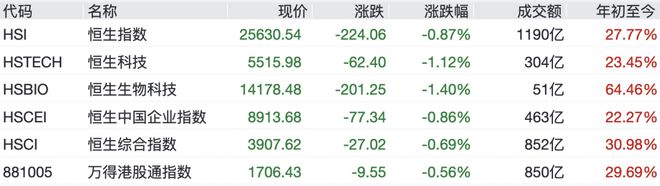
Core Insights - The Hong Kong stock market experienced significant performance in 2025, with the Hang Seng Index rising by 27.77%, marking its best annual performance since 2017 [1] - The Hang Seng Tech Index recorded a 23.45% increase for the year, representing its highest annual growth since its inception in 2020 [1] Market Performance - On the last trading day of the year, the Hang Seng Index fell by 0.87%, while the Hang Seng Tech Index decreased by 1.12% [1] - The sectors that saw the largest declines included healthcare, finance, and consumer industries, whereas the metals sector showed resilience with an upward trend [1]
港股提前收市,恒指全年涨27.77%
Di Yi Cai Jing Zi Xun· 2025-12-31 04:58
Core Viewpoint - The Hong Kong stock market closed early on December 31 due to the New Year holiday, with the Hang Seng Index falling by 0.87% and the Hang Seng Tech Index declining by 1.12%. Despite this, the overall performance for 2025 was strong, with the Hang Seng Index up 27.77%, marking its best performance since 2017, and the Hang Seng Tech Index up 23.45% [1]. Group 1: Market Performance - The Hang Seng Index closed at 25,630.54, down by 224.06 points or 0.87%, with a total trading volume of HKD 119 billion and a year-to-date increase of 27.77% [2]. - The Hang Seng Tech Index ended at 5,515.98, decreasing by 62.40 points or 1.12%, with a trading volume of HKD 30.4 billion and a year-to-date increase of 23.45% [2]. - The Hang Seng Biotech Index saw a decline of 1.40%, closing at 14,178.48, with a year-to-date increase of 64.46% [2]. Group 2: Capital Inflows - Southbound capital net purchases of Hong Kong stocks reached over HKD 1.4 trillion this year, setting a record high [2]. - The total net inflow for the year amounted to HKD 14,013.95 million, with contributions from both the Shanghai and Shenzhen stock connect programs [3].
港股元旦假期提前收市 恒指全年涨幅27.77%
Zheng Quan Shi Bao Wang· 2025-12-31 04:21
人民财讯12月31日电,港股年末最后半日交易日,恒指收跌0.87%,恒生科技指数跌1.12%。医疗、金 融、消费行业跌幅居前,有色股逆势飘红。恒指全年涨幅达27.77%。 ...
股指年度策略:科技引领,股指后继有力
Zhe Shang Qi Huo· 2025-12-31 01:14
1. Report Industry Investment Rating - Not provided in the content 2. Core Viewpoints of the Report - Continue to be bullish on equity assets in 2026, maintaining a "slow bull" pattern. However, the narrative of liquidity will weaken marginally, and the expectation of economic rebound remains weak, so the increase in 2026 may be smaller than that in 2025 [3][8] - Structurally, it is more optimistic about the opportunities in technology growth stocks and the profit repair direction of enterprises in the "anti-involution" line. It is more bullish on IM. If incremental policies for real estate and consumption are implemented, low-valued sectors have the dual opportunities of profit and valuation repair, and IF can be allocated [5] 3. Summary According to Relevant Catalogs External Environment - **Sino-US Relations**: Before the US mid-term elections in 2026, Sino-US frictions will continue, but they are more of a means of game, and the probability of a significant increase in tariffs is small. Sino-US relations will be in a period of phased relaxation. Pay attention to the possible visit of Trump to China in April 2026, which may cause significant market fluctuations [5][16] - **US Interest Rate Policy**: The recent rise in the US unemployment rate to 4.6% and the decline in core CPI to 2.6% in November provide a basis for interest rate cuts. It is expected that there will be 2 - 3 interest rate cuts in 2026, with a space of 50 - 75BP [18] - **Global Capital Flow**: With the continuation of the global interest rate cut process, overseas funds' allocation demand is expected to further spill over to emerging markets. Chinese equity assets are cost-effective, and overseas funds are expected to contribute more marginal increments to the domestic market. However, Japan's interest rate hike to 0.75% may disrupt global capital spillover and weaken the capital spillover effect [23] Domestic Judgment - **Policy Orientation**: Fiscal policy remains positive, and monetary policy is moderately loose. The support at the macro level has not increased. The real estate market is in the deep - water area of stability, and policies to expand consumption are expected. The main lines of new quality productivity and anti - involution remain unchanged. Capital market policies aim to enhance internal market stability, with strict supervision as the norm [28][31] - **Economic Situation**: GDP growth rate will remain relatively stable at around 4.9% in 2026. Economic stability depends on the central government's borrowing. Manufacturing investment and infrastructure construction investment are expected to pick up in 2026, while the real estate market is still in a downturn. Domestic consumption improvement has fallen short of expectations, and exports may still drive GDP growth next year [34][35][38] - **Market Liquidity**: The A - share market will maintain sufficient liquidity in 2026. Incremental funds come from retail investors' new accounts, margin trading funds, index ETFs, dividend reinvestment, foreign capital, and long - term funds (insurance funds). However, attention should be paid to the impact of shareholder reductions and net outflows of southbound funds, as well as the IPO progress [52] Structural Judgment - **Industry Growth**: The economic growth engine is shifting, and structural opportunities still exist in 2026. Traditional industries such as real estate, construction, coal, and food and beverage are still under pressure of negative growth, while industries representing cutting - edge technologies such as computer, electronics, and power equipment maintain growth. Non - ferrous metals also benefit from technologies such as AI [62] - **Growth vs. Value Stocks**: The strength of domestic growth stocks and value stocks is highly correlated with the yield of the 10 - year US Treasury bond. It is expected that the US will cut interest rates 2 - 3 times in 2026, and the yield of the US Treasury bond has room to decline further, so growth stocks are expected to remain strong [70] - **Index Allocation**: From an absolute valuation perspective, the valuations of the Shanghai Stock Exchange 50 and CSI 300 are both below 15 times, with allocation value. If incremental policies for real estate and consumption are implemented, low - valued sectors have the dual opportunities of profit and valuation repair, and IF can be allocated. The absolute valuations of the CSI 500, CSI 1000, ChiNext, and STAR 50 have increased significantly, pending verification of profit fundamentals. Among the four major index futures, the CSI 1000 has the highest annualized basis rate, which can provide a safety cushion, and can be allocated when its annualized basis rate is higher than 15% [71][75]
【策略】关注春季行情——2026年1月A股及港股月度金股组合(张宇生/王国兴)
光大证券研究· 2025-12-30 23:05
以下文章来源于宇观策略 ,作者张宇生 宇观策略 . 光大策略张宇生团队感谢您的支持 点击注册小程序 查看完整报告 特别申明: 报告摘要 12月A股、港股出现分化 12月A股主要指数普遍上涨。受政策利好催化、市场风险偏好回暖等因素影响,12月(截至26日),A股 主要指数普遍上涨,其中创业板指涨幅最大,12月份累计上涨了6.3%,而科创50涨幅最小,累计上涨了 1.4%。行业端分化明显,国防军工、通信、有色金属涨幅居前。相对而言,金融地产及消费等板块表现则 较差,如传媒、房地产、食品饮料、银行等。 12月港股市场走势震荡。12月受美联储降息预期波动、美股波动等因素影响,港股市场整体走势较为震 荡。截至2025年12月26日,恒生香港35、恒生指数、恒生综合指数、恒生科技、恒生中国企业指数的涨幅 分别为2.4%、-0.2%、-0.4%、-1.8%、-2.4%。 A股观点:市场有望震荡上行 政策有望持续发力,叠加各类资金有望积极流入,市场有望震荡上行。一方面,历史来看,A股市场中几 乎每年都存在"春季躁动"行情;另一方面,政策有望持续发力,经济增长有望保持在合理区间,进一步夯 实资本市场繁荣发展的基础。此外,政策红 ...