机械

Search documents
因子周报20260116:本周Beta和低杠杆风格显著定期报告-20260117
CMS· 2026-01-17 14:42
Group 1: Market Index and Style Performance Review - Major broad market indices mostly increased this week, with the CSI 500 rising by 2.18%, the Northbound 50 by 1.58%, and the CSI 1000 by 1.27%. However, the Shanghai Composite Index fell by 0.45% and the CSI 300 by 0.57% [2][10]. - Over the past month, all major broad market indices have risen, with the CSI 500 up by 17.59% and the CSI 1000 by 14.64% [10][11]. - In terms of industry performance, sectors such as computer, electronics, media, non-ferrous metals, and machinery performed well, while defense, agriculture, coal, real estate, and non-bank financials lagged behind [14][16]. Group 2: Factor Performance Tracking - In the CSI 300 stock pool, factors such as the 20-day volume variation coefficient, standardized unexpected earnings, and overnight momentum before earnings announcements performed well this week [3][24]. - In the CSI 500 stock pool, the 60-day specificity, 20-day specificity, and 60-day momentum factors showed strong performance [3][26]. - The overall market stock pool saw strong performance from quarterly ROA, quarterly ROE, and quarterly net profit margin factors [3][22]. Group 3: Quantitative Fund Performance - The average excess return for CSI 300 index-enhanced products was 0.58%, while the CSI 500 index-enhanced products had an average excess return of -0.26% [4][12]. - The best-performing active quantitative fund this week was Huian Quantitative Preferred A [4][12]. Group 4: Quantitative Index Enhancement Portfolio Tracking - The CSI 300 index enhancement portfolio achieved an excess return of 0.24% over the past week, while the CSI 500 index enhancement portfolio had an excess return of 0.27% [5][12]. - The CSI 800 index enhancement portfolio recorded an excess return of 0.59% [5].
现金流ETF(159399)微幅回调,市场关注现金流策略配置价值
Mei Ri Jing Ji Xin Wen· 2026-01-16 06:23
Group 1 - The core viewpoint of the article highlights the increasing attention on cash flow strategies in the market, particularly in light of regulatory enhancements regarding cash dividends for listed companies [1] - The "National Nine Articles" policy is expected to strengthen the regulation of cash dividends, making high free cash flow companies attractive to conservative investors due to their stable cash flow returns [1] - In the current market environment, cash flow ETFs can serve as a crucial component of a "technology innovation + dividend asset" allocation strategy, complementing growth sectors like artificial intelligence [1] Group 2 - During the interest rate downcycle, high-quality assets with sustainable free cash flow generation capabilities are likely to see an increase in valuation, especially in traditional industries such as non-ferrous metals, machinery, and chemicals [1] - Some companies have achieved substantial improvements in cash flow through quality enhancement and efficiency gains [1] - Investors are encouraged to pay attention to the cash flow ETF (159399), which has outperformed the CSI Dividend Index and the CSI 300 Index for nine consecutive years from 2016 to 2024 [1]
A股上市公司2025年年报业绩预告持续披露 半导体、生物医药等行业回暖明显
Sou Hu Cai Jing· 2026-01-16 02:42
Group 1 - As of January 15, 2025, a total of 243 A-share listed companies have disclosed their performance forecasts, with 120 companies expecting positive results, indicating resilience in corporate operations and industry outlook [1] - Among the companies that disclosed their 2025 performance forecasts, 142 expect a year-on-year increase in net profit attributable to shareholders exceeding 100%, with notable increases from companies like Huisheng Biological, Zhongtai Co., and Baiwei Storage [3] - For instance, Zhongke Lanyun anticipates a net profit of 1.4 billion to 1.43 billion yuan for 2025, representing a year-on-year growth of 366.51% to 376.51%, while its revenue is expected to be between 1.83 billion and 1.85 billion yuan [3] Group 2 - Industries such as semiconductors, biomedicine, chemicals, machinery, and non-ferrous metals are showing significant performance recovery among listed companies [3] - For example, Chifeng Gold expects a net profit of 3 billion to 3.2 billion yuan for 2025, reflecting a year-on-year increase of 70% to 81%, driven by a 49% rise in gold product sales prices [3]


侯喜保:实体经济“大树”根深叶茂
Jing Ji Ri Bao· 2026-01-16 00:05
Core Viewpoint - The "14th Five-Year Plan" emphasizes the importance of consolidating and strengthening the foundation of the real economy as a strategic task, highlighting its critical role in China's modernization efforts [1]. Group 1: Modern Industrial System - Building a modern industrial system is a strategic choice to strengthen the foundation of the real economy and is essential for promoting high-quality development [2]. - The focus should be on intelligent, green, and integrated development, promoting deep integration of technological and industrial innovation [2]. - Traditional industries need optimization and enhancement, while emerging industries should focus on cultivation and growth in sectors like new energy and aerospace [2]. Group 2: Manufacturing Sector - The manufacturing sector is fundamental to national strength and the core of the modern industrial system, with China's manufacturing value added accounting for nearly 30% of the global total [3]. - China has maintained its position as the world's largest manufacturer for 15 consecutive years, producing the majority of 504 major industrial products globally [3]. - The goal is to strengthen and optimize the manufacturing sector, ensuring it remains a backbone of the modern industrial system [3]. Group 3: Service Industry - The modern service industry is a crucial support for the modern industrial system, but it faces structural and systemic challenges [3]. - There is a need to promote high-quality development in the service sector, enhancing the integration of productive services with manufacturing [3]. - The focus should be on improving the quality and diversity of life services while advancing the digitalization of the service industry [3]. Group 4: Infrastructure Development - Infrastructure is essential for industrial development and must be optimized to support the real economy [4]. - A modern infrastructure system should leverage China's large market and existing facilities, focusing on new infrastructure construction and the digital transformation of traditional infrastructure [4]. - The goal is to enhance the resilience and adaptability of infrastructure to support China's modernization efforts [4].
广东省制造业赋能对接系列活动在全省全面铺开
Nan Fang Ri Bao Wang Luo Ban· 2026-01-15 10:09
Group 1 - The Guangdong province has launched a series of manufacturing empowerment activities to help enterprises expand their markets and promote high-quality industrial products, integrating global resources to create a precise supply-demand matching hub [1][2] - Since Q4 2025, over 180 manufacturing empowerment events have been held, resulting in 7,441 intended cooperation agreements and total investment exceeding 90 billion yuan [2] - The activities focus on upgrading traditional industries and utilize AI technology as a core engine, covering the entire value chain from R&D innovation to market sales [1][2] Group 2 - The Guangdong Provincial Department of Industry and Information Technology plans to complete a second batch of empowerment matching before the Spring Festival and will promote online sales of Guangdong industrial products [2][3] - Manufacturing is a cornerstone of Guangdong's economy, contributing to 1/8 of the national industrial added value and over 30% of the province's GDP [2] - Future efforts will focus on deepening the manufacturing empowerment system, targeting key industries and products, and converting cooperation intentions into actual investments to support economic growth [3]
——12月进出口数据解读:2026年出口会继续强吗?
Huafu Securities· 2026-01-15 03:29
Export Performance - In December, China's export year-on-year growth rate recorded 6.6%, an increase of 0.7 percentage points from the previous month, with a two-year average growth rate rising[3] - The main drivers of export growth were the electronics industry and high-tech products, with significant increases in exports to neighboring regions, while other regions saw declines[3] - Automotive exports continued to grow significantly, benefiting from a low base, while electronic exports also strengthened due to a decrease in the base[4] Import Trends - December's import year-on-year growth rate was 5.7%, up 3.8 percentage points from the previous month, with the growth rate exceeding the average of the past five years[5] - The increase in imports was primarily driven by higher energy imports and a significant rise in electronic product imports, particularly from the EU and Latin America[5] - Notably, imports from the EU surged by 17.9%, a rise of 16.2 percentage points, while imports from the US fell by 28.6%[5] Future Outlook - Exports are expected to maintain resilience in 2026, with a slight decrease in the growth rate center, influenced by a low base in January and February[4] - The "reciprocal tariff" policy is anticipated to lead to a significant decline in exports to the US starting April 2025, but the decline is expected to narrow after April 2026[4] - Recent agreements between China and the EU regarding electric vehicle exports are expected to boost automotive exports to Europe[4] Risks - Potential risks include slower-than-expected domestic economic recovery, weaker demand from developing countries, and unexpected declines in demand from Europe and the US[7] - Changes in import and export policies, particularly regarding tariffs, pose additional uncertainties for future trade performance[7]
2026年出口会继续强吗?——12月进出口数据解读
陈兴宏观研究· 2026-01-15 02:42
Core Viewpoint - China's export growth recorded a year-on-year increase of 6.6% in December, driven by strong performance in the electronics and high-tech sectors, while imports also saw significant growth, particularly in energy and electronic products [2][4][12]. Export Performance - December's export growth of 6.6% represents a 0.7 percentage point increase from November, with the growth rate exceeding the median of the past five years, indicating increased export momentum [2][4]. - The electronics sector saw a notable increase in export growth, rising by 13.6 percentage points to 15.9%, contributing 2.8 percentage points to overall export growth [4]. - High-tech product exports also increased, with a year-on-year growth of 16.9%, contributing 4.0 percentage points to overall export growth [4]. - Exports to neighboring regions surged, particularly to Hong Kong (31.5%) and ASEAN (11.3%), while exports to the US (-30.2%) and the EU (11.5%) declined [6]. Import Performance - Imports grew by 5.7% year-on-year in December, a significant increase of 3.8 percentage points from the previous month, driven by higher imports of energy and electronic products [12][14]. - Notably, imports from the EU increased by 17.9%, while imports from the US decreased by 28.6% [12]. - The import growth was supported by both volume and price increases across various categories, with energy and electronic products showing substantial improvement [14]. Trade Balance - China's trade surplus expanded slightly to $114.14 billion in December, with net exports continuing to support the economy [17]. - The outlook for exports in early 2026 remains positive, with expectations of sustained resilience despite potential declines in growth rates due to external factors [19].

临沂、济宁冲刺万亿,撑起鲁南增长极
Feng Huang Wang Cai Jing· 2026-01-15 00:57
Core Viewpoint - The article discusses the need for a trillion-yuan "pivot" in the Lunan economic circle of Shandong, emphasizing that this pivot may not be a single city but rather the simultaneous development of multiple cities like Linyi and Jining towards becoming trillion-yuan cities [1][2][4]. Group 1: Economic Development Goals - The "14th Five-Year Plan" for Shandong explicitly names Linyi and Jining as cities to accelerate their journey towards becoming trillion-yuan cities, which is a rare occurrence in the country [2][4]. - Linyi's GDP is projected to reach 655.58 billion yuan in 2024, while Jining is expected to surpass 580 billion yuan, both cities are in the high-growth range of 500 to 700 billion yuan [3][4]. Group 2: Industrial Foundations - Linyi's industrial base is strong, with a target of achieving over one trillion yuan in industrial output, supported by its status as "China's Market City" with a total trade and logistics volume exceeding one trillion yuan [5][6]. - Jining is focusing on industrial development, with plans to achieve over 900 billion yuan in industrial revenue by 2027, supported by its positioning as a new industrialization strong city and a northern inland shipping center [7][8]. Group 3: Growth Drivers - Both cities are leveraging cultural tourism as a significant growth driver, with Linyi expecting to receive over 100 million tourists and generate over 100 billion yuan in tourism revenue by 2025 [9][10]. - Jining is also focusing on cultural tourism, with projections of nearly 10 million domestic tourists and significant revenue growth from tourism activities [9][10]. Group 4: Regional Impact - The rise of trillion-yuan cities in Lunan will lead to more policy support, resource aggregation, and talent influx, transforming the regional industrial layout from "individual battles" to "collaborative wins" [13][14]. - The emergence of Linyi and Jining as trillion-yuan cities will create a stable structure among Shandong's three economic circles, addressing regional development imbalances and injecting stronger momentum into the province's high-quality development [13][14].
中原证券晨会聚焦-20260115
Zhongyuan Securities· 2026-01-15 00:46
Core Insights - The report highlights the strong performance of the semiconductor industry, with a 5.11% increase in December 2025, outperforming the broader market indices [15][16] - The automotive sector is projected to achieve record production and sales, exceeding 34 million units in 2025, maintaining its position as the world's largest market for 17 consecutive years [9][6] - The gaming industry is experiencing steady growth, with animation films leading box office revenues, indicating a robust demand for content in the entertainment sector [23][25] Domestic Market Performance - The Shanghai Composite Index closed at 4,126.09, down 0.31%, while the Shenzhen Component Index rose by 0.56% to 14,248.60, reflecting mixed performance across different indices [4] - The A-share market has shown signs of increased trading activity, with a total transaction amount of 36,991 billion, indicating a return of investor confidence [10][11] International Market Performance - The Dow Jones Industrial Average closed at 30,772.79, down 0.67%, while the Nikkei 225 rose by 0.62% to 26,643.39, showcasing varied performance across global markets [5] Industry Analysis - The semiconductor sector is expected to continue its upward trajectory, driven by strong demand for AI-related hardware and increasing capital expenditures from major tech companies [15][16] - The food and beverage sector has faced challenges, with a 4.05% decline in December 2025, particularly in traditional categories like liquor and meat products, while emerging categories like snacks and health products remain resilient [19][20] - The new materials sector has shown strong performance, with a 7.20% increase in December, indicating a growing demand for advanced materials in various industries [27][28] Investment Recommendations - The report suggests focusing on sectors with strong growth potential, such as semiconductor equipment, storage solutions, and AI-driven technologies, as these areas are expected to benefit from ongoing industry trends [17][31] - In the food and beverage sector, investment opportunities are recommended in soft drinks, health products, and baked goods, which have shown resilience despite overall market challenges [19][20] - The gaming and animation sectors are highlighted for their growth potential, with specific companies recommended for investment based on their strong market positions and innovative content offerings [23][25]
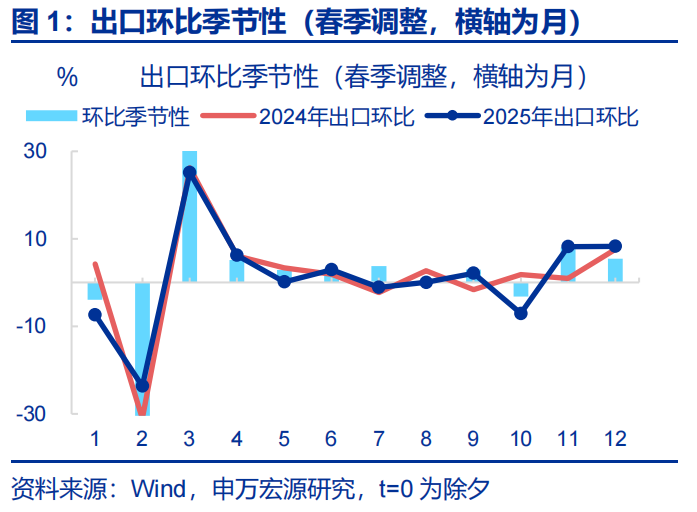
数据点评 | 为何12月出口“再超预期”?(申万宏源·赵伟团队)
Xin Lang Cai Jing· 2026-01-14 16:32
Core Viewpoint - December exports showed strong performance, supported by pricing effects, new product launches, and improvements in external demand [2][7] Group 1: Export Performance - December exports (in USD) increased by 6.6% year-on-year, exceeding expectations of 2.2% and the previous value of 5.9% [1][4] - The increase in exports reflects both structural and aggregate factors, with a 0.7 percentage point rise from November [2][7] - The appreciation of the RMB since November contributed to a 0.4 percentage point increase in total exports due to pricing effects [2][7] Group 2: Sector Analysis - Consumer electronics exports rose significantly by 16.3 percentage points to 19.6%, driven by new smartphone launches and improved external demand [3][22] - Exports of production materials also improved, with aluminum, integrated circuits, and steel seeing increases of 23.9%, 13.6%, and 3.5% respectively [3][22] - Import of processing trade increased by 3.8 percentage points to 5.7%, indicating a continuation of export improvement [29][57] Group 3: Country-Level Insights - Exports to emerging economies showed strong performance, with a 1.4 percentage point increase to 13.5% year-on-year [14][22] - Exports to ASEAN and India rose by 2.9 and 14 percentage points to 11.1% and 22.1% respectively [14][22] - Exports to developed economies, particularly the US and Europe, experienced a decline, with a limited drop of 1.5% to -30% for the US [14][54] Group 4: Future Outlook - The competitive advantage of Chinese exports is expected to remain strong, with projections for 2026 indicating sustained resilience in exports [4][36] - The industrialization of emerging countries is anticipated to drive demand for production materials, supporting China's export growth [4][36] - Potential easing of US-China tariffs and ongoing inventory replenishment in the US may lead to a rebound in exports to the US [4][36]