化工品

Search documents
风格不准漂移了
Datayes· 2025-11-10 11:35
Group 1 - The core viewpoint of the article discusses the recent draft of the "Guidelines for Theme Investment Style Management of Publicly Raised Securities Investment Funds" by the Asset Management Association of China, aimed at regulating style drift and investment concentration issues in theme investment funds [1] - The article highlights the recent rise in consumer stocks, attributed to the positive October CPI, government actions to boost consumption, and the seasonal shift towards growth and value styles in the fourth quarter [3] - The article provides a table showing monthly performance of high PE vs. low PE stocks from 2013 to 2025, indicating varying trends and probabilities of style dominance [4] Group 2 - Tesla's delay in delivering one million humanoid robots has impacted the robotics sector, with the delivery target now pushed to 2035, which was part of a compensation plan for Elon Musk [5] - Citigroup anticipates that the upcoming Central Economic Work Conference will set a tone for a realistically accommodative policy package for 2026, with expectations of slight cuts in policy rates and reserve requirements [6][7] - The article discusses the expected government borrowing scale reaching 7.9% of GDP in 2026, with a focus on stabilizing domestic demand while avoiding excessive bubbles in the real estate sector [7] Group 3 - The article notes that on November 10, the A-share market saw mixed performance, with the Shanghai Composite Index rising by 0.53% and the Shenzhen Component Index increasing by 0.18%, while the ChiNext Index fell by 0.92% [10] - It highlights the strong performance of consumer sectors such as liquor, tourism, and retail, with several stocks hitting the daily limit up [10] - The lithium battery supply chain is also noted for its active performance, driven by ongoing demand in the energy storage market, with lithium hexafluorophosphate prices rising significantly [10][11]


10秒钟 20cm涨停!化工板块集体走强 芯片存储概念股活跃
Zhong Guo Ji Jin Bao· 2025-11-10 03:51
Market Overview - On November 10, A-shares opened higher but experienced fluctuations, with the Shanghai Composite Index falling below 4000 points and the ChiNext Index down 1.68% [1] - The chemical, petroleum, coal, and food and beverage sectors showed strength, while the communication and electronics sectors struggled [1] Chemical Sector Performance - The chemical sector continued to strengthen, with significant activity in fluorine and phosphorus chemicals [3] - Key stocks such as LUXI Chemical, Chengxing Shares, and Hualu Hengsheng hit the daily limit, while Dongyue Silicon Material rose over 10% [3][4] - Lithium battery electrolyte stocks were particularly active, with Huasheng Lithium Battery reaching a 20% limit up [5] Lithium Battery Market Insights - From October 1 to November 7, the price of lithium hexafluorophosphate surged from 61,000 yuan/ton to 121,500 yuan/ton, marking a recent high [6] - CITIC Securities reported that the chemical sector is trading based on three main themes: increased demand for energy storage, ongoing industry self-discipline, and high growth potential in the chemical industry [7] Storage Chip Sector Activity - On November 10, storage chip stocks surged, with ShenGong Co. hitting a 20% limit up shortly after opening [8] - Other stocks like Yintang Zhikong also reached the daily limit, indicating strong market interest [10] NAND Flash Price Increase - Reports indicated that SanDisk raised NAND flash contract prices by 50% in November, causing a ripple effect throughout the storage supply chain [12] - This price increase highlights supply tightness in the storage market, with expectations of accelerated profit releases for domestic storage module companies by the second half of 2025 due to rising prices [12]





综合晨报-20251110
Guo Tou Qi Huo· 2025-11-10 03:39
Report Industry Investment Ratings No relevant content provided. Core Views of the Report - The crude oil market faces supply - demand pressure in Q4 and Q1 next year, and short - term sanctions risks on Russian oil are easing. Consider bearish strategies [2]. - The precious metals market is waiting for new drivers, forming a high - level oscillation platform, and it's advisable to wait and see [2]. - Various metal markets, including copper, aluminum, zinc, etc., show different trends. For example, copper consumption is a concern, aluminum has short - term upward resistance but large market divergence, and zinc has opportunities for cross - market reverse arbitrage [3][4][7]. - Energy - related products like fuel oil and asphalt have different trends. Fuel oil is affected by crude oil, and asphalt is in a downward trend due to weak demand [21][22]. - Agricultural products such as soybeans, corn, and livestock products like pigs and eggs have their own market characteristics. For example, soybeans may have inventory reduction in Q1 next year, and pig prices may have a second bottom in H1 next year [36][41]. - Financial products like stocks and bonds also show specific trends. The stock market is expected to be oscillating strongly in the short term, and the bond market's yield curve steepening may end [48][49]. Summaries by Related Catalogs Metals Crude Oil - Last week, international oil prices declined, with the Brent 01 contract down 1.36%. The US government shutdown impacts the employment and jet - fuel demand. The supply - demand pressure in Q4 and Q1 next year needs to be released, and short - term sanctions risks on Russian oil are easing. Consider bearish strategies [2]. Precious Metals - US economic data was stable last week, but the government shutdown brings uncertainties. The market is waiting for new drivers, and it's advisable to wait and see [2]. Copper - Last Friday, copper prices oscillated negatively. The market focuses on copper consumption. China's un - wrought copper imports in October were low, and the US consumer confidence index was poor. Wait for the social inventory data and expect the previous up - rush to cool down. Wait and see [3]. Aluminum - On Friday, Shanghai aluminum prices declined. Since October, domestic inventory and spot performance have been neutral. Macroeconomic sentiment dominates, and the short - term upward resistance is around 21,800 yuan. The high index position reflects large market divergence, so beware of capital flow changes [4]. Cast Aluminum Alloy - The Baotai ADC12 spot price is 20,900 yuan. Scrap aluminum supply is tight, and tax policy adjustments are unclear. It follows aluminum price fluctuations and has no independent market for now [5]. Alumina - Alumina production capacity is at a historical high, inventory is rising, and the supply - surplus situation persists. The spot price decline slows but remains at a discount. It will operate weakly with limited rebound space [6]. Zinc - Domestic zinc ore supply is tightening, and smelting costs are rising. The zinc ingot export window is open, and domestic inventory is falling. There is an expectation of over 10,000 - ton delivery at LME. Consider cross - market reverse arbitrage and short - term long positions on Shanghai zinc, with the upper pressure at 23,200 yuan/ton [7]. Lead - LME lead inventory is decreasing, and the import window is closed. Domestic refineries are resuming production, with tight raw materials and strong cost support. The market is in a multi - empty situation, and Shanghai lead is expected to oscillate between 17,300 - 17,500 yuan/ton [8]. Nickel and Stainless Steel - Shanghai nickel opened high and closed low, with weak downstream demand. Although there are news of stainless - steel plant production cuts, the implementation needs to be observed. The inventory of pure nickel decreased by 700 tons to 48,800 tons, while nickel - iron and stainless - steel inventory increased. Shanghai nickel is in a weak operation [9]. Tin - Last Friday, tin prices oscillated. There are differences in institutional inventory data. The tin market is in a game between short - term supply tightness and long - term supply stability. Tin prices are expected to decline with significant upper resistance. Consider short - selling strategies [10]. Lithium Carbonate - Lithium carbonate prices are rising again, with active trading. The total market inventory decreased by 3,000 tons to 127,000 tons. The spot is supported, and the futures price is strengthening. It is expected to oscillate strongly in the short term [11]. Polysilicon - The polysilicon market is affected by capacity - control policy expectations. In November, production cuts are expected in the southwest, and downstream silicon wafers are also reducing production. The inventory pressure relief is limited, and it will oscillate in the short term [12]. Industrial Silicon - Industrial silicon production in Sichuan and Yunnan is at a low level during the dry season, and downstream polysilicon has seasonal production cuts. It shows a supply - demand weak pattern and will oscillate [13]. Steel Rebar and Hot - Rolled Coil - On Friday night, steel prices oscillated weakly, and Tangshan billet prices dropped by 10 yuan/ton over the weekend. Rebar demand and production decreased, and the de - stocking slowed. Hot - rolled coil demand and production also declined, with a slight inventory increase. The market is under pressure, and pay attention to the support at the lower edge of the oscillation range [14]. Iron Ore - Iron ore prices declined last week. Global shipments are at a high level, and domestic arrivals have increased. Port inventory is rising. Terminal demand is in the off - season, and steel demand and iron - water production are decreasing. It is expected to oscillate weakly [15]. Coke - Coke prices oscillated upward. After the third - round price increase, there is an expectation of a fourth - round increase. Coke inventory decreased slightly, and downstream demand is weak. The price may oscillate strongly [16]. Coking Coal - Coking coal prices oscillated upward. Mongolian coal imports are at a high level, and terminal inventory increased slightly. The carbon - element supply is abundant, and downstream demand is weak. The price may oscillate strongly [17]. Manganese Silicon - Manganese silicon prices oscillated strongly. Iron - water production is decreasing, while manganese silicon production is rising, and inventory is slowly increasing. The price has strong bottom support [18]. Silicon Iron - Silicon iron prices oscillated strongly. Iron - water production is decreasing, but export and secondary demand are rising. Supply is high, and inventory is decreasing. The price has strong bottom support [19]. Shipping Container Freight Index (Europe Line) - Last week, the shipping order pressure existed, and the new SCFI European route price dropped by 1.6% week - on - week. In late November, the freight rate may rise. The upside space is limited, and it's advisable to wait and see. The fire at the TPP port may affect the rotation time of the Gemini European line [20]. Energy - Related Products Fuel Oil and Low - Sulfur Fuel Oil - The fuel oil market oscillates, mainly affected by crude oil. Low - sulfur fuel oil is relatively strong, but its continuous upward momentum is limited. High - sulfur fuel oil's supply will be more abundant in the medium - term. The spread between them may widen [21]. Asphalt - Asphalt has entered the off - season. The demand in the southwest and south can't offset the weakening in the north. Social inventory has been increasing year - on - year since late October. Refineries are cutting prices, and the market is bearish [22]. Liquefied Petroleum Gas - The LPG main contract oscillates narrowly. The chemical and combustion demand has increased, and the inventory rate of refineries and ports has decreased. The fundamentals support the LPG price [23]. Chemical Products Urea - Affected by the new export quota, urea prices rose over the weekend. Autumn fertilizer demand is ending, and production is high with limited inventory accumulation. India's new tender and domestic export liberalization boost the market, but be cautious when chasing long [24]. Methanol - Methanol futures oscillate at a low level. Iranian gas restrictions are delayed, and port inventory is high and rising. Downstream product profits are poor, and demand is weak. It will oscillate weakly until the inventory inflection point [25]. Pure Benzene - Last week, pure benzene prices declined. Port inventory increased, and production rose. The market will consolidate in the short term and face import and demand risks in the medium term. Consider month - spread reverse arbitrage [26]. Styrene - Styrene has insufficient cost support, and the inventory is high. The price will remain weak [27]. Polypropylene, Plastic, and Propylene - Propylene is affected by falling oil prices, and demand is weak. Polyethylene has stable factory prices but cautious downstream purchases. Polypropylene's e - commerce inventory demand is disappointing, and new supply is expected [28]. PVC and Caustic Soda - PVC supply is high, and inventory is rising. Demand is affected by weather and exports. It will operate at a low level. Caustic soda oscillates at a low level, with weak downstream demand [29]. PX and PTA - PX supply increased, and PTA load decreased. Polyester and weaving loads changed slightly. PTA may have inventory accumulation in the medium term. Consider reverse arbitrage [30]. Ethylene Glycol - Ethylene glycol production increased slightly, and port inventory rose. Supply is expected to increase, and demand will weaken. Consider reverse arbitrage, and watch for possible production cuts [31]. Short - Fiber and Bottle - Chip - Short - fiber has no new investment pressure, and the spot market is good, but profits are squeezed. In mid - late November, demand will weaken. Bottle - chip demand is weakening, and capacity is excessive [32]. Building Materials Glass - Glass prices are weak. After the Shahe production halt, prices rose but at a slower pace. Inventory is decreasing, and costs are rising. The decline space is limited, and keep the short - put option [33]. Rubber 20 - Rubber, Natural Rubber, and Butadiene Rubber - International crude oil prices oscillate, and Thai rubber prices vary. Global rubber supply is in the high - yield period, and Chinese tire production and inventory changed slightly. Rubber inventory increased, and cost support is weak. Consider oversold - rebound strategies and cross - variety arbitrage [34]. Chemical Fertilizers Soda Ash - Soda ash prices rose slightly. Supply is high, and inventory is high. The demand for heavy soda decreased due to glass production cuts. It's hard to fall in the short term [35]. Agricultural Products Soybeans and Soybean Meal - Last Friday night, soybean prices oscillated weakly. Importing US soybeans has no price advantage, and domestic soybean inventory may decrease in Q1 next year. Watch for USDA reports and possible long - buying opportunities [36]. Soybean Oil and Palm Oil - US soybean prices declined. Palm oil rebounded, and it's necessary to watch if the rebound is sustainable. Consider the possibility of short - term stabilization of palm oil [37]. Rapeseed and Rapeseed Oil - Canadian rapeseed prices are under pressure due to low sales and limited export markets. Domestic prices will oscillate, and pay attention to Australian rapeseed imports [38]. Bean No. 1 - Bean No. 1 prices fell from a high level. The purchase of domestic soybeans by the state reserve may support the market. Watch for policy guidance [39]. Corn - Northeast corn prices are stable and rising slightly, and Shandong's supply increased. The import tax rate on US corn changed. The market will oscillate weakly at the bottom, and watch for new trade agreements [40]. Pigs - Pig prices were stable over the weekend. The sow inventory decreased in October. Future supply pressure is large, and prices may form a second bottom in H1 next year [41]. Eggs - Egg prices declined over the weekend, and sales were slow. The laying - hen inventory is high, and chick replenishment is low. Consider short - selling at high prices [42]. Cotton - US cotton prices declined. China's cotton procurement may increase. Domestic cotton cost supports the market, but demand is average. Watch for tariff changes and export improvements [43]. Sugar - US sugar prices oscillated. International sugar supply is abundant. In China, the focus is on the new - season sugar production estimate, and the outlook for Guangxi's production is good [44]. Apples - Apple prices oscillated widely. Apple inventory decreased, but the quality is poor, and the selling - reluctance is strong. Consider short - selling strategies [45]. Wood - Wood prices are weak. Supply import is limited due to high foreign prices, and demand supports the price. Inventory is low, and it's advisable to wait and see [46]. Pulp - Pulp prices oscillated upward. Port inventory decreased by 2.6% week - on - week. Demand is average, and the valuation is low. Consider long - buying at low prices or wait and see [47]. Financial Products Stock Index - A - shares oscillated and adjusted, with most futures contracts falling. The inflation data improved, and the US consumer confidence index was low. The stock market is expected to oscillate strongly in the short term. Keep a mid - term focus on technology and advanced manufacturing and balance with cyclical and consumer sectors [48]. Treasury Bonds - Treasury bond futures declined, and short - term Shibor rates rose. The export growth was lower than expected. The yield curve steepening may end [49].
中信证券:储能带动上游材料景气度回升,“反内卷”发力化工品价格回暖
Mei Ri Jing Ji Xin Wen· 2025-11-10 00:54
Group 1 - The core viewpoint of the article highlights three main trading themes in the chemical sector [1] Group 2 - The first theme is the boost in industry sentiment driven by energy storage demand, with a reshaping of the supply-demand landscape for upstream lithium battery materials, recommending materials related to new energy [1] - The second theme focuses on the ongoing "anti-involution" in the chemical industry, where multiple sectors are initiating self-discipline, leading to a potential recovery in chemical product prices from their bottom [1] - The third theme indicates that the chemical industry itself is experiencing high prosperity, with core business expected to maintain high growth [1]

中信证券:储能带动上游材料景气度回升,反内卷发力化工品价格回暖
Zheng Quan Shi Bao Wang· 2025-11-10 00:48
Group 1 - The core viewpoint is that the chemical sector is currently trading around three main lines: energy storage demand is driving the improvement in the industry chain's prosperity, with the supply-demand pattern of upstream lithium battery materials expected to be reshaped [1] - The chemical industry is continuing to enhance self-discipline across multiple sectors, which is likely to lead to a bottoming out and recovery in chemical product prices [1] - The chemical products industry itself is experiencing high prosperity, with main business operations expected to maintain high growth [1]
中辉能化观点-20251107
Zhong Hui Qi Huo· 2025-11-07 05:11
中辉能化观点 | | 中辉能化观点 | | | --- | --- | --- | | 品种 | 核心观点 | 主要逻辑 | | | | 淡季供给过剩仍为核心驱动,油价承压下行。11 月 2 日,OPEC+计划于 | | 原油 | 12 谨慎看空 | 月继续扩产 13.7 万桶/日,并计划于明年初暂停扩产;供需方面,消费 | | ★ | | 淡季开启,OPEC+仍在扩产周期,原油供给过剩压力逐渐上升,油价下行 | | | | 压力较大,重点关注原油边际产量变化。策略:空单持有,可轻仓加空并 | | | | 购买看涨期权。 | | | | 液化气跟随成本端油价走弱。美国制裁俄罗斯风险释放,油价回调,沙特 | | LPG | 谨慎看空 | 再度下调 CP 合同价,成本端利空;供需基本面改善,供给量小幅下降, | | ★ | | 下游化工开工率提高,需求端韧性较强;库存端,港口与厂内库存均下降。 | | | | 策略:空单持有。 | | L | | 成本支撑转弱,基差走强,但现货仍未止跌。装置陆续重启,国内开工季 | | | 空头延续 | 节性回升,10 月进口到港较多,后市仍存增加预期,供给延续宽松格局。 | | ...
化工日报:本周MEG华东主港延续累库-20251107
Hua Tai Qi Huo· 2025-11-07 05:09
Report Industry Investment Rating No relevant information provided. Core Views - The main port of MEG in East China continued to accumulate inventory this week. The EG main contract closed at 3,924 yuan/ton, up 10 yuan/ton or 0.26% from the previous trading day. The spot price of EG in the East China market was 3,978 yuan/ton, down 4 yuan/ton or 0.10% from the previous trading day. The spot basis of EG in East China was 74 yuan/ton, up 3 yuan/ton month-on-month [1]. - The domestic ethylene glycol load is operating at a high level, and the domestic supply will be abundant in the future. Overseas, there are still many losses in ethylene glycol supply, and more than two sets of Saudi devices are still in shutdown or low-load operation, with little change in import expectations. On the demand side, with the recent cooling, the polyester downstream has moderately improved, but the increase in polyester load is limited [2]. - The strategy includes cautious short selling hedging on a unilateral basis. There is a large pressure to accumulate inventory in the fourth quarter under high supply, with many production plans, and port inventories are expected to gradually recover. For the inter - term strategy, it is recommended to reverse the spread between EG2601 and EG2605 [3]. Summary by Directory Price and Basis - The closing price of the EG main contract was 3,924 yuan/ton, up 10 yuan/ton or 0.26% from the previous trading day. The spot price of EG in the East China market was 3,978 yuan/ton, down 4 yuan/ton or 0.10% from the previous trading day. The spot basis of EG in East China was 74 yuan/ton, up 3 yuan/ton month - on - month [1]. Production Profit and Operating Rate - According to Longzhong data, the production profit of ethylene - made EG was - 57 US dollars/ton, unchanged month - on - month. The production profit of coal - made syngas - made EG was - 860 yuan/ton, down 43 yuan/ton month - on - month [1]. International Spread No relevant information provided. Downstream Production, Sales and Operation - With the recent cooling, the polyester downstream has moderately improved, but the increase in polyester load is limited [2]. Inventory Data - According to CCF data released every Monday, the inventory of MEG in the main port of East China was 562,000 tons, up 39,000 tons month - on - month. According to Longzhong data released every Thursday, the inventory of MEG in the main port of East China was 564,000 tons, up 65,000 tons month - on - month. As of November 6, the total inventory of MEG in the main port area of East China was 564,000 tons, an increase of 53,000 tons from Monday. The planned arrivals at the main port of East China this week are relatively large, and inventory accumulation is expected again [1].
化工日报:检修集中兑现,PTA大幅上涨-20251107
Hua Tai Qi Huo· 2025-11-07 03:20
Report Industry Investment Rating - Unilateral: PX/PTA/PF/PR are rated neutral [4] - Cross-variety: Go long on PF processing fees at low prices: PF2511 - 0.855PTA2601 - 0.332MEG2601 [5] - Inter-period: PTA2601 - 2605 reverse spread [5] Core Viewpoints - On November 6, the PX/PTA main contracts rose by 3.05% and 2.27% respectively. The current PTA spot market has abundant supply, with good long - term expectations but pressure in the near - term market, requiring comprehensive judgment [1] - In the cost side, the re - balancing of Russian oil trade is in the market observation period. The market focus is on the significantly increased maritime inventory. The structure of the increased inventory is crucial for the fourth - quarter oil price trend. PX's short - term floating price rebounds, but the rebound space of PXN is limited. PTA's processing fees are compressed to a low level, with more near - term maintenance plans, but the inventory accumulation pressure will gradually emerge after December [2] - The polyester operating rate is 91.7% (month - on - month increase of 0.3%). Since late October, domestic sales orders have improved significantly. The PF's short - term supply - demand situation is better than that of raw materials, and the processing fees are expected to be strong. The PR's spot processing fees are expected to fluctuate within a range [3][4] Summary by Directory Price and Basis - Covers TA main contract, basis, and inter - period spread trends; PX main contract trends, basis, and inter - period spreads; PTA East China spot basis; and short - fiber 1.56D*38mm semi - bright natural white basis [9][10][13] Upstream Profits and Spreads - Includes PX processing fees (PXN: PX China CFR - Naphtha Japan CFR), PTA spot processing fees, South Korean xylene isomerization profits, and South Korean STDP selective disproportionation profits [16][19] International Spreads and Import - Export Profits - Involves toluene US - Asia spreads (FOB US Gulf - FOB South Korea), toluene South Korea FOB - Japan naphtha CFR, and PTA export profits [24][26] Upstream PX and PTA Start - up - Focuses on the operating rates of PX and PTA in China, South Korea, and Taiwan [27][30][32] Social Inventory and Warehouse Receipts - Covers PTA weekly social inventory, PX monthly social inventory, PTA total warehouse receipts + forecast volume, PTA warehouse receipt inventory, PX warehouse receipt inventory, and PF warehouse receipt inventory [37][40][41] Downstream Polyester Load - Includes filament sales, short - fiber sales, polyester load, direct - spun filament load, polyester staple fiber load, polyester bottle chip load, filament factory inventory days, Jiangsu and Zhejiang loom start - up rates, Jiangsu and Zhejiang texturing machine start - up rates, Jiangsu and Zhejiang dyeing start - up rates, and filament profits [49][51][61] PF Detailed Data - Contains 1.4D physical inventory, 1.4D equity inventory, polyester staple fiber load, polyester staple fiber factory equity inventory days, recycled cotton - type staple fiber load, original - recycled price difference, pure polyester yarn start - up rate, pure polyester yarn production profit, polyester - cotton yarn start - up rate, and polyester - cotton yarn processing fees [71][81][83] PR Fundamental Detailed Data - Covers polyester bottle chip load, bottle chip factory bottle chip inventory days, bottle chip spot processing fees, bottle chip export processing fees, bottle chip export profits, East China water bottle chips - recycled 3A - grade white bottle chips, bottle chip next - month spread, and bottle chip next - next - month spread [90][92][100]
PTA、MEG早报-20251107
Da Yue Qi Huo· 2025-11-07 03:12
Report Information - Report Title: PTA&MEG Morning Report - November 7, 2025 [1] - Author: Jin Zebin from the Investment Consulting Department of Dayue Futures [1] - Investment Consulting Qualification Number: Z0015557 [1] - Contact Information: 0575 - 85226759 [1] Report Industry Investment Rating - Not provided in the report Core Viewpoints - PTA: Affected by the broader market and market rumors, PTA futures rose significantly. The spot market had a mediocre trading atmosphere with weak spot basis. It's expected to fluctuate with the cost in the short - term, and attention should be paid to device changes [5]. - MEG: This week, there is a concentrated arrival of foreign - made ethylene glycol vessels. In the medium - to - long - term, there is a continuous expectation of supply surplus. It's expected that the price center of ethylene glycol will decline, and attention should be paid to cost and device changes [7]. Summary by Directory 1. Previous Day's Review - Not provided in the report 2. Daily Tips - **PTA**: - Fundamental: Affected by the broader market and rumors, futures rose, spot trading was mediocre, and the basis was weak. 11 - month goods were traded at a discount of 75 - 85 to the 01 contract, with a price range of 4480 - 4605. The mainstream spot basis was 01 - 80 [5]. - Basis: Spot price was 4540, 01 contract basis was - 148, with the futures price higher than the spot price [5]. - Inventory: PTA factory inventory was 4.09 days, an increase of 0.06 days compared to the previous period [5]. - Market Trend: The 20 - day moving average was upward, and the closing price was above the 20 - day moving average [5]. - Main Position: Net short position with a reduction in short positions [5]. - Expectation: The spot market trading atmosphere is dull, mainly dominated by traders. It's expected to fluctuate with the cost in the short - term, and attention should be paid to device changes [5]. - **MEG**: - Fundamental: On Thursday, ethylene glycol had a wide - range adjustment. This week, there is a concentrated arrival of foreign - made vessels, and the supply in the month is abundant [7]. - Basis: Spot price was 3978, 01 contract basis was 54, with the futures price lower than the spot price [8]. - Inventory: The total inventory in East China was 56.7 tons, an increase of 6.7 tons compared to the previous period [8]. - Market Trend: The 20 - day moving average was downward, and the closing price was below the 20 - day moving average [8]. - Main Position: Net short position with a reduction in short positions [7]. - Expectation: In the medium - to - long - term, there is a continuous expectation of supply surplus. It's expected that the price center will decline, and attention should be paid to cost and device changes [7]. 3. Today's Focus - Not provided in the report 4. Fundamental Data - **PTA Supply - Demand Balance Sheet**: Shows the supply and demand data of PTA from January 2024 to December 2025, including production capacity, output, consumption, inventory, etc. For example, in January 2024, PTA production capacity was 8062, output was 591, and consumption was 572 [11]. - **Ethylene Glycol Supply - Demand Balance Sheet**: Displays the supply and demand data of ethylene glycol from January 2024 to December 2025, including production, import, consumption, port inventory, etc. For example, in January 2024, ethylene glycol production was 51, import was 128, and consumption was 211 [12]. - **Price Data**: Includes spot and futures prices of various products such as naphtha, PX, PTA, MEG, and polyester products on November 6 and 5, 2025, as well as price changes, basis, and processing margins. For example, the spot price of PTA was 4540 yuan/ton on November 6, 2025, an increase of 10 yuan/ton compared to the previous day [13]. 5. PTA Daily View - As described in the "Daily Tips" section for PTA [5] 6. MEG Daily View - As described in the "Daily Tips" section for MEG [7]
商品日报(11月6日):PX午盘拉涨超3%创两个月新高 沥青触及逾一年新低日线“六连阴”
Xin Hua Cai Jing· 2025-11-06 10:26
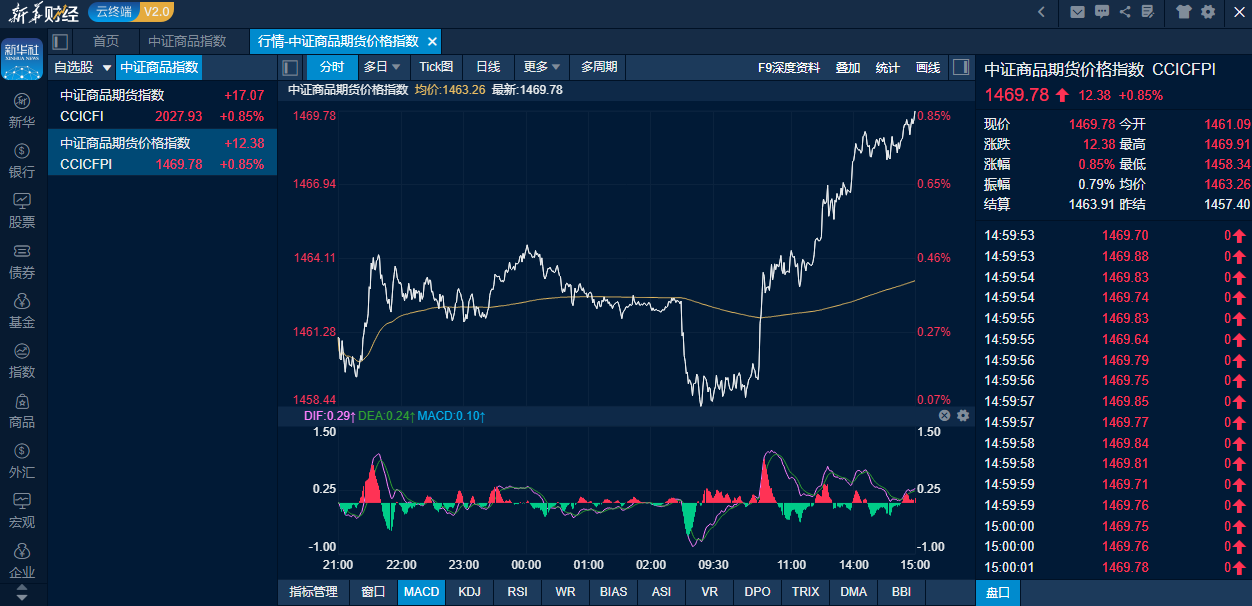
Group 1: Market Overview - The domestic commodity futures market stabilized on November 6, with most varieties rebounding. The China Securities Commodity Futures Price Index closed at 1469.78 points, up 12.38 points or 0.85% from the previous trading day [1] - The China Securities Commodity Futures Index closed at 2027.93 points, also up 17.07 points or 0.85% from the previous trading day [1] Group 2: Chemical Sector - The chemical sector showed significant rebound signs, with paraxylene (PX) leading the market with a 3.05% increase, reaching a two-month high. Improved supply-demand expectations were the main drivers for PX's price increase [2] - The demand for PX is supported by a recovery in new orders from weaving enterprises and a reduction in inventory levels for weaving and polyester products [2] Group 3: Coking Coal and Coke - Coking coal and coke futures rose, with coking coal and coke main contracts recording increases of 2.38% and 2.07%, respectively. The tightening supply is a major bullish factor for the coking market [3] - As of November 6, the capacity utilization rate of coking coal mines was 83.8%, down 1 percentage point week-on-week, indicating a reduction in supply [3] Group 4: Shipping Index - The shipping index for Europe experienced a significant decline of nearly 4%, with a drop of 3.91% at the close. This was attributed to market adjustments following previous price increases and high capacity levels [4] - The main contract for the shipping index saw a reduction of 5660 contracts, with a net outflow of over 200 million yuan, indicating a retreat of bullish sentiment [4] Group 5: Asphalt and Other Chemical Products - The asphalt market continued to show weakness, hitting a new low not seen since September of the previous year, with a 2.05% decline. The drop was influenced by falling oil prices and seasonal demand reductions [5] - Other chemical products like polyethylene continued to show weakness, although the decline in prices moderated towards the end of the trading day [5]