
有色

Search documents
山东:2025年机电产品出口1.06万亿元,首次迈上万亿台阶
Zhong Guo Fa Zhan Wang· 2026-01-21 03:12
Core Insights - Shandong province is focusing on industrial economic development as a key strategy, aiming for a significant increase in industrial product exports by 2025, targeting 1.97 trillion yuan with a growth rate of 4.4% [1] - The province is emphasizing high-end, intelligent, and digital transformation in manufacturing, with notable growth projections for various sectors, including a 47% increase in high-end equipment exports [1] - Key industrial clusters such as steel, non-ferrous metals, and petrochemicals are expected to see substantial improvements, with specific export growth rates projected for steel, aluminum, and refined oil products [2] Industrial Development - By 2025, Shandong aims to export industrial products worth 1.97 trillion yuan, with machinery and electrical products expected to reach 1.06 trillion yuan, marking an 8.7% growth [1] - High-end equipment exports are projected to reach 108.96 billion yuan, growing by 47%, while electronic information exports are expected to grow by 30% [1] - The province is implementing policies to enhance production capabilities and streamline customs processes for biopharmaceuticals and medical instruments [1] Key Industry Clusters - Major industries such as steel, non-ferrous metals, and petrochemicals are set to improve quality and efficiency, with steel, aluminum, and refined oil exports projected to grow by 3.3%, 7%, and 29.5% respectively by 2025 [2] - Shandong has 105 categories of electromechanical products that rank first in national export value, with certain products like diesel trucks and concrete mixers accounting for over 10% of global exports [2] - The province's strategy is shifting towards a comprehensive competitive advantage in technology, brand, quality, and service, with over one-third of electromechanical product exports being self-branded [2] Green Trade Initiatives - Shandong's "new three samples" products are expected to see a 37% increase in exports by 2025, with electric vehicle exports projected to grow by 126% [2] - Customs is enhancing responses to green trade barriers and integrating various data sources to support carbon emission calculations and facilitate green cross-border trade [2]
【省委“十五五”规划《建议》解读之三】深刻把握“十五五”时期我省的发展方位和发展思路
Xin Lang Cai Jing· 2026-01-21 01:01
Core Viewpoint - The "14th Five-Year Plan" period is a crucial time for Shanxi to achieve high-quality development and deepen comprehensive transformation, laying a solid foundation for the realization of socialist modernization [1] Group 1: Development Opportunities - The overall judgment for Shanxi's development during the "14th Five-Year Plan" period is that opportunities outweigh challenges, with favorable conditions stronger than unfavorable factors [2] - Xi Jinping's personal attention and guidance for Shanxi's development provide significant confidence and support for the province [2] - The upcoming national policies and strategic measures during the "14th Five-Year Plan" period, such as constructing a new energy system and modern industrial system, offer broad space and rare opportunities for Shanxi's development [2] Group 2: Development Advantages - Shanxi is an important birthplace of Chinese civilization and a key energy base, with rich resources in coal and other minerals, as well as a strong foundation in traditional industries like electricity, steel, and chemicals [2] - The province has a unique geographical position and is well-connected, which enhances its importance in the national development landscape [2] - Achievements during the "13th Five-Year Plan" period have laid a solid foundation for high-quality development and modernization in the "14th Five-Year Plan" period [2] Group 3: Challenges and Issues - Shanxi faces prominent issues of unbalanced and insufficient development, with structural, institutional, and quality-related contradictions in its resource-based economy [2] - The transition from old to new growth drivers is still in progress, and there are significant shortcomings in ecological protection and public welfare [2] - The peak in coal consumption expected in the next five years poses urgent demands for industrial transformation and upgrading [2] Group 4: Development Principles - The overall requirements for economic and social development during the "14th Five-Year Plan" period include adherence to Marxism, comprehensive implementation of Xi Jinping's thoughts, and alignment with national strategic deployments [3] - Key principles include maintaining the Party's leadership, prioritizing high-quality development, and ensuring effective market and government collaboration [3] - The focus is on promoting economic growth, enhancing people's well-being, and ensuring decisive progress towards socialist modernization [3]
增速5.8%!甘肃经济稳中向好韧性凸显质效双升——2025年甘肃省经济运行成绩单透视
Xin Lang Cai Jing· 2026-01-21 01:00
Core Viewpoint - Gansu Province's economy demonstrated resilience and positive growth in 2025, with a GDP of 1.36975 trillion yuan, reflecting a year-on-year increase of 5.8%, surpassing the national average by 0.8 percentage points [1]. Economic Growth Indicators - Gansu's economic performance in 2025 showed "five positive trends": stable growth outpacing the national average, improved supply across all three industries, resilient investment and consumption, strong foreign trade growth, and enhanced quality and efficiency [2]. - Key indicators included industrial added value growth exceeding the national average by 3.6 percentage points, import and export growth surpassing the national average by 12.4 percentage points, and per capita disposable income growth exceeding the national average by 0.6 and 0.5 percentage points respectively [2]. Industry Performance - The agricultural sector achieved a record grain output of over 13 million tons, with significant growth in specialty products like vegetables and medicinal herbs, establishing Gansu as a major seed production base [3]. - The industrial sector saw a 0.5 percentage point acceleration in industrial added value growth, with key industries like non-ferrous metals and electricity contributing significantly to economic stability [3]. - The service sector emerged as a primary growth driver, contributing 51.4% to GDP growth, with tourism seeing over 500 million visitors and generating 403.6 billion yuan in spending [3]. Domestic and Foreign Trade - Gansu implemented measures to boost domestic demand and stabilize foreign trade, resulting in a 2.7% increase in project investment despite a downturn in the real estate market [4]. - The province's total import and export value exceeded 70 billion yuan, with a growth rate 12.4 percentage points higher than the national average, and a notable increase in high-tech product exports [4]. Development Momentum and Quality Improvement - New industries and private sector growth contributed to Gansu's economic transformation, with significant increases in strategic emerging industries and private enterprise performance [5][6]. - In 2025, Gansu added 16.05 million kilowatts of new power generation capacity, with a total capacity exceeding 80 million kilowatts and a year-on-year increase in power generation of 11.4% [6]. - The province saw a 22.6% increase in funds for newly established and ongoing investment projects, with a notable rise in the contribution of private enterprises to both industrial output and foreign trade [6].
兴业证券:A股业绩预告即将进入披露高峰 关注哪些方向?
智通财经网· 2026-01-20 10:56
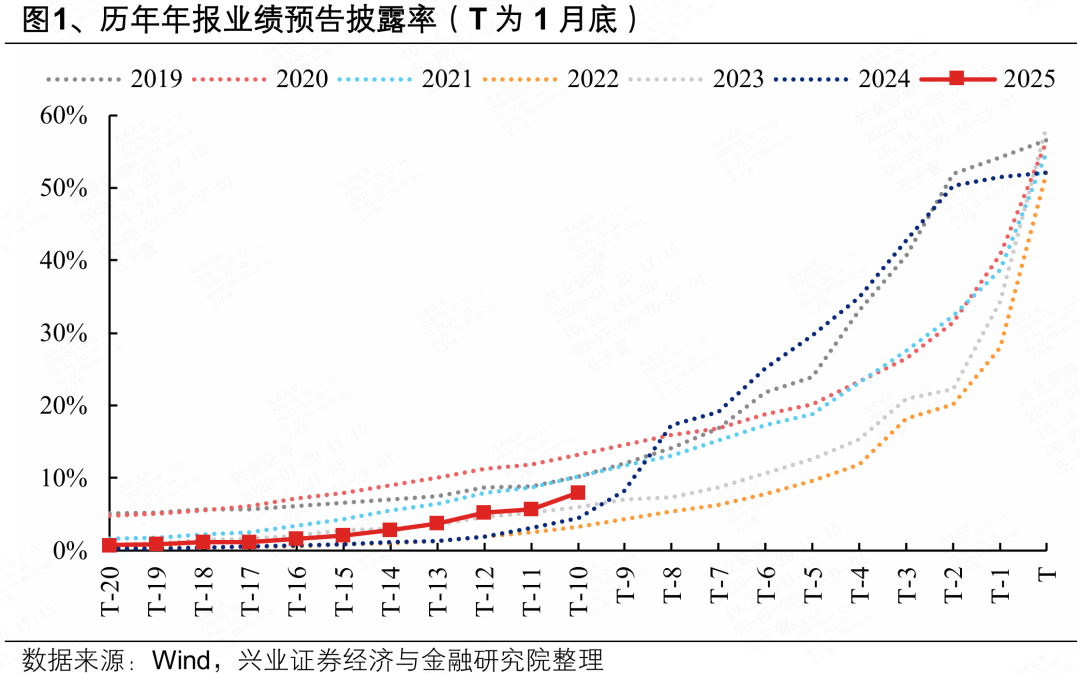
Core Viewpoint - As of January 19, the disclosure rate of annual performance forecasts for A-shares is 7.98%, with a peak expected in late January, where the final disclosure rate may reach around 55% [2][5]. Group 1: Performance Forecasts - The performance forecasts indicate that companies with significant net profit growth are primarily in sectors such as computing power, new energy, chemicals, pharmaceuticals, non-ferrous metals, and computers [6][10]. - By January 19, 447 A-share companies have released annual performance forecasts, with 144 companies expecting net profit growth exceeding 50%, mainly in computing power (semiconductors, communication equipment), new energy (batteries, photovoltaics), and chemicals [6][10]. Group 2: Market Reactions - As the performance forecasts enter their peak disclosure period, the correlation between stock prices and performance is expected to increase significantly in the latter half of January, with market sentiment returning to rationality [5]. - The market is likely to undergo a structural adjustment based on fundamentals, with previous hot sectors facing performance validation, while some low-performing but high-quality sectors may attract new capital inflows [5]. Group 3: Industry Insights - The sectors with upward revisions in profit forecasts since November include technology (especially in upstream computing hardware and downstream applications like consumer electronics and software), advanced manufacturing (new energy, military, automotive), and cyclical industries (building materials, non-ferrous metals, coal, steel) [12][13]. - The industries with lower performance growth since the last market rally include AI computing power, new energy, pharmaceuticals, and cyclical sectors like steel and glass fiber [14].


滨州将培育绿色工厂 绿色园区20家,持续打造“无废城市”
Qi Lu Wan Bao· 2026-01-20 09:05
Group 1 - The core focus of the report is on promoting green and low-carbon development in Binzhou by 2026, emphasizing structural adjustments and demonstration projects [1] - The city plans to accelerate the development of new energy, including the construction of a comprehensive wind-solar-storage transmission base and the implementation of 10 key projects, aiming to add 1 million kilowatts of renewable energy capacity [1] - Initiatives include the development of new models for "source-grid-load-storage" and "green electricity direct connection," along with the establishment of a 500 kV highland transmission and transformation project [1] Group 2 - The report highlights the importance of improving ecological environment quality through actions such as the clean transformation of 99 coal-fired furnaces and the renovation of 120 kilometers of rainwater and sewage pipelines [2] - It emphasizes the implementation of a river and lake chief system and systematic governance of river basins to enhance the beauty of coastal areas [2] - The completion of a national regional waste salt disposal center and the promotion of red mud comprehensive utilization are part of the efforts to create a "waste-free city" [2]
长城基金:市场震荡上行趋势有望延续
Xin Lang Cai Jing· 2026-01-20 08:00
Core Insights - The A-share market has seen a significant increase in financing transaction activity, with the financing balance reaching 2.68 trillion yuan, a new historical record, and financing transaction volume accounting for 11.3% of total market transactions as of January 14 [1][4]. Financing Margin Adjustment - On January 14, the Shanghai and Shenzhen Stock Exchanges announced an adjustment to the financing margin ratio, increasing the minimum margin requirement for investors from 80% to 100% when buying securities on margin [1][4]. - This adjustment is a key tool for regulatory authorities to conduct counter-cyclical adjustments, aimed at preventing excessive accumulation of systemic risks [2][5]. - Historical adjustments include a previous increase from 50% to 100% in November 2015 to curb rapid financing growth and a decrease from 100% to 80% in August 2023 to enhance market liquidity [1][2][4]. Impact on Market Dynamics - The core objective of raising the margin requirement is to maintain stable capital market operations and prevent excessive concentration of leveraged trading risks, reducing the leverage from 1.25 times to 1 time for new financing contracts [2][5]. - The policy will only apply to new financing contracts, while existing contracts will continue under the previous rules, reflecting a cautious regulatory approach to mitigate market impact and systemic risks [2][5]. Market Outlook - Short-term regulatory measures may not alter the upward trend of the market, with underlying support for continued market growth expected amidst fluctuations [2][5]. - Investment focus should be on policy initiatives and industry prosperity, particularly in technology growth sectors such as semiconductors, internet, electronics, media, and computing, as well as globally competitive sectors like power and machinery [2][5]. - Non-bank financial sectors are likely to benefit from increased demand for wealth management and capital market reforms, while cyclical sectors like tourism, hospitality, and consumer goods may present marginal improvement opportunities due to expanding domestic demand policies [2][5].
——金属周期品高频数据周报(2026.1.12-2026.1.18):M1 M2增速差已连续三个月回落-20260120
EBSCN· 2026-01-20 07:47
Investment Rating - The report maintains an "Accumulate" rating for the steel and non-ferrous metals sector [5] Core Insights - The M1 and M2 growth rate difference has been declining for three consecutive months, reaching -4.7 percentage points in December 2025, indicating a tightening liquidity environment [10][18] - The average daily crude steel production of key steel enterprises in early January has rebounded to levels close to mid-October 2025 [21][42] - The report highlights that the prices of titanium dioxide and glass are at low levels, with titanium dioxide priced at 13,200 CNY/ton and glass at 1,124 CNY/ton [79] Summary by Sections Liquidity - The M1 and M2 growth rate difference is -4.7 percentage points as of December 2025, a decrease of 1.60 percentage points month-on-month [10][18] - The BCI small and medium enterprise financing environment index was 47.15 in December 2025, down 10.19% from the previous month [10][18] - The current price of London gold is 4,599 USD/ounce, reflecting a 2.00% increase [10] Infrastructure and Real Estate Chain - The average daily crude steel production for key steel companies in early January is approximately 1.903 million tons, a 21.55% increase compared to the previous month [42] - The national high furnace capacity utilization rate is 85.48%, down 0.56 percentage points [42] - The price changes for various materials include rebar up 1.22%, cement price index down 0.94%, and rubber down 1.26% [21] Industrial Chain - The operating rate of semi-steel tires is at 73.44%, an increase of 7.55 percentage points [2] - Copper spot prices have reached a historical high, while tungsten concentrate prices have also hit a new high since 2012 [2] - The price of electrolytic aluminum is 24,000 CNY/ton, with a profit margin of 6,787 CNY/ton [2] Price Relationships - The price ratio of London spot gold to silver has reached a new low since 2013 [3] - The price difference between rebar and iron ore is currently 3.99 [3] - The price difference between small rebar (used in real estate) and large rebar (used in infrastructure) is 200 CNY/ton, a 31.03% decrease from the previous week [3] Export Chain - The new export orders PMI for China in December was 49.00%, an increase of 1.4 percentage points [3] - The CCFI composite index for container shipping rates is 1,209.85 points, up 1.25% [3] - The capacity utilization rate for U.S. crude steel is 75.70%, an increase of 1.30 percentage points [3] Valuation Percentiles - The CSI 300 index decreased by 0.57%, while the industrial metals sector performed best with a 2.81% increase [4] - The PB ratio of the steel sector relative to the CSI 300 is currently at 0.50, with a historical high of 0.82 [4] - The report suggests that the supply of steel may be reasonably constrained, leading to a potential recovery in sector profitability to historical average levels [4]
中游分化,关注下游消费释放
Hua Tai Qi Huo· 2026-01-20 02:56
Report Summary Industry Investment Rating No industry investment rating is provided in the given content. Core View The report focuses on the differentiation in the mid - stream industries and suggests paying attention to the release of downstream consumption. It presents recent events in the production and service industries, and analyzes the price and operation status of upstream, mid - stream, and downstream industries [1]. Detailed Summary by Directory 1. Mid - view Event Overview - **Production Industry**: From January 15th to 16th, China Aero - Engine's "Taihang 7", "Taihang 15", and "Taihang 110" gas turbine innovation and development demonstration projects passed the evaluation and acceptance of the National Energy Administration, which will drive the industrialization and commercialization of China's gas turbine industry [1]. - **Service Industry**: As of January 17th, 2026, since the full - island customs closure of Hainan Free Trade Port on December 18th, 2025, Haikou Customs supervised 4.86 billion yuan in off - island duty - free shopping, a 46.8% year - on - year increase; 745,000 shopping visitors, a 30.2% increase; and 3.494 million shopping items, a 14.6% increase [1]. 2. Industry Overview - **Upstream**: Copper prices declined slightly; egg and pork prices rebounded; PTA prices dropped [2]. - **Mid - stream**: PX and urea in the chemical industry maintained high operating rates; power plant coal consumption was at a low level [3]. - **Downstream**: Second - tier city commercial housing sales increased seasonally; domestic flight frequencies decreased slightly [4]. 3. Key Industry Price Index Tracking - **Agriculture**: On January 19th, the spot price of corn was 2,262.9 yuan/ton (up 0.38% year - on - year), eggs 7.9 yuan/kg (up 8.28%), palm oil 8,620 yuan/ton (down 2.31%), cotton 15,889.3 yuan/ton (up 0.74%), and the average wholesale price of pork 18.5 yuan/kg (up 2.33%) [36]. - **Non - ferrous Metals**: On January 19th, the spot price of copper was 101,140 yuan/ton (down 2.07%), zinc 24,402 yuan/ton (up 1.16%), aluminum 23,890 yuan/ton (down 1.98%), and nickel 146,416.7 yuan/ton (up 0.46%) [36]. - **Black Metals**: On January 19th, the spot price of rebar was 3,232.3 yuan/ton (down 0.42%), iron ore 833.9 yuan/ton (down 1.03%), wire rod 3,480 yuan/ton (down 0.50%), and glass 12.9 yuan/square meter (down 0.23%) [36]. - **Non - metals**: On January 19th, the spot price of natural rubber was 15,583.3 yuan/ton (down 1.48%), and the China Plastics City price index was 775.7 (up 1.34%) [36]. - **Energy**: On January 19th, the spot price of WTI crude oil was 59.3 US dollars/barrel (up 0.37%), Brent crude oil 64.1 US dollars/barrel (up 1.25%), liquefied natural gas 3,514 yuan/ton (down 0.90%), and coal 803 yuan/ton (up 0.88%) [36]. - **Chemical Industry**: On January 19th, the spot price of PTA was 5,019.8 yuan/ton (down 2.02%), polyethylene 6,840 yuan/ton (up 2.47%), urea 1,767.5 yuan/ton (up 1.29%), and soda ash 1,214.3 yuan/ton (down 0.35%) [36]. - **Real Estate**: On January 19th, the national cement price index was 134.5 (down 0.44% year - on - year), the building materials composite index increased by 0.03%, and the national concrete price index decreased by 0.18% [36].
银河期货每日早盘观察-20260120
Yin He Qi Huo· 2026-01-20 02:41
1. Report Industry Investment Ratings No relevant content provided. 2. Core Views of the Report - The stock index is expected to continue its volatile consolidation, with the performance of the stock index futures differentiating. The market sentiment is affected by various factors such as high - level stocks and regulatory policies [20][21]. - In the agricultural product sector, the supply of protein meal still has pressure, the international sugar market is weak, the oil and fat sector maintains a volatile trend, and the prices of different agricultural products are affected by factors like supply and demand, weather, and policies [24][27][32]. - In the black metal sector, the steel price is likely to maintain a volatile trend before the Spring Festival, and the double - coke and iron ore are expected to run weakly, while the ferro - alloy has strong bottom support [55][59][61]. - In the non - ferrous metal sector, precious metals like gold and silver reach new highs due to the escalation of disputes between the US and Europe, and the prices of other non - ferrous metals are affected by factors such as geopolitics, supply and demand, and inventory [70][71][79]. - In the shipping sector, the container shipping market is in a low - season, and the freight rate is controversial. The market is waiting for new drivers [113]. - In the energy and chemical sector, the crude oil market is in a stalemate, and the prices of other chemical products are affected by factors such as raw material prices, supply and demand, and geopolitics [117][120]. 3. Summaries According to Relevant Catalogs 3.1 Financial Derivatives - **Stock Index Futures**: The stock index shows differentiation. After a slight decline in the opening, it fluctuated higher. The performance of the CSI 500 and CSI 1000 indexes was strong. The stock index futures also showed differentiation. The future market is expected to continue to fluctuate and consolidate [17][20][21]. - **Trading Strategy**: Short - term volatility, box operation, grid operation for single - side trading; IM\IC long 2606 + short ETF cash - and - carry arbitrage; double - selling strategy for options [21]. 3.2 Agricultural Products 3.2.1 Protein Meal - **Supply and Demand**: The overall supply and demand of US soybeans are relatively loose, and the domestic soybean meal cost side still has pressure. Although the short - term supply may decline and the demand is good, there is still pressure in the medium and long term [24]. - **Trading Strategy**: Short - side thinking for single - side trading; MRM spread widening for arbitrage; selling wide - straddle strategy for options [24]. 3.2.2 Sugar - **Market Condition**: The international sugar market is expected to fluctuate at the bottom in the short term, and the domestic sugar price is weakly following. The cost side provides some support, but there is also sales pressure [27]. - **Trading Strategy**: Observe for the domestic short - term main contract; observe for arbitrage; sell put options [27]. 3.2.3 Oil and Fat Sector - **Market Trend**: The market is expected to continue to fluctuate, with no obvious trend. The supply of rapeseed may increase, and the palm oil is in the production - reduction period [32]. - **Trading Strategy**: High - throw and low - suck interval operation for single - side trading; observe for arbitrage and options [32]. 3.2.4 Corn/Corn Starch - **Market Situation**: The US corn is expected to oscillate at the bottom in the short term, and the domestic corn spot price is stable in the short term but has pressure in the long term. The futures price is oscillating at a high level [35]. - **Trading Strategy**: Bullish thinking for the outer - market 03 corn after stabilization; short - term long for the 07 corn after correction; do long the 05 corn - starch spread when it is low for arbitrage [36]. 3.2.5 Live Pigs - **Supply and Demand**: The supply of live pigs is gradually increasing, and the overall price is declining. The overall inventory is high, and the supply pressure exists [37][38]. - **Trading Strategy**: Short - side thinking for single - side trading; observe for arbitrage; sell wide - straddle strategy for options [39]. 3.2.6 Peanuts - **Market Status**: The peanut spot price is stable, and the futures price is oscillating at the bottom. The import volume decreases, and the oil mill has profits [41]. - **Trading Strategy**: Go long the 05 peanut when it is low for single - side trading; observe for arbitrage; sell pk603 - C - 8200 options [41]. 3.2.7 Eggs - **Market Analysis**: The demand for eggs has improved, and the price is stable with a slight increase. The supply is in the process of capacity reduction, but the upward space of the 03 contract is limited [44]. - **Trading Strategy**: Go long the 5 - far - month contract when it is low for single - side trading; observe for arbitrage and options [45]. 3.2.8 Apples - **Market Condition**: The cold - storage inventory of apples is low, and the price is firm. The cost of warehouse receipts is high, and the demand is acceptable. The 5 - month contract price may rise if the demand remains normal [48]. - **Trading Strategy**: Partially take profits for the long position of the 5 - month contract; go short the 10 - month contract when it is high; do long the 5 - month contract and short the 10 - month contract for arbitrage [49]. 3.2.9 Cotton - Cotton Yarn - **Market Trend**: The cotton sales progress is fast, and the downstream stocking willingness increases. The cotton price is expected to oscillate in a short - term range [52]. - **Trading Strategy**: Observe for single - side trading, arbitrage, and options [52]. 3.3 Black Metals 3.3.1 Steel - **Market Situation**: The demand for steel has support, and the price is expected to continue to oscillate before the Spring Festival. The market sentiment and raw material prices affect the price [55]. - **Trading Strategy**: The steel price may be under pressure in the volatile market; short the coil - coal ratio when it is high and hold the short position of the coil - screw spread for arbitrage; observe for options [56]. 3.3.2 Double - Coking - **Market Analysis**: The supply of double - coking is relatively loose, and it is expected to run weakly with oscillations. The Mongolian coal supply and the downstream inventory - building situation affect the price [58]. - **Trading Strategy**: Oscillate weakly for single - side trading; observe for arbitrage; sell out - of - the - money call options [59]. 3.3.3 Iron Ore - **Market Condition**: The market expectation of iron ore is repeated, and the price is running weakly. The supply is loose, and the demand is expected to decline [61]. - **Trading Strategy**: Run weakly for single - side trading [62]. 3.3.4 Ferro - Alloy - **Market Status**: After adjustment, the ferro - alloy has strong bottom support. The supply of silicon - iron and manganese - silicon may decline, and the demand has support. The cost is relatively stable [64][65]. - **Trading Strategy**: Consider it as a long - position variety when it is low for single - side trading; observe for arbitrage; sell put options when it is high [68]. 3.4 Non - Ferrous Metals 3.4.1 Gold and Silver - **Market Trend**: Due to the escalation of disputes between the US and Europe, gold and silver reach new highs. The short - term performance of silver is more volatile, and gold is relatively more stable [70][71][72]. - **Trading Strategy**: Hold the long position of Shanghai gold against the 5 - day moving average; take profits for Shanghai silver conservatively or hold the long position cautiously for aggressive investors; do long the outer - market and short the inner - market for arbitrage; bullish call spread strategy for options [72][73]. 3.4.2 Platinum and Palladium - **Market Analysis**: The oscillation range of platinum and palladium converges. Platinum has stronger upward driving force, and the policy uncertainty still exists [74][75]. - **Trading Strategy**: Go long platinum when it is low for single - side trading; observe for palladium; observe for arbitrage and options [75]. 3.4.3 Copper - **Market Condition**: The short - term volatility of copper increases, and the long - term upward trend remains. The geopolitics, inventory, and consumption affect the price [77][79]. - **Trading Strategy**: Pay attention to profit protection and control positions for single - side trading; observe for arbitrage and options [80]. 3.4.4 Alumina - **Market Status**: Alumina is expected to run weakly. The increase in warehouse receipts and the downward trend of cost put pressure on the price [83]. - **Trading Strategy**: Oscillate weakly for single - side trading; observe for arbitrage and options [84]. 3.4.5 Electrolytic Aluminum - **Market Analysis**: The risk - aversion sentiment rises again, and the aluminum price stabilizes. The geopolitics, tariff policy, and inventory affect the price [86]. - **Trading Strategy**: The aluminum price stabilizes and rebounds for single - side trading; observe for arbitrage and options [87]. 3.4.6 Cast Aluminum Alloy - **Market Condition**: The market sentiment is repeated, and it stabilizes with the aluminum price. The supply of scrap aluminum is tight, which supports the price [89]. - **Trading Strategy**: No specific trading strategy provided [89]. 3.4.7 Zinc - **Market Analysis**: The price of zinc is affected by capital sentiment. The short - term price may return to the fundamental situation, with a downward pressure and then an interval oscillation [91][93]. - **Trading Strategy**: Observe the support at 17000 - 17200 and go long lightly when it is low for single - side trading; observe for arbitrage and options [93]. 3.4.8 Lead - **Market Status**: The price of lead is affected by capital sentiment. Similar to zinc, it may run weakly and then oscillate in an interval [95]. - **Trading Strategy**: Observe the support at 17000 - 17200 and go long lightly when it is low for single - side trading; observe for arbitrage and options [95]. 3.4.9 Nickel - **Market Analysis**: The nickel price adjusts with non - ferrous metals. The regulatory attitude is stable, and the long - term trend of non - ferrous metals is positive [97]. - **Trading Strategy**: Pay attention to the overall atmosphere of the non - ferrous metal sector for single - side trading; observe for arbitrage and options [98]. 3.4.10 Stainless Steel - **Market Condition**: Stainless steel follows the nickel price. The terminal demand is in the off - season, and the supply is tight. The price is expected to oscillate at a high level [100]. - **Trading Strategy**: Follow the nickel price for single - side trading; observe for arbitrage [101]. 3.4.11 Industrial Silicon - **Market Analysis**: Due to the sudden supply reduction news, the price is expected to be strong in the short term. The supply is expected to decrease, and the inventory may turn to de - stocking [102]. - **Trading Strategy**: Close the short position and go long when it is low for single - side trading; observe for arbitrage and options [103]. 3.4.12 Polysilicon - **Market Status**: The price is weakly stable. The actual transaction price may be the key to the disk. It is recommended to observe in the short term [104]. - **Trading Strategy**: Observe [104]. 3.4.13 Lithium Carbonate - **Market Analysis**: The price is running at a high level. The market may turn from inventory - building to de - stocking, and it is necessary to pay attention to the support level after the volatility decreases [107]. - **Trading Strategy**: Wait for the volatility to return to the normal level for single - side trading; observe for arbitrage; sell out - of - the - money call options [108]. 3.4.14 Tin - **Market Condition**: Due to the increasing risk of trade friction between Europe and the United States, the tin price rises with non - ferrous metals. The supply and demand situation and geopolitical risks need to be concerned [109][110]. - **Trading Strategy**: Observe the impact of trade friction on the tin price for single - side trading; observe for options [111]. 3.5 Shipping Sector - **Container Shipping**: The spot freight rate is in the process of peaking and falling. The market has different views on the strength of the upcoming peak - shipping season. The long - term recovery of the European line is still difficult. It is recommended to observe for single - side trading and do long the 6 - 10 spread when it is low for arbitrage [113][114][115]. 3.6 Energy and Chemical Sector 3.6.1 Crude Oil - **Market Situation**: The trading is light, and the market is in a stalemate. The international oil price is expected to oscillate widely. It is recommended to observe for arbitrage and options [117]. - **Trading Strategy**: Oscillate widely for single - side trading [117]. 3.6.2 Asphalt - **Market Analysis**: The raw material premium rises, and the asphalt is expected to oscillate at a high level. The supply is expected to be tight, and the demand is in the off - season. It is recommended to observe for options [120]. - **Trading Strategy**: Oscillate at a high level for single - side trading; pay attention to the BU4 - 6 positive spread for arbitrage [121]. 3.6.3 Fuel Oil - **Market Status**: The cost is oscillating, and the supply rhythm of high - and low - sulfur fuel oil needs to be concerned. The price may be volatile due to geopolitical factors. It is recommended to observe for options [122][123][124]. - **Trading Strategy**: Oscillate strongly, be vigilant about geopolitical risks for single - side trading; pay attention to the FU59 positive spread for arbitrage [124]. 3.6.4 Natural Gas - **Market Analysis**: The TTF/JKM price falls from a high level, and the HH rebounds after an over - decline. The short - term price is affected by weather and geopolitics, and the long - term price center may move down. It is recommended to observe for arbitrage [126][127][128]. - **Trading Strategy**: Continue to hold the short position of TTF and JKM in the third quarter, add positions aggressively for single - side trading; long - term roll - selling of out - of - the - money call options for TTF or JKM [128]. 3.6.5 LPG - **Market Condition**: The chemical demand is marginally weakening. The cost support weakens, and the supply increases slightly while the demand decreases slightly. The price may be under pressure [129]. - **Trading Strategy**: Oscillate weakly for single - side trading; observe for arbitrage and options [129]. 3.6.6 PX&PTA - **Market Analysis**: The polyester production cut increases, and the load decreases rapidly. The PX supply is high, and the PTA is affected by the cost and downstream demand. It is recommended to observe for arbitrage and options [132]. - **Trading Strategy**: No specific trading strategy provided [132]. 3.6.7 BZ&EB - **Market Status**: The pure benzene is expected to have a supply reduction, and the styrene has an inventory - de - stocking expectation. The price of pure benzene may be strong, and the styrene inventory is expected to decrease. It is recommended to observe for arbitrage and options [134][136]. - **Trading Strategy**: Oscillate strongly for single - side trading [136]. 3.6.8 Ethylene Glycol - **Market Analysis**: The seasonal inventory - building is obvious. The supply is stable, and the downstream demand is weak. The price is expected to oscillate weakly. It is recommended to observe for arbitrage [137]. - **Trading Strategy**: Oscillate weakly for single - side trading; sell call options [138]. 3.6.9 Short - Fiber - **Market Condition**: The supply is sufficient, and the terminal demand is weakening. The load may decrease, and the downstream is bearish. It is recommended to observe the implementation of the Spring Festival production - cut plan [140]. - **Trading Strategy**: No specific trading strategy provided [140]. 3.6.10 Bottle Chips - **Market Analysis**: The maintenance is accelerating. The production is expected to decrease, and the replenishment momentum may slow down. It is recommended to observe for arbitrage and options [142][144]. - **Trading Strategy**: Oscillate widely for single - side trading [144]. 3.6.11 Propylene - **Market Status**: The supply pressure is relieved. The supply improvement is limited, and the production enterprise has a
未知机构:陈果机构沟通小结与市场展望260118-20260120
未知机构· 2026-01-20 01:55
Summary of Conference Call on Market Trends and Investment Opportunities Industry and Company Overview - The conference focused on the dynamics of the financial markets, particularly the A-share and Hong Kong stock markets, analyzing their current status and future trends [1][2] - Emphasis was placed on the impact of AI technology advancements on market performance and investor sentiment [1][2] Core Insights and Arguments - **Market Sentiment and Risk Appetite**: A-share risk appetite is closely linked to market sentiment and liquidity, while Hong Kong stocks are driven by both domestic and foreign liquidity and company fundamentals [1][2] - **Investment Opportunities**: Key sectors highlighted for investment include technology, non-bank financials, and innovative pharmaceuticals, with a particular focus on the potential for recovery in the internet sector [1][2] - **Policy Influence**: The importance of market sentiment and policy direction in investment decisions was emphasized, suggesting that investors should monitor specific market signals to optimize their investment timing [1][2] Detailed Analysis - **Market Trends**: The discussion noted a potential shift towards a consolidation phase in the market, with a focus on the importance of the market sentiment index and the influence of incremental capital on market dynamics [3] - **Spring Market Outlook**: The second wave of the spring market is expected to involve policy-driven valuation recovery, particularly in the technology sector and among large-cap internet companies [3] - **AI Applications**: Despite a short-term cooling of risk appetite, AI applications are viewed as a significant long-term growth driver, with recommendations to hold stocks of companies with strong fundamentals [4] Hong Kong Market Insights - **Performance Discrepancies**: The Hong Kong market's performance is influenced by domestic and foreign capital flows, with a noted difference in pricing preferences between domestic and foreign investors [5][8] - **Valuation Restructuring**: The potential for valuation restructuring in internet companies due to AI applications was discussed, with the Hang Seng Internet Index showing signs of value emergence [6] - **Investment Recommendations**: Suggested sectors for investment include upstream raw materials, non-bank financials, and innovative pharmaceuticals, with a focus on companies showing improved fundamentals [6][24] Additional Considerations - **Market Signals**: Investors were advised to remain vigilant for specific market signals that could indicate optimal investment opportunities, particularly during periods of low sentiment [9][10] - **Long-term Outlook**: The long-term outlook for the technology sector, especially in AI computing and semiconductor equipment, remains positive, despite current market fluctuations [13][19] - **External Factors**: The influence of the US dollar index on Hong Kong stock liquidity was highlighted, indicating that a weaker dollar could enhance liquidity conditions for the Hong Kong market [23] Conclusion - The conference underscored the importance of understanding market sentiment, policy implications, and sector-specific dynamics in making informed investment decisions. Investors are encouraged to focus on sectors with clear fundamental improvements and to remain patient in their investment strategies, particularly in the context of the evolving AI landscape and market conditions [20][21][24]