电解铝

Search documents
反内卷投资品行业还有哪些机会?
2025-07-14 00:36
Summary of Key Points from Conference Call Records Industry or Company Involved - Investment opportunities in various sectors including precious metals, petrochemicals, polyester, and the overall market outlook for A-shares Core Views and Arguments 1. **Market Liquidity and Bullish Outlook** The market liquidity is supported by state intervention and increased insurance capital inflow, with a bullish sentiment continuing as A-shares reach 3,500 points [3][5][6] 2. **Anti-Inflation Measures** The concept of "anti-involution" is seen as a long-term solution to deflation, enhancing market risk appetite and providing valuation support for related industries, although profit and capacity utilization improvements may take time [4][6] 3. **External Environment Impact** Changes in the external environment, such as reduced recession expectations in the US and potential shifts in Federal Reserve leadership, position China favorably, maintaining optimism in the A-share market [5][6] 4. **Investment Opportunities in Precious Metals** Long-term bullish outlook on precious metals, with central bank gold purchases continuing. Silver and platinum are seen as having rebound potential, while cyclical metals like copper and aluminum benefit from supply-demand restructuring [6][10] 5. **Petrochemical Sector Challenges** The petrochemical sector faces limited refining capacity and declining profitability in coal-to-olefins and gas-to-olefins projects, with potential project shutdowns due to tariff impacts [11][12] 6. **Polyester Sector Developments** The polyester sector is entering a non-involution phase, with leading companies reducing production. Demand is expected to rise, particularly in the filament segment, with a significant turning point anticipated in 2026 [2][12][13] 7. **Steel Industry Adjustments** The steel industry is expected to see a reduction in production capacity, with a target of 20-30 million tons to balance supply and demand. The anti-involution policy is likely to enhance profitability [21][23] 8. **Cement Industry Measures** The cement industry has implemented anti-involution measures, leading to improved supply-demand dynamics and better-than-expected performance in some companies [24][26] 9. **Coal Industry Dynamics** The coal industry is expected to improve its supply-demand balance due to the exit of outdated capacity, with a focus on optimizing profitability and safety standards [20][22] 10. **Glass Industry Outlook** The glass industry, particularly photovoltaic glass, is seeing a reduction in supply due to production cuts, with expectations for price rebounds. The float glass sector is still in a bottoming phase, with potential for supply-side improvements [25] Other Important but Possibly Overlooked Content - The importance of maintaining a favorable investment environment in the context of global economic shifts and domestic policy adjustments - The role of leading companies in various sectors in stabilizing market conditions through coordinated production cuts and strategic planning - The potential for significant market recovery in sectors like polyester and glass, driven by demand increases and effective supply management strategies
电投能源(002128) - 002128电投能源投资者关系管理信息20250711
2025-07-11 10:36
Group 1: Company Operations and Performance - The main source of alumina is from Shandong and Hebei, with an average inventory duration of about 20 days [1] - The company’s electrolytic aluminum production capacity will reach 1.61 million tons after the completion of the Zha Aluminum Phase II project [2] - The company has a low price-to-earnings ratio compared to peers, indicating it is undervalued despite being a comprehensive energy company [3] Group 2: Investor Relations and Transparency - The company adheres to regulatory policies by regularly disclosing quarterly reports but does not provide monthly operational updates [2] - There is a suggestion from investors for the company to improve transparency and provide more frequent operational data to enhance market valuation [2] - The company has a market value management system in place and is open to strategic investors joining [2] Group 3: Asset Management and Restructuring - The company is currently undergoing asset restructuring, with no specific timeline provided for completion [5] - Concerns were raised regarding the slow progress of the White Yin Hua coal power asset integration, which has been under management for several months [4] - The company is evaluating the assets involved in the restructuring, but the assessment process is still ongoing [5]

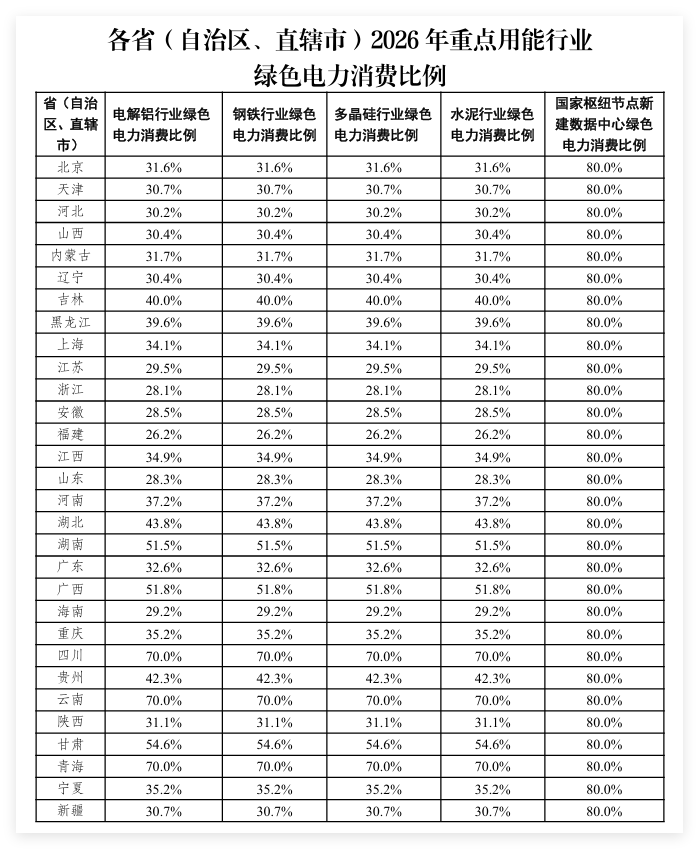
两部门:2025年增设钢铁、水泥、多晶硅行业和国家枢纽节点新建数据中心绿色电力消费比例
news flash· 2025-07-11 09:14
Core Viewpoint - The National Development and Reform Commission and the National Energy Administration have announced a plan to increase the green electricity consumption ratio for the steel, cement, polysilicon industries, and newly built data centers at national hub nodes by 2025, in line with various energy and carbon reduction policies [1]. Summary by Category Green Electricity Consumption Ratios - The green electricity consumption ratios for various industries and regions have been specified, with the following notable figures: - Electrolytic aluminum industry: ranges from 26.1% to 70.0% across different provinces [2][4] - Steel industry: ranges from 26.1% to 70.0% across different provinces [2][4] - Polysilicon industry: ranges from 26.1% to 70.0% across different provinces [2][4] - Cement industry: ranges from 25.2% to 70.0% across different provinces [2][4] - National hub node data centers: set at 80.0% across all provinces [2][4] Regional Breakdown - Specific provinces have varying green electricity consumption ratios: - Beijing: 30.6% for electrolytic aluminum, steel, polysilicon, and cement [4] - Guangdong: 32.6% for electrolytic aluminum, steel, polysilicon, and cement [2] - Sichuan and Yunnan: both at 70.0% for electrolytic aluminum, steel, polysilicon, and cement [2][4] - Hunan: 51.5% for electrolytic aluminum, steel, polysilicon, and cement [2] - Jiangsu: 27.5% for electrolytic aluminum, steel, polysilicon, and cement [4]

有色2025年中期策略
2025-07-09 02:40
Summary of Key Points from Conference Call Records Industry Overview - The conference call discusses the non-ferrous metals industry, focusing on gold, copper, rare earths, aluminum, tin, and tungsten markets. Core Insights and Arguments Gold Market - The average gold price for the second half of the year is expected to be between $3,300 and $3,400, an increase from $3,200 in Q2 [2] - Factors supporting gold prices include: - The passage of the "Big and Beautiful" Act in the U.S., which increases national debt and weakens the dollar and U.S. Treasury credit [2] - Continued gold purchases by global central banks, with China's central bank increasing its gold holdings in June [2] - A rebound in gold ETF holdings, indicating investor expectations of a potential Fed rate cut in September [2] - Potential bearish factors for gold prices include the introduction of stablecoins and geopolitical events, but these have been largely priced in by the market [3] - Recommended companies to watch include Shandong Gold and Chifeng Jilong Gold [3] Copper Market - The copper market shows a balanced supply-demand situation, but the smelting sector faces pressure with current TC prices around -$45 [4] - Potential for smelting plant losses and production cuts could lead to higher copper prices, as seen in March 2024 when production cuts led to price increases [4] - U.S. inventory accumulation from non-U.S. regions is expected to support copper prices [4] - Recommended companies include Luoyang Molybdenum, Jiangxi Copper, and Western Mining [4] Rare Earth Market - Rare earth prices are expected to rise in the second half of the year due to tight global supply and China's export restrictions [5][6] - Demand from electric vehicles and renewable energy sectors is increasing [5] - Companies with resource advantages like Northern Rare Earth and Zhongke Sanhuan are expected to benefit from rising prices [6] - A price increase of 30% to 40% is anticipated in the rare earth market, with a focus on companies related to neodymium refining [8] Aluminum Market - The aluminum market faces oversupply pressures, with rising costs for alumina and electricity potentially impacting prices [7] - The Chinese government may intervene to stabilize market prices, limiting overall price volatility [7] Tin Market - Tin prices are expected to remain high due to limited global resources and strong demand from electronics [7] - However, macroeconomic downturns or the emergence of substitute materials could negatively impact tin prices [7] - Recommended companies include Yunnan Tin Company, Huaxi Silver, and Xingye Silver Tin [11] Tungsten Market - China's environmental regulations are improving supply-demand dynamics and supporting tungsten prices [7] - Growth in high-performance materials and military applications is expected to drive demand [7] - Recommended companies include Xiamen Tungsten and China Tungsten High-tech [7] Additional Important Insights - The overall non-ferrous metals market is influenced by geopolitical uncertainties, macroeconomic conditions, and regulatory changes in major producing countries [1][2][3] - The anticipated demand growth in electronic consumption is a critical factor for tin and other metals, with a focus on companies that can leverage these trends [11]
优质稀缺资产,红利价值彰显——电解铝行业2025年度中期投资策略
2025-07-07 16:32
Summary of the Electrolytic Aluminum Industry Conference Call Industry Overview - The electrolytic aluminum sector presents significant investment opportunities, categorized into two types: stable high-dividend companies (e.g., Hongqiao, Hongchuang, Zhongfu, Tianshan) and economically resilient high-elasticity companies (e.g., Shenhuo, Yun Aluminum, China Aluminum, Huadong) [1][2] - The top return on equity (ROE) for resource companies typically reaches 40%-60%, with Zijin Mining and China Hongqiao achieving 20% [1][4] - Domestic ROE may have reached 50%-60%, indicating that irrational supply expansion is unlikely [1][4] Market Dynamics - Despite a challenging global economy, prices for metals like copper and aluminum are rising, driven by industrial resilience, demand for new energy, and a trend of consumer downgrading [1][6] - Increased consumer purchases of vehicles and 3C products, along with greater industrial equipment investment, support long-term demand for copper and aluminum [1][6] - The copper and zinc industries maintain rigid supply, suggesting potential price growth exceeding that of coal [1][7] Investment Strategy - The current investment strategy emphasizes electrolytic aluminum due to long-term industrial recovery, rigid supply, and declining costs, with expectations for profit recovery [2][20] - The best investment timing for copper and zinc stocks is after a peak in gold prices, indicating the start of industrial recovery [8][9] - Copper and aluminum stocks are expected to see valuation increases in the latter part of the interest rate cut cycle, with current price-to-earnings (P/E) ratios of 11-12 times for copper and 1.5 times for aluminum indicating high value [10][9] Seasonal Trends - The copper and aluminum markets perform well from February to April and July to September, as prices are typically high and inventories low during these periods [11] Demand Characteristics - Aluminum demand has shown strong resilience, with an annual growth rate of approximately 5%, outpacing copper and steel [12] - The electric revolution has driven stable growth in copper demand, while aluminum's diverse applications contribute to its stronger growth potential [12] Supply Situation - Domestic production capacity is constrained due to high energy consumption policies, while overseas capacity additions are slower than expected due to regulatory challenges [13][14] - Global annual capacity additions are around one million tons, indicating slow overall supply growth [14] Financial Health - The industry has seen significant cash flow improvements and reduced debt ratios, with companies like Hongqiao increasing their net operating income from 20 billion to approximately 60 billion [16] - The overall sector is experiencing a high dividend trend, similar to the coal industry after years of balance sheet repair [16][19] Dividend Trends - The aluminum sector is showing a positive trend in dividends, with companies like Hongqiao increasing their payout ratio from 50% to 60% [17] - State-owned enterprises are also beginning to show marginal increases in dividends, suggesting further potential for growth [17] Stock Selection - Stock selection is straightforward, divided into two categories: companies with completed integration and stable dividends (e.g., China Hongqiao) and those with capital expenditure expectations (e.g., China Aluminum) [18] Future Outlook - The aluminum industry has a positive outlook, with expectations for further recovery in profitability and cash flow, and the sector remains undervalued with a price-to-book (PB) ratio of approximately 1.5 times [19][20] - Short-term fluctuations in aluminum prices are expected, but long-term demand resilience suggests a steady upward trend in price levels [21]
【钢铁】5月电解铝产能利用率创2012年有统计数据以来新高水平——金属周期品高频数据周报(6.30-7.6)(王招华/戴默)
光大证券研究· 2025-07-07 08:34
Core Viewpoint - The article discusses various economic indicators and trends in different sectors, highlighting the current state of liquidity, construction, real estate, industrial products, and export chains, along with price movements and production metrics. Liquidity - The M1 and M2 growth rate difference was -5.6 percentage points in May 2025, with a month-on-month increase of 1.1 percentage points [3] - The BCI small and medium enterprise financing environment index was 49.12 in June 2025, reflecting a slight increase of 0.07% from the previous month [3] - London gold prices increased by 1.94% compared to the previous week [3] Infrastructure and Real Estate Chain - The average daily crude steel output of key enterprises in late June was 2.129 million tons, showing a month-on-month decrease of 0.88% [4] - Price changes included rebar up by 2.91%, cement price index down by 1.68%, and iron ore up by 3.55% [4] - National capacity utilization rates for blast furnaces, cement, asphalt, and all-steel tires changed by -0.54 percentage points, +16.00 percentage points, -0.6 percentage points, and -1.89 percentage points respectively [4] Real Estate Completion Chain - Prices for titanium dioxide and flat glass decreased by 1.47% and remained unchanged respectively, with glass profit at -58 CNY/ton and titanium dioxide profit at -1227 CNY/ton [5] - The operating rate for flat glass was 75.68% this week [5] Industrial Products Chain - The PMI new orders index for June was 50.20%, reflecting a month-on-month increase of 0.4 percentage points [6] - Major commodity prices showed mixed results, with cold-rolled steel and copper prices increasing by 0.27% and 0.22%, while aluminum prices decreased by 0.91% [6] - The operating rate for semi-steel tires was 70.41%, down by 7.64 percentage points [6] Subcategories - The capacity utilization rate for electrolytic aluminum reached a record high since 2012 in May [7] - The price of electrolytic aluminum was 20,750 CNY/ton, down by 0.91%, with a calculated profit of 3,428 CNY/ton (excluding tax) [7] - The price of graphite electrodes remained stable at 18,000 CNY/ton, with a comprehensive profit of 1,357.4 CNY/ton, down by 5.56% [7] Price Comparison Relationships - The price ratio of rebar to iron ore reached a near seven-month high at 4.27 this week [8] - The price difference between hot-rolled and rebar steel was 110 CNY/ton, while the price difference between cold-rolled and hot-rolled steel reached 340 CNY/ton, up by 170 CNY/ton [8] - The price difference for small rebar (used in real estate) and large rebar (used in infrastructure) was 140 CNY/ton, down by 26.32% from last week [8] Export Chain - The new export orders PMI for China in June 2025 was 47.70%, with a month-on-month increase of 0.2 percentage points [9] - The CCFI comprehensive index for container shipping rates was 1,342.99 points, down by 1.92% [9] - The capacity utilization rate for U.S. crude steel was 79.10%, down by 0.50 percentage points [9] Valuation Percentiles - The CSI 300 index increased by 1.54%, with the best-performing cyclical sector being ordinary steel, which rose by 6.52% [10] - The PB ratios for ordinary steel and industrial metals relative to the CSI 300 PB were 37.44% and 69.40% respectively [10] - The current PB ratio for the ordinary steel sector relative to the CSI 300 PB is 0.53, with the highest value since 2013 being 0.82 [10]

通胀预期的兑现路径探讨
Hua Tai Qi Huo· 2025-07-06 10:02
Report Summary 1. Investment Rating The provided content does not mention the industry investment rating. 2. Core Views - **Macro**: In the second half of the year, the demand is pro - cyclically weak, and the policy is "easy to loosen and hard to tighten". Under the assumption of relatively mild monetary and supply - side policies, focus on policy expectations in July, with a relatively positive macro tone. From July to September, if policies do not turn significantly looser, the US will face liquidity risks and the threat of "reciprocal tariffs", bringing macro pressure. After September, pay attention to the expansion of fiscal policy and the transmission of inflation [8][29][30]. - **Mesoscopic**: From the perspective of policy documents and industry self - discipline, industries such as steel, refining, synthetic ammonia, cement, electrolytic aluminum, data centers, coal - fired power, photovoltaic, lithium batteries, new energy vehicles, and e - commerce can be focused on for the current comprehensive rectification of "involution - style" competition [9]. - **Microscopic**: Overseas, the core is the inflation expectation dominated by currency. It is necessary for the Fed to restart the easing cycle smoothly, and gold, crude oil, and non - ferrous metals are relatively beneficial. Domestically, the core is the supply - side policy. Referring to 2015, sectors with obvious supply - side production cuts had greater increases, and industrial profits improved, with the mid - and downstream benefiting more than the upstream. This round focuses on sectors such as the black sector and new energy metals [10]. 3. Summary by Directory 3.1 Macro - **Demand and Inventory Cycle**: The pro - cyclical demand in the second half of the year is weak. The Sino - US inventory cycle has re - entered the destocking phase, and this round of destocking may last until the end of 2025 [14]. - **Monetary and Fiscal Policies**: Global central banks are "easy to loosen and hard to tighten", and both China and the US are increasing fiscal policies. In China, a series of financial policies have been introduced, and the "market bottom" is clear [20][21]. - **Tariff Threats**: Global populist waves are continuous. Trump has issued tariff threats, and the US is in different stages of trade negotiations with various countries [25]. - **Macro Scenario Deduction**: In July, focus on policy expectations; from July to September, there is macro pressure; after September, pay attention to the expansion of fiscal policy and the transmission of inflation [28][29][30]. 3.2 Mesoscopic - **Policy Shift in the US**: The passage of the "Great Beauty" bill marks the US's shift from the first half of the year's "tight fiscal expectation + neutral currency" to a "easy to loosen and hard to tighten" policy stage [32]. - **Domestic Policy Focus**: The Central Financial and Economic Commission meeting focuses on governing "involution - style" competition, but details of industry production cuts are needed to determine the inflation trading theme [32]. - **Policy on "Involution - style" Competition**: Policy documents and industry self - discipline focus on industries such as steel, refining, etc. The causes of "involution - style" competition are analyzed, and comprehensive rectification ideas are proposed [9][35][36]. 3.3 Commodities - **Capital Expenditure**: The capital expenditure of non - ferrous metals has slowed down, while that of the black, chemical, and energy sectors has increased. The capital expenditure of crude oil has increased, and the capital expenditure of industrial metals has shown different trends [42][45]. - **Asset Performance in Stagflation - like Situations**: Overseas macro situations are more in line with "stagflation - like" characteristics. In historical stagflation - like stages, the performance of various assets is highly differentiated [54]. - **2015 Supply - side Reform Review**: In 2015, supply - side structural reform was proposed, with clear tasks such as "cutting overcapacity, reducing inventory, deleveraging, reducing costs, and strengthening weak links". Sectors with obvious production cuts had greater increases, and industrial profits improved [61][62].
深度思考:反内卷与供给侧改革的异同
雪球· 2025-07-06 07:50
以下文章来源于黑貔貅俱乐部 ,作者黑貔貅 黑貔貅俱乐部 . 宏观经济 ,亮点行业,大类资产配置 风险提示:本文所提到的观点仅代表个人的意见,所涉及标的不作推荐,据此买卖,风险自负。 作者:黑貔貅俱乐部 来源:雪球 站在当下看未来的3-5年 , 反内卷或许会成为影响中国社会以及经济最重要的事件之一 。 映射到资本市场 上也会带来巨大的投资机会 , 尤其是对商品而言 , 可能会成为影响部分品种的核心变量 。 尽管大家都在 类比16年的供给侧改革 , 但是我觉得还是有很大的差异性 。 01 有较大的背景跟性质差异 15年过剩的行业相对集中在中上游领域 , 产品的同质化竞争是比较严重的 , 比如钢铁 , 水泥 , 电解铝 , 玻璃等等 , 大家生成的东西没有多少不同 , 价格上也没有多少差距 。 而且这种过剩很大程度上是因为 2011-2012年的经济繁荣带来的投资 , 主要是周期性因素为主 , 通过棚改货币化刺激需求以及行政手段 压减无效产能 , 退出效果还是比较显著的 。 但是本轮产能主要集中在终端消费领域 , 产品的差距还是很大 , 中低高端都有 , 很难通过行政命令去去 化 , 比如光伏是差异化过剩问题 。 ...

钢铁行业周思考(2025年第27周):反内卷是钢铁行业的中期投资逻辑
Orient Securities· 2025-07-06 02:45
Investment Rating - The report maintains a "Positive" investment rating for the non-ferrous and steel industry [6]. Core Viewpoints - The mid-term investment logic for the steel industry is centered around the concept of "anti-involution," which is expected to improve profitability [10][15]. - Despite some investors questioning the sustainability of the "anti-involution" theme, the report argues that it is a key driver for profit improvement in the steel sector [10][15]. - The report anticipates a shift in the iron ore supply side dynamics, which will further reinforce the mid-term investment logic of "anti-involution" in the steel industry [10][15][16]. Summary by Sections Investment Suggestions and Targets - The report highlights the importance of focusing on stable profit and high dividend-paying segments within the electrolytic aluminum sector [9]. - It suggests monitoring companies with high gross profit elasticity per ton of steel, such as Sansteel Minmetals, Hualing Steel, and Nanjing Steel [10]. Steel Industry Analysis - The report indicates that steel demand is better than expected, with a notable increase in rebar consumption [17]. - Total steel inventory is expected to decline further due to the "anti-involution" measures [24]. - Profit margins for long and short process rebar steel are projected to continue expanding [28]. - Steel prices are likely to rise further, with the rebar price showing a significant increase [34]. New Energy Metals - The report notes a substantial year-on-year increase in lithium production, indicating a positive outlook for lithium prices [38]. - The demand for new energy vehicles remains strong, with significant growth in production and sales [42]. Industrial Metals - The report observes a decrease in electrolytic aluminum inventory, suggesting potential price increases [56]. - The global refined copper production is slightly better than expected, with a year-on-year increase [59]. Other Notable Insights - The report emphasizes the importance of supply-side reforms in the steel industry, particularly in reducing overcapacity and improving efficiency [16]. - It highlights the role of state-owned enterprises in leading the charge against involutionary competition within the steel sector [16].
东方证券:重点关注盈利稳定、高分红的电解铝板块投资机会 建议关注中国宏桥
Zhi Tong Cai Jing· 2025-07-04 03:32
Group 1 - The core viewpoint is that with the continuous destocking of aluminum chain and aluminum processing products, primary aluminum prices are expected to maintain an upward trend, and leading companies may exhibit higher profit elasticity [1] - In the short term, there is no favorable demand side, while in the medium term, investment should focus more on supply-side logic [1] - The current overall dividend yield of the sector remains attractive compared to other dividend assets, suggesting a focus on China Hongqiao (01378) [1] Group 2 - Long-term stable low-cost electricity supply is a hard constraint for the domestic and international electrolytic aluminum industry [2] - Although overseas energy costs have been at a low level in recent years, there may be significant upward risks in the future [2] - The electrolytic aluminum industry is expected to maintain a good supply-demand pattern in the medium term [2] Group 3 - The stability of the supply-demand pattern is expected to enhance the stability of future industry profits [3] - Continuous decline in capital expenditure within the electrolytic aluminum industry is likely to lead to sustained improvements in the balance sheets of listed companies, ultimately reflecting in increased dividends and buybacks [3] - Major listed companies in the electrolytic aluminum sector are projected to have dividend yields close to 6% [3]