
农副食品加工

Search documents
金融期货早评-20260202
Nan Hua Qi Huo· 2026-02-02 05:06
Report Industry Investment Rating There is no information about the report industry investment rating in the provided content. Core Views of the Report - If Kevin Warsh is successfully appointed as the Chairman of the Federal Reserve, he will combine a hawkish stance with political compromise, implementing a unique policy of simultaneous interest rate cuts and balance - sheet reduction. His core goal is to compress the private sector's balance sheet and repair the government's balance sheet, with oil prices serving as a key supplementary tool for this policy. This series of policy adjustments will interact with the narrative of the loss of US dollar credit, becoming a crucial scenario to test this narrative [2]. - The market is expected to enter a cautious exploration period in February. The key lies in Warsh's explanation of policy contradictions during the Senate hearing. His combination policy of interest rate cuts and balance - sheet reduction may suppress risk assets such as equities and be beneficial for the bond market to carry out short - term borrowing and long - term investment strategies. However, the high - level operation of long - term yields also brings uncertainties to the real economy [2]. - The trend of Warsh's policies will become the core variable in the global financial market, and whether his nomination can be confirmed by the Senate is currently the primary uncertainty factor. Subsequently, three key points need to be focused on: the Senate voting result, the possible risk of the Fed's independence caused by Powell's departure, and the switch of the global market trading narrative [2]. Summary According to Relevant Catalogs Financial Futures - **Market Information**: Trump nominated Kevin Warsh as the next Fed Chairman. Senate Democrats and some Republicans oppose the nomination. Eurozone Q4 2025 GDP grew 1.3% year - on - year. Japan's Tokyo January core CPI slowed to 2%. South Korea is concerned about the won's depreciation. The US continued to list Japan as a "monitoring object" [1]. - **Core Logic**: If Warsh takes office, the Fed's monetary policy framework may change from the "post - Keynesian data - dependent model" to the "supply - side monetarism" paradigm. The US dollar index may strengthen if US economic data is positive. His policy may suppress risk assets and benefit the bond market [2]. - **RMB Exchange Rate**: Warsh's nomination triggered high market volatility. The on - shore RMB depreciated slightly against the US dollar. The change in the Fed's policy framework may reshape market expectations, and the US dollar index may rise [2][3]. - **Stock Index**: The nomination of Warsh led to market fluctuations. Overseas market reactions may affect A - shares in the short term, causing a phased adjustment. The market style may shift from "small - and - medium - cap stocks outperforming" to "large - cap stocks outperforming" [6]. - **Treasury Bonds**: The bond market's rise was partly due to the stock market's adjustment and policy rumors. Warsh's nomination may lead to a deeper market adjustment. The 10 - year Treasury bond yield may break through 1.80%, and mid - line long positions can consider partial profit - taking [6][7][8]. - **Container Shipping to Europe**: The market shows a pattern of near - term weakness and long - term strength. Near - month contracts are suppressed by weak spot prices, while long - term contracts are supported by geopolitical uncertainties. The market is expected to continue this differentiation [8][9][10]. Commodities Non - ferrous Metals - **Copper**: The copper price first rose and then fell. Global copper inventories continued to rise, but the growth rate slowed. China's power grid investment may increase copper demand. Before the holiday, short - term range trading is recommended [12][13][14]. - **Aluminum Industry Chain**: The aluminum price was affected by funds and emotions, first rising and then falling. Fundamentally, there is pressure on aluminum prices due to increased production and weakening demand. In the long term, the aluminum price is expected to rise. For alumina, the long - term trend is weak, and for cast aluminum alloy, it is recommended to pay attention to the price difference with aluminum [16][17]. - **Zinc**: The zinc price recovered its previous gains. The supply is expected to be loose, and the demand is weak. It is expected to maintain a wide - range shock [17]. - **Nickel - Stainless Steel**: The prices of nickel and stainless steel fell. They are mainly affected by the market and macro - level emotions. The supply and demand pattern may be affected in the long - term, but the short - term impact is limited [18][19]. - **Tin**: The tin price fell, but there is support at the bottom. The market is in a state of divergence, and the price is expected to fluctuate widely in the short term [20]. - **Lead**: The lead price was weak, and the market is expected to fluctuate within a range. Selling options to collect stable premiums is recommended [20]. Oils and Feeds - **Oilseeds**: The market shows a pattern of strong oils and weak meals. The supply of imported soybeans may have a gap in Q1, and the prices of domestic soybean meal and rapeseed meal are not optimistic [22][23][24]. - **Oils**: The overall trend of oils is still prone to rise and difficult to fall. Palm oil is facing a pressure test, and the prices of soybean oil and rapeseed oil are affected by supply and demand factors such as production and policies [24][25][26]. Energy and Oil and Gas - **Fuel Oil**: The high - sulfur fuel oil supply is gradually recovering, but the demand is weak. The low - sulfur fuel oil supply is abundant, and the demand is stable. The cracking spread of high - sulfur fuel oil is expected to decline in the long - term, and the pressure on the low - sulfur fuel oil to contract is increasing [28][29]. - **Asphalt**: The asphalt price is rising weakly. The recent rise is driven by multiple factors, but the supply pressure will increase in the future. The 03 contract may provide a trading opportunity [30]. Precious Metals - **Platinum & Palladium**: Warsh's nomination led to a sharp decline in platinum and palladium prices. In the short - term, the "tightening trade" expectation does not change the long - term "loose trade" trend. Attention should be paid to position control [31][33][34]. - **Gold & Silver**: The prices of gold and silver fluctuated sharply. In the short - term, they may enter a phased adjustment period, but in the long - term, they are expected to rise due to factors such as the Fed's policy and the global de - dollarization trend [34][38][39]. Chemicals - **Pulp - Offset Paper**: The prices of pulp and offset paper futures fell. The decline is due to factors such as the overall bearish sentiment in the commodity market, increased port inventories, and reduced downstream demand. It is recommended to wait and see [40][41][42]. - **LPG**: The LPG price is affected by geopolitical factors. The supply is neutral - low, and the demand is weak. Attention should be paid to the risk of price increases [42][43]. - **PTA - PX**: The PX supply is expected to remain high, and the PTA supply is stable. The high processing fee of PTA is expected to be difficult to maintain. It is recommended to buy PX on dips and short the PTA processing fee on highs [43][44]. - **MEG - Bottle Grade Resin**: The demand for ethylene glycol is seasonally weak, and the supply is expected to increase. The price is expected to fluctuate widely with the macro - environment. Attention should be paid to geopolitical risks [46][47]. - **Methanol**: The methanol market is volatile, mainly affected by geopolitical risks and the improvement of the energy - chemical commodity market sentiment. It is recommended to wait and see [47]. - **PP**: The PP price is affected by macro - emotions and cost factors. The supply and demand are both decreasing. Attention should be paid to macro - trends and cost changes [49]. - **PE**: The PE price is affected by macro - emotions and cost factors. The supply is increasing, and the demand is decreasing. Attention should be paid to the risk of price declines [50]. - **Pure Benzene - Styrene**: The prices of pure benzene and styrene are affected by geopolitical factors. The supply of pure benzene is increasing, and the demand is decreasing. The supply of styrene will increase in February, and the demand will decline. It is recommended to wait and see and buy styrene on dips [50][52]. - **Urea**: The urea price is expected to decline in the short - term. It is recommended to close long positions [52]. - **Glass - Soda Ash**: The soda ash supply is expected to be in excess, and the glass market is in a situation of weak supply and demand. It is recommended to wait and see [54][56]. - **Propylene**: The propylene price is affected by cost and supply - demand factors. The supply and demand are both decreasing, and the price is expected to be supported. Attention should be paid to the development of the US - Iran situation [57]. Black Metals - **Rebar & Hot - Rolled Coil**: The prices of rebar and hot - rolled coil are in a range - bound state. The supply may increase, and the demand is seasonally weak. The iron ore price is affected by factors such as steel mill restocking and supply and demand [58][59]. - **Iron Ore**: The iron ore price follows the overall market trend. The supply is in a seasonal low, and the demand may increase with the rise of iron - water production [60]. - **Coking Coal & Coke**: The coking coal market is in a stage of excess supply, and the coke price increase may face difficulties. The short - term price volatility may increase, and the long - term trend depends on domestic mine复产 and downstream demand recovery [62]. - **Silicon Iron & Silicon Manganese**: The prices of silicon iron and silicon manganese are in a range - bound state, with cost support at the bottom and supply - demand pressure at the top [62]. Agricultural and Soft Commodities - **Hogs**: The pig prices in the north rebounded, and those in the south stabilized. The market is expected to see an increase in both supply and demand before the Spring Festival. The specific price trend depends on the actual出栏 volume and terminal consumption [64][65]. - **Cotton**: The cotton price is under pressure due to the strengthening of the US dollar. The domestic cotton price is supported by supply - demand expectations but restricted by the high domestic - foreign price difference. It is recommended to buy on dips [65][66]. - **Sugar**: The international raw sugar price fell, and the domestic sugar price is affected by international prices. The short - term price increase is mainly due to capital factors, and the upward space is limited [66][67][68]. - **Eggs**: The spot egg price is stable at a high level, and the large basis indicates risks after the Spring Festival. The price is expected to fluctuate within a range [68]. - **Apples**: The pre - holiday apple stocking accelerated, the spot price was loose, and the futures price was relatively stable. Attention should be paid to the logic of the shortage of delivery goods [69][70]. - **Jujubes**: The jujube supply is abundant, and the demand is the focus. The short - term price may fluctuate at a low level, and the long - term price is under pressure [70][71]. - **Logs**: The log inventory is at a low level, and the spot price is rising. The overall valuation is increasing. It is recommended to sell put options [72][73].
未知机构:国海银行资产配置1月PMI点评景气度有所回落非制造业持续扩张-20260202
未知机构· 2026-02-02 02:10
Summary of Conference Call Notes Industry Overview - The overall economic sentiment in China has declined, with the composite PMI output index at 49.8% (↓0.9pp) indicating a contraction in economic activity [1] - Manufacturing PMI stands at 49.3% (↓0.8pp), below Bloomberg's expectation of 50.1% [1][2] - Non-manufacturing PMI is at 49.4% (↓0.8pp), also below Bloomberg's expectation of 50.3% [1][2] Manufacturing Sector Insights - Manufacturing supply and demand indices have decreased: - Production index at 50.6% (↓1.1pp), indicating continued expansion [4] - New orders at 49.2% (↓1.6pp) and new export orders at 47.8% (↓1.2pp), showing a decline in demand [4] - Price indices show signs of recovery: - Main raw material purchase price index at 56.1% (↑3.0pp) and factory price index at 50.6% (↑1.7pp), with the latter exceeding the critical point for the first time in 20 months [4] - Large enterprises maintain expansion with PMI at 50.3% (↓0.5pp), while medium and small enterprises show contraction at 48.7% (↓1.1pp) and 47.4% (↓1.2pp) respectively [4] - Market expectations remain generally positive with a production and business activity expectation index at 52.6% (↓2.9pp), still above the critical point [4] - Specific industries such as agricultural and food processing have maintained high activity levels, with expectation indices above 56.0% for two consecutive months [4] Non-Manufacturing Sector Insights - The construction industry has entered a contraction phase due to factors like low temperatures and the upcoming Spring Festival, with a business activity index at 48.8% (↓4.0pp) [5] - New orders index at 40.1% (↓7.3pp) and business activity expectation index at 49.8% (↓7.6pp), marking the latter's first drop into contraction since March 2020 [5] - Input prices have risen to 52.0% (↑1.1pp) for four consecutive months, while sales prices at 48.2% (↑0.8pp) and employment index at 41.1% (↑0.1pp) show varying degrees of recovery [5] - Service sector shows slight decline with a business activity index at 49.5% (↓0.2pp) [6] - Financial services, capital markets, and insurance sectors remain active with indices above 65.0%, while the real estate sector's index has dropped below 40.0%, indicating weak sentiment [6]
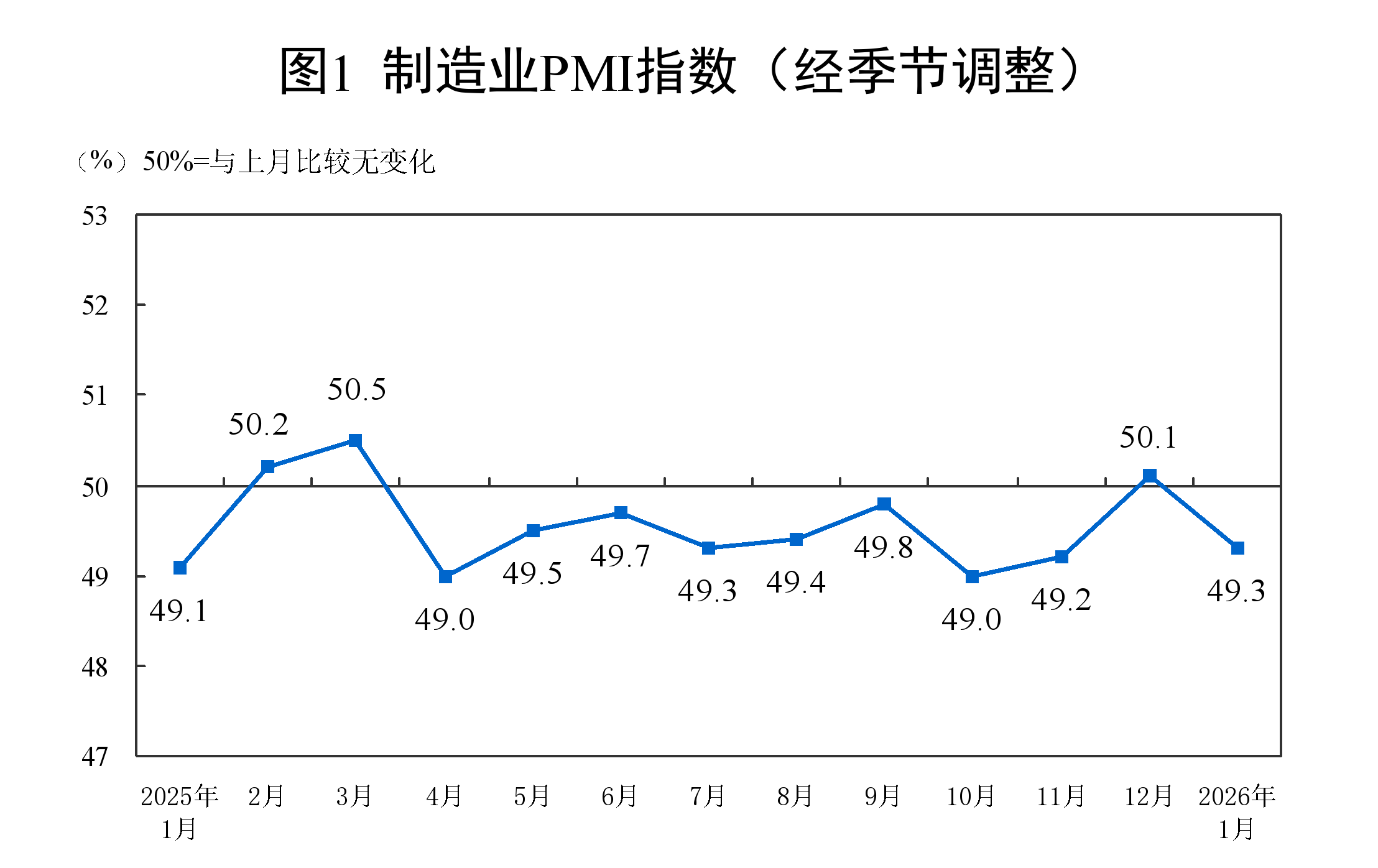
1月份制造业PMI为49.3%
Ren Min Ri Bao Hai Wai Ban· 2026-02-02 01:48
Group 1 - The manufacturing Purchasing Managers' Index (PMI) for January is 49.3%, a decrease of 0.8 percentage points from the previous month, indicating a decline in manufacturing activity due to seasonal factors and insufficient market demand [2] - The production index stands at 50.6%, indicating continued expansion in manufacturing production, while the new orders index is at 49.2%, reflecting a drop in market demand [2] - Certain industries such as agricultural processing and aerospace have production and new orders indices above 56.0%, indicating strong demand, while sectors like petroleum and automotive show indices below the critical point, suggesting a slowdown in market demand [2] Group 2 - The main raw materials purchasing price index and the factory price index are at 56.1% and 50.6%, respectively, both showing increases from the previous month, with the factory price index rising above the critical point for the first time in nearly 20 months [3] - Large enterprises maintain a PMI of 50.3%, indicating continued expansion, while medium and small enterprises show PMIs of 48.7% and 47.4%, reflecting a decline in their economic performance [3] - High-tech manufacturing leads with a PMI of 52.0%, remaining above 52.0% for two consecutive months, while consumer goods and high-energy industries show lower PMIs of 48.3% and 47.9%, indicating a decrease in their economic conditions [3] Group 3 - The production and business activity expectation index is at 52.6%, indicating optimism among enterprises, particularly in agricultural processing and food industries, which have indices above 56.0% [4] - The non-manufacturing business activity index for January is 49.4%, a decrease of 0.8 percentage points from the previous month, indicating a decline in overall non-manufacturing activity [4] - The service industry business activity index is at 49.5%, down 0.2 percentage points, with sectors like financial services showing high activity indices above 65.0%, while the real estate sector drops below 40.0%, indicating weak performance [4]

1月份中国采购经理指数有所回落
Guo Jia Tong Ji Ju· 2026-02-02 01:05
Group 1: Manufacturing Sector - The manufacturing Purchasing Managers' Index (PMI) decreased to 49.3% in January, indicating a decline in economic sentiment compared to the previous month [1][2] - The production index remained above the critical point at 50.6%, suggesting continued expansion in manufacturing production, while the new orders index fell to 49.2%, indicating a drop in market demand [2] - Large enterprises maintained a PMI of 50.3%, indicating ongoing expansion, while small and medium-sized enterprises saw declines in their PMIs to 48.7% and 47.4%, respectively [3] - High-tech manufacturing continued to lead with a PMI of 52.0%, reflecting a positive development trend in this sector [3] - The price indices for major raw materials and factory prices rose to 56.1% and 50.6%, respectively, indicating an overall improvement in market price levels [2] Group 2: Non-Manufacturing Sector - The non-manufacturing business activity index fell to 49.4%, reflecting a decrease in overall economic sentiment in this sector [1][4] - The service industry business activity index was at 49.5%, with significant activity in financial services, while the real estate sector's index dropped below 40.0%, indicating weak sentiment [4] - The construction industry experienced a notable decline, with its business activity index at 48.8%, influenced by adverse weather and the upcoming holiday [4] - Despite the decline in current activity, the service industry business activity expectation index rose to 57.1%, indicating increased confidence among service sector enterprises [4] Group 3: Composite PMI - The composite PMI output index was recorded at 49.8%, showing a slight decrease from the previous month, indicating a general slowdown in production and business activities [1][5] - The manufacturing production index and non-manufacturing business activity index were 50.6% and 49.4%, respectively, contributing to the overall composite PMI output index [5]
兼评1月PMI数据:开年PMI边际放缓
KAIYUAN SECURITIES· 2026-02-01 07:12
chence@kysec.cn 证书编号:S0790524020002 制造业:PMI 再度转弱,生产与需求均下行 (1)需求下行叠加高基数拖累,制造业景气度降至荣枯线下。1 月制造业 PMI 为 49.3%、环比下行了 0.8 个百分点,明显弱于季节性规律。此前我们曾指出"12 月工作日数同比增加 2 天,作为环比指标的 PMI 读数会出现一定改善",实际 上经济改善幅度可能有限,但这形成了较高的基数并拖累 1 月 PMI 表现。分行 业来看,农副食品加工、铁路船舶航空航天设备等产需指数位于高景气区间, 油煤加工、汽车等行业则相对承压。 (2)有色原油涨价提振工业原材料价格,预计 1 月 PPI 同比延续回升。1 月 PMI 原材料购进价格为 56.1%,较前值上升了 3.0 个百分点;PMI 出厂价格为 50.6%, 较前值上升了 1.7 个百分点。根据高频指标,我们预计 1 月 PPI 环比可能在 0.3% 左右、同比为-1.3%左右。 2026 年 02 月 01 日 开年 PMI 边际放缓 宏观研究团队 ——兼评 1 月 PMI 数据 何宁(分析师) 陈策(分析师) hening@kysec.cn ...
1月制造业PMI49.3%,制造业市场价格总体改善
2 1 Shi Ji Jing Ji Bao Dao· 2026-02-01 02:29
21世纪经济报道记者冉黎黎 北京报道 1月31日,国家统计局服务业调查中心和中国物流与采购联合会发布了中国采购经理指数。1月份,制造业采购经理指 数(PMI)为49.3%,比上月下降0.8个百分点,制造业景气水平有所回落。 对于制造业PMI回落的原因,国家统计局服务业调查中心首席统计师霍丽慧解读时提到,1月份,部分制造业行业进入传统淡季,加之市场有效需求仍显不 足。 中信证券首席经济学家明明对21世纪经济报道记者表示,2025年12月制造业PMI超预期回升至50.1%,产需全面改善下,春节备货情况有所前置,导致本月 数据回落。 从供需来看,生产指数为50.6%,高于临界点,制造业生产保持扩张;新订单指数为49.2%,市场需求有所回落。从行业看,农副食品加工、铁路船舶航空 航天设备等行业生产指数和新订单指数均高于56.0%,产需释放较快。 需要注意的是,高技术制造业PMI为52.0%,连续两个月位于52.0%及以上较高水平,相关行业发展态势持续向好。装备制造业PMI为50.1%,保持在扩张区 间。 另外,制造业市场价格总体水平改善。受近期部分大宗商品价格上涨等因素影响,主要原材料购进价格指数和出厂价格指数分别为 ...
新华财经早报:2月1日
Xin Hua Cai Jing· 2026-02-01 01:15
财政部、税务总局发布《关于出口业务增值税和消费税政策的公告》、《关于增值税法施行后增值税优惠政策衔接事项的公告》、《关于增值税征税具体范 围有关事项的公告》,对出口货物和跨境销售服务、无形资产适用增值税和消费税退(免)税、免税或者征税政策等有关事项做出说明。(新华财经) 2026年春运将于2月2日开启,至3月13日结束,为期40天。这是有着9天"超长"春节假期的春运,返乡探亲与旅游出行需求叠加释放,预计春运期间全社会跨 区域人员流动量将达到95亿人次,创下历史新高。其中,自驾出行仍将是主体方式,占比约八成。铁路、民航客运量预计分别达到5.4亿人次和9500万人 次,整体规模和单日客流峰值均有望超过历史同期水平。 1月份我国制造业PMI为49.3% 农副食品加工、铁路船舶航空航天设备等行业产需释放较快 财政部、税务总局发布公告明确增值税应税交易销售额计算口径 2026年春运2月2日开启预计春运期间全社会跨区域人员流动量将达到95亿人次 国家统计局服务业调查中心、中国物流与采购联合会31日发布数据显示,1月份,制造业采购经理指数(PMI)为49.3%,比上月下降0.8个百分点。1月份, 生产指数为50.6%,高于 ...

2026年1月PMI点评:节前景气回落,结构分化加剧
Orient Securities· 2026-01-31 23:30
Economic Indicators - The Manufacturing PMI for January 2026 is at 49.3%, falling below the expansion threshold of 50.1%[7] - The Production and New Orders PMI are recorded at 50.6% and 49.2% respectively, both showing significant declines from previous levels[7] Sector Performance - High-tech manufacturing PMI stands at 52%, slightly down from 52.5%, but remains near the second-highest level since the implementation of equal tariff policies in April 2025[7] - The construction sector's activity has slowed significantly, with the PMI dropping below 40% due to adverse weather and the upcoming holiday[7] Demand Dynamics - New Orders PMI has seen a year-on-year decline, marking the second-lowest drop for this period, indicating insufficient domestic demand[7] - New Export Orders PMI decreased by 1.2 percentage points to 47.8%, influenced by prior export surges and trade policy adjustments from key partners[7] Price Trends - Major raw material purchase price index and factory price index have risen to 56.1% and 50.6% respectively, indicating a return to expansion after 20 months[7] - Prices in the non-ferrous metal sector are driving overall price increases, while sectors with weak internal demand, like wood processing, show price contraction[7] Future Outlook - The report suggests that geopolitical changes and investment demand in technology will continue to drive global capital expenditure and commodity prices, particularly in non-energy commodities[7] - The ongoing contradiction of strong supply versus weak demand in the domestic market remains a critical issue, with the ability of upstream prices to transmit to downstream still uncertain[7]
新动能延续扩张态势
Xin Lang Cai Jing· 2026-01-31 22:37
Group 1: Manufacturing Sector - In January 2026, the Manufacturing Purchasing Managers' Index (PMI) was reported at 49.3%, indicating a decrease of 0.8 percentage points from the previous month, reflecting a decline in economic sentiment [1] - The production index stood at 50.6%, indicating continued expansion in manufacturing production, while the new orders index fell to 49.2%, suggesting a decrease in market demand [2] - High-tech manufacturing PMI was at 52.0%, remaining above 52.0% for two consecutive months, indicating a positive development trend in related industries [2] - Large enterprises reported a PMI of 50.3%, indicating sustained expansion and a strong supporting role in the manufacturing sector [3] Group 2: Non-Manufacturing Sector - The Non-Manufacturing Business Activity Index was reported at 49.4%, down 0.8 percentage points from the previous month, indicating a decline in overall non-manufacturing sentiment [4] - The financial sector's business activity index rose above 65%, showing a significant increase compared to the same period last year, providing a favorable financing environment for growth [4] - The service sector's business activity expectation index rose to over 57%, indicating optimism among enterprises regarding the impact of the upcoming Spring Festival on service sector demand [4][5] Group 3: Economic Outlook - Experts suggest that the market demand issue is gradually easing, with a decrease in the proportion of manufacturing enterprises reporting insufficient demand, down 9.4 percentage points to 54.9% [2] - The manufacturing production and operational activity expectation index was at 52.6%, indicating confidence in future manufacturing activities [3] - Post-Spring Festival, it is anticipated that investment-related demand will be released, potentially boosting the construction sector's sentiment [5]
高技术制造业PMI连续两个月为52.0%及以上—— 新动能延续扩张态势
Jing Ji Ri Bao· 2026-01-31 22:09
企业预期保持乐观 "1月份,部分制造业行业进入传统淡季,加之市场有效需求仍显不足,制造业景气水平较上月下 降。"国家统计局服务业调查中心首席统计师霍丽慧说。 从供需两端看,生产指数为50.6%,高于临界点,制造业生产保持扩张;新订单指数为49.2%,市场需 求有所回落。 国家统计局服务业调查中心、中国物流与采购联合会1月31日发布数据显示,2026年1月份,制造业采购 经理指数(PMI)、非制造业商务活动指数和综合PMI产出指数分别为49.3%、49.4%和49.8%,比上月 下降0.8个、0.8个和0.9个百分点,经济景气水平有所回落。 1月份,制造业生产经营活动预期指数为52.6%,继续高于临界点。农副食品加工、食品及酒饮料精制 茶等行业生产经营活动预期指数连续两个月位于56.0%以上较高景气区间,相关企业对近期行业发展信 心较强。 文韬认为,1月份,受季节性因素和外部因素影响,制造业运行有所波动,但市场需求有趋稳迹象,生 产活动保持扩张,市场价格联动上升,产业结构继续优化,制造业后市回稳运行具备基础。预计2月 份,受春节假期影响,制造业运行或继续有所放缓。随着春节过后经济社会回归正常运行,制造业将继 续 ...