消费服务

Search documents
四大证券报头版头条内容精华摘要_2026年1月19日_财经新闻
Xin Lang Cai Jing· 2026-01-19 00:37
Group 1 - The China Securities Regulatory Commission (CSRC) emphasizes the importance of maintaining a stable market as a primary task for capital market reform and development in 2026, with targeted policies expected to be introduced to support this goal [1] - The State Administration of Customs highlights the need to balance export expansion with appropriate import growth during the 14th Five-Year Plan period, aiming to enhance domestic and international circulation [2] - The State Council's recent meeting calls for accelerating the cultivation of new growth points in service consumption, with increased policy support across various sectors including the silver economy and green consumption [3] Group 2 - The People's Bank of China and financial regulators have announced a reduction in the minimum down payment ratio for commercial real estate to 30%, aimed at addressing inventory issues in the commercial property market [5] - Insurance companies are optimistic about the equity market in 2026, planning to enhance asset allocation strategies focused on "hard technology" investment opportunities [6] - Recent disclosures from high-performing funds indicate a shift in holdings towards sectors with favorable industry conditions, particularly in AI-related industries and innovative pharmaceuticals [7][8] Group 3 - The data factor market is experiencing significant changes, with numerous policy documents focused on data value extraction being released, indicating a growing emphasis on digital economy development [9] - The Ministry of Industry and Information Technology has expanded the scope of its nurturing program to include technology-based small and medium-sized enterprises, enhancing support for innovative businesses [11] - The China Securities Regulatory Commission has initiated an investigation into Rongbai Technology for potentially misleading statements regarding significant contracts, aiming to uphold market integrity [12] Group 4 - Several small and medium-sized banks have recently raised deposit rates, with specific increases noted in products such as the "Fuman Deposit" [13] - The bank wealth management market is seeing a rise in demand for fixed-income products and gold-linked structured deposits, with expectations of a market growth of 3.83 trillion yuan in 2026 [16] - Three securities investment consulting firms have been penalized and barred from taking on new clients due to regulatory violations, reflecting ongoing scrutiny in the sector [17]
A股策略周报20260118:市场的阶段与主题投资的位置-20260118
SINOLINK SECURITIES· 2026-01-18 13:05
Market Regulation and Investor Sentiment - Recent regulatory measures have led to a "cooling" in both commodity and stock markets, which may stabilize investor expectations despite initial concerns about increased volatility[3]. - The implied volatility of the CSI 300 index has diverged from historical volatility, indicating that investors were already pricing in higher future volatility before the regulatory actions[12]. Historical Context of Market Cooling - Historical instances of regulatory tightening do not consistently correlate with market peaks; for example, after regulatory actions in 2015, market tops appeared with a one-month lag[3]. - The tightening of regulations has often occurred during rapid market uptrends, yet subsequent market recoveries have been observed, as seen in 2019 and 2020[3]. Theme Investment Analysis - The current theme investment phase has not yet reached a dominant status, with only 48.43% of theme indices outperforming the Wind All A index, below the 50% threshold[5]. - The number of rising themes has increased to 54%, surpassing levels seen in Q1 2023, indicating a growing interest in specific sectors like commercial aerospace and AI applications[5]. Types of Theme Investments - Theme investments can be categorized into four types: policy-driven, industry-driven, event-driven, and new themes, each influenced by different factors such as performance realization and trading heat[4]. - For policy and industry-driven themes, the realization of performance is crucial for determining the end of the theme, while trading heat and regulatory tightening have a more significant impact on new and event-driven themes[6]. Future Outlook - The market environment remains conducive for industry-driven themes, with a focus on potential fundamental changes in the medium to long term[6]. - Key sectors for investment include AI applications, industrial resources, and consumer recovery channels, with a particular emphasis on sectors like copper, aluminum, and lithium[6].
央行官宣:结构性降息落地,万亿再贷款力挺民企
Di Yi Cai Jing Zi Xun· 2026-01-15 09:33
Group 1 - The central bank has announced a reduction in structural monetary policy rates by 0.25 percentage points, following a previous cut in May 2025, to stimulate credit flow to key sectors [1] - The one-year interest rate for various structural monetary policy tools has been lowered from 1.5% to 1.25%, which will reduce the cost for banks to obtain refinancing from the central bank [1] - This rate cut is expected to encourage banks to offer loans at lower rates to small and micro enterprises, technological innovation, and green transformation, thereby reducing the overall financing costs for the real economy [1] Group 2 - The targeted nature of the structural policy tool rate cut is designed to enhance the efficiency of fund utilization and improve financial services for the real economy [2] - The policy signals a strong commitment from the government to support specific industries such as technology, consumption, and elderly care, which is anticipated to boost confidence among business entities and stabilize market expectations [2] - The central bank plans to enhance support for structural tools, including increasing the quota for agricultural and small enterprise refinancing by 500 billion yuan and establishing a separate refinancing quota of 1 trillion yuan for private enterprises [2] Group 3 - The refinancing quota for technological innovation and technical transformation has been increased from 800 billion yuan to 1.2 trillion yuan, expanding the support to high R&D investment private small and medium enterprises [2] - The central bank aims to streamline the management of existing bond financing support tools for private enterprises and technological innovation, providing a combined refinancing quota of 200 billion yuan [2] - Future monetary policy will focus on effectively balancing short-term and long-term goals, growth stability, and risk prevention, while directing financial resources towards technological innovation, green development, and consumption [3]
央行:贷款利率、首付比例下调
Sou Hu Cai Jing· 2026-01-15 08:34
Core Viewpoint - The Chinese government has announced a series of financial policy measures aimed at lowering loan rates and supporting small and medium-sized enterprises, particularly in the context of promoting effective domestic demand and enhancing liquidity in the market [1][2]. Group 1: Interest Rate Adjustments - The interest rates for various structural monetary policy tools have been reduced by 0.25 percentage points, with the one-year relending rate decreasing from 1.5% to 1.25% [1]. Group 2: Support for Small and Medium Enterprises - The quota for agricultural and small enterprise relending has been increased by 500 billion yuan, with a separate quota of 1 trillion yuan designated for private enterprises [1]. - The relending quota for technological innovation and technological transformation has been raised from 800 billion yuan to 1.2 trillion yuan, expanding support to high R&D investment private small and medium enterprises [1]. Group 3: Debt Risk Management - A combined risk-sharing tool for bonds related to technological innovation and private enterprises has been established, providing a total relending quota of 200 billion yuan [1]. Group 4: Green Transition Support - The scope of carbon reduction support tools has been expanded to include energy-saving renovations and green upgrades, encouraging banks to support comprehensive green transitions [1]. Group 5: Real Estate Market Support - The minimum down payment ratio for commercial property loans has been lowered to 30% to help reduce inventory in the commercial real estate market [2]. Group 6: Currency Risk Management - Financial institutions are encouraged to enhance their foreign exchange risk management services, offering cost-effective and flexible tools for enterprises [2].
央行出台一批重磅政策
Sou Hu Cai Jing· 2026-01-15 08:15
Core Viewpoint - The People's Bank of China (PBOC) is implementing monetary policy measures to support high-quality development of the real economy, including interest rate cuts and enhanced structural tools to optimize economic transformation. Group 1: Monetary Policy Measures - The PBOC will lower various structural monetary policy tool rates by 0.25 percentage points, reducing the one-year re-lending rate from 1.5% to 1.25% [1] - The PBOC will merge agricultural and small enterprise re-lending with re-discounting, increasing the agricultural and small enterprise re-lending quota by 500 billion yuan, with a separate quota of 1 trillion yuan for private enterprises [1] - The quota for re-lending for technological innovation and technological transformation will be increased from 800 billion yuan to 1.2 trillion yuan, expanding support to high R&D investment private small and medium-sized enterprises [1] Group 2: Additional Support Tools - The PBOC will merge the private enterprise bond financing support tool and the technological innovation bond risk-sharing tool, providing a total re-lending quota of 200 billion yuan [2] - The scope of carbon reduction support tools will be expanded to include energy-saving renovations and green upgrades, guiding banks to support comprehensive green transformation [2] - The PBOC will expand the support areas for service consumption and elderly care re-lending, incorporating health industry standards into the support framework [2] Group 3: Financial Institution Support - Financial institutions are encouraged to enhance foreign exchange risk hedging services, providing cost-effective and flexible foreign exchange risk management tools for enterprises [4] - The minimum down payment ratio for commercial property loans will be reduced to 30% to support the commercial real estate market [2] Group 4: Future Monetary Policy Outlook - There is still room for further cuts in reserve requirement ratios and interest rates, with the average reserve requirement ratio currently at 6.3% [5] - The PBOC indicates that the stability of the RMB exchange rate and the current interest rate environment provide a favorable backdrop for potential rate cuts [5]

聚焦“消费场景+消费金融”,上海出台4项举措创新金融产品服务
2 1 Shi Ji Jing Ji Bao Dao· 2026-01-13 06:16
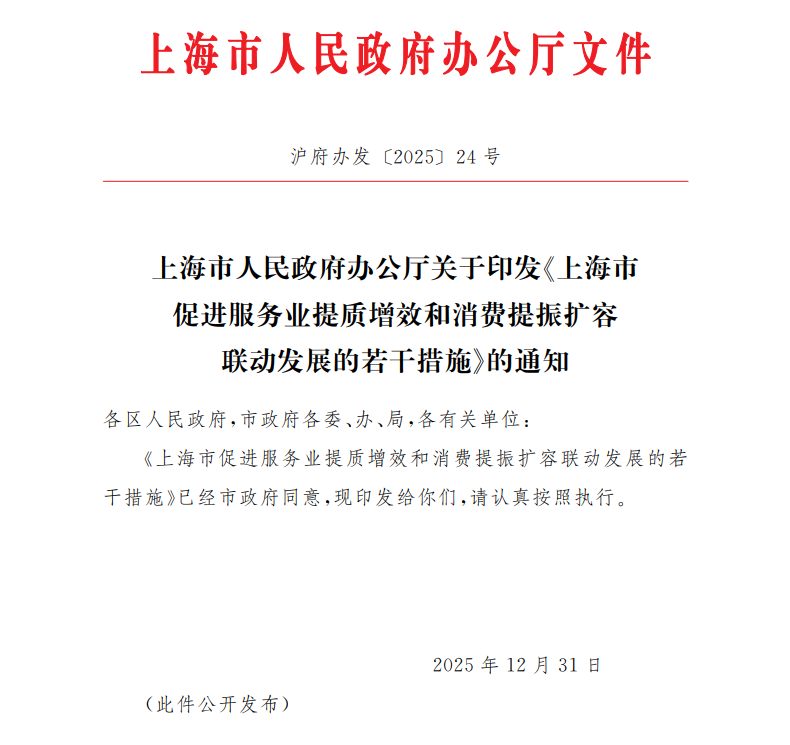
Core Viewpoint - The Shanghai Municipal Government has issued a set of measures aimed at enhancing the quality and efficiency of the service industry and boosting consumption through 28 policy initiatives across seven areas, with a specific focus on the financial sector [1]. Financial Sector Initiatives - The measures encourage financial institutions to innovate and develop financial products tailored to new consumption trends, such as holiday, night, nostalgic, and anime economies, and to implement diverse card discount activities during consumption festivals [5]. - Personal consumption loan interest subsidy policies will be implemented, and the application process for auto loans will be optimized by relaxing conditions and reasonably determining loan issuance ratios, terms, and interest rates [5]. - The development of credit products for large consumer areas like green smart home decoration will be expanded, and mobile payment services will be enhanced [5]. - The measures promote the securitization of retail loans such as personal consumption and credit cards to revitalize existing credit stock [5]. Insurance Product Support - The government plans to upgrade existing inclusive insurance products and increase insurance coverage for specific groups and small micro-enterprises in the service industry [6]. - There will be an expansion of product offerings in travel, accident, and health insurance, along with efforts to synchronize medical insurance and commercial health insurance settlements in major hospitals [6]. - The development of third-pillar pension insurance will be encouraged, with a focus on creating diverse personal pension products and innovative commercial pension offerings [6]. Financial Support for Business Entities - The measures include utilizing policies like service consumption and pension refinancing, as well as government financing guarantees, to support various business entities with loans [6]. - Financial institutions are encouraged to innovate financing products based on expected revenue rights from service contracts and explore new financing models such as ticket revenue pledges [6]. - There will be an emphasis on expanding pledge financing for accounts receivable and intellectual property, as well as supply chain finance [6]. Infrastructure Financial Support - Financial institutions are encouraged to support key projects in the consumption sector, including the renovation of commercial facilities and community service centers, with favorable loan conditions [6]. - The issuance of real estate investment trusts (REITs) for consumption infrastructure will be supported, along with the application of local government special bonds for eligible projects [6]. Overall Strategy - The focus of the measures is on optimizing supply and expanding consumption simultaneously, aiming to cultivate new growth points in service supply and consumer demand to promote high-quality development in the service industry [7]. - The government emphasizes the importance of financial services in stimulating industry and activating consumption, with a growing demand for diverse financial services in wealth management and commercial insurance [7]. - Future efforts will prioritize the integration of service supply and consumer demand, enhancing digital, green, and intelligent consumption, and fostering a favorable environment for sustained consumption growth [7].
展望2026年资本市场:结构性机遇点亮投资新航程
Zhong Guo Jing Ji Wang· 2026-01-13 06:04
Group 1: Capital Market Overview - The year 2026 is seen as a critical year for the "14th Five-Year Plan," with the capital market at a pivotal point for policy reform and industrial transformation [1] - The capital market is expected to exhibit structural characteristics such as "technology-driven leadership, breakthroughs in green sectors, and coordinated consumer investment" [1] - By the end of 2025, various long-term funds held approximately 23 trillion yuan in A-share market value, a 36% increase from the beginning of the year [1] Group 2: Market Dynamics and Economic Indicators - The focus on adjusting the structure of listed companies aims to attract long-term funds like insurance and pension funds to enhance market liquidity [2] - A significant reduction in market volatility was noted, with the number of trading days where the index fell more than 1% being the lowest in recent bull markets [2] - The nominal GDP is projected to rise from 4.0% in 2025 to 4.5% in 2026, indicating an improvement in corporate profitability [2] Group 3: Technology and AI Focus - A consensus among nearly 60 experts indicates that technology, particularly AI and its related industries, will be the core focus of the capital market in 2026 [3] - The application of AI across various industries is expected to drive significant capital expenditure from major companies [3] - The potential for domestic replacement in AI hardware and models is anticipated to be a key investment theme for the next five years [3] Group 4: Green Transition and Energy Sector - The construction of a new energy system is identified as a core engine for the "dual carbon" transition, emphasizing clean energy sources like solar, wind, and hydrogen [5] - The dual carbon goals present systemic opportunities in clean energy and related sectors, with a shift from demonstration to large-scale application [5] - The demand for new technologies and equipment in traditional industrial energy-saving transformations and the electric vehicle supply chain is expected to grow [5] Group 5: Policy and Consumer Investment - The 2025 Central Economic Work Conference prioritized domestic demand, shifting the policy focus from merely stimulating consumption to enhancing income and optimizing supply [7] - Structural opportunities in consumer spending are anticipated, particularly in sectors like healthcare, tourism, and sports, driven by policies aimed at increasing residents' income [7] - Investment strategies will focus on optimizing project efficiency and structure, with significant attention on rural revitalization and urban renewal initiatives [7]
上海:加大对符合条件的各类经营主体首贷、续贷、信用贷、中长期贷款等支持力度
Zheng Quan Shi Bao Wang· 2026-01-13 02:20
Core Viewpoint - The Shanghai Municipal Government has issued measures to enhance the quality and efficiency of the service industry and stimulate consumption, focusing on financial support for business entities [1] Financial Support Measures - The government aims to utilize policies such as service consumption and elderly care re-loans, as well as government financing guarantees, to support business entities in the service sector [1] - Implementation of loan interest subsidy policies for service industry operators is emphasized, along with active financing matchmaking activities [1] - Increased support for various types of loans, including first loans, renewal loans, credit loans, and medium to long-term loans for eligible business entities [1] Financial Innovation Encouragement - Financial institutions are encouraged to innovate and develop financing products based on expected revenue rights from service contracts and other intangible assets [1] - Exploration of financing models such as "ticket revenue rights pledge" is suggested to expand financing options [1] - Support for accounts receivable, intellectual property pledge financing, and supply chain finance is also highlighted [1] - The government will support the application of financial innovation projects in the service and consumption sectors for the Shanghai Financial Innovation Award [1]
支持成都建设国际消费中心城市
Xin Lang Cai Jing· 2026-01-12 18:00
Core Viewpoint - Sichuan has issued the "Implementation Opinions on Promoting High-Quality Urban Development," supporting Chengdu in becoming an international consumption center city and a demonstration area for park city practices [1][2] Group 1: Urban Development Goals - By 2030, significant progress is expected in the construction of modern urban systems in Sichuan, with improved policies for high-quality urban development and enhanced living quality [1] - By 2035, the urbanization rate of the permanent population is projected to steadily increase, with the influence of "park city, comfortable home" continuing to rise [1] Group 2: Support for Chengdu - The opinions emphasize enhancing Chengdu and the Chengdu metropolitan area's development capabilities, supporting Chengdu in becoming a demonstration area for park city practices and strengthening its core functions [1] - The establishment of the Tianfu New Area as a pilot area for park city development and high-quality growth is also highlighted [1] Group 3: Innovation and Collaboration - The opinions mention the development of core areas such as the Western (Chengdu) Science City and the China (Mianyang) Science City, aiming to create a collaborative innovation ecosystem [2] - Support for the Chengdu metropolitan area to enhance inter-city cooperation and improve commuting efficiency is outlined [1][2]
富国基金2026策略重磅:A股双重共振,十大主线精准锚定
Sou Hu Cai Jing· 2026-01-12 08:40
Group 1 - The core logic for A-shares in 2026 is the dual resonance of traditional industry profit recovery and improved risk appetite [3] - The manufacturing, technology services, and non-bank financial sectors are expected to lead the profit recovery, with the real estate chain's profit squeeze being a key variable for A-share profit growth [3] - The macro backdrop of synchronized interest rate cuts in China and the US will create diverse investment opportunities, with a focus on long-term asset reallocation [4] Group 2 - The AI sector is shifting from hardware to applications, with significant long-term potential in areas like AI coding and autonomous driving [6] - The pharmaceutical industry is focusing on the global competitiveness of domestic innovative drugs, particularly in oncology, with an emphasis on safety and efficacy in selection [6] - The consumer sector is anticipated to improve with inflation recovery and service consumption upgrades, with a focus on sectors like tourism and aviation [6] Group 3 - The cyclical sector is expected to benefit from policy support and external demand recovery, with industrial metals and precious metals showing strong price support [7] - The "14th Five-Year Plan" emphasizes the construction of a modern industrial system, which will accelerate investments in key sectors like high-end equipment and green energy [7] - The fixed income and "fixed income plus" sectors should focus on capturing trading opportunities through flexible duration management [7] Group 4 - A diversified asset allocation strategy is crucial for risk dispersion in the context of global monetary easing and changing asset correlations [8] - The investment logic for Hong Kong and overseas markets will evolve with liquidity trends and industry developments, particularly in AI applications [9] - The 2026 investment landscape is characterized by structural opportunities in traditional industry profit recovery and breakthroughs in emerging sectors [9]