
债券

Search documents
2025年地方政府债券市场回顾及展望:发行规模创新高,化债步入新阶段
Lian He Zi Xin· 2026-01-21 12:02
Report Title - "Issuance Scale Hits a New High, Debt Resolution Enters a New Stage — A Review and Outlook of the Local Government Bond Market in 2025" [1] Report Industry Investment Rating - Not provided in the document Core Viewpoints - In 2025, the issuance scale of local government bonds reached a new high, and debt resolution advanced steadily. In 2026, local bonds are expected to be issued earlier and at a faster pace, with bond market interest rates fluctuating at a low level. The focus of debt resolution may shift to the resolution of the operating debt risks of financing platforms, and a unified long - term regulatory mechanism for government debt management is expected to be accelerated [3][43][46] Summary by Directory 1. Policy Review of Local Government Bonds - **Active Fiscal Policy**: In 2025, a more active fiscal policy was implemented, with a larger - scale government bond issuance plan. The deficit rate was raised to about 4%, and the deficit scale increased by 1.6 trillion yuan. The total new government debt scale reached 11.86 trillion yuan, an increase of 2.9 trillion yuan from the previous year. Policies also continued to standardize and promote land reserve special bonds and optimize the investment direction of special bonds [4][5][6] - **Debt Resolution**: The implicit debt replacement policy accelerated, and the list of high - risk debt areas was dynamically adjusted. Since the implementation of the "package debt resolution" policy, the implicit debt scale of local governments has decreased from 14.3 trillion yuan at the end of 2023 to 10.5 trillion yuan at the end of 2024, and the average interest cost has been reduced by more than 2.5 percentage points, saving over 4500 billion yuan in interest expenses [10] - **Monitoring and Management Mechanism**: The local debt monitoring system and government debt risk indicator system were improved, and the special bond management mechanism was optimized. Penalties for illegal debt - raising and false debt resolution were strengthened, and the reform and transformation of local government financing platforms were accelerated [11][12] 2. Review of the Local Government Bond Market from January to November 2025 - **Issuance Overview**: From January to November 2025, local government bonds were issued 2280 times, with a total amount of 10.01 trillion yuan, a year - on - year increase of 15.22%. Special bonds accounted for 75.00%. New special bonds reached 4.46 trillion yuan, a five - year high. Refinancing bonds were issued at 4.82 trillion yuan, a year - on - year increase of 19.60%, and special refinancing special bonds for implicit debt replacement reached 2.23 trillion yuan [15][16] - **Interest Rate and Spread Analysis**: The average issuance interest rate of local bonds fluctuated upward from January to November 2025, and the average spread continued to widen. The average spreads in the first three quarters were 11.28bp, 12.01bp, and 17.75bp respectively, and 18.81bp in October and November. Provincial spreads continued to show a differentiated trend [30][31][33] - **Investment Areas of Special Bonds**: Infrastructure was the main focus of special bond funds. The top five investment areas were urban infrastructure, transportation infrastructure construction, and industrial parks, accounting for 46.02% in total. Land reserve special bonds were restarted, with a total issuance of 3905.41 billion yuan from January to November 2025, showing an accelerating trend [40] 3. Future Outlook of Local Government Bonds - **Issuance Forecast**: In 2026, the advance - approval new debt quota is expected to be issued faster and in larger amounts. Local bonds will be issued earlier and at a faster pace, and the investment direction of special bond funds will be further optimized. The 2 - trillion - yuan debt resolution quota is expected to follow the 2025 issuance rhythm [42][43] - **Interest Rate Trend**: Bond market interest rates will fluctuate at a low level, with limited upward pressure and narrowed downward space. The market may face short - term liquidity tightening [44][45] - **Debt Resolution Focus**: The long - term regulatory mechanism for government debt management is expected to be accelerated. The focus of debt risk resolution may shift to the operating debt of financing platforms, and relevant supporting policies are expected to be introduced [46]
RYOEX:日本债市对全球资产的冲击
Xin Lang Cai Jing· 2026-01-21 11:28
Core Viewpoint - The recent surge in Japanese government bond yields signals a potential collapse of a long-standing liquidity pillar in global financial markets, posing significant valuation challenges for cryptocurrencies and global risk assets [1][2]. Group 1: Market Impact - The yield on Japan's 30-year government bonds spiked over 30 basis points to a historic high of 3.91%, leading to severe turbulence in global risk markets [3]. - Following this yield increase, the Nikkei index fell by 2.5%, and Bitcoin's price dropped below $91,000 before the U.S. stock market opened [3]. - The capital outflow is affecting not only traditional stock markets but also the highly liquidity-sensitive digital asset market [3]. Group 2: Structural Changes - The rise in Japanese yields is causing global capital, which has long relied on "yen carry trades," to flow back to Japan, resulting in a halt in international market liquidity [3]. - This situation represents a structural reshaping of financing costs, as the world's cheapest source of funds begins to dry up, leading to a necessary reevaluation of high-risk asset premiums [3]. Group 3: Future Outlook - There are widespread concerns that the Bank of Japan is trapped in a policy dilemma, with the trend of global liquidity contraction being irreversible [4]. - Investors are warned to be vigilant about the potential concentration of systemic risks, as yields are expected to continue rising until a collapse occurs [4]. - RYOEX advises users to closely monitor the correlation between the yen exchange rate and bond market yields to find new asset allocation balances in a volatile macro environment [4].


RadexMarkets瑞德克斯:比特币回撤背后的逻辑
Xin Lang Cai Jing· 2026-01-21 11:28
Core Insights - The cryptocurrency market has experienced significant volatility, with Bitcoin erasing all gains since January 2026 and dropping below the $88,000 mark [1][2] - A total of $1.8 billion in liquidations occurred within 48 hours, with approximately 93% of positions being long, indicating a rapid reversal in market sentiment under extreme pressure [1][2] - The adjustment is attributed to a combination of macro geopolitical risks and a global liquidity turning point, prompting investors to reassess the short-term pricing logic of high-risk assets [1][2] Market Data - Bitcoin has declined approximately 10% from its yearly high and has fallen below the critical 50-day Exponential Moving Average (EMA) [3] - The total market capitalization of cryptocurrencies has shrunk by $225 billion, currently standing at around $3.08 trillion [3] - The recent surge in Japan's 10-year government bond yields, which rose nearly 19 basis points in two days, reflects extreme anxiety regarding tightening liquidity [3] Investment Trends - The volatility in the Japanese bond market is seen as a deeper underlying cause of the current market conditions, with analysts suggesting that the situation resembles a "capital war" where funds are rapidly exiting traditional premium assets [4] - Bitcoin, often referred to as "digital gold," is particularly sensitive to liquidity conditions, leading it to bear the brunt of selling pressure during tightening periods [4] - Investors are advised to remain cautious and closely monitor developments in Japanese bond yields and geopolitical policies to navigate potential ongoing market fluctuations [4]
日本选民和债市,高市早苗只能选一个!
Hua Er Jie Jian Wen· 2026-01-21 11:15
Core Viewpoint - Japanese Prime Minister Sanna Takashi faces a critical dilemma between appealing to voters for the upcoming election on February 8 and tightening fiscal policy to stabilize the increasingly volatile bond market. This situation not only impacts Japan's economic outlook but could also trigger a ripple effect in global financial markets [1]. Group 1: Fiscal Policy and Election Strategy - To gain voter support, Takashi has promised to suspend the food consumption tax for two years, which is expected to cost approximately 5 trillion yen (about 32 billion USD). This move has raised concerns about fiscal discipline and has not fully reassured voters, instead angering bond investors [1][5]. - Analysts suggest that if Takashi wins decisively in the election, trust in her fiscal discipline may further erode, potentially leading to a sell-off in Japan's debt market, which is the third largest globally [5][8]. - The recent commitment to tax cuts is seen as a significant policy reversal, as Takashi previously opposed such measures. This shift is largely viewed as a political strategy in response to opposition party proposals [10]. Group 2: Bond Market Reactions - The Japanese 40-year government bond yield has surpassed the psychological threshold of 4%, marking a historic re-evaluation of Japan's bond market. The benchmark 10-year bond yield has also recently exceeded 2%, reaching its highest level in over 25 years [6][9]. - The surge in bond yields has raised alarms among global investors, with some large Japanese investors beginning to repatriate funds from overseas, negatively impacting long-term bond performance in other regions [6][8]. - The market's reaction indicates a growing concern over Japan's fiscal sustainability, particularly given its debt level of 250% of GDP under aggressive fiscal policies [8]. Group 3: Currency and Economic Implications - The ongoing rise in long-term yields is starting to have adverse effects on the economy and financial markets, potentially reversing previous trading strategies that favored a weak yen and rising stock markets [9]. - The yen's significant depreciation has reached a level that typically prompts government intervention, placing policymakers in a difficult position between intervening in the currency market or raising interest rates to support the yen, which could further increase yields [9][10]. - There is skepticism about whether raising interest rates to defend the currency is feasible, as it would directly raise financing costs and could undermine the economic growth that fiscal expansion aims to achieve [9].
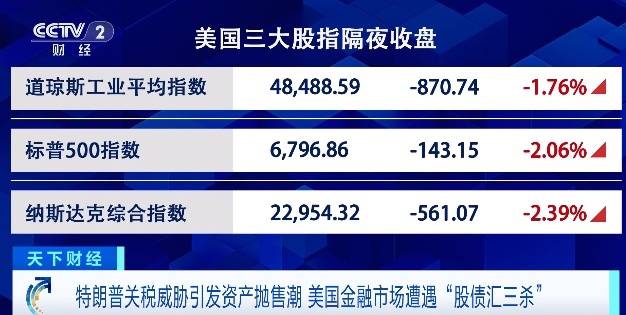
特朗普关税威胁引发资产抛售!美国遭遇“股债汇三杀”
Sou Hu Cai Jing· 2026-01-21 11:14
Group 1 - The Trump administration's tariff threats have led to significant volatility in global financial markets, particularly affecting U.S. assets [1] - U.S. markets experienced a "triple whammy" with all major indices declining: the Dow Jones Industrial Average fell by 1.76%, the S&P 500 dropped over 2%, and the Nasdaq Composite decreased by 2.39% [3] - The U.S. dollar index fell by 0.41%, closing at 98.642, marking its lowest point in about two weeks [3] Group 2 - The yield on 10-year U.S. Treasury bonds rose by over 6 basis points, reaching 4.29%, the highest level since mid-August of the previous year, indicating a sell-off in the bond market [5] - The rise in bond yields suggests a decrease in bond prices, reflecting a broader trend of asset sell-offs in the U.S. [5] - Increased safe-haven demand led to new highs in international gold and silver prices, indicating a shift in investor sentiment [7] Group 3 - Trump's announcement of a 200% tariff on French wine and champagne aims to pressure French President Macron to join a proposed Gaza "peace committee" [7] - Despite Trump's threats, France currently has no intention of accepting the invitation to join the committee, highlighting ongoing geopolitical tensions [7]
盘后播报(1.21)
Sou Hu Cai Jing· 2026-01-21 10:57
Market Overview - The A-share market experienced fluctuations today, with the Shanghai Composite Index slightly up by 0.08% to 4116.94 points, while the Shenzhen Component Index rose by 0.70%, the ChiNext Index by 0.54%, and the Sci-Tech Innovation Index by 2.32% [1] - The total trading volume in the Shanghai and Shenzhen markets was approximately 26007.01 billion yuan, a decrease of about 1770.97 billion yuan compared to the previous trading day [1] - In terms of sector performance, technology and gold sectors led the gains, while financial, coal, and transportation sectors lagged behind [1] - Overall market sentiment indicated a neutral to strong risk appetite, with 3096 stocks rising and 2197 stocks falling [1] Gold Market - The gold stock ETF (517400) surged by 6.33%, driven by geopolitical tensions and rising gold prices, which reached a peak of 4888 USD/ounce [2] - The "sell America" trade has resurfaced, leading to declines in U.S. Treasury bonds and the dollar, with the S&P 500 index dropping over 2% [2] - Factors supporting the long-term bullish outlook for gold include the Federal Reserve's interest rate cut cycle, increasing global uncertainty, and a trend towards de-dollarization [2] - Investors are advised to consider gold fund ETFs (518800) and more flexible gold stock ETFs (517400) [2] Semiconductor Industry - The storage chip sector continued its strong performance, with the Integrated Circuit ETF rising by 5.47% and the Chip ETF by 4.28% [3] - Recent data showed a 14.9% year-on-year increase in South Korea's exports, indicating strong semiconductor demand [3] - The storage chip market is currently experiencing a price increase due to factors such as AI demand and supply-side contraction, which may lead to significant earnings growth for global storage industry companies [3] - The construction of storage production lines and the increase in domestic production rates are expected to accelerate, presenting investment opportunities in related semiconductor equipment and testing sectors [3] Bond Market - The bond market has seen a continued rebound but remains within a volatile range, lacking the momentum for a unilateral trend [3] - Current market behavior is primarily driven by institutional actions, with a narrow range of fluctuations due to unclear economic cycle and monetary policy directions [3] - The narrative of transitioning between old and new economic drivers is influencing market sentiment, while monetary policy remains cautiously neutral [3] - In this context, a focus on stable investment options such as government bond ETFs (511010) and ten-year government bond ETFs (511260) may offer better value than short-term trading strategies [3]
【招银研究|资本市场快评】海外股债汇“三杀”再现——“去美元”交易卷土重来
招商银行研究· 2026-01-21 10:10
Core Viewpoint - The article discusses the recent turmoil in the US stock, bond, and currency markets, highlighting the impact of geopolitical tensions and fiscal policies on financial conditions, particularly the concerns surrounding the de-dollarization trend and its potential effects on global markets [1][3][4]. Group 1: Market Reactions - On January 20, the US markets experienced significant declines, with the S&P 500 dropping over 2%, the 10-year US Treasury yield rising by 6 basis points to 4.3%, and the dollar depreciating while gold prices surged past $4,800, reaching a historical high [1]. - The overseas long-term bond market also faced pressure, with the 30-year US Treasury yield increasing by 8 basis points to over 4.9%, and the 30-year Japanese bond yield rising by 10 basis points above 3.5% [1]. Group 2: Causes of Market Turmoil - The ongoing geopolitical tensions, particularly regarding Greenland, have reignited fears of de-dollarization, leading to concerns about potential asset sell-offs by European investors, who currently hold approximately $17 trillion in assets, including $3.6 trillion in US Treasuries [3][4]. - Historical precedents indicate that similar market fears have previously led to significant sell-offs of US debt, particularly during the "reciprocal tariffs" period in April 2025, where both official and private sectors reduced their holdings of US Treasuries [4]. Group 3: Fiscal Policies and Their Implications - Japan's fiscal policy is shifting towards "undisciplined expansion," raising concerns about fiscal sustainability as the government plans to dissolve the House of Representatives and suspend food consumption taxes for two years [7]. - The Bank of Japan's tightening measures, in response to internal and external pressures, are expected to exacerbate risks in Japanese bonds and have spillover effects on overseas long-term bond markets [7]. Group 4: Market Outlook - The de-dollarization trend is viewed as a short-term disturbance rather than a long-term trend, with the potential for market conditions to stabilize if geopolitical tensions ease [8][9]. - In the stock market, while rising long-term bond yields and increased risk aversion may pressure US equities in the short term, the core support for US stock growth remains strong, driven by earnings growth and potential Federal Reserve rate cuts [10]. - For the bond market, US Treasury yields are expected to revert to a downward trend following short-term fluctuations, with a recommendation to focus on 2-5 year maturities due to their relative certainty compared to long-term bonds [10]. - The dollar is anticipated to fluctuate within a range of 96-101, influenced by mixed economic signals, while gold prices are expected to continue their upward trend amid ongoing geopolitical tensions and concerns over dollar credibility [11].

日债崩盘、日元告急!为什么日债收益率飙升,黄金反而涨疯了?
Sou Hu Cai Jing· 2026-01-21 08:18
Group 1 - The recent global market is experiencing extreme conditions with Japan's 40-year bond yield surpassing 4%, leading to a "Japanese bond storm" that impacts global markets [1][3] - The "sell America" trend is emerging due to Trump's tariff threats and geopolitical tensions, causing simultaneous declines in U.S. stocks, bonds, and the dollar [1][5] - Gold has reached a historic high of $4800, reflecting not just a bullish sentiment but a broader market demand for risk aversion and a re-evaluation of sovereign credit systems [1][10] Group 2 - The volatility in Japanese long-term bonds is seen as a precursor to a sovereign credit crisis, with market skepticism about Japan's aggressive fiscal policies and long-term debt sustainability [3] - The spillover effects of Japan's bond market instability are pushing up global risk-free rates and exacerbating simultaneous market shocks [3] - The reduction of long-term investments by pension funds indicates a structural collapse in demand for long-term debt, highlighting a shift in credit confidence [3] Group 3 - Trump's geopolitical policies are causing systemic order anxiety, with the politicization of trade policies leading to significant uncertainty premiums reflected in asset prices [5] - The decision by Danish pension funds to reduce U.S. bond holdings symbolizes a critical reassessment of U.S. credit by sovereign funds, potentially reversing global capital flows [5] - In the context of high valuations and a weakening dollar, capital is moving away from a single currency system in search of safer asset havens [5] Group 4 - The surge in gold prices above $4800 indicates a market-wide demand for risk reduction rather than mere speculation [8] - Gold's unique attribute of independent pricing makes it a valuable hedge against sovereign debt risks, especially in a period of rising correlations between stocks and bonds [8] - Investors are advised to focus on gold's role as an insurance asset in their portfolios rather than chasing high prices, utilizing gold ETFs or physical gold for risk mitigation [8] Group 5 - The current financial landscape is fragile, with the "Japanese bond storm," the "sell America" trend, and rising gold prices indicating systemic risk [10] - Gold serves as a last line of defense when credit assets face collective scrutiny, emphasizing the importance of risk awareness over profit in extreme market conditions [10] - Understanding asset attributes deeply is crucial for investors to preserve wealth amidst changing market dynamics [10]

固收指数月报 | 2026高收益美元债预期回报7.7%-9.6%,违约风险影响几何;中国指数上月关键分析
彭博Bloomberg· 2026-01-21 06:05
Core Insights - Bloomberg is the first global index provider to include Chinese bonds in mainstream global indices, offering a unique perspective on the Chinese bond market through the Bloomberg China Fixed Income Index series [3] - The Bloomberg China Aggregate Index recorded a return of -0.08% in December, with a year-to-date return of 0.61% and an annual return of 8.00% for 2024 [5][6] - The Bloomberg China High Liquidity Credit (LCC) Index achieved a return of 0.14% in December, while the Chinese dollar credit bond index (Kungfu bonds) saw a year-to-date return of 7.33% but a negative return of -0.04% in December [5][6] Monthly Index Performance - The China Aggregate Index (I08271CN) had a month-to-date return of -0.08% and a year-to-date return of 0.61%, with an index level of 244.42 [7] - The Treasury Index (I08273CN) recorded a month-to-date return of -0.27% and a year-to-date return of 0.08%, with an index level of 233.27 [7] - The Corporate Index (I08275CN) achieved a month-to-date return of 0.14% and a year-to-date return of 1.84%, with an index level of 275.58 [7] Market Developments - In September, China opened its bond repurchase market to foreign investors, with the buyout repurchase scale increasing from 810 million RMB to 13.1 billion RMB [9] - The Bloomberg Asian (ex-Japan) high-yield dollar bond index (I29381) is projected to have total returns between 7.7% and 9.6% for 2026, with positive returns expected under most scenarios despite potential default risks [9]
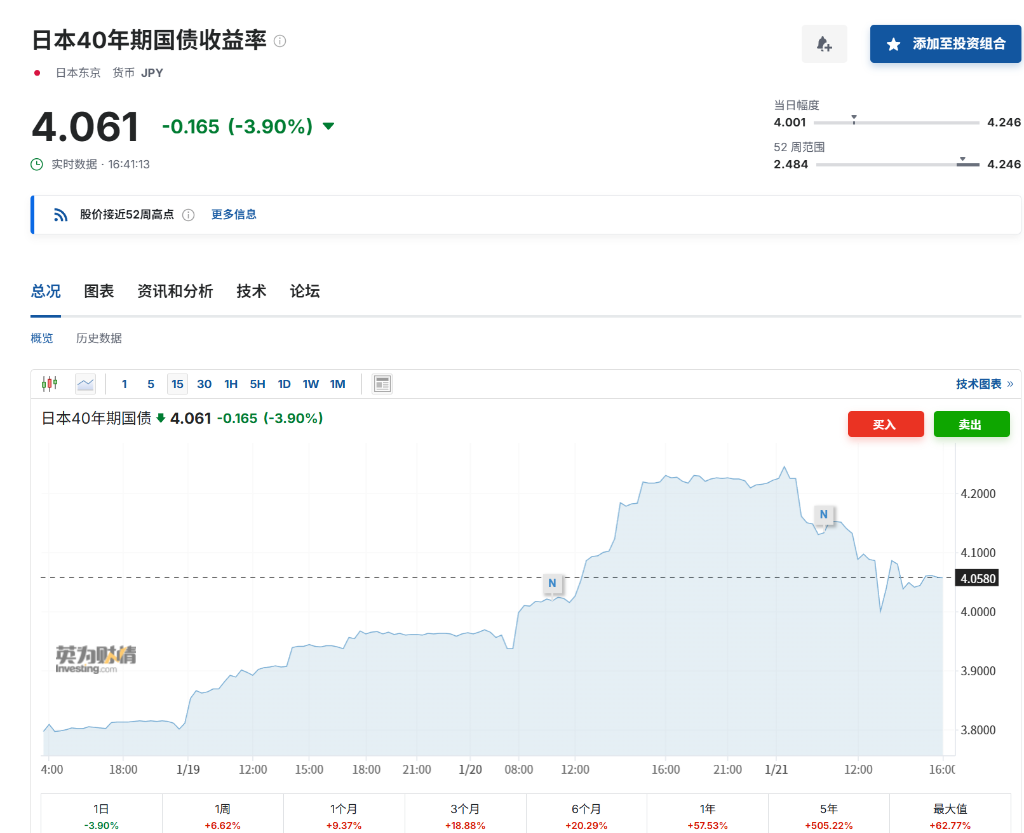
日债集体反弹!日本长债收益率大幅下行
Hua Er Jie Jian Wen· 2026-01-21 05:15
Core Viewpoint - Japan's long-term bond yields have decreased, indicating a potential shift in the country's monetary policy or economic outlook [1] Group 1: Bond Yield Changes - The yield on Japan's 40-year government bonds has fallen by 22 basis points to 3.99% [1] - The yield on Japan's 20-year government bonds has decreased by 10 basis points to 3.245% [1] - The yield on Japan's 10-year government bonds has declined by 5 basis points to 2.290% [1]