
非银金融

Search documents
2026 年可转债年度策略:穿越“墨西拿海峡”
Huafu Securities· 2026-01-09 11:55
Group 1 - The report highlights that the valuation of convertible bonds does not directly reflect the volatility of the underlying stocks but rather follows the directional changes of the stocks. The market's confidence in the direction of stocks for 2026 remains strong, and the opportunity cost of convertible bonds is expected to be low in the near term [3][4] - The current high valuation of convertible bonds has already factored in significant expected increases in the underlying stocks' prices. The report suggests that the potential for further valuation increases in 2026 may rely more on the recovery of profitability rather than broad-based earnings growth [4][10] - The convertible bond market is expected to exhibit a "dumbbell" structure in 2026, with an increase in the number of new issues and changes in individual bond sizes and industry structures. However, the overall high valuation level may lead to new issues maintaining elevated listing valuations, making secondary market participation less attractive [5][10] Group 2 - The report discusses the construction of a long inflation strategy portfolio, including specific convertible bonds from sectors such as agriculture and electronics, while also preparing a corresponding cash flow strategy portfolio to mitigate potential adverse scenarios [9][10] - The analysis indicates that the high-low price strategy did not yield significant excess returns in 2025, and the report emphasizes the need to maintain a focus on low absolute price screening levels for future selections [6][10] - The report notes that the implied volatility of convertible bonds has recently exceeded the actual volatility of the underlying stocks, indicating a divergence that may reflect market sentiment rather than fundamental value [3][87]
非银金融行业资金流出榜:中国平安等9股净流出资金超亿元
Zheng Quan Shi Bao Wang· 2026-01-09 09:36
Market Overview - The Shanghai Composite Index rose by 0.92% on January 9, with 29 out of the 31 sectors experiencing gains, led by the media and comprehensive sectors, which increased by 5.31% and 3.60% respectively [1] - The banking and non-bank financial sectors were the biggest losers, declining by 0.44% and 0.20% respectively [1] Capital Flow - The main capital flow showed a net outflow of 24.126 billion yuan across the two markets, with 8 sectors seeing net inflows [1] - The media sector had the highest net inflow of 9.703 billion yuan, coinciding with its 5.31% increase, followed by the non-ferrous metals sector, which saw a 2.78% rise and a net inflow of 4.552 billion yuan [1] Non-Bank Financial Sector - The non-bank financial sector experienced a decline of 0.20%, with a total net outflow of 5.343 billion yuan [2] - Out of 82 stocks in this sector, 67 rose, with 3 hitting the daily limit, while 14 fell [2] - The top three stocks with significant net inflows were Hainan Huatie (1.54 billion yuan), Huajin Capital, and Yuexiu Capital (both 1.45 billion yuan) [2] - Major stocks with net outflows included China Ping An (3.328 billion yuan), CITIC Securities (999 million yuan), and Huatai Securities (270 million yuan) [2] Non-Bank Financial Sector Capital Flow Rankings - The table lists various stocks in the non-bank financial sector, highlighting their daily price changes, turnover rates, and main capital flows, with notable mentions including: - China Ping An: -1.96% with a net outflow of 3.328 billion yuan [2] - Huajin Capital: +9.98% with a net inflow of 1.4549 billion yuan [4] - Hainan Huatie: +4.01% with a net inflow of 1.5428 billion yuan [4]



博时市场点评1月9日:两市成交突破3万亿,沪指站上4100点
Xin Lang Cai Jing· 2026-01-09 08:19
Market Overview - The Shanghai Composite Index has risen above 4100 points, with trading volume exceeding 3.1 trillion yuan, indicating active trading sentiment [1][7] - The People's Bank of China emphasized the continuation of a moderately loose monetary policy, focusing on expanding domestic demand and optimizing supply as key points for this year's monetary policy [1][7] Economic Indicators - In December 2025, the Consumer Price Index (CPI) increased by 0.2% month-on-month and 0.8% year-on-year, while the core CPI (excluding food and energy) rose by 1.2% year-on-year [2][8] - The Producer Price Index (PPI) decreased by 1.9% year-on-year, with the decline narrowing by 0.3 percentage points compared to the previous month [2][8] - The stable CPI indicates a steady domestic consumption demand, providing room for maintaining a moderately loose monetary policy [2][8] Gold Market - As of the end of 2025, the total value of official gold reserves held by non-U.S. central banks is estimated at approximately $3.93 trillion, surpassing the total value of U.S. Treasury securities held by these countries, which is about $3.88 trillion [2][8] - This milestone reflects a long-term trend of diversification in foreign exchange reserve assets among central banks, providing solid support for long-term demand for gold [3][9] Stock Market Performance - On January 9, 2026, the A-share market saw all three major indices rise, with the Shanghai Composite Index closing at 4120.43 points, up 0.92% [4][10] - The Shenzhen Component Index rose by 1.15% to 14120.15 points, while the ChiNext Index increased by 0.77% to 3327.81 points [4][10] - Among the sectors, media, comprehensive, and defense industries showed significant gains, with increases of 5.31%, 3.60%, and 3.29% respectively [4][10] Fund Tracking - The market turnover reached 31,525.96 billion yuan, an increase from the previous trading day [5][11] - The margin trading balance reported at 26,206.09 billion yuan, also showing an increase compared to the previous day [5][11]
粤开市场日报-20260109-20260109
Yuekai Securities· 2026-01-09 07:48
Market Overview - The A-share market showed a general upward trend today, with the Shanghai Composite Index rising by 0.92% to close at 4120.43 points, and the Shenzhen Component Index increasing by 1.15% to 14120.15 points [1] - The ChiNext Index rose by 0.77% to 3327.81 points, while the Sci-Tech 50 Index increased by 1.43% to 1475.97 points [1] - Overall, 3918 stocks rose, while 1344 stocks fell, with a total trading volume of 31,227 billion yuan, an increase of 3,224 billion yuan compared to the previous trading day [1] Industry Performance - Among the Shenwan first-level industries, sectors such as Media, Comprehensive, National Defense and Military Industry, Computer, and Nonferrous Metals led the gains, with increases of 5.31%, 3.60%, 3.29%, 2.90%, and 2.78% respectively [1] - Conversely, the Banking and Non-Banking Financial sectors experienced declines of 0.44% and 0.20% respectively [1] Concept Sector Performance - The top-performing concept sectors today included Pinduoduo partners, Xiaohongshu platform, Kimi, Douyin Doubao, WEB3.0, Virtual Humans, ChatGPT, AIGC, Internet Celebrity Economy, Rare Metals Selection, Multimodal Models, Short Drama Games, Intelligent Agents, Chinese Corpus, and Live Streaming E-commerce [2] - In contrast, sectors such as Silicon Energy, Power Equipment Selection, Photovoltaic Glass, Insurance Selection, and Banking Selection saw a pullback [2]
24产融04(240563)14时27分发生一笔偏离估值较大的价格异动
Mei Ri Jing Ji Xin Wen· 2026-01-09 06:55
Group 1 - The latest transaction price of 24产融04 (240563) is 73.849 yuan, which deviates by -13.13% from the previous trading day's valuation of 85.0144 yuan [1] - The bond has a rating of AA+ and a coupon rate of 2.99%, with a remaining maturity of 3.06 years [1] - The issuer, 中航工业产融控股股份有限公司, also holds a rating of AA+ and operates in the non-bank financial sector [1]

【盘中播报】沪指涨0.63% 传媒行业涨幅最大
Zheng Quan Shi Bao Wang· 2026-01-09 06:21
证券时报·数据宝统计,截至下午13:57,今日沪指涨0.63%,A股成交量1411.61亿股,成交金额25688.33 亿元,比上一个交易日增加13.85%。个股方面,3141只个股上涨,其中涨停86只,2117只个股下跌, 其中跌停2只。从申万行业来看,传媒、综合、有色金属等涨幅最大,涨幅分别为4.14%、3.68%、 2.85%;银行、非银金融、建筑材料等跌幅最大,跌幅分别为0.50%、0.43%、0.26%。(数据宝) (文章来源:证券时报网) | 申万行业 | 行业涨跌(%) | 成交额(亿元) | 比上日(%) | 领涨(跌)股 | 涨跌幅(%) | | --- | --- | --- | --- | --- | --- | | 传媒 | 4.14 | 985.02 | 43.58 | 天龙集团 | 20.02 | | 综合 | 3.68 | 45.70 | -7.38 | 东阳光 | 7.22 | | 有色金属 | 2.85 | 1534.84 | 15.48 | 海亮股份 | 10.02 | | 国防军工 | 2.51 | 2506.14 | 22.26 | 国科军工 | 17.38 | | 计 ...
证券ETF(512880)连续两日资金净流入超17亿元,规模同类第一,牛市中期金融板块配置价值凸显
Mei Ri Jing Ji Xin Wen· 2026-01-09 05:57
信达证券指出,非银金融行业的弹性正在逐步增加,牛市中期金融板块有望成为底仓和稳定器。证 券板块受益于资本市场回暖及政策鼓励并购重组,PB和ROE均出现小幅回升。非银金融估值仍处于长 期趋势以下偏低位置,随着盈利企稳,股价弹性正在增强。此外,资本市场制度红利有望驱动大级别牛 市,"资产荒"逻辑下保险等配置型资金增配意愿提升,非银金融行业配置价值凸显。 证券ETF(512880)跟踪的是证券公司指数(399975),该指数从A股市场中选取业务涉及证券经 纪、承销与保荐、自营等领域的上市公司证券作为指数样本,以反映证券行业相关上市公司的整体表 现。该指数成分股市值规模较大,行业集中度较高,具有显著的周期特性和市场敏感性特征。 风险提示:数据来源wind、截至2025.1.8,证券ETF规模为580.19亿,在同类21只产品中排名第 一。提及个股仅用于行业事件分析,不构成任何个股推荐或投资建议。指数等短期涨跌仅供参考,不代 表其未来表现,亦不构成对基金业绩的承诺或保证。观点可能随市场环境变化而调整,不构成投资建议 或承诺。提及基金风险收益特征各不相同,敬请投资者仔细阅读基金法律文件,充分了解产品要素、风 险等级及收益 ...
A股早盘冲高回落,沪指4100点得而复失
Sou Hu Cai Jing· 2026-01-09 04:10
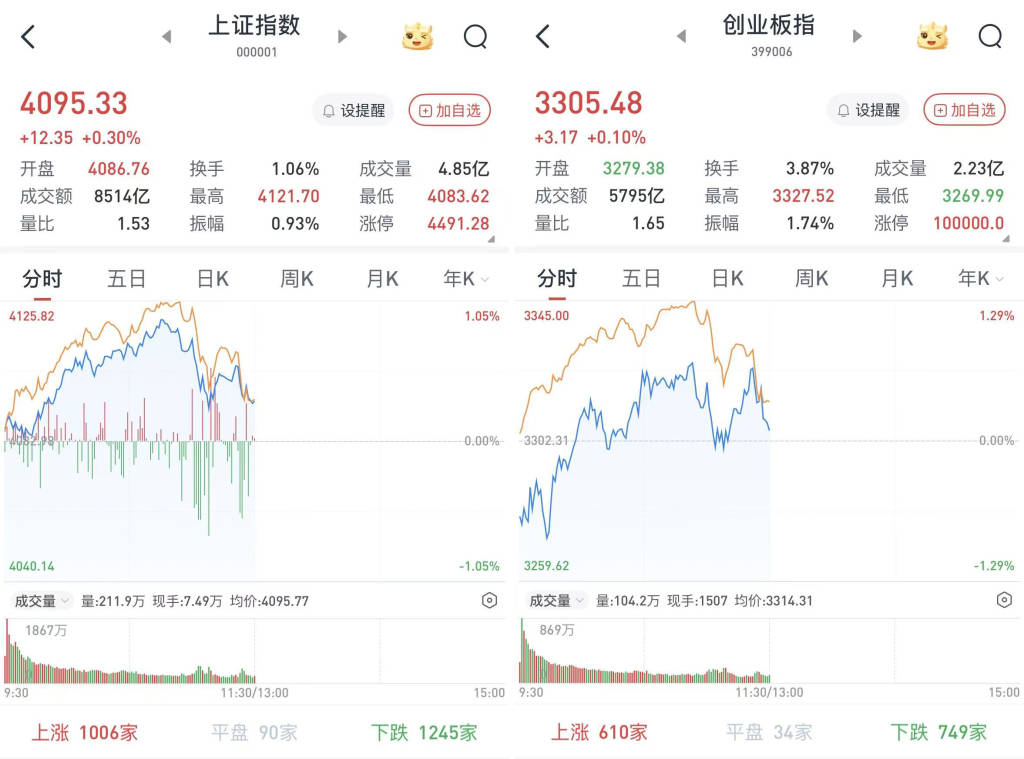
Market Overview - The three major A-share indices opened mixed on January 9, with the Shanghai Composite Index successfully breaking through the 4100-point mark before experiencing a pullback due to cooling in the morning session [2] - By midday, the Shanghai Composite Index rose by 0.3% to 4095.33 points, the Sci-Tech Innovation 50 Index increased by 0.05% to 1455.97 points, the Shenzhen Component Index climbed by 0.57% to 14038.46 points, and the ChiNext Index gained 0.1% to 3305.48 points [3] Trading Activity - The total trading volume in the Shanghai and Shenzhen markets reached 20.614 trillion yuan, with 2343 stocks rising and 2928 stocks falling, while 192 stocks remained flat [4] - Notably, media stocks surged, with companies like Yidian Tianxia and Tianlong Group hitting the daily limit or rising over 10% [4] - The defense and military sector continued to strengthen, with nearly 10 stocks, including Huayin Technology and Guokai Military Industry, also hitting the daily limit or rising over 10% [4] Sector Performance - The financial sector faced declines, particularly in banking stocks, with institutions like Hangzhou Bank and Ningbo Bank dropping over 1% [4] - Non-bank financial stocks also saw significant declines, with major players like Ping An Insurance and Zhongyin Securities among those with the largest drops [5] Future Outlook - According to Huang Yanming, Director of the Research Institute at Dongfang Securities, the A-share market is expected to exhibit a "sideways fluctuation with slight strengthening" in the first half of 2026, with core opportunities identified in mid-cap blue chips, particularly in the cyclical (chemicals, non-ferrous metals) and manufacturing (new energy, robotics) sectors [5] - Long-term, technology remains a key focus, although a short-term adjustment is anticipated [5]

21个行业获融资加仓,牛市里别再追高踏空
Sou Hu Cai Jing· 2026-01-09 02:47
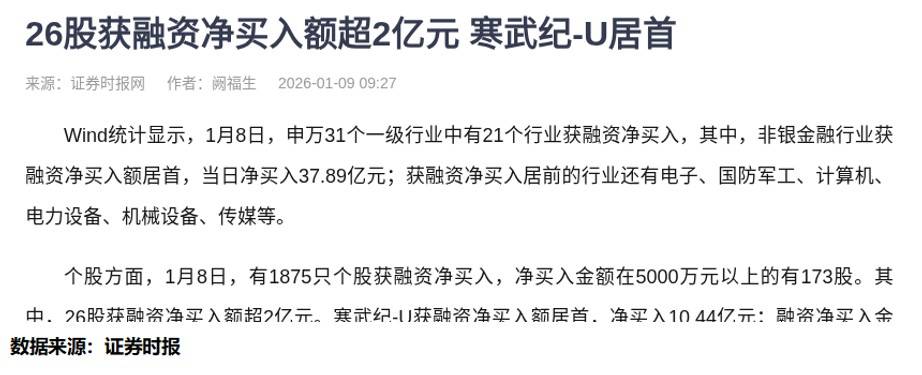
1月8日的市场消息挺热闹——Wind数据说,申万31个一级行业里有21个都被融资资金"加仓"了,非银金融一下子买了37.89亿,电 子、国防军工这些热门行业也在名单里。个股更夸张,1875只股票都被融资资金买了,其中26只买超2亿,寒武纪-U居然被买了 10.44亿。看着这些"抢筹"消息,是不是很多朋友心里直痒痒?想着"赶紧上车别踏空",但又怕"冲进去就套在高点"?其实我之前也 犯过这错,直到用了量化大数据才明白:牛市里的追高踏空,都是因为没看清交易背后的真实意图。 一、融资加仓的热闹里,藏着最容易犯的错 二、上涨时看"赚钱卖一点",别做追高的接盘侠 我之前跟踪过一只从10块涨到20块的股票,中间有五次密集的"赚钱卖一点"的黄柱子。第一次出现时,股价刚涨到13块,黄柱子一 排,结果接下来跌了15%,差点回到11块的启动点;第二次涨到15块,又跌了10%;直到第五次涨到20块,黄柱子比之前更长,直 接跌了25%,回到15块。 你看这张图里的五次黄柱子,每一次都是"不能追"的信号。要是当时能看到这个,是不是就不会在13块、15块的时候冲进去?哪怕 等一等,等黄柱子消失、股价调整到11块、14块再买,是不是更安全? ...
沪指继续收阳线
Hua Tai Qi Huo· 2026-01-09 02:40
1. Report Industry Investment Rating - Not mentioned in the provided content 2. Core Viewpoints of the Report - The market volume remains high, but large funds control the market rhythm well. This round of the market does not follow the "crazy bull" pattern. The narrowing short - term gains do not affect the long - bull situation, and investors can actively seize investment opportunities in stock index futures [3] 3. Summary by Relevant Catalogs 3.1 Market Analysis - **Macro - economic Information**: In China, the Deputy Minister of Finance, Liao Min, met with the CEO of the London Stock Exchange Group, indicating that China's economy will be stable and improving in 2025. In the United States, the number of initial jobless claims last week rose to 208,000, slightly lower than market expectations. The number of layoffs in December last year was 35,553, the lowest in 17 months. The trade deficit in October 2025 narrowed by 39% month - on - month to $29.4 billion, the lowest since June 2009 [1] - **Spot Market**: A - share indexes fluctuated. The Shanghai Composite Index had 15 consecutive positive lines but fell 0.07% to close at 4082.98 points on the day. The ChiNext Index fell 0.82%. Most sector indexes declined, with National Defense and Military Industry, Media, Building Decoration, and Real Estate leading the gains, while Non - Banking Finance, Non - ferrous Metals, and Communication leading the losses. The trading volume of the Shanghai and Shenzhen stock markets remained at 2.8 trillion yuan. Overseas, the three major US stock indexes closed mixed, with the Dow Jones rising 0.55% to 49,266.11 points and the Nasdaq falling 0.44% to 23,480.02 points [1] - **Futures Market**: In the futures market, the basis of stock index futures rebounded. The trading volume and open interest of IF and IM increased simultaneously [2] 3.2 Strategy - Although the short - term gains are narrowing, it does not affect the long - bull pattern. Investors can actively seize investment opportunities in stock index futures [3] 3.3 Charts 3.3.1 Macro - economic Charts - Include charts showing the relationship between the US dollar index and A - share trends, US Treasury yields and A - share trends, RMB exchange rates and A - share trends, and US Treasury yields and A - share style trends [6][7][9] 3.3.2 Spot Market Tracking Charts - **Stock Index Performance**: The Shanghai Composite Index closed at 4082.98, down 0.07%; the Shenzhen Component Index closed at 13,959.48, down 0.51%; the ChiNext Index closed at 3302.31, down 0.82%; the CSI 300 Index closed at 4737.65, down 0.82%; the SSE 50 Index closed at 3122.06, down 0.73%; the CSI 500 Index closed at 7894.54, up 0.25%; the CSI 1000 Index closed at 7971.59, up 0.82% [12] - Also include charts of the trading volume of the Shanghai and Shenzhen stock markets and margin trading balances [6][13] 3.3.3 Stock Index Futures Tracking Charts - **Trading Volume and Open Interest**: The trading volume of IF was 119,688, an increase of 6990; the open interest was 288,744, an increase of 5981. The trading volume of IH was 44,844, a decrease of 2701; the open interest was 91,182, an increase of 937. The trading volume of IC was 147,847, a decrease of 1682; the open interest was 294,237, a decrease of 8269. The trading volume of IM was 196,014, an increase of 18,492; the open interest was 374,177, an increase of 2896 [14] - **Basis**: The basis of each contract of IF, IH, IC, and IM showed different changes. For example, the basis of IF's current - month contract was 0.15, an increase of 4.02 [40] - **Inter - period Spread**: The inter - period spreads of IF, IH, IC, and IM also showed different changes. For example, the spread between the next - month and current - month contracts of IF was - 11.60, an increase of 0.20 [45]