
基建

Search documents
生产热度回升,出口量价分化
Haitong Securities International· 2025-09-17 07:28
Consumption - Service consumption continues to decline, while durable goods consumption shows weakness[5] - Food and clothing consumption sees seasonal increases, but overall demand remains weak[5] - Movie attendance and box office revenue drop to historical lows, indicating reduced consumer interest[6] Investment - Real estate sector remains weak, with new home sales not showing sustained improvement despite policy optimizations in major cities[15] - Infrastructure investment shows marginal recovery, but overall funding remains below last year's levels[15] Trade and Export - Domestic export prices continue to decline, with a decrease of 2.1% in export freight rates, indicating a retreat from technical rush shipments[22] - Port activity increases with the upcoming Christmas stocking season, reflecting a rise in overseas demand[22] Production - Overall production heat is recovering, with significant increases in coal consumption and steel production rates[25] - The operating rate for PTA has rebounded significantly, driven by increased demand in the textile sector[27] Prices and Inflation - CPI remains stable, while PPI shows a general decline, with industrial prices mostly decreasing[37] - Cement prices have dropped by 2.0% due to weak construction demand, while copper and aluminum prices have increased by 1.4% and 1.8%, respectively[37] Liquidity - The 10-year government bond yield rises to 1.86%, the highest level in 2025, reflecting strong equity market performance and improved inflation data[39] - The overall liquidity remains stable, with a net injection of 196.1 billion yuan through reverse repos by the central bank[39] Risks - Trade uncertainties and escalating geopolitical risks pose significant threats to market stability[46]
【建筑建材】8月新房价格降幅总体收窄,发改委签署“一带一路”相关合作规划——建筑建材基建公募REITs周报(0908-0912)
光大证券研究· 2025-09-16 23:07
Core Viewpoint - The article highlights that the decline in housing prices across various cities is stabilizing, with a notable narrowing of the year-on-year decline in August 2025, indicating a potential recovery in the real estate market [4][5]. Group 1: Housing Price Trends - In August 2025, the new residential property prices in first-tier cities decreased by 0.1% month-on-month, with Shanghai seeing a 0.4% increase, while Beijing, Guangzhou, and Shenzhen experienced declines of 0.4%, 0.2%, and 0.4% respectively [4]. - Year-on-year, first-tier cities saw a 0.9% decrease in new residential property prices, with Shanghai increasing by 5.9%, while Beijing, Guangzhou, and Shenzhen recorded declines of 3.5%, 4.3%, and 1.7% respectively [4]. - Second and third-tier cities experienced month-on-month declines of 0.3% and 0.4%, respectively, with year-on-year declines of 2.4% and 3.7%, both showing a narrowing of the decline compared to previous months [4][5]. Group 2: Policy Impact - Recent local government policies aimed at easing the real estate market have shown effectiveness, particularly in first-tier cities, contributing to a stabilization in housing prices [5]. - The expectation is that the effects of these easing policies will gradually reflect in the fundamental market conditions, potentially boosting demand in the real estate sector [5]. Group 3: International Cooperation - The National Development and Reform Commission has signed over 30 cooperation documents with various countries, focusing on initiatives related to the Belt and Road Initiative, digital economy, and green development [6]. - Key agreements include cooperation plans with Kazakhstan and Uzbekistan on the Belt and Road, as well as memorandums on digital economy collaboration with multiple Central Asian countries [6].

2025年8月经济数据点评:充分释放政策效应,经济仍偏平稳
Shanghai Securities· 2025-09-16 12:21
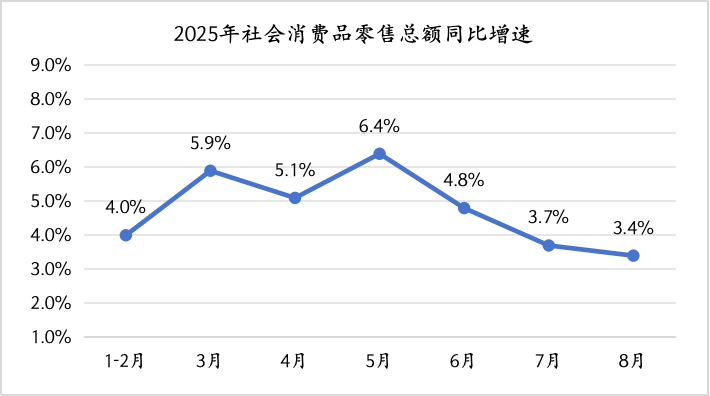
Economic Performance - In August, the industrial production growth rate was 5.2%, a decrease of 0.5 percentage points compared to the previous month[10] - Fixed asset investment from January to August was 326,111 billion CNY, with a year-on-year growth of 0.5%, down from 1.6%[10] - Retail sales of consumer goods in August totaled 39,668 billion CNY, growing by 3.4% year-on-year, a decline of 0.3 percentage points from the previous month[10] Investment Trends - Infrastructure investment decreased by 1.2 percentage points, while manufacturing investment growth fell by 1.1 percentage points[18] - Real estate development investment from January to August was 60,309 billion CNY, down 12.9% year-on-year, with the decline expanding by 0.9 percentage points[19] - The first industry investment grew by 5.5%, while the second industry saw a growth of 7.6%[18] Consumption Patterns - Urban retail sales grew by 3.2%, while rural retail sales increased by 4.6% in August[21] - Jewelry sales saw a significant increase, and automotive consumption turned positive after previous declines[22] - The decline in retail sales growth was primarily influenced by a drop in commodity retail sales, despite a rebound in dining consumption[25] Policy Outlook - The macroeconomic policy is expected to remain proactive, with continued support for infrastructure and real estate investments to stabilize the economy[29] - The government aims to effectively release domestic demand potential, which is crucial for economic recovery[29] Risk Factors - Potential risks include worsening geopolitical events, changes in international financial conditions, and unexpected shifts in US-China policies[30]
8月经济数据点评:终端需求政策需加力
Huachuang Securities· 2025-09-16 09:14
Demand-Side Analysis - In August, the growth rate of cyclical demand dropped to 2.2%, significantly lower than the nominal GDP growth rate of Q2, indicating a potential need for policy support[3] - The composite PMI output index averaged 50.3% in July and August, suggesting a possible policy response if it continues to decline in September[3] Policy Direction - Current low inflation suggests that policy measures should focus on boosting terminal demand without increasing future industrial supply[4] - Possible directions include promoting service consumption and advancing major projects from the 14th Five-Year Plan[4] Economic Data Overview - In August, industrial production growth was 5.2%, while the service sector's production index was 5.6%[5] - Retail sales growth year-on-year was 3.4%, down from 3.7% in the previous month[5] - Fixed asset investment saw a year-on-year decline of 7.1%, compared to a previous decline of 5.3%[5] Real Estate Sector - Real estate sales area decreased by 10.6% year-on-year in August, worsening from a 7.8% decline in July[5] - Real estate investment in August fell by 19.4% year-on-year, indicating ongoing sector challenges[5] Employment and Inflation - The urban survey unemployment rate rose to 5.3% in August, reflecting seasonal trends[26] - CPI was down 0.4% year-on-year, while PPI decreased by 2.9%, indicating deflationary pressures[24]
如何理解8月经济数据:周度经济观察-20250916
Guotou Securities· 2025-09-16 08:33
Economic Overview - August economic data continues to reflect insufficient total demand, with investment, consumption, and exports all slowing down, indicating increasing downward pressure on the economy[2] - Industrial added value in August year-on-year was 5.2%, down 0.5 percentage points from July, showing a cooling in industrial production[4] - Fixed asset investment in August saw a year-on-year decline of 7.1%, a record low, with infrastructure, manufacturing, and real estate investments continuing to decline[6] - Real estate investment in August decreased by 19.5% year-on-year, with new construction area down 20.3%[10] Financial Market Insights - Social financing growth in August was 8.8%, down 0.2 percentage points from the previous month, indicating a potential peak in social financing for the year[14] - The average interest rate for new corporate loans in August was approximately 3.1%, slightly down by 0.1 percentage points from the previous month, remaining at historical lows[14] - Market expectations for the Federal Reserve to cut interest rates three times in 2025, with a high probability of a 25 basis point cut in September[28] Inflation and Policy Outlook - The U.S. CPI in August rose to 2.9%, with a month-on-month increase of 0.4%, reflecting a controlled inflationary environment[23] - The core CPI remained stable at 3.1%, indicating limited upward pressure on core service prices[24] - The anticipated fiscal and monetary policy support in the U.S. is expected to bolster the stock market, which may continue to perform strongly[28]
8月经济观察:“反内卷”影响显现,政策加码窗口临近
Xin Lang Cai Jing· 2025-09-16 07:13
Economic Growth Overview - In August, China's economic growth momentum slowed down, with both supply and demand sides experiencing a decline in growth rates. Analysts suggest that due to high base effects and tariff uncertainties, along with the waning effects of the "trade-in" policy, downward pressure on the domestic economy is expected to increase in the fourth quarter, necessitating new policies to stabilize investment and promote consumption to achieve the annual growth target of around 5% [1][11]. Production Sector Analysis - In August, the industrial added value for large-scale enterprises grew by 5.2% year-on-year, a decrease of 0.5 percentage points from the previous month. The service production index growth rate was 5.6%, down 0.2 percentage points from the previous month [1]. - The "anti-involution" policy is identified as a primary reason for the cooling of industrial production. The industrial production intensity has declined for two consecutive months, influenced by extreme weather and the effects of the "anti-involution" policy [2]. - The added value of upstream production sectors showed strong performance, with non-ferrous metal smelting and rolling industries growing by 9.1% year-on-year, while coal mining and washing industries grew by 5.1% [2]. Demand Side Insights - In August, the total retail sales of consumer goods and exports in USD grew by 3.4% and 4.4% year-on-year, respectively, both showing declines from the previous month [3]. - The retail sales growth rate has been declining for three consecutive months, primarily due to the diminishing effects of the "trade-in" policy. The largest month-on-month declines were seen in home appliances and communication equipment, with decreases of 14.4% and 7.6% respectively [3][5]. Investment Trends - Investment growth has slowed for five consecutive months, with real estate, infrastructure, and manufacturing investments all experiencing varying degrees of decline [6]. - Infrastructure investment growth fell to 2.0% year-on-year for the first eight months, a decrease of 1.2 percentage points from the previous month. Manufacturing investment growth dropped to 5.1%, the lowest level since early 2021 [9]. - Analysts indicate that the decline in manufacturing investment is influenced by extreme weather and rising global trade uncertainties, which suppress the willingness of downstream enterprises to expand production [7]. Policy Recommendations - Analysts suggest that maintaining stable economic growth is becoming increasingly challenging, and timely policy adjustments are necessary. The potential for new incremental policies is anticipated, possibly by the end of September, including new policy financial tools and early allocation of local government debt quotas to improve infrastructure investment [12].
8月经济数据点评:经济延续放缓,政策调控紧迫性增加
Great Wall Securities· 2025-09-16 04:46
Consumption Data - In August 2025, the total retail sales of consumer goods reached 39,668 billion yuan, with a year-on-year growth of 3.4%, slowing from 3.7% in the previous month[2] - The retail sales growth was negatively impacted by a 2.3% decline in tobacco and alcohol sales, which reduced the overall growth rate by 0.03 percentage points[7] - The "old-for-new" policy significantly stimulated sales in home appliances and cultural office supplies, while oil and petroleum products saw negative growth due to global economic conditions[2] Real Estate Market - The sales area of commercial housing in August was 57.44 million square meters, down 11% year-on-year, with the decline expanding by 0.03 percentage points compared to the previous month[17] - Real estate development investment decreased by 12.9%, reflecting ongoing adjustments in the market and low consumer confidence[2] - The cumulative year-on-year decline in real estate development funding sources was 8%, with personal mortgage loans down 10.5%[28] Investment Trends - From January to August 2025, fixed asset investment totaled 326,111 billion yuan, with a year-on-year growth of 0.5%, slowing by 1.1 percentage points from the previous month[3] - Infrastructure investment (excluding electricity) grew by 2%, but the overall investment environment remains challenging due to reduced government spending and ongoing market adjustments[30] - Manufacturing investment growth was recorded at 5.1%, but this was a decline of 1.1 percentage points from the previous month, indicating a slowdown in industrial investment[36] Economic Outlook - Industrial production growth for January to August was 6.2%, maintaining stability but facing challenges from insufficient domestic demand[39] - The urgency for macroeconomic adjustments has increased, with potential policy focuses on interest rate cuts and increased issuance of government bonds[44] - Risks include potential underperformance of domestic macroeconomic policies and unexpected credit events[47]
基建投资连续下滑,期待后续财政加码
Changjiang Securities· 2025-09-16 04:43
Investment Rating - The industry investment rating is "Positive" and maintained [9] Core Viewpoints - Infrastructure investment has been declining, with expectations for increased fiscal support in the future [6][12] - From January to August, narrow infrastructure investment increased by 2.0% year-on-year, while broad infrastructure investment increased by 5.9% year-on-year [2][12] - In August alone, narrow infrastructure investment decreased by 5.8% year-on-year, and broad infrastructure investment decreased by 3.2% year-on-year, with a month-on-month decline of 1.8 percentage points [2][6] Summary by Sections Economic Data - The National Bureau of Statistics reported that from January to August, narrow infrastructure investment totaled 12 trillion yuan, with a year-on-year increase of 2.0%, and broad infrastructure investment totaled 16.3 trillion yuan, with a year-on-year increase of 5.9% [12] - In August, narrow infrastructure investment was 1.5 trillion yuan, showing a year-on-year decrease of 5.8%, while broad infrastructure investment was 2.1 trillion yuan, reflecting a year-on-year decrease of 3.2% [12] Investment Breakdown - In August, only electricity investment showed year-on-year growth, while investments in other sectors declined [12] - Transportation investment decreased by 5.4% in August, with railway investment down by 6.6% and road investment down by 11.6% [12] - Water conservancy investment saw a significant decline of 14.8%, with water management investment down by 29.8% [12] Cement Production - Cement production has been declining, with a year-on-year decrease of 4.8% from January to August, and a decrease of 6.2% in August alone [12] - The data indicates that construction activities may have slowed down due to seasonal factors [12] Fixed Asset Investment - Fixed asset investment growth has declined for two consecutive months, with attention on the physical workload progress in September and potential fiscal increases [12] - As of September 12, 2023, a total of 3.4138 trillion yuan in bonds has been issued this year, which is 655.2 billion yuan more than the previous year [12]
经济数据点评:增长放缓,债市不反应?
Tianfeng Securities· 2025-09-16 04:11
1. Report Industry Investment Rating No relevant content provided. 2. Core View of the Report - The economic growth in August continued to slow down, with industrial production, consumption, and investment all showing signs of weakness. Insufficient effective demand remains the core contradiction [1][8]. - Given the slowdown in economic growth, macro - policies need to play a role in promoting economic recovery. Fiscal, consumption, and real - estate policies are expected to be further adjusted [2][9]. - The bond market is supported by insufficient effective demand and weak fundamental recovery, but potential risks from subsequent policy efforts need to be noted. Bond market fluctuations may depend more on marginal changes in institutional behavior and capital flows [3][12]. 3. Summary by Directory 8 月经济数据:经济增长再放缓 - In August, industrial增加值 was 5.2% year - on - year (expected 5.7%, previous value 5.7%), social retail sales were 3.4% year - on - year (expected 3.8%, previous value 3.7%), and fixed - asset investment cumulative year - on - year was 0.5% (expected 1.3%, previous value 1.6%). Manufacturing, infrastructure, and real - estate investment all declined [8]. 工业生产韧性尚存,环比动能略降 - In August, the year - on - year growth of the added value of industrial enterprises above designated size was 5.2%, 0.5 percentage points lower than the previous month, and the cumulative growth from January to August was 6.2%. The growth of the service industry production index was 5.6%, slightly down 0.2 percentage points from the previous month [14]. - The year - on - year growth rates of the electrical machinery and chemical industries increased significantly, while those of the special equipment and transportation equipment industries declined. The added value of the equipment manufacturing and high - tech manufacturing industries was 8.1% and 9.3% respectively, 2.9 and 4.1 percentage points faster than the overall industrial added value [16][17]. - The output of emerging products such as robot reducers, industrial robots, 3D printing equipment, and industrial control computers and systems increased rapidly [17]. 消费增速延续回落,增量政策箭在弦上 - In August, the total retail sales of consumer goods were 39668 billion yuan, a year - on - year increase of 3.4%, 0.3 percentage points lower than in July, the lowest increase this year. The growth rate of commodity retail sales decreased by 0.4 percentage points, and the growth rate of catering revenue increased by 1.0 percentage point but remained at a relatively low level [19]. - The effect of the "trade - in" policy weakened, and the subsidy method adjustment in some areas affected the policy's immediate pulling effect. The weak performance of commodity sales, especially the sluggish automobile consumption, also dragged down the overall retail sales [21][22]. - The Ministry of Finance and other departments issued the "Implementation Plan for the Fiscal Interest Subsidy Policy for Personal Consumption Loans", and the State Council Information Office will hold a press conference on expanding service consumption policies [10][24]. 投资增速出现下行,继续低位磨底 - From January to August, the year - on - year growth rate of fixed - asset investment was 0.5%, 1.1 percentage points lower than from January to July, showing a downward trend. The investment structure was characterized by "slowing manufacturing, declining infrastructure, and real - estate drag" [25]. - Manufacturing investment cumulative year - on - year was 5.1%. The policy effect of large - scale equipment renewal continued to be released, with equipment purchase investment growing rapidly. However, in the short term, corporate investment motivation may decline, and corporate medium - and long - term loans increased less year - on - year [28]. - Infrastructure investment (excluding electricity) cumulative year - on - year was 2.0%, with the construction progress of major traditional infrastructure projects slowing down. The high - temperature and rainy weather in August affected construction, and the capital in - place situation of some projects may not meet expectations due to local government debt - resolution pressure [28][29]. - Real - estate investment cumulative year - on - year was - 12.9%. The decline in sales area and sales volume of new commercial housing widened, and real - estate development investment reached the largest decline this year. The real - estate market was still in the stage of "trading price for volume", and real - estate relaxation policies may need to be actively implemented in the second half of the year [29].
兼评8月经济数据:内需续弱,政策加码窗口临近
KAIYUAN SECURITIES· 2025-09-15 14:42
Consumption - Retail sales growth continued to slow, with August year-on-year growth down 0.3 percentage points to 3.4%[2] - The multiplier effect of the "trade-in" policy for consumer goods may decline by 23%-32%, from 8.7 times to 5.9-6.7 times[2][18] Production - Industrial production in August increased by 5.2% year-on-year, a decrease of 0.5 percentage points from the previous value[3] - Service sector production weakened slightly, down 0.2 percentage points to 5.6% year-on-year in August[3][21] Fixed Asset Investment - Real estate investment fell by 12.9% year-on-year in August, with a monthly decline of 19.5%[4][22] - Manufacturing investment decreased by 1.1 percentage points to 5.1%, marking five consecutive months of slowdown[4][27] Economic Outlook - Internal demand pressure is increasing, with expectations of policy support in Q4 to counteract economic slowdown[5][35] - Potential policy measures may include interest rate cuts, a 500 billion yuan policy financial tool, and support for service consumption and real estate[5][35] Risks - Risks include potential policy changes that may be less than expected and the possibility of an unexpected recession in the U.S. economy[6][36]