
债券

Search documents
债市日报:1月15日
Xin Hua Cai Jing· 2026-01-15 09:04
Core Viewpoint - The bond market showed slight strengthening with most interbank bond yields declining by around 1 basis point, while the central bank's net injection was 169.4 billion yuan, leading to a general decrease in funding rates. The market is expected to remain volatile in the short term, with a continued need for a loose monetary environment into 2026, and potential for flexible use of interest rate cuts and reserve requirement ratio reductions [1][6]. Market Performance - The closing prices for government bond futures showed an increase for most contracts, with the 10-year main contract rising by 0.11% to 108.035. The yields for various government bonds also decreased, with the 10-year government bond yield down by 0.95 basis points to 1.8475% [2]. - The China Convertible Bond Index rose by 0.20% to 516.90 points, with a trading volume of 90.616 billion yuan. Notable gainers included Jin 05 Convertible Bond and Guo Wei Convertible Bond, which increased by 20.00% and 15.15%, respectively [2]. International Bond Market - In North America, U.S. Treasury yields fell across the board, with the 10-year yield down by 4.33 basis points to 4.132%. Similar downward trends were observed in the Asian and Eurozone markets, with Japanese and European bond yields also declining [3][4]. Primary Market - The China Development Bank's 3-year and 7-year financial bonds had winning yields of 1.6675% and 1.9086%, respectively, with bid-to-cover ratios of 3.03 and 4.11. The Export-Import Bank's financial bonds had winning yields of 1.4387% and 1.7481%, with bid-to-cover ratios of 2.63 and 6.39 [5]. Funding Conditions - The central bank conducted a 179.3 billion yuan reverse repurchase operation at a fixed rate of 1.40%, resulting in a net injection of 169.4 billion yuan for the day. Additionally, a 900 billion yuan 6-month buyout reverse repurchase operation was carried out, marking the fifth consecutive month of increased operations [6]. - The Shibor rates for various tenors showed a collective decline, with the overnight rate down by 1.6 basis points to 1.374% [6]. Institutional Perspectives - Institutions highlighted the necessity of loose monetary policy to address the structural issues in the economy, emphasizing the need for counter-cyclical tools to facilitate asset balance sheet recovery. The central bank's actions are seen as supportive of government bond issuance and encouraging financial institutions to increase credit supply [8].
ETF资产配置月报(2026年1月):全球权益看A股,黄金向上趋势延续-20260115
Orient Securities· 2026-01-15 05:16
Report Industry Investment Rating No relevant content provided. Core Viewpoints of the Report - The report captures global multi - asset investment opportunities (covering domestic assets such as A - shares, bonds, and gold, as well as overseas equity assets like US stocks, Japanese stocks, and Indian stocks) and designs corresponding allocation schemes according to common investment scenarios. All portfolios can be tracked through corresponding ETF/LOF products [7]. - In January 2026, the allocation suggestions are as follows: A - shares may have short - term momentum but also face callback risks, with a focus on cyclical mid - cap blue - chips led by chemicals, domestic AI, satellites, and semiconductors; the domestic bond market is neutral, and short - term varieties can be focused on; US stocks may maintain a neutral shock pattern; Japanese stocks may have a neutral shock pattern; Indian stocks may have a weak shock pattern; gold may remain strong in the short - term but also face volatility risks, and its medium - to - long - term allocation value is significant [7]. - A two - stage robust multi - asset portfolio design method based on "portfolio insurance + risk budget" is introduced, which is decision - making based on risk characteristics, does not rely on asset return forecasts, and has good robustness while considering both return elasticity and risk control [7]. Summary by Relevant Catalogs 1. Market Review and Allocation Outlook 1.1 Market Review - In 2025, gold performed outstandingly, global equity assets showed differentiation (A - shares, Japanese stocks, and US stocks were strong, while Indian stocks declined slightly), and the bond market was relatively sluggish. The return performance of underlying assets was: gold (58.57%) > CSI 800 (23.91%) > Nikkei 225 (22.26%) > Nasdaq 100 (17.50%) > short - term financing (1.78%) > 7 - 10 - year policy - financial bonds (0.22%) > S&P BSE Sensex ( - 0.40%) [16]. 1.2 Asset Allocation Outlook - **A - shares**: Economic prosperity and mild inflation recovery support the medium - to - long - term stock market trend, but there are short - term callback risks. Industry themes such as cyclical mid - cap blue - chips led by chemicals, domestic AI, satellites, and semiconductors can be focused on [18]. - **Domestic bond market**: Due to the risk preference of rising equities and the expectation of mild inflation recovery, bonds are neutral overall, and short - term varieties can be continuously focused on [20]. - **US stocks**: The US economy still has resilience, but due to the downward revision of interest - rate cut expectations and relatively high valuations, US stocks may maintain a neutral shock pattern in the short - term [22]. - **Japanese stocks**: Japan's economy is in a benign "wage - price spiral" and is moderately recovering, but with a marginal net outflow of foreign capital, Japanese stocks may have a neutral shock pattern in the short - term [31]. - **Indian stocks**: The economic prosperity has declined from its peak, and with a marginal net outflow of foreign capital, Indian stocks may have a weak shock pattern in the short - term [34]. - **Gold**: Geopolitical tensions have pushed gold to new highs. It may remain strong in the short - term but also face volatility risks, and its medium - to - long - term allocation value is significant [38]. 2. Robust Portfolio Design Idea: Two - Stage Method of "Portfolio Insurance + Risk Budget" 2.1 Dilemma of Asset Allocation Models in Domestic Investment Applications - The two classic multi - asset portfolio management methods, mean - variance optimization (MVO) and its derivative models, and risk - budget - based models (such as the risk - parity model), have limitations in domestic investment applications. MVO is highly sensitive to changes in returns and risks, and the risk - parity model may lead to an overly low proportion of equity assets in the portfolio [45]. 2.2 Optimization Idea 1: Using Portfolio Insurance Method to Optimize the Sharpe Ratio of High - Risk Assets - The portfolio insurance strategy can optimize the return - risk ratio of high - volatility assets such as A - shares in the medium - to - long - term. Taking the domestic stock - bond CPPI portfolio as an example, it can achieve better risk performance compared to corresponding portfolios [52]. 2.3 Optimization Idea 2: Integrating Target Allocation Central Risk Budget Strategy - By decomposing the risk budget, the target stock - bond allocation central can be integrated into the risk - budget configuration model, and the allocation weights can be dynamically adjusted according to the changes in asset volatility [59]. 2.4 "Portfolio Insurance + Risk Budget": Balancing Return Elasticity and Risk Control - The two - stage combination design method of "portfolio insurance + risk budget" first uses the CPPI method to optimize the Sharpe ratio of single risk assets and then constructs a risk - budget investment portfolio based on the risk characteristics of each sub - portfolio. It can effectively combine return elasticity and risk control and has good robustness [63]. 3. Stock - Bond Target Allocation Central Risk Budget Portfolio 3.1 Investment Scenarios and Scheme Design - In a low - interest - rate environment, the fixed - income plus strategy can alleviate the problem of declining returns of pure - bond assets. Two strategies are designed: the stock - bond target allocation central risk budget strategy (stock - bond RB) and the "CPPI + RB" two - stage stock - bond target allocation central strategy (stock - bond CPPI_RB), with three types of allocation central combinations of 1:9, 2:8, and 3:7 constructed respectively [67][68][69]. 3.2 Portfolio Performance Analysis - During the back - testing period (January 5, 2015 - December 31, 2025), the performance of the strategy integrating the stock - bond target allocation central risk budget is better than that of the fixed - allocation central stock - bond portfolio, and the two - stage stock - bond CPPI_RB portfolio is better than the stock - bond RB portfolio [70]. 3.3 Allocation Weights and Marginal Changes - The stock - bond allocation of the three types of allocation central portfolios meets the requirements of the target allocation central. At the end of December 2025, the stock - bond RB portfolio moderately increased the weight of A - shares and increased the weight of long - term bonds while reducing the weight of short - term bonds within the bond category [75]. 4. Low - Volatility "Fixed - Income Plus" Portfolio 4.1 Investment Scenarios and Scheme Design - To reduce the volatility risk of the stock - bond portfolio during extreme "stock - bond double - kill" market conditions, an appropriate amount of gold is added. The portfolio is designed using the two - stage method of "portfolio insurance (CPPI) + risk budget (RB)", with a target allocation central of stock:gold:bond = 1:1:4 [80][81]. 4.2 Portfolio Performance Analysis - During the back - testing period (January 1, 2015 - December 31, 2025), the low - volatility "fixed - income plus" strategy has an annualized return of 7.08%, an annualized volatility of 3.47%, a maximum drawdown of - 4.92%, a Sharpe ratio of 1.99, and a Calmar ratio of 1.44 [83]. 4.3 Allocation Weights and Marginal Changes - As of December 31, 2025, the latest weights of the strategy are: CSI 800 (10.78%), gold (5.99%), 7 - 10 - year policy - financial bonds (75.09%), and short - term financing (8.14%). In December 2025, the weight of short - term financing was increased, and the weights of other assets were decreased [90]. 4.4 Strategy Implementation: Tracking Based on ETF Assets - The low - volatility "fixed - income plus" strategy can be well tracked by corresponding ETF assets. As of December 31, 2025, the annualized return of the strategy since 2023 is 9.38%, and the annualized returns of the FOF_of_ETFs portfolio based on ETF net value and on - site price are 9.05% and 9.07% respectively [95]. 5. Global Asset Allocation Portfolio 5.1 Investment Scenarios and Scheme Design - In a volatile global situation, global asset allocation can effectively diversify risks and improve the return - risk ratio of the portfolio. A two - stage FOF portfolio design method of "portfolio insurance (CPPI) + risk parity (RP)" is used [102][104]. 5.2 Global Multi - Asset Allocation Strategy I: A - shares + Bonds + Gold + US Stocks - **Performance**: During the back - testing period (January 1, 2014 - December 31, 2025), the annualized return is 11.85%, the annualized volatility is 5.94%, the maximum drawdown is - 7.97%, the Sharpe ratio is 1.91, and the Calmar ratio is 1.49. In 2025, it recorded 20.94% [106]. - **Allocation Weights and Marginal Changes**: As of December 31, 2025, the model allocation weights are: CSI 800 (18.98%), Nasdaq 100 (17.84%), gold (13.66%), and 7 - 10 - year policy - financial bonds (49.51%). In December 2025, the weight of 7 - 10 - year policy - financial bonds was increased, and the weights of other assets were decreased [111]. - **Strategy Implementation**: The strategy can be well tracked by corresponding ETF/LOF assets. As of December 31, 2025, the annualized return of the strategy since 2023 is 16.92%, and the annualized returns of the FOF_of_ETFs portfolio based on ETF net value and on - site price are 16.53% and 17.04% respectively [119]. 5.3 Global Multi - Asset Allocation Strategy II: A - shares + Bonds + Gold + Cross - Border Equities - **Performance**: During the back - testing period (January 1, 2014 - December 31, 2025), the annualized return is 10.25%, the annualized volatility is 5.09%, the maximum drawdown is - 9.97%, the Sharpe ratio is 1.94, and the Calmar ratio is 1.03. In 2025, it recorded 13.56% [126]. - **Allocation Weights and Marginal Changes**: As of December 31, 2025, the model allocation weights are: CSI 800 (9.63%), Nasdaq 100 (9.65%), Nikkei 225 (6.17%), S&P BSE Sensex (17.87%), gold (7.16%), and 7 - 10 - year policy - financial bonds (49.51%). In December 2025, the weights of S&P BSE Sensex and 7 - 10 - year policy - financial bonds were increased, and the weights of other assets were decreased [133]. - **Strategy Implementation**: The strategy can be well tracked by corresponding ETF/LOF assets. As of December 31, 2025, the annualized return of the strategy since 2023 is 14.06%, and the annualized returns of the FOF_of_ETFs portfolio based on ETF net value and on - site price are 13.60% and 14.06% respectively [145].
30年期国债创年内新低银价走低
Jin Tou Wang· 2026-01-15 03:51
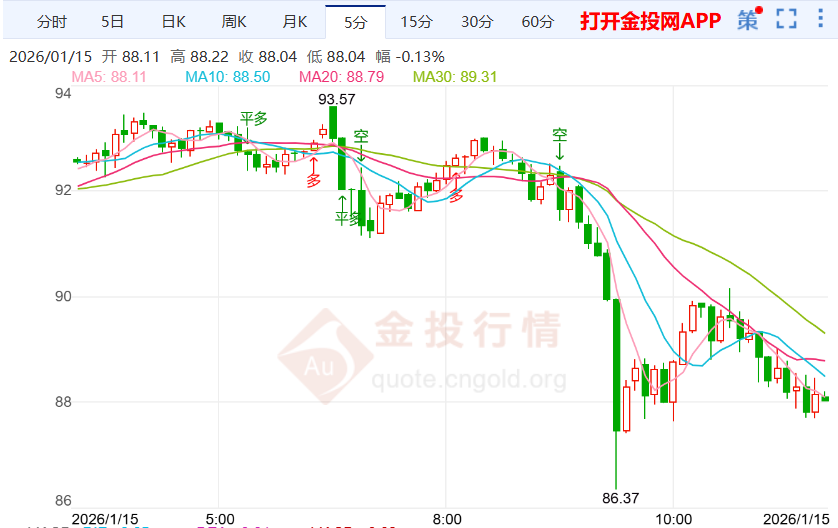
此轮涨势的催化剂包括美股基准指数下跌、美国对伊朗采取军事行动预期引发的额外避险需求,以及最高法院推迟对 关税的裁决(这改善了美国的财政前景)。 供应方面的考量也发挥了作用。此前两天进行的国债拍卖需求强劲,同时纽约时间周三下午2点进行的例行国债回购操 作目标为20至30年到期的债券。此外,美债还受到英债上涨的支撑,10年期英债收益率跌至4.35%,创一年多以来收盘 新低。 【最新国际白银行情解析】 今日周四(1月15日)亚盘时段,国际白银目前交投于88.88一线下方,今日开盘于93.57美元/盎司,截至发稿,国际白银 暂报88.21美元/盎司,下跌5.33%,最高触及93.57美元/盎司,最低下探86.37美元/盎司,目前来看,国际白银盘内短线 偏向震荡走势。 【要闻速递】 随着避险需求升温及债券供应因素影响,美债价格上涨,推动30年期国债收益率跌至今年以来最低水平。美国债市吸 引力下降,促使资金转向贵金属等替代资产。鉴于白银兼具临时避险属性,国债收益率下行导致固定收益资产回报降 低,这在短期内有望持续支撑白银需求,进而使白银的买盘压力维持在较高水平。 纽约时间中午前不久,各期限国债收益率普遍走低至少2个基点, ...

10年期英债收益率创13个月新低,投资者关注英国央行利率前景
Jin Rong Jie· 2026-01-14 18:34
Group 1 - The yield on UK 10-year government bonds fell by 6.3 basis points to 4.336%, approaching the bottom of 4.326% on December 12, 2024, and the bottom of 4.190% on December 3 of the same year, as well as the bottom of 3.729% on September 17 [1] - The yield on 2-year UK bonds decreased by 3.6 basis points to 3.621% [1] - The yield on 30-year UK bonds dropped by 5.2 basis points to 5.087%, while the yield on 50-year UK bonds fell by 1.7 basis points to 4.632% [1] Group 2 - The 2/10 year UK bond yield spread decreased by 2.617 basis points to +71.268 basis points [1]
欧洲债市:英国国债收益率跌至2024年以来最低水平
Xin Lang Cai Jing· 2026-01-14 17:01
Market Overview - The benchmark UK government bond yield has fallen to its lowest level in over a year due to robust demand in the UK bond auction [1] - The market is now focused on the upcoming November GDP data to be released on Thursday [1] - The money market has increased its bets on a rate cut by the Bank of England, now expecting a reduction of 46 basis points this year, up from the previously estimated 44 basis points [1] Bond Yield Movements - The German government bond yield decreased by 2 basis points to 2.82% [2] - German government bond futures rose by 27 points to 128.36 [2] - The Italian 10-year government bond yield fell by 2 basis points to 3.46% [2] - The French 10-year government bond yield decreased by 2 basis points to 3.50% [2] - The 10-year UK government bond yield dropped by 5 basis points to 4.35% [2]
超长信用债的配置窗口已现?
SINOLINK SECURITIES· 2026-01-14 13:39
1. Report Industry Investment Rating No relevant content provided. 2. Core Viewpoints of the Report - In the week from January 5 - 9, 2026, the ultra - long credit bonds showed a downward trend. Affected by multiple factors such as the stock - bond seesaw effect, the withdrawal of impulsive funds, and the supply pressure of long - term bonds, the yields of ultra - long credit bonds generally increased. The number of outstanding ultra - long credit bonds with yields above 2.8% increased to 174 [2][13]. - The supply of ultra - long industrial bonds dropped to a low point. This week, the total supply of new ultra - long credit bonds was 5.03 billion, with issuers highly concentrated in urban investment platforms. The interest rate of new ultra - long urban investment bonds rose to around 3%, but the subscription enthusiasm remained low [3][22]. - The ultra - long credit bond index continued to decline. The sharp rise of the stock market this week impacted the bond market pricing. Most medium - and long - term general credit bond full - price index prices fell, with the price of AA + credit bonds over 10 years dropping by 0.05%. However, the trading activity of ultra - long credit bonds rebounded, and the average trading yield of general credit bonds over 10 years rose above 2.65%. After the New Year, the number of trading transactions of ultra - long credit bonds rebounded to over 350 [4][29][31]. - From a more microscopic perspective, the spread between 7 - 10 - year active ultra - long credit bonds and government bonds of similar maturities was 58bp this week, with good coupon value. In late January, the opening of amortized - cost bond funds may bring local benefits to the ultra - long credit bond market [5][43]. 3. Summary According to the Directory 3.1 Stock Market Characteristics - Ultra - long credit bonds declined. Affected by multiple factors, the yields of ultra - long credit bonds generally increased, and the number of outstanding ultra - long credit bonds with yields above 2.8% increased to 174 compared with last week [2][13]. 3.2 Primary Issuance Situation - The supply of ultra - long industrial bonds dropped to a low point. This week, the total supply of new ultra - long credit bonds was 5.03 billion, with issuers highly concentrated in urban investment platforms [3][22]. - In terms of issuance interest rates, in the context of overall bond market fluctuations and fragile investor sentiment, the market demanded a higher risk premium for ultra - long credit bonds. The interest rate of new ultra - long urban investment bonds rose to around 3% this week. Despite the continuous increase in coupon rates, the subscription enthusiasm for ultra - long urban investment bonds remained low, and market concerns about the uncertainty of ultra - long urban investment bonds with maturities spanning the debt - resolution node intensified [3][22]. 3.3 Secondary Trading Performance - The ultra - long credit bond index continued to decline. The sharp rise of the stock market this week impacted the bond market pricing. Most medium - and long - term general credit bond full - price index prices fell, with the price of AA + credit bonds over 10 years dropping by 0.05% [4][29]. - The trading activity of ultra - long credit bonds rebounded. The supply pressure of government bonds and the warming of stock market sentiment continuously disturbed long - term interest rates. The secondary - market trading yield of ultra - long credit bonds continued to fluctuate. The average trading yield of general credit bonds over 10 years rose above 2.65%. After the New Year, the number of trading transactions of ultra - long credit bonds rebounded to over 350, partly driven by the market pattern of "credit is better than interest rates" this week. Due to the overcrowded trading of short - and medium - term credit products, some asset allocations shifted to the long - end [4][31]. - Corresponding to the secondary - market trading performance, the TKN ratio of general credit bonds over 10 years rebounded to 60%. The certain high coupon attracted funds to flow from more volatile long - term interest - rate bonds to credit bonds [4][36]. - In terms of investor structure, wealth - management funds have the motivation to extend the duration to increase returns, but their behavior is constrained by net - value fluctuations and tends to be cautious during the interest - rate increase period. Public funds with stronger trading attributes have recently shown a continuous attitude of reducing or holding off on long - duration credit bonds. Traditional allocation players such as insurance companies have承接, but the intensity has weakened, and they may reserve more positions for newly issued local government bonds [4][41].
绿色金融迈入“做强时代”:43.5万亿信贷、9千亿绿债背后的结构性转折
和讯· 2026-01-14 09:08
Core Viewpoint - China's green finance is undergoing a significant transition, shifting from a focus on quantity to efficiency and from policy-driven to mechanism-driven growth [2] Group 1: Green Credit - Green credit remains the core and stable pillar of China's green finance system, with a projected balance of approximately 43.5 trillion yuan by the end of Q3 2025, reflecting an 18.9% increase from 36.6 trillion yuan at the end of 2024 [3][6] - In the first three quarters of 2025, green loans contributed 6.47 trillion yuan to the total loan increment, accounting for 43.9% of the total loan growth, indicating a shift from a temporary policy tool to a normalized direction for bank lending [6] Group 2: Green Bonds - The green bond market has shown a significant recovery in 2025, with a cumulative issuance of approximately 914.9 billion yuan from January to November, surpassing the total of 681.4 billion yuan for 2024 and nearing the historical high of 2022 [7] - Financial institutions dominate the green bond issuance, with green financial bonds accounting for about 492.3 billion yuan, focusing on clean energy, green infrastructure, and low-carbon transition projects [7] Group 3: Carbon Market - As of November 2025, the cumulative transaction volume of the national carbon market reached 818 million tons, with a total transaction value of 54.575 billion yuan, reflecting a 23.81% year-on-year increase in transaction volume for 2025 [10] - The carbon market is characterized by stable transaction volumes but a downward trend in prices, indicating a "stable volume, weak price" market feature [10] Group 4: Strategic Transition - The period from 2024 to 2025 is identified as a critical transition point from "growth in quantity" to "optimization in structure" for green finance, with a shift in policy focus towards the quality of fund allocation, emission reduction performance, and risk constraints [13] - By 2026, green finance is expected to further establish its "infrastructure-type" position within the financial system, transitioning from thematic investments to long-term asset allocations [13]

历史性时刻!美国CPI放榜,金银全线狂飙
Sou Hu Cai Jing· 2026-01-14 07:42
Group 1 - The core viewpoint of the article highlights that the recent rise in gold prices, reaching historical highs, is not merely a reaction to cooling inflation but reflects a significant shift in market dynamics and investor sentiment towards systemic risk [1][7]. - The December U.S. core CPI showed a year-on-year increase of 2.6%, maintaining a low range not seen in four years, indicating a long-term trend of declining inflation [1]. - Despite the positive inflation data, the Federal Funds rate futures did not show a drastic drop, suggesting that good news on inflation alone is insufficient to influence the Federal Reserve's policy decisions [3]. Group 2 - The bond market's 10-year U.S. Treasury yield remained around 4.17%, indicating a persistent high-rate environment rather than a sign of easing monetary policy [5]. - In a challenging environment with a strong dollar and flat yields, spot gold prices surged past $4,600, while silver reached $89, with the gold-silver ratio narrowing to a new low not seen in over a decade [5]. - Analysts suggest that the traditional model of "real interest rates driving gold prices" is inadequate to explain the current situation, as gold is increasingly viewed as a hedge against systemic risk rather than just inflation [7]. Group 3 - The rise in gold prices is seen as a systematic reflection of long-term uncertainties rather than a mere emotional response to market conditions [9]. - Understanding why gold remains strong in a dollar-negative environment is deemed more important than focusing on specific price points, emphasizing the need for rational trading strategies in a new era where good news does not automatically lead to easing [9].

基金观察:如何看待债市机会与风险?
Sou Hu Cai Jing· 2026-01-14 02:45
Core Viewpoint - The bond market is expected to experience fluctuations in 2025, with a shift in investor preference towards equities anticipated for 2026 due to declining risk premiums and supportive macroeconomic policies [2][3]. Group 1: Market Trends - The bond market has seen a strong performance over the past four years, primarily due to a lack of attractive returns in the equity market, leading investors to favor lower-risk bond assets [2]. - A significant drop in risk premiums indicates a rising risk appetite among investors, which is likely to result in a decline in bond prices and an increase in stock market performance [2]. - The central economic work conference has set a positive tone for macroeconomic policies, emphasizing proactive fiscal measures and moderately loose monetary policies, which are expected to enhance investor sentiment towards economic recovery [2]. Group 2: Investor Strategies - Investors should adjust their strategies in light of potential economic recovery, focusing on early indicators of corporate profitability such as the Producer Price Index (PPI) [3]. - Recommendations for bond investors include reducing duration by holding shorter-duration bonds and increasing exposure to equity-linked products like convertible bond funds and secondary bond funds to enhance returns [3]. - In the current interest rate environment, the choice between pure bond funds, convertible bond funds, and ETFs tracking government and technology innovation bonds should be based on the investor's outlook on interest rates and economic conditions [4][5]. Group 3: Product Insights - Pure bond funds are focused solely on bond assets, requiring careful attention to the fund manager's ability to adjust the portfolio based on credit and interest rate research [4]. - Government bond ETFs track government bond indices and are sensitive to interest rate changes, while technology innovation bonds carry additional credit risks, potentially offering higher returns [5].
日本长期国债收益率连破纪录
Jin Rong Jie· 2026-01-14 01:58
Core Viewpoint - The Japanese bond market is experiencing significant yield increases, with the 20-year government bond yield reaching a historic high of 3.165% and the 10-year yield at 2.18%, the highest since February 1999, amid speculation regarding the dissolution of the House of Representatives and upcoming elections [1] Group 1 - The yield on newly issued 20-year Japanese government bonds has risen to 3.165%, marking a historical peak [1] - The yield on 10-year Japanese government bonds has increased to 2.18%, the highest level since February 1999 [1] - Speculation surrounding the dissolution of the House of Representatives and the potential for elections is exerting pressure on the market, leading to weaker trends in Japanese government bond futures [1]