啤酒

Search documents
国泰海通|食饮:食饮获配比例回落,乳品、零食板块加配——2025Q4机构持仓总结
国泰海通证券研究· 2026-01-29 14:05
Core Viewpoint - The allocation ratio of the food and beverage sector is expected to decline in Q4 2025, with a notable decrease in both the liquor and non-liquor segments, while other sectors such as beverages, dairy, and snacks show an increase in allocation [1][2]. Group 1: Investment Recommendations - Focus on five main investment lines: 1) Stocks with price elasticity; 2) Beverages benefiting from travel demand; prioritize low valuation and high dividend yields; 3) Growth stocks in snacks and food raw materials; 4) Beer; 5) Stable condiments and livestock capacity reduction, with a recovery expected in food service [2]. - The allocation ratio of actively managed equity public funds in the food and beverage sector decreased by 0.14 percentage points to 4.04%, ranking ninth among all sectors [2]. Group 2: Sector Analysis - In Q4 2025, the allocation ratio for liquor stocks decreased by 0.29 percentage points to 2.92%, driven by declines in leading liquor companies such as Wuliangye and Shanxi Fenjiu [3][4]. - Non-liquor segments, including food processing, beverage dairy, and snacks, saw an increase in allocation ratios, with notable gains in the dairy sector led by Yili and Mengniu, and in snacks led by companies like Wancheng Group and Ximai Foods [3][4]. - The condiment sector also experienced an increase in allocation, with significant rises in stocks like Angel Yeast and Zhongju High-tech, while Haitian Flavoring saw a decrease [4].


ST西发:预计2025年归属于上市公司股东的净利润11000万元~16000万元
Mei Ri Jing Ji Xin Wen· 2026-01-29 12:49
Group 1 - The company ST Xifa expects a net profit attributable to shareholders of 110 million to 160 million yuan for 2025, representing a year-on-year growth of 319.91% to 510.77% [1] - The significant increase in net profit is primarily due to the recovery of large receivables and a substantial reduction in credit impairment losses from its subsidiary, Tibet Lhasa Beer Co., Ltd. [1]

ST西发:预计2025年净利润同比增长319.91%~510.77%
Guo Ji Jin Rong Bao· 2026-01-29 12:41
Core Viewpoint - ST Xifa expects a significant increase in net profit for the fiscal year 2025, projecting a range of 110 million to 160 million yuan, representing a year-on-year growth of 319.91% to 510.77% [1] Financial Performance - The company anticipates a net profit excluding non-recurring gains and losses to be between 20 million and 27 million yuan, indicating a decline of 27.05% to 1.51% year-on-year [1] - A major factor contributing to the substantial increase in net profit attributable to the parent company's shareholders is the recovery of large receivables and the reversal of bad debt provisions, leading to a significant reduction in credit impairment losses [1]
中国必选消费品1月价格报告:次高端及以上白酒分化加剧,本期无大众品折扣减小
Haitong Securities International· 2026-01-29 11:28
Investment Rating - The report assigns an "Outperform" rating to multiple companies in the consumer staples sector, including Guizhou Moutai, Wuliangye, Luzhou Laojiao, and others, indicating a positive outlook for these stocks [1]. Core Insights - There is an intensified divergence among mid-to-high-end baijiu products, with no discount contraction observed in food and beverage categories [1]. - The report highlights that the wholesale prices of various baijiu brands have shown stability or slight changes, with some brands experiencing price increases while others remain flat or decrease [3][4][35]. - Discounts on representative products in condiments, liquid milk, and soft drinks have widened compared to the end of December, indicating a shift in pricing strategies [19][32]. Summary by Relevant Sections Baijiu Pricing - Guizhou Moutai's wholesale prices for Feitian (case and single bottle) and Moutai 1935 are reported at 1600, 1580, and 630 yuan respectively, with changes of 0, -10, and -10 yuan compared to last month [35]. - Wuliangye's eighth-generation price is 830 yuan, reflecting a +10 yuan increase from the previous month [35]. - Luzhou Laojiao's Guojiao 1573 remains at 850 yuan, unchanged from last month [35]. Discount Trends - The average discount rate for condiments decreased from 87.1% to 85.0%, while liquid milk discounts fell from 62.8% to 61.4% [19][22]. - In contrast, discounts for beer, infant formula, and convenience foods remained stable, with beer discounts slightly increasing from 80.3% to 80.7% [20][22][32]. Company Ratings - The report lists several companies with an "Outperform" rating, including: - Guizhou Moutai - Wuliangye - Luzhou Laojiao - Qingdao Beer - China Feihe - Others [1].






一文拆解金星啤酒招股书:“金”酿升级,成长新“星”
GOLDEN SUN SECURITIES· 2026-01-29 11:25
Investment Rating - The report rates the industry positively, highlighting the growth potential of the craft beer segment and the leading position of the company in this market. Core Insights - The company is positioned as a leader in the Chinese craft beer market, benefiting from the expansion of the craft beer segment and innovative product offerings. It has shown significant revenue and profit growth, with a retail revenue CAGR of 23.7% from 2022 to 2024, and a remarkable increase in net profit by 928% year-on-year in 2024 [9][20]. Company Overview - The company, established in 1982, has evolved into a leading brand in the Chinese craft beer sector, with a diverse product portfolio that includes lager and wheat beers, as well as innovative tea-flavored craft beers [9][10]. - As of Q1-Q3 2025, the company ranked eighth in the Chinese beer industry and fifth among domestic brands, while being the third largest craft beer company in China [9]. Financial Performance - Revenue increased from 3.56 billion to 7.3 billion yuan from 2023 to 2024, representing a year-on-year growth of 104.87%. For Q1-Q3 2025, revenue further surged to 11.1 billion yuan, marking a 191.16% increase year-on-year [20][23]. - Net profit rose from 0.12 billion to 1.25 billion yuan during the same period, with a staggering year-on-year growth of 1095.84% in Q1-Q3 2025, reaching 3.05 billion yuan [20][23]. Business Performance - The company focuses on the craft beer segment, with a product matrix that includes traditional and innovative offerings. The craft beer segment accounted for 78.1% of total revenue in Q1-Q3 2025, with a year-on-year growth of 2331.97% [38][42]. - Traditional beer categories, such as the 1982 raw beer and new generation beer, have shown declining performance, indicating a shift in consumer preference towards craft beers [42]. Distribution Channels - The company primarily relies on offline distribution, which accounted for 81% of total revenue in 2024. The online direct sales channel has also seen significant growth, with a year-on-year increase of 2172.17% in 2024 [49]. - The company has expanded its distribution network across various regions, with a focus on increasing its presence in the central and southern regions of China [49]. Future Strategy - The company plans to diversify its product offerings under the "Blue Horse" brand, introducing new products such as rice wine and non-alcoholic tea beer to capture a broader market [71]. - Marketing efforts will focus on enhancing brand visibility through collaborations with influencers and targeted campaigns on social media platforms [71]. Industry Situation - The overall beer market in China is expanding, with a projected market size growth from 604.3 billion yuan in 2019 to 734.7 billion yuan in 2024, reflecting a CAGR of 4.0% [77]. - The craft beer segment is experiencing rapid growth, with a CAGR of 38.4% from 2019 to 2024, indicating a strong consumer shift towards premium and innovative beer products [77][78].
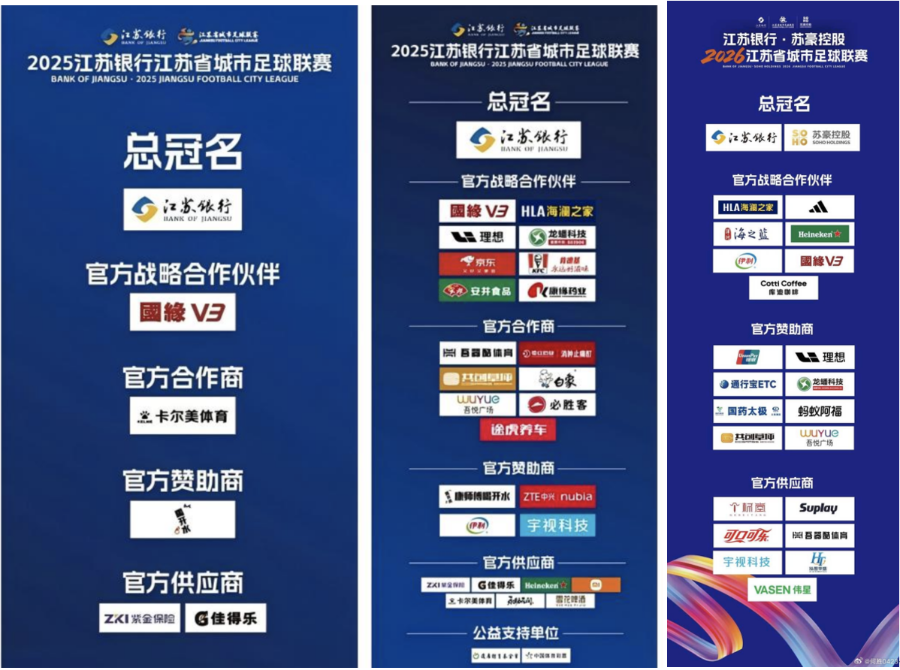
2026年苏超赞助商公布,小微企业可花5万元上桌
2 1 Shi Ji Jing Ji Bao Dao· 2026-01-29 10:31
Core Insights - The 2026 Jiangsu Provincial Urban Football League (referred to as "Su Super") is set to continue the momentum generated by its inaugural season in 2025, with a strong lineup of sponsors and heightened public interest [1][2] Sponsorship and Financial Aspects - The 2026 season has attracted 24 sponsors, including notable companies such as Jiangsu Bank, Suhao Holding Group, Heineken, Adidas, and Ant Financial, showcasing a robust sponsorship portfolio [1][2] - The total sponsorship amount for the 2026 season was previously reported to exceed 202 million yuan, although this figure is still subject to confirmation due to pending agreements [2] Audience Engagement and Popularity - The inaugural season of Su Super saw significant audience engagement, with a total attendance of 2.43 million across 85 matches, averaging 28,000 spectators per match, and online viewership reaching 2.2 billion [4] - The league has generated a cultural phenomenon, with various social media trends and memes emerging from the matches, indicating a strong community connection and engagement [4][5] Socioeconomic Context - The success of Su Super is attributed to the unique competitive spirit among the 13 cities in Jiangsu, each with its own economic strengths and cultural pride, creating a vibrant local rivalry [5][6] - The league's rapid growth in sponsorship from 6 to nearly 40 partners within a year reflects the effective governance and responsiveness of local authorities to capitalize on this sporting event [5] Changes and Innovations for the New Season - The 2026 season will introduce a new competition format, including a two-leg knockout stage in the playoffs, increasing the total number of matches to 91 [8] - The league will also expand its sponsorship model to include small and micro enterprises, allowing them to participate as official sponsors, thereby enhancing community involvement [9] Broader Implications and Future Prospects - The success of Su Super has inspired other regions to launch similar sports events, but experts suggest that replicating its success requires a deep understanding of local cultural and social dynamics [10]



青岛啤酒1月29日现1笔大宗交易 总成交金额720万元 溢价率为-5.62%
Xin Lang Cai Jing· 2026-01-29 10:14
Group 1 - Qingdao Beer saw a stock price increase of 5.49%, closing at 63.57 yuan on January 29 [1] - A block trade occurred with a total volume of 120,000 shares and a transaction amount of 7.2 million yuan [1] - The first transaction price was 60.00 yuan for 120,000 shares, resulting in a premium rate of -5.62% [1] Group 2 - In the last three months, there has been one block trade for the stock, totaling 7.2 million yuan [1] - Over the past five trading days, the stock has increased by 2.62%, with a net inflow of main funds amounting to 33.33 million yuan [1]

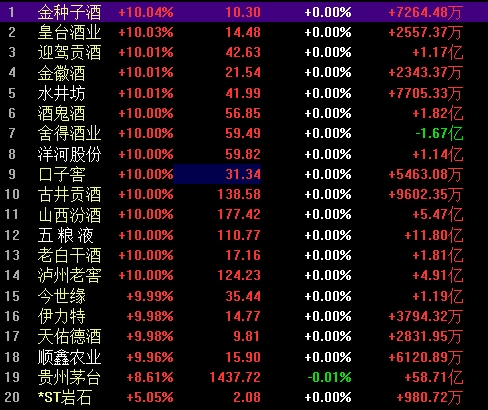
白酒股爆发,午后17股涨停,茅台大涨8.6%
第一财经· 2026-01-29 09:57
Core Viewpoint - The recent surge in Chinese liquor stocks, particularly after a period of poor performance, is attributed to a combination of market sentiment changes and capital seeking safer investments [3][5]. Group 1: Market Performance - On January 29, 2026, 17 liquor stocks, including Kweichow Moutai, experienced a collective surge, with Kweichow Moutai rising by 8.61% [3]. - The afternoon trading session saw a significant shift, with liquor stocks rapidly hitting their daily price limits [3]. - Alongside liquor stocks, yellow wine and beer stocks also saw notable increases, indicating a broader positive trend in the alcoholic beverage sector [3]. Group 2: Recent Trends and Challenges - Since the third quarter of 2025, liquor stocks have faced challenges, with many companies reporting significant declines in earnings growth [4]. - Several liquor companies have issued profit warnings, indicating a substantial impact on their annual performance [4]. - For instance, Jinzhongzi Liquor is expected to report a net loss of between 150 million to 190 million yuan for 2025, yet it also saw a price surge on the same day [5]. Group 3: Market Dynamics - The collective rise in liquor stocks is seen as less related to individual company fundamentals and more influenced by broader market dynamics, including a strong performance in defensive sectors like liquor, resources, and banking [5]. - The current bullish sentiment in the stock market, coupled with the upcoming Spring Festival, is expected to boost liquor consumption, contributing to a more optimistic investor outlook [5]. - Additionally, there is a noted correlation between liquor stocks and the real estate sector, which also experienced a collective rise due to recent news [5].


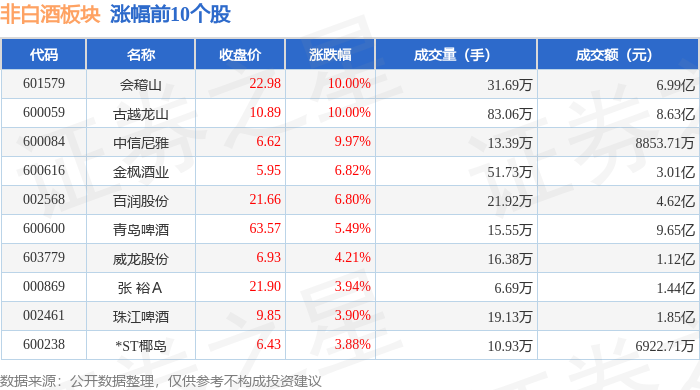
非白酒板块1月29日涨5.18%,会稽山领涨,主力资金净流入3.51亿元
Zheng Xing Xing Ye Ri Bao· 2026-01-29 09:03
Group 1 - The non-white liquor sector increased by 5.18% on January 29, with Kuaijishan leading the gains [1] - The Shanghai Composite Index closed at 4157.98, up 0.16%, while the Shenzhen Component Index closed at 14300.08, down 0.3% [1] - Kuaijishan's stock price rose to 22.98, marking a 10.00% increase, with a trading volume of 316,900 shares [1] Group 2 - The non-white liquor sector saw a net inflow of 351 million yuan from main funds, while retail investors experienced a net outflow of 253 million yuan [2] - The stock of Guhua Longshan also increased by 10.00%, closing at 10.89, with a trading volume of 830,600 shares [1][2] - The trading data indicates that Kuaijishan had a main fund net inflow of 91.30 million yuan, representing 13.06% of its total trading [3]


20只白酒股中19只涨停,贵州茅台大涨8.61%,“老登”酒类股重回A股舞台中央!白的、黄的、啤的、红的全线大涨,超过600亿元资金疯狂涌入白酒板块
Jin Rong Jie· 2026-01-29 08:45
Core Viewpoint - The liquor sector, including core liquor stocks, yellow wine, beer, and red wine, has experienced a significant surge, with many stocks hitting their daily limit up, indicating a strong market interest and potential recovery in the sector [1][2]. Liquor Sector Performance - On the afternoon of the 29th, the core liquor stocks continued to rise, with multiple stocks such as Shui Jing Fang, Shanxi Fenjiu, Wuliangye, and others reaching their daily limit up. Kweichow Moutai saw an increase of over 9% at one point [1]. - A total of 19 out of 20 core liquor stocks hit the daily limit up, while Kweichow Moutai, which did not, still rose by 8.61%. Over 600 billion yuan flowed into the liquor sector, with total trading volume reaching 614.2 billion yuan [2][3]. Price Movements - The price of Feitian Moutai has risen above 1,600 yuan per bottle, with the price on January 29 showing an increase of 20 yuan to 1,610 yuan per bottle. This price increase is attributed to strong demand during the upcoming Spring Festival [5]. Market Sentiment and Future Outlook - Analysts from CITIC Securities suggest that the liquor sector is poised for a recovery as the Spring Festival marketing activities approach, with stable sales expected. The report indicates that the current stock prices reflect market expectations, and the sector's valuation is relatively low, making it an attractive investment opportunity [6]. - The report from Guotai Junan Securities highlights that the current public fund holdings in the liquor sector are at a historical low of 3.93%, suggesting that the conditions for a new cycle in the sector are in place [6]. Broader Market Trends - The real estate sector also saw a significant rise, with stocks like Dayuecheng and Sanxiang Impression hitting their daily limit up, indicating a rotation in market interest towards liquor and real estate sectors [4]. - The A-share indices showed divergent trends, with the Shanghai 50 Index rising over 1% while the Sci-Tech 50 Index fell over 3% [4]. Investment Perspectives - Notable investor Duan Yongping commented on Kweichow Moutai, suggesting that while short-term fluctuations are uncertain, the long-term outlook remains positive, indicating that the current price is not expensive when viewed over a decade [8].