
债券

Search documents
欧洲债市:德国国债牛平 料录得一周以来的首次上涨
Xin Lang Cai Jing· 2026-01-05 17:52
Core Viewpoint - The German bond market is experiencing a bullish trend, influenced by unexpectedly weak US manufacturing data, indicating a potential slowdown in the US economy [1][2] Market Summary - The yield on German 10-year bonds decreased by 3 basis points to 2.87% [5] - German bond futures rose by 25 points, reaching 127.36 [5] - The yield on Italian 10-year bonds fell by 4 basis points to 3.57% [5] - The yield on French 10-year bonds also decreased by 4 basis points to 3.58% [5] - The yield on UK 10-year bonds dropped by 3 basis points to 4.51%, marking the largest increase since December 23 [4][5] Economic Indicators - The spread between Italian and German bonds, as well as between French and German bonds, narrowed by 1 basis point to 70 basis points [2] - Market expectations for a European Central Bank interest rate hike have been adjusted, now pricing in an increase of 1 basis point for the year, down from 3 basis points previously [3]
利率债-信用债-可转债及固收-年度策略
2026-01-05 15:42
Summary of Key Points from Conference Call Records Industry Overview - The records primarily discuss the bond market, focusing on interest rate bonds, credit bonds, convertible bonds, and fixed income strategies for the years 2025 and 2026 [1][2][3][4][5][6]. Core Insights and Arguments 2025 Bond Market Performance - The bond market in 2025 showed weak pricing against fundamentals, particularly after February when CPI turned negative, leading to a deflationary environment [7]. - The central bank's tightening of the monetary policy resulted in major banks selling bonds, causing a liquidity crisis [1][7]. - The insurance sector, particularly dividend insurance, saw a significant year, but new funds directed towards long-term bonds had a marginal impact [1][7]. 2026 Investment Strategy - The investment strategy for 2026 emphasizes a "small and stable" approach, recommending medium to short-term strategies to mitigate volatility [2][6]. - It is suggested to focus on 7-10 year government bonds or 5-7 year perpetual bonds to control risks and maintain stable returns [11]. - The overall bond supply in 2026 is expected to be at least as strong as in 2025, indicating a potential continuation of the liquidity crisis [9]. Key Influencing Factors for 2026 - Several factors are anticipated to dominate the bond market in 2026: 1. U.S.-China trade tensions, particularly tariff increases in April and October [4]. 2. Monetary policy adjustments, with expectations of limited room for interest rate cuts (approximately 10 basis points) [11]. 3. Advances in AI technology, which may enhance market risk appetite [4][5]. 4. Increased government debt supply due to fiscal policies, leading to a liquidity crisis [4]. 5. Stock market performance, which may suppress bond market sentiment [4]. Credit Risk and Strategy - Overall credit risk is deemed manageable, with a steady increase in wealth management scale [12]. - Recommendations include early positioning in the first quarter for returns and extending duration to 4-5 year coupon assets [12]. - Focus on high-quality central enterprises and state-owned enterprise real estate bonds is advised, avoiding prolonged durations [3][12]. Regulatory Impact - New regulatory policies are expected to disrupt the market, particularly in the third and fourth quarters of 2026, with potential negative impacts from public fund sales regulations [10]. Additional Important Insights - The bond market's performance in 2025 was significantly influenced by factors such as the U.S.-China relationship, monetary policy changes, and the introduction of new regulations [17]. - The convertible bond market is projected to face challenges due to high valuations and supply-demand imbalances, with net financing expected to remain negative [21][22]. - The equity market is expected to continue its upward trend, driven by liquidity, with technology sectors (AI, computing, semiconductors) and anti-involution sectors (chemicals, photovoltaics) being key areas of focus [24][25]. Conclusion - The bond market outlook for 2026 suggests a cautious approach with a focus on medium to short-term investments, while keeping an eye on regulatory changes and macroeconomic factors that could influence market dynamics. The emphasis on credit quality and strategic positioning in the face of potential volatility is crucial for investors.
政府债周报(01/04):下周新增债披露发行884亿-20260105
Changjiang Securities· 2026-01-05 14:15
1. Report Industry Investment Rating No relevant content provided. 2. Report's Core View - From January 5th to January 11th, local bonds are expected to be issued worth 1.17664 billion yuan, including new bonds worth 884.34 million yuan (new general bonds worth 10 million yuan and new special - purpose bonds worth 874.34 million yuan) and refinancing bonds worth 292.3 million yuan (refinancing general bonds worth 0 yuan and refinancing special - purpose bonds worth 292.3 million yuan). From December 29th, 2025 to January 4th, 2026, a total of 260 million yuan of local bonds were issued, including new bonds worth 145 million yuan (new general bonds worth 0 yuan and new special - purpose bonds worth 145 million yuan) and refinancing bonds worth 115 million yuan (refinancing general bonds worth 85 million yuan and refinancing special - purpose bonds worth 30 million yuan) [2][6][7]. 3. Summary by Related Catalogs 3.1 Local Bond Actual and Forecasted Issuance - **Actual Issuance and Pre - issuance Disclosure**: From December 29th, 2025 to January 4th, 2026, the issuance details of local bonds are presented, including the issuance of new general bonds, new special - purpose bonds, special refinancing bonds, and net financing [14][15]. - **Comparison of Planned and Actual Issuance**: The comparison shows the differences between planned and actual issuance of new bonds, new general bonds, new special - purpose bonds, and refinancing bonds, with data presented for multiple periods [16][17][23]. 3.2 Local Bond Net Supply - **New Bond Issuance Progress**: As of January 4th, the issuance progress of new general bonds and new special - purpose bonds was 0.00% [27][28]. - **Refinancing Bond Net Supply**: The cumulative scale of refinancing bonds minus local bond maturities as of January 4th is presented, with specific data and statistical details [27][28][29]. 3.3 Special Bond Issuance Details - **Special Refinancing Bond Issuance Statistics**: The issuance statistics of special refinancing bonds as of January 4th are shown, including different rounds of issuance in various regions, with detailed data and statistical notes [31][32][33]. - **Special New Special - purpose Bond Issuance Statistics**: The issuance statistics of special new special - purpose bonds as of January 4th are provided, covering different years and regions, with statistical notes [34][35][36]. 3.4 Local Bond Investment and Trading - **Primary - Secondary Spread**: The primary - secondary spread of local bonds is presented, including the spread for different maturities and changes over time [38][39]. - **Regional Secondary Spread**: The regional secondary spread of local bonds is shown [40]. - **New Special - purpose Bond Investment Direction**: The investment direction of new special - purpose bonds is presented, with a note on the statistical scope [41].
制度型开放标杆:上海离岸经济的规则突破与实践
Di Yi Cai Jing· 2026-01-05 13:17
Core Viewpoint - The exploration of legal adaptation in Shanghai's offshore economic functional zone aims to provide a feasible "Chinese solution" for cross-border trade and financial cooperation, establishing a benchmark for institutional openness in China [1][4]. Group 1: Legislative Framework - The direct legislative power of Pudong will provide rigid support for institutional innovation in the functional zone, allowing local legislation to clarify the scope of offshore business and regulatory standards for banks, insurance, leasing, and bonds [2]. - The legislative model will ensure that national and local departments adhere strictly to the legislative documents, eliminating unnecessary approvals and compliance exploration responsibilities [2]. - Key areas of focus include defining offshore business scope, incorporating tax incentives into regulations, and establishing jurisdiction for international commercial courts [2][3]. Group 2: Legal System Adaptation - The "special adaptation" of the legal system is a core breakthrough for aligning with international rules, proposing that offshore business involving finance, economy, and taxation fully apply common law [3]. - The establishment of the Shanghai Offshore International Commercial Court with judges experienced in common law is suggested to handle disputes in offshore trade and finance [3]. - Training programs in collaboration with institutions from Hong Kong and Singapore will be developed to cultivate professionals familiar with both domestic regulations and international practices [3]. Group 3: Practical Value of Institutional Innovation - The institutional innovation in Shanghai's offshore economic functional zone transcends regional development, providing a practical model for cross-border trade and financial cooperation [4]. - By aligning with international rules, the functional zone aims to reduce legal costs and compliance risks in cross-border transactions, attracting global resources to Shanghai [4]. - This exploration serves as a fresh example for improving the domestic legal system, enhancing China's legal credibility and influence internationally [4].
平安固收:2025年12月托管月报:跨年后债券供给上升,市场承接力面临考验-20260105
Ping An Securities· 2026-01-05 09:32
1. Report Industry Investment Rating No relevant content provided in the report. 2. Core Viewpoints of the Report - In November 2025, the new bond issuance scale decreased year - on - year, mainly dragged down by inter - bank certificates of deposit. The new custody volume of interest - rate bonds decreased slightly, while that of corporate credit bonds increased, mainly supported by industrial bonds [3][4]. - In November 2025, banks significantly increased their bond allocations, while the demand from other investors was weak. After considering the central bank's outright reverse repurchase, commercial banks' bond investments increased year - on - year, and the proportion of banks' increased government bond holdings to the net supply of government bonds was at a relatively high level [3][17]. - In December 2025, the government bond supply decreased year - on - year, and it is expected to increase significantly year - on - year in January 2026. The bond supply after the New Year will rise, and the market's carrying capacity will face a test [3][40]. 3. Summary by Relevant Catalogs 3.1 Bond New Custody Volume in November 2025 - The bond custody balance in November 2025 was 193.57 trillion yuan, with a year - on - year growth rate of 13.37%, a decrease of 0.67 percentage points from the previous month. The new custody scale in November was 143.97 billion yuan, a year - on - year decrease of 82.21 billion yuan [5]. - The new custody volume of inter - bank certificates of deposit and local government bonds decreased by 68.67 billion yuan and 15.19 billion yuan year - on - year respectively. The decline in the supply of inter - bank certificates of deposit was the main reason for the overall decline in bond supply [8]. - The new custody volume of interest - rate bonds decreased slightly year - on - year. Among them, the new custody volumes of treasury bonds and local government bonds were lower than the previous year, while that of policy - financial bonds was higher [11]. - The new custody volume of corporate credit bonds increased by 3.74 billion yuan year - on - year, entirely supported by industrial bonds. The net financing of urban investment bonds and industrial bonds changed by - 7.87 billion and 16.61 billion yuan year - on - year respectively [16]. 3.2 Bond Allocation by Different Institutions in November 2025 - Banks significantly increased their bond allocations, while other investors' demand was weak. After considering the central bank's outright reverse repurchase, commercial banks increased their bond holdings by 91.7 billion yuan year - on - year, while asset management accounts (i.e., non - legal entity products) increased their bond holdings less by 118.62 billion yuan year - on - year, and insurance companies basically remained the same [19]. - Banks' strong bond - allocation efforts may be a passive choice due to the weak demand from non - banks. Banks mainly increased their allocation to various interest - rate bonds. The ratio of banks' increased government bond holdings to the net supply of government bonds in November was 90.9%, higher than the previous month and the average of the past 12 months [22][25]. - Insurance companies' bond - allocation efforts weakened marginally, mainly reducing their allocation to local government bonds and corporate credit bonds. After excluding supply disturbances, the bond - allocation efforts of insurance companies also weakened [29]. - The bond - allocation efforts of asset management accounts weakened, which may be affected by the liability side of wealth management products and the supply of inter - bank certificates of deposit. The new scale of wealth management products and the supply of inter - bank certificates of deposit both decreased significantly year - on - year, leading to less bond - buying by asset management accounts [30]. - Foreign investors and securities brokers mainly reduced their bond holdings. Foreign investors sold 1.36 billion yuan more bonds year - on - year, mainly inter - bank certificates of deposit. Securities brokers sold 27.38 billion yuan more bonds year - on - year, mainly treasury bonds [39]. 3.3 Outlook for Bond Supply and Institutional Behavior - In December 2025, the government bond supply decreased by nearly 1 trillion yuan year - on - year. In January 2026, the government bond supply may increase significantly year - on - year, with the issuance of new special bonds and special refinancing bonds likely to rise [44]. - In December 2025, banks may have a relatively large bond - allocation volume. After the New Year, the supply - demand contradiction of bonds will further test banks. The supply - demand contradiction of long - term bonds remains significant, and attention should be paid to banks' actions [46]. - The value of bond allocation for insurance companies is prominent, and their demand may be supported. The spread between the yield of 30 - year local government bonds and the insurance预定利率 is more than 50BP, and insurance companies are expected to increase their bond - buying as the government bond supply recovers in January 2026 [50]. - The bond - allocation volume of asset management accounts in December 2025 may decrease year - on - year, and there is great uncertainty after the New Year. The decrease in December may be due to bond market adjustments and the significant decrease in the supply of inter - bank certificates of deposit. The pace of deposits moving to wealth management products is uncertain, and asset management accounts may also reduce their positions [54].
2026年债券市场展望:度尽劫波,守候周期
China Post Securities· 2026-01-05 08:44
1. Report Industry Investment Rating No relevant information provided. 2. Core Views of the Report - The core background for the bond market in 2026 remains the continuation of the "liquidation phase" of the debt cycle. The bond yield central - downward space is limited, and the risk of a significant upward movement is also controllable [3]. - Inflation is likely to enter a mild recovery phase in 2026. The drag of inflation on nominal growth is expected to disappear, but it is unlikely to drive interest rates up [4]. - Fiscal policy maintains a more proactive stance, with a high supply of government bonds in 2026. The supply shock of government bonds remains the main risk factor in the "low - interest - rate" phase [5]. - Monetary policy continues its moderately loose tone, shifting its focus from quantity to price. There is still room for a small - scale reduction in policy rates [6]. - In 2026, the bond market's capital structure will be dominated by allocation - type accounts. The yield curve is likely to remain steep, and the riding strategy may be the best choice [7]. - For the credit strategy, avoid the re - evaluation of risk premiums and apply the riding strategy to safe assets. Focus on the riding opportunities of medium - region urban investment bonds, infrastructure chains, and cyclical industrial bonds [8]. 3. Summary by Relevant Catalogs 3.1 Debt Cycle: "Liquidation Phase" Still in Progress - **Leverage Ratio Clearing and Transfer in 2026**: The macro - leverage ratio is in a state of "structural differentiation and overall stability". The de - leveraging process of the household sector is deepening, the enterprise sector's leverage ratio fluctuates at a high level, and the government sector's leverage ratio is expected to rise [23][25][26]. - **Relief of Liability Pressure in Three Sectors**: The liability cost of the household sector has decreased, the enterprise sector's interest - payment pressure has eased but the overall debt pressure remains large, and the government sector's interest - payment pressure is under control [31][35][38]. - **Policy Combination and Asset Prices in the "Liquidation Phase"**: China's debt cycle is still in the "liquidation phase". Fiscal and monetary policies need to maintain a "double - loose" combination. Asset prices should reflect new kinetic energy and improved expectations while considering the background of the debt cycle [43][44][45]. 3.2 Price Trends: Inflation May Enter a Mild Recovery Phase - **Food Prices**: The pig cycle may reach an inflection point in mid - 2026. Food prices are expected to show a trend of "stable first, then rising, with converging fluctuations", and the negative contribution of food prices to CPI is expected to weaken [52]. - **Energy Prices**: In 2026, energy prices are likely to be in a pattern of "strong supply, weak demand, and fluctuating weakly", with limited direct support for inflation [55]. - **Core Inflation**: Policy may drive the central trend to be low in the first half and high in the second half of the year, with a mild recovery throughout the year. The core CPI central may be between 0.8% - 1.2% [59]. - **Industrial Product Prices**: With the implementation of the "anti - involution" policy, the decline of PPI is expected to narrow. The PPI is expected to have an annual central around - 1.95%, and may turn positive periodically [63]. - **Inflation Outlook**: The drag of inflation on nominal growth is expected to be zero. CPI is expected to rise moderately, and PPI's decline is expected to narrow to - 2.0% [66]. 3.3 Fiscal Policy: More Proactive Stance with Maintained Debt - Issuing Scale - **Policy Tone**: Fiscal policy remains proactive in 2026. The general deficit rate is expected to remain around 4%, and the general deficit scale is about 14.55 trillion yuan, remaining stable compared to 2025 [74]. - **Treasury Bonds**: The maturity pressure in 2026 is reduced, and the net issuance is expected to increase steadily. The annual issuance is expected to be 13.9 trillion yuan, and the net financing target is about 6.9 trillion yuan [77]. - **Local Government Bonds**: The issuance scale in 2026 is expected to be 11.12 trillion yuan, slightly increasing. The issuance rhythm may be more front - loaded, and attention should be paid to the progress of debt - resolution work [85]. 3.4 Monetary Policy: Continued Loose Tone with Focus Shifted to Price Regulation - **Policy Tone**: In 2026, the pattern of stable and loose liquidity is likely to continue. The reform of the monetary policy framework will deepen, and the marketization of the interest - rate corridor, policy - rate system, and liability - side price mechanism will further improve [97][98]. - **Price - based Tools**: There is still room for a 20BP reduction in policy rates in 2026, which may guide a new round of adjustments in the interest - rate system [101][102]. - **Quantity - based Tools**: The necessity of reserve requirement ratio cuts has significantly decreased. The regular operations of repurchase and MLF are expected to continue, and the scale of central bank bond - buying operations may decline [105][110][111]. - **Credit and Social Financing**: The de - leveraging cycles of households and enterprises continue, and credit growth faces continuous pressure. Government bond financing and enterprise bond financing expand to offset the weakening of general loan demand [117][120][123]. - **Deposit Situation**: Personal savings continue to grow at a high rate, and non - bank deposits show high - volatility and high - growth characteristics. Unit deposits show differentiated fluctuations [129]. - **Narrow - sense Liquidity**: Liquidity will continue the "low - volatility and stable" characteristics of a downward price central and further converging volatility [140]. 3.5 Institutional Behavior: Allocation - type Accounts Dominate, Trading - type Accounts Under Pressure - **Banks**: In 2025, banks' bond investment thinking has changed systematically. In 2026, the main line of banks' bond investment with an allocation mindset will continue [155]. - **Insurance**: Insurance has a rigid demand for asset - liability duration matching. The allocation of secondary - tier and perpetual bonds has decreased, and the allocation of high - grade credit bonds and policy - based financial bonds has increased [175][180][186]. - **Wealth Management**: The scale of wealth management products is expected to grow in 2026. Asset allocation will focus on "net - value stability", with a preference for short - duration, high - liquidity assets [205][217]. - **Bond Funds**: The pattern of public - offering bond funds is about to change significantly. The trends of amortized - cost and ETF products will continue [218][230][231]. 3.6 Interest Rate Strategy: The Limit of Steepness and the Boundary of Riding - **Curve Shape**: In 2026, the yield curve is likely to remain steep, with the short - end likely to fall and the long - end difficult to decline [237][238]. - **Four Constraints**: Four factors limit the significant upward movement of long - end yields, including the decline of ROIC, the downward trend of long - term loan rates, the neutral stock - bond ratio, and the decline of banks' and insurance companies' liability costs [239][242][244]. - **Interest Rate Strategy**: The riding strategy may be the best choice in 2026, with a focus on the 5 - year Treasury bond [253][254][258]. 3.7 Credit Strategy: Supply Pattern Changes Significantly, Risk Premium Re - evaluated - **Credit Bond Supply**: The issuance of urban investment bonds continues to decline, while the issuance of industrial bonds and quasi - urban investment bonds increases rapidly. Science and technology innovation bonds have become the main incremental source of credit bond supply [263][276][281]. - **Capital Bond Supply**: The issuance of secondary - tier and perpetual bonds continues to decline, and there is still a small gap in TLAC for some banks [290][296]. - **Credit Strategy**: Avoid the re - evaluation of risk premiums in some credit bond sectors. The riding strategy is applicable to short - duration credit bonds, and attention should be paid to the riding opportunities of medium - region urban investment bonds and infrastructure - related industrial bonds [303][316][320].
利率债周报:债市偏弱震荡,收益率曲线平坦化上移-20260105
Dong Fang Jin Cheng· 2026-01-05 08:35
Group 1: Core Viewpoints - The bond market continued to fluctuate last week, with the yield curve flattening and rising. Affected by multiple factors such as the long - term local bond issuance plan in Shandong, the increase in cross - year funding costs, and better - than - expected official PMI data in December, the market sentiment weakened at the end of the year, and the bond market continued to operate weakly. After the New Year's Day holiday, the new regulations on public fund fees were officially implemented and were more lenient than expected, and the funding pressure eased after the New Year, so the bond market recovered somewhat. Overall, the bond market fluctuated weakly last week, and long - term bond yields rose slightly. For short - term bonds, although the central bank made continuous net injections before the holiday, affected by the cross - New Year's Day holiday, the increase in funding costs led to a significant rise in short - end yields, and the yield curve showed a flat upward trend. [3] - This week (the week of January 5), the bond market is expected to maintain a weakly fluctuating pattern. Although the implementation of the new regulations on public fund fees and the loose funding at the beginning of the year will support the bond market to some extent, due to the high supply of local bonds with a high proportion of long - term bonds under the front - loaded fiscal efforts, the expected warming of the A - share spring market may cause capital diversion, and the "good start" of credit, the bond market will continue to fluctuate weakly in the short term. [3] Group 2: Last Week's Bond Market Review Secondary Market - The bond market fluctuated weakly last week. Long - term bond yields first rose and then fell, with an overall slight increase. The 10 - year Treasury bond futures main contract fell 0.39% cumulatively last week. The 10 - year Treasury bond yield rose 0.51bp compared with the previous Friday, and the 1 - year Treasury bond yield rose 2.50bp compared with the previous Friday, with the term spread narrowing. [4] - On December 29, the local bond issuance plan in Shandong broke the previous expectation of "term contraction" of local bonds, causing concerns about the supply of ultra - long - term bonds. Coupled with the cross - year funding fluctuations, the market sentiment cooled, and the bond market weakened significantly. On December 30, the market sentiment recovered somewhat, ultra - long - term bonds recovered, but medium - and short - term bonds were still weak. On December 31, the official PMI data was better than expected, the market sentiment weakened, and the bond market fluctuated weakly. On January 4, the new regulations on fund fees were implemented, which were significantly more lenient than expected, the market sentiment recovered, and the bond market had a good start. [5] Primary Market - A total of 9 interest - rate bonds were issued last week, the same as the previous week. The issuance volume was 26 billion yuan, a decrease of 184.1 billion yuan compared with the previous week, and the net financing was - 32.6 billion yuan, a decrease of 207.4 billion yuan compared with the previous week. There were no Treasury bonds and policy - financial bonds issued last week, while the issuance volume and net financing of local bonds increased compared with the previous week. The overall subscription demand for interest - rate bonds last week was acceptable, with an average subscription multiple of 6.91 times for 9 local bonds issued. [16][17] Group 3: Last Week's Important Events - In December, China's manufacturing PMI was 50.1%, a rebound of 0.9 percentage points from November; the non - manufacturing business activity index was 50.2%, a rebound of 0.7 percentage points from November; the comprehensive PMI output index was 50.7%, an increase of 1.0 percentage point from November. Driven by factors such as the implementation of growth - stabilizing policies and the resilience of exports, the manufacturing PMI index rebounded significantly in December and returned to the expansion range since April. However, the service industry PMI index only increased slightly and was still in the contraction range, and the weak consumer demand needs further improvement. Looking forward, the supporting effect of growth - stabilizing policies on manufacturing prosperity is expected to continue, and the manufacturing PMI index in January 2026 is expected to remain in the expansion range. [19] Group 4: Real - Economy Observation - Most of the high - frequency data on the production side increased last week. The blast furnace operating rate, the operating rate of petroleum asphalt plants, and the average daily pig iron output all increased, while the semi - steel tire operating rate decreased significantly. From the demand side, the BDI index continued to decline, while the China Containerized Freight Index (CCFI) continued to rise; the sales area of commercial housing in 30 large and medium - sized cities decreased significantly. In terms of prices, pork prices rebounded slightly overall last week, and most commodity prices rose. Among them, copper and rebar prices both increased, while oil prices fell significantly. [20] Group 5: Last Week's Liquidity Observation - The central bank made a net injection of 73.74 billion yuan in the open - market last week. The R007 and DR007 first rose and then fell, with an overall decline; the issuance interest rate of inter - bank certificates of deposit of joint - stock banks decreased slightly overall; the discount interest rates of national and stock - holding banks at all terms increased significantly; the trading volume of pledged repurchase continued to decrease; and the leverage ratio in the inter - bank market fluctuated and decreased. [31][33][35]
2025年债券行情回顾:收益率总体企稳回升,信用利差被动收窄
Guoxin Securities· 2026-01-05 05:44
证券研究报告 | 2026年01月04日 2026年01月05日 2025 年债券行情回顾 收益率总体企稳回升,信用利差被动收窄 估值曲线:2025 年债市收益率震荡上行;信用利差方面,多数品种利差 被动收窄。收益率方面,1 年期国债、10 年期国债、10 年期国开债分别 变动了 25BP、17BP、27BP,3 年 AAA、3 年 AA+、3 年 AA 和 3 年 AA-分别 变动了 15BP、8BP、9BP 和-41BP。信用利差方面,3 年 AAA、3 年 AA+、 3 年 AA 和 3 年 AA-分别收窄了 4BP、12BP、11BP 和 61BP。 国债收益率震荡走高:年初资金面大幅收紧导致债市收益率整体上行,3 月 两会后,潘行长关于货币政策的表述推动市场修正预期,10 年期国债收益率 进一步升至 1.90%高位。二季度中美关税拉锯,叠加央行降准降息兑现,资 金面整体环比改善,10 年期国债收益率下行至 1.63%-1.67%区间震荡。三季 度"反内卷"政策推升通胀预期,权益走强压制债市,叠加基金费率新规与 债基赎回,债市收益率整体上行;但在央行呵护资金面背景下,短端收益率 较为平稳,债市呈现"熊 ...
交易商协会出手!
Zhong Guo Ji Jin Bao· 2026-01-05 02:54
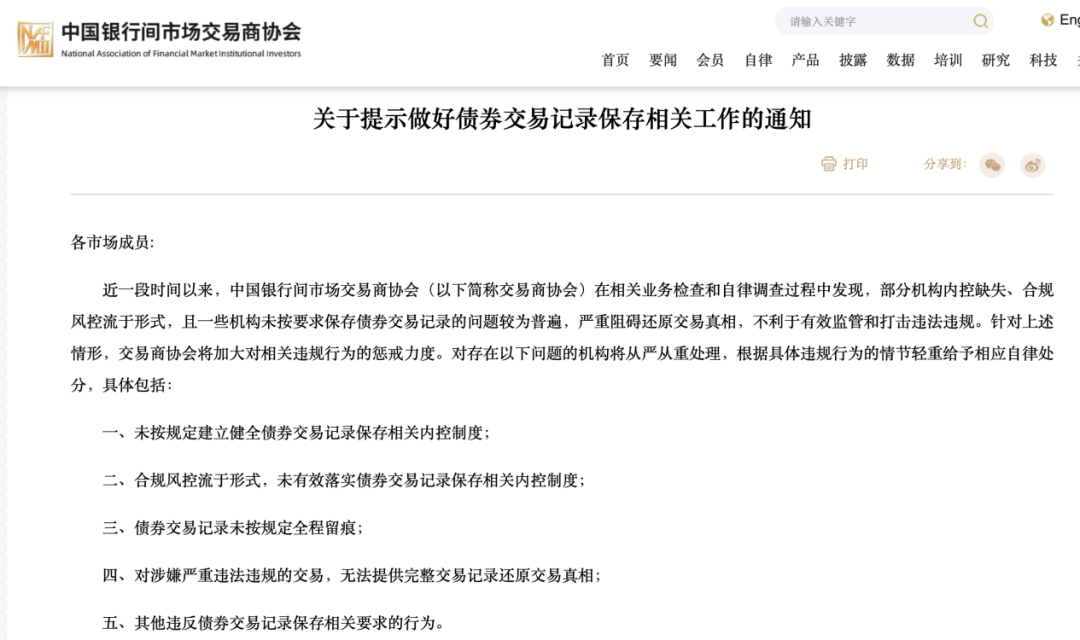
Core Viewpoint - The China Interbank Market Dealers Association is intensifying penalties for violations related to bond trading record-keeping, highlighting widespread issues in internal controls and compliance among institutions [1][2]. Group 1: Regulatory Actions - The association will impose stricter penalties on institutions that fail to establish proper internal control systems for bond trading record-keeping [2]. - Specific violations include inadequate internal controls, failure to maintain complete trading records, and inability to provide records for serious violations [2][3]. - The association emphasizes the importance of accurate and comprehensive record-keeping as a fundamental requirement for the bond market [2]. Group 2: Market Context - There has been a rise in low-price bidding and "price competition" in the bond underwriting sector, which affects industry quality and investor rights [3]. - The bond underwriting business should focus on providing professional services for pricing, distribution, and risk control, reflecting "technical content" and "value creation" [3]. - As of November 2025, the interbank bond market's custody balance reached 173 trillion yuan, accounting for 88.1% of the total bond market custody balance [3].

2025年11月债券市场 共发行各类债券70179.3亿元
Jin Rong Shi Bao· 2026-01-05 01:07
Group 1: Bond Market Overview - In November 2025, the bond market issued a total of 70,179.3 billion yuan across various types of bonds, including government bonds (10,444.2 billion yuan), local government bonds (9,126.9 billion yuan), financial bonds (11,955.0 billion yuan), corporate credit bonds (13,948.8 billion yuan), credit asset-backed securities (327.2 billion yuan), and interbank certificates of deposit (24,009.2 billion yuan) [1] - As of the end of November 2025, the bond market's custody balance reached 196.3 trillion yuan, with the interbank market holding 173.0 trillion yuan and the exchange market holding 23.2 trillion yuan [1] Group 2: Trading Activity - In November 2025, the interbank bond market recorded a transaction volume of 30.5 trillion yuan, with an average daily transaction of 1.5 trillion yuan, reflecting a year-on-year increase of 7.6% and a month-on-month increase of 3.2% [2] - The exchange bond market had a transaction volume of 3.8 trillion yuan, with an average daily transaction of 188.7 billion yuan [2] - The commercial bank counter bond transactions totaled 860.4 billion yuan across 8.1 million transactions [2] Group 3: Foreign Participation - As of the end of November 2025, foreign institutions held a custody balance of 3.6 trillion yuan in the Chinese bond market, accounting for 1.9% of the total custody balance [2] - Among foreign holdings, 2.0 trillion yuan (56.2%) were in government bonds, 0.7 trillion yuan (19.1%) in interbank certificates of deposit, and 0.8 trillion yuan (21.1%) in policy bank bonds [2] Group 4: Money Market Conditions - In November 2025, the interbank lending market recorded a transaction volume of 7.4 trillion yuan, a year-on-year decrease of 17.3% but a month-on-month increase of 9.6% [2] - The bond repurchase transactions totaled 149.8 trillion yuan, showing a year-on-year decrease of 6.8% but a month-on-month increase of 13.9% [2] Group 5: Interest Rates and Commercial Paper - The weighted average interest rate for interbank lending was 1.42%, up by 2.5 basis points month-on-month, while the weighted average interest rate for pledged repos was 1.44%, up by 3.2 basis points [3] - In November 2025, the commercial bill acceptance amount was 4.0 trillion yuan, and the discount amount was 3.1 trillion yuan [3] - As of the end of November 2025, the acceptance balance of commercial bills was 20.9 trillion yuan, and the discount balance was 16.2 trillion yuan [3] Group 6: Stock Market Performance - By the end of November 2025, the Shanghai Composite Index closed at 3,888.6 points, a decrease of 66.2 points or 1.7% month-on-month, while the Shenzhen Component Index closed at 12,984.1 points, down 394.1 points or 2.9% [3] - The average daily trading volume in the Shanghai market was 808.5 billion yuan, down 16.0% month-on-month, while the Shenzhen market's average daily trading volume was 1,089.8 billion yuan, down 7.9% month-on-month [3] Group 7: Holder Structure in Interbank Bond Market - As of the end of November 2025, there were 3,987 institutional members in the interbank bond market, all of which were financial institutions [4] - The top 50 investors in corporate credit bonds held 53.4% of the total bonds, primarily concentrated among state-owned commercial banks, public funds, and insurance financial institutions [4] - The top 200 investors accounted for 84.6% of the holdings, indicating a high concentration of ownership [4]