
金属矿产

Search documents
国泰君安期货商品研究晨报-20251126
Guo Tai Jun An Qi Huo· 2025-11-26 01:49
2025年11月26日 国泰君安期货商品研究晨报 观点与策略 | 黄金:降息预期回升 | 3 | | --- | --- | | 白银:震荡调整 | 3 | | 铜:LME现货走强,驱动价格 | 5 | | 锌:偏弱震荡 | 7 | | 铅:库存减少,限制价格回落 | 9 | | 锡:供应再出扰动 | 10 | | 铝:等待指引 | 12 | | 氧化铝:承压下行 | 12 | | 铸造铝合金:跟随电解铝 | 12 | | 镍:累库节奏稍有放缓,宏观与消息短线扰动 | 14 | | 不锈钢:钢价承压低位震荡,但下方想象力有限 | 14 | | 碳酸锂:市场情绪向好,高位震荡 | 16 | | 工业硅:关注盘面下方支撑 | 18 | | 多晶硅:震荡偏强 | 18 | | 铁矿石:下游需求空间有限,估值偏高 | 20 | | 螺纹钢:宽幅震荡 | 21 | | 热轧卷板:宽幅震荡 | 21 | | 硅铁:仓单大量注册,注意持仓风险 | 23 | | 锰硅:成本底部支撑,宽幅震荡 | 23 | | 焦炭:宽幅震荡 | 25 | | 焦煤:宽幅震荡 | 25 | | 原木:弱势震荡 | 26 | | 对二甲苯:短期 ...
宝武镁业(002182) - 2025年11月24日投资者关系活动记录表
2025-11-25 08:08
Resource Overview - The company has a total of 19.7 million tons of dolomite resources across its subsidiaries, with 0.9 million tons in operation, 5.8 million tons in the subsidiary, and 13 million tons in an associate company [1] - The abundant mineral resources ensure stable raw material supply for magnesium and magnesium alloy production, supporting the company's full magnesium industry chain development [1] Magnesium Alloy Applications - Magnesium alloys can be used in various parts of electric two-wheelers, including wheels, frames, pedals, and luggage compartments, leading to weight reduction and improved range [1] - The adoption of magnesium alloys is expected to lower production costs and enhance market growth [1] Semi-Solid Injection Molding Technology - The technology boasts a material utilization rate of 70%-85%, significantly higher than traditional methods [2] - It offers high production efficiency, reducing energy consumption and shortening production cycles by 20%-30% [2] Automotive Sector Insights - Magnesium prices have remained below aluminum prices, accelerating the penetration of magnesium in the automotive lightweighting sector, especially in new energy vehicles [4] - Some automotive manufacturers are now using over 20 kg of magnesium alloy per vehicle, with potential future usage reaching 50-100 kg as larger magnesium die-cast components are integrated [4] - Key product areas for magnesium application include dashboard supports, electric drive housings, and rear floors, indicating a significant growth opportunity for magnesium alloy die-cast components [4]

新央企,开始组建!
中国基金报· 2025-11-22 06:16
Group 1 - The State-owned Assets Supervision and Administration Commission (SASAC) organized a meeting to promote the professional integration of central enterprises, focusing on optimizing resource allocation and enhancing core competitiveness [2][4] - Central enterprises are required to proactively plan and strengthen strategic guidance, avoid internal competition, and enhance their integration capabilities while fostering a collaborative work environment [4][6] - A total of 17 units signed key projects in areas such as new materials, artificial intelligence, cruise operations, inspection and testing, and air logistics, with China Tourism Group leading the establishment of a central enterprise cruise operation platform [6][7] Group 2 - The cruise industry has a significant economic impact, with a multiplier effect of 1:10 to 1:14, meaning every 1 yuan of revenue generated in the cruise sector can stimulate 10 to 14 yuan in related industries [6] - China Tourism Group is a major state-owned enterprise directly managed by the central government, with a history dating back to 1923 and a diverse business portfolio including travel agencies, scenic spots, hotels, and cruise operations [7] - As of the end of 2024, China Tourism Group is expected to have over 42,000 employees and total assets exceeding 200 billion yuan, serving over 80 million tourists annually [7]


佳鑫国际资源盘中涨超5% 钨市延续稳健行情 战略金属地位凸显
Zhi Tong Cai Jing· 2025-11-21 02:46
Group 1 - The stock of Jiexin International Resources (03858) rose over 5% during the trading session, currently up 3.4% at HKD 32.22, with a trading volume of HKD 30.83 million [2] - The tungsten market continues to show a stable trend, with the price of 65% black tungsten concentrate reported at CNY 327,000 per standard ton, an increase of 128.7% compared to the beginning of the year [2] - The price of 65% white tungsten concentrate is reported at CNY 326,000 per standard ton, reflecting a 129.6% increase since the start of the year [2] Group 2 - According to Kaiyuan Securities, tungsten is a strategic metal in China, and its supply is constrained by resource depletion and environmental factors, along with national total control on tungsten mining, limiting production release [2] - The demand for tungsten is expected to remain tight due to emerging growth areas, which may lead to a continued upward trend in tungsten prices [2] - Beneficiaries of this trend include companies like Jiexin International Resources [2]
镍与不锈钢日评:考验支撑有效性-20251120
Hong Yuan Qi Huo· 2025-11-20 03:02
Report Summary 1. Report Industry Investment Rating No industry investment rating is provided in the report. 2. Core Views - Nickel prices are expected to oscillate at a low level, testing the support around 115,000, due to macro - level suppression, weak fundamentals, inventory pressure, and low valuation [1]. - Stainless steel is expected to show a weak oscillation as the fundamentals are loose and cost support is weak [1]. 3. Summary by Related Content Nickel Market - **Price and Trading Volume**: On November 19, the Shanghai nickel main contract fluctuated within a range. The trading volume was 82,563 lots (-34,853), and the open interest was 85,012 lots (-14,670). LME nickel rose 0.15%. The spot market trading improved, and the basis premium narrowed [1]. - **Supply**: Nickel ore prices declined. Last week, the arrival of nickel ore at ports decreased, and the import inventory decreased. Nickel iron plants' losses deepened. In November, domestic production decreased, while Indonesian production increased. The inventory of nickel iron slurry increased. Domestic electrolytic nickel production decreased, and the loss of electrolytic nickel imports widened [1]. - **Demand**: Ternary production increased; stainless - steel plant production decreased; alloy and electroplating demand remained stable [1]. - **Inventory**: SHFE inventory decreased, LME inventory decreased, social inventory increased, and bonded - area inventory remained flat [1]. - **Trading Strategy**: Adopt a wait - and - see approach [1]. Stainless Steel Market - **Price and Trading Volume**: On November 19, the stainless - steel main contract fluctuated within a range. The trading volume was 88,679 lots (-3,721), and the open interest was 183,832 lots (+6,511). The spot market trading was weak, and the basis premium narrowed [1]. - **Supply**: In November, stainless - steel production decreased, and the production of the 300 - series remained basically the same [1]. - **Demand**: Terminal demand was weak [1]. - **Cost**: The price of high - nickel pig iron and high - carbon ferrochrome declined [1]. - **Inventory**: SHFE inventory decreased, and the social inventory of the 300 - series last week was 623,200 tons (+17,900) [1]. - **Trading Strategy**: It is recommended to hold short positions. Currently, the price is testing the previous low support. If it cannot break through effectively, stop profit and wait and see [1]. Nickel Ore Benchmark Price - The second - phase nickel ore benchmark price in November 2025 was $14,998.67 per thousand tons (dmt), a decrease of about $76.66 compared to the first phase. This price is the main reference for domestic iron ore trading in Indonesia, especially for nickel ores with a moisture content (MC) of 30% - 35%, with the trading term based on FOB. The validity period of this benchmark price covers all transactions in the second half of November [1].
摩根士丹利:2026年,美国股市将领跑全球,美元先弱后强
Sou Hu Cai Jing· 2025-11-18 04:46
Group 1: Core Outlook and Asset Allocation - The report anticipates a strong performance of risk assets by 2026, driven by improvements in micro fundamentals, accelerated AI capital expenditures, and a favorable policy environment, with global market trends influenced by the U.S. [1] - Recommendations include prioritizing equity investments, followed by credit and government bonds, with a preference for U.S. assets; overweighting equities (+5%), U.S. high-yield bonds (+3%), and agency mortgage-backed securities (+3%), while underweighting commodities (-4%), cash (-3%), and U.S. investment-grade corporate bonds (-4%) [1] Group 2: Global Stock Market - The U.S. stock market is expected to outperform other global markets, benefiting from positive operating leverage, pro-cyclical policies, and AI-driven efficiency improvements, with a target for the S&P 500 index at 7,800 points by the end of 2026 (14% increase from current levels) and a projected EPS compound annual growth rate of 14% from 2025 to 2027 [1] - The Japanese stock market is also viewed positively, supported by re-inflation and improvements in return on equity (ROE), with a target for the TOPIX index at 3,600 points (+7%); however, Europe and emerging markets (excluding India and Brazil) lack similar positive catalysts [1] Group 3: Interest Rates and Exchange Rates - G10 interest rates are expected to exhibit a "lower first, higher later" pattern, with the Federal Reserve anticipated to cut rates by 50 basis points in the first half of 2026, leading to a mid-term drop in the 10-year U.S. Treasury yield to 3.75%, before rising to 4.05% by year-end [2] - The U.S. dollar index (DXY) is projected to decline to 94 in the first half of the year, followed by a rebound to 99 in the second half, with risk currencies like the Australian dollar and Swedish krona initially leading, while the euro and pound may struggle due to central bank rate cuts [2] Group 4: Credit and Securitized Products - Corporate credit is expected to benefit from increased capital expenditures, a revival in merger and acquisition activity, and accommodative policies, with high-yield bonds (HY) outperforming investment-grade bonds (IG) in both the U.S. and European markets [2] - There is a preference for 5-10 year maturities to capture rolling yields, with the financial sector expected to perform better than the cyclical sector; securitized products are anticipated to benefit from regulatory easing in the U.S. and Europe, with recommendations to increase holdings in short-term products and BBB- rated channel loan securities [2] Group 5: Commodities - The report indicates that metals are expected to outperform energy, with Brent crude oil projected to stabilize around $60 per barrel; gold is highlighted as a preferred asset, supported by macro factors and strong physical demand, with a target price of $4,500 per ounce [3] - Among industrial metals, copper and aluminum are favored due to significant supply challenges, while in agricultural products, soybean prices are expected to reach a target of $11.7 per bushel over the next 12-18 months, surpassing corn prices at $4.7 per bushel [3]
商品期货早班车-20251107
Zhao Shang Qi Huo· 2025-11-07 03:12
1. Overall Investment Ratings The report does not provide an overall industry investment rating. 2. Core Views - The commodity futures market is influenced by a variety of factors, including economic data, geopolitical events, and supply - demand dynamics. Different commodities show different trends and investment opportunities due to their unique fundamentals [2][4][9]. - In the precious metals market, the price of gold and silver is affected by factors such as US economic data, Fed officials' statements, and inventory changes. In the base metals market, copper, aluminum, and other metals are affected by market risk preferences, supply - demand relationships, and inventory changes. In the black industry, steel, iron ore, and other products are affected by factors such as supply - demand balance and cost changes. In the agricultural products market, factors such as supply - demand balance, weather, and policies affect the prices of soybeans, corn, and other products. In the energy and chemical industry, factors such as new device production, demand, and geopolitical risks affect the prices of LLDPE, PVC, and other products [2][4][7]. 3. Summary by Commodity Categories Precious Metals - **Gold**: Overnight, precious metal prices rose and then fell, with London gold reaching $4000/ounce. The US included copper and silver in the new key minerals list, and US employment data was weak. Domestic gold ETF inflows were 1.1 tons. Suggest buying at the lower support level [2]. - **Silver**: Multiple factors influenced the market, and it is recommended to reduce long positions [2]. Base Metals - **Copper**: Copper prices oscillated. The market risk preference declined, and the supply of copper ore remained tight. It is recommended to treat it with an interval - oscillation mindset in the short term [4]. - **Aluminum**: The price of the electrolytic aluminum main contract increased by 1.10%. Supply increased slightly, and demand decreased slightly. Pay attention to the de - stocking of aluminum ingots [4]. - **Alumina**: The price of the alumina main contract increased by 0.54%. Supply decreased due to environmental protection, and demand remained high. The market is in an oversupply pattern, and prices are expected to oscillate weakly [5]. - **Zinc**: The price of the zinc main contract increased slightly. Supply increased, and demand was in the off - season. It is recommended to sell short at high prices [5]. - **Lead**: The price of the lead main contract decreased slightly. Supply was marginally loose, and demand was mixed. It is recommended to operate within an interval [5]. - **Industrial Silicon**: The price of the main contract increased. Supply decreased, and demand was supported by polysilicon. The price is expected to operate between 8600 - 9400, and it is recommended to wait and see [5]. - **Lithium Carbonate**: The price of the main contract increased. Supply was expected to increase, and demand was high. It is recommended to try to buy on dips [6]. - **Polycrystalline Silicon**: The price of the main contract increased slightly. Supply decreased, and demand was under pressure. It is recommended to buy on dips or sell put options [6]. - **Tin**: Tin prices oscillated weakly. Market risk preferences fluctuated, and supply was expected to ease. It is recommended to use an interval - oscillation mindset in the short term [6]. Black Industry - **Rebar**: The price of the rebar main contract increased. Supply and demand weakened marginally, and the futures price was at a high valuation. It is recommended to wait and see [7]. - **Iron Ore**: The price of the iron ore main contract decreased. Supply and demand were neutral and deteriorated marginally. It is recommended to exit and wait, and aggressive investors can try to short [7]. - **Coking Coal**: The price of the coking coal main contract decreased slightly. Supply and demand were affected by steel production, and the futures price was at a high valuation. It is recommended to exit and wait, and aggressive investors can try to short [8]. Agricultural Products - **Soybean Meal**: US soybeans may enter an oscillation phase. Domestic supply is relatively loose, and the medium - term trend depends on tariff policies and production in the producing areas [9]. - **Corn**: Corn futures prices rose, and spot prices were mixed. New grain is about to be listed, and prices are expected to oscillate in the short term [9]. - **Sugar**: The price of the Zhengzhou sugar 01 contract increased slightly. Internationally, sugar production is expected to increase, and it is recommended to short in the futures market and sell call options [9]. - **Cotton**: International cotton prices fell, and domestic cotton prices oscillated weakly. It is recommended to wait and see within the 13400 - 13700 range [9]. - **Palm Oil**: The Malaysian palm oil market rebounded. Supply increased, and demand increased slightly. The market is expected to be weak, and it is recommended to pay attention to production and policies [10]. - **Eggs**: Egg futures and spot prices rose. Supply decreased, and demand increased seasonally. Prices are expected to oscillate strongly [10]. - **Pigs**: Pig futures prices oscillated narrowly, and spot prices were mixed. Supply is sufficient, and prices are expected to be weak [10]. - **Apples**: The price of the main contract decreased slightly. Different regions have different situations, and it is recommended to wait and see [10]. Energy and Chemicals - **LLDPE**: The price of the LLDPE main contract continued to decline slightly. Supply pressure increased but at a slower pace, and demand was in the off - season. It is recommended to short at high prices in the medium - long term [11]. - **PVC**: The price of the PVC main contract decreased. Supply increased, and demand was weak. It is recommended to short or do a reverse spread [12]. - **PTA**: PX supply increased, and PTA supply pressure was high in the medium - long term. It is recommended to take profit on long positions and short the processing fee in the far - month contracts [12]. - **Glass**: The price of the glass main contract decreased. Supply decreased due to production line shutdowns, and demand improved. It is recommended to do a reverse spread [12]. - **PP**: The price of the PP main contract continued to decline slightly. Supply increased, and demand was in the off - season. It is recommended to short at high prices in the medium - long term [12]. - **Crude Oil**: Oil prices fell. Supply pressure increased, and demand was seasonally weak. Prices are expected to oscillate in the short term, and it can be shorted at high prices if Russian oil production reduction is less than 500,000 barrels per day [13]. - **Styrene**: The price of the styrene main contract continued to decline slightly. Supply and demand were weak, and it is recommended to short at high prices in the medium - long term [13]. - **Soda Ash**: The price of the soda ash main contract increased. Supply and demand were balanced, and it is recommended to wait and see [13].
下一个被美国加税的“热门对象”:铂族金属
Hua Er Jie Jian Wen· 2025-10-22 04:18
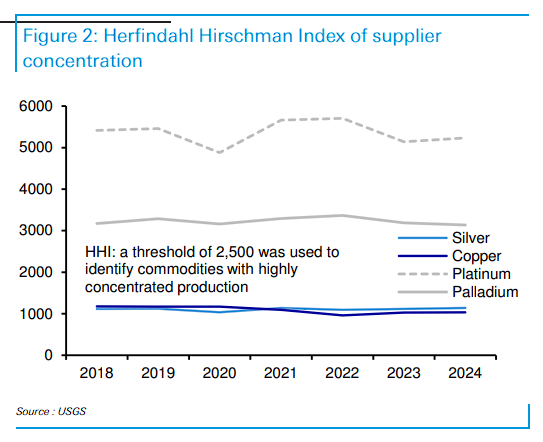
Core Insights - The U.S. is considering significant adjustments to its critical minerals policy, with platinum group metals facing a notable risk of tariffs under Section 232 due to supply chain concentration and geopolitical risks [1][12] Group 1: Policy and Regulatory Developments - The U.S. Department of Commerce is overdue in submitting a critical minerals report that will assess the national security implications of imports, including platinum and palladium [1] - The report is linked to Executive Order 14272 and is expected to evaluate the impact of key mineral imports on national security [1] - The U.S. International Trade Commission's preliminary ruling on anti-dumping for Russian palladium was due on October 20, indicating dual policy risks for palladium [1] Group 2: Market Dynamics and Supply Chain - Potential trade restrictions could exacerbate existing supply tightness in the white precious metals market, with leasing rates for platinum group metals currently above normal levels [2] - Industrial users are experiencing rising operational costs, prompting some to shift from ownership to leasing of metals [2] - Umicore's decision to sell its long-held gold inventory in favor of leasing highlights the market pressure [2] Group 3: Risk Assessment of Platinum Group Metals - According to Deutsche Bank's policy risk scorecard, platinum and palladium exhibit high risk across several dimensions, including global supply concentration and import dependency [5][7] - The Herfindahl-Hirschman Index (HHI) for platinum is 5230 and for palladium is 3137, indicating a high concentration risk [5] - Platinum's net import reliance is 85%, significantly exceeding the 50% threshold for high dependency [7] Group 4: Supply Capability and Geopolitical Risks - South Africa, the primary supplier of platinum, has a risk score of 81, while Russia, the main supplier of palladium, has a score of 90, both categorized as high risk [10] - The U.S. imports nearly 50% of its platinum from South Africa and a similar proportion of palladium from Russia, highlighting the geopolitical vulnerabilities in the supply chain [12] Group 5: Strategic Policy Tools - The U.S. has adopted non-tariff strategies for rare earth elements, contrasting with the current administration's support for tariffs as a tool to stimulate domestic manufacturing [11] - The Department of Defense has established partnerships and funding frameworks to support critical mineral projects, emphasizing flexible financial support over tariffs [11] - The rapid timeline of policy actions seen in copper could be mirrored in the case of platinum group metals, with significant tariff risks looming [12]
日度策略参考-20251015
Guo Mao Qi Huo· 2025-10-15 12:36
Group 1: Investment Ratings - There is no information about the report's industry investment rating in the given content. Group 2: Core Views - In the short term, stock index futures are expected to fluctuate strongly, but beware of the recurrence of tariff policies. Pay attention to the possible meeting between Chinese and US leaders during the APEC meeting in South Korea at the end of this month [1]. - Treasury bond prices are affected by the central bank's interest - rate risk warning, suppressing the upward space [1]. - Gold prices may fluctuate in the short term [1]. - Silver prices may fluctuate further once the physical shortage in London is alleviated [1]. - Copper prices are expected to continue to run strongly due to continuous disturbances in copper - mine supply and improved macro - liquidity, despite the suppression from global trade frictions [1]. - Alumina prices are expected to have limited downward space as they approach the cost line, although the fundamentals are weak with increasing production and inventory [1]. - The non - ferrous sector faces callback risks due to the intensification of Sino - US trade frictions and repeated risk - aversion sentiment. Zinc, nickel, stainless steel, etc. in the non - ferrous sector are affected by various factors such as trade uncertainties, policy changes, and inventory levels, and their prices are expected to fluctuate or be under pressure in the short term [1]. - For agricultural products, palm oil, soybean oil, and other varieties are affected by factors such as policies, reports, and inventory, and their prices have different trends. Cotton prices are expected to fluctuate widely in the short term and face pressure in the long term [1]. - In the energy and chemical sector, products such as crude oil, fuel oil, and asphalt are affected by factors such as OPEC production increase, demand seasonality, and tariff policies, with different price trends [1]. Group 3: Summary by Industry Macro - finance - Treasury bonds: Affected by the central bank's interest - rate risk warning, the upward space is limited [1]. - Gold: Prices may fluctuate in the short term [1]. - Silver: May fluctuate further once the physical shortage in London is alleviated [1]. Non - ferrous metals - Copper: Despite trade - friction suppression, prices are expected to run strongly due to supply disturbances and improved liquidity [1]. - Alumina: Fundamentals are weak, but the downward space is limited as it approaches the cost line [1]. - Zinc: Faces short - term pressure, but the opening of the export window may support the domestic price if the LME inventory continues to decline [1]. - Nickel: Prices are mainly affected by the macro - situation in the short term, with high - inventory pressure. Short - term trading is recommended, and there is still pressure from primary - nickel surplus in the long term [1]. - Stainless steel: Futures prices are expected to fluctuate in the short term. Pay attention to the actual production of steel mills [1]. - Tin: There is a risk of callback in the non - ferrous sector, but there are still opportunities to go long at low levels in the long term due to supply risks and demand support [1]. Black metals - Iron ore: The short - term fundamentals are not optimistic, with supply recovery and possible weakening demand, and high inventory [1]. - Coke: Similar to coking coal, the short - term is in a wait - and - see state [1]. - Coking coal: The price is still in the process of bottom - seeking, but it is not suitable to chase short positions for now [1]. Agricultural products - Palm oil: The Indonesian B50 policy may have a negative impact on near - month contracts, and the MPOB September report is expected to support prices [1]. - Soybean oil: The reduction of raw materials and oil - mill压榨 reduction support the price due to factors such as China's rare - earth export restriction and the expected reduction of US soybean ending stocks [1]. - Rapeseed oil: There is no new driving force, and it is recommended to wait and see [1]. - Cotton: Prices are expected to fluctuate widely in the short term and face pressure in the long term with the new - cotton listing [1]. - Sugar: The original - sugar price has bottomed out and rebounded, but the upward space is limited. It is recommended to short at high levels in the domestic market [1]. - Corn: New - season corn is under selling pressure, and the 01 contract is expected to oscillate and bottom [1]. Energy and chemicals - Crude oil: Affected by factors such as OPEC production increase, geopolitical situation, and demand seasonality [1]. - Fuel oil: Affected by factors such as OPEC production increase, demand seasonality, and US tariff threats [1]. - Asphalt: The short - term supply - demand contradiction is not prominent, and the demand for the 14th Five - Year Plan's construction rush is likely to be falsified [1]. - Rubber: Affected by factors such as US tariffs, supply increase, and weak market atmosphere [1]. - BR rubber: The raw - material fundamentals are loose, and the downstream trading is weak [1]. - PTA: The domestic production has decreased due to unit maintenance [1]. - Ethylene glycol: The port inventory is low, but the price is under pressure due to imports and device commissioning [1]. - Short - fiber: Factory devices are gradually returning, and the delivery willingness of market warehouse receipts has weakened [1]. - Styrene: The export sentiment has eased, and there is support at the cost end [1]. - PF: The price fluctuates strongly due to factors such as reduced market - price center and increased downstream demand [1]. - PVC: The price fluctuates weakly due to factors such as reduced maintenance and high near - month warehouse receipts [1]. - Calcined alumina: The short - term price is bearish, and the medium - term is bullish [1]. - LPG: The upward momentum is limited due to factors such as OPEC production increase and high domestic inventory [1]. Shipping - Container shipping (European line): The price may rebound at a low level, and it is expected to stop falling and stabilize [1].
镍与不锈钢日评:反弹高度有限-20251010
Hong Yuan Qi Huo· 2025-10-10 14:37
Report Summary 1. Report Title - Nickel and Stainless Steel Daily Review 20251010: Limited Rebound Height [1] 2. Core View - On October 9, the main contract of Shanghai nickel fluctuated upwards, with a trading volume of 130,864 lots (+3,674) and an open interest of 86,038 lots (+9,898). LME nickel rose 0.91%. The spot market trading was average, and the basis changed from premium to discount. The nickel fundamentals are weak with inventory pressure, so the rebound height of nickel prices is expected to be limited [2]. 3. Market Data Summary Nickel Futures - **Futures Prices**: The closing prices of Shanghai nickel futures contracts (near - month, continuous - one, continuous - two, continuous - three) increased on October 9 compared to previous dates. For example, the near - month contract closed at 124,260 yuan/ton, up 3,950 yuan compared to September 24 [2]. - **Volume and Open Interest**: The trading volume of the active Shanghai nickel futures contract was 130,864 lots, an increase of 3,674 lots. The open interest was 86,038 lots, an increase of 9,898 lots [2]. - **Inventory**: Shanghai Futures Exchange nickel inventory decreased, while LME nickel inventory increased. The total LME nickel inventory on October 9 was 236,892 tons, an increase of 5,580 tons compared to September 24 [2]. - **Price Spreads**: The spreads between different - term Shanghai nickel futures contracts and the basis between spot and futures changed. For example, the basis between SMM 1 electrolytic nickel average price and the active Shanghai nickel futures contract changed from - 2,430 yuan/ton on September 24 to 1,000 yuan/ton on October 9 [2]. Stainless Steel Futures - **Futures Prices**: The closing prices of Shanghai stainless steel futures contracts also had changes. The near - month contract closed at 12,715 yuan/ton, up 225 yuan compared to September 24 [2]. - **Volume and Open Interest**: The trading volume of the active Shanghai stainless steel futures contract was 88,195 lots, a decrease of 39,957 lots compared to September 24. The open interest was 60,514 lots, a decrease of 7,320 lots [2]. - **Inventory**: The inventory of Shanghai stainless steel futures decreased. The inventory on October 9 was 86,551 tons, a decrease of 418 tons compared to September 24 [2]. - **Price Spreads**: The spreads between different - term Shanghai stainless steel futures contracts and the basis between spot and futures also changed. For example, the basis between 304/2B coil - trimmed edge (Wuxi) average price and the active futures contract was 970 yuan/ton on October 9 [2]. Other Market Data - **Nickel Ore Prices**: The prices of Philippine laterite nickel ore of different grades (0.9%, 1.5%, 1.8%) remained flat [2]. - **Nickel - related Product Prices**: The prices of nickel - related products such as nickel pig iron, battery - grade nickel sulfate, and electro - plating grade nickel sulfate had different changes [2]. 4. Industry News - The Indonesian Ministry of Energy and Mineral Resources (ESDM) revised the validity period of the Work Plan and Budget (RKAB) to one year, and required general mining license (IUP) and single - commodity mining license (IUPK) holders to re - apply for RKAB in 2026 and 2027 [2]. 5. Trading Strategy - Short - term: Short at high prices [2].