非银金融

Search documents
【转|太平洋金工-指数量化深度】基于偏离修复的行业配置策略
远峰电子· 2025-12-21 13:50
文章转自2025年05月21日太平洋 金融工程团队 报告 ,分析师: 刘晓锋 /孙弋轩 报告从标的回撤规律的角度着手,使用迭代方法筛选出可适用的行业,并通过设置合理的入场阈值给定了高质量的左侧买点,以此给出了各个行业在回调阶段的配置 区间建议,奠定了太平洋金工团队后续模型改进的基础,并可作为基准对于后续模型效果作出评估。 正文报告 01 行业指数VS沪深300 沪深300由不同行业的个股组成,考虑自上而下的选股模式,考察时间区间(2010年1月至2025年3月)内的各行业回报率: 31个行业中有17个行业回报率超过了沪深 300。 综合行业指数相对沪深300的净值以及相应的回撤信息,我们可以总结以下三点: 02 偏离修复策略 行业指数相对沪深300的偏离(情景一): 1、在行业层面,选择行业构建组合具有较大概率获取超收益,以简单平均配置为例,可以在区间内获得34%的超额回报; 2、买入并持有单行业相对于沪深300的,可能会产生了较大的回撤,以及较长的回撤时间,存在择时必要性; 3、趋势跟踪已经在前期报告做过阐述,考虑到该策略过程中无法提供空间信息,因此本文考虑空间方面的策略。 业指数相对沪深300的偏离(情景 ...


1月市场和行业有何日历效应?
Huaan Securities· 2025-12-21 13:44
Core Insights - The macroeconomic data for November continues to show a slowdown, with the U.S. non-farm payroll data weakening but within market expectations, leading to a sustained high-level market fluctuation. The AI industry chain remains the core focus for investment, along with sectors experiencing supply-demand recovery and upward trends, such as storage and energy storage chains [2][3]. Market Perspectives - The U.S. unemployment rate rose from 4.44% to 4.56% in November, surpassing the natural unemployment rate level set by the Congressional Budget Office. This marginal change was anticipated by the market, thus not significantly altering the interest rate cut trajectory, which remains limited in its positive impact [3][12]. - The macroeconomic data for November indicates a continued marginal slowdown, with domestic effective demand being a key issue. The GDP growth rate for October-November is estimated at around 4.4%, showing a decline compared to the second quarter and October [4][14]. Industry Allocation - The current phase is seen as a layout period, with a strong emphasis on the AI industry chain and sectors experiencing upward trends. The consumer sector saw a recent uptick due to prior stagnation and the catalyst of Hainan Island's official closure, but the sustainability of this rise is questioned due to weak consumer expectations [5][25]. - The analysis of January's market and industry calendar effects reveals significant volatility in major indices, with the A-share and Shanghai Composite indices showing fluctuations close to or exceeding 5%. Financial sectors are expected to perform strongly, while growth sectors may remain weak [6][30]. Specific Sector Insights - The consumer sector's recent performance is attributed to a combination of prior stagnation and event-driven catalysts, but the overall sustainability of this growth is deemed weak due to low consumer expectations and limited improvement in the economic backdrop [5][25]. - The AI industry chain is identified as a core investment focus, with specific attention on computing power (TPU/GPU/CPO/PCB), supporting components (fiber optics/liquid cooling/power supply), and applications (robots/games/software). The current market conditions are seen as a normal adjustment phase, providing a good opportunity for future investments [37][38].
投资策略周报:“春季躁动”行情的启动,需具备哪些必要条件?-20251221
HUAXI Securities· 2025-12-21 13:28
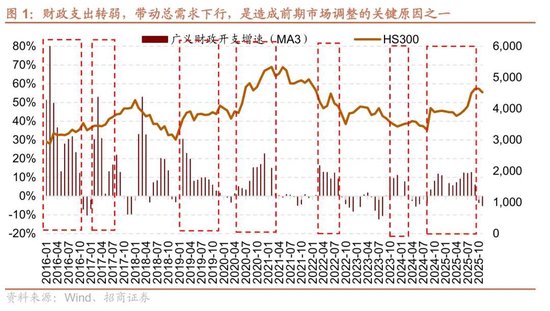
Market Review - Global stock indices mostly declined this week, with the Korean Composite Index, Hang Seng Tech, and Nikkei 225 leading the losses. A-shares saw a decrease in trading volume, with the average daily turnover of the Wind All A Index falling to approximately 1.76 trillion yuan. Market sentiment has turned cautious, with the ChiNext 50 and ChiNext Index leading the declines, while funds rotated into dividend sectors. In terms of styles, the financial and consumer sectors rose, while growth styles fell, with the electronics and power equipment indices dropping over 3%. In the commodity market, COMEX silver surged by 8.7%, and copper and aluminum prices fluctuated upward, while coking coal rebounded from the bottom. In the foreign exchange market, after the Bank of Japan's interest rate hike, the yen depreciated against the dollar, while the renminbi continued to appreciate against the dollar [1][2]. Market Outlook - The "Spring Rally" is accumulating positive factors, with a focus on buying on dips. Historically, the initiation of the A-share "Spring Rally" typically requires reasonable valuation levels, a loose liquidity environment, and effective catalysts to boost risk appetite, such as domestic policies, industrial events, or external risk alleviation. Currently, the Federal Reserve's interest rate cuts and the Bank of Japan's interest rate hike have been implemented, easing concerns about the reversal of arbitrage trades. The subsequent appreciation of the renminbi is expected to attract foreign capital, and the "good start" of insurance premium income at the beginning of the year is also anticipated to bring incremental insurance funds into the market. Recently, stock ETFs have seen large-scale net subscriptions, with multiple broad-based ETFs experiencing increased trading volume, indicating that incremental funds are inclined to buy on dips [2][5]. Historical Review - A review of history shows that, except for 2021 and 2022, the A-share market has often exhibited a "Spring Rally" calendar effect over the past decade. At the end of the year and the beginning of the year, the A-share market is in a "vacuum period" for economic data and corporate earnings reports, making it easier for the market to engage in thematic investments based on policy expectations and industrial trends. Since 2016, there have been 8 instances of "Spring Rally" in the A-share market. The timing of these rallies typically starts between December and January and lasts for 20 to 60 trading days [3][4]. Necessary Conditions for "Spring Rally" - The initiation of the "Spring Rally" requires several necessary conditions: 1) A reasonable market valuation range, as the elasticity of the rally is highly correlated with market valuation levels. In the years with the largest index gains during the past decade's Spring Rallies, the market had generally undergone sufficient adjustments beforehand. For instance, at the beginning of 2016, the "circuit breaker" triggered a liquidity feedback shock, leading to a sharp decline in major A-share indices; at the beginning of 2019, after previous declines, the price-to-earnings ratio of the CSI 300 Index was only 10 times; and in early February 2024, liquidity shocks from products like Xueqiu and quantitative funds brought the CSI 300 Index's price-to-earnings ratio back to around 10 times [4]. 2) A sustained loose liquidity environment with inflows of incremental funds. For example, in early 2018, the central bank implemented targeted reserve requirement ratio cuts, and in early 2019 and 2020, the central bank conducted comprehensive reserve requirement ratio cuts to maintain macro liquidity. In early 2023, there was a significant inflow of foreign capital, and in early 2025, regulatory authorities are expected to promote the entry of medium- and long-term funds into the market [4]. 3) Domestic policies, industrial event catalysts, or external risk alleviation that drive risk appetite upward. For example, in early 2016, supply-side reforms; in early 2019, progress in China-U.S. trade negotiations; in January 2020, the signing of the first-phase trade agreement between China and the U.S.; at the end of 2022, the optimization of epidemic prevention policies and the "three arrows" for real estate; in February 2024, an unexpected reduction in the Loan Prime Rate (LPR); and in early 2025, catalysts from trends in industries like DeepSeek and robotics [4][5]. Accumulating Positive Conditions - Positive conditions for the "Spring Rally" are accumulating, with a focus on buying on dips: 1) In terms of overseas liquidity, the dovish interest rate hike by the Bank of Japan has been implemented, leading to a weaker yen against the dollar and easing pressures from arbitrage trades. The Federal Reserve's expected dovish rate cuts in December are closely tied to the leadership transition, with the overall market expectation for the Fed's policy direction remaining loose [5]. 2) Domestically, the Central Economic Work Conference has set the tone for "continuing to implement an appropriately loose monetary policy," indicating that there is still room for reserve requirement ratio cuts and interest rate reductions [5]. 3) On the micro liquidity front, this week saw large-scale net subscriptions for stock ETFs, with multiple broad-based ETFs experiencing increased trading volume, boosting market sentiment. The anticipated inflow of foreign capital driven by the appreciation of the renminbi and the incremental insurance funds from the "good start" of premium income at the beginning of the year can also be expected [5]. 4) In terms of valuation, the current price-to-earnings ratio of the CSI 300 Index is 14 times, which is at the 76th percentile since 2010, below the historical median plus one standard deviation [5]. 5) From a policy perspective, the Central Economic Work Conference has laid a positive foundation, with 2026 marking the start of the "14th Five-Year Plan," and incremental policies in areas such as technological innovation, anti-involution, and expanding domestic demand are expected to continue to be introduced [5]. Industry Allocation Recommendations - It is recommended to focus on: 1) Growth directions benefiting from industrial policy support, such as domestic substitution, robotics, aerospace, innovative pharmaceuticals, and energy storage [5]. 2) Cyclical directions benefiting from "anti-involution" policies, such as chemicals, energy metals, and resource products [5]. 3) The deepening of consumption-promoting policies may bring short-term catalytic opportunities for the consumer sector [5].
国金策略:单一产业叙事能够带来的收益已经越来越不稳定和难以把握 抓住行情的窄幅波动期布局2026年新主线
Sou Hu Cai Jing· 2025-12-21 12:44
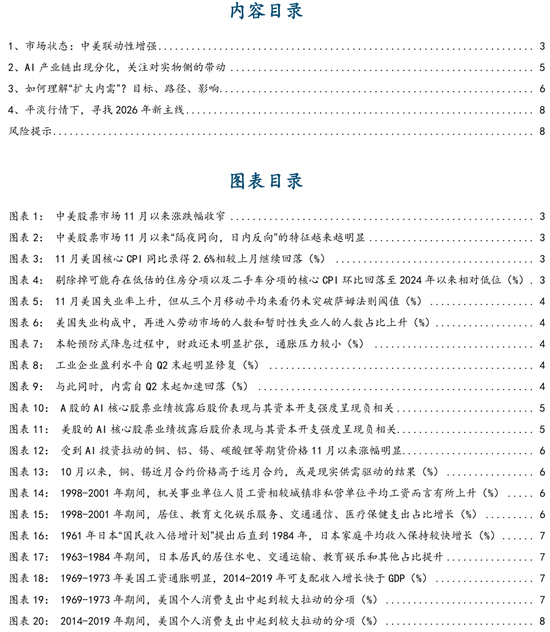
Group 1 - The market status indicates an increased correlation between the US and Chinese markets, with the 20-day rolling correlation of the CSI 300 and S&P 500 rising above the 90th percentile, reflecting a new normal of "overnight alignment and intraday reversal" [2][10][13] - The US core CPI has decreased to 2.6%, the lowest in three and a half years, while the unemployment rate has risen to 4.6%, primarily due to increased labor participation and temporary unemployment, indicating a stable economic environment without significant inflationary pressures [2][10][13] - China's economic fundamentals show a combination of corporate profit bottoming out and a decline in domestic demand, which opens a window for further policy support [2][10][13] Group 2 - The AI industry chain is experiencing a divergence, with broader AI-related assets (copper, lithium, aluminum, energy storage, and electrical equipment) performing better than core AI assets (computing chips, optical modules, PCB) [3][24][25] - Investors are becoming less tolerant of the contradiction between aggressive capital expenditures and the lack of revenue growth in companies within the AI industry chain, leading to a negative correlation between stock performance and capital expenditure as a percentage of revenue [3][24][25] - Commodity prices for copper, aluminum, tin, and lithium carbonate have been rising since late October, driven by demand from AI investments, with near-term contracts for copper and tin outperforming longer-term contracts [3][24][25] Group 3 - The concept of "expanding domestic demand" is emphasized as a strategic move, with a focus on increasing consumer demand supported by income growth and effective investment [4][31][32] - The government plans to enhance the second distribution of income by increasing minimum pension standards and implementing childcare subsidies, while future efforts may focus on optimizing the first distribution through wage reforms [4][31][32] - Historical examples from Japan and the US illustrate that income growth leads to increased service and new-type consumption, suggesting that China's current income growth initiatives could similarly boost consumer spending [4][31][32] Group 4 - The current market environment, characterized by limited macro elasticity and increased industry differentiation, suggests a shift in investment strategy towards tangible demand and domestic policy benefits as the new focus for 2026 [5][42][43] - Recommendations include investing in industrial resource products (copper, aluminum, tin, lithium, crude oil) that benefit from AI investment and global manufacturing recovery, as well as sectors poised for recovery in consumer spending (airlines, hotels, duty-free, food and beverages) [5][42][43] - Non-bank financial institutions (insurance, brokerage) are expected to benefit from capital market expansion and a rebound in long-term asset returns, alongside opportunities in China's equipment export chain and manufacturing sectors [5][42][43]
招商策略:A股跨年行情加春季躁动或将拉开帷幕
Xin Lang Cai Jing· 2025-12-21 12:08
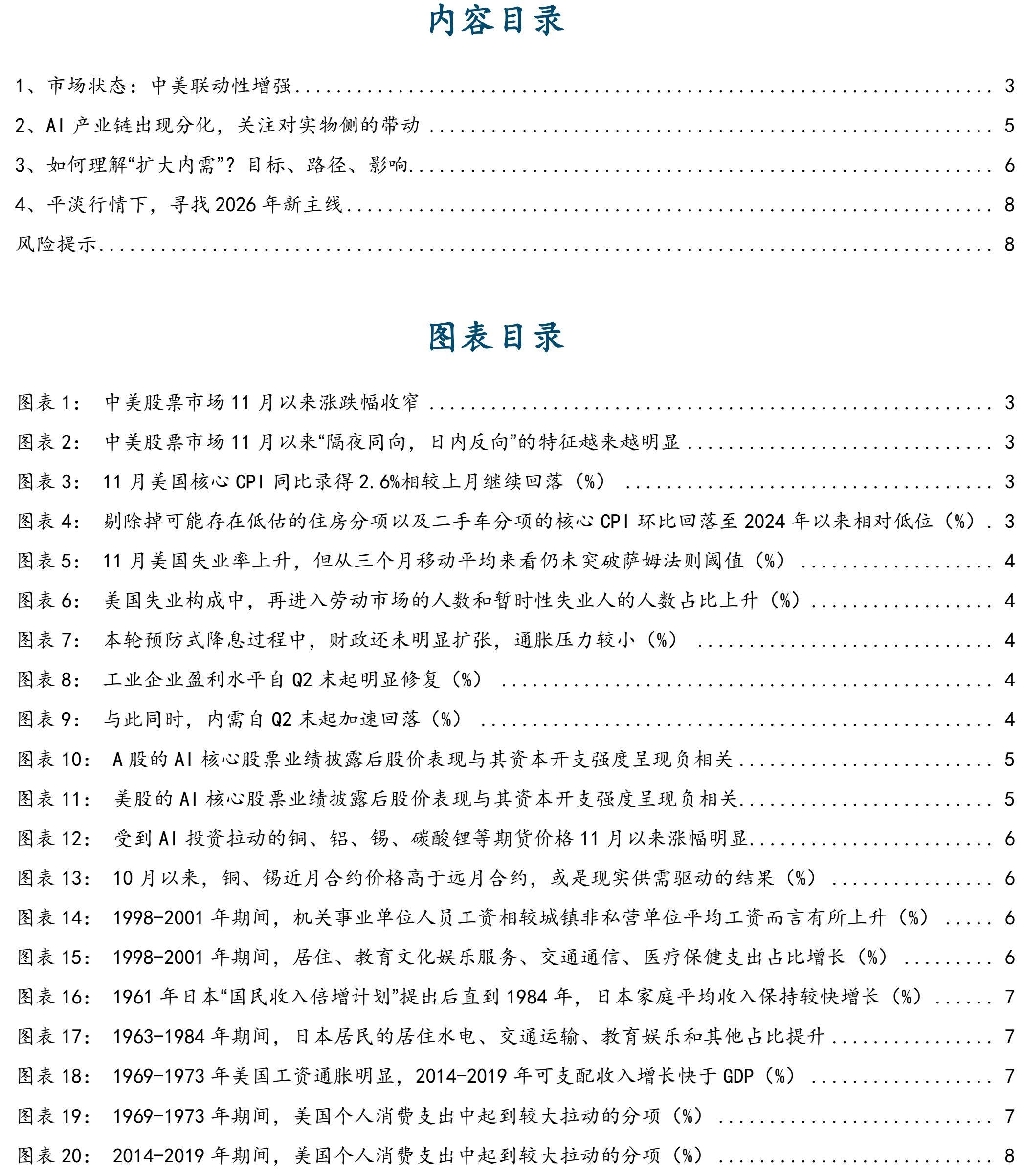
Market Outlook - A classic "cross-year-spring" market is brewing, with signals indicating that it has already begun. Key factors include the expected acceleration of central budget investments and significant institutional investors increasing their holdings in A500 ETF, providing stable incremental funds to the market [2][36][38] - The main focus of the market is likely to be on blue-chip indices represented by the CSI 300 and SSE 50, with an emphasis on cyclical sectors such as industrial metals, non-bank financials, and hotel aviation [2][36][38] Economic Indicators - In November, the year-on-year growth rate of social retail sales narrowed, with a total of 456,067 billion yuan, a decrease of 0.3 percentage points to 4.0%. The retail sales excluding automobiles reached 411,637 billion yuan, growing by 4.6% [43][57] - Major enterprises in the machinery sector showed improvement in sales, with loader sales increasing by 32.1% year-on-year, and the sales of excavators and road rollers also showing significant growth [49][51] Investment Trends - The A500 ETF has seen substantial net subscriptions, with a single-day subscription amount reaching a historical high of 7.1 billion yuan, indicating that significant institutional investors are entering the capital market through this product [13][36] - The offshore RMB exchange rate has been strengthening, suggesting that overseas funds are beginning to flow into the domestic market, which is often associated with expectations of positive changes in domestic policies [15][16][36] Sector Performance - The retail sector has been supported by policies aimed at expanding domestic demand, with notable growth in the commercial retail sector driven by holiday consumption expectations [40] - The technology sector, particularly AI, remains a strong growth engine for the economy, with Hong Kong stocks showing high investment value in technology companies that are not present in A-shares [29][38] Market Dynamics - The A-share market has shown mixed performance, with large-cap value stocks outperforming small-cap stocks as investors become more conservative due to year-end performance assessments [31][39] - The upcoming earnings forecast disclosure period in January is expected to increase pressure on small-cap stocks, while large-cap blue-chip stocks are likely to attract more investment due to their stability [33][36]
华西策略李立峰、张海燕:“春季躁动”行情的启动,需具备哪些必要条件?
Xin Lang Cai Jing· 2025-12-21 12:02
来源:策略李立峰与行业配置笔记 炒股就看金麒麟分析师研报,权威,专业,及时,全面,助您挖掘潜力主题机会! 投资要点 市场回顾:本周全球股指多数下跌,韩国综合指数、恒生科技和日经225指领跌。A股成交再度缩量, 万得全A日均成交额回落至1.76万亿元附近,市场情绪趋于谨慎,主要指数中科创50和创业板指领跌, 资金轮动至红利板块。风格上,金融和消费板块上涨,一级行业中,商贸零售、非银金融、美容护理、 社会服务领涨;成长风格下跌,电子和电力设备指数跌超3%。大宗商品方面,COMEX白银大涨 8.7%,铜铝价格震荡上行,双焦底部反弹。外汇方面,日央行加息落地后,日元对美元汇率走贬,人 民币对美元则延续升值态势。 市场展望:"春季躁动"行情积极因素累积,逢低布局为主。复盘历史,A股"春季躁动"行情启动通常需 满足以下条件:合理的估值水平、宽松的流动性环境以及有效提振风险偏好的催化剂,如国内政策、产 业事件催化或外部风险缓释等。当前来看,海外美联储降息和日本央行加息均已落地,市场对套利交易 逆转担忧缓解,后续人民币汇率升值带动的外资增配、年初保费收入"开门红"带来的增量保险资金入市 亦可以期待。近期股票型ETF再度大规模 ...
下周A股,关键时刻!
Sou Hu Cai Jing· 2025-12-21 11:56
Group 1 - The A-share market is showing signs of a rebound, with the Shanghai Composite Index up 0.03%, while the Shenzhen Component Index and the ChiNext Index fell by 0.89% and 2.26% respectively [1] - The retail trade sector has seen a significant increase, with a rise of over 6%, making it the top-performing industry this week [2] - The overall average stock price in the A-share market decreased by 0.15%, but a continuous rally starting Wednesday has sparked market sentiment, indicating the beginning of an upward trend [1][3] Group 2 - The central government has emphasized the importance of expanding domestic demand as a key task for the upcoming year, with domestic demand contributing 71% to economic growth in the first three quarters of this year [2] - The hydrogen energy industry is at a critical commercialization stage, with a focus on green hydrogen production relying on renewable energy sources, which is expected to drive growth in the sector [4] - The non-bank financial sector is currently undervalued, and institutions are optimistic about the performance of brokerage firms as market activity picks up [4]
中信建投:岁末年初 A股行业配置关注三条线索
Xin Lang Cai Jing· 2025-12-21 10:59
Core Viewpoint - Short-term fluctuations in A-shares are primarily influenced by external factors such as concerns over the AI bubble in the US stock market and interest rate hikes by the Bank of Japan, but A-shares are expected to resonate upward with global markets as US AI core company stock prices stabilize and the impact of the Bank of Japan's rate hike is limited [1] Industry Focus - Key industry focus areas include non-ferrous metals (silver, copper, tin, tungsten), high dividend stocks in Hong Kong, non-bank financials, AI (liquid cooling, optical communication), new energy (energy storage, solid-state batteries), innovative pharmaceuticals, and banking [1] Thematic Focus - Thematic investment areas to pay attention to are Hainan (duty-free), nuclear power, and ice and snow tourism [1]

非银金融行业周报:保险公司资负管理办法发布,明确监管指标和阈值-20251221
KAIYUAN SECURITIES· 2025-12-21 10:16
Investment Rating - The industry investment rating is "Overweight" (maintained) [1] Core Views - The insurance sector has seen a 15.7% increase since December 5, outperforming the CSI 300 index, which increased by 0.5% [4] - The release of the asset-liability management measures for insurance companies is expected to enhance regulatory oversight and impact asset allocation and insurance operations, particularly for small and medium-sized insurers [5] - The brokerage sector is anticipated to benefit from a positive regulatory environment, with potential growth in investment banking, public funds, and overseas business, supporting profitability in 2026 [6] Summary by Sections Insurance Sector - The new asset-liability management measures aim to strengthen the linkage between assets and liabilities, with implementation starting on July 1, 2026 [5] - Key management goals include matching duration structures, cost-benefit alignment, and liquidity matching [5] - The transition to dividend insurance is expected to deepen, with a favorable settlement yield compared to traditional insurance, driven by increased demand for savings products [5] - Long-term interest rates stabilizing and a positive equity market outlook are expected to improve net assets and profitability for insurers [5] Brokerage Sector - The average daily trading volume for stock funds is 2.2 trillion, reflecting a 7.2% decrease [6] - The resumption of trading for China International Capital Corporation (CICC) has led to a rise in stock prices, with expectations of increased leverage and business synergy [6] - The brokerage sector remains undervalued, with strategic opportunities for investment in firms with strong overseas and institutional business advantages [6] - Recommended stocks include Huatai Securities, Guotai Junan, and CICC, among others [6]
国金证券:迎接2026,告别单一叙事
Xin Lang Cai Jing· 2025-12-21 09:36
Group 1: Market Status - The correlation between A-shares and U.S. stocks has increased, with the 20-day rolling correlation of the CSI 300 and S&P 500 rising to over 90% since November, indicating a new norm of "overnight same direction, intraday reverse" [2][11][45] - Both the U.S. and Chinese economies are in a phase of "limited upward elasticity and reduced downward risk," with the U.S. core CPI falling to 2.6%, the lowest in three and a half years, and the unemployment rate rising to 4.6% primarily due to increased labor participation and temporary unemployment [2][13][47] - The Chinese economy shows signs of a bottom in corporate profits, while domestic demand is weakening, creating a favorable environment for subsequent policy support [2][13][47] Group 2: AI Industry Chain - The investment in the AI industry chain is showing two notable characteristics: first, "pan-AI" assets (copper, lithium, aluminum, energy storage, and electrical equipment) are performing better than core AI assets (computing chips, optical modules, PCB) [2][18][52] - Investors are becoming less tolerant of the contradiction between aggressive capital expenditures and the lack of revenue growth in companies within the AI industry chain, as evidenced by the negative correlation between stock performance and capital expenditure as a percentage of revenue [2][18][52] - Commodity prices for copper, aluminum, tin, and lithium carbonate have been rising since late October, driven by supply-demand dynamics, with near-term contracts for copper and tin outperforming longer-term contracts [2][19][53] Group 3: Understanding "Expanding Domestic Demand" - The articles published in "Qiushi" magazine emphasize the importance of consumer demand as a primary focus for expanding domestic demand, highlighting the need for a complete domestic demand system [3][24][58] - The strategy includes enhancing secondary distribution to increase residents' net transfer income and optimizing primary distribution to improve labor income, with potential reforms in state-owned enterprises to guide wage adjustments [3][25][58] - Historical examples from Japan and the U.S. show that periods of rising resident income lead to increased service and new-type consumption, indicating that the current "income increase plan" may boost demand for service consumption and technology-driven durable goods [3][27][58] Group 4: Preparing for 2026 - The current market conditions, characterized by limited macro elasticity and increased industry differentiation, suggest a shift in investment strategy towards "physical demand-driven" and "domestic demand policy dividends" as more certain avenues for growth [2][39][40] - Recommendations include focusing on industrial resource products (copper, aluminum, tin, lithium, crude oil, and oil transportation) that benefit from AI investment and global manufacturing recovery, as well as sectors like aviation, hotels, duty-free, and food and beverage that will benefit from increased consumer spending [2][32][39] - The non-bank financial sector (insurance, brokerage) is expected to benefit from capital market expansion and a bottoming out of long-term asset returns, alongside opportunities in China's equipment export chain and domestic manufacturing sectors [2][32][39]