
生猪养殖

Search documents
供需矛盾持续 生猪产能去化缓慢
Qi Huo Ri Bao· 2025-12-01 23:25
Core Viewpoint - The pig market is experiencing a prolonged period of oversupply, leading to significant price declines and deep losses for producers, with the current average price of live pigs falling nearly 30% year-on-year [2][5]. Group 1: Market Dynamics - The shift in trading focus from the 2601 to the 2603 futures contract indicates a temporary easing of pressure on near-term contracts, but the overall rebound remains weak due to ongoing supply-demand imbalances [1]. - As of the end of November, the average price of live pigs in China is between 11.4 to 11.7 yuan per kilogram, reflecting a substantial year-on-year decrease [2]. - The current pig production capacity reduction is slow, with only about 800,000 fewer breeding sows in the year, despite a recent decline in the breeding sow population below 40 million for the first time in 15 months [2][3]. Group 2: Production Capacity Challenges - The slow pace of capacity reduction is attributed to three main factors: the resilience of large-scale farms, incomplete capacity reduction among smallholders, and an increase in the number of heavier pigs being raised [2][3]. - Large-scale farms are less inclined to reduce production due to their financial and technical advantages, with a slight increase in breeding sow numbers in certain regions [2]. - Smallholder farmers are hesitant to reduce their herds, hoping for a rebound in prices due to seasonal demand, which has led to a lack of significant capacity reduction [2][5]. Group 3: Supply Pressure and Market Expectations - The phenomenon of secondary fattening has intensified supply pressures, with a notable increase in the proportion of heavier pigs being sold, exacerbating the oversupply situation [4][5]. - Producers are facing a "price inversion" situation where the cost of fattening exceeds the selling price, leading to increased losses [4]. - The expectation of a recovery in demand has not materialized, with consumer spending on dining out at a 15-month low, further complicating the market dynamics [5]. Group 4: Policy and Regulatory Environment - The current regulatory framework aims to balance long-term production capacity control with short-term market stabilization measures, but the effectiveness of these policies is limited by the deep supply-demand imbalance [6][7]. - The Ministry of Agriculture has set a target for breeding sow numbers and will implement counter-cyclical management to address significant deviations from this target [7]. - The temporary meat storage policy is intended to provide short-term market support, but its impact is minimal due to limited storage capacity and the time lag in implementation [7][8]. Group 5: Future Outlook - The effects of production capacity adjustments are expected to manifest in 10 to 12 months, while immediate price pressures can only be temporarily alleviated through storage policies [8]. - Without a substantial recovery in consumer demand, the overall weak market conditions in the pig industry are likely to persist [8].
风格再均衡,2026年消费板块如何布局
2025-12-01 16:03
Summary of Key Points from Conference Call Industry Overview - The conference call discusses the consumer sector, particularly focusing on the trends and investment strategies for 2026, highlighting the ongoing differentiation in consumer spending and the impact of government policies on various industries [1][3][6]. Core Insights and Arguments 1. **Consumer Sector Dynamics**: New consumer leaders like Pop Mart and Miniso are gaining global market share through innovation and brand upgrades, while traditional leaders like Midea and Anta are seen as valuable due to low valuations and high dividends [1][5]. 2. **Government Policy Impact**: National policies are fostering the development of trillion-level markets in elder products, smart connected vehicles, and consumer electronics, as well as billion-level hotspots in baby products and smart wearables, which are expected to be significant investment directions [1][4][6]. 3. **Investment Strategy for Essential Consumer Goods**: The essential consumer goods sector is currently undervalued, with expectations of improvement in fundamentals. Real estate stabilization is anticipated to boost consumption, and leading companies are shifting from price wars to product innovation [11][12]. 4. **Agricultural Sector Focus**: The pig farming sector is entering a left-side layout phase, with policy-driven capacity reduction among large pig enterprises. However, short-term price increases are unlikely, and the industry is expected to continue facing losses until 2025 [13][14]. 5. **Beauty Sector Performance**: The beauty sector is currently underperforming, but there are strong signs of resilience in beauty, health, and happiness-related consumption. High-end markets are leading the recovery, with domestic brands expanding their product lines [16][17]. 6. **Emerging Investment Opportunities**: The call emphasizes the importance of emotional consumption and scenario value, with the electronic cigarette industry expected to show strong performance in the next two to three years, particularly for core players like Smoore International [3][18]. Additional Important Insights 1. **Consumer Confidence and Spending**: The call notes that consumer confidence is gradually recovering, particularly in first-tier cities, which is expected to support consumption growth in 2026 [11][16]. 2. **Market Trends in Specific Sectors**: - The toy industry is experiencing a slowdown, but companies like Pop Mart are still leading in innovation and market share [20][28]. - The pet food sector is recovering from previous challenges, with companies like Guobao and Zhongchong showing signs of growth [15]. 3. **Investment Recommendations**: Specific recommendations include focusing on cyclical consumer goods such as liquor, beer, and frozen foods, as well as companies with strong dividend yields and growth potential like Midea, Haier, and Anta [12][55]. 4. **Emerging Technologies**: The call highlights the potential of AI in consumer technology, with companies in smart home and hardware sectors expected to benefit from AI integration [3][56]. This summary encapsulates the key points discussed in the conference call, providing a comprehensive overview of the consumer sector's current state and future outlook.
东兴证券晨报-20251201
Dongxing Securities· 2025-12-01 10:32
Economic News - The Ministry of Transport emphasizes the strong cooperation between China and Norway in the shipping industry, highlighting the potential for collaboration in green and smart shipping [2] - The Ministry of Foreign Affairs announces French President Macron's upcoming state visit to China, marking a significant moment in Sino-French relations [2] - The Ministry of Commerce initiates a final review investigation on anti-dumping measures for imported polyphenylene sulfide from Japan, the US, South Korea, and Malaysia [5] - The People's Bank of China reports that in October, the bond market issued a total of 63,574.6 billion yuan in various bonds, with government bonds accounting for 11,695.5 billion yuan [5] - The National Bureau of Statistics indicates that the manufacturing PMI rose to 49.2% in November, showing signs of improvement in both production and demand [5] Company News - Xunbang Intelligent plans to issue shares and pay cash to acquire 100% of Wuxi Yindi Chip Microelectronics, with the transaction pending approval from the Shenzhen Stock Exchange and the China Securities Regulatory Commission [6] - Changhua Group receives a development notification from a domestic automaker for key metal structural components, with an estimated total sales amount of approximately 732 million yuan over a five-year project lifecycle [6] - Lizhong Group signs a technical agreement with Beijing Weijing Intelligent Technology for the processing of humanoid robot components, utilizing its advanced production facilities [6] - Chongqing Port's board approves a new investment plan for the modernization of the Jiangjin Port's multi-modal transport capacity, with an estimated total investment of 299 million yuan [6] - Hanma Technology reports a significant increase in truck production and sales in November, with production reaching 1,947 units, a year-on-year increase of 137.44% [8] Industry Analysis - The pig farming industry is experiencing low prices, with October prices showing a slight rebound but lacking sustained support, leading to increased pressure on supply [9] - The supply side indicates a decrease in the breeding sow inventory, with a reported 40.35 million heads, a 0.70% decrease from the previous month [10] - Policy adjustments and low prices are expected to accelerate capacity reduction in the pig farming sector, with a potential price increase anticipated in the second half of 2026 [11] - Major pig farming companies, including Muyuan Foods, report significant declines in average selling prices for October, with prices dropping by over 10% [12]

第七届金麒麟农林牧渔行业最佳分析师第一名长江证券陈佳最新行研观点:优质龙头企业竞争力凸显 推荐四大标的
Xin Lang Zheng Quan· 2025-12-01 07:39
Core Insights - The agricultural sector, particularly the pig farming industry, is experiencing a downturn with significant profit declines due to falling pig prices and macroeconomic capacity adjustments [2][6][7] - Leading companies with low costs and strong cash flow are recommended for investment, including Muyuan Foods, Wens Foodstuff, Dekang Agriculture, and Shennong Group [2][6] - The feed industry shows continued growth, with major players like Haida Group benefiting from increased sales and improved profit margins [3] - The pet food sector is witnessing high growth in proprietary brands, although overall profits are under pressure due to declining export revenues [4] Pig Farming Industry - In Q3 2025, the pig farming sector's revenue decreased by 6% year-on-year to approximately 121.6 billion yuan, with net profit dropping by 70% to around 5.9 billion yuan [2] - The average profit for self-breeding and self-raising pigs fell to 42 yuan per head, a decrease of about 13 yuan from Q2 2025 [2][7] - The industry is entering a phase of loss-driven capacity reduction, with supply pressures expected to persist into the first half of 2026 [6][7] Feed Industry - The feed sector's revenue grew by 13.4% year-on-year in the first three quarters of 2025, with a 14.2% increase in Q3 [3] - Major feed companies are seeing a rise in sales volume and market share, with Haida Group's feed exports increasing by approximately 24% [3] - The outlook for the feed industry remains positive, with expectations for continued growth in both domestic and international markets [3] Pet Food Industry - The pet food sector's revenue increased by 9.6% year-on-year in Q3 2025, but net profit fell by 6.1% [4] - Domestic sales for leading brands like Guibao Pet and Zhongchong Co. are growing at around 40% [4] - Export revenues for pet snacks have declined, particularly in the U.S. market, where exports fell by 42% [4]


供大于求格局延续,猪价承压下跌:农林牧渔
Huafu Securities· 2025-12-01 07:27
Investment Rating - The industry rating is "Strongly Outperform the Market" [5][72]. Core Viewpoints - The supply-demand imbalance in the pig farming sector continues, leading to downward pressure on pig prices. As of November 28, the pig price was 11.20 CNY/kg, a decrease of 0.42 CNY/kg week-on-week. The average weight of pigs sold increased to 129.22 kg, up 0.41 kg week-on-week, indicating a potential recovery in prices in the long term due to capacity reduction policies [2][10][30]. - In the beef sector, calf prices have rebounded, and the long-term trend for beef prices is upward. As of November 28, the price for fattened bulls was 25.55 CNY/kg, down 0.12% week-on-week, while calf prices rose to 32.09 CNY/kg, up 0.28% week-on-week. The market is expected to tighten due to a reduction in breeding cows [3][33]. - The poultry sector is experiencing a decrease in the enthusiasm for restocking broiler chicks, with prices slightly adjusting. As of November 28, the price for white feather broilers was 7.19 CNY/kg, up 0.04% week-on-week, while broiler chick prices were 3.47 CNY each, down 0.01 CNY [4][40]. - The agricultural products sector, particularly soybean meal, is seeing price fluctuations. As of November 28, the spot price for soybean meal was 3100 CNY/ton, up 30 CNY/ton week-on-week. The market is expected to continue its oscillating trend due to high domestic inventory levels [4][55]. Summary by Sections Pig Farming - The supply-demand imbalance persists, leading to a decrease in pig prices. The average price on November 28 was 11.20 CNY/kg, with a week-on-week decrease of 0.42 CNY/kg. The average weight of pigs sold increased to 129.22 kg, indicating a potential recovery in prices in the long term due to capacity reduction policies [2][10][30]. - The average profit for self-bred pigs was -147.99 CNY/head, and for purchased piglets, it was -248.82 CNY/head, reflecting ongoing losses in the sector [10]. Beef Industry - Calf prices have shown signs of recovery, with the price for fattened bulls at 25.55 CNY/kg, down 0.12% week-on-week, and calf prices at 32.09 CNY/kg, up 0.28% week-on-week. The market is expected to tighten due to a reduction in breeding cows, leading to a potential upward trend in beef prices in the coming years [3][33]. Poultry Sector - The enthusiasm for restocking broiler chicks has decreased, with broiler prices at 7.19 CNY/kg, up 0.04% week-on-week, and broiler chick prices at 3.47 CNY each, down 0.01 CNY. The ongoing avian influenza outbreak may lead to a contraction in upstream production capacity [4][40][43]. Agricultural Products - The soybean meal market is experiencing price fluctuations, with a spot price of 3100 CNY/ton, up 30 CNY/ton week-on-week. The market is expected to continue its oscillating trend due to high domestic inventory levels and external factors affecting supply [4][55].
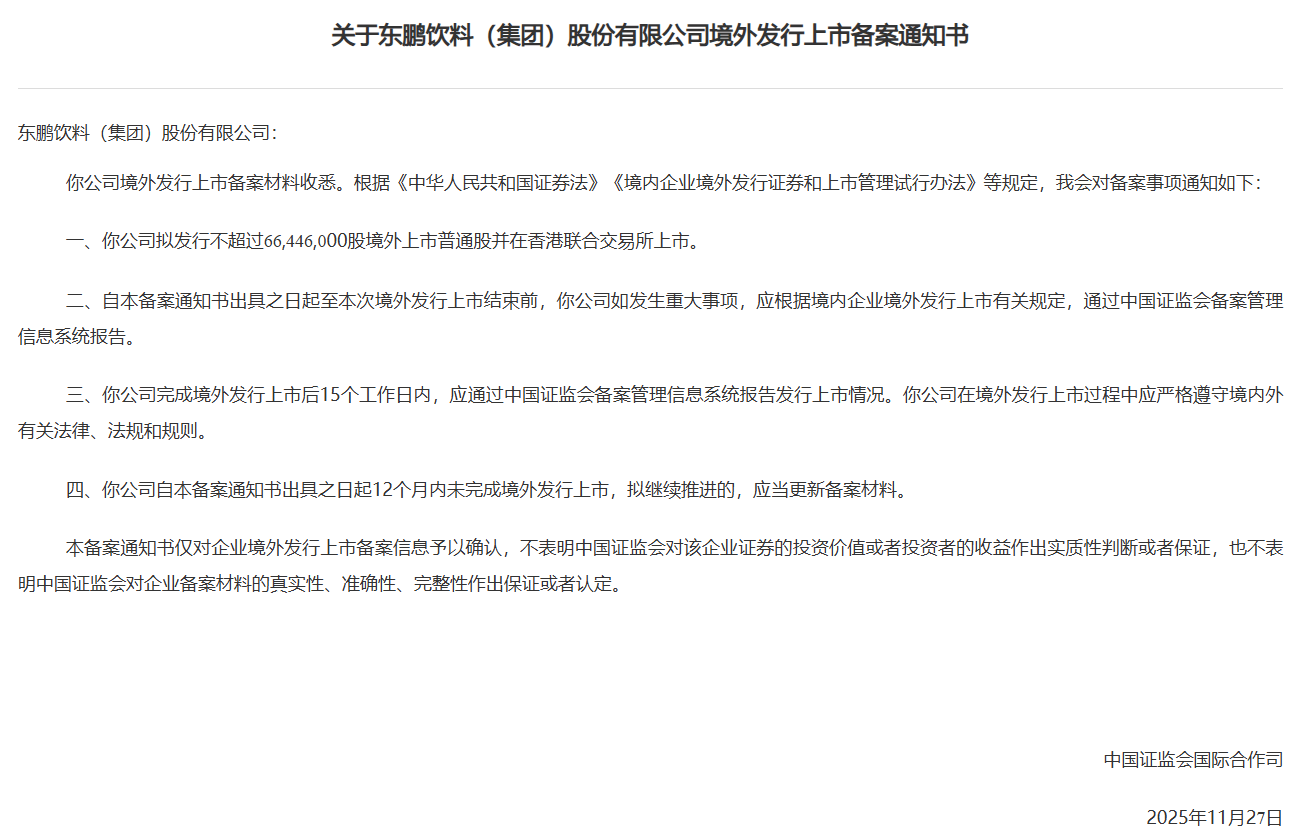
东鹏饮料、圣桐特医、优乐赛等10家企业完成境外上市备案
Sou Hu Cai Jing· 2025-12-01 06:24
Core Viewpoint - The China Securities Regulatory Commission has confirmed the overseas listing applications for several companies, including Dongpeng Beverage, Saintong Medical, Youlesai, Linqingxuan, Jinxun Co., Muyuan Foods, Basic Semiconductor, Huasheng Technology, Xiantong International, and Wuyi Vision, with Huasheng Technology applying for a listing in Taiwan and the others in Hong Kong [1]. Group 1: Dongpeng Beverage - Dongpeng Beverage plans to issue no more than 66,446,000 overseas ordinary shares and list on the Hong Kong Stock Exchange [1]. - The company focuses on beverage R&D, production, and sales, particularly in the functional beverage sector, with products including energy drinks, sports drinks, tea, coffee, plant protein drinks, and fruit and vegetable juices [3]. - Financial projections for Dongpeng Beverage show revenues of 8.5 billion, 11.257 billion, 15.83 billion, and 10.732 billion for 2022 to 2025, with corresponding net profits of 1.441 billion, 2.04 billion, 3.326 billion, and 2.375 billion [3]. Group 2: Saintong Medical - Saintong Medical intends to issue no more than 12,298,300 overseas ordinary shares and list on the Hong Kong Stock Exchange [1]. - The company specializes in the R&D, production, and sales of special medical purpose formula foods, particularly in the infant medical food sector [5]. - Financial forecasts for Saintong Medical indicate revenues of 491 million, 654 million, and 834 million for 2022 to 2024, with net profits of 83.89 million, 170 million, and 91.14 million [5]. Group 3: Youlesai - Youlesai plans to issue no more than 26,833,500 overseas ordinary shares and list on the Hong Kong Stock Exchange [1]. - The company is a leading integrated circular packaging service provider for the automotive industry, offering solutions and smart logistics systems [8]. - Financial projections for Youlesai show revenues of 648 million, 794 million, and 838 million for 2022 to 2024, with net profits of 3.12 million, 64.15 million, and 50.74 million [8]. Group 4: Linqingxuan - Linqingxuan intends to issue no more than 16,061,400 overseas ordinary shares and list on the Hong Kong Stock Exchange [1]. - The company is a high-end skincare brand focusing on plant-based skincare products, using camellia oil as a core ingredient [10]. - Financial forecasts for Linqingxuan indicate revenues of 691 million, 805 million, and 1.21 billion for 2022 to 2024, with net profits of -5.93 million, 84.52 million, and 187 million [10]. Group 5: Jinxun Co. - Jinxun Co. plans to issue no more than 42,280,400 overseas ordinary shares and list on the Hong Kong Stock Exchange [1]. - The company is involved in the development, smelting, and processing of non-ferrous metal new energy materials, with core businesses including cathode copper production and cobalt product processing [11]. - Financial projections for Jinxun Co. show revenues of 637 million, 676 million, and 1.77 billion for 2022 to 2024, with net profits of 84 million, 29 million, and 202 million [11]. Group 6: Muyuan Foods - Muyuan Foods intends to issue no more than 546,276,700 overseas ordinary shares and list on the Hong Kong Stock Exchange [1]. - The company operates a full industry chain in pig farming, including feed processing, breeding, and meat processing [12]. - Financial forecasts for Muyuan Foods indicate revenues of 124.8 billion, 110.9 billion, and 138 billion for 2022 to 2024, with net profits of 14.933 billion, -4.168 billion, and 18.925 billion [12]. Group 7: Basic Semiconductor - Basic Semiconductor plans to issue no more than 39,357,800 overseas ordinary shares and list on the Hong Kong Stock Exchange [1]. - The company focuses on the R&D and industrialization of silicon carbide power devices, with products used in photovoltaic storage and industrial control [15]. - Financial projections for Basic Semiconductor show revenues of 117 million, 221 million, and 299 million for 2022 to 2024, with net losses of 242 million, 342 million, and 237 million [15]. Group 8: Huasheng Technology - Huasheng Technology intends to issue no more than 9,100,000 ordinary shares and list on the Taiwan Stock Exchange [1]. - The company specializes in manufacturing electronic connectors and related products, including automotive wiring harnesses and RF antennas [17]. Group 9: Xiantong International - Xiantong International plans to issue no more than 9,259,900 overseas ordinary shares and list on the Hong Kong Stock Exchange [1]. - The company is a comprehensive enterprise focusing on pharmaceutical R&D, production, and sales, with a pipeline targeting oncology and neurodegenerative diseases [19]. - Financial forecasts for Xiantong International indicate revenues of 10.23 million and 44.06 million for 2022 to 2024, with net losses of 309 million and 156 million [19]. Group 10: Wuyi Vision - Wuyi Vision intends to issue no more than 77,600,840 overseas ordinary shares and list on the Hong Kong Stock Exchange [1]. - The company focuses on digital twin technology, providing applications for smart cities and industrial simulation [21]. - Financial projections for Wuyi Vision show revenues of 170 million, 256 million, and 287 million for 2022 to 2024, with net losses of 190 million, 87 million, and 82 million [21].


温氏股份跌2.05%,成交额2.40亿元,主力资金净流出2186.60万元
Xin Lang Cai Jing· 2025-12-01 02:11
Core Viewpoint - The stock price of Wens Foodstuff Group Co., Ltd. has shown fluctuations, with a current price of 17.71 CNY per share, reflecting a year-to-date increase of 10.60% but a recent decline over the past 20 and 60 days [1] Financial Performance - For the period from January to September 2025, Wens achieved a revenue of 75.82 billion CNY, representing a year-on-year growth of 0.53%. However, the net profit attributable to shareholders decreased by 17.98% to 5.26 billion CNY [2] - Cumulative cash dividends since the A-share listing amount to 30.11 billion CNY, with 6.28 billion CNY distributed over the last three years [3] Shareholder Information - As of September 30, 2025, the number of shareholders decreased by 10.94% to 81,100, while the average circulating shares per person increased by 12.11% to 73,543 shares [2] - The top ten circulating shareholders include Hong Kong Central Clearing Limited, which holds 144 million shares, an increase of 5.50 million shares from the previous period [3]
12月消费金股会议:寻找最具弹性的消费方向
2025-12-01 00:49
Summary of Key Points from Conference Call Records Industry Overview - **Alcohol Industry**: The liquor sector, particularly Moutai, has experienced price fluctuations, dropping below 1,600 yuan due to year-end cash recovery. However, after the digestion of pessimistic sentiment, a buying opportunity may arise in the liquor sector [1][4]. - **Food and Beverage Sector**: This sector is expected to see a rebound due to low expectations and low holdings, with CPI recovery and micro-consumption data resonating with macroeconomic trends [1][5]. - **Light Industry**: Focus on export opportunities, with recommendations for companies like Leshushi (leading market share in Africa for sanitary products) and Jiangxin Home (successful expansion in Vietnam) [1][7]. - **Textile Manufacturing**: Overseas clothing demand remains strong, with U.S. retail growth outpacing wholesale. However, caution in procurement due to tariffs has led to low inventory levels [1][8]. - **Snack Industry**: The sector shows significant improvement in fundamentals, with increased store openings and enhanced terminal sales performance [1][9]. - **Pig Farming Industry**: Currently undergoing accelerated capacity reduction, with a notable decline in breeding sow inventory. The industry is facing deep losses, but policy guidance may elevate future pig price expectations [1][24]. Company-Specific Insights - **New Dairy Industry**: New Dairy's pure oat products show stable growth, with compound oat flakes growing rapidly. The company is expected to accelerate revenue in Q4 due to declining import prices [1][6]. - **Angel Yeast**: The company benefits from declining raw material costs, with steady revenue growth and improvements in domestic and overseas yeast operations [1][6]. - **XGIMI Technology**: Anticipated revenue growth from domestic market outsourcing and acquisitions, with expected increases in overseas revenue due to new product launches [1][13][14]. - **Snack Industry Companies**: Companies like Gu Ming and Hu Shang are expected to benefit from internal growth and product expansion, achieving significant same-store sales growth [1][22][23]. - **Pork Producers**: Companies with low-cost advantages and strong cash flow, such as Muyuan, Wens, and DeKang, are recommended for investment due to their resilience against cyclical downturns [1][24]. Additional Important Insights - **Market Trends**: The snack industry is projected to see further profit margin improvements due to stable competition and expanded procurement scales [1][12]. - **Investment Opportunities**: The planting sector is highlighted for its potential due to global agricultural supply-demand dynamics and the upcoming IPO of Syngenta, which may attract attention to the entire sector [1][26][27]. - **Retail Sector**: The hotel industry is recovering, with companies like Huazhu Group and Tongcheng Travel recommended for their strong performance driven by business travel demand [1][21]. This summary encapsulates the key insights and recommendations from the conference call, providing a comprehensive overview of the discussed industries and companies.
生猪去化趋势不改,择机参与板块配置
GOLDEN SUN SECURITIES· 2025-11-30 12:48
Investment Rating - The industry investment rating is "Maintain Increase" [4] Core Views - The trend of pig reduction continues, suggesting a strategic opportunity for participation in the sector [15][16] - The price of lean meat pigs as of November 28, 2025, is 11.09 CNY/kg, down 9.1% from the previous month, indicating ongoing industry losses [15][18] - The average profit for self-breeding pigs is -147.99 CNY/head, a decrease of 58.66 CNY/head from the previous month, while the profit for purchased piglets is -248.82 CNY/head, down 69.1 CNY/head [15][23] - The number of breeding sows has decreased to 39.9 million, and further production capacity reduction is expected due to policy and low prices [15][16] - The mushroom sector shows a sustained price rebound for enoki mushrooms, with strong performance expected from key companies [16] - The seed industry is seeing a clear trend of variety replacement, with transgenic varieties entering commercial sales, indicating potential growth for related companies [16] - In poultry farming, seasonal price elasticity opportunities are noted for yellow feathered chickens, while white feathered chickens are affected by avian influenza in Europe [17] Summary by Sections Pig Farming - The lean meat pig price is 11.09 CNY/kg, down 9.1% from last month [18] - The average wholesale price of pork is 17.83 CNY/kg, down 1.1% [18] - The profit for self-breeding pigs is -147.99 CNY/head, a decrease of 58.66 CNY/head [23] - The profit for purchased piglets is -248.82 CNY/head, down 69.1 CNY/head [23] Mushroom Sector - Enoki mushroom prices remain strong, confirming a sustained price rebound [16] - The release period for Cordyceps sinensis as a key new product is approaching, with strong performance expected [16] Seed Industry - A clear trend of variety replacement in corn is noted, with transgenic varieties entering commercial sales [16] - Companies like Kangnong Seed Industry and Longping High-Tech are highlighted for potential growth [16] Poultry Farming - The price of meat chicken chicks is 3.47 CNY/chick, down 3.1% from last month [28] - The average price of white feathered chickens is 7.19 CNY/kg, up 1.4% [32] - The average price of chicken products is 8.95 CNY/kg, up 0.6% [32] Agricultural Products - Domestic corn prices increased to 2329.8 CNY/ton, up 4.0% [44] - Domestic wheat prices rose to 2507.28 CNY/ton, up 0.7% [46] - Domestic soybean prices increased to 4014.74 CNY/ton, up 0.4% [57]


农林牧渔组:生猪价格持续偏弱,看好牧业周期反转
SINOLINK SECURITIES· 2025-11-30 12:44
Investment Rating - The report indicates a neutral investment rating for the agricultural sector, with expectations of limited price fluctuations in the near term [61]. Core Insights - The agricultural sector index has shown a weekly increase of 1.57%, but it has underperformed compared to the Shanghai Composite Index [13][14]. - The pig farming industry is currently facing a downward price trend, with an average price of 11.19 yuan/kg, reflecting a week-on-week decrease of 3.87% [21]. - The poultry farming sector is experiencing a stabilization at the bottom of the market, with yellow feathered chicken prices showing improvement due to better downstream demand [28]. - The beef market is expected to see price increases as it enters the consumption peak season, while dairy cow inventory trends are decreasing [35]. - The planting industry is facing short-term supply and demand pressures, but there is potential for improvement if there are significant reductions in grain production [42]. Summary by Sections 1. Market Review - The agricultural index closed at 2991.22 points, with a weekly increase of 1.57%, while the Shanghai Composite Index increased by 1.40% [13][14]. 2. Key Data Tracking 2.1 Pig Farming - The average weight of pigs at market is 129.22 kg, with ongoing losses in the industry. The number of breeding sows is decreasing, indicating accelerated capacity reduction [3][21][22]. 2.2 Poultry Farming - White feathered chicken prices are under pressure, while yellow feathered chicken prices are improving due to better demand and supply contraction [4][28]. 2.3 Livestock - Live cattle prices in Shandong are at 26.80 yuan/kg, with expectations for steady price increases as the market enters a consumption peak [5][35]. 2.4 Planting Industry - Domestic corn prices are at 2218.57 yuan/ton, with fluctuations expected due to new crop listings and external uncertainties [42][43]. 2.5 Feed & Aquaculture - Feed prices are stabilizing, while aquaculture prices are showing upward trends, particularly for shrimp and fish products [48][55].