服务业

Search documents
8月经济数据点评:经济稳中趋缓,地产仍是拖累
Mai Gao Zheng Quan· 2025-09-17 12:22
Production - In August 2025, the industrial added value of enterprises above designated size grew by 5.2% year-on-year, a decrease of 0.5 percentage points from the previous month[11] - The manufacturing sector remains the main driver of industrial growth, with a year-on-year increase of 5.7%, down from 6.2%[11] - High-tech manufacturing added value increased by 9.3% year-on-year, contributing 28.5% to the overall industrial growth[11] Consumption - The total retail sales of consumer goods in August 2025 increased by 3.4% year-on-year, a decline of 0.3 percentage points from July[2] - Rural consumption grew by 4.6%, outpacing urban consumption growth of 3.2%, indicating significant potential in the rural market[14] - Over 80% of product categories saw retail sales growth, with more than 30% achieving double-digit growth[15] Investment - From January to August 2025, fixed asset investment (excluding rural households) increased by 0.5%, continuing a downward trend[24] - Excluding real estate development investment, fixed asset investment grew by 4.2%, indicating resilience in manufacturing and some infrastructure sectors[24] - Real estate development investment fell by 12.9% year-on-year, with new construction, completion, and construction area all showing declines[25]
8月经济数据点评:增长放缓背后的原因是积极的
Orient Securities· 2025-09-17 06:52
Economic Growth Analysis - In August, the industrial added value of large-scale enterprises grew by 5.2% year-on-year, down from 5.7% in July[5] - The total retail sales of consumer goods increased by 3.4% year-on-year, a decrease from 3.7% in the previous month[5] - Fixed asset investment accumulated a year-on-year growth of only 0.5%, down from 1.6% in July[5] Investment and Consumption Trends - The decline in investment was more significant than expected, with fixed asset investment down by 1.1 percentage points year-on-year[5] - Manufacturing investment is expected to remain low, which may improve profit margins in the long run[5] - Service sector performance outpaced goods, with the service production index rising by 5.6% year-on-year in August[5] Structural Adjustments and Future Outlook - The slowdown in growth is seen as manageable, with a focus on optimizing resource allocation rather than a decline in investment confidence[5] - The transition from old to new economic drivers is underway, with high-tech industries showing a 4.1 percentage point increase in added value compared to the overall sector[5] - Future consumer spending is expected to shift towards services, supported by government policies aimed at enhancing consumer confidence[5]
华泰证券今日早参-20250917
HTSC· 2025-09-17 06:02
Key Insights - The report highlights the expectation of a recovery in various asset valuations driven by the rapid increase in Federal Reserve rate cut expectations and the positive sentiment surrounding AI technology [2][3] - The introduction of policies to expand service consumption is expected to create development opportunities in the service sector, particularly in areas such as chain services, entertainment, tourism, and elderly care [3] - The aviation sector is experiencing stable growth in supply and demand during the peak summer season, with an increase in passenger load factors, although ticket prices remain low [4] - Tesla's stock is supported by significant share purchases by Elon Musk, indicating confidence in the company's long-term prospects, alongside multiple catalysts expected to be released in September [5] Fixed Income - The report discusses the implications of potential Federal Reserve rate cuts, which could lower financing costs and improve macroeconomic growth expectations, benefiting emerging market stocks and commodities [2] Consumer Discretionary/Social Services - The report outlines five key areas and 19 measures aimed at enhancing service consumption, indicating a long-term growth potential for China's service sector, which currently lags behind developed countries in terms of GDP contribution [3] Transportation - The report notes that while domestic airline ticket prices have decreased by 6.5% year-on-year during the peak summer season, there is an expectation for a rebound in business travel demand in September, which may lead to improved pricing [4] Key Company - Tesla's recent stock purchase by Elon Musk, valued at approximately $1 billion, reflects his confidence in the company's future, with expectations for advancements in AI capabilities and product launches in the coming years [5]

美国8月零售销售意外强劲,关注美联储利率决议
Hua Tai Qi Huo· 2025-09-17 03:06
Report Industry Investment Rating No information provided Core Viewpoints - China's domestic policy expectations are rising, with potential incremental policies and fiscal stimulus to address external pressures. The US inflation outlook is clearer, and the Fed is likely to restart the interest rate cut cycle in September. Attention should be paid to the subsequent interest rate cut path and the performance of the US real estate market. In the commodity market, there are opportunities for multi - allocation of industrial products and precious metals [1]. - Different commodity sectors have different characteristics. The black and new energy metal sectors are sensitive to domestic supply - side factors, while precious metals and agricultural products are related to overseas inflation expectations. There are also "anti - involution" opportunities in some chemical products. Precious metals are suitable for multi - allocation as the Fed is about to restart the interest rate cut cycle [2]. - For commodities and stock index futures, it is recommended to allocate industrial products and precious metals on dips [3]. Summary by Relevant Catalogs Market Analysis - China: In August, external pressure increased marginally, with weakened exports to the US but resilience in non - US exports. To address this, the government has frequently mentioned stable - growth policies. New social financing and loans increased in August, and the M2 - M1 gap reached a four - year low. The economic data in August showed characteristics of "slow industry, weak investment, and light consumption", and more policies are expected. The stock market had a good performance on September 16, with more than 3,500 stocks rising, and the robot concept stocks booming. Domestic commodity futures mostly rose [1]. - US: The August ISM manufacturing index contracted for the sixth consecutive month, with new orders improving and the price index falling again. The CPI increased year - on - year, while the PPI growth slowed. The new non - farm payrolls and unemployment rate in August were both worse than expected, supporting the Fed's interest rate cut. Retail sales in August increased by 0.6% month - on - month, better than expected. The Fed is likely to restart the interest rate cut cycle in September, and attention is on the subsequent interest rate cut path. The US CBO significantly lowered the economic growth forecast for this year, and the Trump administration announced a reduction in Japanese automobile import tariffs [1]. Commodity Analysis - Black and new energy metal sectors are sensitive to domestic supply - side factors. The black sector is still dragged down by downstream demand expectations. The long - term supply limitation in the non - ferrous sector remains unresolved, but the marginal supply has slightly increased recently. The energy sector has a relatively loose supply in the medium - term as OPEC + plans to increase production in October. In the chemical sector, the "anti - involution" space of some products is worth attention. Agricultural products are driven by short - term tariffs and inflation expectations but need fundamental signals and are affected by Sino - US negotiations. Precious metals are suitable for multi - allocation as the Fed is about to restart the interest rate cut cycle [2]. Strategy - For commodities and stock index futures, it is recommended to allocate industrial products and precious metals on dips [3]. Important News - The Ministry of Commerce and other nine departments issued policies to expand service consumption, including opening up the service industry at a high level and expanding open - pilot areas in relevant fields [1][5]. - Sino - US economic and trade talks in Madrid reached a basic framework consensus on issues such as resolving the TikTok problem, reducing investment barriers, and promoting economic and trade cooperation [1][5]. - The stock market on September 16 had a good performance, with more than 3,500 stocks rising, and the robot concept stocks booming. Gold prices reached a record high. US retail sales in August were unexpectedly strong, and the Fed's interest rate decision - making list was finalized. The Trump administration announced a reduction in Japanese automobile import tariffs [1][5].
满足美好生活需要、拉动经济增长 服务消费升级有哪些实招?| 解读↓
Yang Shi Wang· 2025-09-17 02:24
Core Insights - The Ministry of Commerce released measures to expand service consumption, highlighting its importance in driving economic growth and meeting people's needs [1][3] Group 1: Policy Measures - The document outlines 19 initiatives across five areas: fostering service consumption platforms, enhancing high-quality service supply, stimulating new service consumption, strengthening financial support, and improving statistical monitoring [3] - Eight of the 19 measures focus on increasing high-quality service supply, addressing issues of insufficient supply and weak innovation capabilities in service consumption [7] Group 2: Cultural and Event Consumption - The policy aims to support high-quality cultural consumption by promoting the creation of quality content in film and animation, extending operating hours of cultural venues, and optimizing reservation systems [9] - It emphasizes the integration of events with tourism and dining, proposing to attract high-quality events and develop professional leagues to boost related consumption [12] Group 3: International and Digital Consumption - The measures include expanding visa-free access and issuing multi-entry visas to attract more foreign visitors, leveraging traditional cultural advantages to create appealing travel packages [15] - The document also highlights the importance of enhancing digital service consumption by developing new products and scenarios, integrating artificial intelligence with consumption to improve traditional service efficiency [19]


欧元区经济信心回暖 工业产出反弹劳动力成本持续上行
Xin Hua Cai Jing· 2025-09-16 14:14
Economic Outlook - The economic sentiment in the Eurozone improved in September, with the economic sentiment index rising by 1.0 points to 26.1, exceeding market expectations of 20.3 [1] - The current economic situation index also improved by 2.4 points to -28.8, indicating a more favorable outlook [1] - Approximately 51.7% of surveyed analysts expect stable economic activity, while 37.2% anticipate improvement, and 11.1% foresee deterioration [1] Labor Costs - Eurozone hourly labor costs increased by 3.6% year-on-year in Q2, slightly below the preliminary estimate of 3.7% but higher than the revised 3.4% in Q1 [1] - Wage growth was recorded at 3.7% in Q2, up from 3.5% in Q1, while non-wage costs grew by 3.4%, compared to the previous 3.2% [1] - Labor costs in the business economy sector rose by 4.0%, with construction leading at 4.7%, followed by services at 4.3%, and industry at 3.3% [1] Industrial Production - Eurozone industrial production increased by 0.3% month-on-month in July, reversing a previous decline of 0.6% and aligning with market expectations [2] - Year-on-year, industrial production grew by 1.8%, significantly faster than the 0.7% growth in June [2] - Notable increases were seen in capital goods production, which rebounded by 1.3%, durable consumer goods by 1.1%, and non-durable consumer goods by 1.5% [2] Economic Dynamics - The data indicates a recovery in economic momentum within the Eurozone, although persistently high labor costs may support inflation [3]
利好来了!刚刚,9部门重磅发布!
券商中国· 2025-09-16 10:55
消费领域迎来重磅利好政策。 据新华社消息,商务部等9部门9月16日对外发布《关于扩大服务消费的若干政策措施》(以下简称《政策措施》),提出五方面19条举措,包括:开展"服务消费 季"系列促消费活动;支持优质消费资源与知名IP跨界合作;因地制宜延长热门文博场馆、景区营业时间,优化预约方式,鼓励推行免预约;优化学生假期安排,完 善配套政策等。 在培育服务消费促进平台方面,《政策措施》提出,实施服务消费提质惠民行动。印发《服务消费提质惠民行动工作方案》,从加强政策支持、搭建平台载体、扩 大对外开放、强化标准引领、优化消费环境等方面提出工作举措。持续深化"购在中国"品牌打造,开展"服务消费季"系列促消费活动,围绕贴近群众生活、需求潜 力大、带动作用强的重点领域开展服务消费促进活动,培育服务消费品牌,打造服务消费热点。 《政策措施》指出,开展消费新业态新模式新场景试点城市建设。积极发展首发经济,推动创新和丰富服务消费场景,支持优质消费资源与知名IP跨界合作,打造 一批商旅文体健融合的消费新场景,培育一批新型消费龙头企业。 在丰富高品质服务供给方面,《政策措施》提到,扩大服务业高水平对外开放。推动互联网、文化等领域有序开 ...
经济数据点评:增长放缓,债市不反应?
Tianfeng Securities· 2025-09-16 04:11
1. Report Industry Investment Rating No relevant content provided. 2. Core View of the Report - The economic growth in August continued to slow down, with industrial production, consumption, and investment all showing signs of weakness. Insufficient effective demand remains the core contradiction [1][8]. - Given the slowdown in economic growth, macro - policies need to play a role in promoting economic recovery. Fiscal, consumption, and real - estate policies are expected to be further adjusted [2][9]. - The bond market is supported by insufficient effective demand and weak fundamental recovery, but potential risks from subsequent policy efforts need to be noted. Bond market fluctuations may depend more on marginal changes in institutional behavior and capital flows [3][12]. 3. Summary by Directory 8 月经济数据:经济增长再放缓 - In August, industrial增加值 was 5.2% year - on - year (expected 5.7%, previous value 5.7%), social retail sales were 3.4% year - on - year (expected 3.8%, previous value 3.7%), and fixed - asset investment cumulative year - on - year was 0.5% (expected 1.3%, previous value 1.6%). Manufacturing, infrastructure, and real - estate investment all declined [8]. 工业生产韧性尚存,环比动能略降 - In August, the year - on - year growth of the added value of industrial enterprises above designated size was 5.2%, 0.5 percentage points lower than the previous month, and the cumulative growth from January to August was 6.2%. The growth of the service industry production index was 5.6%, slightly down 0.2 percentage points from the previous month [14]. - The year - on - year growth rates of the electrical machinery and chemical industries increased significantly, while those of the special equipment and transportation equipment industries declined. The added value of the equipment manufacturing and high - tech manufacturing industries was 8.1% and 9.3% respectively, 2.9 and 4.1 percentage points faster than the overall industrial added value [16][17]. - The output of emerging products such as robot reducers, industrial robots, 3D printing equipment, and industrial control computers and systems increased rapidly [17]. 消费增速延续回落,增量政策箭在弦上 - In August, the total retail sales of consumer goods were 39668 billion yuan, a year - on - year increase of 3.4%, 0.3 percentage points lower than in July, the lowest increase this year. The growth rate of commodity retail sales decreased by 0.4 percentage points, and the growth rate of catering revenue increased by 1.0 percentage point but remained at a relatively low level [19]. - The effect of the "trade - in" policy weakened, and the subsidy method adjustment in some areas affected the policy's immediate pulling effect. The weak performance of commodity sales, especially the sluggish automobile consumption, also dragged down the overall retail sales [21][22]. - The Ministry of Finance and other departments issued the "Implementation Plan for the Fiscal Interest Subsidy Policy for Personal Consumption Loans", and the State Council Information Office will hold a press conference on expanding service consumption policies [10][24]. 投资增速出现下行,继续低位磨底 - From January to August, the year - on - year growth rate of fixed - asset investment was 0.5%, 1.1 percentage points lower than from January to July, showing a downward trend. The investment structure was characterized by "slowing manufacturing, declining infrastructure, and real - estate drag" [25]. - Manufacturing investment cumulative year - on - year was 5.1%. The policy effect of large - scale equipment renewal continued to be released, with equipment purchase investment growing rapidly. However, in the short term, corporate investment motivation may decline, and corporate medium - and long - term loans increased less year - on - year [28]. - Infrastructure investment (excluding electricity) cumulative year - on - year was 2.0%, with the construction progress of major traditional infrastructure projects slowing down. The high - temperature and rainy weather in August affected construction, and the capital in - place situation of some projects may not meet expectations due to local government debt - resolution pressure [28][29]. - Real - estate investment cumulative year - on - year was - 12.9%. The decline in sales area and sales volume of new commercial housing widened, and real - estate development investment reached the largest decline this year. The real - estate market was still in the stage of "trading price for volume", and real - estate relaxation policies may need to be actively implemented in the second half of the year [29].
罗志恒:如何看待当前经济?如何理解股市与经济的背离?
Sou Hu Cai Jing· 2025-09-16 03:45
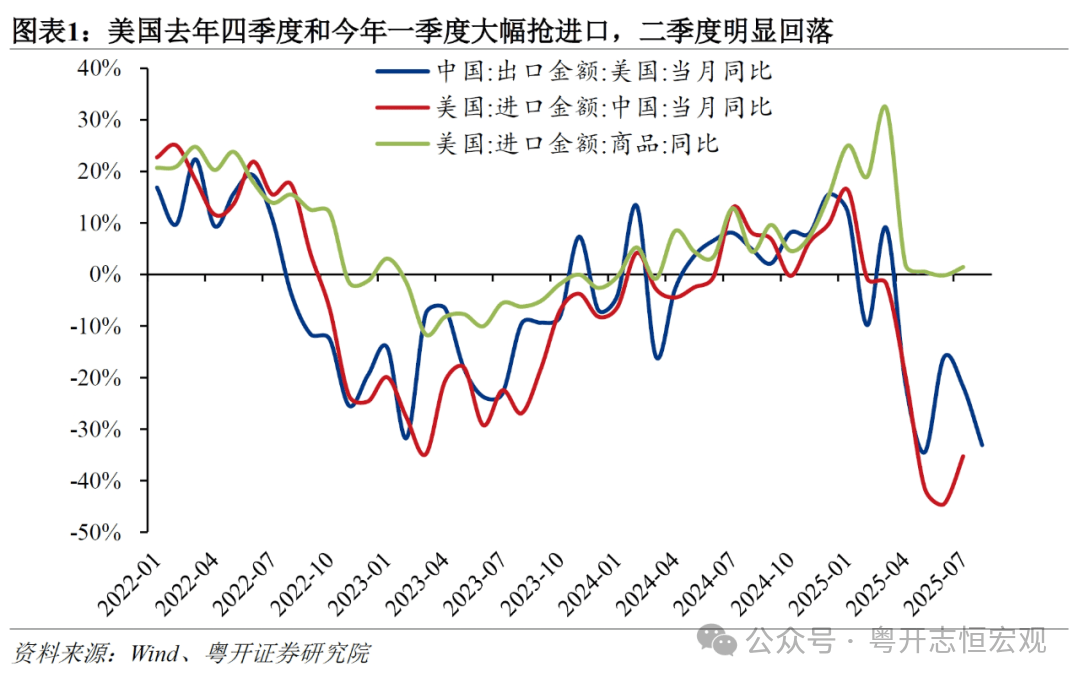
罗志恒、马家进(罗志恒系粤开证券首席经济学家、中国首席经济学家论坛理事) 摘要 8月生产、消费、投资等主要经济指标的同比增速呈现放缓态势,经济承压主要是由于前期支撑增长的因素正在逐步回落,同时房地产进一步下行拖累经 济,三季度经济增速有可能低于5%。此前,抢出口和转出口带动出口强劲,以旧换新政策带动消费回升,大规模设备更新和财政靠前发力支撑投资,共 同推动了上半年的经济增长。然而,这些因素的"透支效应"开始显现:随着"抢出口"行为的消退,出口增速放缓;消费品以旧换新政策对耐用消费品的刺 激作用边际递减,导致社零消费增速回落;同时,房地产市场持续低迷、制造业投资动能减弱以及地方财政紧平衡,对整体投资形成拖累。但当前经济也 呈现出一些积极因素,例如核心CPI同比回升以及股市持续上涨。 展望未来,下阶段经济增长面临的风险挑战进一步增多,四季度经济增速或回落至5%以下。从外部看,中美贸易关系的未来走向充满不确定性,同时美 国通胀形势可能扰动美联储的降息进程,对全球经济和资本市场造成不利冲击。从内部看,去年四季度政策拉动下的高基数将对今年同期的同比增速形成 压力;更为关键的是,房地产价格仍有下行压力,不仅直接抑制了房地 ...
8月经济数据现短期波动,政策加码预期升温
第一财经· 2025-09-15 23:23
Core Viewpoint - In August, China's economy showed short-term fluctuations due to export pressures but demonstrated strong resilience and vitality, with expectations for macro policies to continue supporting growth [3][11]. Economic Performance - In August, the industrial added value of large-scale enterprises grew by 5.2% year-on-year, a slight decrease of 0.5 percentage points from July, marking the lowest since September 2024 [3]. - The total retail sales of consumer goods increased by 3.4% year-on-year, down 0.3 percentage points from July, representing the lowest growth rate this year [3]. - From January to August, fixed asset investment increased by 0.5% year-on-year, slowing down by 1.1 percentage points compared to the first seven months of the year [3]. New Growth Points - High-tech manufacturing added value grew by 9.5% year-on-year from January to August, with integrated circuit manufacturing and aerospace equipment manufacturing increasing by 22.3% and 14.6%, respectively [5]. - The production of industrial robots and civilian drones surged by 29.9% and 53.7%, respectively, indicating steady progress in intelligent and green transformation [5]. - Despite a nominal decline of 0.4% in industrial enterprises' export delivery value in August, the overall industrial production remained stable with ongoing cultivation of new productive forces [5][6]. Consumption Trends - The retail sales of consumer goods increased by 4.6% year-on-year from January to August, with service retail sales growing by 5.1% [8]. - In August, the retail sales of consumer goods rose by 3.4%, with non-automotive consumer goods retail sales increasing by 3.7% [8]. - The implementation of consumption promotion policies, such as trade-in programs, has stimulated consumer demand, leading to significant growth in related product sales [9]. Investment Landscape - From January to August, fixed asset investment (excluding rural households) reached 326.1 billion yuan, with a year-on-year growth of 0.5% [11]. - Manufacturing investment grew by 5.1% year-on-year, while infrastructure investment (excluding certain utilities) increased by 2.0% [11][12]. - Real estate investment continued to decline, with a cumulative drop of 12.9% in the first eight months, although signs of stabilization are emerging in the market [13]. Policy Outlook - Analysts expect new significant measures to be introduced in the fourth quarter, focusing on fiscal stimulus, interest rate cuts, and stronger support for the real estate market [3][14]. - The macro policy is characterized by a gradual and supportive approach, with an emphasis on stabilizing investment and promoting consumption to counteract economic pressures [14].