贵金属

Search documents
以后的黄金会是以前的房子吗?
Sou Hu Cai Jing· 2026-02-02 04:02
Core Viewpoint - The recent volatility in precious metal prices, particularly gold and silver, has led to significant financial losses for investors, raising questions about the future of gold as an investment compared to real estate [2][3][5][11]. Precious Metals Market - Gold prices experienced a dramatic drop, with a single-day decline of 9.25% on January 30, marking the largest drop since 1983, falling from $5,627 to $4,682 per ounce [3]. - Silver also saw a significant decline, dropping from a high of $122 to $74.28 per ounce [3]. - The global precious metals market lost over $3.4 trillion in value, equivalent to the total market capitalization of the cryptocurrency market [4]. Investor Impact - Approximately 220,000 investors faced liquidation, with total losses exceeding $900 million, leading to substantial financial distress for many [5]. Comparison of Gold and Real Estate - Gold is viewed as a financial and safe-haven asset, driven by global credit and demand for safety, while real estate is considered a tangible asset with value based on local supply and demand [7][9]. - The current trend shows a shift from a booming real estate market to a more differentiated one, while gold is experiencing increased demand due to central bank purchases [11][14]. Market Dynamics - Real estate prices are influenced by regional factors such as population movement and government policies, while gold prices are determined by global economic conditions, geopolitical risks, and monetary policies [16][19]. - The liquidity of gold is significantly higher than that of real estate, allowing for easier transactions and lower costs [20]. Investment Strategy - Investors are advised to view gold as part of a diversified asset allocation rather than a direct replacement for real estate investments [20].


A股午评:沪指跌1.32%失守4100点,创业板指跌1.18%,电网、白酒股逆势上涨,黄金及贵金属板块全线下跌
Jin Rong Jie· 2026-02-02 03:46
Market Overview - A-shares experienced a decline in early trading on February 2, with all three major indices dropping over 1%. The Shanghai Composite Index fell by 1.32% to 4063.54 points, the Shenzhen Component Index decreased by 1.41% to 14006.25 points, and the ChiNext Index dropped by 1.18% to 3306.94 points. The STAR Market 50 Index saw a decline of 2.21% to 1476 points. The total trading volume in the Shanghai and Shenzhen markets was approximately 1.65 trillion yuan, with around 1800 stocks rising and 3500 stocks falling [1]. Sector Performance Strong Sectors - The electric power sector showed strength, with stocks like Shuangjie Electric and Electric Science Institute hitting the daily limit of 20%. The liquor sector also performed well, with stocks such as Huangtai Liquor reaching the daily limit and Kweichow Moutai rising over 2%. Other sectors that saw gains included banking, photovoltaic equipment, film and television, controllable nuclear fusion, and aviation [1]. Weak Sectors - The precious metals sector experienced a significant decline, with multiple stocks including Hengbang Shares and Zhaojin Gold hitting the daily limit down. On January 30, the international precious metals market saw a sharp drop, with spot gold falling over 12% at one point and ultimately closing down 9.52% at $4865 per ounce. Spot silver also saw a dramatic decline, dropping 26.9% to $84.7 per ounce [3]. Investment Insights Liquor Sector Outlook - The liquor sector is expected to see a bottoming out by 2026, with a projected increase in market share for leading brands. Analysts are optimistic about potential investment opportunities in the liquor sector around the Spring Festival [4]. Market Sentiment - According to Galaxy Securities, the market is likely to experience structural fluctuations as it approaches the Spring Festival, with a focus on sectors with strong fundamental support. The rotation of sectors is expected to be the main theme leading up to the holiday [5]. Strategic Recommendations - Zheshang Securities suggests maintaining a bullish outlook while adjusting portfolio structures. The technology growth sector is anticipated to enter a phase of high-level consolidation after a strong performance, while the resource sector may experience volatility. The market is expected to remain in a strong fluctuation pattern leading up to the Spring Festival [6]. Focus on Pricing Trends - CITIC Securities emphasizes the importance of monitoring price increase signals across sectors, particularly in cyclical industries where profit margins are expected to recover. The focus should remain on industries with competitive advantages in global pricing power, such as chemicals, non-ferrous metals, electric power equipment, and new energy [7].

历史性撕裂!VIX指数“失灵”,恐慌情绪转向大宗商品与汇率战场
Zhi Tong Cai Jing· 2026-02-02 03:20
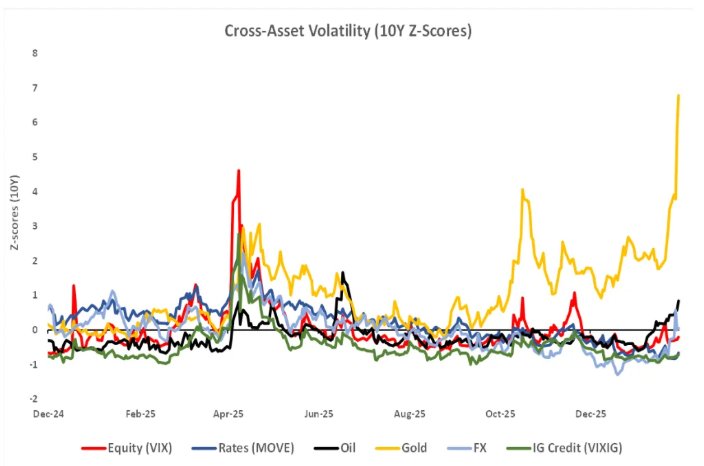
Market Volatility - The stock market has experienced lower volatility compared to other markets, while precious metals, currencies, and commodities have seen increased volatility [1] - Gold prices surged to a historical high but faced the largest drop since the 1980s, influenced by speculation of U.S. intervention in currency rates and geopolitical concerns [1][3] - The Chicago Board Options Exchange Volatility Index (VIX) remains below the average level of the past year, indicating subdued stock market volatility [1] Gold Market Dynamics - Gold prices have risen significantly due to U.S. President Trump's policies, with a record monthly increase despite a recent 9% drop [3] - The demand for call options on gold has surged, with the SPDR Gold Trust (GLD) accumulating over $20 billion in the past eight months [3] - The implied volatility of GLD reached historical highs relative to the S&P 500 index, indicating a shift in perception of precious metals as safe-haven assets [6] Currency and Interest Rate Impact - The relationship between gold prices and the USD/JPY exchange rate has become a popular trading strategy, with institutional investors betting on rising gold prices alongside interest rate changes [7] - The appointment of Kevin Warsh as Federal Reserve Chair has led to a more stable bond market response, with investors less inclined to bet on long-term interest rate fluctuations [10] Stock Market Correlation - Individual stock volatility remains high, as evidenced by Microsoft's 10% drop following disappointing earnings, while overall stock market volatility remains low [3] - The correlation between gold and stocks has slightly increased due to inflows into both asset classes, contrasting with historical trends where their correlation hovered around zero [6]
港股异动 | 加密货币ETF及概念股走低 币圈遭遇“血洗” 比特币一度跌破76000美元
智通财经网· 2026-02-02 02:37
Core Viewpoint - The cryptocurrency ETF and related stocks have experienced significant declines, with Bitcoin and Ethereum facing substantial price drops, indicating a bearish trend in the market [1] Group 1: Cryptocurrency Market Performance - As of the latest report, major cryptocurrency ETFs such as 嘉实以太币 (03179) and 华夏以太币 (03046) have dropped by 16.39% and 16.09% respectively, while 华夏比特币 (03042) fell by 6.87% [1] - Bitcoin's price fell below $76,000, marking a decline of approximately 40% from its peak in 2025, before recovering slightly to $77,225 [1] - Ethereum also faced a significant drop, with its price decreasing over 11% to a low of $2,256 [1] Group 2: Market Sentiment and Predictions - Brian Jacobson, Chief Economist at a U.S. wealth management firm, predicts further selling pressure in the cryptocurrency market in the coming days [1] - The sell-off is not limited to cryptocurrencies; precious metals like gold and silver also experienced sharp declines following the announcement of Trump's nomination of Waller for the next Federal Reserve Chair [1]
现货黄金盘中跌逾6%!机构称抛售或难以持续
2 1 Shi Ji Jing Ji Bao Dao· 2026-02-02 02:32
Group 1 - The extreme volatility in precious metals continues, with spot gold dropping below $4,700 and experiencing a decline of over 6%, while spot silver saw a dramatic drop of over 7% before rebounding [1] - In the domestic futures market, the main gold futures contract fell over 15%, reaching 1,016 yuan per gram, and the main silver futures contract hit the limit down [1] - The precious metals sector in the A-share market faced significant losses, with most stocks, except for Hunan Silver, hitting the limit down, and heavy selling pressure observed in popular stocks [1] Group 2 - Looking ahead, New Lake Futures believes that medium to long-term support for gold prices remains, driven by geopolitical risks and economic uncertainties, while the long-term trend of deteriorating global debt sustainability and de-dollarization supports structural strength in gold [2] - Central banks, particularly in emerging markets, continue to increase their gold holdings, providing solid support for gold prices, with expectations that European official or institutional investors may also join the gold buying trend this year [2] - In terms of trading strategies, Longcheng Futures suggests that after a significant short-term correction, the upper pressure range for the main gold futures contract is between 1,115 yuan per gram and 1,165 yuan per gram, while the lower support range is between 950 yuan per gram and 1,000 yuan per gram [2]
光大期货:2月2日金融日报
Xin Lang Cai Jing· 2026-02-02 02:22
Group 1: Market Performance - In January, the Wind All A index rose significantly with a monthly increase of 5.83% and an average daily trading volume of 3.05 trillion yuan, although it fell by 1.59% in the last week [3] - The CSI 1000 index increased by 8.68%, the CSI 500 by 12.12%, the CSI 300 by 1.65%, and the SSE 50 by 1.17%, driven mainly by the electronics and non-ferrous metals sectors, while the banking sector dragged down the overall index [3] - Domestic investor sentiment was high, with a monthly increase in financing balance of 197.1 billion yuan, while the issuance of stock funds decreased to 20 billion yuan, but mixed funds surged to 46.9 billion yuan, significantly above the monthly average of 13.4 billion yuan in 2025 [3][4] Group 2: Policy Expectations - The current valuation levels of A-share hot topics are high, with the dynamic PE of the CSI 500 index exceeding two standard deviations above the past five years [4] - The China Securities Regulatory Commission emphasized the need for a stable market, discouraging excessive speculation and market manipulation, indicating a preference for a "slow bull" market rather than a "crazy bull" [4][5] - The Shanghai and Shenzhen stock exchanges have introduced measures to increase the minimum margin ratio for financing purchases of stocks [4] Group 3: Bond Market Dynamics - In January, the bond market experienced a decline followed by a recovery, with the People's Bank of China (PBOC) significantly increasing the net injection of Medium-term Lending Facility (MLF) [6][7] - As of January 30, the yields for 2-year, 5-year, 10-year, and 30-year government bonds were 1.38%, 1.58%, 1.81%, and 2.29% respectively, with varying changes from the previous month [6] - The issuance of government bonds in January was 2.08 trillion yuan, with a net issuance of 1.181 trillion yuan, including 426.7 billion yuan of central government bonds and 754.3 billion yuan of local government bonds [8] Group 4: Manufacturing and Economic Indicators - The official manufacturing PMI for January was 49.3, below the expected 50.1, indicating a contraction in the manufacturing sector [9][10] - The decline in PMI is attributed to seasonal factors and insufficient market demand, with labor-intensive industries experiencing a drop in exports and early returns of workers for the Spring Festival [10] - The price indices for raw materials and factory output both increased, with the purchasing price index at 56.1 and the factory price index at 50.6, indicating potential pressure on corporate profits [11][12] Group 5: Precious Metals Market - In January, gold prices rose by 13.01% to 4,880.034 USD/oz, while silver surged by 19.12% to 85.259 USD/oz, with both metals experiencing extreme volatility [25][26] - The market dynamics were influenced by geopolitical tensions, concerns over the US dollar's credibility, and expectations of continued loose monetary policy from the Federal Reserve [25][26] - The sharp adjustment on January 30 was seen as a forced liquidation of overbought positions, but the long-term drivers for precious metals remain intact [26][27]

startrader:贵金属历史性崩盘 芝商所紧急上调期货保证金
Sou Hu Cai Jing· 2026-02-02 02:20
Core Viewpoint - The international precious metals market has experienced a historic crash, with London spot gold plummeting nearly $450 within 30 minutes after reaching a record high of $5,591 per ounce, marking a daily decline of 5.7% [1]. Group 1: Market Reaction - London silver also saw a significant drop of 9.2%, the largest single-day decline since 2020 [1]. - The domestic market mirrored this trend, with the A-share precious metals sector falling by 8.89%, resulting in over 20 stocks hitting the daily limit down [1]. Group 2: Regulatory Response - The Chicago Mercantile Exchange (CME) responded by significantly raising the margin requirements for precious metal futures to curb excessive speculation and mitigate market risks [1][3]. - For non-high-risk accounts, gold futures margin increased from 6% to 8%, and silver futures margin rose from 11% to 15% [3]. - High-risk accounts faced even larger increases, with gold margins rising from 6.6% to 8.8% and silver from 12.1% to 16.5% [3]. Group 3: Causes of the Crash - The crash was attributed to multiple negative factors, primarily the reversal of Federal Reserve policy expectations, which maintained the benchmark interest rate and signaled a prolonged period of high rates, undermining the financial appeal of precious metals [3]. - The precious metals sector had seen a substantial increase of 62% in A-share prices within the first month of the year, leading to overvaluation and profit-taking, exacerbated by high leverage in the market [3]. Group 4: Market Sentiment - Market reactions have been polarized, with optimistic views suggesting that the crash is a temporary profit-taking and policy adjustment effect, not altering the long-term bullish outlook for precious metals [4][5]. - Cautious perspectives warn that short-term downward pressure remains, with ongoing deleveraging in the precious metals market and potential further margin increases from CME that could trigger more forced liquidations [5]. Group 5: Key Variables Influencing Future Trends - Future movements in precious metals will be influenced by the Federal Reserve's upcoming policy announcements, the pace of interest rate cuts, and the ongoing adjustments in margin requirements by CME [5]. - Additionally, the demand for gold from global central banks, geopolitical risks, and the realization of industrial demand for silver will reshape market dynamics [5]. - The interconnectedness of domestic and international markets will also play a crucial role in determining the trajectory of precious metal prices [5].
黄金暴跌后何去何从? 短期震荡中长期不改向上格局
Jin Tou Wang· 2026-02-02 02:12
摘要今日周一(2月2日)亚盘时段,现货黄金最新报价为1053.13元/克,较前一交易日下跌35.17元,跌幅 3.24%,日内呈现暴跌走势。当日开盘价报1057.20元/克,盘中最高触及1091.48元/克,最低下探至 1030.11元/克。上一交易日,贵金属价格出现惊人暴跌。交易员正在消化此前推动金价升至历史新高的 那轮上涨行情出现的戏剧性逆转。金价最低触及4697.67美元/盎司,日内跌幅达到192美元;上周四金价 最高曾触及创纪录的5598.18美元/盎司。 【最新现货黄金行情解析】 贵金属市场近日遭遇抛售潮,直接导火索为特朗普提名凯文.沃什接任美联储主席。沃什以鹰派立场著 称,其提名被市场解读为美联储或转向紧缩政策,推动美元指数上周五一举录得去年5月以来最大单日 涨幅,进而施压以美元计价的贵金属。 尽管此前市场已预警贵金属炽热涨势或需回调,但此次跌幅仍超预期。特朗普的人事提名直接冲击了支 撑近期贵金属行情的"货币贬值交易"逻辑,投资者选择在高位集中获利了结,令2026年1月成为贵金属 史上最动荡月份。渣打银行商品研究主管Suki Cooper分析,抛售是多重因素叠加的结果,既包括美联 储主席提名,也涉 ...
有色金属:鹰派扰动,价格巨震
GUOTAI HAITONG SECURITIES· 2026-02-02 02:02
股票研究 /[Table_Date] 2026.02.02 鹰派扰动,价格巨震 [Table_Industry] 有色金属 | [姓名table_Authors] | 电话 | 邮箱 | 登记编号 | | --- | --- | --- | --- | | 李鹏飞(分析师) | 010-83939783 | lipengfei2@gtht.com | S0880519080003 | | 魏雨迪(分析师) | 021-38674763 | weiyudi@gtht.com | S0880520010002 | | 刘小华(分析师) | 021-38038434 | liuxiaohua@gtht.com | S0880523120003 | | 王宏玉(分析师) | 021-38038343 | wanghongyu@gtht.com | S0880523060005 | | 梁琳(分析师) | 021-23185845 | lianglin@gtht.com | S0880525070014 | | 李阳(分析师) | 021-23185618 | liyang7@gtht.com | S088052504 ...
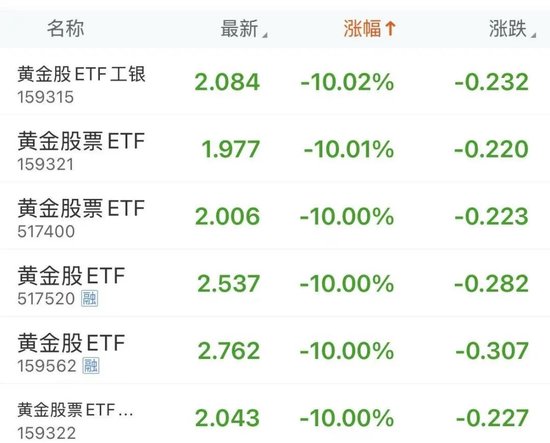
黄金股ETF,批量跌停
Xin Lang Cai Jing· 2026-02-02 02:00
Core Viewpoint - The precious metals sector, particularly gold and silver, is experiencing significant declines, with multiple stocks and ETFs hitting their lower limits amid a market crash. Group 1: Market Performance - The precious metals sector opened significantly lower on Monday, with gold and silver stocks leading the decline, resulting in over thirty stocks hitting their daily limit down [1][8] - On January 30, the international precious metals market saw a dramatic drop, with spot gold peaking at a decline of over 12% and ultimately closing down by 9.52%. Spot silver experienced a peak drop of 36%, closing down by 26.9% [2][9] - The Shanghai gold futures contract saw a drop of over 15% at one point during the day, with the decline narrowing to 11.08% by the time of reporting [3][10] Group 2: ETF Performance - Multiple gold stock ETFs, including the Industrial and Commercial Bank of China Gold ETF, opened at their lower limits, with significant declines noted: - ICBC Gold ETF at 2.084, down 10.02% - Gold Stock ETF at 1.977, down 10.01% - Other ETFs also reported declines of around 10% [2][9] Group 3: Regulatory Response - The Shanghai Gold Exchange issued an urgent notice to adjust margin levels and price fluctuation limits for silver futures contracts due to the high volatility in silver prices [7][14]