
新能源车

Search documents
一个“不看估值”的投资方法
雪球· 2025-08-12 08:42
Core Viewpoint - The article emphasizes the importance of understanding the trade-offs between certainty, prosperity, and valuation in investment strategies, suggesting that investors must adopt a flexible approach to identify opportunities and manage risks effectively [3][4][6]. Group 1: Investment Strategies - The concept of "the impossible triangle" illustrates that no investment opportunity can possess certainty, prosperity, and valuation simultaneously, requiring investors to prioritize two while sacrificing one [4]. - Three basic investment styles emerge from this triangle: - Deep value investing focuses on certainty and valuation, sacrificing prosperity [4]. - Sector rotation focuses on prosperity and valuation, sacrificing certainty [4]. - Track allocation focuses on prosperity and certainty, sacrificing valuation [4]. - The article discusses the deep value investment method, which is suitable for non-professional investors but requires overcoming psychological challenges related to market fluctuations [6][10]. Group 2: Sector Allocation - The article argues that abandoning valuation can be an effective strategy, as market consensus on valuation is subjective and can change over time [9]. - During periods of high prosperity, such as from May 2020 to November 2021, the most successful investment strategies were those that did not focus on valuation [10]. - Investors should consider a "configuration strategy," allocating part of their portfolio to high-prosperity sectors while seeking high-certainty stocks, often leading to standard configurations among institutional investors [11][12]. Group 3: Industry Trend Investment - Industry trend investment capitalizes on high-growth sectors, which often experience rapid valuation changes, making it challenging to apply traditional valuation methods [15][16]. - The article highlights that early-stage industry trends can lead to significant stock price increases, as seen in the lithium battery sector [17]. - Investors must navigate the uncertainty of defining "early-stage" trends, as market conditions can shift rapidly, impacting stock performance [18][19]. Group 4: Forecasting and Response - Investors need to predict changes in both prosperity and market expectations, as high prosperity sectors can lead to rapid stock price declines when signs of downturns appear [25][26]. - The article stresses the importance of qualitative analysis alongside quantitative tracking of prosperity to avoid pitfalls in investment strategies [28]. - A successful investment approach requires understanding the nature of the risks involved and aligning strategies with personal investment styles [32][33].



今年以来二十四只环境主题基金成立 公募持续布局“双碳”
Xin Hua Wang· 2025-08-12 06:19
谈及"双碳"背景下将为各产业部门低碳发展与高碳转型带来的发展机遇,招商基金认为,在低碳发 展方面,电力部门高排放占比的现状决定了电力脱碳降低碳排放的关键,光伏、风电、储能等行业迎来 历史性机遇。高碳转型方面,工业、建筑等行业均不可避免地需要进行终端电气化,火电、煤炭、钢铁 行业也面临着新的转型发展机遇。 工银瑞信相关负责人认为,权益市场经历调整之后,风险得到了有效的释放,当前聚焦着市场热点 和景气赛道的碳中和主题投资更加具有投资价值和投资性价比。碳中和主题有望成为未来40年的市场主 流投资方向。通过"1+N"碳中和政策体系,从降碳路径到保障措施,将在能源、工业、建筑、交通等众 多领域逐步实现结构调整和产业升级,在供给侧、输配侧和需求侧三大产业链上形成更多的投资机会, 让更多市场参与者分享经济转型的红利。 对于碳中和投资机会,易方达指数研究部总经理庞亚平认为,碳中和实现路径下对应两大投资主 线:一是增量角度,深度低碳领域的投资机会未来空间较大,包括清洁能源及储能、新能源车、减碳及 固碳技术等;二是存量角度,传统高碳转型企业通过技术改造,逐步向绿色发展转型的投资机会,如能 源供给侧的绿色电力、上游周期制造板块减碳 ...
频受国际巨头青睐 自主品牌新能源车迈向技术输出新阶段
Xin Hua Wang· 2025-08-12 05:49
Core Insights - Xiaopeng Motors has signed a strategic cooperation framework agreement with Volkswagen Group to jointly develop two B-class electric vehicle models based on Xiaopeng's G9 platform and advanced driver assistance systems, marking a shift in China's automotive industry from technology importation to exportation [1][2][5] Group 1: Strategic Partnerships - Xiaopeng Motors and Volkswagen plan to develop two electric vehicle models for the Chinese mid-size car market, expected to launch in 2026, with Volkswagen investing approximately $700 million for a 4.99% stake in Xiaopeng [2] - Audi has deepened its collaboration with SAIC Group to expand its high-end intelligent connected electric vehicle product lineup, aiming to develop new localized platforms for next-generation smart vehicles [3][4] Group 2: Market Dynamics - The Chinese automotive market has become the largest in the world, with new energy vehicle sales led by companies like BYD, which maintained monthly sales above 200,000 units, while Xiaopeng and other new energy vehicle brands are gaining recognition for their innovation and technology [5][6] - Volkswagen's global electric vehicle deliveries reached 321,600 units in the first half of the year, a 48% increase, but still only accounted for 7.4% of total deliveries, highlighting the competitive pressure from local brands like BYD, which saw a 95.78% year-on-year increase in sales [5][6] Group 3: Technological Advancements - Xiaopeng Motors emphasizes the importance of smart driving technology, with its XNGP system expected to cover multiple cities without relying on high-precision maps, indicating a significant advancement in autonomous driving capabilities [6] - The collaboration between Xiaopeng and Volkswagen is seen as a milestone in the domestic automotive industry, showcasing the recognition of Chinese brands' electric and intelligent capabilities on a global scale [6]


比亚迪前7个月新能源车销量同比增88.81% 出海进一步提速
Xin Hua Wang· 2025-08-12 05:49
Group 1 - In July, BYD sold 262,161 new energy vehicles, a year-on-year increase of 61.30% [1] - From January to July, BYD sold 1,517,798 new energy vehicles, achieving 88.81% year-on-year growth and completing half of its annual sales target of 3 million units [1] - BYD's overseas sales in July reached 18,169 units, a month-on-month increase of 72.45% and a year-on-year increase of 351.29% [1] Group 2 - BYD has expanded its presence in 53 countries and regions, including Japan, Germany, Australia, and Brazil, with notable success in markets like Thailand, New Zealand, and Singapore [1] - The company plans to increase its overseas market efforts, focusing on models like BYD ATTO3 and others [2] - BYD is establishing a large production complex in Brazil with a total investment of 30 billion Brazilian Reais (approximately 4.5 billion RMB) [3] Group 3 - The global market for new energy vehicles is seen as a blue ocean, with Chinese manufacturers like BYD gradually expanding their international market influence [3] - In the first half of 2023, China's new energy vehicle exports reached 534,000 units, a year-on-year increase of 160% [3] - The total export value of automotive products from China in the first half of 2023 was $99.97 billion, reflecting a year-on-year growth of 41.7% [3]

煤炭龙头超越“宁王” 公募新旧赛道掰手腕
Xin Hua Wang· 2025-08-12 05:47
Group 1 - The core phenomenon observed is that the market capitalization of traditional energy leader China Shenhua has surpassed that of new energy leader CATL, highlighting the competitive dynamics between old and new energy sectors [1][2] - The performance of China Shenhua, with a market capitalization of 664.6 billion yuan, has outperformed many new energy stocks despite positive news in the electric vehicle sector, such as BYD surpassing Tesla in quarterly sales [2][4] - Fund managers are increasingly recognizing the potential in old energy stocks as new energy valuations become overheated, leading to a strategic shift towards undervalued traditional energy companies [3][7] Group 2 - The annual stock price growth of China Shenhua from 2019 to 2023 has been impressive, with increases of 13.12%, 10.11%, 56.89%, 43.83%, and 25.05%, significantly outperforming many new energy stocks [2][4] - The demand for upstream resources in China is rising due to economic recovery, which is positively impacting the stock performance of companies like China Shenhua [3] - Some fund managers are returning to traditional energy investments, indicating a trend where the old energy sector is being viewed as a stable and attractive investment opportunity amidst the volatility of new energy stocks [4][6] Group 3 - The shift in investment focus from new to old energy is attributed to the supply-demand imbalance created by excessive capital inflow into new energy, which has led to a cooling off in the old energy sector [7][8] - Historical examples, such as the performance of traditional media stocks in the U.S., illustrate that old sectors can thrive even when new sectors are gaining attention, suggesting a similar potential for old energy stocks in the current market [8]

港股科技、红利有所分化,3个关键指标看懂如何布局
Sou Hu Cai Jing· 2025-08-12 05:42
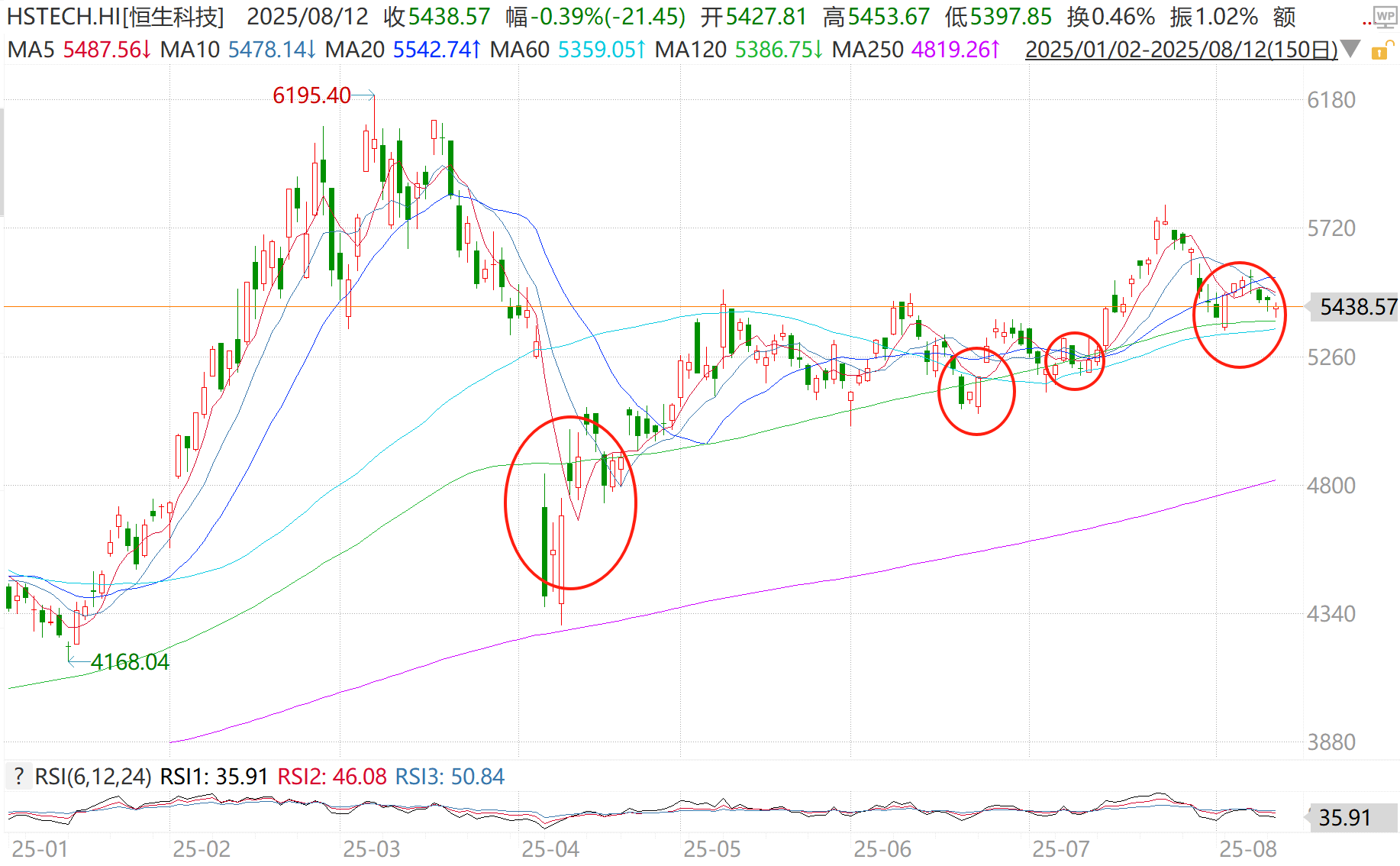
Group 1 - The Hang Seng Index showed slight gains while the Hang Seng Tech Index fell by 0.39%, indicating a divergence between dividend and growth sectors [1] - The Hang Seng Tech Index is approaching the 120-day moving average, which historically has led to quick rebounds, suggesting a potential buying opportunity [1] - The Hong Kong Technology 50 ETF (159750) is the only ETF that fully covers the "China Tech Giants," with significant inflows despite a slight decline in value [3][4] Group 2 - Major tech companies like Tencent, Alibaba, Xiaomi, and BYD account for over 40% of the Hong Kong Technology 50 ETF, which covers key growth sectors such as AI, new energy vehicles, and semiconductors [6] - Tencent is set to release its Q2 earnings report, with expectations that AI will contribute significantly to revenue, potentially boosting the tech sector and the ETF [6] - The Hong Kong Dividend Low Volatility ETF (520550) announced its fourth dividend of the year, with a payout of 0.04 HKD per 10 shares, reflecting a 0.33% dividend yield [7][9] Group 3 - The Hong Kong Dividend Low Volatility ETF has maintained a monthly dividend distribution since April, with a competitive fee rate of 0.2%, making it an attractive option for investors seeking cash flow [7][9] - The ETF tracking the Hang Seng High Dividend Low Volatility Index has a dividend yield of 5.81%, providing a safety net during market fluctuations [9] - The Hong Kong Technology 50 ETF is expected to further increase its year-to-date gain of 31% due to the upcoming AI earnings reports [10] Group 4 - A balanced investment strategy is suggested, utilizing dividend income to mitigate volatility, with recommendations for a 5:5 or 6:4 allocation between dividend and tech investments [11]
三大优势树立性价比标杆——试驾极狐阿尔法S6
Zhong Guo Qi Che Bao Wang· 2025-08-12 03:10
Core Insights - The article highlights the competitive landscape of the new energy vehicle market, emphasizing the launch of the Alpha S6 by Jihu Automobile as a game-changer in terms of cost-effectiveness and technology equality [2] - The Alpha S6 is positioned as a versatile vehicle, showcasing its unique advantages during a recent test drive event [2] Group 1: Range and Charging - The Alpha S6's 735MAX version boasts a CLTC range of 735 km, surpassing the BYD Han EV by 34 km, which can significantly reduce charging stops during long trips [3] - The vehicle's ternary lithium battery maintains 95% energy retention at -7°C, addressing range anxiety for users in colder regions [3] - The Alpha S6 can recharge approximately 240 km of range in just 10 minutes, alleviating concerns for long-distance travel [3] Group 2: Advanced Driving Assistance - The Alpha S6 features three laser radars, providing 360-degree environmental scanning, a rare capability in vehicles under 200,000 yuan [4] - Compared to pure vision systems, the laser radar offers superior precision in detecting obstacles and traffic signs, enhancing driving safety [4] - The vehicle, equipped with Huawei's ADS 3.3 system, achieves a 99% success rate in complex driving scenarios, significantly reducing driver fatigue [4] Group 3: Interior Space and Comfort - The Alpha S6 has a wheelbase of 2915 mm, offering spacious interior comfort, accommodating tall passengers easily [5] - The hatchback design allows for a maximum trunk capacity of 1300L, suitable for family outings and various cargo needs [5] - The vehicle's interior features low formaldehyde and low benzene materials, along with a CN95 filter, creating a "mobile oxygen bar" for a fresh in-car atmosphere [5][6] Group 4: Overall Product Strength - The Alpha S6 combines impressive range, advanced driving systems, and exceptional comfort, establishing itself as a benchmark for cost-effectiveness in the 200,000 yuan segment [6]

帮主郑重:中美关税暂停90天!三个中长线机会与两大暗雷
Sou Hu Cai Jing· 2025-08-12 02:54
Core Insights - The recent Stockholm joint statement has extended the 24% tariff suspension for an additional 90 days, impacting $380 billion in trade and signaling potential investment opportunities and risks in various sectors [1][3]. Group 1: Tariff Suspension Benefits - The suspension covers 1,120 categories of goods, including semiconductors and renewable energy equipment, leading to a cost reduction of 3%-5% for export companies in Zhejiang and Guangdong [3][4]. - Non-tariff retaliatory measures from China have also been paused, allowing for potential collaboration in semiconductor equipment and biomedicine, although high-tech competition remains intense [3][5]. Group 2: Strategic Implications of the 90-Day Window - The ongoing negotiations indicate a shift towards a "talk while fighting" approach, establishing a phase of stability despite unresolved core issues [4]. - The U.S. retains strategic flexibility, with the Treasury Secretary emphasizing that the final decision on tariffs lies with the President, indicating potential future punitive measures [5]. Group 3: Investment Opportunities and Risks - Three key sectors to focus on for investment include: - Export-sensitive manufacturing, particularly home appliances (e.g., Haier) and machinery (e.g., Sany Heavy Industry), which will benefit from reduced costs [5]. - Cross-border e-commerce leaders like SHEIN and Temu, with increased order fulfillment expected [5]. - Semiconductor equipment and innovative pharmaceuticals, which may see valuation recovery due to eased non-tariff barriers [5]. - Two sectors to avoid include: - Oil and gas equipment and shipping companies, which may face pressure if U.S. sanctions on Russian oil imports are implemented [5]. - Textile manufacturing firms that rely solely on low-cost exports, which may face heightened risks post-suspension [5]. Group 4: Strategic Recommendations for Investors - Focus on export companies' order growth in the first 30 days, with a target of a 15% month-over-month increase for potential investment [5]. - Monitor U.S. election polls by the 60-day mark, as a lead for Trump may necessitate reducing exposure in solar energy [5]. - Prioritize companies that can leverage currency appreciation from the tariff suspension, particularly those with favorable foreign exchange cycles [5].
每日市场观察-20250812
Caida Securities· 2025-08-12 02:18
Market Performance - The Shanghai Composite Index rose by 0.34%, the Shenzhen Component increased by 1.46%, and the ChiNext Index gained 1.96% on August 11, 2025[3] - The total trading volume of the Shanghai and Shenzhen markets exceeded 1.8 trillion yuan, an increase of over 100 billion yuan compared to the previous Friday[1] - Approximately 4,200 stocks saw gains, indicating a bullish market sentiment[1] Sector Analysis - Key sectors that performed well included energy metals, power equipment, consumer electronics, and medical services, while precious metals and banking sectors faced declines[1] - The technology sector, particularly PEEK materials, Nvidia concepts, computing power, and semiconductors, showed strong activity, reflecting current market sentiment[1] Investment Strategy - The moving average system for the Shanghai Composite Index has formed a bullish arrangement, suggesting a likelihood of continuous new highs in the market[1] - The PCB sector has remained active since June, with leading stocks reaching historical highs, making technology stocks a favorable investment strategy[1] - Investors are advised to closely monitor trading volume changes as effective volume expansion is crucial for the Shanghai Composite Index's upward momentum[1] Economic Indicators - In the first half of 2025, domestic tourism saw 3.285 billion trips, a year-on-year increase of 20.6%, with total spending reaching 3.15 trillion yuan, up 15.2%[5] - The core Consumer Price Index (CPI) rose by 0.8% year-on-year in July, marking the third consecutive month of growth, while the Producer Price Index (PPI) fell by 0.2% month-on-month[6][7] Fund Performance - Over 90% of large private equity funds achieved positive returns this year, with an average return exceeding 16% as of the end of July[13][14] - The first two data center REITs listed on August 8 saw a 30% increase on their debut, with 20.55% of public REITs achieving similar first-day gains[15]
交银国际每日晨报-20250812
BOCOM International· 2025-08-12 02:11
Group 1: Company Insights - Semiconductor company, 中芯国际, reported a 2Q25 revenue decline of 1.7% with a gross margin of 20.4%, exceeding expectations due to growth in 8-inch products [1][2] - Management guidance for 3Q25 indicates a revenue recovery with a projected growth of 5%-7% and a gross margin forecast of 18%-20% [1][2] - The company is expected to add 1.1 million pieces of 12-inch monthly capacity in 3Q25, with an average selling price (ASP) anticipated to be higher than 2Q25 but slightly lower than 1Q25 [2] Group 2: Automotive Industry Insights - In July, the penetration rate of new energy vehicles reached 54%, marking a year-to-date high, with retail sales of new energy vehicles at 987,000 units, a year-on-year increase of 12% [3][4] - The overall retail sales of passenger cars in July were 1.826 million units, showing a year-on-year increase of 6.3% but a month-on-month decline of 12.4% [3] - The automotive market is expected to see gradual recovery in retail sales due to the upcoming launch of several new models, including 理想 i6 and 小鹏 P7 [7] Group 3: Real Estate Industry Insights - The real estate market experienced a seasonal decline in supply and demand, with total sales in July dropping 38.1% month-on-month to 229.4 billion yuan [9] - The average selling price and sales area decreased by 21.4% and 21.8% respectively in July, reflecting seasonal factors [9] - Future policies are expected to support the market, focusing on urban village renovations and financial support [9]