
通信

Search documents
每周研选 | 如何看待当前市场的分化格局?
Xin Lang Cai Jing· 2026-01-25 13:14
Core Viewpoint - The A-share market is experiencing a volatile upward trend, with significant recovery in profitability, while major indices show mixed performance and increasing market style differentiation [1][11]. Group 1: Market Trends - The recent market has shown a high trading volume and a clear recovery in profitability, with small-cap indices like the CSI 500 and CSI 1000 outperforming large-cap indices such as the SSE 50 and CSI 300 [1][11]. - The implementation of counter-cyclical adjustment policies is expected to influence the spring market dynamics, with a focus on structural differentiation continuing [1][11]. Group 2: Institutional Insights - CITIC Securities indicates that market confidence is steadily recovering, suggesting that sectors with low valuations and growth potential, particularly in the consumer chain, are prime for allocation from now until March [1][12]. - Industrial and thematic ETFs are seeing positive subscriptions despite large-scale redemptions in broad-based ETFs, indicating a resilient market structure [3][13]. Group 3: Performance Predictions - Historical data suggests that February is one of the months with the highest win rates for major indices, with expectations for upward market elasticity as liquidity remains abundant [2][12]. - The current spring market is anticipated to have further room for development, with short-term fluctuations providing good investment opportunities [3][14]. Group 4: Sector Focus - Key sectors for investment include chemicals, non-ferrous metals, new energy, and power equipment, with a focus on high-growth areas such as semiconductor equipment and materials [1][12][20]. - The performance of high-growth sectors like AI, commercial aerospace, and other technology-driven industries is expected to continue, with potential for expansion into other high-growth areas [19][20]. Group 5: Earnings Outlook - As of January 23, over 900 listed companies have disclosed earnings forecasts, with a 37.7% positive forecast rate, indicating a potential acceleration in corporate profit recovery [5][15]. - The median year-on-year growth rate for total A-share net profit is projected to reach 17.8% for 2025, with significant growth expected in sectors like computing, communication, lithium batteries, and energy storage [5][15].
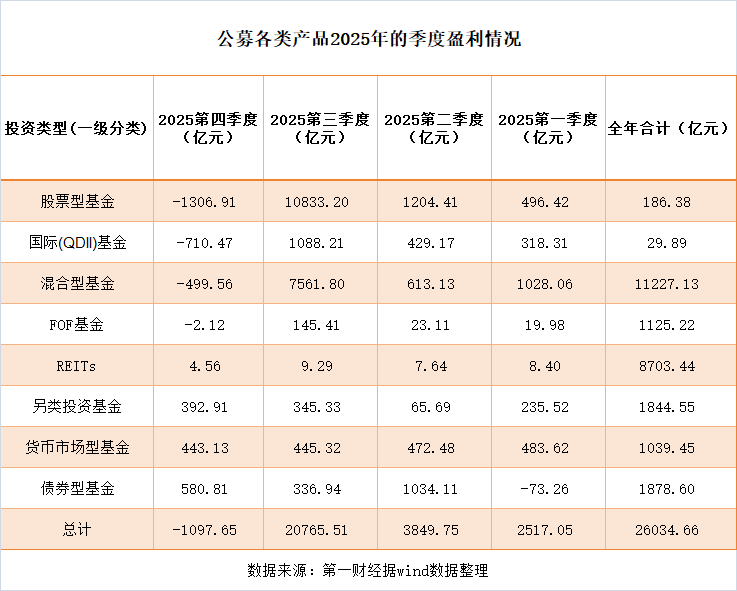
公募去年四季度亏超千亿终结七连盈,科技周期成加仓核心
Di Yi Cai Jing· 2026-01-25 12:00
Core Insights - The public fund industry in China achieved a record profit of 2.6 trillion yuan in 2025, recovering from a cumulative loss of 1.87 trillion yuan from 2022 to 2023 [1][2] - Despite a loss of approximately 110 billion yuan in Q4 2025, the overall annual performance marked a significant recovery for the industry [2][3] Fund Performance - In Q4 2025, public funds reported a total loss of 1,097.65 billion yuan, ending a streak of seven consecutive profitable quarters [2][3] - Equity funds were the hardest hit, with a combined loss of 1,306.91 billion yuan in Q4, while mixed funds lost 499.56 billion yuan [3][4] - For the entire year, equity funds still managed to generate a profit of 1.99 trillion yuan, despite the Q4 downturn [4] Product Categories - QDII funds and FOF funds also faced losses in Q4, amounting to 710.47 billion yuan and 2.12 billion yuan respectively, but ended the year with profits of 1,125.22 billion yuan and 186.38 billion yuan [4] - Fixed-income products, including bond and money market funds, contributed significantly to profits, with bond funds earning 580.81 billion yuan and money market funds 443.13 billion yuan [4] Fund Company Performance - Among 167 fund companies, 108 reported positive profits, with over 60% achieving profitability [5] - Notable performers included Guotou Ruijin Fund, which led the industry with a profit of 72.82 billion yuan [5] Stock Holdings Adjustments - Public funds increased their holdings in 83 new stocks by the end of Q4 2025, with a focus on technology and cyclical sectors [7] - Ningde Times remained the top holding stock, despite a reduction of 1,993 million shares, while Zhongji Xuchuang became the most held stock among active funds [10][11] Sector Focus - The communication sector, particularly in optical modules, saw increased institutional investment, with Zhongji Xuchuang and Xinye Technology becoming top holdings [10] - The top three sectors for public fund investments were electronics, power equipment, and communication, with significant capital allocated to these areas [13]




机构论后市丨市场信心持续恢复 A股维持震荡偏强趋势
Di Yi Cai Jing· 2026-01-25 12:00
Core Viewpoint - The A-share market shows mixed performance with the Shanghai Composite Index up 0.84% and the Shenzhen Component Index up 1.11%, while the ChiNext Index is down 0.34% and the Sci-Tech Innovation Board Index up 2.41% [1] Group 1: Market Analysis - CITIC Securities reports that market confidence is gradually recovering, suggesting that sectors with logical narratives at relatively low valuations may see recovery [1] - Zhongtai Securities indicates that the short-term market will continue to exhibit a differentiated pattern, supported by high elasticity sectors attracting new capital and a stable RMB exchange rate [2] - Huajin Securities notes that the short-term economic and profit recovery trends are weak, with PPI expected to rise and A-share profits maintaining a structural recovery trend [3] Group 2: Investment Strategy - CITIC Securities recommends increasing allocations in non-bank sectors (securities, insurance) and enhancing returns through domestic demand or high-growth sectors [1] - Zhongtai Securities anticipates that after the Spring Festival, the market's pricing logic will shift from risk preference and valuation expansion to performance verification and profit growth [2] - Everbright Securities advises investors to maintain a steady approach and hold stocks through the holiday, predicting a new upward momentum post-Spring Festival [4] Group 3: Sector Focus - Everbright Securities highlights sectors such as electronics, power equipment, and non-ferrous metals as key areas of focus, depending on market style [4] - The commercial aerospace sector is noted for its recent recovery, with specific sub-sectors like space computing and upstream materials expected to remain active [5]
投资策略周报:保持慢牛上涨的趋势不变,聚焦三条配置主线
HUAXI Securities· 2026-01-25 10:50
Market Overview - Global stock indices experienced more declines than gains this week, with Hong Kong, US, and European markets all showing downturns, while the A-share Shanghai Composite Index and Shenzhen Component Index rose slightly by 0.8% and 1.1% respectively[1] - In the A-share market, small-cap stocks outperformed large-cap stocks, with the Micro-cap Index, CSI 500, and CSI 2000 leading gains, while the SSE 50 and CSI 300 lagged behind[1] - In terms of sectors, cyclical and technology growth sectors performed well, with construction materials, oil and petrochemicals, steel, and chemicals leading the gains, while large financials, telecommunications, and food and beverage sectors faced declines[1] Market Outlook - The slow bull market trend is expected to continue, focusing on three main investment lines: technology sector expansion, price increase beneficiaries, and high-growth sectors in annual report forecasts[2] - The current period is marked by a high volume of annual report forecasts, with a pre-announcement success rate of 38% among over 900 listed companies, indicating strong interest in sectors like electronics, machinery, and pharmaceuticals[3] - The A-share market's trading volume remains robust, with a peak of 3.99 trillion yuan on January 14, and a turnover rate of 3.9%, suggesting potential for increased market volatility if the turnover rate continues to rise[3] Risk Factors - Key risks include unexpected global economic fluctuations, ineffective policy measures, overseas liquidity risks, and geopolitical tensions[2] - The current risk premium for the CSI 300 index stands at 5.27%, indicating that there is still ample room for growth compared to historical levels where risk premiums have dropped to around 2.5%[3]
策略周报:产业主题与涨价链共舞下的春季行情-20260125
East Money Securities· 2026-01-25 10:49
Strategy Insights - The report highlights a strong spring market driven by active trading in small-cap and thematic investments, with A-share trading volume exceeding 3 trillion, indicating robust market confidence and capital inflow [3][8][22] - The report identifies key themes for investment, including commercial aerospace, AI applications, and the price increase chain, which are expected to attract medium-risk capital [3][22] - The report notes a shift in market structure, with increased focus on real estate, resource products, and price increase chains, reflecting a rebalancing of investment styles [3][22] Market Dynamics - The A-share market has shown a recovery with the Shanghai Composite Index stabilizing and trading volumes rebounding, indicating a restoration of investor confidence [8][13] - Small-cap indices such as the CSI 500 and CSI 1000 have outperformed large-cap indices, suggesting a growing interest in mid and small-cap stocks [11][22] - The report emphasizes the importance of supply-demand mismatches in driving price increases across various sectors, particularly in the semiconductor and resource sectors [3][22][27] Sector Focus - The report suggests that the real estate sector is a critical area for investment, driven by recent policy signals aimed at boosting domestic demand, with leading companies in this sector likely to see revaluation opportunities [3][24] - The cyclical resource sector is expected to benefit from rising PPI and inflation expectations, with a notable increase in prices for industrial metals and chemicals [27][28] - Communication stocks, particularly in the optical communication segment, have faced downward pressure, indicating a need for cautious investment in this area despite overall market optimism [29][41]
光大证券:近期以稳为主 但仍应持股过节
Xin Lang Cai Jing· 2026-01-25 10:00
Core Viewpoint - The report from Everbright Securities suggests maintaining a steady investment approach while holding stocks through the holiday season, anticipating market fluctuations before the Spring Festival [1] Market Outlook - The market is expected to remain volatile before the Spring Festival, with a decline in trading enthusiasm among investors and a tightening of micro liquidity [1] - Historical data indicates that the probability of major indices rising in the 20 trading days leading up to the Spring Festival is less than 50% [1] - After the Spring Festival, a new upward momentum is anticipated, with higher probabilities and average gains for major indices in the subsequent 20 trading days [1] Investment Recommendations - Investors are advised to adopt a cautious approach while still holding stocks during the holiday period [1] - Key sectors to focus on include electronics, electrical equipment, and non-ferrous metals [1] Industry Performance - If the market style in January is growth-oriented, the top-scoring industries based on a five-dimensional industry comparison framework are electronics, electrical equipment, telecommunications, non-ferrous metals, automotive, and defense [1] - If the market style is defensive, the leading industries are non-bank financials, electronics, non-ferrous metals, electrical equipment, automotive, and transportation [1] - There is a notable similarity in the top-scoring industries under both growth and defensive market scenarios [1]

【广发宏观王丹】需求端补短板,驱动力再优化:2026年中观环境展望
郭磊宏观茶座· 2026-01-25 09:59
Core Viewpoint - The article analyzes the performance of China's assets in 2025, highlighting a 27.6% increase in the Wind All A Index, with significant gains in sectors such as non-ferrous metals, electronics, and defense industries, driven by global narratives and high-end manufacturing [1][12][13]. Group 1: Asset Performance and Industry Analysis - In 2025, the Wind All A Index rose by 27.6%, with leading sectors including non-ferrous metals (94.7%), electronics (47.9%), and defense (34.3%) [1][13]. - The profitability of industrial enterprises showed a positive trend, particularly in high-end manufacturing and related raw materials, with notable profit growth in non-ferrous metals (32.3%) and computer communication electronics (15.0%) [1][14]. - The performance of various industries was influenced by global trends, with precious metals and the AI industry chain showing remarkable results [1][12]. Group 2: Demand Drivers and Economic Structure - The demand side in 2025 was driven by three main factors: consumer spending on durable goods (e.g., home appliances), exports of electromechanical and high-tech products, and investment in equipment [2][16]. - Exports of electromechanical products and high-tech goods grew by 8.4% and 7.5%, respectively, outpacing overall export growth of 5.5% [2][18]. - Investment in construction and infrastructure declined by 8.4%, while equipment investment increased by 11.8% due to policy incentives [2][16]. Group 3: Industrial Price Trends - The Producer Price Index (PPI) fell by 2.6% in 2025, with traditional raw material sectors contributing significantly to this decline [3][20]. - The PPI decline was primarily driven by upstream traditional industries, which accounted for 66% of the decrease, while emerging manufacturing sectors contributed 23% [3][21]. - In the second half of 2025, PPI showed signs of recovery, with month-on-month increases observed in several industries, including coal and non-ferrous metals [3][22]. Group 4: Inventory Dynamics - The inventory-to-sales ratio in the industrial sector rose to 0.58 by November 2025, indicating a trend of increasing inventory levels [4][24]. - The inventory cycle showed a pattern of active replenishment at the beginning of the year, followed by passive accumulation later in the year [4][25]. - By November 2025, nominal and actual inventory levels had increased by 4.6% and 6.8%, respectively, compared to the previous year [4][24]. Group 5: Policy Outlook for 2026 - The core policy focus for 2026 is to address demand shortfalls, with an emphasis on optimizing supply-demand relationships [5][27]. - If fixed asset investment recovers to around 3.8%, the economic supply-demand ratio is expected to improve significantly [5][28]. - The 2026 policy aims to enhance consumer spending and investment, particularly in the service sector, to stimulate economic growth [5][35]. Group 6: Export and Consumption Trends - The export environment in 2026 is expected to remain stable, with structural highlights in midstream manufacturing [6][30]. - The IMF projects a global economic growth of 3.1% for 2026, with emerging economies in Asia and Africa leading the growth [6][31]. - Policies aimed at increasing consumer spending, particularly in the service sector, are anticipated to drive economic recovery [6][35]. Group 7: Investment Recovery and Infrastructure - Investment in infrastructure is projected to recover in 2026, with significant funding allocated for various projects [8][39]. - The early 2026 investment outlook is positive, with a notable increase in the scale of funding for key projects compared to 2025 [8][38]. - Central enterprises are expected to play a crucial role in driving investment, with substantial planned expenditures in infrastructure [8][39]. Group 8: Emerging Industries and Technological Development - The "14th Five-Year Plan" emphasizes the development of emerging industries, including artificial intelligence and quantum technology [9][40]. - Significant growth was observed in sectors such as drone technology and satellite communications, indicating a robust expansion of new industries [9][40]. - The application of advanced technologies in industrial enterprises has increased dramatically, reflecting a shift towards more innovative practices [9][40].

投资策略周报:保持慢牛上涨的趋势不变,聚焦三条配置主线-20260125
HUAXI Securities· 2026-01-25 09:14
Market Review - Global stock indices experienced more declines than gains this week, with Hong Kong, US, and European markets all showing downturns. In contrast, the A-share market saw slight increases, with the Shanghai Composite Index and Shenzhen Component Index rising by 0.8% and 1.1% respectively. Small-cap stocks outperformed large-cap stocks, with indices such as the Micro-cap Index, CSI 500, and CSI 2000 leading gains, while the SSE 50 and CSI 300 lagged behind. In terms of sectors, cyclical and technology growth sectors performed well, with construction materials, oil and petrochemicals, steel, and chemicals leading the gains, while large financials, telecommunications, and food and beverage sectors faced declines. In the commodities market, precious metals continued to strengthen, with COMEX silver and gold prices reaching new historical highs, while domestic black commodities remained weak. The US dollar index fell below 98, and the RMB appreciated against the US dollar [1][2][3]. Market Outlook - The report maintains a "slow bull" market trend and focuses on three main investment lines. In the past two weeks, under "counter-cyclical adjustment" measures, net outflows from major A-share ETFs and a slight decline in financing balances have effectively controlled trading momentum. Market turnover remains relatively high, with strong support for small-cap growth stocks, indicating a shift into a phase of accelerated sector rotation. Looking ahead, the current period coincides with a dense disclosure of annual report forecasts, with high-growth sectors becoming the focal point of market attention. The report suggests focusing on the expansion of technology trends, price increase themes, and sectors with high growth in annual report forecasts [2][3]. Sector Allocation - The report recommends focusing on the following sectors: 1) Technology industry expansion, including AI computing, AI applications, robotics, space photovoltaics, storage, and Hong Kong internet sectors 2) Sectors benefiting from "anti-involution" and price increases, such as chemicals and non-ferrous metals 3) Industries with high growth in annual report forecasts, including electronics, machinery, and pharmaceuticals [2][3]. Structural Analysis - Currently, the market is in a window of dense annual report forecast disclosures, with high growth or improving sectors becoming the focus. As of January 24, over 900 listed companies have disclosed their 2025 performance forecasts, with an overall positive forecast rate of 38%. In specific sectors, those with high growth in annual reports (with a median year-on-year growth rate of over 100% in net profit after deducting non-recurring gains) include PCB, storage, optical modules, lithium batteries, non-ferrous metals, and pharmaceuticals. Since the beginning of the year, the Wind pre-increase index has risen by 18%, indicating that outstanding performance sectors have become one of the market's focal points [3][4]. Long-term Perspective - From a medium to long-term perspective, comparing the current A-share market to previous bull markets, this round of market activity is still in the middle stage, with a "slow bull" trend expected to continue. Compared to the peaks of the bull markets in 2007, 2015, and 2021, the CSI 300 index has only reached the mid-stage, with current index levels significantly lower than previous highs. The current risk premium of the CSI 300 is 5.27%, which is higher than the 2.5% level seen in previous bull markets. Additionally, the ratios of total A-share market capitalization to M2 and free float market capitalization to household deposits are both near historical averages, indicating that there is still ample space and opportunity for the market [3][4].
一周主力|五大行业获资金青睐 三花智控遭抛售超61亿元
Di Yi Cai Jing· 2026-01-25 08:57
Group 1 - The banking sector received significant net inflow of 4.752 billion yuan, indicating strong investor interest [1] - The non-bank financial, non-ferrous metals, coal, and oil & petrochemical industries also attracted main capital [1] - In contrast, the electronics, communications, computers, power equipment, and machinery sectors experienced net outflows exceeding 10 billion yuan each [1] Group 2 - Individual stocks such as China Ping An, Midea Group, Haiguang Information, Cambricon Technologies, and Ganfeng Lithium saw net inflows exceeding 1 billion yuan [1] - Conversely, stocks like Sanhua Intelligent Controls, Zhongji Xuchuang, and Xiangnong Chip Creation faced significant net outflows of 6.14 billion yuan, 4.988 billion yuan, and 4.169 billion yuan respectively [1]


负债行为跟踪:咬紧科技不放松
ZHONGTAI SECURITIES· 2026-01-25 08:53
Report Industry Investment Rating - No information provided in the report Core Viewpoints of the Report - This week, the performance of broad - based indexes was differentiated. The science and technology sector generally rose, with more declines on Monday and Tuesday and most sectors rising with heavy trading volume from Wednesday to Friday. The main line of science and technology is more focused and clear, and it is the sector where the consensus of funds on the liability side is concentrated and the best elastic offensive variety [4][11]. - Although broad - based ETFs continued to have net outflows this week, industry ETFs were in a net - buying state. The science and technology sector still had substantial net buying, and the inflow of funds into the non - ferrous sector was significant [5]. - The margin trading and short - selling transaction volume decreased significantly, and the margin trading and short - selling balance first decreased and then increased. The demand for hedging reflected by stock index futures weakened after Wednesday [6][9]. - Foreign capital actively participated as a right - side force in the New Year's opening market, and its participation degree even exceeded that of margin trading and short - selling. It has become a more active incremental force in the short - term market [10]. Summary by Relevant Catalogs A - share Market - **Index Performance**: This week, the performance of broad - based indexes was differentiated. The CSI 300 fell by 0.6%, while the Shanghai and Shenzhen indexes rose by 0.8% and 1.1% respectively. The CSI 500 and the micro - cap index performed well, rising by 4.3% and 5.2% respectively. The performance of technology stocks was also differentiated, with the ChiNext Index falling by 0.3%, the STAR 50 rising by 2.6%, and the CSI 1000 rising by 2.9% [14]. - **Trading Volume**: The trading volume of broad - based indexes decreased significantly. The average daily trading volume decreased from 3.5 trillion to 2.8 trillion. Specifically, the trading volume of the entire A - share market decreased from over 3 trillion from Monday to Thursday to about 2.7 trillion, and rebounded to over 3 trillion on Friday [19]. A - share Industry - **Industry Performance**: This week, the top five rising industries were building materials (8.82%), basic chemicals (6.76%), steel (5.78%), petroleum and petrochemicals (5.76%), and non - ferrous metals (4.92%). The top five falling industries were banks (- 4.07%), media (- 2.96%), communications (- 2.77%), non - bank finance (- 2.57%), and computers (- 2.52%) [26]. - **Science and Technology Sub - sectors**: Since 2026, areas such as storage, semiconductors, and HBM have had relatively large excess returns compared to the Wind All - A Index. The excess returns of commercial aerospace and optical modules, which performed well in December, have declined or even turned negative. This week, the science and technology sector generally rose, with more declines on Monday and Tuesday and most sectors rising with heavy trading volume from Wednesday to Friday [28][32]. ETF Funds - **Broad - based ETFs**: Index ETF funds continued to have large - scale net outflows, with large - cap index ETFs having more outflows. The average daily net outflow of the CSI 300 ETF was over 14 billion, the average daily net outflow of the SSE 50 ETF was 7.3 billion, and the average daily net outflow of the CSI 1000 ETF was 6.2 billion. The SSE Composite Index ETF had a slight net inflow [37]. - **Industry ETFs**: Although broad - based ETFs still had net outflows this week, industry ETFs were in a net - buying state. The non - ferrous sector had a significant pulsed inflow of funds, and the science and technology sector still had substantial net buying. Science and technology sub - sectors represented by software and satellites continued to rank high in terms of net inflow [44]. Leveraged Funds - **Margin Trading and Short - Selling Transaction Volume and Balance**: After the implementation of the new margin trading and short - selling regulations on January 19, the proportion of margin trading and short - selling transactions decreased from 11.2% to 9.9%. The margin trading and short - selling balance first decreased and then increased, with the average balance this week being about 2.72 trillion, slightly higher than last week's 2.70 trillion [49]. - **Broad - based Index Margin Trading and Short - Selling**: From Monday to Tuesday this week, except for the SSE 50 and the STAR 50, the leveraged funds of most broad - based index components had net outflows; from Wednesday to Thursday, the leveraged funds of the CSI 300, SSE Composite Index, SSE 50, and CSI 1000 index components turned into net inflows. Overall, the net inflow of index margin trading and short - selling this week was less than that of last week [54]. - **Industry Margin Trading and Short - Selling**: On Monday and Tuesday this week, most industries de - leveraged, while on Wednesday and Thursday, most industries re - leveraged. Non - bank finance, communications, transportation, and comprehensive industries had relatively large increases in the proportion of margin trading net buying to trading volume [59]. - **Stock Market Value and Margin Trading and Short - Selling**: This week, stocks of all market - value gradients added leverage, with stocks with a market value of over 500 billion adding leverage to a greater extent [61]. - **Popular Stocks and Margin Trading and Short - Selling**: Popular stocks in electronics, power equipment, national defense and military industry, and non - ferrous metals mostly added leverage, while popular stocks in the media mostly de - leveraged. The proportion of leveraged funds in the trading volume of the top 35 popular stocks decreased this week [64][68]. Quantitative Funds - **Quantitative Index Enhancement Excess Returns**: Since January, the excess returns of the CSI 500 and CSI 1000 quantitative index enhancement have fallen to negative values, with the medians being - 1.14% and - 0.07% respectively [72]. - **Stock Index Futures Basis**: This week, the basis of stock index futures declined compared to last week but still remained at a relatively high level. From Wednesday to Friday, the basis of near - month stock index futures turned into a premium, indicating a weakening of hedging demand after Wednesday [78]. Main Funds - **Broad - based Index Main Funds**: The main funds of the CSI 300, ChiNext, and STAR Market continued to have net outflows this week, but the outflow slowed down significantly compared to last week. The CSI 300 had a large - scale net outflow from Monday to Tuesday and then turned into a net inflow on Wednesday and Thursday [83]. - **Industry Main Funds**: This week, the main funds flowed out of most industries, with the largest outflows in electronics, followed by computers, communications, and power equipment. The outflows were relatively large on Monday and Tuesday. The main funds flowed into banks, building materials, and coal [91]. North - bound Funds - **Participation Degree**: Foreign capital actively participated as a right - side force in the New Year's opening market, and its participation degree even exceeded that of margin trading and short - selling. The trading volume proportion of north - bound funds increased from 11.0% before the New Year's Day to 11.8%, an increase of 0.8 percentage points, while the proportion of margin trading and short - selling only increased from 10.6% to 11.0%, an increase of 0.4 percentage points [93]. - **Trading Volume and Proportion**: This week, the total trading volume of north - bound funds decreased, with the average daily trading volume decreasing from 401.1 billion to 338.5 billion, and the proportion of A - share trading volume increasing from 11.61% to 12.10%. Since late December, the trading activity of north - bound funds has significantly rebounded [102].