
Hua Er Jie Jian Wen

Search documents
地缘局势微妙,油价连涨3周
Hua Er Jie Jian Wen· 2026-01-10 02:31
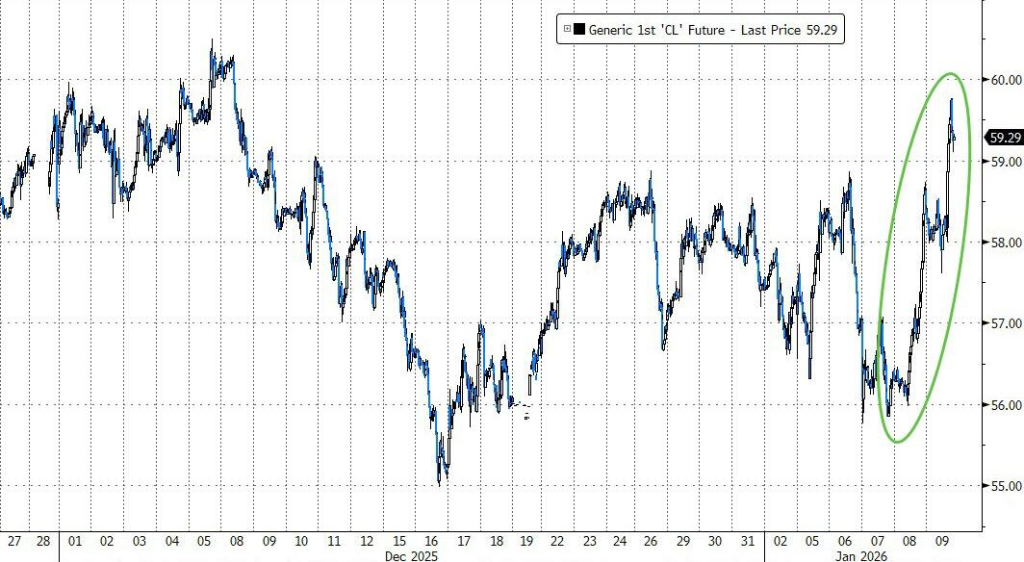
Core Viewpoint - Geopolitical risk premium has returned to the energy market, with crude oil prices recording the longest weekly gain since June of last year [1][2]. Group 1: Geopolitical Risks - Protests in Iran have been ongoing, with the Iranian National Security Council accusing the U.S. and Israel of orchestrating the unrest [1]. - U.S. President Trump warned of severe consequences for Iran if they are found responsible for any deaths related to the unrest [1]. - The focus of the market has shifted from Venezuela to Iran, as Iran's potential supply disruptions have a greater impact on oil prices due to its larger production capacity [2][6]. Group 2: Market Reactions - WTI crude oil futures saw a rise of over 3% on Friday, accumulating a gain of over 5% in the past two trading days, marking three consecutive weeks of increases [2][3]. - The options market reflects a shift in risk appetite, with call options skew reaching the highest level since July, indicating traders are paying the highest insurance premiums since the conflict between Israel and Iran began [4]. - Despite rising prices, fundamental pressures remain, with Goldman Sachs noting that clients' bearish sentiment towards oil prices is at a ten-year high [4]. Group 3: Supply and Demand Dynamics - The market is increasingly concerned about the potential for U.S. intervention in Iran if civilian casualties rise, with a 70% likelihood of intervention according to Rapidan Energy Group [7]. - Venezuela's role as a supplier has diminished significantly due to U.S. sanctions and aging infrastructure, while Iran continues to produce over 3 million barrels per day [6]. - The market is currently focused on Iran as the primary source of supply risk, overshadowing concerns about Venezuela [6]. Group 4: Financial Flows and Positioning - The amplification of risks related to Iran is attributed to traders holding significant bearish positions, which could lead to a sharp market reversal if geopolitical tensions force these positions to be unwound [9][10]. - Trend-following commodity trading advisors (CTAs) have been buying crude oil, and if prices stabilize, they are expected to continue purchasing [11]. - Over $6 billion is anticipated to flow into the market in the coming days due to annual rebalancing, primarily from commodity index funds [11]. Group 5: Price Outlook - Despite rising geopolitical risks, macro-level expectations of oversupply are limiting the upside potential for oil prices [12]. - The increase in Venezuelan supply and production rises in other regions may keep oil prices trading around $50 in the first quarter [12]. - Historical trends suggest that price spikes due to geopolitical events may be temporary, as seen when oil prices surged following U.S. bombings of Iranian nuclear facilities but quickly retreated once production was confirmed unaffected [12].

2026年的第一周,全球风险资产齐涨,投资者“情绪高涨”
Hua Er Jie Jian Wen· 2026-01-10 02:21
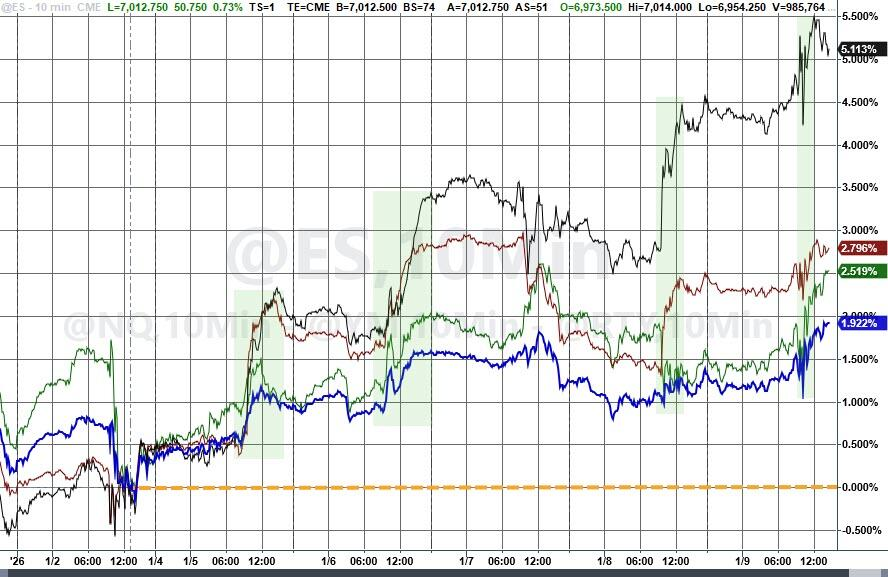
Market Overview - The global financial markets have shown strong risk appetite in the first trading week of 2026, with major stock indices reaching historical highs as investors shift from defensive assets to cyclical sectors and high-risk assets [1][5] - The S&P 500 index rose by 1.6%, while the Russell 2000 index surged by 4.6%, indicating an expanding market breadth [1] Asian Market Performance - The A-share market in China witnessed significant activity, with the Shanghai Composite Index breaking the 4100-point mark and achieving a remarkable "16 consecutive days of gains," with daily trading volume exceeding 3.15 trillion yuan [2][12] Commodity Market Dynamics - The commodity market performed strongly, driven by geopolitical factors and inflation expectations, with oil prices experiencing the largest single-day increase since October of the previous year, silver rising by 10% over the week, and gold nearing historical highs [3][14][15] Credit Market Activity - The credit market also joined the upward trend, with junk bond spreads narrowing by 10 basis points, stimulating new corporate borrowing [8] - The U.S. government's supportive policies, including new measures for the real estate market, have contributed to the market's rally [8] Investor Sentiment and Trends - Investors are increasingly favoring high-beta assets, with significant capital flowing into riskier segments of the market, as evidenced by the Vanguard S&P 500 ETF attracting $10 billion in just a few days [6] - Speculative assets have also seen active trading, with a "Meme stock" ETF soaring nearly 15% and heavily shorted stocks rising by 7%, marking the best start since at least 2008 [6] Economic Indicators - Despite a slight miss in U.S. non-farm payroll data, with only 50,000 jobs added in December against an expectation of 70,000, positive indicators such as service sector expansion and productivity gains have helped maintain investor optimism [11] - The U.S. monetary policy and strong fiscal support are expected to provide a favorable backdrop for economic activity in the second quarter of 2026 and beyond [11] Geopolitical Influences - Geopolitical risks have significantly impacted commodity prices, with oil and precious metals experiencing notable increases [14][16] - The volatility in stocks and bonds has decreased amid rising geopolitical tensions [17] Market Caution - Despite the bullish market sentiment, some analysts express caution, suggesting that the current speculative fervor may be unwarranted after a nearly doubling of the S&P 500 index over three years [19] - The upcoming decision on the successor to the Federal Reserve Chair Jerome Powell is also a focal point for market participants [19]
特朗普要代美联储“管房贷利率”?贝森特表态:“特朗普QE”目标是匹配美联储“缩表”
Hua Er Jie Jian Wen· 2026-01-10 01:50
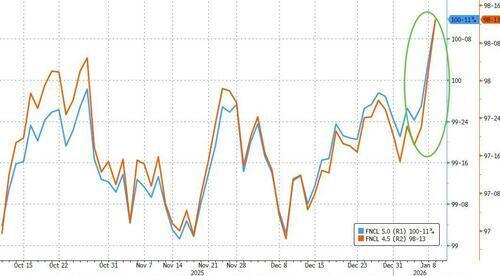
Core Viewpoint - The Trump administration is intervening in the mortgage market to lower mortgage rates by directing Fannie Mae and Freddie Mac to purchase mortgage-backed securities (MBS), countering the Federal Reserve's balance sheet reduction [1][2][5]. Group 1: Government Intervention - The U.S. Treasury Secretary, Mnuchin, announced that the government has instructed the Federal Housing Finance Agency (FHFA) to purchase $200 billion in MBS, marking a significant intervention in the housing affordability crisis [2]. - The initial phase of this plan involves a $30 billion purchase, which is seen as an aggressive move by the White House to address housing costs [2]. Group 2: Market Impact - Following the announcement, MBS prices surged, leading to a potential decrease in mortgage rates by approximately 0.25 percentage points [3][5]. - The risk premium of MBS relative to U.S. Treasuries narrowed by about 0.18 percentage points, indicating a positive market response to the intervention [5]. Group 3: Concerns Over Federal Reserve Independence - The intervention has raised concerns about the independence of the Federal Reserve, as traditionally, interest rate adjustments are within the Fed's purview [6][7]. - Analysts warn that this action blurs the line between market-driven effects and political manipulation, potentially reintroducing political risks into the financial markets [6]. Group 4: Future of Fannie Mae and Freddie Mac - The policy complicates the future privatization of Fannie Mae and Freddie Mac, as the government now views these entities as essential policy tools [8]. - There are conflicting expectations between the government's use of these government-sponsored enterprises (GSEs) as policy levers and the traditional expectations of private investors regarding their profitability [8].
华尔街见闻早餐FM-Radio | 2026年1月10日
Hua Er Jie Jian Wen· 2026-01-09 23:25
Market Overview - The U.S. Supreme Court has not yet announced its ruling on Trump's tariffs, with the next decision expected on January 14 [8] - Non-farm payroll data showed mixed results, with an increase of 50,000 jobs in December, below the expected 65,000, and the unemployment rate dropping to 4.4%, the lowest annual increase since 2020 [19] - The S&P 500 rose by 0.6%, reaching a new high, while the Nasdaq 100 increased by 1% [2] - The two-year U.S. Treasury yield rose by 4.39 basis points, reflecting market expectations for the Federal Reserve to maintain interest rates in January [2] Cryptocurrency and Commodities - Bitcoin fell below $90,000 after a strong start to the week, ending the week roughly flat [3] - Spot gold prices increased by 0.7%, surpassing $4,500, with a weekly gain of over 4% [3] - WTI crude oil saw a brief increase of 2.3% before settling at a 0.6% gain due to geopolitical tensions [3] Chinese Economic Indicators - China's December CPI rose by 0.8% year-on-year, marking a 34-month high, driven by increased food prices, particularly fresh vegetables, which rose by 18.2% [5][17] - The PPI has seen a continuous increase for three months, indicating rising industrial prices [17] - The Chinese Ministry of Finance announced the cancellation of VAT export rebates for 249 products, including solar energy products, starting in April [7][18] Company News - Intel's stock surged over 10% following a meeting between its CEO and Trump, with the U.S. government’s investment in Intel now valued at approximately $19.74 billion [33] - Minimax's debut on the Hong Kong stock market saw its shares soar by 109%, with significant backing from major investors like Alibaba and Tencent [11][23] - TSMC reported a 20.4% year-on-year increase in December revenue, driven by strong demand for AI chips and iPhone 17, alleviating market concerns about a potential bubble [28] Regulatory Developments - The State Council's Anti-Monopoly Committee announced an investigation into the food delivery service industry due to issues related to subsidies and pricing competition [6][18] - The U.S. is expected to release the results of its Section 232 tariff investigation, which could significantly impact the prices of silver, platinum, and palladium [19]

特朗普:“无论难易”都要得到格陵兰岛
Hua Er Jie Jian Wen· 2026-01-09 22:17
Core Viewpoint - The U.S. President Trump emphasized the need for the U.S. to acquire Greenland during a meeting with executives from major oil companies, indicating a desire for an "easy" transaction but open to a "difficult" approach if necessary [1] Group 1 - The meeting took place on the afternoon of September 9 at the White House [1] - Trump has not yet considered the financial aspects of "purchasing" Greenland [1] - The emphasis on an "easy" transaction suggests a strategic interest in Greenland's resources, potentially impacting the oil industry [1]
特朗普:美国将立即开始提炼和销售5000万桶委石油
Hua Er Jie Jian Wen· 2026-01-09 21:05
Core Viewpoint - The U.S. government is planning to facilitate the rebuilding of Venezuela's oil industry through discussions with major oil companies, with a focus on direct dealings between these companies and the U.S. rather than the Venezuelan government [1] Group 1: U.S. Government Actions - President Trump announced that the U.S. will begin refining and selling up to 50 million barrels of Venezuelan oil, allowing all countries to purchase any desired quantity [1] - The U.S. government will determine which oil companies can enter Venezuela, indicating a shift in how international oil transactions will be conducted [1] Group 2: Venezuelan Oil Supply - Venezuela provided 30 million barrels of oil to the U.S. on January 8, highlighting the country's willingness to engage in oil trade [1] - The discussions aim to channel some funds back into Venezuela's oil industry, potentially revitalizing its production capabilities [1] Group 3: Future Engagements - President Trump mentioned that there will be another meeting with oil companies next week to further discuss the plans for Venezuela's oil sector [1]
委内瑞拉宣布启动“探索性外交”,美代表团抵委评估重启使馆
Hua Er Jie Jian Wen· 2026-01-09 19:25
Group 1: Diplomatic Relations - Venezuela and the United States are initiating a process to normalize relations, marking the first substantial diplomatic contact after over five years of severed ties [1][3] - A U.S. State Department delegation has arrived in Caracas to assess the reopening of the U.S. embassy, with Venezuelan representatives also set to visit the U.S. [1][3] - Venezuela's Foreign Minister announced the government's decision to start "exploratory diplomacy" with the U.S. to restore diplomatic missions and address mutual concerns [1][3] Group 2: Oil Investment Opportunities - The Trump administration is adjusting policies to allow U.S. oil companies to invest in Venezuela, focusing on rebuilding the country's oil infrastructure [4][5] - Major U.S. oil companies, including Chevron and ExxonMobil, are expected to invest at least $100 billion in Venezuela's oil and gas infrastructure [5] - The U.S. Energy Secretary stated that investments will primarily come from corporate capital, with no current requests for government funding from oil companies [4][5] Group 3: Military and Security Actions - The U.S. military has conducted operations to intercept vessels involved in transporting Venezuelan oil, with the latest operation resulting in the seizure of the "Olina" tanker [6] - This marks the fifth interception of vessels related to Venezuelan oil exports in recent weeks, aimed at controlling the flow of oil from Venezuela [6] Group 4: Regional Security Concerns - Colombian President Petro expressed concerns about potential military actions similar to those faced by Venezuelan President Maduro, indicating a climate of insecurity in the region [7] - He noted that Trump had previously hinted at possible military operations in Colombia, although he believes the immediate threat has been "frozen" [7]
美联储月末降息没戏?“新美联储通讯社”称12月非农就业给按兵不动铺路,交易员预计1月几无可能
Hua Er Jie Jian Wen· 2026-01-09 19:25
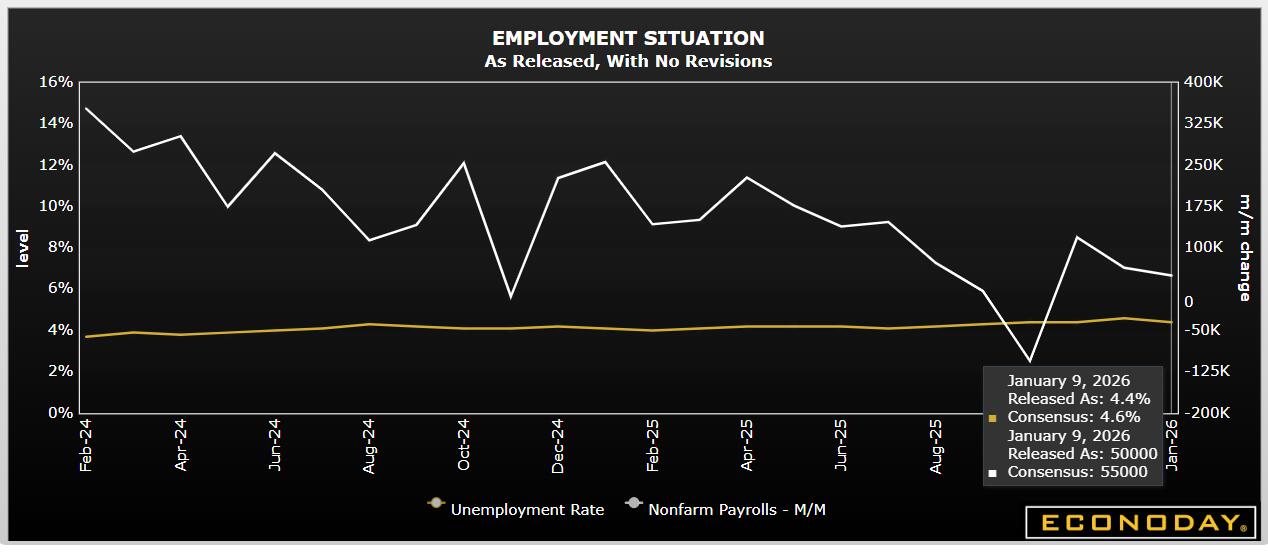
Core Viewpoint - The December non-farm payroll report has diminished market expectations for a Federal Reserve rate cut at the end of the month, as the unemployment rate unexpectedly dropped to 4.4% despite only 50,000 new jobs added [1][3]. Employment Data Summary - December saw a mere increase of 50,000 non-farm jobs, falling short of Wall Street's expectation of 65,000. The previous two months' data was revised down by a total of 76,000, with October's job loss revised from a decrease of 105,000 to 173,000 and November's from an increase of 64,000 to 56,000 [5]. - The average monthly job growth in the private sector over the last three months has dropped to 29,000, marking the second-lowest level for the year. The total non-farm employment increase for 2025 was only 584,000, the weakest annual performance since the pandemic caused a reduction of 9.2 million jobs in 2020 [5]. - In terms of industry performance, healthcare added 21,000 jobs, while retail, construction, and manufacturing sectors experienced job losses, with five out of eleven major industries reporting declines [8]. Unemployment Rate Insights - The unemployment rate fell from an initial estimate of 4.6% in November to 4.4% in December, which was below the expected 4.5%. This decrease has alleviated some of the most severe concerns regarding labor market deterioration [9]. - The drop in the unemployment rate was partly due to a decline in the labor force participation rate to 62.4%, indicating that some unemployed individuals have exited the labor market and are no longer counted as actively seeking work [9]. Market Reactions - Following the employment report, U.S. Treasury yields rose, with the two-year yield increasing by 3 basis points to 3.52% and the ten-year yield rising to 4.17%. The market has adjusted expectations for a rate cut, pushing the first anticipated cut to June, with an overall expectation of a 50 basis point reduction for the year [9][10]. - Analysts suggest that the Federal Reserve is likely to maintain its current interest rates in January, focusing more on the unemployment rate rather than the overall employment figures, which may have a slightly negative impact on U.S. interest rates [10].
特朗普“泄密”!提前12小时发帖曝光美非农就业数据
Hua Er Jie Jian Wen· 2026-01-09 19:03
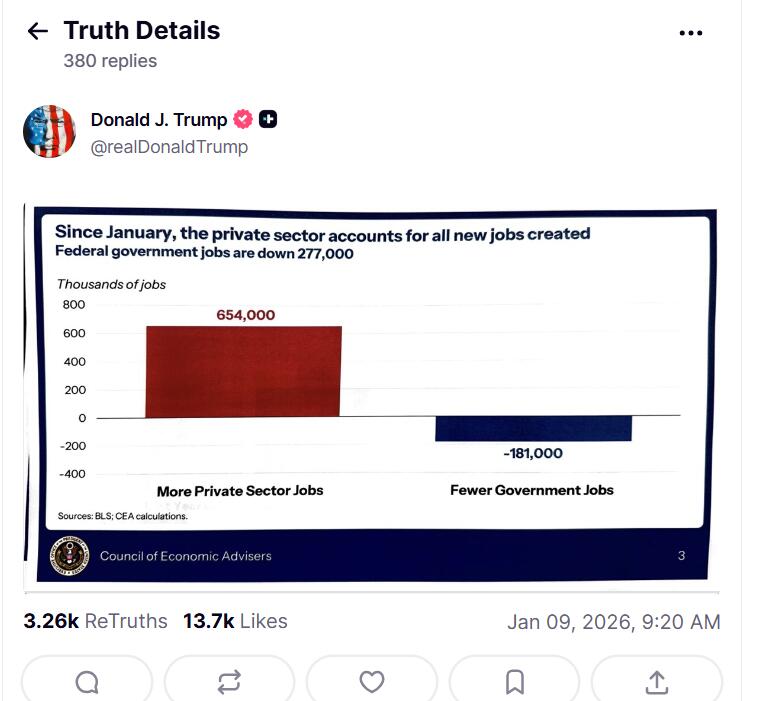
Core Insights - President Trump disclosed part of the U.S. employment data ahead of its official release, revealing that the private sector added 654,000 jobs since January, while government jobs decreased by 181,000 [1][2] - The official report from the Bureau of Labor Statistics (BLS) showed that non-farm employment increased by only 50,000 in December, falling short of the expected 65,000, marking the worst annual performance since the pandemic [3][6] - The private sector's job growth in December was only 37,000, significantly lower than the previous year's figures, indicating a weak labor market [6][8] Employment Data Summary - The BLS reported a total increase of 584,000 non-farm jobs for the year, the lowest since the pandemic caused a loss of 9.2 million jobs [3][6] - The average monthly job addition in the private sector for 2025 was 61,000, the weakest since 2003 without an economic recession [6][8] - Employment growth was primarily in the leisure and hospitality sectors, with healthcare adding 21,000 jobs in December, but other sectors like retail, construction, and manufacturing saw declines [8] Historical Data Revisions - The BLS revised previous months' data significantly, with October's job loss adjusted from 105,000 to 173,000 and November's from a gain of 64,000 to 56,000, totaling a downward revision of 76,000 jobs [10] - The three-month moving average for job growth now shows a decline of 22,000 jobs, indicating a weakening labor market trend [10] Unemployment Rate Insights - Despite weak job growth, the unemployment rate fell from 4.6% to 4.4%, attributed to a decrease in labor force participation to 62.4% [12] - The drop in unemployment has diminished expectations for a Federal Reserve rate cut in January, with traders anticipating no changes in the upcoming meeting [12] - Average hourly earnings increased by 0.3% month-over-month, with a year-over-year growth of 3.8%, outpacing inflation by about 1 percentage point [12]
OpenAI和软银对合作伙伴SB Energy投资10亿美元
Hua Er Jie Jian Wen· 2026-01-09 19:01
Core Insights - The article discusses the recent financial performance of a leading company in the technology sector, highlighting a significant increase in revenue and net income compared to the previous year [1] Financial Performance - The company reported a revenue of $10 billion for the last quarter, representing a 20% increase year-over-year [1] - Net income reached $2 billion, which is a 25% increase compared to the same quarter last year [1] Market Trends - The technology sector is experiencing robust growth, driven by increased demand for cloud services and artificial intelligence solutions [1] - Analysts predict that this trend will continue, with an expected market growth rate of 15% annually over the next five years [1] Strategic Initiatives - The company has announced plans to invest $1 billion in research and development to enhance its product offerings and maintain competitive advantage [1] - A new partnership with a leading AI firm is expected to accelerate innovation and expand market reach [1]
