
Zhong Guo Jing Ying Bao

Search documents
A股再现“天价离婚案”:时创能源董事长被分割4.46亿元股权
Zhong Guo Jing Ying Bao· 2025-12-31 16:27
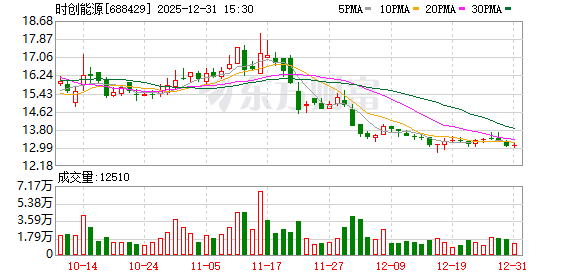
Core Viewpoint - The announcement of the divorce between the actual controller and chairman of Shichuang Energy, Fu Liming, and Wang Yanxiao, involves a significant transfer of shares but does not impact the company's governance structure or operations significantly [2][3]. Shareholder Changes - Fu Liming will transfer approximately 34.16 million shares of Shichuang Energy, valued at about 446 million yuan, to Wang Yanxiao as part of their divorce settlement [2][3]. - Following the share transfer, Fu Liming's indirect ownership in Shichuang Energy will decrease from 28.88% to 20.34%, yet he will still control about 70.04% of the voting rights through Shichuang Investment and Nanjing Sicheng [3]. Company Performance - Shichuang Energy, which went public on the Sci-Tech Innovation Board in 2023, operates in three main sectors: photovoltaic wet process auxiliary materials, photovoltaic equipment, and photovoltaic cells [3]. - For the first three quarters of 2025, Shichuang Energy reported revenues of 705 million yuan, with a net loss of 254 million yuan [3].


发布全球首款个人机器人引关注 上纬新材“光速”回应:尚未量产及规模化销售
Zhong Guo Jing Ying Bao· 2025-12-31 16:27
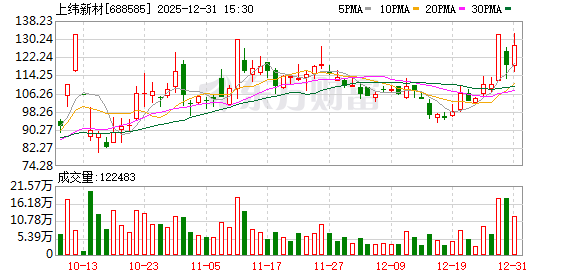
Group 1 - The core point of the article is the launch of the world's first personal robot, Qiyuan Q1, by the A-share listed company, Shangwei New Materials (688585.SH), marking its entry into the personal robotics market under the "Shangwei Qiyuan" brand [2] - Qiyuan Q1 is noted as the smallest full-body force-controlled humanoid robot, achieving breakthroughs in joint systems, overall size, and application scenarios, condensing laboratory-level humanoid robot capabilities into a backpack-sized device [2] - The company claims that through multi-dimensional innovations in materials, structure, and control algorithms, the QDD collimation drive joint has been successfully compressed to a size "smaller than an egg," while retaining the force control performance and high dynamic response capabilities of full-size models [2] Group 2 - Following the product launch, Shangwei New Materials issued a stock trading risk warning, indicating that its embodied intelligent robot business is still in the prototype stage and in the early stages of promotion, with uncertainties regarding product development, market launch timing, and market promotion [3] - The company reported that in 2025, its stock price increased by over 18 times, making it the "A-share king," with a stock price of 127.37 yuan per share and a total market capitalization of 52.38 billion yuan as of December 31, 2025 [3]

物流时效压缩至“分钟级” 海南自贸港封关后迎eVTOL跨海峡首飞
Zhong Guo Jing Ying Bao· 2025-12-31 16:27
Core Insights - The successful flight of the eVTOL "Kai Rui Ou" marks the first cross-strait transport scenario validation in China, demonstrating the potential of low-altitude logistics in the Hainan Free Trade Port [1][2] Group 1: Company Developments - The "Kai Rui Ou," developed by Fengfei Aviation, is the world's first eVTOL aircraft over one ton to receive all three necessary certifications: Type Certificate (TC), Production Certificate (PC), and Airworthiness Certificate (AC) [1] - The aircraft has a maximum takeoff weight of 2 tons and can carry a payload of 400 kilograms, with a range of 200 kilometers [1] - The company plans to introduce a six-seat manned eVTOL aircraft, "Sheng Shi Long," for cross-strait flights to enhance transportation efficiency [2] Group 2: Industry Trends - The flight demonstrated the capability of eVTOLs to significantly reduce transportation time from hours to minutes, alleviating pressure on traditional ferry and land transport across the Qiongzhou Strait [2] - Hainan Province is leveraging its early advantages in low-altitude airspace reform to promote three high-value scenarios: "low-altitude + logistics," "low-altitude + cultural tourism," and "low-altitude + emergency services" [2] - The integration of high-efficiency eVTOL logistics with the benefits of the free trade zone is expected to contribute to a trillion-yuan low-altitude economy in China [2]
引导董秘积极履职 上交所拟修订股票上市规则及规范运作指引
Zhong Guo Jing Ying Bao· 2025-12-31 15:45
中经记者 孙汝祥 夏欣 北京报道 本次规则修订主要包括两方面内容:一是落实证监会《上市公司董事会秘书监管规则(征求意见稿)》 的要求,建立董秘聘任、履职、解聘全流程监管体系,进一步完善董秘履职保障,引导董秘更好履职, 充分发挥董秘在信息披露事务办理、公司治理、内外部沟通协调等方面的作用,推动提高上市公司质 量。 二是根据证监会《上市公司治理准则》细化董事、高管相关规定,完善董事、高管监管制度,从任职、 履职、离职等方面进行全面规范,督促董事、高管忠实、勤勉地履行职责;健全董事、高管激励约束机 制,要求上市公司制定薪酬管理制度,规定董事、高管薪酬与公司经营业绩、个人业绩相匹配,促进董 事、高管和公司更好实现利益绑定;进一步规范控股股东、实际控制人行为,严格限制可能对上市公司 产生重大不利影响的同业竞争。 (编辑:罗辑 审核:夏欣 校对:颜京宁) 近日,上海证券交易所修订主板和科创板《股票上市规则》及《规范运作指引》,并向市场公开征求意 见。 上交所表示,此次修订旨在进一步规范上市公司董事、高级管理人员和控股股东、实际控制人等"关键 少数"行为,引导董秘积极履职,推动上市公司优化内部治理,切实保护中小投资者合法权 ...
加码“长钱长投” 2025年险资在一级市场出资规模超千亿元
Zhong Guo Jing Ying Bao· 2025-12-31 15:45
Group 1 - The core viewpoint of the articles highlights the accelerated influx of insurance capital into the primary market, driven by regulatory guidance and a low-interest-rate environment, with insurance institutions contributing significantly to private equity funds [1][2] - In 2025, insurance institutions contributed a total of 1,097.56 billion yuan to private equity funds, marking a 55.85% increase compared to the same period in 2024 [1] - The top three insurance companies in terms of contributions to private equity funds in 2025 were China Pacific Life Insurance (205.99 billion yuan), Ping An Life Insurance (150 billion yuan), and Sunshine Life Insurance (114.88 billion yuan) [2] Group 2 - Insurance capital's participation in the primary market is facilitated through various investment methods, including fund-of-funds, direct investment funds, and proprietary capital [3] - In the first half of 2025, insurance asset management institutions registered equity investment plans totaling approximately 268 billion yuan, reflecting a year-on-year growth of 188% [3] - The significant performance of insurance capital in the primary market is attributed to three main factors: the need to address "asset scarcity," supportive regulatory policies, and the natural alignment of insurance capital characteristics with equity investments [3] Group 3 - Insurance capital is primarily directed towards future industries and new productive forces, promoting a shift towards more rational and patient value investing in the market [4] - Notable investments include a 50 billion yuan fund initiated by China Life Asset Management focused on hard technology, and a 100 billion yuan fund established by PICC aimed at modernizing industrial systems [4][5] - Insurance capital is characterized as "patient capital," favoring long-term investments in sectors aligned with national strategies, such as hard technology, AI, and healthcare [5] Group 4 - Despite the growing scale of insurance capital investments, not all general partners (GPs) are favored; insurance capital has stringent requirements for GP selection based on management scale, historical performance, and team capabilities [6] - Preferred GPs include those with insurance or state-owned backgrounds, as well as top-performing market-oriented GPs [6] - The collaboration between insurance capital and GPs is influenced by the need for alignment in long-term interests and risk management strategies [6][7]
2026年“两新”政策公布 挖掘农村消费潜力
Zhong Guo Jing Ying Bao· 2025-12-31 15:45
Group 1 - The core policy for 2026 focuses on large-scale equipment updates and consumer goods replacement, with specific support areas and subsidy standards outlined in the notification [2] - The 2026 policy introduces new subsidy categories, including updates for old residential elevators, equipment for elderly care institutions, and safety equipment [3] - The policy aims to enhance rural consumer access by increasing offline business entities and guiding online channels towards rural areas [3][4] Group 2 - The subsidy mechanism for 2026 has been optimized, with differentiated subsidies based on the number of elevator floors and prioritizing electric vehicle updates for old operational trucks [5] - In the consumer goods replacement sector, the subsidy for cars remains unchanged, while home appliance subsidies are adjusted to support only energy-efficient products, with a cap of 1,500 yuan per item [6] - The policy emphasizes the importance of service consumption and aims to expand domestic demand through the implementation of the "Two New" policies [6][7]


商业不动产试点正式开启 证监会发文推动REITs高质量发展
Zhong Guo Jing Ying Bao· 2025-12-31 15:45
中经记者 孙汝祥 夏欣 北京报道 2025年12月31日,证监会发布《关于推动不动产投资信托基金(REITs)市场高质量发展有关工作的通 知》(以下简称"《通知》")。《通知》明确提出,推动商业不动产REITs平稳健康发展,加快推进 REITs市场体系建设,完善REITs申报注册制度机制,加强监管与风险防范。 同日,《中国证监会关于推出商业不动产投资信托基金试点的公告》(以下简称"《公告》")正式发 布,并自当日起实施。 除了推动商业不动产REITs平稳健康发展外,《通知》还提出要加快推进REITs市场体系建设,完善 REITs申报注册制度机制,加强监管与风险防范。 《通知》表示,重点支持符合政策导向、具有商业属性的资产发行商业不动产REITs,提高发行上市效 率。鼓励REITs持有业态相近、功能互补或运营协同的资产组合,推动跨领域资产整合,提升规模效应 和风险分散能力。支持经营规范、治理健全、资产管理经验丰富的银行保险业资产管理公司等金融机构 参与商业不动产REITs业务。有序拓展原始权益人范围。 《公告》明确了商业不动产REITs的定义,指通过持有商业不动产以获取稳定现金流并向基金份额持有 人分配收益的封 ...
稳增长政策发力显效 制造业PMI自4月以来首次升至扩张区间
Zhong Guo Jing Ying Bao· 2025-12-31 15:45
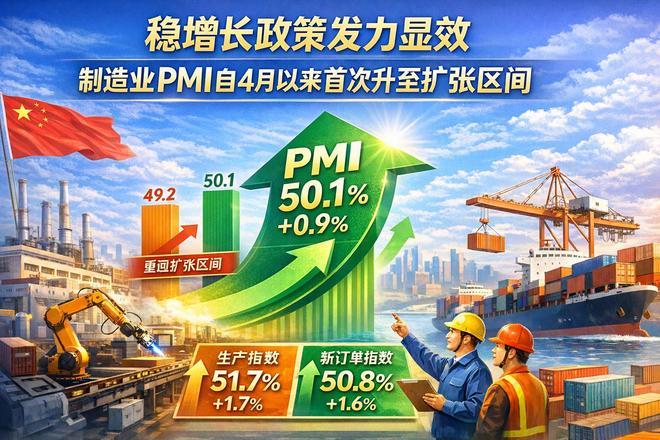
Core Viewpoint - The manufacturing PMI has returned to the expansion zone, indicating a recovery in both production and demand in the manufacturing sector, driven by steady growth policies and resilient exports [2][3]. Manufacturing PMI Overview - In December, the manufacturing PMI was reported at 50.1%, an increase of 0.9 percentage points from the previous month, marking the first return to the expansion zone since April [2]. - The non-manufacturing business activity index also improved to 50.2%, up by 0.7 percentage points from the previous month, reflecting a simultaneous improvement in non-manufacturing activity [2]. Factors Driving Recovery - The recovery in the manufacturing PMI is attributed to the ongoing implementation of growth-stabilizing policies and resilient export performance [2]. - The "two 500 billion" growth-stabilizing policies introduced in late September and early October have begun to show effects, with 500 billion yuan in new policy financial tools fully deployed by October, boosting infrastructure and manufacturing investments [2][4]. Production and Demand Indices - The production index and new orders index for December were reported at 51.7% and 50.8%, respectively, both showing significant increases of 1.7 and 1.6 percentage points from the previous month [2][3]. - The new orders index has risen above the critical point for the first time since the second half of the year, indicating expansion in both production and demand [3]. Enterprise Size Analysis - Large enterprises saw a PMI of 50.8%, up by 1.5 percentage points, returning to the expansion zone, while medium-sized enterprises had a PMI of 49.8%, up by 0.9 percentage points, indicating a slight recovery [4]. - Small enterprises, however, experienced a decline in PMI to 48.6%, down by 0.5 percentage points, reflecting greater pressure due to weak consumer demand [4][5]. Future Outlook - The production and business activity expectation index rose to 55.5%, an increase of 2.4 percentage points, indicating growing confidence among manufacturing enterprises regarding market development [5]. - The support from growth-stabilizing policies is expected to continue to bolster manufacturing sentiment, with projections suggesting that the manufacturing PMI may remain in the expansion zone into January 2026 [5].
碳酸锂行情“V型反转” 2026年能否继续“狂飙”?
Zhong Guo Jing Ying Bao· 2025-12-31 15:21
Core Viewpoint - The lithium carbonate market is expected to experience a rebound in 2025, with prices showing a V-shaped recovery after hitting a low of 59,000 yuan/ton in June, eventually surpassing 130,000 yuan/ton by December, marking an increase of over 120% from the low point [1][2][3]. Price Trends - In early 2025, lithium carbonate prices fluctuated around 75,200 yuan/ton, dropping below 70,000 yuan/ton by the end of April and reaching a low of 59,000 yuan/ton in June [1]. - By July 2025, prices began to rebound, breaking through 65,000 yuan/ton on July 14, 70,000 yuan/ton on July 21, and closing at 76,680 yuan on July 24, eventually exceeding 120,000 yuan/ton by December 23 [2]. - The price trajectory for 2025 is characterized by a typical V-shaped curve, with significant recovery driven by demand from the energy storage sector and a reduction in inventory levels [1][2]. Demand and Supply Dynamics - The demand for lithium carbonate is supported by a substantial increase in global power battery installations, which reached approximately 867.4 GWh from January to October 2025, a year-on-year growth of 34% [3]. - The new energy storage capacity in China exceeded 100 million kilowatts by September 2025, representing a growth of over 30 times compared to the end of the 13th Five-Year Plan, accounting for over 40% of the global total [4]. - The long-term outlook for lithium demand remains optimistic, with projections indicating that global lithium demand could reach 2 million tons of lithium carbonate equivalent by 2026, driven by sectors such as electric vehicles and energy storage [7]. Industry Performance - The recovery in lithium prices has positively impacted the performance of lithium companies, with stock prices of Tianqi Lithium and Ganfeng Lithium increasing by over 160% and 173%, respectively, since their lows in April [3]. - Ganfeng Lithium reported a net profit increase of 364.02% year-on-year in its third-quarter report, reflecting improved financial performance amid rising lithium prices [3]. Future Outlook and Challenges - The market may face uncertainties in 2026, with potential downward pressure on prices if inventory levels rise significantly due to slower-than-expected growth in energy storage demand [8]. - The development of alternative technologies, such as sodium batteries, may introduce new variables into the market, potentially exerting downward pressure on lithium carbonate prices, although current production scales and costs differ significantly from lithium batteries [9].
上市公司全面废除监事会 审计委员会接棒治理新时代
Zhong Guo Jing Ying Bao· 2025-12-31 15:15
Core Viewpoint - The transition from a supervisory board system to an audit committee structure in listed companies is set to enhance governance, improve information disclosure quality, and strengthen internal controls and audit communication as of January 1, 2026 [1][2]. Group 1: Regulatory Changes - The new Company Law effective from July 1, 2024, allows companies to establish an audit committee within the board of directors, replacing the supervisory board [2]. - By December 31, 2025, all A-share listed companies are required to amend their articles of association to reflect this change [1][2]. Group 2: Pain Points Addressed - The reform aims to address three main issues: the formalization and marginalization of the supervisory board, the disconnection between supervision and decision-making, and the inefficiency and cost of governance [3]. - The supervisory board often intervenes post-factum, while the audit committee will be involved in key processes such as financial disclosures and external audits, thus enhancing the timeliness and effectiveness of oversight [3]. Group 3: Advantages of Audit Committees - Audit committees, primarily composed of independent directors with relevant expertise, are expected to provide more effective oversight compared to supervisory boards [4]. - The direct accountability of audit committees to the board enhances the efficiency of communication regarding oversight findings and necessary management actions [4]. Group 4: Market Impact - The reform is anticipated to increase board seats, potentially unlocking additional capital allocation opportunities in the market [5]. - Current statistics indicate that the average number of board members in listed banks is around 14, with the potential for an increase of approximately one seat per bank due to the reform [5][6]. - If each bank releases one board seat, it could attract an estimated 456.2 billion yuan in capital to the A-share banking sector [6].
