
Qi Huo Ri Bao Wang

Search documents
二十年交易老兵的“快乐投资”之道
Qi Huo Ri Bao Wang· 2025-11-19 01:06
Core Insights - Lin Hai, a seasoned trader with 20 years of experience, emphasizes the importance of understanding macro policies and market dynamics in trading, leading to his recognition in the high-net-worth group and as an outstanding trader in polysilicon futures and options [1] Group 1: Trading Philosophy - The core of Lin Hai's trading philosophy is to "grasp the big contradictions," focusing on major market trends rather than minor fluctuations [2] - He transitioned from stock trading to futures, realizing that both markets share the same profit and loss sources, and that significant profits come from major market movements [2] Group 2: Market Opportunities - Lin Hai identified a key opportunity in the polysilicon market, where prices rose from 30,000 yuan/ton to 50,000 yuan/ton, by recognizing that the industry was at a loss and that the "anti-involution" policy would support high-quality development [3] - He noted that the price of polysilicon had fallen below the cost line, indicating a potential for recovery as the industry aimed for higher quality [3] Group 3: Risk Management - Lin Hai advocates for a diversified investment strategy, limiting exposure to any single commodity to no more than 10% to mitigate risks from unexpected market events [4] - His approach combines long-term strategic views with short-term tactical adjustments, focusing on maintaining a comfortable mental state while trading [4]
以精准金融服务助力实体经济发展
Qi Huo Ri Bao Wang· 2025-11-19 01:06
Group 1 - The event hosted by the Shanghai Futures Exchange (SHFE) in Chengdu aims to enhance the professional capabilities of futures practitioners in Sichuan, aligning with the provincial plan to strengthen financial tools for supporting the real economy [1] - Chengdu is positioning itself as a financial center in Western China, promoting the integration of various financial services including futures, credit, and insurance [1] - SHFE has launched six international specific varieties and 32 tradable varieties for qualified foreign investors, covering sectors such as metals, energy, and chemicals [1] Group 2 - SHFE has registered 128 overseas brands, including 42 from Belt and Road Initiative countries, facilitating better alignment of production standards with Chinese market needs [2] - Since 2025, SHFE has made significant progress in international cooperation, including partnerships with the Osaka Exchange and Gulf Commodity Exchange [2] - The introduction of the first recycled metal futures product, casting aluminum alloy futures and options, addresses the green transformation needs of the non-ferrous metals market [2] Group 3 - Sichuan Shenglin New Materials Technology Co., Ltd. plans to utilize aluminum alloy futures and options to hedge against price risks and improve risk management across procurement, sales, and inventory [3] - The company aims to integrate futures tools into its business strategy to support sustainable development as it expands production capacity [3]
广期所:为绿色低碳转型贡献更多期货力量
Qi Huo Ri Bao Wang· 2025-11-19 01:06
李慕春表示,下一步,广期所将聚焦加快打造绿色期货交易所,通过进一步丰富完善品种体系、持续加 强市场服务和培育、深入推进高水平对外开放,为绿色低碳转型贡献更多期货力量。(齐宣) 本报讯 11月18日,第二十届中国经济论坛平行论坛——2025大湾区科技与金融创新发展大会在广州南 沙成功举办。广期所副总经理李慕春在演讲中介绍,为助力绿色低碳转型,广期所近年来已陆续推出工 业硅期货与期权、碳酸锂期货与期权、多晶硅期货与期权。这些期货品种已在产业发展中发挥多方面重 要功能:价格发现作用良好,实物交割平稳运行,产业参与度逐步提高,同时投资者结构持续优化,工 业硅期货法人客户持仓占比为60%。 ...
止损是保住本金的最后一道防线
Qi Huo Ri Bao Wang· 2025-11-19 01:04
Core Insights - The article highlights the success of Wang Ran, a trader who emerged as the sixth place winner in the national futures trading competition, emphasizing his emotional stability and experience in trading [1] Group 1: Key Factors for Success - Risk management and decisive action during critical moments were identified as the two main pillars of Wang Ran's success in the competition [2] - Wang Ran's strategy involved a combination of fundamental and technical analysis, where fundamentals set the direction, technicals determine entry points, and drawdown rates establish stop-loss levels [3] Group 2: Trading Philosophy and Experience - Wang Ran's trading journey was marked by challenges, including significant losses during the 2008 soybean oil market, which taught him the principle of market reversals [4] - His trading philosophy emphasizes the importance of risk control, with strict discipline in managing exposure, ensuring that each trade only risks 1-3% of the total capital [4]
AI相关概念股表现活跃 煤炭股集体调整
Qi Huo Ri Bao Wang· 2025-11-18 09:41
Group 1 - The A-share market showed a rebound in technology stocks, particularly in AI-related concepts, while the lithium battery industry experienced a correction [1] - The Shanghai Composite Index fell by 0.81%, the Shenzhen Component Index decreased by 0.92%, and the ChiNext Index dropped by 1.16% [1] - AI application stocks performed well, with Fushi Holdings hitting the daily limit, Meideng Technology rising over 22%, and Vision China also reaching the daily limit [1] Group 2 - The coal sector faced a collective adjustment, with the coal mining and processing sector declining by 4.59% [1] - Individual stocks such as Yunmei Energy and Baotailong hit the daily limit down [1] - Yunmei Energy announced that it did not find any media reports or market rumors that could significantly impact its stock price, and it reported negative net profits for both 2024 and the first nine months of 2025 [1] Group 3 - Shanxi Securities' research report indicated that with the implementation of "anti-involution" policies, the expected increase in domestic coal supply is limited, providing downward support for coal prices [1] - The demand is expected to rise in the fourth quarter due to seasonal factors, leading to an optimistic outlook for coal prices [1] - The coal industry's performance in the fourth quarter may surpass that of the third quarter, suggesting potential value for allocation in the sector [1]




金融监管总局:保险资金运用余额达到37.46万亿元
Qi Huo Ri Bao Wang· 2025-11-18 09:41
Core Insights - The total investment balance of insurance funds reached 37.46 trillion yuan by the end of Q3 2025, marking a 12.6% increase from the beginning of the year and a 3.4% increase from mid-year [1] - The investment in bonds remains the largest asset class, totaling 18.18 trillion yuan, which is a 14.1% increase from the beginning of the year [1] - There is a notable increase in stock investments, with a total of 5.59 trillion yuan, reflecting a 36.2% growth since the start of the year [2] Investment Trends - The investment balance for life insurance companies was 33.73 trillion yuan, while property insurance companies had 2.39 trillion yuan [1] - The proportion of investments in bonds slightly decreased to 48.5% from 49.3% in the previous quarter [1] - The allocation to bank deposits also saw a slight decline, with life insurance companies holding 2.49 trillion yuan and property insurance companies holding 374.2 billion yuan [1] Policy and Market Environment - The government has implemented measures to encourage long-term capital market entry, including increasing the equity asset allocation limits for insurance funds [3] - The overall market environment is improving, leading to expectations of further increases in the proportion of insurance funds invested in stocks [4]
湖北省公安县棉花“保险+期货”项目为棉农扎实筑牢价格风险屏障
Qi Huo Ri Bao Wang· 2025-11-18 06:32
本次项目由湖北人保提供保障,申银万国期货联合同业期货公司共同参与风险管理。项目覆盖公安县 7.3万亩优质棉田,对应皮棉产量4.1万吨。通过创新运用金融工具,切实保障了参保农户的种植收益, 为棉花产业的稳定发展注入了强大动能。 公安县作为全国优质棉生产基地和湖北省棉花主产区,其棉花种植面积位居全省第一,本次棉花"保险 +期货"收入保险试点项目的实施,成功为公安县的棉花种植户提供了收入风险保障,为以后湖北省棉 花种植区扩大、普及棉花"保险+期货"项目积累宝贵经验。申银万国期货将持续发挥金融优势,为实体 产业提供申银万国智慧,助力乡村振兴。 棉花是关系国计民生的战略物资。湖北作为传统产棉大省,将保险、期货等金融资源导入到棉花产业链 条,探索稳定棉花种植面积、重振内地棉花产业的可行路径。近年来,国内棉花自然灾害频发、价格频 繁波动严重影响了农民的收入,挫伤了农户种植棉花积极性。 近日,由申银万国期货有限公司(以下简称"申银万国期货")推进的,中国人民财产保险股份有限公司 湖北省分公司(以下简称"湖北人保")承保的公安县棉花"保险+期货"项目顺利入场。 ...
“反内卷”对玻璃行业的影响分析
Qi Huo Ri Bao Wang· 2025-11-18 01:08
Group 1: Industry Overview - The float glass industry has faced severe challenges since 2021, including weakened demand, high inventory levels, and continuous price pressure due to the adjustment cycle in the real estate market [1][15] - The industry is expected to accelerate capacity clearance and transformation by 2025-2026, moving away from its reliance on the real estate sector [1][15] Group 2: Supply-Side Structural Reform - Supply-side structural reform was first proposed in November 2015, focusing on reducing excess capacity, improving total factor productivity, lowering enterprise costs, and preventing financial risks [2] - Significant progress has been made in eliminating excess capacity in key industries, including steel, cement, and flat glass, with 300 million tons, 400 million tons, and 150 million weight boxes of capacity eliminated respectively by the end of 2022 [3] Group 3: Real Estate Market Dynamics - The real estate market has shown significant policy-driven improvements, with a notable increase in new housing starts and sales from 2015 to 2016, but has since entered a downward trend [4][5] - By 2024, new housing starts are projected to drop to 7.39 million square meters, a 67% decline from peak levels in 2019-2020 [13][14] Group 4: Float Glass Demand and Supply Dynamics - The float glass industry is heavily dependent on the real estate sector, with 80% of its demand linked to construction activities [11] - The industry has experienced a significant drop in demand, with housing completion areas expected to decrease by 26.13% in 2024 [15] - Current inventory levels in the float glass sector are at historical highs, with total inventory reaching 63.14 million weight boxes, a 29.05% increase year-on-year [18] Group 5: Financial Performance and Profitability - The float glass industry has been in a prolonged state of loss, with average weekly profits for natural gas-based production lines at -172.70 yuan/ton [20] - The profitability of the industry is being affected by fluctuating raw material costs, with some production lines still maintaining profits due to lower costs of coal-based gas [20][21] Group 6: Future Outlook - The float glass industry is expected to undergo significant changes, with a focus on reducing reliance on the real estate sector and enhancing operational efficiency [15][21] - The ongoing adjustments in the real estate market and the implementation of "anti-involution" policies are likely to further influence the industry's dynamics and competitive landscape [12][21]

衍生品成工业硅磨粉企业破局“金钥匙”
Qi Huo Ri Bao Wang· 2025-11-18 01:08
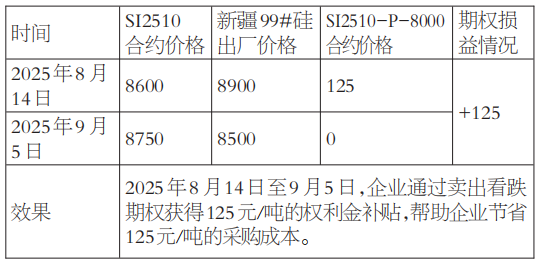
Core Insights - The market mechanism and price formation logic of industrial silicon are undergoing significant changes, highlighting the increasing value of financial derivatives for market participants [1] - Financial derivatives provide standardized price signals and establish a comprehensive risk buffer mechanism, enabling companies to maintain operational stability amid market volatility [1] Group 1: Financial Derivatives and Their Role - Financial derivatives, particularly options, allow companies to manage risks and optimize costs/profits, providing a way to gain additional returns while controlling risks [2] - Selling put options can reduce procurement costs by generating premium income, which can be beneficial regardless of whether the option is exercised [2] Group 2: Case Study and Practical Application - A case study illustrates a downstream grinding company using options to lower raw material procurement costs, achieving a cost saving of 125 yuan/ton through the sale of put options [3] - The company sold 1,000 tons of SI2510-P-8000 options on August 14, 2025, with a premium of 125 yuan/ton, which helped in reducing procurement costs [3] Group 3: Industry Challenges and Strategies - Industrial silicon grinding companies face shrinking profit margins due to volatile raw material prices and increased competition, making effective use of financial derivatives crucial for overcoming operational challenges [4] - Futures can lock in raw material costs and sales prices, while options allow companies to hedge against price declines while retaining upside potential, thus optimizing cost structures and improving capital efficiency [4] Group 4: Future Outlook - The application of financial derivatives in the industrial silicon sector is expected to expand, becoming a core support for optimizing risk management and enhancing resource allocation efficiency [5] - This development is anticipated to help the industry seize opportunities in the context of global energy transition towards low carbon [5]
资金需求下降 利率可能走弱
Qi Huo Ri Bao Wang· 2025-11-18 01:08
Core Viewpoint - The domestic market interest rates are on an upward trend, influenced by strong short-term funding demand and a rebound in medium to long-term rates [1] Interest Rate Summary - As of November 17, the overnight, 1-week, 2-week, 6-month, and 9-month Shibor rates are reported at 1.508%, 1.514%, 1.55%, 1.62%, and 1.64% respectively, showing increases of 2.9, 3.6, 5.8, 0.15, and 0.1 basis points compared to November 10 [1] - The 3-month and 1-year Shibor rates remain unchanged at 1.52% and 1.65% respectively, while the 1-month Shibor rate decreased by 0.5 basis points to 1.52% [1] Liquidity and Policy Outlook - A total of 1.12 trillion yuan in reverse repos is set to mature this week, with the central bank conducting a 283 billion yuan reverse repo operation yesterday, indicating a clear stance to support liquidity and stabilize interest rate fluctuations [1] - October's domestic social financing and new RMB loan data showed average performance, with an overall decline in financing demand, suggesting a higher probability of weak interest rate market conditions [1] - Year-end policy announcements are expected to be frequent, prompting investors to closely monitor changes in the policy landscape [1]