Qi Huo Ri Bao

Search documents
中盛期货:供应预期收紧,焦炭价格上行
Qi Huo Ri Bao· 2026-01-09 00:48
Group 1 - The recent surge in coking coal prices is primarily driven by policy disruptions in coking coal supply and the combined effects of market sentiment and funding conditions [1][3] - A recent meeting in Yulin City announced the removal of 26 coal mines from the electricity supply guarantee list due to non-compliance with supply responsibilities, which may tighten coal supply elasticity but not significantly reduce total output [1] - The meeting indicates a shift in policy management towards more flexible coal production oversight, potentially influencing other coal-producing regions and amplifying market expectations of supply contraction [1] Group 2 - Mongolia's recent revocation of special mining licenses for four companies is aimed at deepening mining governance rather than restricting coal output, with a clear intention to increase coal exports to China [2] - Despite the license revocations, the impact on Mongolia's coking coal exports to China is expected to be minimal, as Mongolia remains the largest supplier of coking coal to China, accounting for 50.9% of total imports [2] - Long-term, effective anti-corruption and governance measures in Mongolia could enhance the investment and operational environment in the coal sector, improving supply stability and efficiency [2] Group 3 - The current market for coking coal is experiencing a marginal tightening in supply and demand, with daily pig iron production showing signs of recovery and steel mill profit margins increasing to 38.1% [3] - Coking coal prices are heavily influenced by coking coal costs, and while there is some demand from coking plants, there is caution regarding expanding production due to high raw material prices [3] - The consensus among domestic coking enterprises is to proactively reduce production and control costs, indicating a cautious approach to market fluctuations despite being in an upward price trend [3]
宝成期货:焦煤追高需谨慎
Qi Huo Ri Bao· 2026-01-09 00:48
新年伊始,焦煤期货价格强势上涨,周三主力合约一度涨停,周四午盘收涨3%。现货方面,主产区煤 矿成交有所回暖,竞拍成交放量,流拍率大幅下降,但价格仅小幅上涨。 焦煤期货价格上涨的主要原因是商品市场情绪回暖。自2025年10月以来,大宗商品价格强势上涨,其中 有色金属、贵金属和新能源金属表现较强,市场情绪得到提振,继而带动估值相对偏低的黑色品种走 强。 综上所述,焦煤供应稳中有升,需求依然偏弱,基本面并无实质性改善,期货价格上行空间或有限,短 期追高需谨慎。(作者单位:宝成期货) 资讯编辑:祝蓉 021-66896654 资讯监督:乐卫扬 021-26093827 资讯投诉:陈跃进 021-26093100 免责声明:Mysteel发布的原创及转载内容,仅供客户参考,不作为决策建议。原创内容版权归Mysteel所有,转载需取得Mysteel书面授 权,且Mysteel保留对任何侵权行为和有悖原创内容原意的引用行为进行追究的权利。转载内容来源于网络,目的在于传递更多信息,方 便学习与交流,并不代表Mysteel赞同其观点及对其真实性、完整性负责。 看向基本面,当前焦煤市场供需格局并无实质性改善,国内供应稳中有升,主 ...
基本面变化不大 纯碱上方空间有限
Qi Huo Ri Bao· 2026-01-09 00:42
Core Viewpoint - After the New Year, the mainstream region's soda ash spot prices have gradually stabilized, with an increase in export volume in November 2025, but domestic demand remains weak, keeping prices low [1] Group 1: Supply and Production - In 2025, the national soda ash production reached 37.857 million tons, a year-on-year increase of 2.2%, with December production rising to 3.18 million tons [2] - The operating rate of domestic ammonia-soda plants was 79.2% as of January 2, 2026, a decrease of 4.1 percentage points month-on-month and 7.3 percentage points year-on-year; the operating rate of the soda-lime process was 72.7%, down 1.1 percentage points month-on-month and 8.5 percentage points year-on-year [2] - Two new production units are planned to be commissioned in the first quarter of 2026, adding a total capacity of 3.7 million tons per year, bringing the total domestic soda ash capacity to 44.6 million tons per year [2] - Domestic soda ash companies have been depleting inventory for two consecutive weeks, with inventory dropping to 1.4083 million tons as of January 2, a decrease of 30,200 tons week-on-week and 40,000 tons year-on-year, although the absolute inventory level remains high [2] Group 2: Export and Demand - In November 2025, soda ash exports totaled 189,400 tons, a decrease of 25,100 tons month-on-month; the total export volume from January to November 2025 was 1.9612 million tons, an increase of 922,500 tons year-on-year [2] - The increase in export volume is primarily due to domestic soda ash prices being at a low point, leading to increased export orders; however, future export growth remains uncertain with rising spot prices [2] - As of January 2, 2026, the daily melting volume of float glass nationwide was 153,300 tons, a decrease of 0.9% month-on-month and 3.3% year-on-year; the daily melting volume of photovoltaic glass in December 2025 was 73,500 tons, an increase of 4.2% month-on-month and 2.2% year-on-year [3] - The demand structure for heavy soda indicates that float glass accounts for 35%-40% and photovoltaic glass for 10%-15%; float glass production decreased by 6.5% year-on-year, while photovoltaic glass production fell by 9.3% year-on-year [3] - Light soda demand has increased due to the recovery in the lithium carbonate industry, while the demand for alumina and detergents remains stable; overall, the short-term supply-demand balance for soda ash is unlikely to change significantly [3]
基本面并无实质性改善 焦煤追高需谨慎
Qi Huo Ri Bao· 2026-01-09 00:42
看向基本面,当前焦煤市场供需格局并无实质性改善,国内供应稳中有升,主产地多数停产的煤矿开始 复产。据钢联统计,2026年1月1日至5日,有49座煤矿复产,涉及产能7505万吨,1月产量环比有望增 长。同时,高频数据显示,截至2026年1月8日当周,523家炼焦煤矿山样本核定产能利用率为85.3%, 原煤日均产量为189.9万吨,环比分别增加5.7个百分点、12.7万吨,增幅显著。此外,去年年底蒙煤积 极冲量,甘其毛都口岸上个月日均通关量为19.11万吨,环比、同比分别增长6.14%、130%。元旦假期 后蒙煤通关车数有所下降,目前通关车数降至1100车左右,依旧处于历史同期高位。整体来看,焦煤供 应压力依然较大。 新年伊始,焦煤期货价格强势上涨,周三主力合约一度涨停,周四午盘收涨3%。现货方面,主产区煤 矿成交有所回暖,竞拍成交放量,流拍率大幅下降,但价格仅小幅上涨。 焦煤期货价格上涨的主要原因是商品市场情绪回暖。自2025年10月以来,大宗商品价格强势上涨,其中 有色金属、贵金属和新能源金属表现较强,市场情绪得到提振,继而带动估值相对偏低的黑色品种走 强。 需求方面,本周钢厂开始复产。根据Mysteel数据 ...
供应预期收紧 焦炭价格上行
Qi Huo Ri Bao· 2026-01-09 00:42
Group 1 - The recent surge in coking coal prices is primarily driven by policy disruptions in coking coal supply and the combined effects of market sentiment and funding conditions [1][3] - A recent meeting in Yulin City announced the removal of 26 coal mines from the electricity supply guarantee list due to failure to meet supply responsibilities, which may tighten coal supply in the region [1] - The adjustment in coal supply management indicates a shift from a "guarantee equals safety" expectation, suggesting stricter enforcement of supply responsibilities for coal mines [1] Group 2 - Mongolia's revocation of special mining licenses for four companies is aimed at deepening mining governance rather than restricting coal output, with a clear intention to increase coal exports to China [2] - The four companies affected primarily operate in metal and coal mining, but the overall impact on Mongolia's coking coal exports to China is expected to be minimal [2] - Long-term, effective anti-corruption and governance measures in Mongolia could enhance the investment and operational environment in the coal sector, improving supply stability and efficiency [2] Group 3 - The current supply-demand dynamics for coking coal show a marginal tightening, with daily pig iron production stabilizing and steel mill profit margins increasing to 38.1% [3] - Despite some demand recovery, the willingness of steel mills to stockpile is limited, which may restrict the extent of demand rebound [3] - The consensus among domestic coking enterprises is to proactively reduce production and control costs, indicating a cautious approach to expanding production despite rising prices [3]
“弱现实”压力仍在 多晶硅期货多个合约跌停
Qi Huo Ri Bao· 2026-01-09 00:34
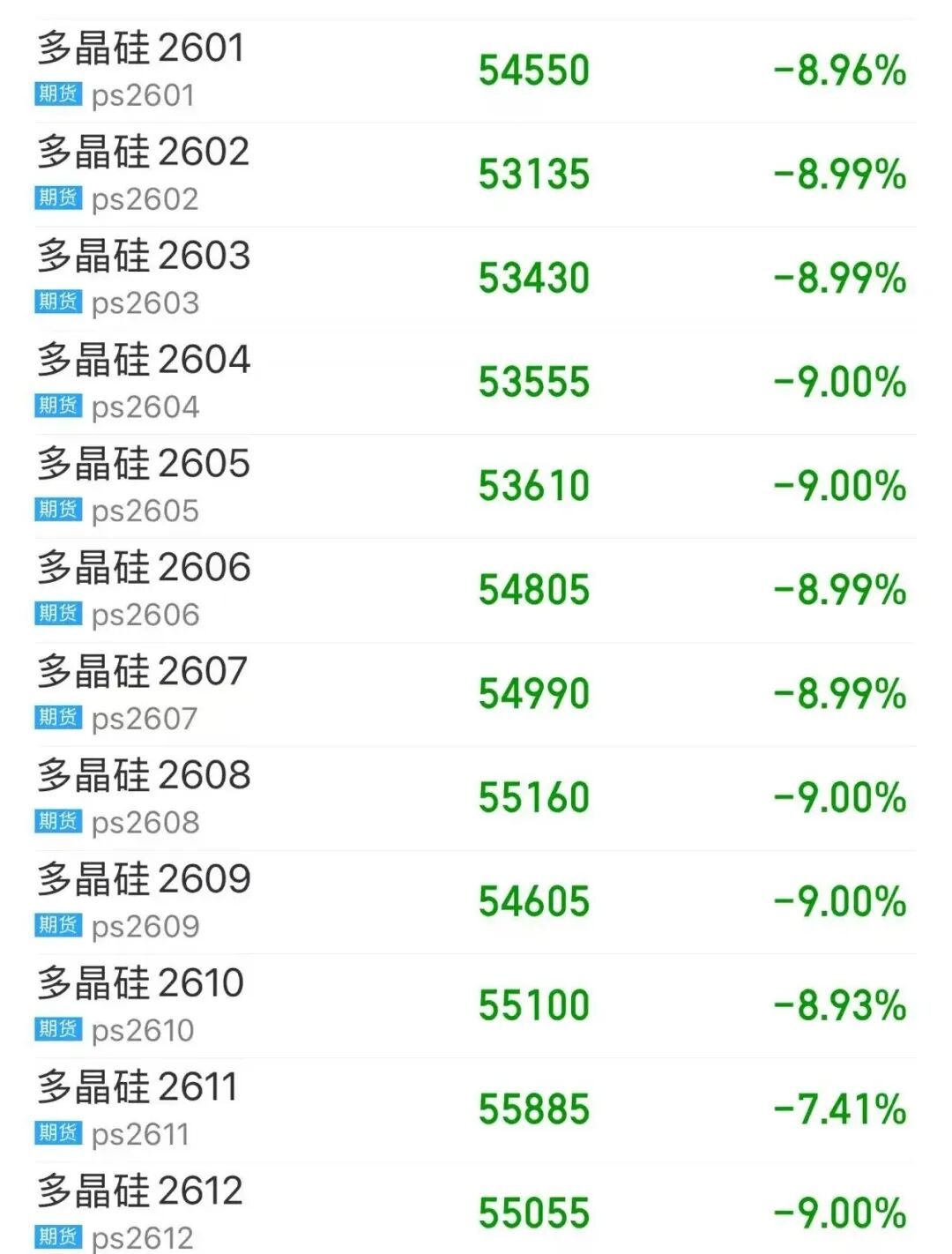
1月8日,多晶硅期货多个合约午后跌停,截至午盘收盘,主力2605合约报53610元/吨,下跌9%。 | 多晶硅 2601 | 54550 | -8.96% | | --- | --- | --- | | 期货 ps2601 | | | | 多晶硅 2602 | 53135 | -8.99% | | 期货 ps2602 | | | | 多昌硅 2603 | 53430 | -8.99% | | 期货 ps2603 | | | | 多晶硅 2604 | 53555 | -9.00% | | 期货 ps2604 | | | | 多晶硅 2605 | 53610 | -9.00% | | 期货 ps2605 | | | | 多晶硅 2606 | 54805 | -8.99% | | 期货 ps2606 | | | | 多晶硅 2607 | 54990 | -8.99% | | 期货 ps2607 | | | | 多醋硅 2608 | 55180 | -9.00% | | 期货 ps2608 | | | | 多晶硅 2609 | 54605 | -9.00% | | 期货 ps2609 | | | | 多晶硅 2610 ...

伊朗大范围断网!特朗普:如再有人员死亡 将对伊进行“严厉打击”!“美国可能正准备世界大战”!油价大涨
Qi Huo Ri Bao· 2026-01-09 00:31
早上好,先来关注下美国总统特朗普的最新表态。 据央视新闻最新消息,特朗普8日再次就伊朗骚乱事件发出威胁,称如再有人员死亡,美国将对伊朗进行"严厉打击"。 图片来源:央视新闻 CME近期第三次上调贵金属期货保证金 特朗普当天接受一家电台采访时说,美国正密切关注伊朗发生的骚乱事件,他不确定"是否一定要追究某个人的责任",但如果伊朗当局对相关人员死亡事 件负有直接责任,"他们将付出惨痛的代价"。 据悉,伊朗多地发生骚乱,造成人员伤亡。特朗普2日威胁将就伊朗骚乱事件进行干涉。伊朗方面强调,伊朗人民将通过彼此之间的对话与互动来解决自 身问题,绝不允许任何形式的外来干预,并表示如果美国采取冒险行动,伊朗会作出回应。 特朗普还表示,美国必须"拥有"整个格陵兰岛,而不仅仅是依据现有条约在当地行使军事和防务权利。 特朗普称,所有权本身具有无法通过租赁或条约获得的战略价值。 关于美联储主席人选,特朗普称"心中已经有了决定",但没有透露最终人选。当被问及他的首席经济顾问凯文·哈塞特时,特朗普称"我不想说",但他形 容哈塞特"无疑是我喜欢的人之一"。 值得注意的是,伊朗突发大范围断网。当地时间8日晚,伊朗首都德黑兰互联网服务出现中断 ...

碳酸锂短期存在回调风险
Qi Huo Ri Bao· 2026-01-09 00:19
近期,受需求增长预期增强、国内大型矿山复产延期等利多消息提振,碳酸锂期货价格加速上行。 供应增量有限 澳大利亚方面,Greenbushes矿山约52万吨精矿产能在2025年年底如期投产,但产能提升周期较长,短 中期供应增量相对有限。在产矿山中,Pilgangoora、Kathleen Valley及Holland矿山供应有望增长,Mt Marion和Wodgina矿山有低品位矿石处理计划,短中期供应或有所下降。 非洲方面,Bougouni矿山首批货源即将到港,后续马里矿山稳定发运将带来一定的供应增量。此外,刚 果(金)政局动荡、尼日利亚采矿政策变动较大,导致Manono矿山新增产能投放延期、存量矿山供应 也可能中断。 国内方面,2025年12月紫金矿业旗下道县矿冶一体化项目投产,短中期会带来一定的供应增量。宁德时 代枧下窝矿山复产时间尚未确定,仍需进一步跟踪。 巴西方面,Grota do Cirilo矿山及Mibra项目复产后将带来一定的供应增量,但数量有限。 综合来看,短中期澳大利亚锂精矿产量稳中有增,我国产量有望小幅增长,非洲产量存在不确定性。 矿石提锂方面,短中期来看产线复产与检修并存,随着资源供应增加 ...
“进口量或下降四成”!甲醇要涨价?
Qi Huo Ri Bao· 2026-01-08 23:43
彭杰斌表示,预计1月我国甲醇进口量大幅缩减至106.74万吨,环比下降约38.6%,中东货源进口量可能 腰斩,港口大概率进入去库周期。库存去化有望为港口甲醇价格带来有力的支撑。 "目前甲醇市场基本面有三个特点:一是进口下降预期较强,1月供应和库存压力有望下降;二是需求边 际改善,MTO领域的青海盐湖、宁波富德装置1月重启,联泓格润装置开工负荷提升,传统下游刚需保 持稳定;三是冬季运费坚挺叠加煤炭价格止跌回升,甲醇成本支撑较强。不过,当前下游处于传统淡 季,若进口下降幅度不及预期或需求复苏缓慢,将限制甲醇价格上行空间。"彭杰斌说。 汤剑林认为,地缘政治风险升温为甲醇市场增添了不确定性。近期伊朗内乱愈演愈烈,若局势持续发 酵,可能推迟伊朗甲醇装置重启时间,进而加剧供应短缺。此外,甲醇期货价格上行空间取决于下游 MTO装置的利润表现。当前烯烃利润偏低,若甲醇价格持续反弹压缩MTO企业利润,可能引发装置降 负或停车,进而制约甲醇价格涨幅。 近期,甲醇期货走出了一波亮眼的反弹行情。从盘面表现来看,甲醇期货主力合约本周二逼近2300元/ 吨的阶段性高点,但最近两个交易日价格有所回落。 "甲醇期货盘面的表现符合市场预期。" ...

“双引擎”驱动有色与贵金属板块上涨 | 破译金属新主线
Qi Huo Ri Bao· 2026-01-08 23:40
Core Insights - The recent volatility in precious metals, platinum group metals, and non-ferrous metals is driven by macroeconomic factors, particularly U.S. fiscal expansion and AI-related capital expenditures, which are expected to support price increases in these sectors [2][3] Group 1: Market Dynamics - U.S. fiscal expansion plays a crucial role in the current economic cycle, acting as a counter-cyclical support for growth [3] - Major tech companies like Microsoft, Google, and Amazon are projected to invest hundreds of billions to over a trillion dollars in AI-related capital expenditures, creating new demand for non-ferrous metals such as copper and aluminum [3] - The power density requirements of AI data centers significantly exceed those of traditional facilities, leading to increased reliance on copper and aluminum for power distribution and cooling systems [3] Group 2: Economic Outlook - Domestic economic recovery is anticipated to continue, with the Producer Price Index (PPI) expected to turn positive after the third quarter of 2026 [3] - The significant increase in export value added indicates resilience in industrial upgrades within the country [3] - The monetary credit cycle has reached an inflection point, with the M1-M2 indicator leading the PPI by approximately six months, suggesting a potential moderate recovery in prices [3] Group 3: Key Divergences - The paradox of capacity clearance is evident in industries like electrolytic aluminum and lithium salt processing, where leading companies are expanding despite losses, delaying industry clearance [4] - The impact of massive capital expenditures on future investment potential and the verification of productivity gains from AI remain uncertain [4] - The U.S. has classified copper and silver as critical minerals, leading to increased trade barriers and supply tightness [4] - Emerging Asian economies may slow down their coal phase-out processes due to energy security and economic considerations, affecting demand for related commodities [4] Group 4: Investment Strategy - The historical combination of fiscal expansion and de-globalization, similar to the environment starting in the 1970s, suggests a potential for a significant bull market in commodities [4] - Investors are advised to focus on structural opportunities in the non-ferrous and precious metals sectors, driven by AI and fiscal connections, while remaining cautious of monetary policy shifts and geopolitical events that could lead to market volatility [4]