
Jin Shi Shu Ju

Search documents
当流动性潮水褪去,黄金和股市都躲不掉抛售?
Jin Shi Shu Ju· 2025-10-20 12:17
Group 1 - The global market is experiencing a unique situation where gold prices are surging like in 1979, while stock markets are reflecting the prosperity of 1999, despite the contrasting economic conditions of both eras [1] - Analysts suggest that the rise in gold during a new stock market boom is driven by investors seeking to hedge against policy uncertainties, particularly in the U.S., indicating a cognitive dissonance among global investors [1][2] - Ruchir Sharma, Chairman of Rockefeller International, attributes the simultaneous rise of gold and stock markets to massive liquidity injected by governments and central banks, with U.S. money market fund holdings reaching $7.5 trillion, significantly above long-term trends [1][2] Group 2 - Despite the Federal Reserve's claims of "moderate tightening," nominal interest rates remain below nominal GDP growth, keeping financial conditions loose, while the U.S. maintains the highest deficit levels among developed economies [2] - The liquidity in the market is closely tied to risk appetite, with increased confidence in financial asset appreciation leading to more funds being invested, supported by expectations of government intervention during downturns [2] - The rise of new trading applications and zero-commission investment tools has made it easier for ordinary investors to buy financial assets, contributing to the influx of liquidity into various market segments [2] Group 3 - The relationship between liquidity and the simultaneous rise of gold and stock prices has historically been disconnected, with past data showing zero correlation between the two during different market conditions [3] - Sharma remains optimistic about gold in the long term, especially after 2022 when central banks began increasing gold reserves as a substitute asset, although he expresses concern about the potential backlash from excessive liquidity [3] - The current market dynamics, including the rise of non-traditional safe-haven commodities and high-risk assets, do not reflect the inflationary fears typical of the 1970s [3] Group 4 - If the market genuinely feared inflation, this sentiment would be reflected in long-term bond yields and traditional inflation-hedging tools, but current bond market signals indicate expectations of long-term inflation remaining below 2.5% [4] - The Federal Reserve appears to be ignoring asset price inflation, and if consumer price inflation accelerates, it may force the Fed to tighten policies, potentially leading to unexpected shocks for investors who bought gold as a hedge [4]
每日投行/机构观点梳理(2025-10-20)
Jin Shi Shu Ju· 2025-10-20 10:29
Group 1: Gold Market Insights - Deutsche Bank reports that gold's share in global "foreign exchange and gold" reserves has risen to 30%, while the dollar's share has decreased from 43% to 40%. If gold is to match the dollar's share, its price would need to rise to approximately $5,790 per ounce [1] - Western Securities suggests that the current high gold prices indicate the potential for a long-term bull market, driven by central bank purchases, despite some investor concerns about short-term overbought conditions [2] Group 2: U.S. Banking Sector Analysis - CICC states that recent bank failures in the U.S. do not pose a systemic risk to the financial system, as they are more localized credit risk events rather than widespread issues. However, rising credit risks in a high-interest environment could lead to tighter lending conditions [2] - Huatai Securities highlights that while the U.S. banking sector currently shows healthy cash flows and liquidity, long-term integration pressures remain due to the large number of small banks facing challenges in asset quality and competition [7] Group 3: Economic Indicators and Market Trends - CICC emphasizes that the expectation of an economic cycle recovery is the most significant factor influencing asset pricing this year, with indicators showing diminishing resistance to recovery [6] - CICC also notes that while maintaining optimism towards the stock market, investors should be cautious in their asset allocation, focusing on undervalued sectors and commodities expected to perform well in the fourth quarter [6] Group 4: Rare Earth and Cobalt Market Opportunities - CITIC Securities reports that China's recent export controls on rare earths are expected to strengthen its strategic position, potentially leading to price increases and challenges for overseas supply chains [4] - The report indicates that the tightening of controls on rare earths will likely benefit high-performance magnetic materials, increasing demand for iron oxide permanent magnets [4] Group 5: Environmental Regulations and Market Potential - Huatai Securities estimates that the market space for tail gas treatment under the National Seven standards could reach 100 billion yuan, benefiting companies with advanced technology and competitive products in this sector [8]
小盘股热度回归:短期领跑,大盘仍是长期赢家?
Jin Shi Shu Ju· 2025-10-20 10:29
Core Insights - Small-cap stocks, represented by the Russell 2000 index, are experiencing a resurgence in 2025, but they are unlikely to catch up with the S&P 500 index, which has historically outperformed them [1][2] - The Russell 2000 index has risen approximately 10% year-to-date, while the S&P 500 has increased over 13% during the same period [1] - Despite a recent rally, small-cap stocks have not outperformed large-cap stocks in a calendar year since 2020, when the Russell 2000 rose 18.4% compared to the S&P 500's 16.3% [1] Performance Analysis - The current bull market has significantly favored large-cap stocks, with the S&P 500 continuously setting new records since early 2024 [2] - Small-cap stocks are benefiting from a favorable economic environment characterized by lower interest rates and robust economic growth, but their recent performance is driven more by optimism than by solid earnings [2][5] Earnings and Valuation - A significant portion of the Russell 2000 consists of companies with poor or no earnings records, with 43% of its constituents not reporting positive earnings [3] - Stocks without reliable earnings in the Russell 2000 have surged by 55% year-to-date, while profitable stocks have only increased by 8% [3] - Analysts expect small-cap stocks to achieve stronger earnings growth in 2025, with an estimated EPS growth of 26.5% for the Russell 2000 compared to 10.3% for the Russell 1000 [5] Market Dynamics - The rebound in small-cap stocks is largely attributed to expectations of improved earnings driven by lower interest rates, which allow these companies to refinance more easily [5][6] - The trend of private equity and venture capital keeping high-growth potential companies private has contributed to the underperformance of small-cap stocks over the past decade [6] - Recent regulatory changes allowing ordinary investors to invest in private equity may further impact the availability and performance of small-cap stocks [6] Investor Sentiment - Despite challenges, long-term investors focused on small-cap stocks remain optimistic, viewing them as a sustainable asset class [7] - There is a trend of financially sound small-cap companies acquiring their portfolios from private equity, providing liquidity to these firms [7]
全球资管巨头开始集体做空!英镑“凶多吉少”?
Jin Shi Shu Ju· 2025-10-20 09:59
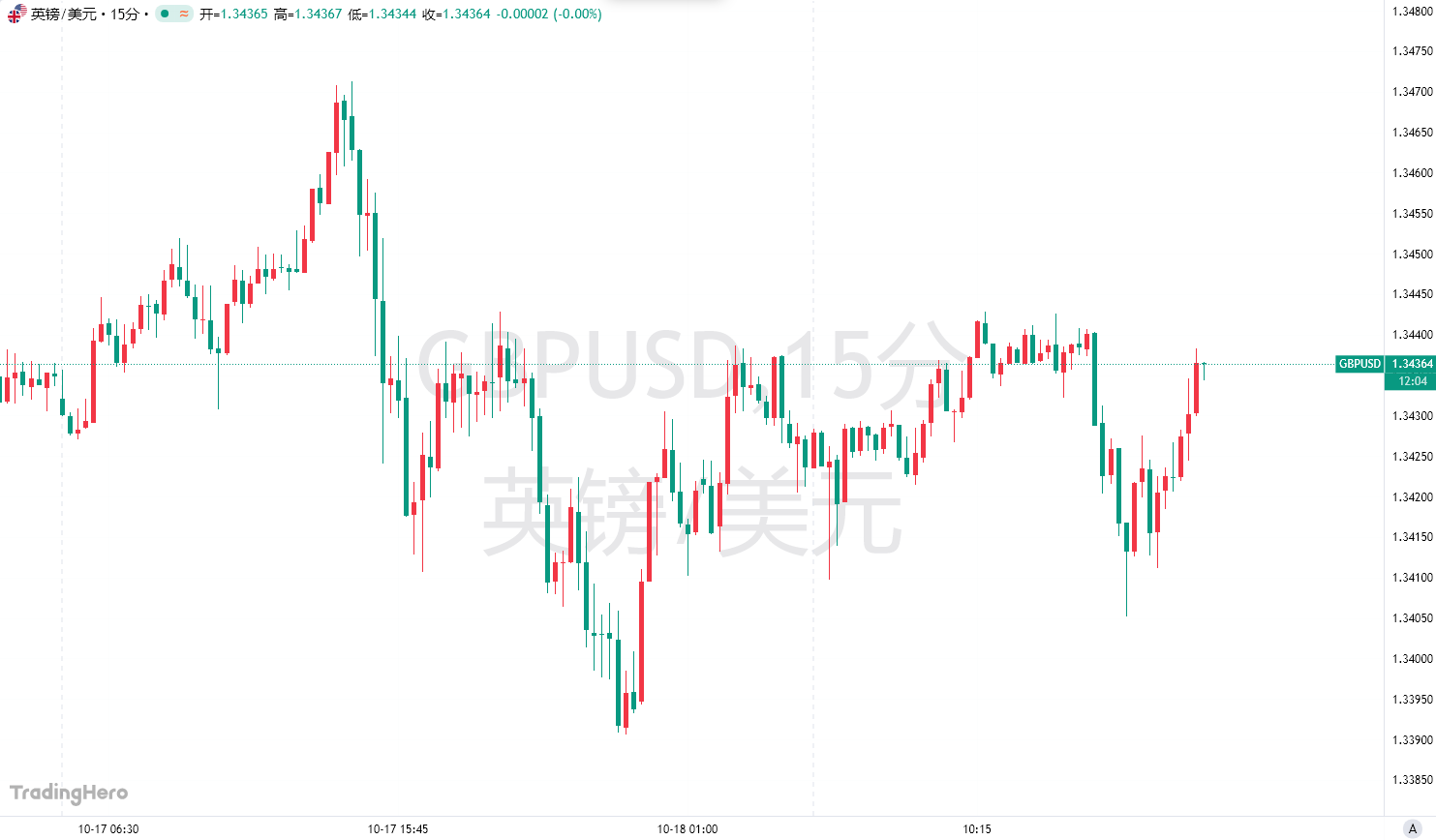
投资管理公司Candriam已经建立了英镑空头头寸,其全球固定收益主管Nicolas Jullien强调了英国充满挑战的前景。RBC BlueBay资产管理公司同样持有看跌 英镑的押注。周一,英镑兑美元维持震荡。 在通胀顽固和GDP增长微弱的背景下,外界普遍预计里夫斯将在定于11月26日发布的秋季预算案中宣布增税和削减开支。 英国国家统计局公布的新数据显示,英国经济8月份仅增长了0.1%。其中,制造业产出增长了0.4%,但建筑业产出下降了0.3%,服务业则停滞不前。与此同 时,国际货币基金组织发布的《世界经济展望》报告指出,英国今年的平均通胀率约为3.4%,高于所有其他发达经济体。 由于英国正努力应对步履蹒跚的经济增长,且财政大臣里夫斯在下个月的预算案中将面临迫在眉睫的财政难题,许多资产管理公司正在押注英镑将会贬值。 英国央行将于11月6日再次召开会议,决定是否下调目前为4%的基准利率。Jullien在一份市场评论中表示,"市场对英国央行的定价似乎过于乐观,预计要到 明年3-4月份才会降息,我们认为这低估了下行风险。" RBC BlueBay的投资级债券投资组合经理Neil Mehta指出,尽管薪资数据有所改 ...

日本央行鹰派发声:别管政治,现在就是加息的绝佳时机!
Jin Shi Shu Ju· 2025-10-20 09:21
日本央行审议委员高田创表示,尽管存在政治不确定性,但提高政策利率的时机已经成熟。此番言论重 申了他上个月投下反对票、反对维持政策不变时的坚定信念。 曾是资深经济学家和债券分析师的高田创表示,今年早些时候美联储降息后日元未能升值,这是支持日 本央行加息的另一个因素。日元汇率持续疲软,徘徊在150关口附近。 "我相信,现在是提高政策利率的绝佳时机,"高田创周一在日本西南部广岛市向当地商界领袖发表演讲 时说。"日本那种曾经根深蒂固的(通缩)常态已经减弱,价格稳定目标已基本实现。" 高田创说:"尽管美联储在2025年9月采取了降息措施,但日元并未升值,反而出现贬值。此外,日美两 国股市均处于历史高位,也营造了有利的市场情绪。" 这是高田创在提出加息建议后的首次演讲。他指出,日本的通胀水平已连续三年多超过日本央行的目 标,解决这个问题至关重要。他的言论表明,即便支持货币宽松政策的高市早苗本周极有可能成为日本 新任首相,他依然坚定不移地支持加息。 高田创表示,随着日本持续的通缩时代告一段落,当局需要改变策略。他说:"我开始相信,我们必须 重点关注整体通胀水平,过去三年半里,该数据一直保持在2%及以上的水平,这种情况亟待解 ...
改写全球投资格局?金价暴涨带飞新兴市场!
Jin Shi Shu Ju· 2025-10-20 09:16
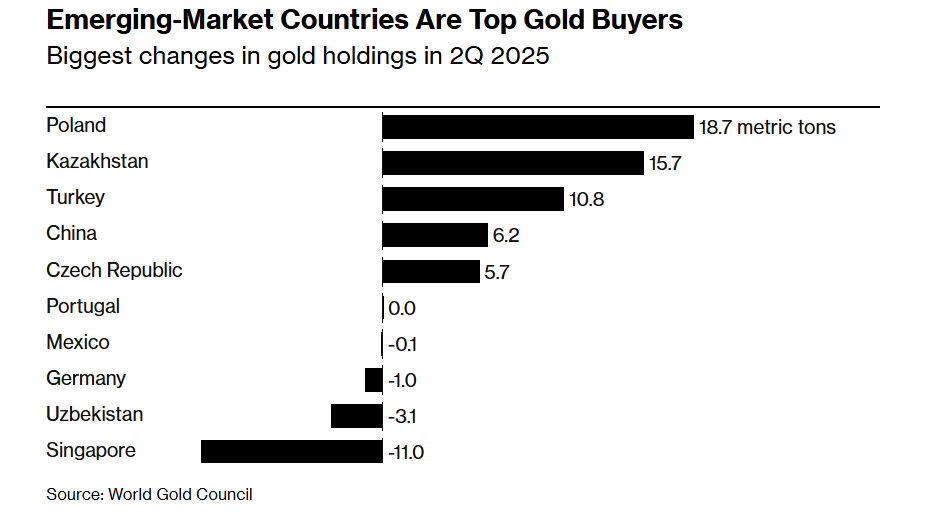
Group 1 - The surge in gold prices has unexpectedly benefited emerging markets, boosting investor confidence in both gold-producing and purchasing countries [1] - South Africa, home to the world's deepest gold mines, is experiencing its best stock market performance in two decades, with companies like Sibanye Stillwater Ltd., AngloGold Ashanti Plc, and Gold Fields Ltd. seeing stock prices triple [1] - Ghana, Africa's largest gold producer, has had its credit rating upgraded by Moody's, reflecting the positive impact of rising gold prices on national fiscal health [1] Group 2 - The rising gold prices have created a wealth effect for both producing and purchasing countries, encouraging fund managers in emerging markets to maintain a bullish stance [4] - South Africa's strong mining sector is a key reason for the positive outlook on its bonds and stock market, with the FTSE/JSE Africa Index up over 30% in 2025 [4] - The South African rand is nearing a one-year high, and the yield on 10-year government bonds has recently fallen below 9% for the first time in over seven years, indicating improved market sentiment [4][7] Group 3 - Ghana is recovering from an economic crisis and debt default, with its currency appreciating approximately 38% this year, the highest increase globally [8] - Other countries like Poland, Turkey, and Kazakhstan are also increasing their gold reserves, but investors are advised to interpret this trend cautiously [8] - The relationship between rising gold prices and risk assets has reversed due to a weakening dollar and concerns over U.S. economic policies, making emerging markets the beneficiaries [8][9]
散户逢跌买入热度飙升!别人贪婪我恐惧?
Jin Shi Shu Ju· 2025-10-20 08:23
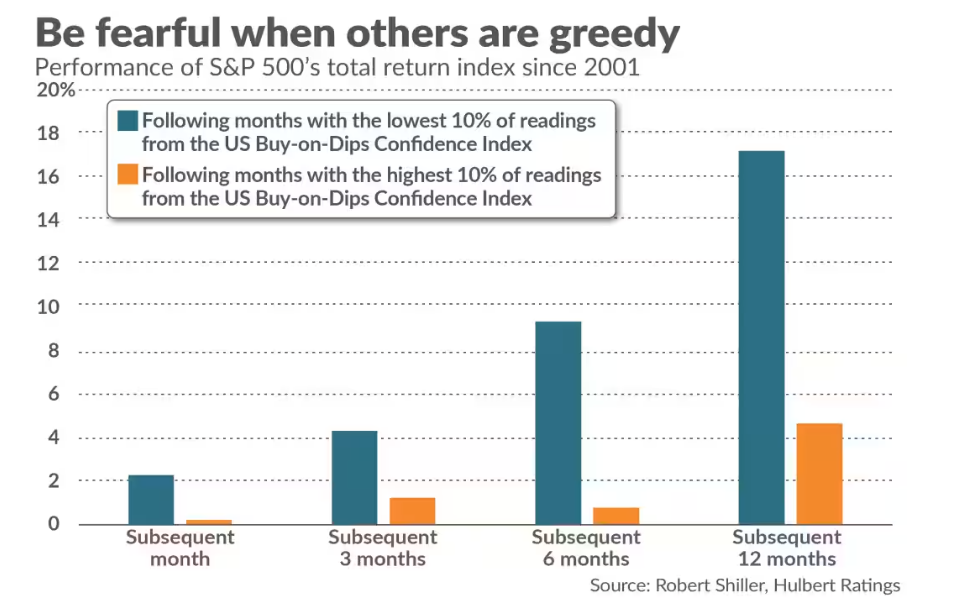
Core Insights - Retail investors are eagerly buying the dip despite the Dow Jones falling nearly 900 points, which is considered a dangerous signal for the market [1][3] - The behavior of retail investors indicates a contrarian indicator; when they view declines as buying opportunities, the market is often near its peak, while at the bottom, they tend to sell during any market uptick [1] - Yale professor Robert Shiller's "buying the dip confidence index" shows that when this index is high, the S&P 500's performance tends to be significantly worse compared to when the index is low [1][3] Group 1 - Shiller's index has a lag in updates, making it unclear how recent retail investor behavior will affect the October index readings, but the enthusiasm for buying the dip is nearing a five-year peak, which is not a positive sign [3] - Research from Robinhood Markets indicates that stocks heavily bought by retail investors on a given day tend to underperform the market by an average of 5% over the following month [3] Group 2 - Historical precedents do not guarantee that current investor behavior will lead to market weakness, as extreme "buying the dip" sentiment has occurred in the late stages of bull markets, yet the market continued to rise [3] - Warren Buffett's warning about being fearful when others are greedy highlights the elevated risk levels in the current market environment [3]

还没到唱空美国经济的时候?一个可靠的前瞻信号并未示警
Jin Shi Shu Ju· 2025-10-20 07:25
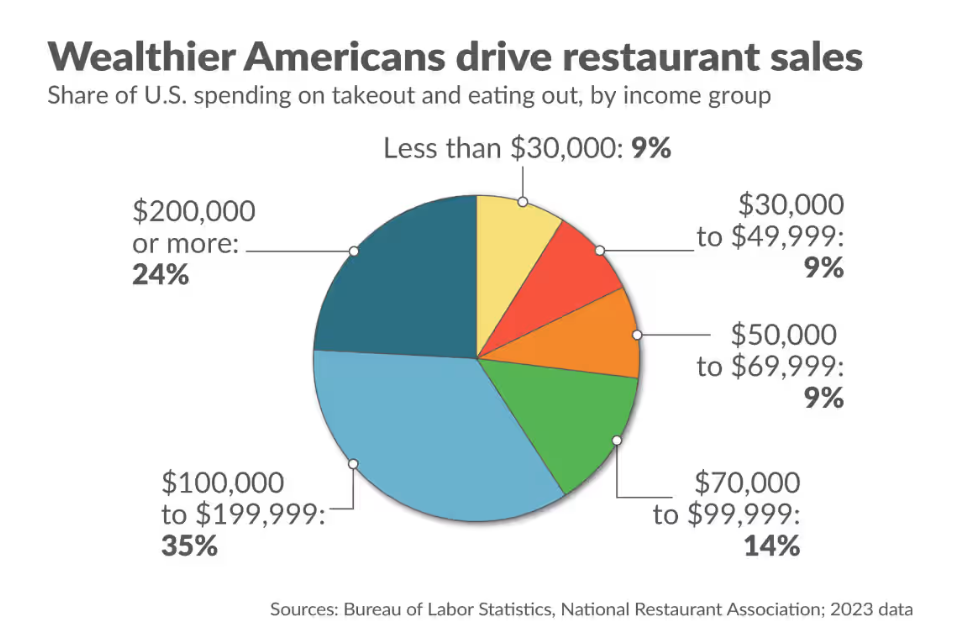
Core Insights - The resilience of the restaurant industry is highlighted as consumers, particularly high-income groups, continue to spend on dining out despite economic pressures [2][3][6] - Sales in the restaurant sector have shown a growth of 6.5% over the past year, surpassing the previous year's growth of 4.3% [2] - The strong performance of the stock market has significantly boosted consumer spending, especially among high-income households [3][6] Sales Performance - Restaurant sales are thriving due to the overall growth of the U.S. economy, which has kept unemployment rates low [2] - High-income Americans are the primary drivers of growth in the restaurant sector, with online reservation platform OpenTable reporting a 12% increase in bookings compared to last year [6] - Fast-food chains are attracting price-sensitive consumers through new promotional offers, as seen with Domino's Pizza's $9.99 special [6] Consumer Behavior Changes - Consumers are adopting new habits to manage expenses, such as opting for smaller portions and sharing meals [8] - The Federal Reserve's economic survey indicates that diners are cutting back on desserts and alcoholic beverages to save money [8] - The restaurant industry has seen minimal job growth, with only 13,000 new positions added in the first eight months of the year, compared to 40,000 in the same period of 2024 [8] Future Trends and Risks - Low-income families are under increased pressure due to rising inflation, leading them to reduce visits to fast-food restaurants [9] - Major chains like McDonald's are experiencing a decline in foot traffic from low-income customers, prompting them to enhance promotional efforts [9] - A potential stock market downturn poses a significant threat, as high-income households, which account for nearly 60% of restaurant spending, may reduce their dining out frequency [10]
市场预期恶化!美政府最长停摆纪录或被打破
Jin Shi Shu Ju· 2025-10-20 06:17
Core Viewpoint - The current U.S. government shutdown, initially expected to last only two to three weeks, is evolving into a significant crisis that may extend into November, with analysts predicting it could become the longest federal government shutdown in U.S. history [1] Duration of Shutdown - The shutdown has already lasted 20 days, with the longest previous shutdown being 35 days during Trump's first term [1] - Market predictions indicate the shutdown could last approximately 41 days, a significant increase from earlier forecasts of just 14 days [1][2] - Key dates include November 1, when the "Obamacare" enrollment begins, which may pressure both parties to reach an agreement [2] Factors Influencing Resolution - The deadlock is primarily due to disagreements over including "Obamacare" subsidy extensions in the funding bill, with the actual deadline for subsidy action being December 31 [2] - Travel delays due to personnel shortages at airports could also pressure negotiations, as TSA and air traffic control staff are working without pay [2] - Analysts suggest that public sentiment regarding travel issues or rising healthcare costs could serve as potential breakthroughs for ending the shutdown [2] Economic Impact - Economists estimate that the shutdown could result in a GDP loss of approximately 0.1% to 0.2% per week [3][4] - The second quarter GDP growth was reported at 3.8%, indicating that while the immediate impact seems small, prolonged shutdowns could lead to larger economic consequences [4] - Over 4,100 layoff notices have been issued, with potential final numbers exceeding 10,000, although a federal judge has temporarily blocked these layoffs [4] Market Sentiment - A poll indicated that 47% of respondents are most concerned about the economic impact of the shutdown, surpassing concerns about travel disruptions and unpaid employee wages [4] - Analysts from Wolfe Research remain optimistic, suggesting that as long as military personnel continue to receive pay, the long-term impacts of the shutdown may be limited [5] - Independent economists warn that while a recession may not be imminent, the shutdown could have lasting effects on an already fragile economy [5]
金价狂飙难阻买入冲动,“越涨越买”背后暗藏央行FOMO焦虑
Jin Shi Shu Ju· 2025-10-20 03:15
Core Insights - Central banks continue to buy gold despite record high prices, indicating a strategic shift in their perception of gold as a key reserve asset [1][3] - The global central bank gold purchases reflect concerns over geopolitical uncertainties and the reliability of fiat currencies like the US dollar [1][3] - The US remains the country with the largest gold reserves, with approximately 8,133 tons stored in various locations [2] Group 1: Central Bank Behavior - Central banks added 19 tons of gold reserves in August, following a decrease in July, showing ongoing interest in gold despite high prices [1] - The World Gold Council noted that the record gold prices may limit the pace of central bank purchases, but this does not indicate a waning interest in gold overall [1] - Countries like Kazakhstan, Bulgaria, and El Salvador have recently joined the ranks of gold buyers, with Poland being the largest buyer this year [3] Group 2: Strategic Reasons for Gold Accumulation - Central banks are increasing gold reserves to diversify assets and mitigate risks associated with the US dollar, particularly due to concerns over the US fiscal situation [3] - Nations such as Russia are converting part of their reserves into "sanction-resistant assets," while others are exploring alternatives to reduce reliance on the dollar [3] - The trend of increasing gold reserves is expected to continue, positioning central banks as significant players in the gold market for the foreseeable future [3]