
Jin Shi Shu Ju

Search documents
改写全球投资格局?金价暴涨带飞新兴市场!
Jin Shi Shu Ju· 2025-10-20 09:16
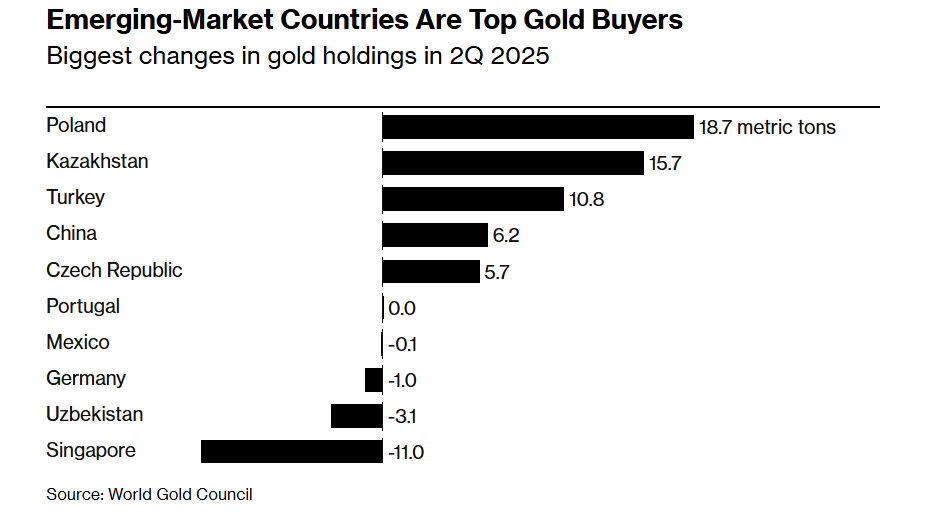
Group 1 - The surge in gold prices has unexpectedly benefited emerging markets, boosting investor confidence in both gold-producing and purchasing countries [1] - South Africa, home to the world's deepest gold mines, is experiencing its best stock market performance in two decades, with companies like Sibanye Stillwater Ltd., AngloGold Ashanti Plc, and Gold Fields Ltd. seeing stock prices triple [1] - Ghana, Africa's largest gold producer, has had its credit rating upgraded by Moody's, reflecting the positive impact of rising gold prices on national fiscal health [1] Group 2 - The rising gold prices have created a wealth effect for both producing and purchasing countries, encouraging fund managers in emerging markets to maintain a bullish stance [4] - South Africa's strong mining sector is a key reason for the positive outlook on its bonds and stock market, with the FTSE/JSE Africa Index up over 30% in 2025 [4] - The South African rand is nearing a one-year high, and the yield on 10-year government bonds has recently fallen below 9% for the first time in over seven years, indicating improved market sentiment [4][7] Group 3 - Ghana is recovering from an economic crisis and debt default, with its currency appreciating approximately 38% this year, the highest increase globally [8] - Other countries like Poland, Turkey, and Kazakhstan are also increasing their gold reserves, but investors are advised to interpret this trend cautiously [8] - The relationship between rising gold prices and risk assets has reversed due to a weakening dollar and concerns over U.S. economic policies, making emerging markets the beneficiaries [8][9]

散户逢跌买入热度飙升!别人贪婪我恐惧?
Jin Shi Shu Ju· 2025-10-20 08:23
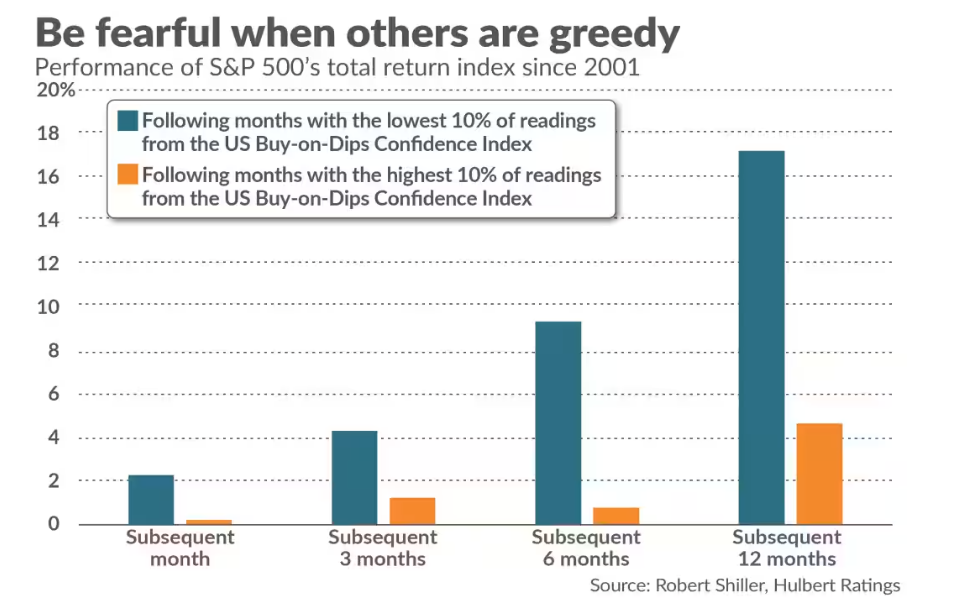
Core Insights - Retail investors are eagerly buying the dip despite the Dow Jones falling nearly 900 points, which is considered a dangerous signal for the market [1][3] - The behavior of retail investors indicates a contrarian indicator; when they view declines as buying opportunities, the market is often near its peak, while at the bottom, they tend to sell during any market uptick [1] - Yale professor Robert Shiller's "buying the dip confidence index" shows that when this index is high, the S&P 500's performance tends to be significantly worse compared to when the index is low [1][3] Group 1 - Shiller's index has a lag in updates, making it unclear how recent retail investor behavior will affect the October index readings, but the enthusiasm for buying the dip is nearing a five-year peak, which is not a positive sign [3] - Research from Robinhood Markets indicates that stocks heavily bought by retail investors on a given day tend to underperform the market by an average of 5% over the following month [3] Group 2 - Historical precedents do not guarantee that current investor behavior will lead to market weakness, as extreme "buying the dip" sentiment has occurred in the late stages of bull markets, yet the market continued to rise [3] - Warren Buffett's warning about being fearful when others are greedy highlights the elevated risk levels in the current market environment [3]

还没到唱空美国经济的时候?一个可靠的前瞻信号并未示警
Jin Shi Shu Ju· 2025-10-20 07:25
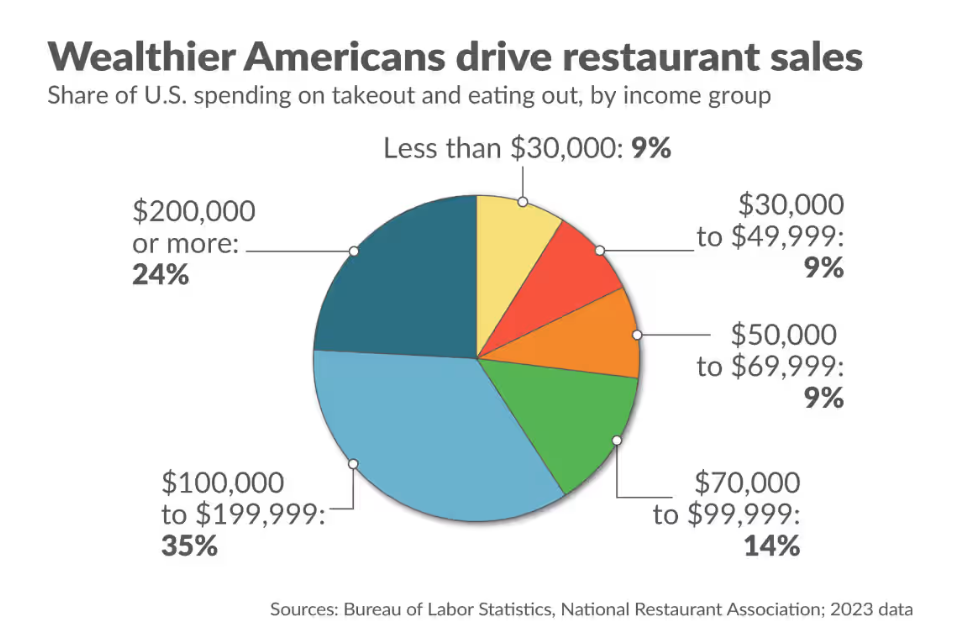
Core Insights - The resilience of the restaurant industry is highlighted as consumers, particularly high-income groups, continue to spend on dining out despite economic pressures [2][3][6] - Sales in the restaurant sector have shown a growth of 6.5% over the past year, surpassing the previous year's growth of 4.3% [2] - The strong performance of the stock market has significantly boosted consumer spending, especially among high-income households [3][6] Sales Performance - Restaurant sales are thriving due to the overall growth of the U.S. economy, which has kept unemployment rates low [2] - High-income Americans are the primary drivers of growth in the restaurant sector, with online reservation platform OpenTable reporting a 12% increase in bookings compared to last year [6] - Fast-food chains are attracting price-sensitive consumers through new promotional offers, as seen with Domino's Pizza's $9.99 special [6] Consumer Behavior Changes - Consumers are adopting new habits to manage expenses, such as opting for smaller portions and sharing meals [8] - The Federal Reserve's economic survey indicates that diners are cutting back on desserts and alcoholic beverages to save money [8] - The restaurant industry has seen minimal job growth, with only 13,000 new positions added in the first eight months of the year, compared to 40,000 in the same period of 2024 [8] Future Trends and Risks - Low-income families are under increased pressure due to rising inflation, leading them to reduce visits to fast-food restaurants [9] - Major chains like McDonald's are experiencing a decline in foot traffic from low-income customers, prompting them to enhance promotional efforts [9] - A potential stock market downturn poses a significant threat, as high-income households, which account for nearly 60% of restaurant spending, may reduce their dining out frequency [10]
市场预期恶化!美政府最长停摆纪录或被打破
Jin Shi Shu Ju· 2025-10-20 06:17
Core Viewpoint - The current U.S. government shutdown, initially expected to last only two to three weeks, is evolving into a significant crisis that may extend into November, with analysts predicting it could become the longest federal government shutdown in U.S. history [1] Duration of Shutdown - The shutdown has already lasted 20 days, with the longest previous shutdown being 35 days during Trump's first term [1] - Market predictions indicate the shutdown could last approximately 41 days, a significant increase from earlier forecasts of just 14 days [1][2] - Key dates include November 1, when the "Obamacare" enrollment begins, which may pressure both parties to reach an agreement [2] Factors Influencing Resolution - The deadlock is primarily due to disagreements over including "Obamacare" subsidy extensions in the funding bill, with the actual deadline for subsidy action being December 31 [2] - Travel delays due to personnel shortages at airports could also pressure negotiations, as TSA and air traffic control staff are working without pay [2] - Analysts suggest that public sentiment regarding travel issues or rising healthcare costs could serve as potential breakthroughs for ending the shutdown [2] Economic Impact - Economists estimate that the shutdown could result in a GDP loss of approximately 0.1% to 0.2% per week [3][4] - The second quarter GDP growth was reported at 3.8%, indicating that while the immediate impact seems small, prolonged shutdowns could lead to larger economic consequences [4] - Over 4,100 layoff notices have been issued, with potential final numbers exceeding 10,000, although a federal judge has temporarily blocked these layoffs [4] Market Sentiment - A poll indicated that 47% of respondents are most concerned about the economic impact of the shutdown, surpassing concerns about travel disruptions and unpaid employee wages [4] - Analysts from Wolfe Research remain optimistic, suggesting that as long as military personnel continue to receive pay, the long-term impacts of the shutdown may be limited [5] - Independent economists warn that while a recession may not be imminent, the shutdown could have lasting effects on an already fragile economy [5]
金价狂飙难阻买入冲动,“越涨越买”背后暗藏央行FOMO焦虑
Jin Shi Shu Ju· 2025-10-20 03:15
Core Insights - Central banks continue to buy gold despite record high prices, indicating a strategic shift in their perception of gold as a key reserve asset [1][3] - The global central bank gold purchases reflect concerns over geopolitical uncertainties and the reliability of fiat currencies like the US dollar [1][3] - The US remains the country with the largest gold reserves, with approximately 8,133 tons stored in various locations [2] Group 1: Central Bank Behavior - Central banks added 19 tons of gold reserves in August, following a decrease in July, showing ongoing interest in gold despite high prices [1] - The World Gold Council noted that the record gold prices may limit the pace of central bank purchases, but this does not indicate a waning interest in gold overall [1] - Countries like Kazakhstan, Bulgaria, and El Salvador have recently joined the ranks of gold buyers, with Poland being the largest buyer this year [3] Group 2: Strategic Reasons for Gold Accumulation - Central banks are increasing gold reserves to diversify assets and mitigate risks associated with the US dollar, particularly due to concerns over the US fiscal situation [3] - Nations such as Russia are converting part of their reserves into "sanction-resistant assets," while others are exploring alternatives to reduce reliance on the dollar [3] - The trend of increasing gold reserves is expected to continue, positioning central banks as significant players in the gold market for the foreseeable future [3]
达利欧警告:黄金是最成熟的货币,零配置或低配都是战略失误!
Jin Shi Shu Ju· 2025-10-20 00:40
Core Viewpoint - The founder of Bridgewater Associates, Dalio, presents a unique perspective on gold, viewing it as the most mature form of currency rather than merely a metal, and emphasizes its role as a hedge against debt and currency devaluation [1][2]. Group 1: Gold as Currency - Gold is perceived as a form of currency with purchasing power similar to cash, providing a long-term real return rate of approximately 1.2%, but it does not generate income [1][2]. - Unlike fiat currency, gold cannot be printed or devalued, making it a superior hedge during market downturns or credit system collapses [1][2]. Group 2: Investment Strategy - Dalio argues that gold is a fundamental investment rather than a regular commodity, and its unique position as a non-debt currency makes it essential in investment portfolios [2][3]. - A strategic allocation of around 15% in gold can optimize the risk-return ratio in diversified portfolios, despite potentially lowering long-term expected returns [4]. Group 3: Comparison with Other Assets - While silver and platinum have inflation-hedging properties, they lack the historical value storage and stability of gold, making them less effective for wealth preservation [2][3]. - Inflation-protected bonds are still debt commitments and may not provide the same level of security as gold during systemic financial crises [3][4]. Group 4: Market Dynamics - Gold ETFs enhance market liquidity and transparency but are still smaller in scale compared to the physical gold market and central bank holdings, thus not being the primary driver of recent gold price increases [5]. - Gold is increasingly replacing U.S. Treasuries as a "risk-free asset" in the portfolios of central banks and institutional investors, highlighting its historical stability compared to government debt [5].
金十数据全球财经早餐 | 2025年10月20日
Jin Shi Shu Ju· 2025-10-19 23:09
Group 1 - Trump signed an executive order imposing a 25% tariff on imported medium and heavy trucks, indicating a shift in trade policy [12] - The U.S. and China agreed to hold a new round of economic and trade consultations soon, reflecting ongoing trade discussions [14] - The U.S. Treasury Department purchased Argentine pesos at an unofficial exchange rate, highlighting currency market interventions [12] Group 2 - The Hang Seng Index closed down 2.48%, with significant declines in chip stocks, Apple-related stocks, and electric equipment stocks [3] - The A-share market saw all three major indices decline, with the Shanghai Composite Index down 1.95% and the Shenzhen Component Index down 3.04% [4] - The market experienced a broad sell-off, with over 4,700 stocks declining, while certain sectors like precious metals and gas saw gains [4] Group 3 - Gold prices hit a historical high of $4,379 per ounce before dropping nearly $130, closing at $4,250.93 per ounce, while silver also saw significant fluctuations [2][7] - WTI crude oil rose by 0.65% to $57.24 per barrel, and Brent crude oil increased by 0.69% to $61.26 per barrel, influenced by geopolitical developments [2][7] - Major U.S. stock indices, including the Dow Jones and S&P 500, recorded gains, with the Dow up 0.52% and the S&P 500 up 0.53% [2][7]

一周热榜精选:黄金连破三大整数关口!市场押注超常规降息
Jin Shi Shu Ju· 2025-10-17 13:46
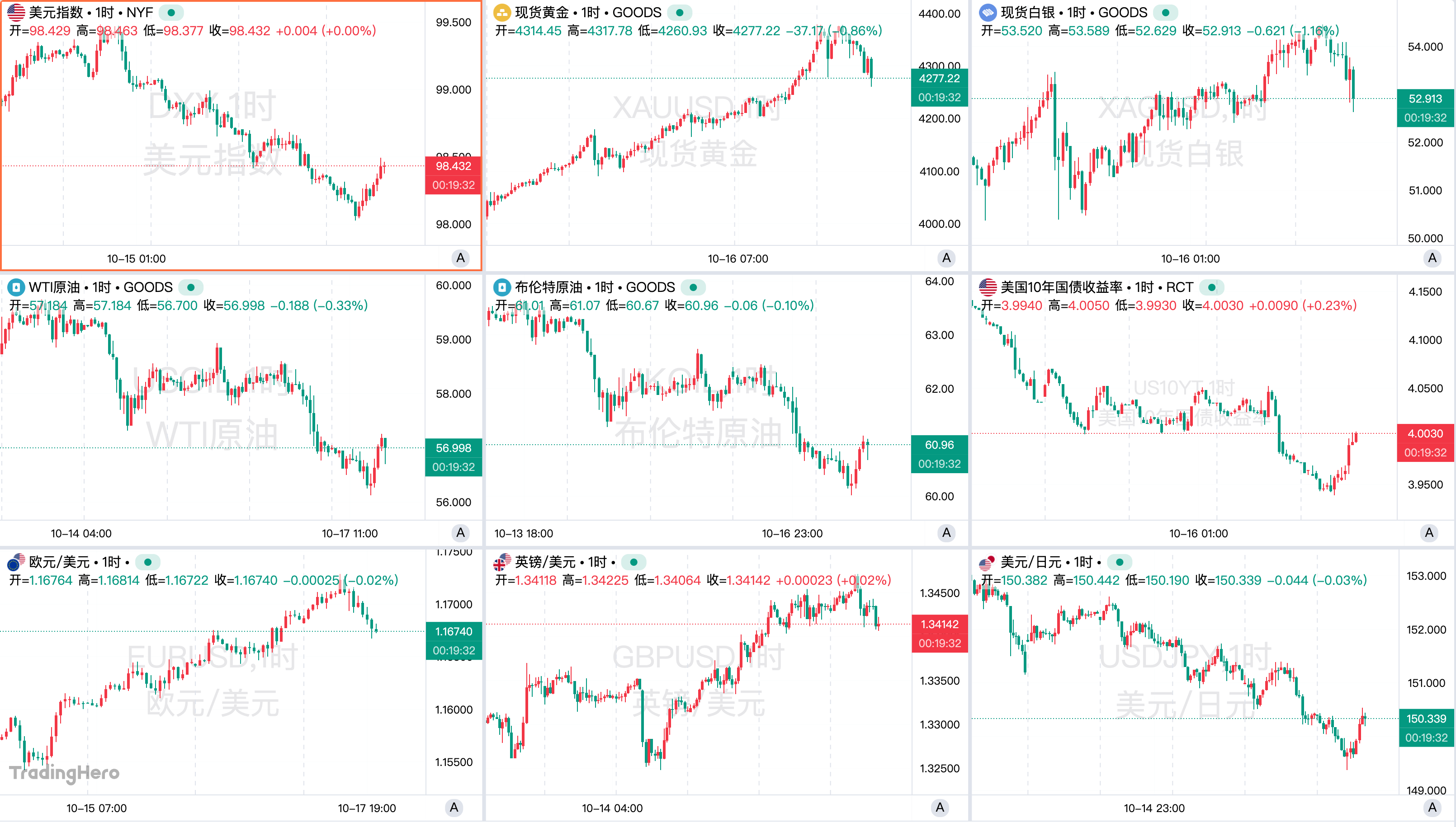
Market Overview - The US dollar index weakened overall this week, dropping to 98.42, with a significant decline following a brief return above 99 [1] - Gold prices reached a historic high, nearing $4380 per ounce, and closed at $4277 per ounce, while silver also surged past $54 per ounce [1] - Non-US currencies appreciated against the dollar due to its weakness, with the euro, pound, and yen all recording gains [1] - International oil prices continued to decline for the third consecutive week, with warnings of a severe global supply surplus by 2026 contributing to the downward trend [1] US Stock Market - The US stock market maintained high-level fluctuations, with a notable rally driven by technology stocks early in the week, but later showed signs of weakness [2] - Concerns over credit quality arose after two regional banks disclosed loan fraud and bad debt issues, leading to a 6.2% drop in the regional bank index and a loss of over $100 billion in market value [2] Investment Bank Insights - A survey by Bank of America indicated that going long on gold has become the most crowded trade, surpassing investments in major US tech stocks [5] - Several investment banks have raised their gold price forecasts, with ANZ predicting a peak of $4600 per ounce by June next year, and Bank of America increasing its forecast to $5000 per ounce [5] Federal Reserve and Economic Policy - Market expectations for significant rate cuts by the Federal Reserve have intensified, with traders betting on at least a 50 basis point cut by year-end [8] - Fed Chair Jerome Powell highlighted risks in the labor market and indicated that the Fed would adjust monetary policy based on economic outlook rather than a preset path [8][9] - The use of the Fed's standing repo facility surged to $6.75 billion, raising concerns about liquidity in the market [9] Banking Sector Concerns - The regional banking sector faced turmoil due to revelations of loan fraud, with significant market value losses and heightened investor concerns about credit quality [13] - Major banks have shown a mixed approach to provisioning for future bad debts, with some increasing reserves while others reported record low provisioning levels [13] Gold Market Regulation - The Shanghai Gold Exchange issued a risk warning regarding the volatility in gold prices, urging members to enhance risk management practices [14] International Relations and Trade - The White House is set to extend tariff exemptions on imported auto parts, providing relief to manufacturers [16][17] - Tensions between the US and India arose after Trump claimed that India would cease purchasing Russian oil, which India denied [22] Economic Recognition - The Nobel Prize in Economic Sciences was awarded to three economists for their contributions to understanding innovation-driven economic growth [25]

美联储“内战”升级! 鲍威尔巩固10月降息,但鹰派已蠢蠢欲动
Jin Shi Shu Ju· 2025-10-17 12:47
Group 1 - The Federal Reserve is preparing to lower interest rates again this month due to a weakening job market overshadowing inflation concerns, but this balance may not last long [1] - Economic data is mixed, showing resilient growth and consumer spending, while hiring has slowed down, complicating the Fed's decision-making process [1] - Fed Chair Powell emphasizes the risks of delaying action, indicating a likely 25 basis point rate cut in October, with futures markets anticipating another cut in December [2][5] Group 2 - The internal debate within the Fed is intensifying, with some officials warning about persistent inflation and the potential for strong economic growth to complicate future rate cuts [2][3] - The balance of risks between employment and inflation will shape the Fed's policy discussions leading into 2026, with potential changes in leadership and voting members adding uncertainty [4] - The ultimate extent of rate cuts may be less than what the market is currently pricing in, as the economy shows signs of overheating [5]
每日期货全景复盘10.17:沪金期货盘中一度突破1000元关口,表现尤为强势!
Jin Shi Shu Ju· 2025-10-17 09:53
Group 1: Market Overview - The futures market shows a bearish sentiment with 29 contracts rising and 50 contracts falling, indicating a concentration of trading activity in declining varieties [2] - The main contract for gold futures has surged past the 1000 yuan mark, marking a significant milestone with a year-to-date increase of over 370 yuan, or more than 60% [12] - The market is currently influenced by expectations of interest rate cuts and ongoing geopolitical tensions, which are driving demand for safe-haven assets like gold [23] Group 2: Key Commodity Movements - The top gainers in the futures market include gold (+3.82%), lithium carbonate (+2.55%), and silver (+2.06%), driven by supply-demand dynamics [5] - Conversely, the largest decliners include caustic soda (-4.37%) and glass (-3.69%), likely impacted by increased bearish sentiment or negative fundamental factors [6] - Significant inflows were observed in the China Securities 1000 contract (3.136 billion yuan) and gold futures (1.274 billion yuan), while notable outflows were seen in the CSI 300 contract (-749 million yuan) [8] Group 3: Production and Supply Insights - The average daily pig iron output from 247 surveyed steel mills is 2.4095 million tons, reflecting a slight decrease from the previous week [17] - Indonesia is transferring previously seized tin assets to PT Timah, which is expected to stabilize the country's tin production amid supply concerns [16] - Argentina's soybean planting area for the 2025/26 season is projected to decline by 2.8% to 17.5 million hectares, indicating potential supply constraints [15] Group 4: Future Outlook - Upcoming data releases include U.S. soybean export sales and potential interest rate cuts by the central bank, which could influence market dynamics [19][20] - The lithium carbonate market is experiencing a tightening supply situation, with production gradually increasing, supporting price stability [24][25] - The caustic soda market is under pressure due to high inventory levels and potential production cuts in the alumina sector, which may limit price recovery [26][28]
